



Abstract
Mobile cloud computing (MCC) is a technology which provides cloud server resources to mobile users with optimized latency. MCC allows mobile device to access cloud resources and to offload tasks to cloud let servers at any time and from anywhere. The cloud let servers are attached to wireless Access points. But mobility plays an important role which leads to the loss of connectivity of mobile devices because of varying signal strengths. On the other hand, optimal code execution is a challenge. In this paper, a connectivity base mobility prediction method is proposed to assign the cloud resources to the user without loss in the connection. The past accessing history of the users and path loss factors are taken into consideration to predict proper access point. From the performance evaluation the performance of the proposed method is increased by 15.23% when compared to other existing methods.
Introduction
Mobile cloud computing is an emerging technology where mobile devices are augmented by leveraging heterogeneous cloud resources. It integrates mobile environment and cloud computing hence overcomes the issues which are related to security, resource limitations such as storage, battery life, CPU processing capacity. Computation offloading plays an important role to improve performance by migrating heavy computation tasks to cloud servers. But the tasks are offloaded to distant clouds and many solutions have been proposed to offload tasks to clouds. But those solutions are insufficient for real time applications particularly in the Wide Area Networks. Relaying on distant clouds in mobile cloud computing applications such as health care, road traffic measurements, smart education etc., often leads to high latency and low bandwidth hence poor performance. One solution is to use cloud let; a mini cloud server which is attached to a local network access point thus provides high speed code execution. A cloud let will have less computation capability compared to a remote cloud server. Due to mobility of user’s, the allocation of resources to the user’s requests has become a challenge. Furthermore, the Wi-Fi signal strengths of different access points vary greatly over time. Many methods have been proposed to overcome the problem but fail to capture user’s mobility pattern. Since the user is moving from one location to another location, the connection is unstable unlike in wired connection. Wireless channels suffers from signal fluctuations. Thus lead to poor signal to noise ratio. The signal fluctuations are caused due to path loss, multi path fading and shadowing effect. In some cases even the user is present under communication coverage there will be loss in connectivity. Many methods have been proposed but they have neglected radio propagation fluctuation factors. They have assumed that the user can connect to cloud let if it is located in the coverage. But in practice those factors should not be neglected. Radio propagation fluctuation factors such as path loss, shadowing are location dependent and static in time domain. In this paper, the access point is predicted based on the users access history and wireless connectivity. The radio fluctuation factors have been considered to establish the connection.
Related work
The latency, resource utilization is important by applying dynamic application placement algorithm In [1]. A model was proposed which captures cost, capacity-heterogeneity of mobile cloud environment. It not only serves mobile devices but also any client beyond in the network. The resource per unit is assumed to be increasing with depth and decrease in capacity with depth. A platform is provided to schedule tasks, placement and system state prediction [2]. For rapid adoption, ease and for experimental testing the platform is developed in python. The platform targeted mainly at Internet of Thongs services and also provides flexibility at cost of performance for large tasks. By placing redundant processing and replication on different nodes in a distributed system the fault tolerance can be provided. The data is replicated and placed the a redundant processing in different computational nodes to avoid the faults in the network. The platform is designed to optimize task processing placement in the network. In [3] a proactive service replication is proposed to support delay-sensitive applications in 5G edge network. Different optimization models were investigated for proactive service mitigation in the network and to predict user mobility patterns. A two-integer linear problem optimisation scheme is proposed to optimize QoE degradation. Another research area includes application content delivery network [4, 5, 6]. It deals with the web services deployement in different servers by distributing dynamic content and service code as well. In [7] a virtual machine hand off method is proposed to tolerate cloud lets high variability. Vehicular cloud computing is another interesting research area due to advantages and applications. In [8] a novel solution is proposed to optimize effect of resources mobility by using resource management scheme. It is based on prediction of vehicles. In [9] a fault tolerance task assignment method is proposed which is based on redundancy that mitigates resource volatility effect in vehicular clouds. It is implemented in a parking lot. But this solution does not applicable for higher mobility environments like urban areas and highways. In [10] a clustering technique was proposed to overcome the topology changes in vehicular cloud due to high mobility. Where the clusters which are dynamic and more suitable will become cluster heads. It optimizes resource management. But it does not deal with mobility prediction. A game-theoritical approach is proposed for optimal resource allocation [11] in vehicular cloud environment. to increase virtual machine migration efficiency a resource reservation scheme is proposed. In [12, 13, 14] many fault tolerant systems have been proposed using checkpoint or restart techniques. They relay on stable storage which is persistent during system failure. The number of replicas are determined dynamically based on state of the system [14, 15, 16, 17]. But they are static and failed replicas cannot be restarted. An efficient model is proposed in [18] to minimize channel interference and execution time in mobile cloud environment. It has achieved good performance compared to other methods. In [19] machine learning techniques were used to optimize network traffic in mobile cloud environment. Hence the drop in call and signal have been optimized. Random forest algorithm has given more accuracy when compared to other algorithms.
Proposed methodology
System model
Mobility plays an important role in offloading decision. It causes dynamic network environments which will lead to failure of user requests. Thus reliability is an important factor in mobile cloud computing due to the mobility of users. Since mobile cloud computing is dynamic in nature i.e., the users moves from one location to another location. The access points should be assigned to the users accordingly to provide continuous connectivity. In this paper, a prediction connectivity based algorithm is proposed. The accessing history of the users is considered and the radio access connectivity is also considered. The mobile access prediction is done based on the velocity of the user’s movement. In this paper the velocity is taken as constant. The procedure starts from the first access point. Firstly the access point is checked whether it satisfies the criteria. If it satisfies then it is considered as next accessing point to the user otherwise the process is repeated with the remaining access points until it matches the criteria. The number of access points are kept varying with different users position. Finally, the frequent access point will be considered as the next access point of the user. To assign the access point the radio propagation is also considered. Usually 10–15 dB is considered as minimum value for establishment of unreliable connection; 16–24 dB is considered as poor connection, 24–40 dB as good as and greater than 41 dB is considered as excellent connection. In this paper the maximum signal to noise ratio is taken as 40 dB. If the obtained SNR value is greater than or equal to 40 dB then the connection will be established otherwise it is considered as poor and hence neglected. The SNR value can be obtained from the given equation,
where
where
The SNR is calculated by varying the distance between the user and access points.
Path loss is the reduction in electromagnetic wave power density when it passes through space. It is an important component in analysis and designing of link budget in telecommunication system. This term is usually used in signal propagation and wireless communications. It occurs due to many factors like reflection, refraction, absorption, free space loss. It is generally influenced by environment, distance between receiver and transmitter, propagation medium and location of antennas. Path loss can be given as,
where
Shadowing is the fluctuation of received signal power due to obstruction of propagation by the objects between transmitter and receiver. The received power fluctuates with log-normal distribution. It means the local mean power will be expressed in logarithmic values.
Log-normal distribution
It is a probability distribution of a random variable where its logarithamic value is distributed normally.
where
By expressing path loss in dB we get,
Let us consider the total access points as
Proposed architecture.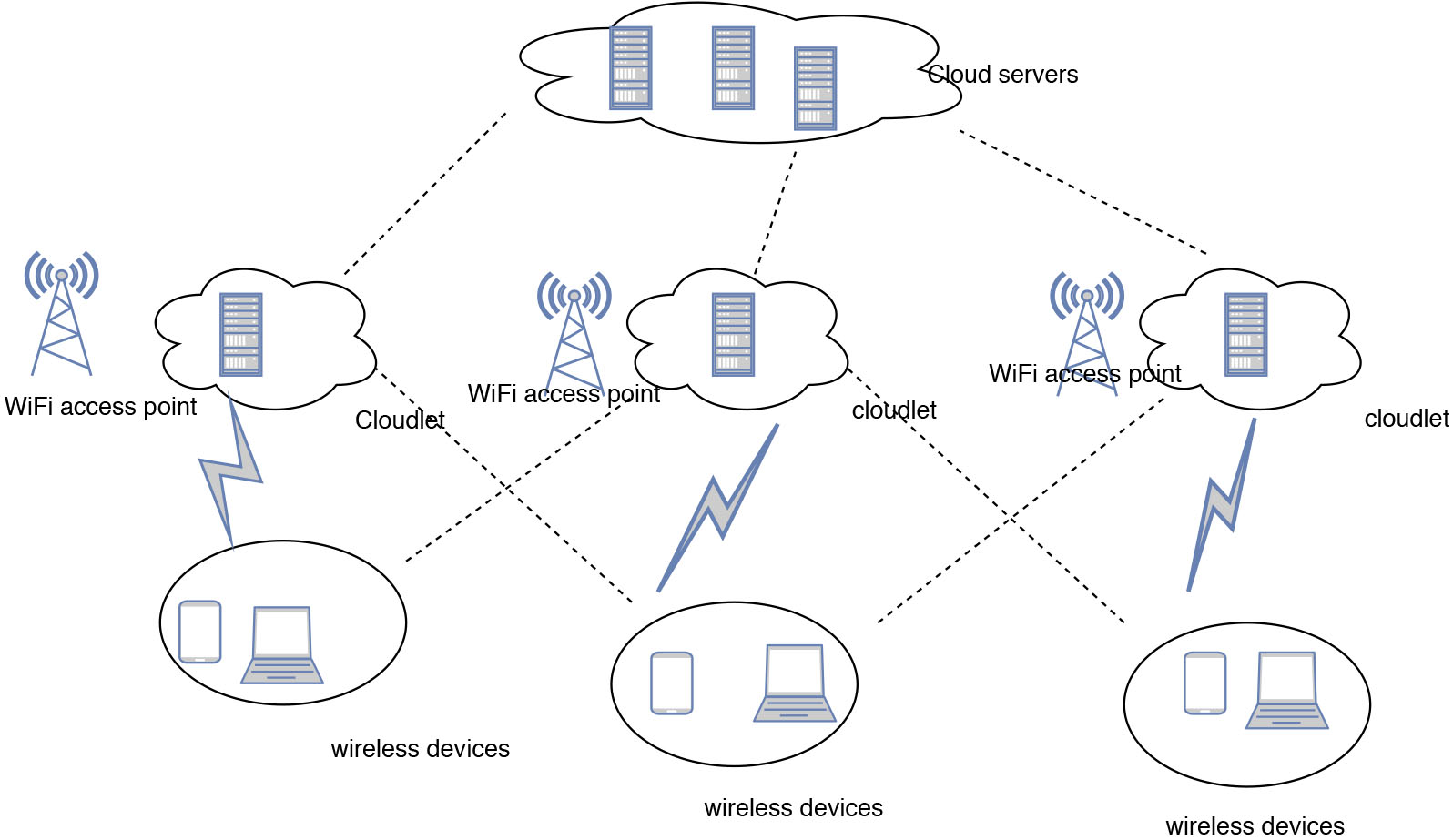
Mobility of user.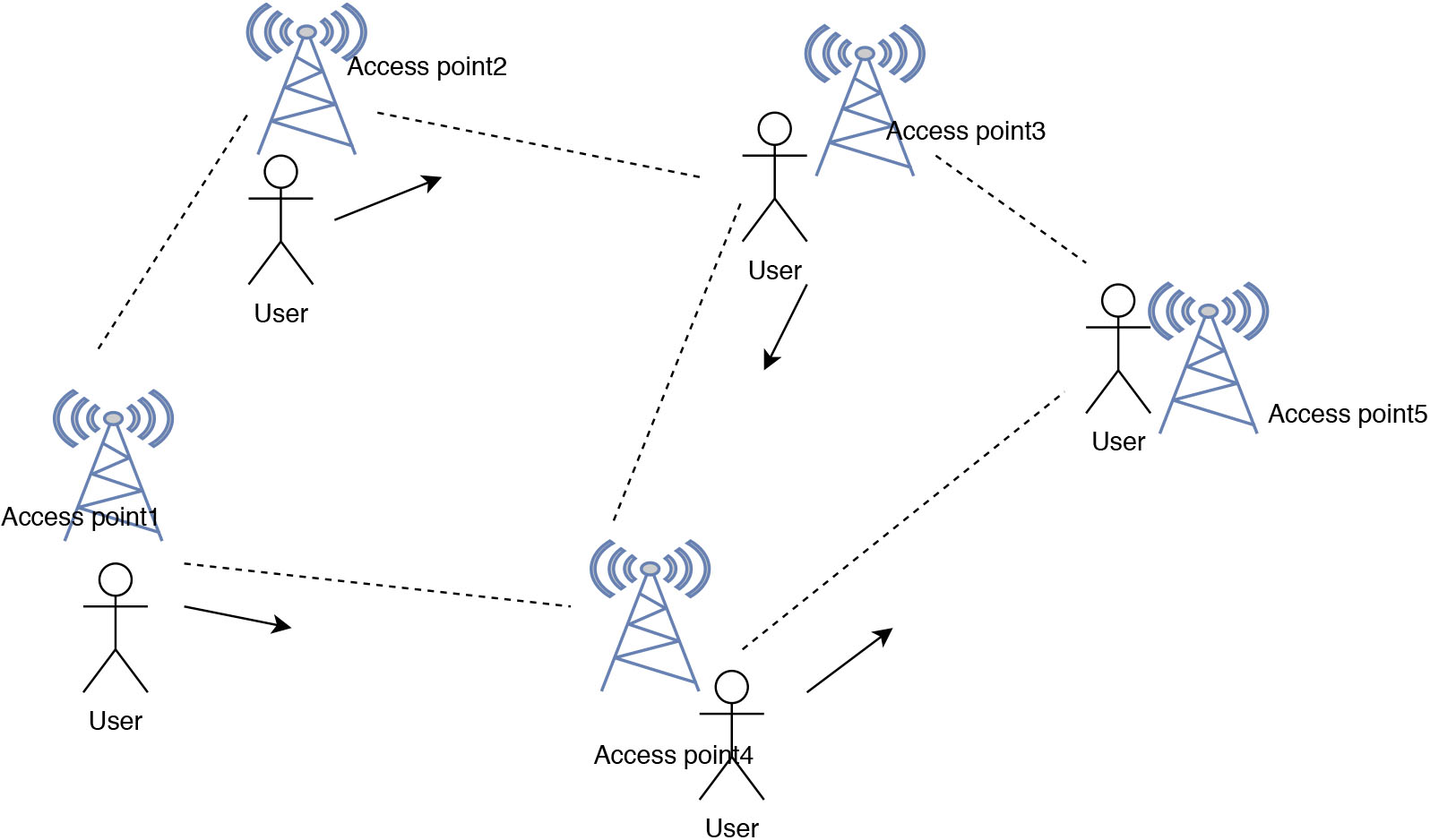
The value of
The access point with highest accuracy is considered as the next access point.
After assigning the access point, the execution time is calculated from, Execution time
where
Illustration with 3 access points.
Illustration with 4 access points.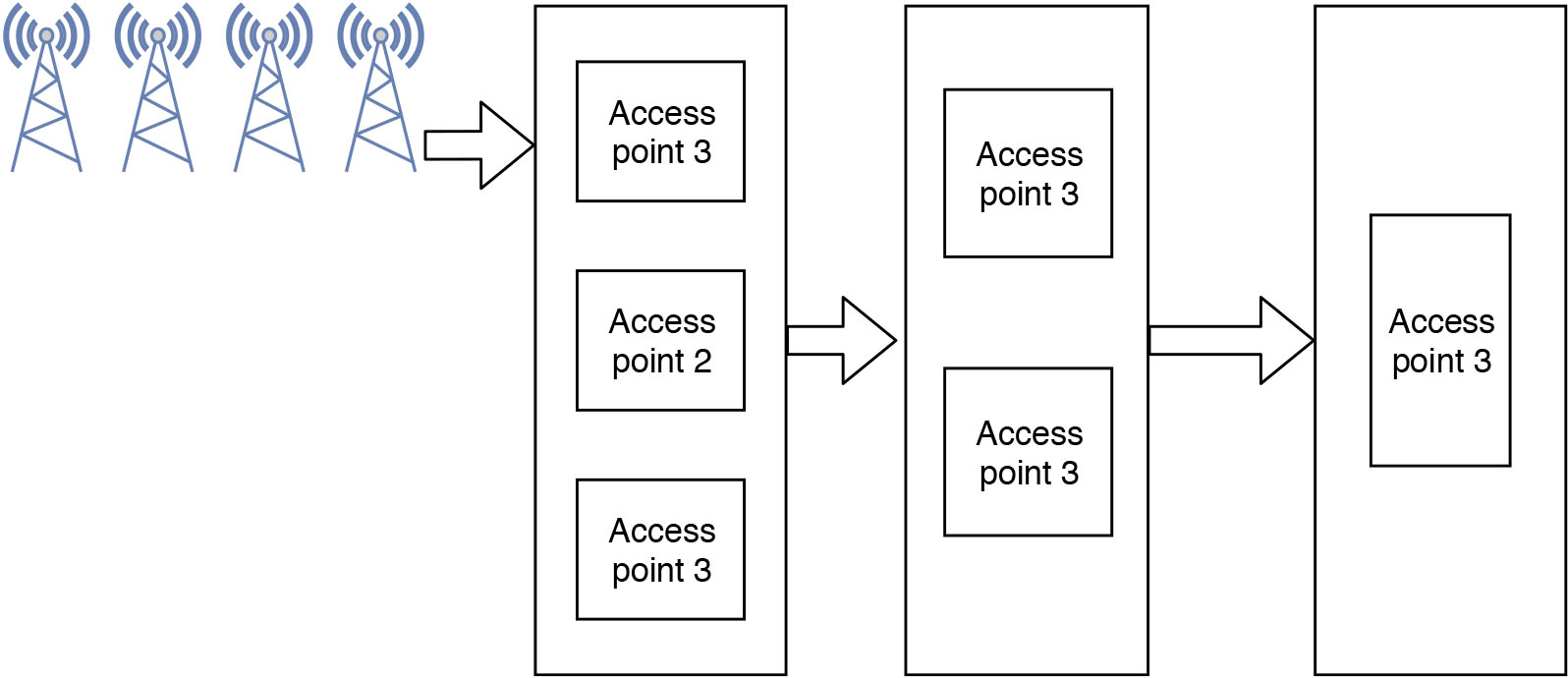
In the Fig. 1. the mobile devices are requesting resources from the cloud through cloud let. Each mobile device is connected to a cloud let and access point. when the request is sent, the fluctuation factors and users accessing history is determined. If the condition is satisfied i.e., SNR is greater than 40 dB then the access point is assigned and corresponding cloud let. In Fig. 2. there are access points and users. Since the mobile cloud environment is mobile in nature i.e., the user will keep on moving from one location to another location, thus changing the access point. From the figure it is observed that the user is moving from Access point 1 to access point 2 with constant velocity and then from third point to fourth and so on. The access points should be assigned accordingly. The mobile users offload the computation tasks to the cloud lets. All cloudlets are capable of receiving, executing and transferring the tasks.
In the Fig. 3 there are total 3 access points. The predicted access points are {2, 1, 2}. The access point 2 is occuring twice in the set. So, the access point 2 is considered as frequent access point. In the Fig. 4 there are 4 access points. The predicted access points are {3, 2, 3}. The access point 3 is occuring twice in the set. So, the access point 3 is considered as frequent and next access point. In the Fig. 5 there are 5 access points. The predicted access points are {3, 3, 5}. The access point 3 is occuring twice in the set. So,the access point 3 is considered as frequent and next access point. When all the values are taken the final set will be {2, 1, 2, 3, 2, 3, 3, 3, 5}. When the accuracy is calculated from the equation, it is observed that access point 3 is the frequent occurring value and hence considered as the next accessing point for the users.
Illustration with 5 access points.
We consider five access points AP1, AP2, AP3, AP4 and AP5. Consider there are total ‘
Checking user’s location history. Calculate Calculate radio frequency fluctuation factors
Check for availability. If This process is repeated with different number of access points. In the proposed method, the access points are taken as 3 and increased till 5. In the each iteration the access point is added to the list. The value which is occurring more times is considered as frequent access point and thus predicted as next access point. Calculate execution time.
Assign the access point to the user. Repeat the process till the last access point. Find the accuracy of each access point.
Find the access point with highest accuracy and that will considered as the next access point. Assign the requested resources to the clients.
Prediction of access point
[1]
Objective function
Data size
Data rate
Instructions Ins
Cloudlet capacity
Input Applications
Check past history
Calculate radio fluctuating factors
Calculate accuracy of each access point,
The highest accuracy Access point is the next access point
Cannot gain access to the access point, poor connection
Output the Access point
Allocation of access points to the mobile devices
Allocation of access points to the mobile devices
Accuracy of each access point
The implementation is done using Green Cloud simulator to evaluate the performance of the proposed method which is an extension of NS2. The evaluation of energy consumption which is consumed by the data center elements Green cloud simulator is used to evaluate the energy consumption consumed by the data center elements like communication links,servers and switches can be done using Green Cloud Simulator. The performance obtained is high compared to other simulators because it is based on packet-level simulations of communications in the data center infrastructure. Table 1 represents the allocation of access points to the mobile user. The present location is varied and access point is assigned accordingly. In this paper, it is assumed that the user is moving with constant velocity of 1 m/sec. The performance is evaluated with different access points. In the first case total three access points are considered and then it is changed to four and five. For each step the present location is varied and the access points are predicted based on the history. The output is the next access point. This is repeated with different data size tasks. The cloudlet computation capability is taken as 3.5 Ghz, path loss index as 0.1, AGWN as
Parameter and their values
Parameter and their values
Parameters used to evaluate the performance
Execution time
Execution time
The studies shows from the Table 1 that for the total three access points the predicted access points are {2, 1, 2}, for total four access points the predicted access points are {3, 2, 3} and for five access points the predicted access points are {3, 4, 5}. It means that for three access points and cloud lets, if the user is located at third position and moving with velocity 1 m/sec the next predicted access point is 2 i.e., the user is moving in a direction close to access point 2 and the radio fluctuation factors are also less compared to other access points. Hence the second access point is considered as suitable one and assigned to the user. Now, the user can send requests to the cloud let2 and access the resources. The parameters used to evaluate the performance and its values are given in the Table 2. The parameters used to evaluate execution time, radio fluctuation parameters and its description are given in the Table 3. The studies from the Table 4, shows that the execution time obtained for users sending request with different task size. The obtained values are compared with the existing method ENDA [20]. From the table we can observe that the execution time for the proposed method is less compared to another method called ENDA. The distance is assumed as constant i.e., 100 m. From the results, it is observed that for the distance 100 m, data size 10 MB the execution time for proposed method is 29.6 msec and for ENDA it is 35 msec. For data size 20 MB the execution time for proposed is 32.1 msec and ENDA is 39 msec. For 50 MB data size it is 39.7 msec for proposed and 50 for ENDA. Hence from the results we can conclude that the execution time for proposed method id less compared to other method. The accuracy for all the access points are calculated in Table 5. From the table it is observed that for Access point 1 the prediction accuracy is 10%, for second point the accuracy is 33.3%,
Performance analysis for different task size.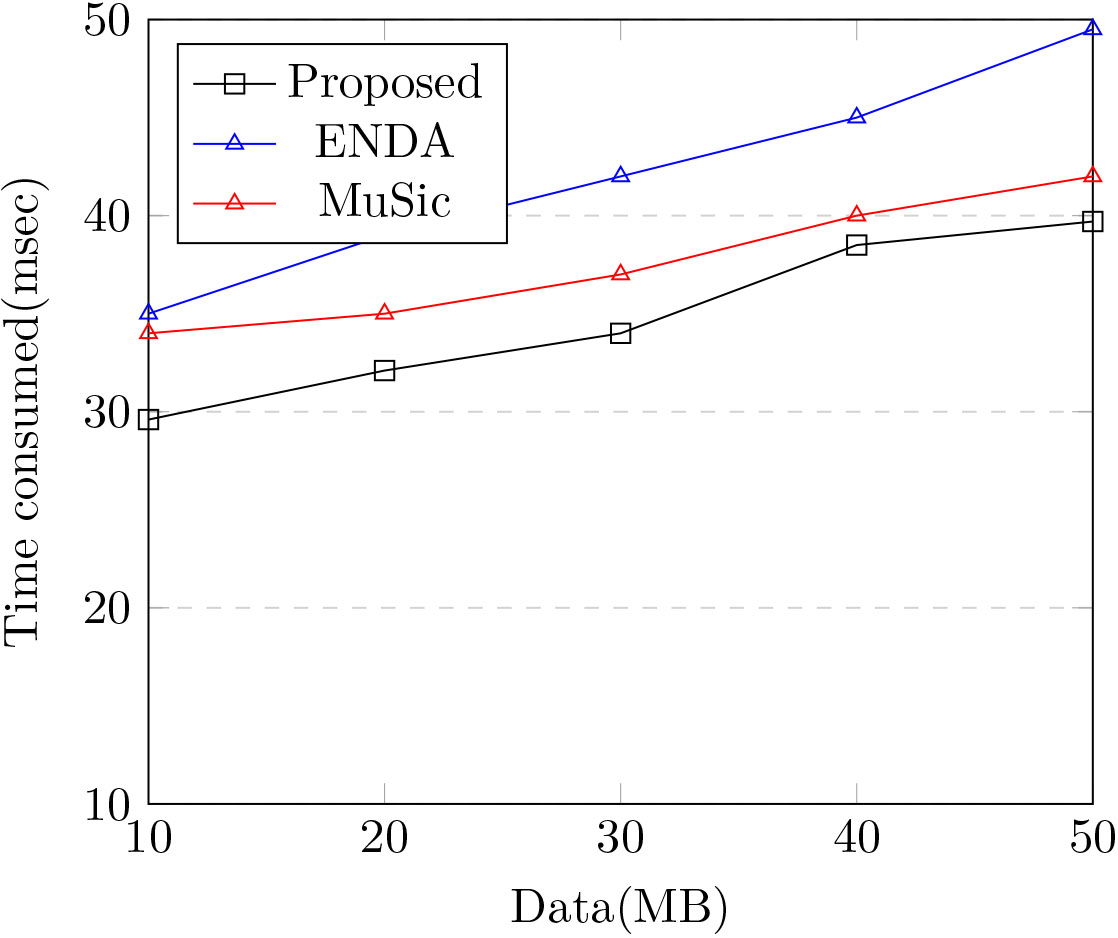
Performance analysis based on accuracy.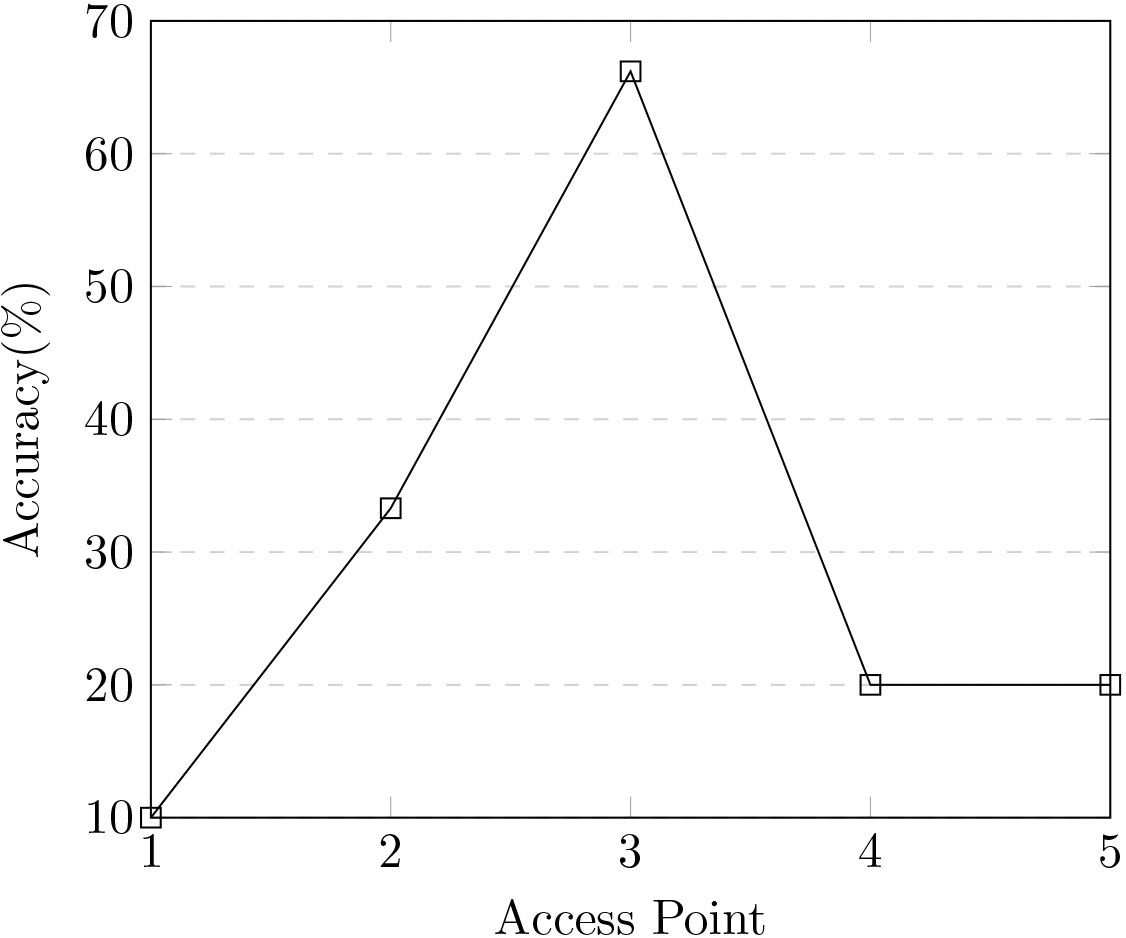
for third point the accuracy is 66.2%, for access point 4 the prediction accuracy is 20% and for access point 5 the accuracy is 20%. From the results it is observed that for the access point 3 the accuracy is high. It means the access point 3 will be considered as next access point for the users. The results are presented in the pictorial representation in the Fig. 6. It is observed that The obtained execution time for different data size tasks with constant distance 100 m is less compared to ENDA. From the Fig. 7 it is observed that the access point 3 has high frequency compared to other access points. Hence considered as next access point for the users.
This paper mainly focused on the prediction of next access point of the user to offload the tasks. The connectivity based mobility prediction algorithm is proposed and its performance is evaluated by varying number of access points and current location. The evaluation is done with different task size with constant velocity and distance. It is observed that the execution time increases with the increase in the data size. The prediction accuracy is satisfactory. The experimental results shows that the proposed method is more reliable and efficient. The performance has been increased by 15.23% compared to other methods. In the future work, the work load of the cloud let can be considered to evaluate the performance of the mobility of the user.