



Abstract
Optimization algorithms are being widely applied in real-time applications. In recent times, Jaya and Rao algorithms have been prominent. The performance of these algorithms will be analyzed for the objective function. The results thus obtained are more accurate and fast compared to previous algorithms. Also, Jaya and Rao algorithms will be utilized for linear array antenna synthesis for the arrays that are equally spaced. Therefore it is of present interest to evaluate the performance of linear antenna array using these algorithms.
Introduction
In the world of communication, antennas play an important role. From the very first invention of the antenna, there have been prominent developments in data transmissions and receptions. Antennas are usually preferred to be deployed in arrays rather than single because of high gain and directivity. Linear array antennas where antennas are placed in a line with isotropic elements having uniform spacing are proved to be efficient in use. Sidelobe level and beam width are the two important factors. Due to the side lobes, there may be a loss in energy of transmitting antennas. In receiving antennas, they may pick interference signals and add noise. Therefore it is important to minimize the side lobe levels and FNBW in order to reduce interference. In swarm intelligence and evolutionary-based algorithms, they require algorithm-specific parameters like in Genetic algorithm requires number of generations, mutation, crossover etc [1, 2]. Ant Colony Optimization based on how ant colonies get food and carry back to their nests [3]. In Particle Swarm Optimization requires number of particles, problem dimension [4, 5]. In Antlion and Grasshopper Optimization, the behavior of Antlion in hunting insects and how Grasshopper seeking food sources [6]. Flower Pollination Optimization imitates the behavior of pollination [7, 8, 9]. Firefly Optimization depends on intensity of light [10], Cuckoo Search depends on breeding behavior [11], Cat Swarm Optimization depends on seeking mode and tracking mode of a cat [12]. In this paper, Jaya and Rao algorithms are used to achieve reduction in SLL and FNBW. Ravipudi Venkata Rao, the author who introduced Rao and Jaya algorithms has developed it in a way that it only requires common control parameters without any algorithm-specific parameters. Rao algorithm provides better and simple optimization techniques with effective solutions for complex problems when compared with metaphor-based algorithms [13]. Jaya solves constrained and unconstrained optimization problems and it has better convergence results. It provides optimal results with a comparatively less number of functional evaluations [14].
Linear Antenna Array and mathematical formulation
Figure 1 shows the uniform Linear Antenna Array. The structure contains high side lobe levels, which increases electromagnetic interference. To reduce this, side lobe levels should be reduced.
Uniform Linear Antenna Array.
where,
To optimize the maximum side lobe levels fitness function is used. Equation (2.2) shows fitness Without Beam Width constraint
where,
In radar antennas, sometimes the false alarm may occur due to thermal noise exceeds the preset threshold level with the presence of spurious signals. To avoid this, close in side lobe reduction is the solution. To increase the range resolution, a reduction in close in side lobes is required. The radiation pattern in which the close in side lobes to the main lobe is suppressed to a very low value keeping farther side lobes at another higher level than the close SLL. Thus range resolution of the radar system can be increased.
The final fitness function is
Here,
Flow chart for implementing Rao and Jaya algorithms.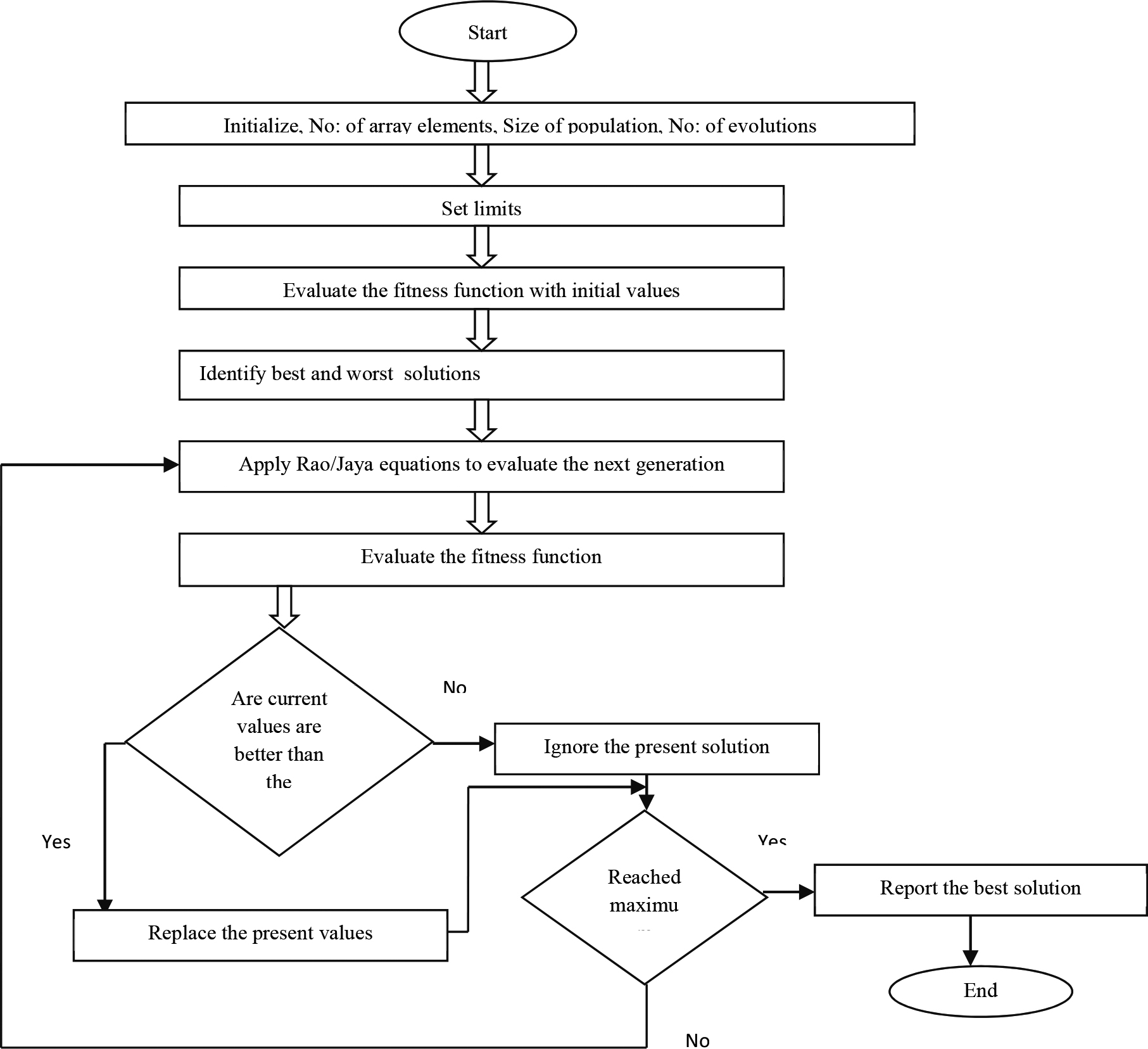
The response of Linear Antenna Array for 20 elements. 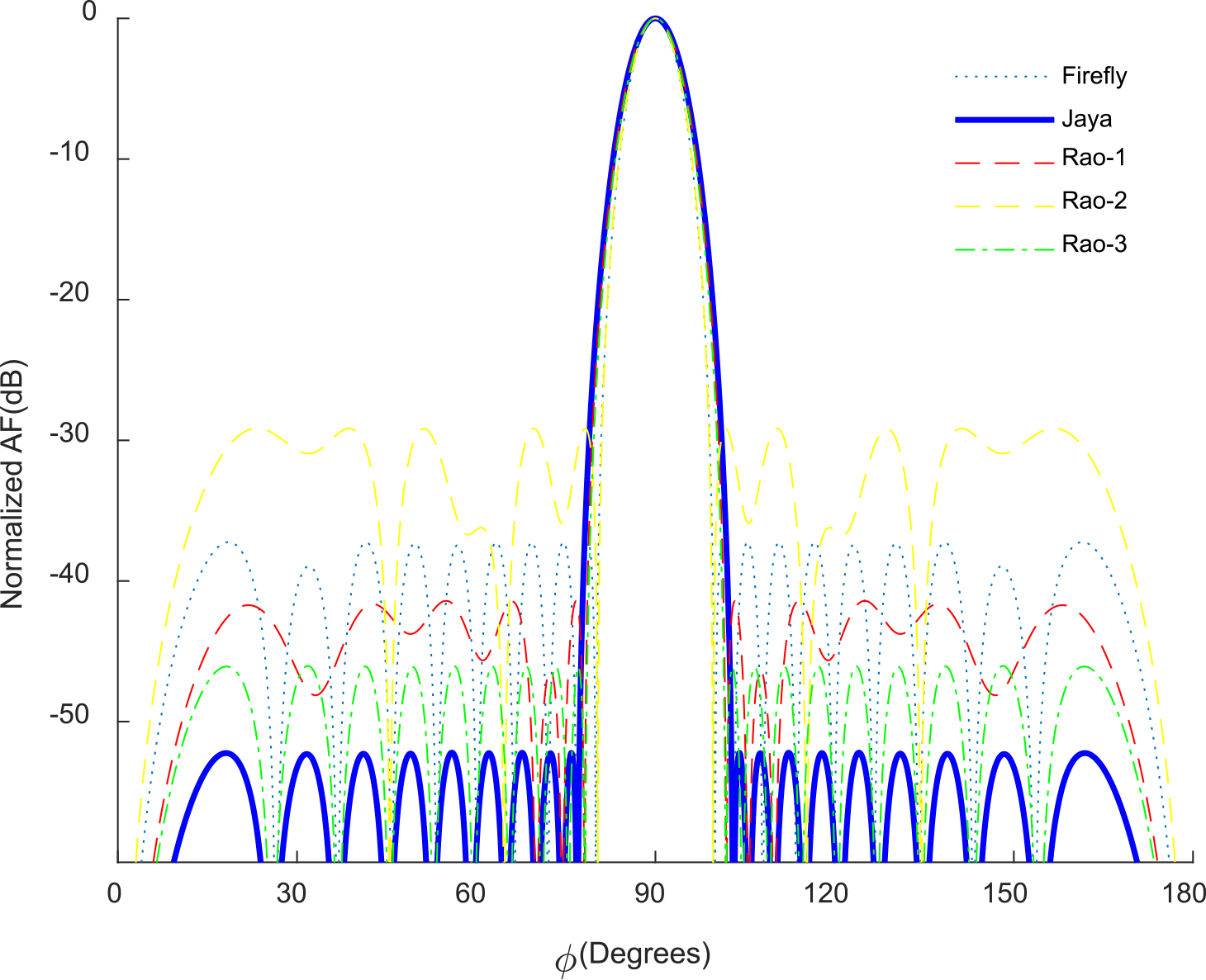
The response of Linear Antenna Array for 40 elements.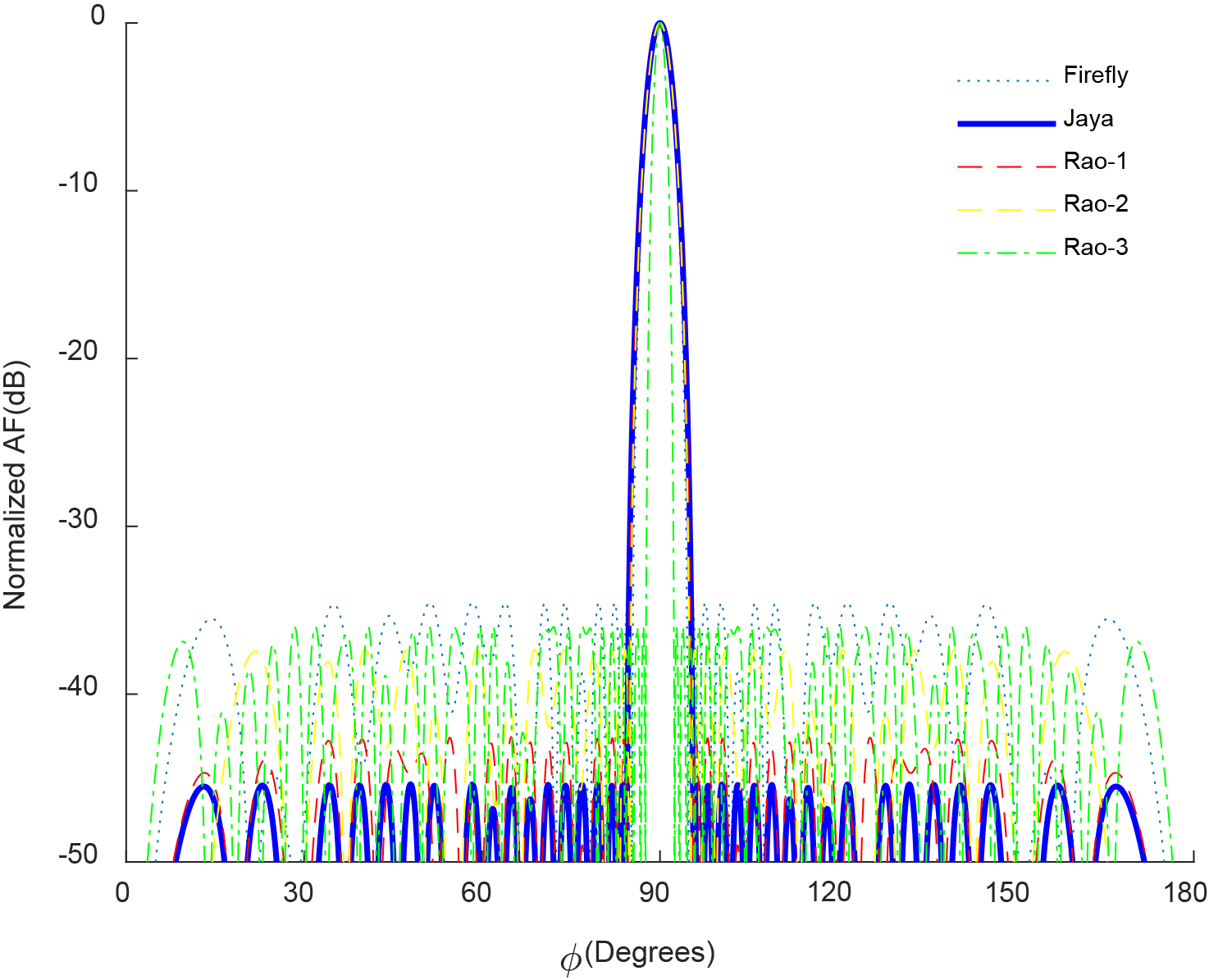
The response of Linear Antenna Array for 60 elements.
The response of Linear Antenna Array for 80 elements.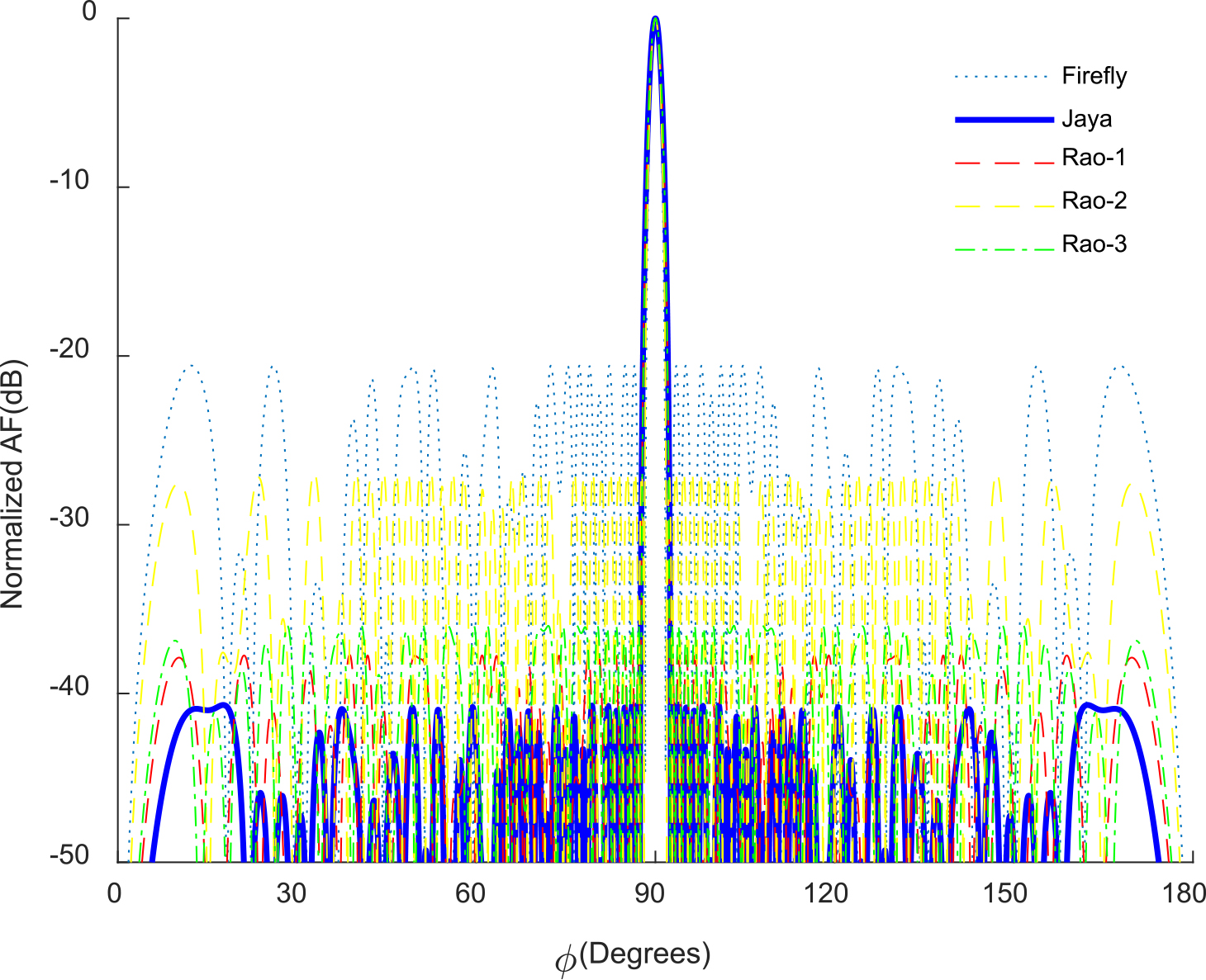
Reduction in close in side lobe for 20 elements.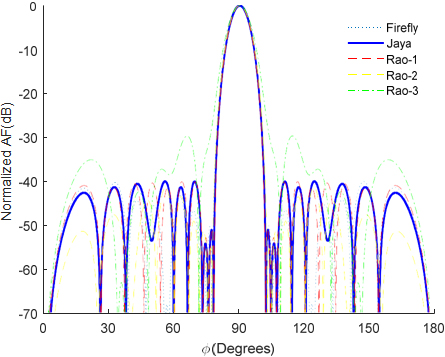
Reduction in close in side lobe for 40 elements.
Reduction in close in side lobe for 60 elements.
Reduction in close in side lobe for 80 elements.
Rao algorithm
Rao algorithm has three metaphor less equations for constrained and unconstrained optimization solving to control sidelobe levels. Rao algorithm does not depend on any natural phenomenon like Firefly and Particle Swarm algorithms. Rao algorithmis based on data analysis depending on their best and worst solutions. It provides better and simple optimization techniques for complex problems [13].
where,
Jaya algorithm is the extension of Rao algorithm based on population. This algorithm does not have parameters and easy to implement and has only one phase. In this algorithm lower and upper range values of design variables of initial solutions of P are generated randomly. variable values of every solution are updated using equation.
where,
In Jaya algorithm, the objective function of every set of possible solutions in the population is improved. The objective function values of every solution are moved to the best solution by changing variable value and at the same time, the set of possible solutions are driven far from the worst solution.The corrected best solution is compared with old solutions and the solution with best objective function is taken for following generation. So, the Jaya algorithm achieves better SLL suppression. It has a high rate of convergence and also easy to implement [14].
Performance table for without beamwidth constraint
Rao, Jaya, Firefly algorithms are successfully applied for 2N
Conclusion
Reduced side lobe levels radiation patterns are produced using Jaya and Rao algorithms and compared with the Firefly algorithm. Jaya algorithm results give the optimal solutions when compared to other algorithms. The close-in side lobes to the main lobe are suppressed to a very low value keeping farther side lobes at another higher level than the close SLL. Due to this, the range resolution of the radar system will increase and there will be a decrease in the false alarms occurred by the radar systems. The methodology can be extended to other array geometries with the objective of generating shaped beams.