



Abstract
Yaozhou ware is located in Huangbao Town, Tongchuan City. It began in the Song Dynasty and flourished in the Tang Dynasty. Its warm and jade like glaze color, exquisite decorative techniques, and rich and varied utensil shapes all give it a very important position in history. The traditional Yaozhou porcelain contains the ancient people’s concept of creation and their attitude towards humans and nature. Each artifact of Yaozhou porcelain contains the designer’s understanding and emotions about the world, establishing a dialogue between people and objects to form a desired lifestyle. The production method of Yaozhou porcelain that has been preserved for thousands of years shares many similarities with modern design ideas. The quality evaluation of Yaozhou porcelain decoration design is viewed as multiple-attribute decision-making (MADM). The grey relational analysis (GRA) is a useful tool to cope with the MADM issue. The probabilistic simplified Neutrosophic set (PSNSs) is easy to characterize uncertain information during the quality evaluation of Yaozhou porcelain decoration design. In this paper, in order to obtain the weight information, an optimization model is constructed to obtain a simple and exact formula which can be employed to derive the attribute weights values based on the Lagrange function and the probabilistic simplified neutrosophic (PSN) grey relational analysis (PSN-GRA) method is originated for MADM to rank the decision alternatives. Finally, a numerical example for quality evaluation of Yaozhou porcelain decoration design is used to verify the practicability of the PSN-GRA method and compares it with other methods.
Keywords
Introduction
Yaozhou porcelain originated in the Tang Dynasty and flourished in the Song Dynasty. It has been continuously fired since the migration of the Jin and Yuan dynasties, with a firing history of over 1500 years [1, 2]. In Tongchuan, Shaanxi, where it originated and developed, due to its unique regional environment and cultural characteristics, and the unremitting efforts and creations of generations of Yaozhou potters, it has created unique artistic characteristics and cultural connotations of Yaozhou porcelain [3, 4]. At the same time, it also embodies people’s longing and hope for a better life. The kiln workers use their wisdom and hands to “make clay into a blank, and the wheels are made” [5, 6]. From quarrying, weathering, raking mud, maturing mud, kneading mud, pulling mud, repairing mud, drying, glazing, decoration, to sacrificing kiln, firing kiln, watching fire, and exiting kiln … the entire process is ancient and simple, with a strong folk atmosphere [7, 8]. Yaozhou ceramics, whether in their exquisite shapes or diverse patterns, are products of historical culture and era cognition, and also continue the traditional cultural connotations and artistic creation style of China [9, 10]. The rich ceramic creation is a microcosm of the era of Yaozhou porcelain. Since the workers of Yaozhou ware are all in the agricultural civilization of Guanzhong, Shaanxi Province, in the production of Yaozhou porcelain, the theme is often centered on the local culture where they live and based on the folk local culture. They mostly use flowers, animals, and opera characters in Guanzhong, Shaanxi Province seen in ordinary life as the main creative materials. Due to the development of the Silk Road and the smooth communication between the north and south, Yaozhou ceramics also had more innovative themes [11, 12]. In terms of decorative patterns, there were not only common birds in the north, but also common fish and ducks in the south. However, the expansion of these contents was also an evolution based on the original materials, which did not deviate from the artistic and cultural characteristics of their region. Yaozhou ceramics, whether in their exquisite shapes or diverse patterns, are products of historical culture and era cognition, and also continue the traditional cultural connotations and artistic creation style of China [13, 14]. The rich ceramic creation is a microcosm of the era of Yaozhou porcelain [15, 16]. Since the workers of Yaozhou ware are all in the agricultural civilization of Guanzhong, Shaanxi Province, in the production of Yaozhou porcelain, the theme is often centered on the local culture where they live and based on the folk local culture. Due to the development of the Silk Road and the smooth communication between the north and south, Yaozhou ceramics also had more innovative themes [17, 18]. In terms of decorative patterns, there were not only common birds in the north, but also common fish and ducks in the south. However, the expansion of these contents was also an evolution based on the original materials, which did not deviate from the artistic and cultural characteristics of their region [19, 20]. The pictures of Yaozhou porcelain are mostly symmetrical, which is a typical Chinese decoration [21, 22]. The bottom of the bowl is centered on the flower bud protruding from the three lotus flowers, and the three blooming lotus flowers are decorated in the middle of the bowl, which is dense, just like the three blooming lotus flowers picked in the middle of summer, the fragrance is fragrant in the summer night. The Artistic language expression of Yaozhou porcelain is rooted in the traditional Chinese art concept, with simple patterns and clear themes. It is good at transforming things in three-dimensional space into plane shapes. It is worth noting that the decorative design of Yaozhou porcelain focuses more on the expression of the external contour of the decoration rather than shaping it in space. In this process, Yaozhou porcelain focuses on refining the characteristics of objects, grasping the characteristics of the object as a whole [23]. The decoration in Yaozhou porcelain reflects the aesthetic concept of “Tang people advocating law, Song people advocating rhyme, and Yuan people advocating meaning”, which is a true record and artistic reflection of the historical period at that time [24, 25]. It involves multiple aspects such as folk customs, beliefs, ethics, aesthetics, and reflects a unique cultural connotation through techniques such as abstraction and symbolism, as well as the expression of truth, goodness, and beauty.
Decision analysis is actually a cognitive process that determines and selects options based on the decision-maker’s values, preferences, and knowledge structure [26, 27]. Later, as time passed, people’s social, economic and other activities continued to enrich, unknown factors in the decision-making process continued to increase, and the depth and breadth of knowledge involved in the decision-making problem gradually increased [28, 29]. Under these conditions, these precise mathematical models are no longer sufficient to meet people’s needs for characterizing uncertainty when facing practical decision-making problems [30]. Based on this situation, proposing more effective information expression methods and solving more complex decision-making problems based on them is a necessary requirement for the development of modern decision-making science [31, 32]. With the increasing complexity of decision-making problems, decision makers hesitate when analyzing the membership of an element that belongs to a set [33, 34]. It is difficult to accurately express their judgment results using only a single evaluation value. As an effective extension of fuzzy set [35], Smarandache [36] constructed the neutrosophic sets (NSs). Ye [37] constructed the definition of simplified NSs (SNSs). Liu et al. [38] constructed Hamacher information operators under NSs. Sahin and Kucuk [39] constructed the entropy information measure of SVNSs. Liu et al. [40] constructed the Heronian mean information operators under SVNSs. Altun et al. [41] constructed the PSNSs.
There are two shortcomings for coping with MADM under PSNSs that to form our incentives as following:
The existing MADM decision methods just paid attention to distance-based similarity degree under PSNSs [41]. How to construct the MADM models consider the shape-based similarity degree is an interesting research topic. For this reason, the first incentive of this paper is to construct the novel shape-based similarity degree MADM models based on the classical GRA method [42]. Yaozhou ware is one of the famous ancient kilns in China’s ceramic history. The decorative techniques of Yaozhou porcelain are rich and diverse, including carving, printing, scratching, picking, pasting, painting, shaping, stacking, and hollowing out, each with its own unique effects [43, 44]. Among them, carving is particularly prominent and has achieved outstanding results, earning the reputation of “the crown of northern carved celadon” [45]. The ancients used the term “insects moving” to describe the authenticity and superb craftsmanship of carved decorative effects, reflecting the lively and vivid artistic effect of Yaozhou celadon, which is extremely rich in the atmosphere of life [46, 47]. The decorative technique of Yaozhou porcelain carving is also known as the “biased knife” technique. Using bamboo, bone, or metal cutting tools, carve the shape and structure of the pattern on the semi dry body, making the pattern slightly prominent, with clear contours, clear layers, in place structure, strong volume, and a shallow relief effect. The quality evaluation of Yaozhou porcelain decoration design is viewed as MADM. The PSNSs can easily depict the uncertain information during the quality evaluation of Yaozhou porcelain decoration design. Thus, the second incentive of this paper is to construct novel MADM models for quality evaluation of Yaozhou porcelain decoration design under PSNSs.
On this basis, combined with the characteristics of quality evaluation of Yaozhou porcelain decoration design, a novel MADM method for quality evaluation of Yaozhou porcelain decoration design under PSNSs is constructed. Specifc research points are constructed as follows:
In this paper, the probabilistic simplified neutrosophic grey relational analysis (PSN-GRA) method is constructed based on GRA method [42, 48, 49] and PSNSs [41] with completely unknown weight. Then, in order to obtain the weight information, an optimization model is constructed to obtain a simple and exact formula which can be employed to derive the attribute weights values based on the Lagrange function. The PSN-GRA is constructed to cope with the MADM consider the shape-based similarity degree. Finally, a numerical example for quality evaluation of Yaozhou porcelain decoration design has been constructed and some comparisons is constructed to show the advantages of PSN-GRA method.
The overall structure of this article is: The definition of PSNSs is introduced in Sect. 2. The PSN-GRA model is constructed to solve the MADM in Sect. 3. An example of quality evaluation of Yaozhou porcelain decoration design is used to verify the PSN-GRA method in Sect. 4. Comparative analysis is supplied in Sect. 5. Sect. 6 draw a conclusion.
Wang et al. [50] designed the SVNSs.
where the
Altun, Sahin [41] designed the PSNSs.
where the
The GRA is a method of determining whether the connections between different sequences are close based on the similarity of the geometric shapes of the sequence curves [42]. The basic idea is to convert the discrete behavior observation values of system factors into piecewise continuous broken lines, and then construct a model to measure the degree of correlation based on the geometric features of the broken lines. The closer the geometric shape of the polyline is, the greater the correlation between the corresponding sequences, and vice versa. Until now, the GRA has been used to different environments and different domains [51, 52, 53, 54, 55, 56, 57]. In this paper, the PSN-GRA is constructed for MADM under PSNSs based on basic ideas of extended GRA method [48, 49] with completely unknown weight information based on the Lagrange function. Let
The decision framework of the PSN-PGRA for MADM with lagrange function.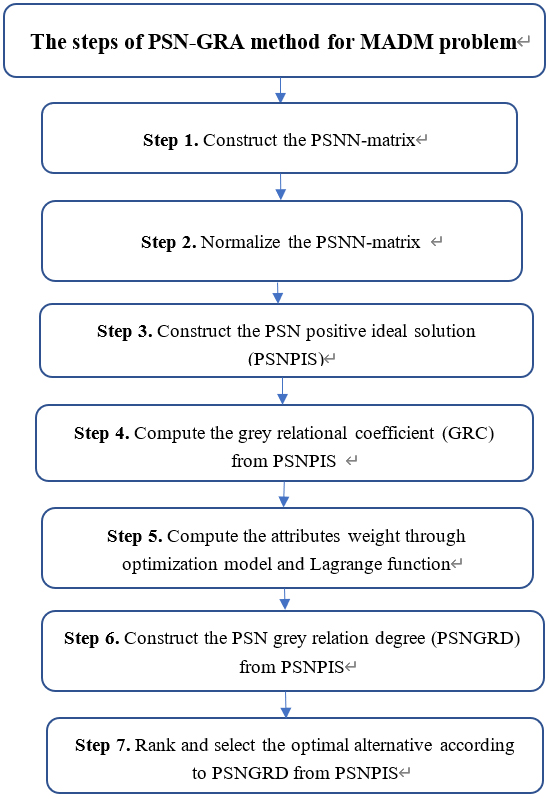
where
In generally,
If the attribute weights are completely unknown, firstly, we should obtain the weight information. Thus, the comprehensive PSNGRC deviation sum is constructed:
So, the multiple objective optimization model (MOOM-1) is established to obtain the weight values below:
Since each alternative is equal, so there is no any preference on all the decision alternatives. Then, the model (MOOM-1) is fused with equivalent weights into the single objective optimization model (SOOM-1):
To derive SOOM-1 model, the Lagrange function is constructed:
where
Differentiating Eq. (12) with respect to
Case study
Yaozhou ware is located in Huangbao Town, Tongchuan City, more than 100 kilometers north of Xi’an. The kiln site is centered around Huangbao, covering the areas of Shangdian, Lidipo, Yuhua, Chenlu, and Yaoxian Tapo. This place was under the jurisdiction of Yaozhou ware in the Song Dynasty. Its product is called Yaozhou Porcelain, or Yaozhou Porcelain. This kiln was founded and fired in the Tang Dynasty (618-906 AD), matured during the Five Dynasties, reached its peak during the Song Dynasty, continued during the Jin and Yuan Dynasties, and ended in the late 15th century of the mid Ming Dynasty. It has a continuous firing history of over 800 years. The techniques of printing and flower drawing were extremely skilled, expressing rare birds and auspicious beasts. Flowers, birds, fish, and insects often imitated the decorative patterns of fabrics and gold and silver vessels. The composition was full and open, and the brushstrokes were like flowing clouds and flowing water. With only a few strokes, the business was abundant. Yaozhou ware Huangbao Kiln has a very rich variety of ceramic decoration techniques, but painting decoration techniques occupy a very important position. One of the important reasons is that Emperor Taizong of Tang of the Tang Dynasty devoted himself to calligraphy, set up Hongwen Hall, selected officials with calligraphy, and calligraphy style flourished. A large number of famous artists emerged at that time. Influenced by this, after the gradual decline of Sancai ware, brush was used as a tool in the middle and late Tang Dynasty, White glazed brown colored porcelain and plain black colored porcelain made of low-temperature green glaze with a three-color legacy, as well as blue glazed white porcelain and other painted ceramics made of makeup clay. White glazed green color and white glazed brown color are a type of underglaze color technique used for painting and decoration. Firstly, a brush is used to dip in the color material juice to draw various flowers and plants on the surface of the porcelain body, or a few strokes are casually applied, and then glazed and fired. This technique was popular in the Mid Tang and Late Tang dynasties and was still used during the Five Dynasties period to decorate objects such as boxes, jars, pots, lamps, candlesticks, etc. At present, there are nearly a hundred known decorative patterns, most of which are made of plant flowers and decorated on the edges and shoulders of pots and pans. The composition method includes a continuous pattern with two sides of the edges, used for the mouth edge. There are abnormal radiation patterns, dotted on the shoulders of the pots. In the composition of the decorative patterns of the plain body black color, a more rigorous method is reflected, and the “mind method”, “one method”, “bone method”, “blood method”, and “tendon method” from Tang Dynasty calligraphy are also used in the dot painting of the plain body black color, forming a thick and vigorous dot, a strong and vigorous brush, and a naive and clumsy brush. The lyric charm of density, intensity, hardness and softness, shape and spirit are worthy of being a masterpiece of strong childishness in the ceramic decoration art of Yaozhou ware”. In addition, this artistic effect perfectly expresses the emotions of the Qin people, with a simple and straightforward personality inside. Carefully savoring it, it really has a stirring feeling. The quality evaluation of Yaozhou porcelain decoration design is MADM. In this given paper, the PSN-GRA is designed for quality evaluation of Yaozhou porcelain decoration design. Five Yaozhou porcelain decoration design schemes
The PSNNs information
The PSNNs information
Then, the PSN-GRA is designed for quality evaluation of Yaozhou porcelain decoration design under PSNSs.
The normalized information matrix by PSNNs
The PSNPIS
The
The attributes weight
The
The order
In this part, PSN-GRA is made comparison with PSNWA and PSNWG operators [41], PNN-PROMETHEE method [41]. Eventually, the results are constructed in Table 8.
Results of different decision methods
Results of different decision methods
In accordance with WS coefficients [59, 60], the WS coefficient calculation between the PSNWA and PSNWG operators [41], PNN-PROMETHEE method [41] and the proposed PSN-GRA method is 1.0000, 0.9167, 1.0000, respectively. Thus, From the information Table 8, it is evident that these decision methods’ orders are slightly different, but these decision methods have same best Yaozhou porcelain decoration design schemes. This verifies the PSN-GRA method is reasonable and effective. At the same time, compared with existing PSN-GRA method [58], the main differences between the proposed PSN-GRA method and the existing PSN-GRA method [58] are outlined: (1) how to calculate the weight information: the proposed PSN-GRA method construct an optimization model to obtain a simple and exact formula which can be employed to derive the attribute weights values based on the Lagrange function, while the existing PSN-GRA method [58] use the CRITIC method to derive the attribute weights values; (2) Whether consider the PSNN positive ideal solution (PNNPIS) and PSNN negative ideal solution (PSNNNIS): the proposed PSN-GRA method only consider the PNNPIS, while the existing PSN-GRA method [58] consider the PNNPIS and PSNNNIS, simultaneously; (3) Different sorting rules: the proposed PSN-GRA method sort the alternatives according to the PSN grey relation degree (PSNGRD) from PSNPIS, while the existing PSN-GRA method [58] sort the alternatives according to the PSNN relative relational degree (PSNNRRD) for PSNNPIS.
The emergence of modern ceramic art has led to ceramic art aimed at individual expression and spiritual pursuit, which transcends practical functions and expresses a complete sense of beauty, artistic conception, or concept. In terms of creative techniques, it presents a diverse situation. Ceramic creation pays attention to the organic combination of modeling and decoration, and emphasizes the handicraft culture. These characteristics are forming a common Artistic language with the underglaze five colors. The aesthetics of ceramic art is actually the aesthetic expression of contemporary art, and the aesthetic laws can be said to follow the rules of formal beauty, which is the foundation of all artistic forms. Whether in ceramic modeling or ceramic painting, it is a topic worth exploring and deepening. The quality evaluation of Yaozhou porcelain decoration design is viewed as multiple attribute decision-making (MADM). In this paper, the probabilistic simplified neutrosophic point grey relational analysis (PSN-GRA) method is originated for MADM. Then, under probabilistic simplified Neutrosophic set (PSNSs), the PSN-GRA method and CRITIC method are combined to rank the decision alternatives and a numerical example for quality evaluation of Yaozhou porcelain decoration design is used to verify the practicability of the PSN-GRA method and compares it with other methods.
Although the advantages of GRA are significant and have achieved widespread and effective applications. However, GRA also has certain shortcomings, which require in-depth research by scientific and technological workers to make it increasingly perfect. (1) The commonly used grey correlation degree quantification model always calculates a positive correlation degree, which cannot fully reflect the relationship between things because there can be both positive and negative correlations between things. (2) Moreover, the shapes of time series curves with negative correlations are vastly different. If commonly used correlation models are still used, incorrect conclusions will be drawn. (3) In our future works, we shall use other subjective or objective determination of weights in multi-criteria decision support systems [61, 62, 63, 64, 65, 66].
Footnotes
Acknowledgments
The work was supported by the 2022 Art and Science Planning Project of Shaanxi Provincial Culture and Tourism Department “Research of the Application of Yaozhou Kiln Decorative Art in Cultural and Creative Design under the Background of Rural Revitalization” Research achievement (Project No.: 2022HZ1658).