In this paper, we define the Quadripartition Neutrosophic Weighted Neutrality Aggregative (QNWNA) operator and Quadripartition Neutrosophic Ordered Weighted Neutrality Aggregative (QNOWNA) operator for solving Multi-Attribute Group Decision Making (MAGDM) problems. The basic properties of both operators are discussed thoroughly. A new MAGDM strategy is developed using these developed operators. A case study of e-commerce site selection in India is discussed to show the applicability of the proposed MADM strategy. Moreover, the performance of the QNWNA and QNOWNA operators are compared with Quadripartition Neutrosophic Weighted Arithmetic Aggregation (QNWAA) operator and Quadripartition Neutrosophic Weighted Geometric Aggregation (QNWGA), Quadripartition Single valued Neutrosophic Dombi Weighted Arithmetic Aggregation (QSVNDWAA) and QSVN Dombi Weighted Geometric Aggregation (QSVNDWAA) operator.
Multi-Attribute Group Decision Making (MAGDM) is a popular decision-making strategy. It is a process to identify the most suitable alternative from a set of feasible alternatives under some criteria. The utilization of MAGDM problems [1, 2, 3] is increasing as the intricacies of our daily lives get more complex. It is often difficult for the decision makers to express the rating value as a specific number in various uncertainty situations. To deal with it, Zadeh first defined “Fuzzy Set” (FS) [4] to handle the ambiguities in the information, which utilizes the “Membership Degree” (MD) that reflects uncertainty. The concept of FS was extended to “Intuitionistic Fuzzy Set” (IFS) [5] by Atanassov by adding “Non-Membership Degree” (NMD) along with MD to describe the fuzzy information. The range of IFS information is very narrow with the constraint condition that MDs and NMDs should not be greater than one i.e. . Later on, Smarandache defined the “Neutrosophic Set” (NS) [6] which contains “Indeterminacy Membership Degree” (IMD) to handle the decision-making problems more accurately. The NS has three MDs – “Truth Membership Degree (TMD) , Indeterminacy Membership Degree (IMD) , and Falsity Membership Degree (FMD) ”, and they hold the condition . Researchers have intensively investigated neutrosophic theory [7, 8, 9, 10] in dealing with real-life situations containing ambiguity. Even though the hesitation margin of neutrosophic theory is independent of truth or falsity membership, it appears to be more comprehensive than intuitionistic fuzzy sets.
Atanassov et al. [11] recently looked at the relationships between inconsistent IFS, picture fuzzy sets [12], NS [13], and IFS [5]. However, whether the element’s belongingness or non-belongingness causes the indeterminacy associated with a particular element is unclear. This has been noticed by Chatterjee et al. [14] who defined a more generic construction of NS, namely Quadripartitioned Single Valued Neutrosophic Set (QSVNS). The concept of QSVNS is based on Smarandache’s four numerical-valued neutrosophic logic [15] and Belnap’s four-valued logic [16], in which indeterminacy is separated into two independent parts: unknown and contradiction. However, in the context of neutrosophic research, the QSVNS appears to be quite rational. So, researchers are giving more consideration in this theory, and they are using Aggregation Operators(AOs) to solve DMPs. For example, Chatterjee et al. [14] presented the concept of some similarity measures and entropy on QSVNS. Chatterjee et al. [17] developed AOs for Quadripartition Neutrosophic Numbers(QNNs). Mohanasundari and Mohana [18] presented Dombi weighted AOs for MADM. Roy et al. [19] defined similarity measures of Quadripartitioned Single Valued Bipolar Neutrosophic Sets (QSVBNS) and applied them to the MADM problem. Mohanasundari and Mohana [20] presented axiomatic characterizations of Quadripartitioned Single Valued Neutrosophic Rough Sets (QSVNRS).
Research gap and motivation
From the foregoing studies, it has been seen that researchers have put a lot of efforts into developing different kinds of AOs under SVNSs and QNN environments to handle the uncertainties in the data. No studies have been conducted using a neutrality operator in the QNN environment.
This research gap motivates us to develop a new MAGDM strategy using neutrality operator in the QNN environment. Until now many AOs have been defined in NS [21, 22, 23, 24] and QNNs [17, 18] environments. But the neutral operator is different from all other operators. In neutral operator, we have to define the Probability Sum (PS) function and the proportional distribution rules for each membership function. He et al. [25] defined Neutral Averaging Operators (NAO) using this PS function and the proportional distribution rules of MD and NMD of IFSs and applied it to the MADM problem. Garg [26] defined the NO-based Pythagorean Fuzzy Aggregation Operator (PFAO) and employed them to solve Multiple Attribute Group Decision-Making (MAGDM) processes. Garg and Chen [27] defined the NAO of q-rung orthopair FSs, and applied it for MAGDM. Garg et al. [28] presented NAO for complex q-rung orthopair FSs. Garg [29] presented the novel NAO-based MAGDM method for single-valued neutrosophic numbers. All the above NAOs dealt with two or three membership degrees. They missed the information about CMD and IMD. To get fair treatment towards evaluating these four MDs, we utilize the PS function and the interaction between the MDs to define some new operational laws. For this, we define some new addition and scalar multiplication rules for different QNNs to aggregate different QNNs. Based on these operational laws, some weighted averaging AOs are proposed to explore the process to solve the MADM problems. A literature review for different aggregation operators in neutrosophic and QNN environments is shown in Table 1.
Literature review for different aggregation operators in neutrosophic and QNN environments
Operator
Approach
Application
Averaging and geometric AOs
Averaging and geometric AOs under QNNs environment [17]
Air quality evaluation
Harmonic mean AOs
Harmonic mean AOs in neutrosophic number environment [30]
Linguistic neutrosophic partitioned maclaurin symmetric mean operators [34]
Logistical park location selection
Heronian AOs
Neutrosophic uncertain linguistic number Heronian mean operators [35]
Investment company
It is found during the study that when decision-makers evaluate the objects equally considering the MDs and NMDs, their aggregated values by addition or multiplication are not equal. As a result, biasness may occur in decision making. By utilizing the probability sum and proportional distribution rules of the membership function, we offer some additional neutrality addition and scalar operations to manage such circumstances and to make a decision more flexible and relevant considering the decision maker’s attitudes.
The main objectives of this paper are as follows:
To develop the neutral operational laws for QNN based on a process-neutral decision.
To create a new MADM strategy based on QNWNA and QNOWNA operators in a QNNs environment.
To present a comparative study with the existing operators in QNNs environment.
To show the advantages of the developed operators.
The following is the outline of the paper. Section 2 presents some fundamental concepts of QNNs, such as some basic operations on QNNs, weighted arithmetic and geometric aggregation operators, and the entropy measure of QNNs. In Section 3, the neutrality operational law for QNNs is introduced. Then, the QNWNA and QNOWNA operators are developed and some of their characteristics are investigated in Section 4. Section 5 develops an MAGDM strategy using entropy weights and QNWNA and QNOWNA operators. The applicability of the proposed MAGDM strategy is illustrated in Section 6 with the help of a case study of E-commerce site selection in India. In Section 7, we also conduct a comparison with other aggregating operators. Finally, Section 8 concludes the paper and outlines some future research directions.
Some preliminaries
Definition 2.1 A quadripartition neutrosophic number [14] is an element of denoted by , where denotes the TMD, denotes the CMD, denotes the IMD, and denotes the FMD. From the definition, .
Definition 2.2 Assume that and be two QNNs. Then the following operations [14] hold:
(1) (2)
Definition 2.3 The score function [14] of a QNN is defined as
Definition 2.4: Let . Then, for any two QNNs and , the idea of comparability [14] in a broader sense is defined as follows:
I. II. III. If , then
(a) (b) with (c) with and (d) with and .
Definition 2.5: Let be a set of QNNs where . Then quadripartitioned neutrosophic weighted arithmetic aggregation (QNWAA) operator [14] and quadripartitioned neutrosophic weighted geometric aggregation (QNWGA) operator [14] are defined as
where is the weight of .
Definition 2.6: The QSVNS has an entropy measure [17] given by
for all .
Neutrality operational law
Definition 3.1 Let and be two QNNs. The neutrality operation of and is defined as
where TCS, CCS, ICS and FCS present truth membership, contradiction membership, ignorance membership, and falsity membership coefficient sum of and , respectively, and , , , and .
Proposition 1 For QNN and , we have
Proof: If we take . . By the principle of mathematical induction, we can easily write
For QNN and , we have
Then we have the following propositions:
Proposition 2 For QNN and , we have
where
Definition 3.1 For QNN and a real number , scalar neutrality operator is defined by
Proposition 3 For QNNs and if and then . Also, if then and if then .
Remark 1 If and , then from Eq. (3), we get . Therefore, from the above proposition, we can say that the proposed operation presents the neutral nature to the decision maker when the TCS, CCS, ICS and FCS are equal. For this reason, we call Eqs (3) and (3) as neutrality operation and scalar neutrality operation, respectively.
Now, based on the definition of TCS, CCS, ICS, FCS and PS function, Eq. (3) can be presented as
In the following, we explain the origin of the scalar neutrality operation as given in definition 3.1.
Definition 4.1 Let be a collection of QNNs. The Quadripartition Neutrosophic Weighted Neutrality Aggregative (QNWNA) operator for QNNs is thus defined as follows:
Theorem 4.5 (Boundedness) Let , be a set of QNNs, and let and , then .
Proof: From Theorem 4.4, we have
Therefore, we can write
Hence the theorem.
Definition 4.2 Let be a collection of QNNs. The Quadripartition Neutrosophic Ordered Weighted Neutrality Aggregative (QNOWNA) operator for QNNs is thus defined as follows:
Here is a permutation map such that for that is, is the th largest value of and is the weight vector of and .
Theorem 4.6 For collection of QNNs , we have
where, is the weight of and .
The proof of the theorem is omitted as it is same as Theorem 4.1.
Example 4.2 Let and be three QNNs, and let . Then according to definition 2.2 we obtain: .
Therefore, according to definition 4.2 Then,
Corollary 4.1 The QNOWNA operator has commutativity, idempotent, boundness and monotonicity properties as satisfied by QNOWNA operator given in Theorems 4.2, 4.3, 4.4 and 4.5. The proofs are omitted here for brevity.
MAGDM strategy based on QNWNA and QNOWNA operators in the QNN environment
Suppose that and be two sets of alternatives and attributes, respectively. Assume that the attribute weights are and . Assume that ) be the set of decision makers and be the weights of the decision makers and . The MAGDM strategy based on QNWNA and QNOWNA operators is developed through the steps given below:
Step 1:Formulate a decision-making matrices.
Let be a decision matrix. The details of the alternative w.r.t. the attribute are included. Then A is defined as follows:
Step 2:Standardize the decision-making matrices.
Suppose that, in the neutrosophic decision matrices Eq. (28), is the rating value of alternative with regard to attribute such that
The DM is standardized to eliminate the effects of various physical measurements. To obtain the standardized DM , the entry in the matrix is to be considered as given in the following:
(i) For benefit criterion,
(ii) For cost criterion,
The following is the standardised A:
Step 3: To obtain aggregate decision matrices, we use QNWNA operator which is presented below:
where is the weight of the decision maker.
Step 4:The entropy measure for QSVN is
for all .
The normalized weights of the attributes are given by
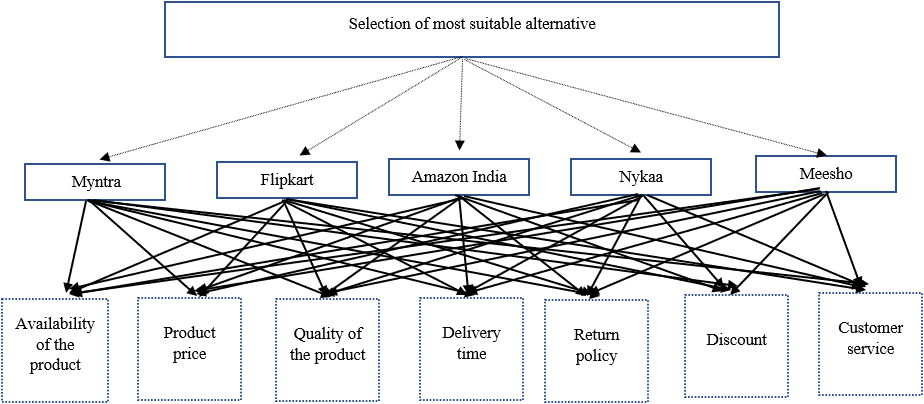
Decision-making structure of the QNN-MAGDM strategy.
Step 5: Collect the overall assessment values into a global value by utilizing either QNWNA operator as:
or, the QNOWNA operator
Step 6:Determine the final decision matrix score and accuracy value:
Step 7:Use the score and accuracy values of the alternatives to rank the options.
Application of the proposed strategy: A case study of selection of E-commerce site alternatives in India
The e-commerce sites are gradually becoming popular in India. During COVID-19 pandemic situation all over the country, these sites were used as home shopping sources. Here we take five e-commerce sectors
Decision matrices
Alternative
Standardize decision matrices
Alternative
Aggregated decision matrices
and put seven attributes on them; then, we find out which site is the best to buy products for our daily needs. Here we only consider the clothing selection of the following five e-commerce site: (a) Myntra , (b) Flipkart , (c) Amazon India and (d) Nykaa and (e) Meesho . For the selection of the site, we consider seven attributes: (1) Availability of the product , (2) Product price , (3) Quality of the product , (4) Delivery time , (5) Return policy , (6) Discount and (7) Customer service .
Availability of the product , quality of the product , return policy , Discount and Customer service are benefit attributes, and product price and delivery time are cost attributes.
We consider three experts , and to evaluate the given alternatives under each attribute according to the QNN environment. Also, 0.35, 0.4, and 0.25 are respectively the assigned weights of the three experts. We construct the following decision matrices and proceed to do the calculations according to the steps outlined in Section 5.
Step 2: Using Eqs (29) and (30), the standardize DM is then obtained as shown in Table 3.
Step 3: Aggregate the standardize matrices into a signal DM using Eq. (32), which is presented in Table 4.
Step 4: Here, we evaluate the entropy weights of the attributes.
Using Eqs (33) and (34), we obtain the weights of the attributes shown in Table 5.
Values of the entropy and weights
0.9972
0.9889
0.9923
0.9934
0.9869
0.9793
0.993
0.0413
0.1605
0.1118
0.0952
0.1897
0.2998
0.1016
Step 5: Using the QNWNA and QNOWNA operators in Eqs (5) and (5), we aggregate the DM and present in Table 6.
Values of QNWNA and QNOWNA operators
Alternatives
QNWNA
QNOWNA
Step 6: The score and accuracy values of the aggregative DM of QNWNA and QNOWNA operators are obtained by using Eqs (37)–(40) as shown in Table 7.
The score and accuracy values of the alternatives obtained using the QNWNA and QNOWNA operators
QNWNA
QNOWNA
Alternative
Sc. Value
Sc. Value
0.0195
0.0971
0.0008
0.007
0.1365
0.1812
0.0057
0.123
0.0271
0.0982
0.0098
0.0069
0.0985
0.1524
0.0064
0.0974
0.0547
0.095
0.0042
0.0017
0.025
0.0617
0.0079
0.0066
0.0514
0.1202
0.0013
0.0097
0.0452
0.3540
0.0072
0.0288
0.0204
0.1112
0.0026
0.0057
0.0113
0.0577
0.0076
0.0008
Step 7: The ranking order of the alternatives is determined using the QNWNA operator as follows:
Also, the rank of the alternatives is generated using the QNOWNA operator as follows:
The above shows that i.e. selecting the Amazon India for shopping cloth is the most suitable alternative.
Hierarchical structure of the decision-making problem.
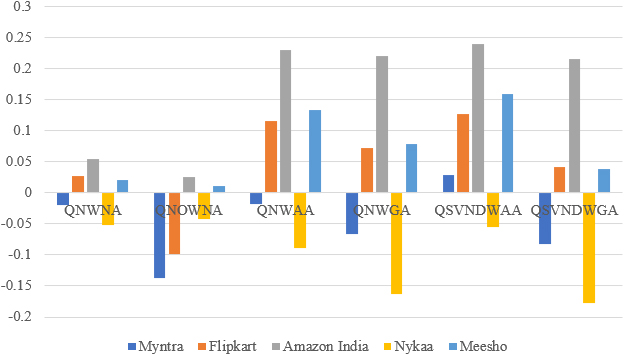
Graphical presentation of QNWNA, QNOWNA, QNWAA, QNWGA, QSVNDWAA and QSVNDWGA operators.
Comparative analysis
To verify the consistency of the proposed strategy with the existing approach [17, 18] presented in the literature under the QNN environment, we make an analysis with some of the AOs; namely QN Weighted Arithmetic Aggregation (QNWAA) [17], QN Weighted Geometric Aggregation (QNWGA) [17], QSVN Dombi Weighted Arithmetic Aggregation (QSVNDWAA) [18], QSVN Dombi Weighted Geometric Aggregation (QSVNDWGA) [18]. The aggregative values of QNWNA, QNWGA, QNWAA, QNWGA, QSVNDWAA, and QSVNDWGA operators are shown in Table 8. Based on these aggregative QNNs value, we evaluate score value of each of the alternative using and result is provided in Table 9 corresponding each of the alternative. Based on AOs process, the best alternative remains the best alternative, while the other alternatives have changed their relevance based on the AOs process. Furthermore, the existing AOs and the suggested ones use different computational processes. A graphical representation of the alternative can be visualized in Fig. 3.
Aggregated values of QNWNA, QNWGA, QNWAA, QNWGA, QSVNDWAA and QSVNDWGA operators
QNWNA
QNOWNA
QNWAA
QNWGA
QSVNDWAA
QSVNDWGA
The QNWNA, QNOWNA, QNWAA, QNWGA, QSVNDWAA and QSVNDWGA operators are compared in terms of score values and ranking of the alternatives
Operator
Sc. values of the alternatives
Ranking
QNWNA
0.0195
0.0271
0.0547
0.0514
0.0204
QNOWNA
0.1365
0.0985
0.025
0.0452
0.0113
QNWAA
0.0185
0.1149
0.2304
0.0896
0.1338
QNWGA
0.0658
0.0723
0.22
0.1633
0.0783
QSVNDWAA
0.0279
0.1265
0.2394
0.055
0.1585
QSVNDWGA
0.0824
0.0416
0.2147
0.1781
0.0391
The superiority as well as the advantages of the suggested AOs over these existing AOs are demonstrated in the following.
The QNWNA and QNOWNA operators seem to be more generic than the QNWAA and QNWGA operators. The QNWNA and QNOWNA operators have several advantages, the most important of which is that they present a neutral nature to decision-makers, conforming to their preferences for equal membership and non-membership degrees. This functionality, however, does not satisfy QNWAA and QNWGA operators.
The approaches presented in [25, 26, 27, 29] under IFSs, PFSs, q-rung orthopair FSs, complex q-rung orthopair FS, and SVNS are bounded by the area of their MD and NMD. The key benefit of adopting QNNs is that they represent a more generalised version of the above-mentioned set. As a result, these sets are unable to explore data such as (0.8, 0.2, 0.3, 0.7), but QNNs can handle such data.
Conclusion
By using the decision-makers attitude characteristics in the analysis under the QNN environment, we have suggested several new weighted averaging aggregation operators. The key benefits of the suggested operators are that they present a neutral nature to the decision-makers in line with their preferences for equal degrees of membership and non-membership. This functionality, however, does not satisfy the numerous current operators. To manage this feature, some additional neutral addition and scalar multiplication operational laws have been proposed for the aggregated QNN data. In this article, we aim to assist with more ambiguities in the structure that represents QNN in the MAGDM problem. This paper has introduced two important operators viz. QNWNA and QNOWNA operators are on NAOs. The fundamental features of these operators are thoroughly examined. The proposed operators have several advantages, the most important of which is that they present a neutral nature to decision-makers. The MAGDM strategy is developed using the QNWNA and QNOWNA operators. The e-commerce site selection is made with the proposed strategy, and the ranking of the alternatives is obtained. Also, the obtained results are compared with the results for QNWAA, QNWGA, QSVNDWAA, and QSVNDWGA operators results. This study’s limitations stem from the fact that these operators have complex mathematical structures and are difficult to compute. QNNs theory can be further explored in the future, and various forms of aggregation operators can be studied. One can also expand the work done in this paper by addressing various types of practical problems in other fields such as uncertain theory [36], pattern recognition [37], cluster analysis [38], selection of renewable energy alternatives [39] etc.
Footnotes
Acknowledgments
The authors would like to express their sincere thanks to the anonymous reviewers for providing helpful comments and suggestions on the earlier version of the manuscript, which have helped a lot in improving the quality of the original manuscript.
References
1.
BiswasPPramanikSGiriBC. TOPSIS method for multi-attribute group decision-making under single-valued neutrosophic environment. Neural Computing & Applications.2016; 27: 727-737.
2.
PramanikSMallickR. VIKOR based MAGDM strategy with trapezoidal neutrosophic numbers. Neutrosophic Sets and Systems.2018; 2: 118-130.
3.
PramanikSMallickR. TODIM strategy for multi-attribute group decision making in trapezoidal neutrosophic number environment. Complex & Intelligence System.2019; 5(4): 379-389.
4.
ZadehLA. Fuzzy sets. Information and control.1965; 8(3): 338-353.
SmarandacheF. A unifying field of logics. Neutrosophy: neutrosophic probability, set and logic. American Research Press. Rehoboth. 1998.
7.
BroumiSSmarandacheF. Several similarity measures of neutrosophic sets. Neut. Sets and Syst.2013; 1: 54-62.
8.
MajumdarPSamantaSK. On similarity and entropy of neutrosophic sets. Journal of Intelligent & Fuzzy Systems.2013; 26: 1245-1252.
9.
JunY. Similarity measures between interval neutrosophic sets and their application in multicriteria decision-making. Journal of Intelligent & Fuzzy Systems.2014; 26: 165-172.
10.
BiswasPPramanikSGiriBC. NH-MADM strategy in neutrosophic hesitant fuzzy set environment based on extended GRA. Informatica.2019; 30(2): 1-30.
11.
AtanassovKTVassilevP. Intuitionistic fuzzy sets and other fuzzy sets extensions representable by them. Journal of Intelligent & Fuzzy Systems.2020; 38: 525-530.
12.
CuongBCKreinovichV. Picture fuzzy sets – A new concept for computational intelligence problems. In Proceedings of the Third World Congress on Information and Communication Technologies WICT’2013, Hanoi, Vietnam, 2013. pp. 1-6.
13.
WangHSmarandacheFZhangQSunderramanR. Single valued neutrosophic sets. Multispace Multistruct.2010; 4: 410-413.
14.
ChatterjeeRMajumdarPSamantaSK. On some similarity measures and entropy on quadripartitioned single valued neutrosophic set. Journal of Intelligent & Fuzzy Systems.2016; 30: 2475-2485.
15.
SmarandacheF. n-valued refined neutrosophic logic and its applications to physics; 2014. arXiv 2014, arXiv: 1407.1041.
16.
BelnapND. A useful four-valued logic. In: Dunn JM, Epstein G. (Eds.) Modern Uses of Multiple-Valued Logic. Episteme (A Series in the Foundational, Methodological, Philosophical, Psychological, Sociological, and Political Aspects of the Sciences, Pure and Applied) 2, Dordrecht; 1977.
17.
ChatterjeeRMajumdarPSamantaSK. A multi-criteria group decision making algorithm with quadripartitioned neutrosophic weighted aggregation operators using quadripartitioned neutrosophic number in IPQSVNSS environment. Soft Computing.2019; 24: 8857-8880.
18.
MohanasundariMMohanaK. Quadripartitioned single valued neutrosophic Dombi weighted aggregation operators for multiple attribute decision making. Neutrosophic Sets and Systems.2020; 32: 107-122.
19.
RoySLeeJGPalASamantaSK. Similarity measures of quadripartitioned single valued bipolar neutrosophic sets and its application in multi-criteria decision making problems. Symmetry.2020; 12(6): 1012.
20.
MohanasundariMMohanaK. Axiomatic characterizations of quadripartitioned single valued neutrosophic rough sets. Journal of New Theory.2020; 30: 86-99.
21.
LiuPChuYLiYChenY. Some generalized neutrosophic number hamacher aggregation operators and their application to group decision making. International Journal of Fuzzy Systems.2014; 16(2): 242-255.
22.
SahinRLiuP. Possibility-induced simplified neutrosophic aggregation operators and their application to multi-criteria group decision making. Journal of Experimental & Theoretical Artificial Intelligence.2017; 29(4): 769-785.
23.
GargH, Nancy. Some hybrid weighted aggregation operators under neutrosophic set environment and their applications to multicriteria decision-making. Applied Intelligence.2018; 48(12): 4871-4888.
24.
LiYLiuPChenY. Some single valued neutrosophic number heronian mean operators and their application in multiple attribute group decision making. Informatica.2016; 27(1): 85-110.
25.
HeYChenHHeZZhouL. Multi-attribute decision making based on neutral averaging operators for intuitionistic fuzzy information. Applied Soft Computing.2015; 27: 64-76.
26.
GargH. Neutrality operations-based Pythagorean fuzzy aggregation operators and its applications to multiple attribute group decision-making process. Journal of Ambient Intelligence and Humanized Computing.2020; 11: 3021-3041.
27.
GargHChenSM. Multiattribute group decision making based on neutrality aggregation operators of q-rung orthopair fuzzy sets. Information Sciences.2020; 517: 427-447.
28.
GargHGandomiAHAliZMahmoodT. Neutrality aggregation operators based on complex q-rung orthopair fuzzy sets and their applications in multiattribute decision-making problems. International Journal of Intelligent Systems.2021; 37(1): 1010-1051.
29.
GargH. Novel neutrality aggregation operator-based multiattribute group decision-making method for single-valued neutrosophic numbers. Soft Computing.2020; 24(2): 10327-10349.
30.
MondalKPramanikSGiriBCSmarandacheF. NN-harmonic mean aggregation operators-based MCGDM strategy in a neutrosophic number environment. Axioms.2018; 7: 12.
31.
LiuCLuoY. Power aggregation operators of simplified neutrosophic sets and their use in multi-attribute group decision making. IEEE/CAA Journal of Automatica Sinica. 2017; 1-10.
32.
LiuPChuYLiYChenY. Some generalized neutrosophic number Hamacher aggregation operators and their application to group decision making. International Journal of Fuzzy Systems.2014; 16(2): 242-255.
33.
YangLLiB. An extended single-valued neutrosophic normalized weighted Bonferroni mean Einstein aggregation operator. International Journal of Applied Mathematics.2018; 48: 4.
34.
LiuPYouX. Linguistic neutrosophic partitioned Maclaurin symmetric mean operators based on clustering algorithm and their application to multi-criteria group decision-making. Artificial Intelligence Review.2020; 53: 2131-2170.
35.
LiuPShiL. Some Neutrosophic uncertain linguistic number Heronian mean operators and their application to multi-attribute group decision making. Neural Computing and Applications.2017; 28(5): 1079-1093.
36.
ChangJSunLZhangBPengJ. Multi-period portfolio selection with mental accounts and realistic constraints based on uncertainty theory. Journal of Computational and Applied Mathematics.2020; 377: 112892.
37.
ChaiJSSelvachandranGSmarandacheF, et al. New similarity measures for single-valued neutrosophic sets with applications in pattern recognition and medical diagnosis problems. Complex Intelligence Systems.2021; 7: 703-723.
38.
ZhangJMaZ. Hybrid fuzzy clustering method based on FCM and enhanced logarithmical PSO (ELPSO). Computational Intelligence and Neuroscience Volume. 2020; 1-12.
39.
HasanHESahinR. A neutrosophic VIKOR method-based decision-making with an improved distance measure and score function: Case study of selection for renewable energy alternatives. Cognitive Computation.2020; 12: 1338-1355.