




Abstract
Since texture is prominent low level feature of an image, most of the image processing and computer vision applications rely on this feature for efficient extraction, retrieval, visualization and classification of the images. Hence, the texture analysis method mainly concentrates on efficient feature extraction and representation of the image. The images captured and analyzed in many of the applications are not in same (or) similar scale, orientation and illumination and also texture has regular, stochastic, periodic, homogeneous (or) inhomogeneous and directional in nature. To address these issues, recent texture analysis method focused on efficient and invariant feature extraction and representation with reduced dimension. Hence this paper proposes a invariant texture descriptor, Locality preserving Rotation Invariant Modified Directional Local Binary Pattern (LRIMDLBP) based on LBP. The classical LBP descriptor is widely used in most of the texture analysis applications due to its simplicity and robustness to illumination changes. However, it does not efficiently capture the discriminative texture information because it uses sign information and ignores the magnitude value of the neighborhood and also suffers from high dimensionality. Hence to improve the performance of LBP, many variants are proposed. Though most of these LBP variants are either geometrical or direction invariant, fails to address the spatial locality and contrast invariance. To address these issues, the proposed LRIMDLBP incorporates spatial locality, contrast and direction information for rotation invariant texture descriptor with reduced dimension. The proposed LRIMDLBP consists of 5 phases: (i) Reference point identification, (ii) Magnitude calculation, (iii) Binary Label computation based on threshold, (iv) Pattern identification in dominant direction and (v) LRIMDLBP code computation. The locality and rotation invariance is achieved by identifying and using reference point in a local neighborhood. The reference point is a dominant pixel whose magnitude is large in the neighborhood excluding center pixel. The spatial locality and rotation invariance is achieved by preserving the weights of LBP dynamically based on the reference point. The proposed method also preserves the direction information of the texture by comparing the magnitude of the pixel in the four dominant directions such as horizontal, vertical, diagonal and anti-diagonal directions. Finally the proposed invariant LRIMDLBP descriptor computes histogram based on decimal pattern value. The proposed LRIMDLBP descriptor results in texture feature with reduced dimension when compared to other LBP variants. The performance of the proposed descriptor is evaluated with large and well known four bench mark texture datasets namely (i) CUReT, (ii) Outex, (iii) KTS-TIPS and (iv) UIUC against three classifiers such as (i). K-Nearest Neighbor (K-NN), (ii). Support Vector Machine (SVM) with Radial Basis Function (RBF) and (iii). Gradient Boosting Classifier (GBC). The intensive experimental result shows that the ensemble based GBC yields superior classification accuracy of 99.38%, 99.43%, 98.67% and 98.82% for the datasets CUReT, Outex, KTH-TIPS and UIUC respectively when compared with other two classifiers and also improves the generalization ability. The proposed LRIMDLBP descriptor achieves approximately 15% more classification accuracy when compared with traditional LBP and also produces 1% to 2.5% more classification accuracy compared with other state of the art LBP variants.
Keywords
Introduction
Texture is an intrinsic property of most of the real world objects and it plays a vital role in many applications such as finger print identification and matching, face and facial expression recognition, object tracking, biodiversity information system, digital library, crime prevention, medical imaging, remote sensing, scene recognition, historical archives and image analysis and recognition. There are numerous methods exist for texture feature extraction and analysis. Th ey can be classified into four categories: (i) Structural (ii) Statistical, (iii) Transform and (iv) Model based methods.
Structural methods are characterized by a set of well defined primitives (texels) and the spatial arrangement of those primitives. Since the performance of this method mainly relies on identification of texels and it is mostly suitable for artificial texture than natural texture. Statistical approach models an image by measuring the spatial distribution and relationship of pixel values. For texture feature extraction and discrimination, either they use simple (first order) or higher order (second and third) statistics. Typical statistical measures of a texture include the gray level co-occurrence matrix [1], grey level difference matrix and run length features [2]. It is less suited for large applications because the computational complexity increases exponentially with the order of statistics. The transform or signal processing method is based on spatial or frequency domain filtering. Generally, Multi-channel filtering is employed to obtain localized spatial-frequency information of a texture. The drawback of this method is number of distinct texture classes should be known in advance.
Model based texture analysis attempt to construct a generative and stochastic image model for estimating the texture feature. The methods reported in the literature are Markov Random Fields (MRF) [3], fractals [4] and multi-resolution autoregressive features [5]. The computational complexity arising in the estimation of stochastic model parameters is the main cause. Fractal model is well suited for natural textures. The main drawback of this method is lack of orientation and hence it is not suitable for local texture structures. Though there are plenty of methods reported in the literature for extracting the texture, in which Local Binary Pattern (LBP) plays an important one in spatial domain.
However, it also has some drawbacks: (i) sensitive to geometric transformation, (ii) High dimension, (iii) Less semantic description of patterns, (iv) missing of spatial encoding among patterns, (v) sensitive to noise and (vi) Magnitude of gray level information is lost. So in order to overcome these limitations, this paper proposes a novel robust Locality preserving Rotation Invariant Modified Directional Local Binary Pattern (RIMDLBP) for Texture Classification. The main contribution of the proposed method is as follows:
Locality and contrast preserving rotation invariant modified LBP pattern is proposed using the position and magnitude information of the neighboring pixels. The directionality of the texture is identified by sampling the pair of the pixel values in the four dominant direction such as Both uniform and non uniform patterns are considered to identify the micro texture with reduced dimension.
The rest of the paper is organized as follows: Section 2 presents the related work and Section 3 describes the original Local Binary Pattern (LBP). The various steps involved in the proposed Locality preserving Rotation Invariant Modified Directional Local Binary Pattern (LRIMDLBP) are given in Section 4. The performance measures and the experiments and results are discussed in Section 5. Section 6 describes the conclusion.
The LBP, initially described in [6] and it has many advantages: (i) it is one of the powerful low level feature discriminator with less computational cost, (ii) robust against image intensity changes and (iii) easy to implement. Due to its simplicity and excellent performance, it becomes a reputable texture descriptor in spatial domain. However, it also has some drawbacks: (i) sensitive to geometric transformation, (ii) High dimension, (iii) Less semantic description of patterns, (iv) missing of structural information, (v) sensitive to noise and (vi) loss of magnitude of gray level information. In order to overcome these limitations, variants of LBP methods have proposed in the literature and some of them are discussed below:
Liao et al. [7] have introduced two set of features for texture classification: (i) Dominant Local Binary Pattern (DLBP) and (ii) Circular Symmetric Gabor filter. Since these features are rotation invariant and somehow insensitive tohistogram equalization and noise,it does not capture the distant pixel interaction. Tan and Triggs [8] have reported a more discriminant texture descriptor called Local Ternary Pattern (LTP), which employed three level quantization instead of binary quantization in traditional LBP. It has been proved that the three level quantization processes reduce the noise sensitivity in uniform regions.In order to improve the performance of the LTP, Ji et al. [9] have introduced a multi-scale classification method using a group of Median Local Ternary Pattern (MLTP) descriptors for noisy images. This method consists of three descriptors namely (i) MLTP Central descriptor (MLTP_C), (ii) Radial descriptor (MLTP_R) and (iii) Magnitude descriptor (MLTP_M). These three features are concatenated to form a rotation invariant multi-scale texture feature under different sampling scales and rotation.
The completed LBP (CLBP), which utilizes the both magnitude and sign of gray level differences in a local region havebeen described in [10]. In this method three patterns are introduced namely CLBP_Center (CLBP_C), CLBP_Sign (CLBP_S), CLBP_Magnitude (CLBP_M). These three patterns are fused as a feature vector for texture classification. Though it overcomes the illumination variation in ambient lighting, it produces huge number of features. To address the inadequacy of CLBP, recently Multi Quantized Local Binary Patterns (MQLBP) has been proposed in [11]. This method has higher discrimination power, improved noise robustness and better generalization capability.
The rotation invariance sorted consecutive LBP (scLBP), which builds patterns irrespective of their spatial transition has described in [12]. This method encodes all binary patterns with any number of spatial transitions without scarifying the rotation invariance by using the combination of scLBP and kd-tree. The spatial arrangement of local structure of the texture is considered in [13]. This method utilizes the local spatial information of the image while computing the LBP. In this method the scale parameter and the threshold value of the LBP code are determined using bilateral multi scale filter. Yuan et al. [14] have introduced a joint histogram of LBP and Hamming-Distance-based Local Binary Patterns (HDLBP) to represent the LBP co-occurrence with HDLBP (LBPCoHDLBP) for capturing the spatial structure of the texture.
A rotation invariant Dominant Rotated Local Binary Pattern (DRLBP) has been reported in [15]. In this method, rotation invariance is computed by identifying the reference pixel in a local neighborhood. This descriptor possess both structural and magnitude information of the texture, thereby achieving more discriminative power. A hybrid scheme based on globally rotation invariant matching with locally variant LBP texture features called LBP Variance (LBPV) has been presented in [16]. This method does not have quantization process and also reduces the dimensionality of the feature using distance measurement. Hence they have claimed that, this method achieves improved speed of computation and better classification accuracy over other classical locally invariant LBP methods. These methods are robust to specific rotation angles only. This limitation is addressed in [17]. The Principal Curvatures based LBP (PCLBP) descriptor is constructed by employing the complementary information of LBP and Principal Curvatures (PCs) of texture surface. The PCs, which consist of minimum and maximum curvatures, can capture the macro and microstructure texture information and have the capability of consecutive rotation invariance. The PCLBP is rotation and illumination invariant descriptor with less computational cost.
The Local Directional Ternary Pattern (LDTP) has been introduced in [18]. This method combines contrast and directional information from LTP and LDP descriptors respectively. To achieve robustness and get more detailed information, this method uses Frei-Chen masks and second order Gaussian filter over the (3
LBP Computation. (a) (3 
Center Symmetric Local Binary Co-occurrence pattern for texture has been presented in [22]. In this method, the LBP code is constructed by considering different directions and distances. It obtains texture feature from the co-occurrence of LBP codes, while the traditional LBP extracts frequency information from histogram. Merabet et al. [23] have introduced a variant of Center Symmetric LBP (CS-LBP) called Attractive CS-LBP (ACS-LBP) and Repulsive CS-LBP (RCS-LBP). These patterns consider the four triplets corresponding to the vertical and horizontal directions, and the two diagonal directions by including the value of the central pixel. In addition to that, Average Local Gray Level (ALGL), Average Global Gray Level (AGGL) and the median value over (3
A scale and orientation adaptive extension of Local Binary Pattern has been described in [24]. This method has high computational complexity as compared with lightweight LBPs and produces discriminative and reliable features for noisy images. A new rotation invariant Feature based Local Binary Pattern (FbLBP) have described in [25]. In this method, difference vector is decomposed into sign and magnitude part, the sign part is described by conventional LBP, while the magnitude part is described by two features of the mean and the variance of the magnitude vector. They claimed that these two features have high complementarily to the sign part and sensitive to illumination changes with a low dimensionality. To obtain statistical, directional and structural characteristics of the texture, recently wavelet based LBP methods are introduced in [26, 27, 28, 29].
Generally the texture has regular, stochastic, periodic, homogeneous (or) inhomogeneous and directional in nature and the images used for training and testing are not captured in same (or) similar scale, orientation and illumination. Since the LBP and its variants are excellent in capturing the structure of the image in spatial domain, but the state of the art LBP based texture descriptor discussed above is robust to either one (i.e. Rotation invariant) or the combination of one or more issues (i.e. rotation invariant with illumination, scale, spatial and direction invariant) resulting a feature descriptor in high dimension. Hence in order to improve the classification accuracy, this paper proposes a robust Locality preserving Rotation Invariant Modified Directional Local Binary Pattern (RIMDLBP) for Texture Classification. The classical LBP and the proposed RIMDLBP are described in forthcoming sections.
Ojala et al. [6] have proposed the Local Binary Pattern (LBP) to represent the local gray level structure. The LBP considers the local neighborhood around each pixel and compare the neighborhood pixel with center pixel. The neighboring pixels are assigned a binary label, which can be either 0 or 1 depending on whether the center pixel has higher intensity value than the neighboring pixel. These binary values are multiplied by specific weights and summed up. The LBP code is given by
where
where
A binary pattern is computed for all the pixels in the image and is called the local binary map of the image. Then the histogram
where
To obtain the rotation invariant LBP, Ojala et al. [30] have presented the following steps as:
where
Though the LBP descriptor is robust to rotation invariant, it fails to capture the locality, direction and contrast information. Hence the proposed method overcomes the limitations of traditional LBP and the details are presented in the next section.
The classical LBP descriptor uses only the sign information to compute the descriptor and ignores the magnitude value. In order to increase the discriminative power of the descriptor, the magnitude information is used in [9] and the LBP is rotation variant due to fixed arrangement of weights. Though, the rotation invariant
Consider two textons whose center pixels are 63 and the neighboring pixels are {14, 52, 58, 70, 78, 53, 221, 43} and {22, 42, 50, 80, 92, 58, 250, 52} respectively. The LBP codes are same for both the textons as {1, 1, 0, 1, 0, 0, 0, 0}. Though the LBP codes are same for these two textons, their contrast (magnitude) (i.e. the absolute difference between neighboring pixel and center pixel) information is different whose values are {49, 11, 5, 7, 15, 10, 158, 20} and {41, 21, 13, 17, 29, 5, 187, 11} respectively. So the traditional LBP ( Consider two textons whose center pixels are 50 and the neighboring pixels are {14, 52, 58, 70, 78, 53, 221, 43} and {58, 70, 78, 53, 221, 43, 14, 52} respectively. The LBP code for these textons are {1, 1, 0, 1, 0, 0, 0, 0} and {0, 1, 0, 0, 0, 0, 1, 1} respectively. It is observed that, the pixels in the textons are same but their positions are different. Since the neighborhood pixels are same, their relative position changes resulting in two different LBP code. This is because the LBP samples the neighboring pixels in a static order. Hence it is inferred that the
Framework for the proposed LRIMDLBP computation.
Proposed LRIMDLBP computation. (a) Example (3 
Based on the two observation it is identified that, the
Initially the input image is converted into gray scale and is given to Gaussian filtering to reduce the noise and complicated patterns. Then it is normalized using Z-score normalization to reduce illumination variation. The LRIMDLBP pattern is extracted and the decimal equivalent value is computed. Histogram is constructed based on the decimal value and then these values are classified with Gradient boost classifier.
The proposed LRIMDLBP utilizes magnitude information to derive the rotation invariant texture feature descriptor. The proposed LRIMDLBP consists of 5 phases: (i) Reference point identification, (ii) Magnitude calculation, (iii) Binary Label computation based on threshold, (iv) Pattern identification in dominant direction and (v) LRIMDLBP code computation. In the reference point identification phase, the dominant pixel value is identified from the (
The dominant pixel (
In this case, the pixel values in a (
The proposed method uses an adaptive sampling order based on reference point
Then the proposed method identifies the binary label (BL) for each neighboring pixel in order to compute the pattern as follows:
Proposed rotation invariant LRIMDLBP computation. (a) (3 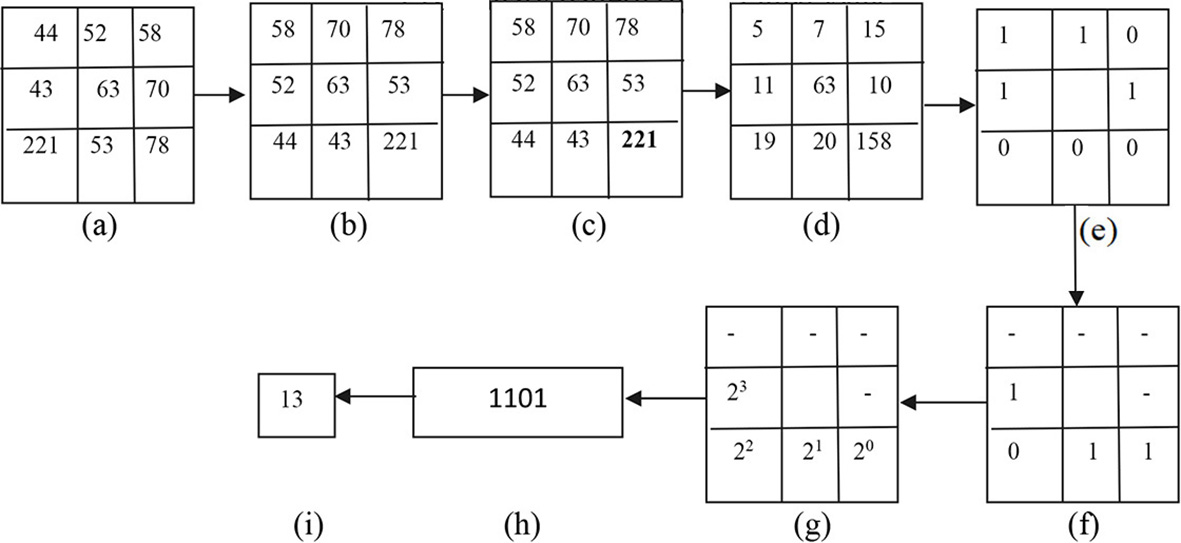
where
The decimal pattern for the block is obtained by multiplying the binary values obtained using the Eq. (4.1) with the weights. The weights are arranged based on the reference point
Pseudo code of the proposed LRIMDLBP Method.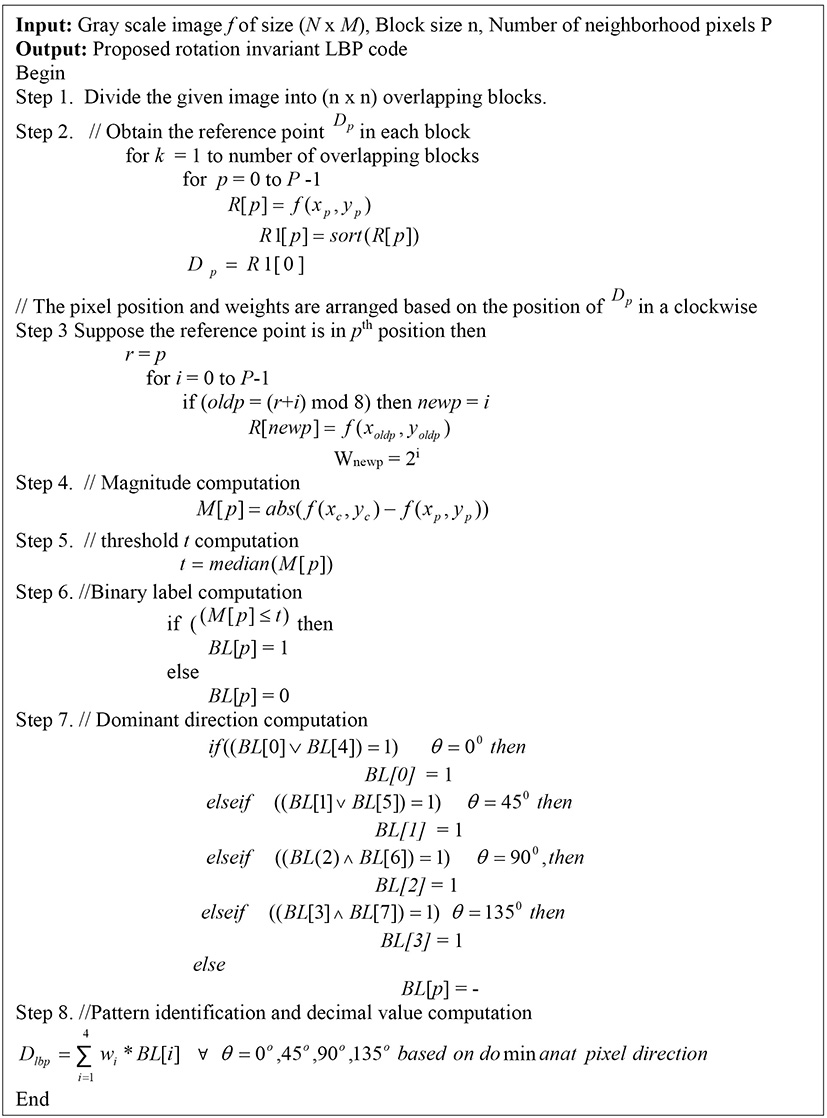
The proposed method LRIMDLBP is experimented with four dataset such as CUReT [31], Outex [32], KTH-TIPS [33] and UIUC [34]. It is implemented in windows environment using JDK10 and Scikit learn. The performance of the proposed method is measured with classification accuracy which is defined as number of images correctly classified by total number of images and is shown below:
where
During experimentation, the proposed method converts the input color image into gray scale image. In order to remove noise and retain the smoothness, the Gaussian filter is applied with the kernel size
where
The performance of the proposed method is measured with three different classifiers such as (i) k-Nearest Neighbor (k-NN), (ii) Support Vector Machine (SVM) and (iii) Ensemble classifier. The proposed method adapts a class of ensemble learning based on Gradient Boosting classifier. In boosting method, the base estimators are combined to produce a powerful ensemble which will address the bias issue effectively. Generally the accuracy of the classifier depends on parameters of the algorithm. The proposed method is implemented with four different dataset with three different classifiers. The same parameter set for a particular classifier is not suitable for all the four dataset. Hence the proposed method identifies the appropriate hyper parameter for each classifier with grid search method and to measure the accuracy of the model with 5 fold cross validation. The hyper parameter set used for tuning for each classifier is presented in Table 1.
Parameter set for k-NN, SVM and Gradient Boost classifiers for tuning
Classification accuracy of the three classifiers for the proposed LRIMDLBP method.
The classification accuracy of the classifiers for the four dataset is obtained and is shown in the Fig. 6. From the figure, it is evident that the gradient boosting performs well when compared to other classifiers and yields high classification accuracy for all the four dataset. The k-NN produces high classification accuracy such as 97.52%, 98.56% and 97.51% for CUReT, KTH-TIPS and UIUC dataset respectively when compared with SVM. The SVM and gradient boosting gives similar accuracy for the Outex and UIUC datasets.
The experiments are conducted with different neighborhood and radius values. The P, R values considered in this experiments are (8, 1) , (16, 2) and (24, 3). During experimentation it is observed that, the higher values of P, R yields less classification accuracy when compared with P
The Columbia-Utrecht (CUReT) [31] database contains 61 surface texture classes and each class posses 205 images with different illumination and viewing angles. Among 205 images from each class, we have considered only 92 images with less than
The experiments are conducted with different number of images in the training set. The number of images considered for training is 46, 26, 12 and 6 and the remaining images are for testing. The value of
Classification accuracy of the proposed and other methods for CUReT database
Classification accuracy of the proposed and other methods for CUReT database
The Outex [32] database contains 24 different classes of texture images which are captured under three different illuminations (“horizon”, “inca” and “t184”) and various rotation angles such as (
With these training images, the experiments are conducted based on the steps explained above. The classification accuracy of the proposed LRIMDLBP is presented in Table 3. The proposed method yields the classification result for the TC-10 and TC-12 dataset as 99.43% and 97.24% respectively for P
Classification result of the proposed and other methods for TC-10 and TC-12
Classification result of the proposed and other methods for TC-10 and TC-12
The KTH-TIPS [33] database is a challenging database, which contains 10 texture classes. The images are captured in nine different scales, three different poses and three illumination conditions resulting in 81 images per class. A random split applied on each class of texture images and obtained 40 images for training and the rest is for testing. Since the KTH-TIPS database is not rotation invariant, but for the proposed method rotates the image into
Classification accuracy of proposed and other methods for KTH-TIPS dataset
Classification accuracy of proposed and other methods for KTH-TIPS dataset
The UIUC [34] dataset has 25 classes of texture images, with each class containing 40 images. The database images undergone to different scale, rotation and illumination variations. The size of each image is (640
Classification Accuracy of proposed and other methods for UIUC dataset
Classification Accuracy of proposed and other methods for UIUC dataset
The dimensionality of the feature plays a vital role in the performance analysis. The methods consider above for performance analysis utilizes the rotation invariant uniform patterns. The experimental study proved that the non uniform patterns also significantly improve the classification accuracy so the proposed method utilizes both uniform and non-uniform patterns. Since the DRLBP [16] used a dictionary learning to select the appropriate patterns for classification, the original feature length is 256. The discriminative patterns are obtained by incorporating kd-Tree approach in scLBP [15] method. So the length of the features is dynamically varying with different dataset. The actual feature length of MLTP is 6561 for P
Dimensionality of feature (for P
In this paper, a novel texture descriptor called as Locality preserving Rotation Invariant Modified Directional Local Binary Pattern (LRIMDLBP) is proposed. The proposed descriptor utilizes the magnitude and adaptive sampling of the order of the pixel neighborhood to achieve contrast and locality preserving LBP. The proposed method also preserves the direction information in four dominant directions such as horizontal, vertical, diagonal and anti-diagonal directions resulting in less dimension of the texture feature. The rotation invariance is achieved by identifying the reference point in the local neighborhood. The experimental analysis of the proposed method is performed on four different dataset such as CUReT, Outex, KTS-TIPS and UIUC with three classifiers namely k-NN, SVM, and gradient boosting. The proposed method obtains better classification accuracy based on gradient boosting classifier when compared with other classical LBP variants. The proposed method is extended for color texture classification and other classification applications in future.