



Abstract
With the Indian economy growing rapidly, the rate of employment has seen a tremendous upward rise. The expansion of boundaries and the credible usage of internet have heightened the demands for highly skilled managers and professionals. An opinion poll of HR professionals from various countries reveals a unanimous view that rampant job hopping has become a culture across industries (Khatr, Chong & Budhwar, 2001: 54). A number of earlier studies suggest that the length of service in a job can be used to estimate the levels of worker job satisfaction. The assumption is that the less satisfied workers tend to resign while the more satisfied workers tend to remain in a job. This situation should result in a higher average level of satisfaction reported by employees who have been in a given organization for a greater period of time. Kim, Price Mueller & Watson (1996) Price and Mueller’s Model is a comprehensive employee turnover model which captures a 360 degree view of the determinants of employee turnover. It comprises of Individual determinants, Structural determinants, Environmental determinants, Process variables and correlates. In this paper, we initially studied the impact of age, salary and marital status of the correlates on structural and process determinants, and we further consider studying the moderating effect of eight variables of structural and two variables of process determinants in the Indian context by using Structural equation modeling.
Keywords
Introduction
One of the biggest challenges for the human resource professional is to retain its employees. Employee turnover has grown in complexity and many new theories and concepts have evolved over a period of time, beginning from March & Simon (1958), who believed that “under nearly all conditions the most accurate single predictor of labor turnover is the state of economy” (March & Simon, 1958. P. 100; Hom & Griffeth, 1995, P. 53). They also believed that enticements provided through an employer could influence employee job satisfaction and the desire to remain with the present employer as turnover theory and practice progressed. Price (1977) linked structural or organizational determinants to the turnover process. He suggested that employees develop activities to enhance job satisfaction rather than be dissatisfied, as employees are more likely to stay when job satisfaction outweighs dissatisfaction. Structural determinants play a vital role in creating job satisfaction and organizational commitment in employees. The author would like to study few co-relates such as Age, Cost to Company, Marital Status, Number of Companies Worked for, Years of Experience, and Number of Years in the same company and understand the impact of the same on structural determinants and process variables. In this paper we intend to study the moderating effect of six correlates on structural and process determinants in the Indian context.
Literature review
Employee turnover in organizations is a very serious issue; it is costly for organizations to search, select, train and replace leavers (Mobley, 1982; Price 1977; Staw, 1980). When low or average performers leave an organization it doesn’t create much of impact, whereas when high performers leave an organization, (especially those who are managers and professionals), this leaves a negative impact on the overall organizational effectiveness and firm success (Holtom, Mitchell, Lee & Inderrieden, 2005; Mitchell, Holtom, Lee, Sablynski & Erez, 2001). However literature review and analysis of the effects of employee turnover on companies is quite limited; most research on employee turnover in the past focuses on understanding and explaining employee turnover at individual levels (Griffeth, Hom & Gaertner, 2000; Hom & Griffeth, 2000; Hom & Griffeth, 1995; Mowday, Porter & Steers, 1982; Peterson 2004). Barrick & Zimmerman (2005) researched 1500 studies in the past 50 years on employee turnover. Most studies focused on understanding reasons for employee departure; few focused on what employers should do to hold people back, in order to increase stickiness in their organizations. Terborg and Lee (1984) were the first ones to stress that without the study of organizational determinants, the concepts of employee turnover would reduce understanding. They also questioned the existence of homology between functional relations found at the individual level of analysis and those that might exist at the organizational level of analysis. Among the most frequent causes of turnover in the European context is the status of employees in the typical organization. Turnover is negatively correlated & commitment is positively correlated to age, seniority (tenure), skill, job prestige, earnings, and chances of promotion. Women have higher turnover than men. Other determinants, which may themselves be a result of status in an organization, include job satisfaction, job challenge, job achievement, and cohesiveness with fellow employees. These determinants are again negatively correlated to turnover and positively related to commitment to an organization (Kerr 9147; Smith and Kerr, 1953; Silcock, 1954; Herzberg et al., 1957; Hedberg 1960; Hall and Schneider, 1972; Hrebiniak and Alutto, 1972; Buchanan, 1974). Although the relationship between pay and employee turnover has generated a tremendous amount of interest and research over the years, it has not been able to produce much interest in this area as most researchers have downplayed the importance of pay to turnover. Hom & Griffeth (1995) maintain that both employers and employees perceive pay playing a central role in turnover. Prevailing motivational theories have tended to emphasize intrinsic motivation, maintaining that lower needs are of lesser importance in modern society (Brief & Aldag, 1989). Research in management literature has generally underscored the limited role of pay, with findings indicating only modest associations between compensation and employee departure. Age has been found to be positively correlated with what has been defined as commitment, but its effect on structural determinants and individual determinants are not clearly mentioned (Hackett et al., 1994; Hrebiniak and Alutto, 1972, Meyer Allen and Smith 1993). With the Indian economy growing rapidly, the rate of employment has seen a tremendous upward rise. The expansion of boundaries and the credible usage of internet have heightened the demands for highly skilled managers and professionals. An opinion poll of HR professionals from various countries reveals a unanimous view that rampant job hopping has become a culture across industries (Khatr, Chong & Budhwar, 2001: 54). A number of earlier studies suggest that the length of service in a job could be used to estimate the levels of job satisfaction of workers. The assumption is that less satisfied workers tend to resign while more satisfied workers tend to remain in a job. Consistent with this thinking, a negative relationship between job satisfaction and turnover has been reported by several researchers (Atchinson and Lefferts, 1975; Karp et al., 1973; Locke, 1976; Mobley et al., 1979). This situation should result in a higher average level of satisfaction reported by employees whose have been in a given organization for a greater period of time.
The structural determinants under study have been taken from the Price and Mueller model (Kim, Price Mueller & Watson, 1996). In this model, Kim differentiated three types of determinants named as individual determinants, structural determinants, and environmental determinants. These in turn affect process variable, and correlates influences the determinants. The author in this study would like to understand the moderating effects of correlates (Age, Cost to Company, and Marital Status). A brief definition of structural determinants, process variable, and correlates are mentioned below.
Objective of the study
Impact of age on Structural and Process determinants. Impact of salary on Structural and Process determinants. Impact of marital status on Structural and Process determinants. Moderating effect of six correlates on structural and process determinants.
This research is based on primary and secondary data. Primary data was used in the form of questionnaires along with turnover interviews to understand reasoning. The turnover intentions questionnaire by Kim and Muller was used to collect data from the respondents.
Descriptive and inferential research was conducted with the help of a structured questionnaire. Employees from different industries were questioned and observed. Questions were framed using Likert Scale (five and seven point). The data is collected from binary solutions. Binary solutions are the biggest distribution of Dell, HP, and Lenovo in India. They also have a back office for client servicing. The survey sampled mainly consists of customer touch point employees. The data was collected from 386 employees.
The second company we picked was a large distributor for hardware products specialised in dealing computers and printers and allied hardware products with a national presence. 100% of the staff from the sales and customer service was administered. This company is one of the largest of its kind in the industry and caters to B2B Segment.
The third company we chose is service based. It is one of the world’s largest companies into managing customer Loyalty and Engagement programs. Their business is to manage back end for organisations into technology development and redemption and catalogue management. Their business has a very unique model as they Design, Develop, Co-create and implement Loyalty and Engagement solution to enhance business productivity and create satisfaction. There are more than 90 customers facing staff in the organisation, however, 84 officially participated in the survey with 100% accuracy and completion.
The fourth company is an emerging leader in the Automobile sector and is part of a big automobile giant. It manufactures and sells two wheelers in the Indian Market. Its model consists of a 60 odd dealership across India managed by 100 odd people. The questionnaire was sent to all 103 officials, however only 83 participated and returned 100% completed data.
All four companies were from different sectors and verticals in their industries. They were selected due to ease in assessing the employee data for administration of the questionnaire. The sales and marketing team was very cooperative, and the data was collected from the companies over one and a half years. The questionnaire was administered through pen and paper for the Software Company and for the other three companies; it was administered through survey portal survey monkey.com. The sample selected is convenient sampling.
Impact of age on structural and process determinants
Structural determinants
From the above table, we concluded that at 95% level of significance the null hypothesis is rejected for all factors of structural determinants. As an alternative hypothesis accepted, this means that age is dependent on all variables of Structural determinants. So further, we have to find out which age group perception was more or less for that we would use descriptive statistics. From the descriptive statistics, we concluded that the employees of older age groups have negative perceptions for the variables of structural determinants such as autonomy, distributive justice, job stress, promotional growth, routinization and social support as compared to younger age groups.
There is no significant relationship between age and turnover intentions. At any age people may tend to leave jobs or may not leave jobs based on structural determinants and process determinants.
Process determinants
From the above table, we concluded that at 95% level of significance the null hypothesis rejected for all factors of process determinants. As alternative hypothesis accepted, this means age is dependent on all variables of process determinants. When we try to relate the age group of managers to structural determinants it was found that the reasons for youngsters quit were lack of professional growth, autonomy and distributive justice; for the elders, reasons included promotional chances, routinization and social support were also the reasons for turnover intentions. The young managers are still keen to work and variables like promotional chances, routinization and social support are a few of the reasons. They are also able to positively cope with the job stress component.
Structural determinants
From the above table, we concluded that at 95% level of significance the null hypothesis is rejected for all factors except professional growth of structural determinants. As the alternative hypothesis accepted, this means the salary of an employee is dependent on all the variables of Structural determinants except professional growth.
Process determinants
From the above table, we conclude that at 95% level of significance the null hypothesis is rejected for all the factors of process determinants. As the alternative hypothesis accepted, this means that income is dependent on all the variables of process determinants. Therefore, we further have to find out which age group perception was more or less for that we will use descriptive statistics. From the descriptive statistics, we conclude that employees of the lower income group have adverse perception towards the variables of process determinants such as job satisfaction and organization commitment as compared to medium and high-income group. Therefore, the organization should concentrate on the lower income group.
Structural determinants
From the above table, we conclude that at 95% level of significance the null hypothesis is rejected for all factors except professional growth of structural determinants. As the alternative hypothesis accepted, this means that marital status of the employee is dependent of all variables of Structural determinants except professional growth. We can therefore conclude that the married and unmarried group perceptions were the same for professional growth. So we further have to find out which group perception was more or less; for this we will use descriptive statistics for the remaining factors. From the descriptive statistics, we conclude that employees of the married status group have a greater positive perception towards factors such as autonomy, job stress, promotional chances, routinization and social support whereas for distributive justice is higher in unmarried status group.
From the above table, we conclude that at 95% level of significance the null hypothesis is rejected for all the factors of process determinants. As the alternative hypothesis accepted, this means marital status is dependent on all variables of process determinants. So we further have to find out which age group perception was more or less; for that we will use descriptive statistics. From the descriptive statistics, it is observed that in the unmarried status group the perception of job satisfaction and organization commitment is greater compared to the married status group. So we can conclude that married employees are more satisfied with their job and are more committed towards their organization.
Model evaluation or testing. CFA model can be evaluated on basis of two major aspects (Hair et al. 1998): Overall goodness of fit. The interpretability, size and statistical significance of the model parameter estimates. The model is shown in Fig. 1.
Hair et al. (1998) argued that there was not yet consensus among scholars regarding the standard of the goodness of fit test. Thus, he suggested that researchers pick any one or two indices to evaluate the goodness of fit towards the model. In this research, the results have shown overall significant values of goodness of fit to accept the proposed model. The Goodness of fit test which indicates Chi Square value is 96; and sig. value is 0.468. Hence lower the chi square value, better the model, sig. value is
The model fit the data perfectly, since the estimation of this model required precisely at all degrees of freedom that was available. The completely standardized parameter estimates of this model are shown in the above table.
Results of the model.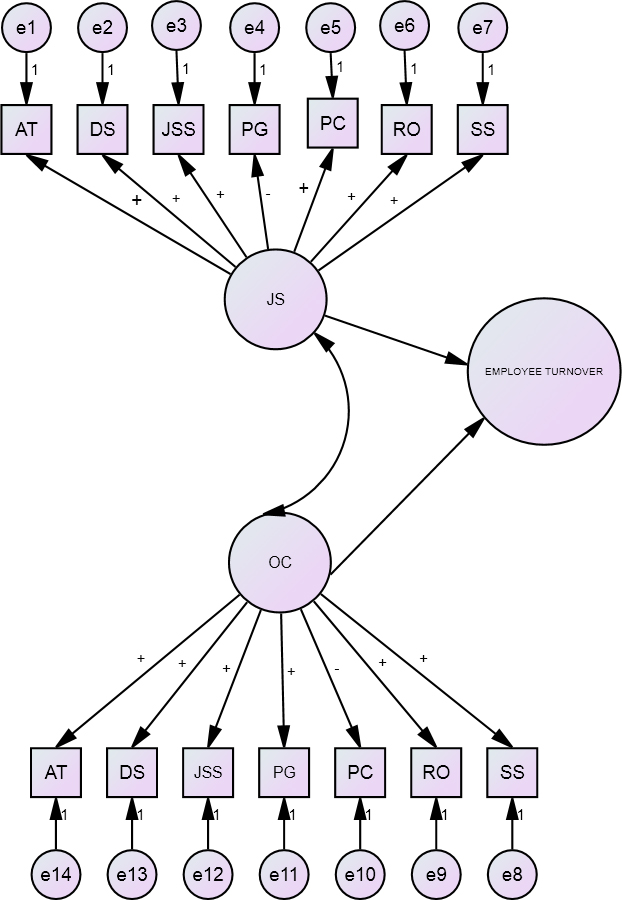
The above table shows the standard regression weights of the latent variables manifesting the construct overall job satisfaction and organization commitment. These regression weights represent the degree of association between the construct and manifesting variables. For example, if overall job satisfaction increases by 1 standard deviation, the standard deviation of autonomy, Distributive Justice, Job Stress, Promotional Chances, Routinization, Social Support and Professional Growth will increase by 0.42, 0.39, 0.31, 0.34, 0.25, 0.14 and 0.113 respectively. Similarly, if organization commitment increases by 1 standard deviation, the standard deviation of autonomy, Distributive Justice, Job Stress, Promotional Chances, Routinization, Social Support and Professional Growth will increase by 0.22, 0.22, 0.47,
Critical ratio is similar to
Completely standardized parameters estimates and completely standardized parameters for the moderating effect of job satisfaction and organization commitment with employee turnover
Employee turnover is a very complex, unstructured, nonlinear and dynamic phenomena. Organizations spend huge amounts of time, money and effort to retain talented employees for success of their business, however till today researchers have been unable to completely decode the process of turnover. This study is an attempt to conduct a multilevel investigation of determinants of employee turnover in Indian organizations. The structural modeling findings further state that there is a negative correlation between professional growth and job satisfaction. The findings state that an organization needs to work on framing proper policies of promotion; as a result, the chances of employee turnover will reduce. Promotional policy will also have a positive impact on organization commitment. Job satisfaction and job commitment are the most important variables for reduction in employee turnover. There is close relationship between job satisfaction and organization commitment and vice versa.
From the findings employees of the older age group negatively perceive attributes such as autonomy, distributive justice, job stress, promotional chances, routinization and social support as compared to the younger age group. Employees in the older age group are dissatisfied with their jobs and lack commitment to their organization. Empowerment policies, freedom to take decisions and proper reward managements will help reduce employee turnover.
Income of the employee is dependent on all variables of structural determinants except professional growth. We can conclude that the chances provided by an employer to increase job-related knowledge and skills for different income groups i.e. lower, medium and higher are the same. For the attributes autonomy, distributive justice, job stress, promotional chances, routinization and social support the perception of higher income is positive as compared to the medium income group. So the higher income groups are more satisfied with their jobs and they are more committed towards the organization; the organization, however, should think about innovative practices to design right compensation policies to increase job satisfaction amongst employees.
Married employees have greater positive perception towards factors such as autonomy, job stress, promotional chances, routinization and social support whereas distributive justice is greater in the unmarried status group.
There is a significant relationship between the variables i.e. autonomy followed by distributive justice, promotional chances, job stress routinization and social support of structural determinates on process variable i.e. job satisfaction. Finally, there is a significant relationship between the variables i.e. autonomy followed by distributive justice, job stress routinization and social support of structural determinates on process variable i.e. organization commitment.