



Abstract
In this paper, the authors propose the SIR deterministic model of political fanaticism figure to understand the spread of voters in a population. The dynamics of the model involving ordinary differential equations of three class of voters; susceptible voters
Keywords
Introduction
The first general elections (PEMILU) in Indonesia was held in 1955. The elections is indirect elections because voters elect the political parties, which then elects the president. The president is elected for a five-year term. The voters are Indonesian citizens and the minimum voting age is 17; however, persons under 17 who are married at the time of registration are allowed to vote. Direct general elections has been held twice in Indonesia, which are in 2004 and 2009. The third direct Indonesian presidential elections already being held in July 9, 2014.
Candidates for president will be nominated as individuals (along with a vice-presidential running partner). However, support from the main political parties are likely to play a key role in influencing the result. Partly for this reason, the highly changeable map of political parties in Indonesia contributes to the uncertainty of political trends during 2013 and into 2014 in the run-up to the presidential elections. In recent years, the number of political parties contesting major elections (both elections for the national and regional parliaments, and the presidential elections) has varied considerably. In 2004, 24 parties contested the national elections and 16 secured enough seats to be represented in the national parliament. In 2009, 38 parties contested the national elections and 9 secured enough seats to be represented in the national parliament. In 2014, 11 parties contested the national elections.
Only two candidates will compete in Indonesian presidential elections 2014, Joko Widodo and Prabowo Subianto. Joko Widodo supported by Indonesian Democratic Party of Struggle (PDI-P) and the coalition parties, such as National Democratic Party (NASDEM), National Awakening Party (PKB), People’s Conscience Party (HANURA), and Indonesian Justice and Unity Party (PKPI), while Prabowo Subianto supported by Great Indonesia Movement Party (GERINDRA) and the coalition parties, such as Prosperous Justice Party (PKS), Party of the Functional Groups (GOLKAR), Democratic Party (PD), National Mandate Party (PAN), and United Development Party (PPP). It is expected that candidates for president who hope to mount an effective campaign will need to secure the support of at least one of the major parties as well as several other smaller parties.
Mathematical models have been widely used in various areas, for example in physics and engineering by Strogatz (2001), in economics by Tu (1992), in biology such as MERS-CoV cases by Yong and Owen (2016) and dengue cases by Yong and Chin (2017). Mathematical modelling is the use of mathematics to describe real-world phenomena, investigate important questions about the observed world, explain real-world phenomena, and make predictions about the real world. Mathematical models are used for comparing, planning, implementing, evaluating, optimizing various detection, and control programs. There is no best model, only better models.
The presidential candidates who will be standing in elections should try to get as much support among the voters. The problem is what kind of mathematical model which can explain a situation that describes it. Many studies focus on political parties for knowing the dynamical change of voters, for example in study by Khan (2000) and Peterson (1991). Currently, there is no study focus on political fanaticism figure for knowing the dynamical spread of voters of political figure. In some countries with a direct presidential elections like in America and Indonesia, a political figure is one of the most important things must be considered by political parties, because the political figure can convince people to choose the political figure such that the political figure has the highest level of position in the elections.
Many dynamical social phenomenon may be modelled by using the epidemiological type differential equations (Brauer & Castillo-Chavez, 2001). During the elections, the political figures or party members convince the persons to vote the political figures so it is more appropriate to use epidemic approach in the modeling process of the political figures. It has similar property to infectious disease, such as rapid rate of transmission in large population. The political figures or party members also appeal to the voters to choose their candidate. By using epidemiological approach, the study of Khan (2000) and Peterson (1991) was limited and main focus has been given only to the multiparty political system. In the present study, the model of a political fanaticism figure for the spread of voters in Indonesian elections will be constructed using epidemiological approach, following the SIR compartmental model. We assume that individuals of voters class are susceptible to political figure, like in SIR epidemic model, where one susceptible class, one infective class, and one recovered class have been considered. The SIR epidemic model is a compartmental model based on relatively simple assumptions on the rates of flow between different classes of members of the population. To formulate our model, we have to make assumptions to simplify reality. The following characteristics/assumptions of the model appropriate to SIR epidemic model (Brauer & Castillo-Chavez, 2001):
The total population size remains constant. In our model, the total voters is constant. The individuals are born into the susceptible class. In our model, new voters enter into the susceptible voters class. The infected individuals are also infectious and able to spread the disease by contact with susceptible. In our model, the susceptible voters can become “infected” through contact with individuals infected by political figure. Infected individuals spread the disease to susceptible, and remain in the infected class before moving into the recovered class. In our model, infected voters can move into the recovered voters class because of boredom of the political figure. The individuals in the recovered class are assumed to be immune for life. In our model, the individuals in the recovered voters class cannot move into the susceptible voters class. It cannot make the recovered voters open to infection again. The population size is large enough to take care of the fluctuations in the spread of the disease. In our model, the total voters size is large and it is assumed that the transmission mechanism of political figure is the same as infectious diseases. We assumed that each voter experiences frequent and constant media exposure and it is also assumed that the transmission rate which are depend on proportion of media exposure and the number of media events remains constant over time.
We use survey from Litbang KOMPAS and social media counter for determining the initial values of each compartment and estimating the parameter values. The stability of equilibrium points that exist in the model will be analyzed. Basic reproductive number also will be determined. From simulation, the performance of political figures will be compared each other so that political parties can determine the next strategy for their candidates to reach the maximum voters.
In this section, we propose a basic compartmental (deterministic) model to understand the spread of voters in political fanaticism figure in a population. The dynamics of the political figure voters is studied by a SIR compartmental model involving ordinary differential equations of three class of voters; susceptible voters
Figure 1 describes the transitions of individuals from
The SIR transmission model for the spread of political fanaticism figure voters can be mathematically described by the following differential equations:
The domain of the model Eq. (1) is
Initial values of the SIR political fanaticism figure voters model based on 2014 Indonesian presidential elections
The SIR political fanaticism figure voters model.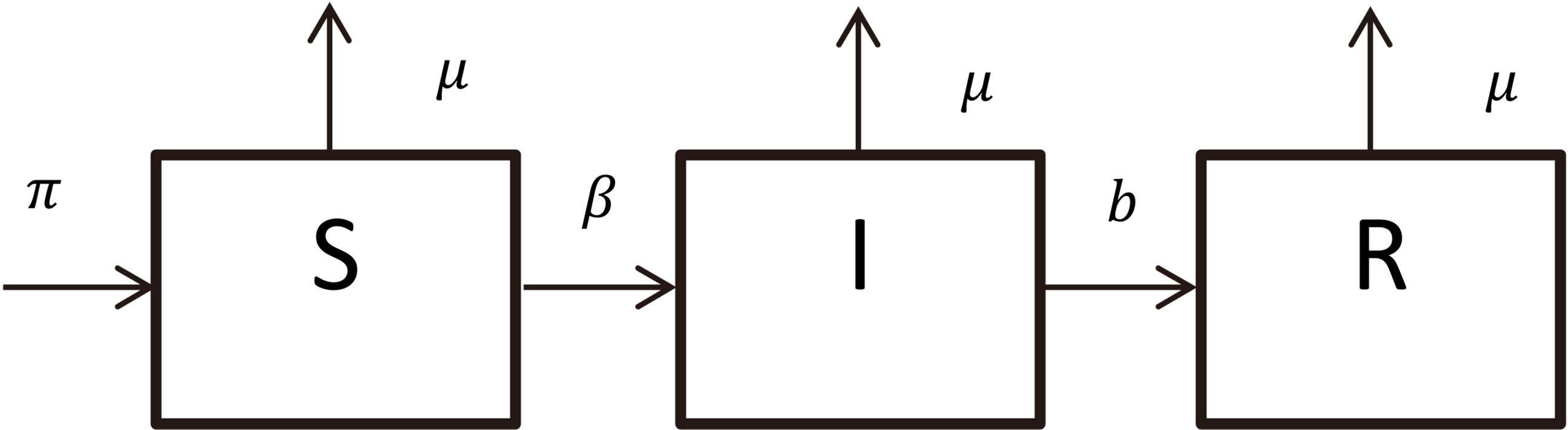
The General Election Commission released the total voters for Indonesian presidential elections in 2014 is 186,610,000 people (KPU, 2014) and it is a fixed value. Many institutions take the survey before elections to help identify likely voters. First survey by Litbang KOMPAS from November 26, 2012 to December 11, 2012, Prabowo-Hatta had a popularity rating of 13.3% with Jokowi-Kalla on 17.7%. Second survey by Litbang KOMPAS from Mei 30, 2013 to June 14, 2013, Jokowi-Kalla leads the race with 32.5% compared to Prabowo-Hatta’s electability of 15.1%. These surveys, drawn from a total 1380 to 1400 respondents from 34 provinces in Indonesia, had a margin of error of about 2.6% (Auliani, 2014). According to these surveys, the average infected voters of Prabowo-Hatta is 14.2% or 26,498,620 people and the average infected voters of Jokowi-Kalla is 25.1% or 46,839,110 people. The parameter values for model are presented in Table 2 below and we assume 1 year is 365 days.
Parameter values of the SIR political fanaticism figure voters model based on 2014 Indonesian presidential elections
The requirement of the voters at least 17 years old and many people above 75 years old lose their interest in politics because of age and health problems. With these reasons, we assume that persons are involved in politics only between the age of 17–75 years old, thus we may take the ratio of number voters with 17–75 age with total population is
Consider the following transformations:
with
Equilibrium of system Eq. (2) can be solved by letting the right hand side of each of the equations equal zero, so that the possible equilibrium of the system are
If
In this section, the numerical solutions for model are shown using the parameters and initial conditions as presented in Tables 1 and 2. Figs 2a, 3a and 4a show the dynamics of SIR model for Prabowo-Hatta while Figs 2b, 3b and 4b show the dynamics of SIR model for Jokowi-Kalla.
The dynamics of the SIR political fanaticism figure voters model with 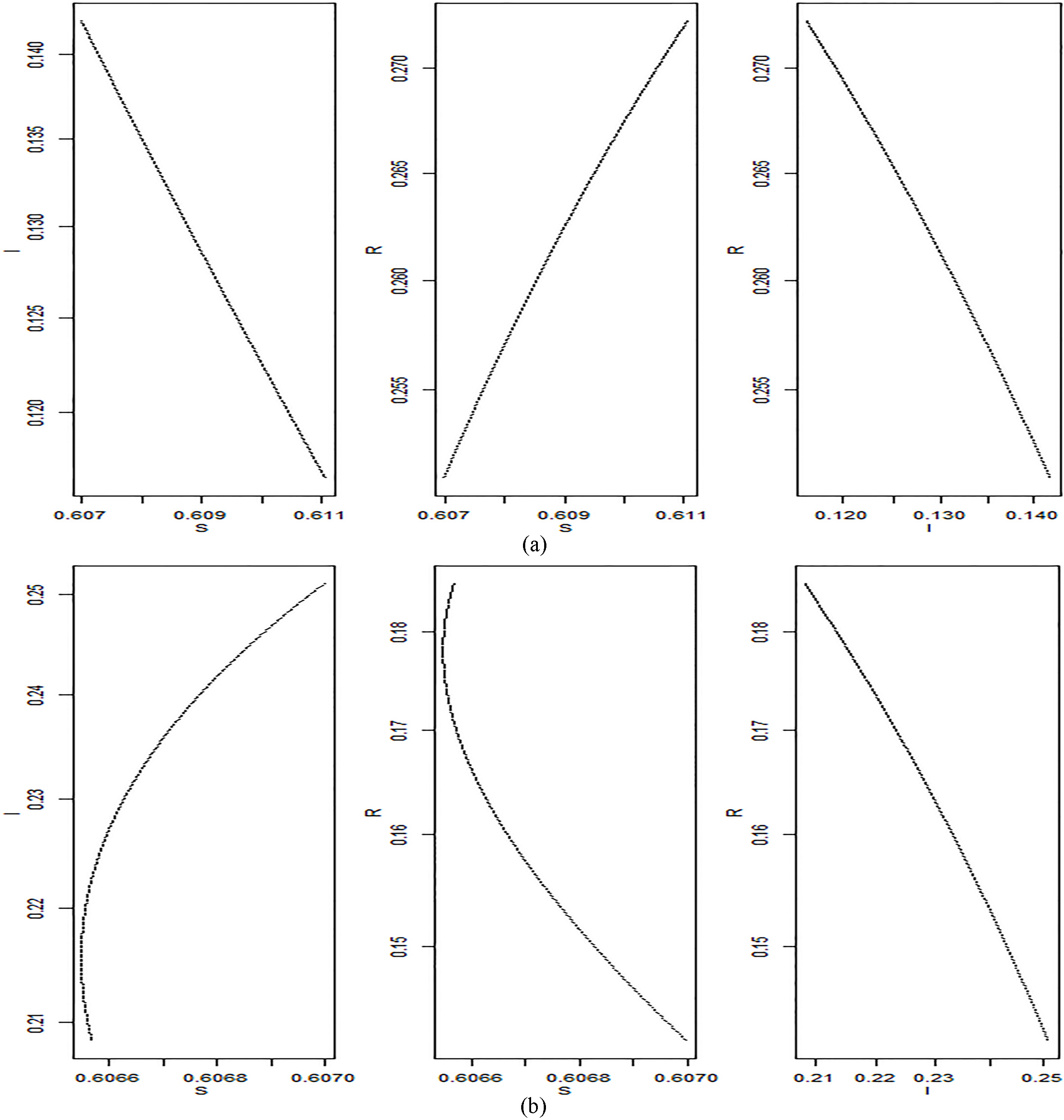
The dynamics of the SIR political fanaticism figure voters model with 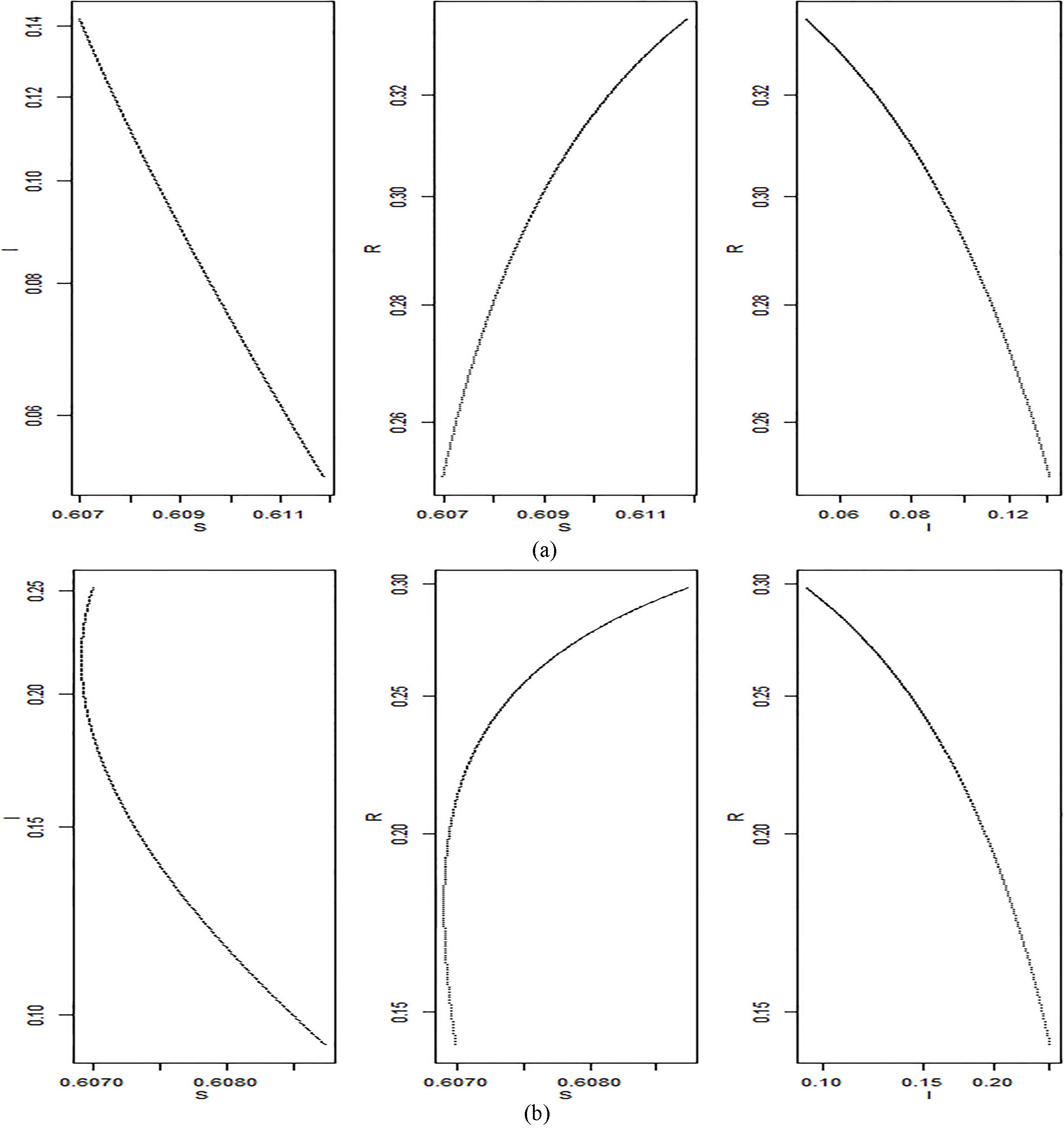
Figure 2a shows that for
Figure 3a shows that for
Percentage number of voters from the SIR political fanaticism figure voters model for each scenario
The dynamics of the SIR political fanaticism figure voters model with 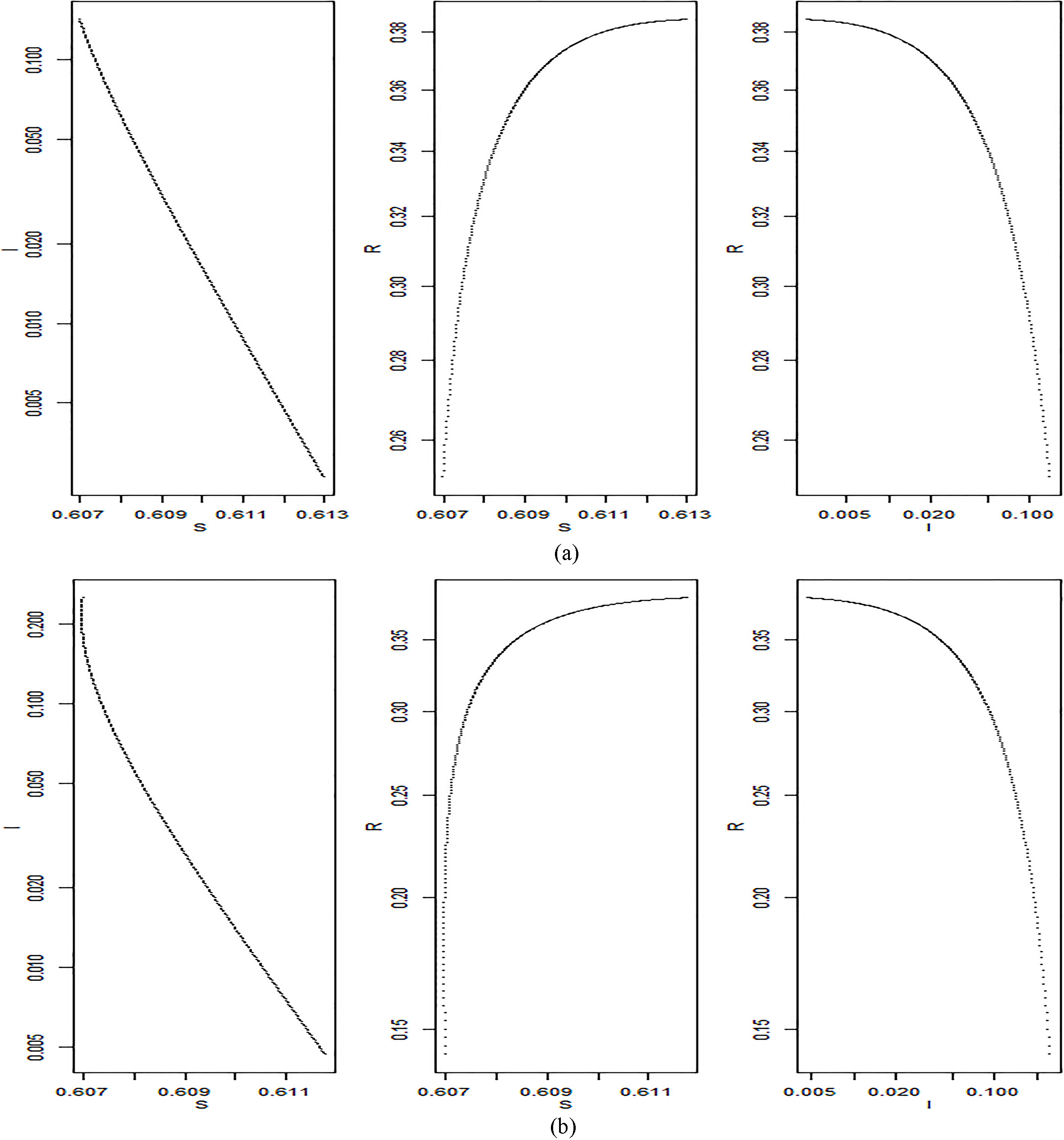
Figure 4a shows that for
From Figs 2 and 3, and Table 3, it can be confirmed numerically that the higher the boredom rate, the lower number of infected voters. A higher rate of boredom can affect voters significantly to not choose the political figure.
In this paper, we applied a simple deterministic model for the spread of voters in political fanaticism figure using epidemiological approach to the 2014 Indonesian presidential elections. The model of political fanaticism figure voters is studied through SIR transmission model approach. The basic reproductive number is found to classify the stability property of each equilibrium state. From numerical results, we conclude that if basic reproductive number less than one, population is free from political fanaticism figure voters, otherwise if basic reproductive number greater than one, there will be an endemic in the population. The dynamical behavior of each population for both conditions of the basic reproductive number have been presented in this paper. It also can be seen that when there is the higher boredom rate between voters population, the infected voters by political figures will decrease faster. The time dependent rate and the stochastic model could be applied for further research.
Footnotes
Acknowledgments
The authors would like to thank the anonymous reviewers for their valuable comments and suggestions to improve the quality of the paper.