



Abstract
The emergence of idols in music industries, especially recently in South Korea, has led to an increase in the number of fans from around the world, especially among teenagers. The popularity of these idols is also due to the influence of social media reporting on their performances, way of life and daily activities, which covers both positive and negative news. In this research, we develop mathematical models to analyze the impact of media on the idols’ popularity using a statistical approach. To apply the models, we collect data from Google Trends for searching statistics graphs that display the popularity of the Korean idols BTS and EXO, and the American idols Taylor Swift and Selena Gomez. We observe the effect of negative and positive news on the popularity of these Eastern and Western idols. It was expected that positive news would increase the number of fanatical fans while negative news would make the fans become bored with the idol quickly. The results show that negative news about Korean idols can reduce their popularity, but on the contrary, negative news about the American idols does not affect their popularity.
Introduction
Being an idol has become a dream for many people, especially for teenagers, since they can perform and also entertain others with their talents. Moreover, by becoming entertainers they can earn a high income and gain popularity. There are many television programs broadcasting talent scout events, such as American Idol, the Voice, Britain’s Got Talent, K-POP Star and others. These talent shows give publicity to the participants. We know that almost all countries have their own talent shows. We observe this phenomenon in America, as representing part of the Western population, and in Korea, representing the Eastern population. The popularity of an idol is not only determined by his/her achievements but also by other factors, for instance, frequent appearances in the news and social media. In this work, we observe the impacts of social media via YouTube videos and Twitter data, which can be represented by hit counts in Google Trends. The data is dynamic and fans and non-fans can comment to support or criticize the news on idols. In a social media platform, anyone can give opinions and thoughts that can be read by everyone.
In 2010, Kaplan and Haenlein stated that social media is defined as an Internet-based application that is built on the ideology and technology of Web 2.0. It enables the creation and exchange of user-generated content (BTS & EXO, 2020). Nowadays, social media is very diverse and content can be easily created by everyone using their accounts. It can be accessed anytime and anywhere via the internet network. Currently, the number of total active users of social media has reached 2.3 billion (Ishii et al., 2012). Through social media, many people can exchange information and be connected (Ishii et al., 2018); consequently, news about idols and favorite singers can spread more quickly than with paper-based media. Table 1 shows the five social networking sites that have the most members.
Numbers of social media users
Numbers of social media users
The easiest way to show your talent and hopefully to become famous because of it, is to create YouTube videos featuring yourself singing famous songs or performing your favorite dances. Many popular music idols, such as Justin Bieber, David Choi, and Ariana Grande, started to get attention from the music industry due to their YouTube videos and now they have become successful singers. For many idols, social media is also a medium to communicate with fans. Idols can share their thoughts and activities with fans by uploading photos on Instagram, creating a vlog on YouTube, sharing their voice records on Snapchat, and in many more ways. The more frequent the stories, news and information about the idol, the more people talk about that idol. Furthermore, a music idol possibly has his/her own musical genre. Idols from the United States mostly have music genres such as pop, RnB, and country music. A popular idol has his/her own fan base, for example Taylor Swift has a fan base named the Swifties, and Selena Gomez has a fan base named Selenator.
A similar phenomenon is also happening for Korean idols. Having different characteristics from American idols, most have the ability to sing, dance and rap at once. They produce good music videos and have a wide spectrum of genres. Nowadays, K-Pop, which stands for Korean Pop, is popular not only in Asia but also worldwide. Two Korean idols, BTS with a fan base called ARMY, and EXO with a fan base called EXO-L, usually perform dancing, singing and rapping, and also have excellent choreography and wear attractive fashions.
Thanks to massive publicity of this industry, idol fever has become an “epidemic” where individuals suffer through having an excessive obsession with their idols (Bailey, 2019). Generally, the majority of fans are youngsters and have difficulty controlling themselves. It shows through their exaggerated actions, such as wasting time continuously in searching for information about their idols, viewing photos of their idol, watching their idol’s activity on vlogs, and listening to music on their idol’s YouTube channel. Fans are also very loyal to their idol, demonstrated by collecting the idol’s music albums, buying expensive concert tickets, purchasing items related to their idols, etc. Those kinds of actions can classified as symptoms of the idol fever that has broken out among young people. Bieber fever is an example, since a lot of young people around the world are idolizing him (Bailey, 2019). Moreover, there are Korean waves of idol fever that have hit almost everywhere in the world. BTS received the best media social award in the Billboard Awards for the last three years and a Grammy Award this year.
The mathematical model is a powerful tool that can be used to analyze the dynamics of the impact of the massive development of social media on the entertainment industry throughout the world. Some research papers have discussed the problem of predicting the popularity of idols using differential equations, for example Tweedle and Smith discussed the mathematical model for Bieber Fever (Bailey, 2019). Nika proposed a mathematical approach to predict the spread of celebrity (Idol, 2019). Ishii et al. discussed a mathematical model for the ‘hit’ phenomenon in entertainment within a society is presented as a stochastic process of human dynamics interactions (Rosabel et al., 2016). Ishii and Kawahata analyzed the dynamics of the number of social media posts for movies, events, and a YouTube movie using the established models of sociophysics (Tweedle et al., 2012). Ma et al. used mechanistic modelling of viral spreading on popularity prediction (Wahid-Ul-Ashraf 2019). Wahid-Ul-Ashraf et al. proposed physics-inspired approach to predict social relationship to link prediction in social network.
In this paper we discuss the trend of idol popularity and examine the specific impact of good and bad news that is spread through social media. To see this impact, a dynamic comparison is made for Selena Gomez and Taylor Swift cases, from the Western world, and also BTS and EXO from the Eastern world. We observe the number of hits due to positive and negative news from the data through Gradient Slope Analysis at each point along with collected data from 2015 to 2019.
In Section 2 the statistical model approach is presented, Section 3 will provide results and analysis, and we conclude with comments and discussion in the last section.
It is assumed that the collected data from websites represents the popularity of idols. We assume the data follows the Poisson distribution and that large counts are rare. This assumption makes sense, since the data from the Google Trends website range from 0–100. In this work, we use Poisson regression to generate a general model of an idol’s popularity.
In Poisson regression, the incidence rate
Usually, the value of
One method to find the estimated values is Maximum Likelihood Estimation. In this work, we use SPSS software to estimate the values of unknown parameters.
The statistical method introduced above is applied to data from the Google Trends website. The data represents the weekly popularity of the selected idols, Selena Gomez, Taylor Swift, BTS, and EXO, from early 2015 until late 2019. Data is divided into training data that will be implemented into the statistical methods, and test data that will be used to validate the model. A good model will show small regression errors between test data and values from the obtained models. This means the model can predict a near future value with small regression errors.
Weekly popularity values range from 0 to 100. From early 2015 until late 2019, there are 260 recorded elements of data. The first 208 elements become the training data, and the remainder are the test data.
The 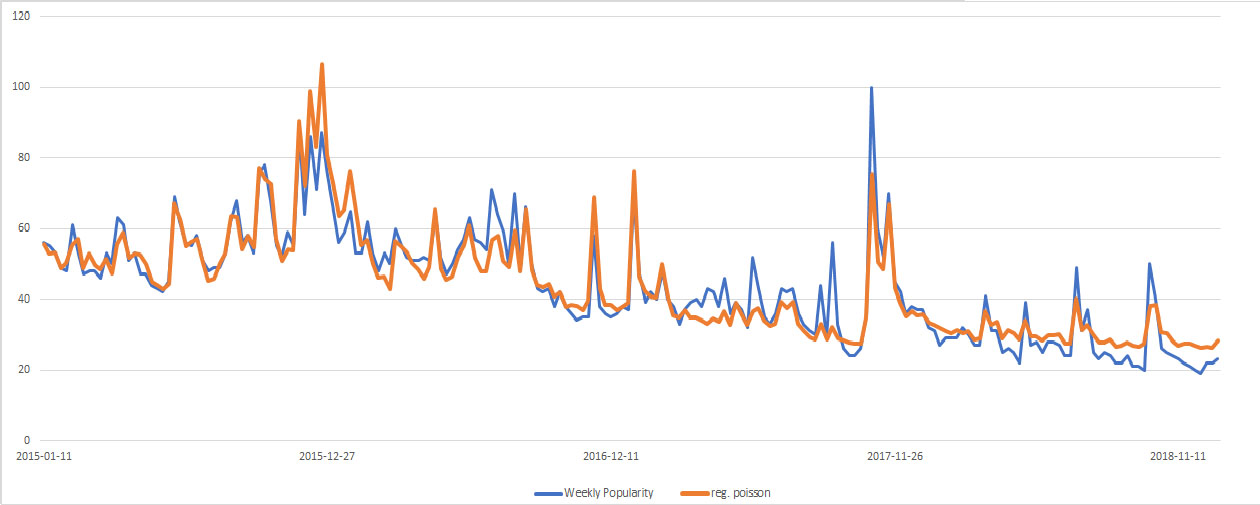
Let
Selena gomez popularity
Figure 1 depicts the values from the obtained model from Poisson regression compared to the real data of the weekly popularity of Selena Gomez. The regression equation is given as follows
where
Using the Curve-Fitting method, we now construct a model of the idol’s popularity represented by web search
with
with
The 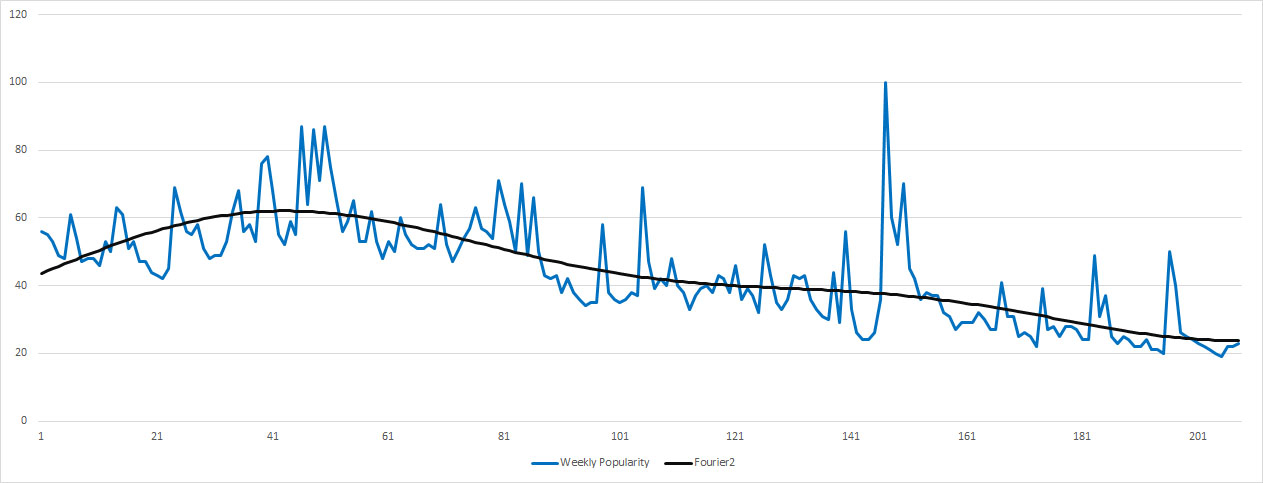
The 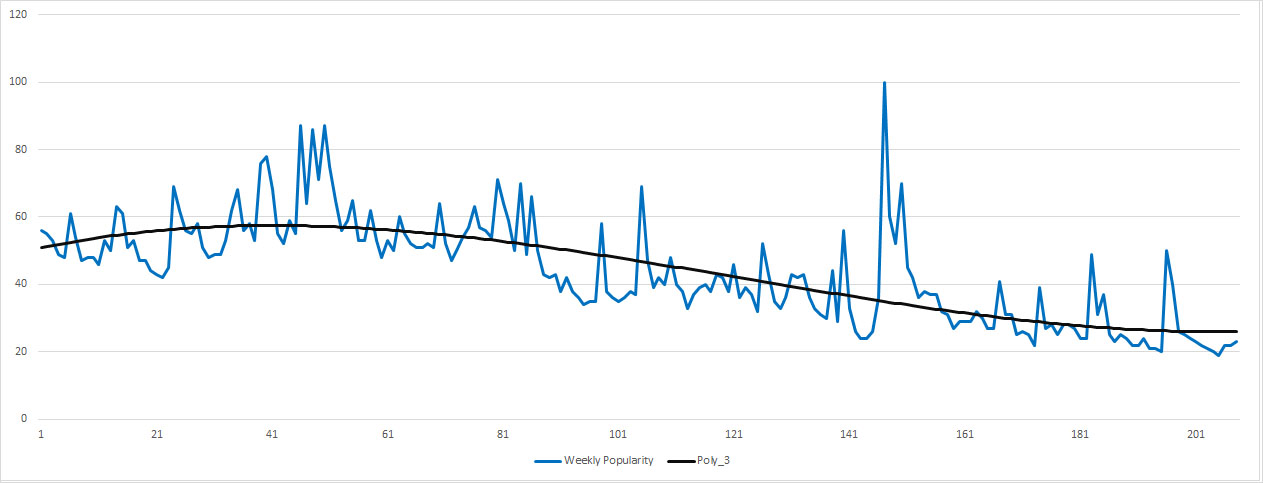
Figure 4 depicts the values from the obtained model from Poisson regression compared to the real data of the weekly popularity of Taylor Swift. The regression equation is given as follows
The 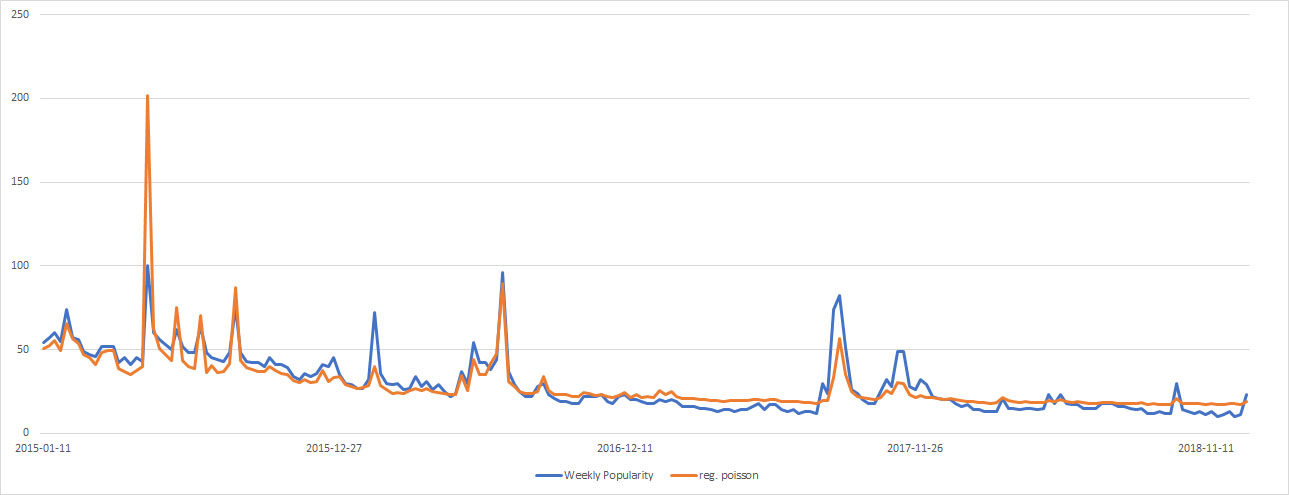
The 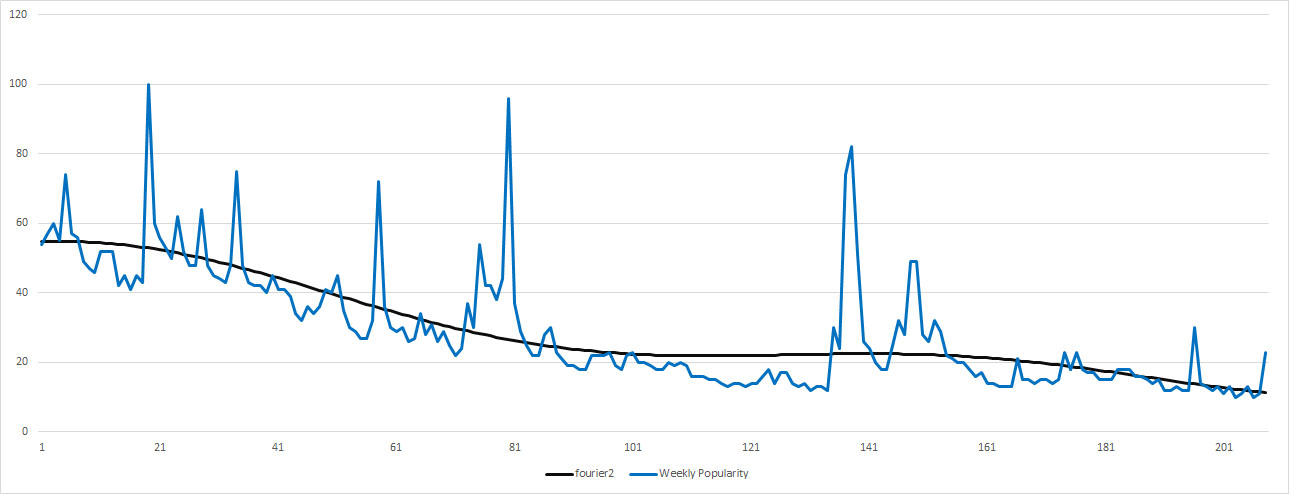
The 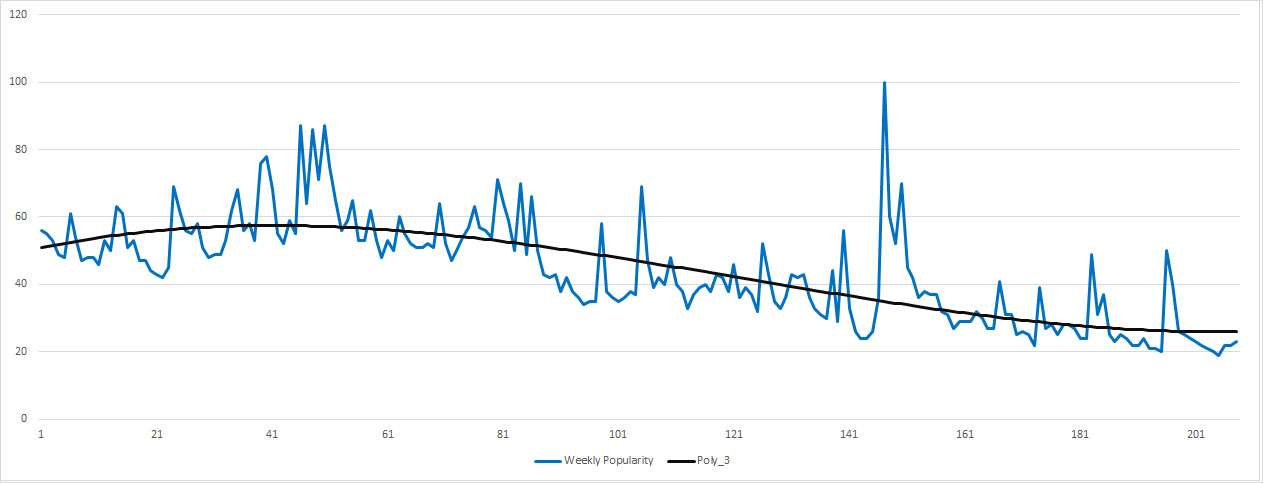
Similar to the previous section, we construct the model of popularity
with
Figure 6 depicts the regression for Taylor Swift using a two-term exponential which is given by
with
The 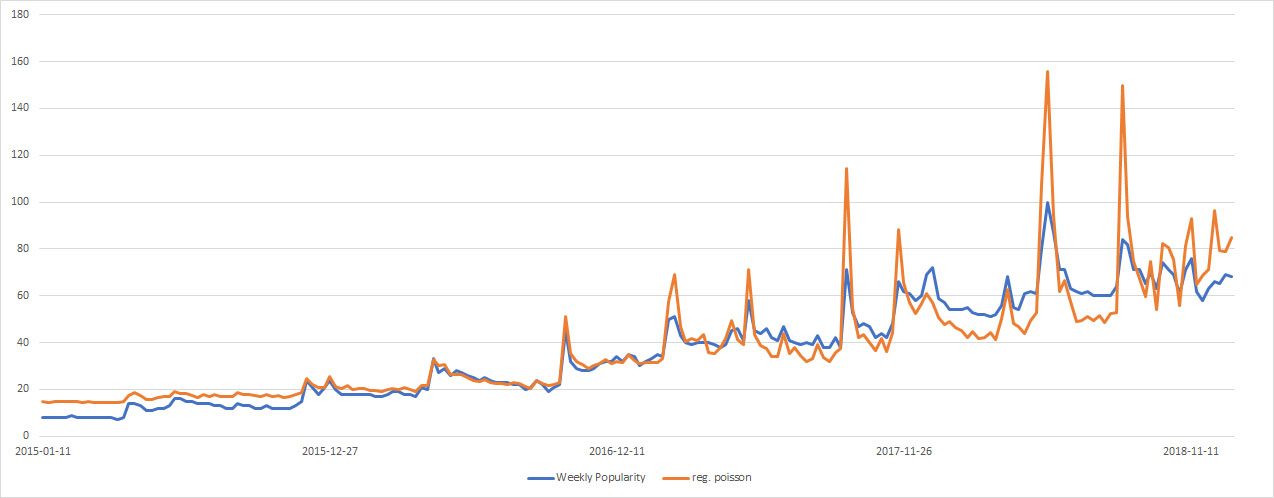
The 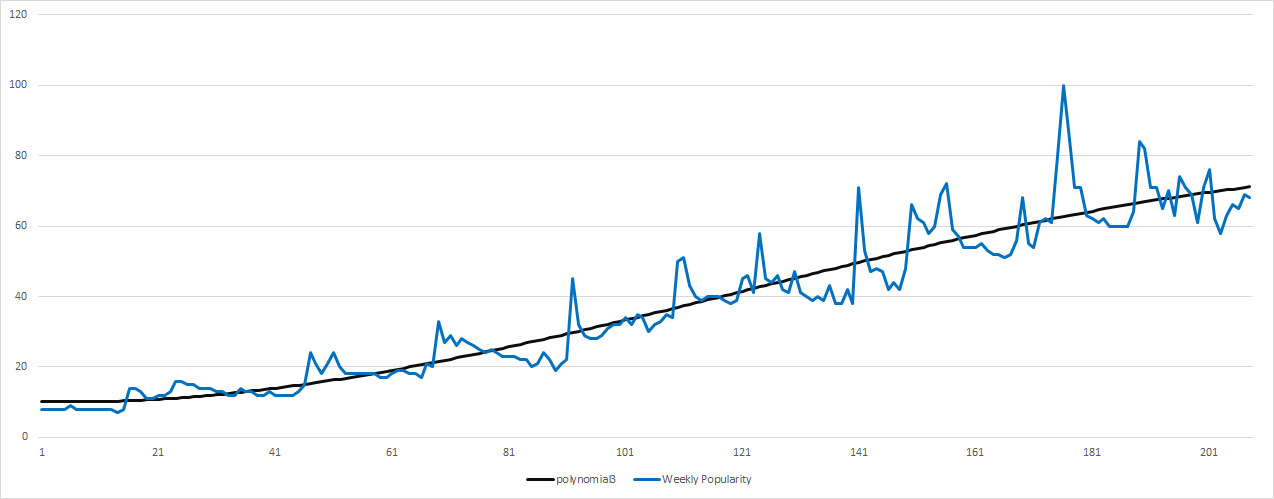
The 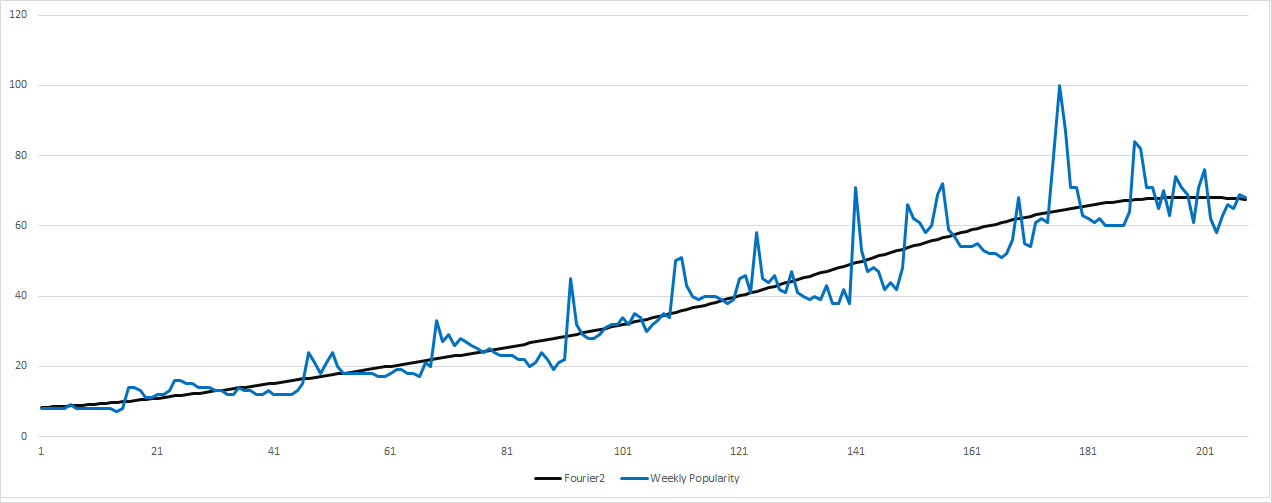
Figure 7 depicts the comparison between the Poisson regression model and the real data of the weekly popularity of BTS. The regression equation is given as follows
A curve-fitting model for the popularity of BTS is shown in Figs 8 and 9. The regression model by the third degree polynomial is given as:
and the regression model using the second-degree Fourier is given by
with
Figure 10 depicts the graphs from the Poisson regression model and the real data on the weekly popularity of EXO. The regression equation is given as follows
The 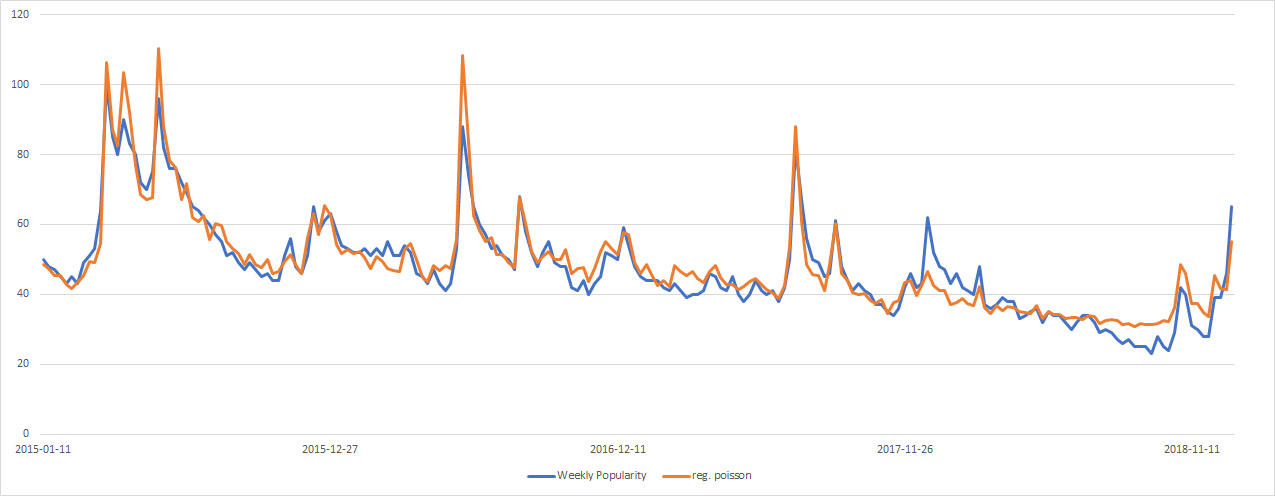
The 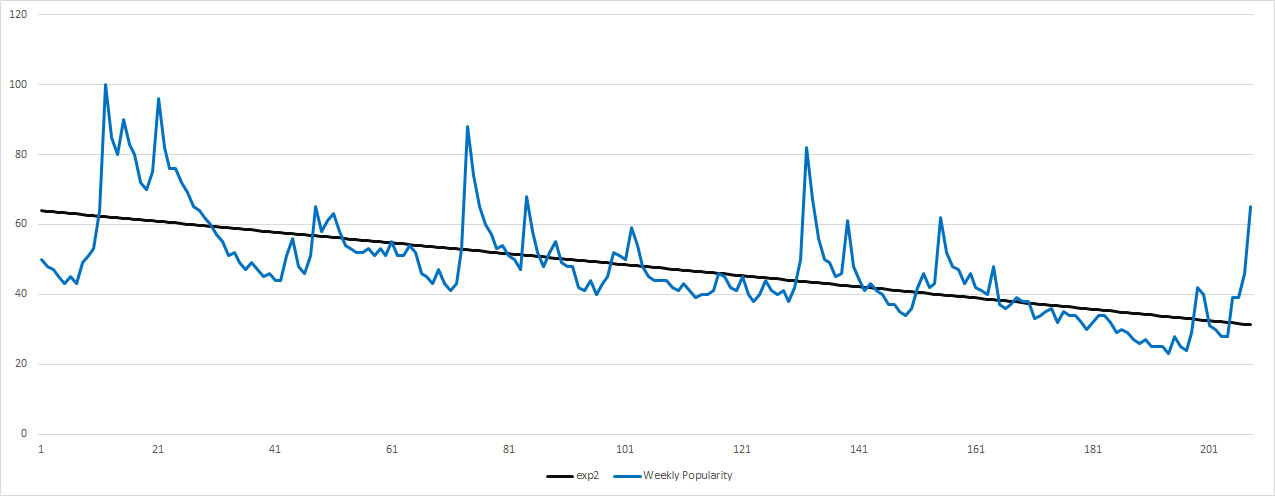
The 
Forecasting result for selena gomez’s popularity with RMSE (Root mean square error) is 6.9312 With respect in weekly time steps. Some peaks in the observed data (blue graph) are very well covered by the Eq. (2) forecasting model in year of 2019.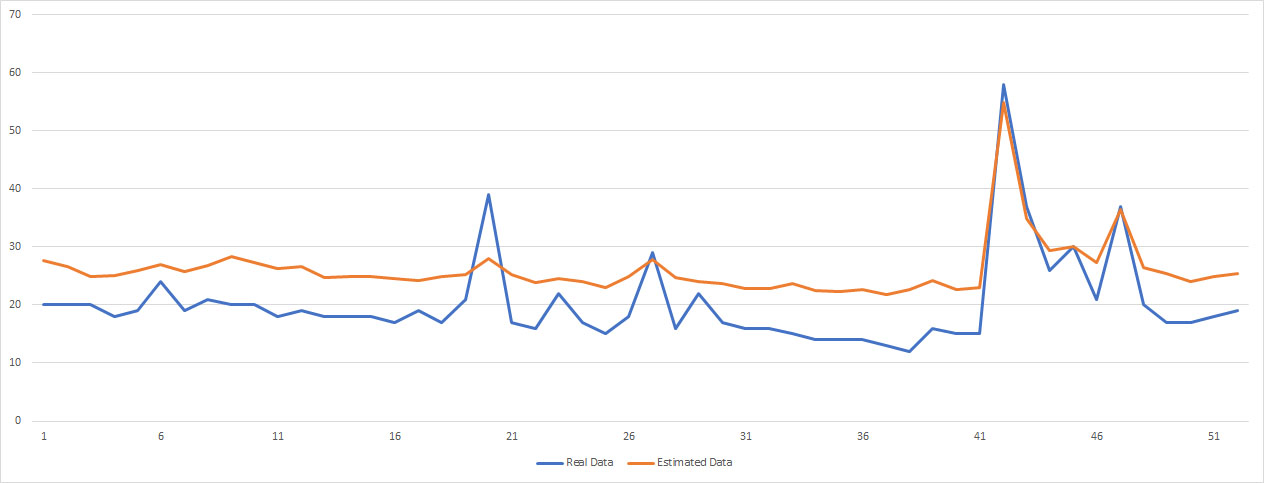
Forecasting result for Taylor Swift’s popularity with RMSE (Root mean square error) is 5.6013 With respect in weekly time steps. This prediction model captures all general data trend, and calculation errors are less than the test model in Eq. (5).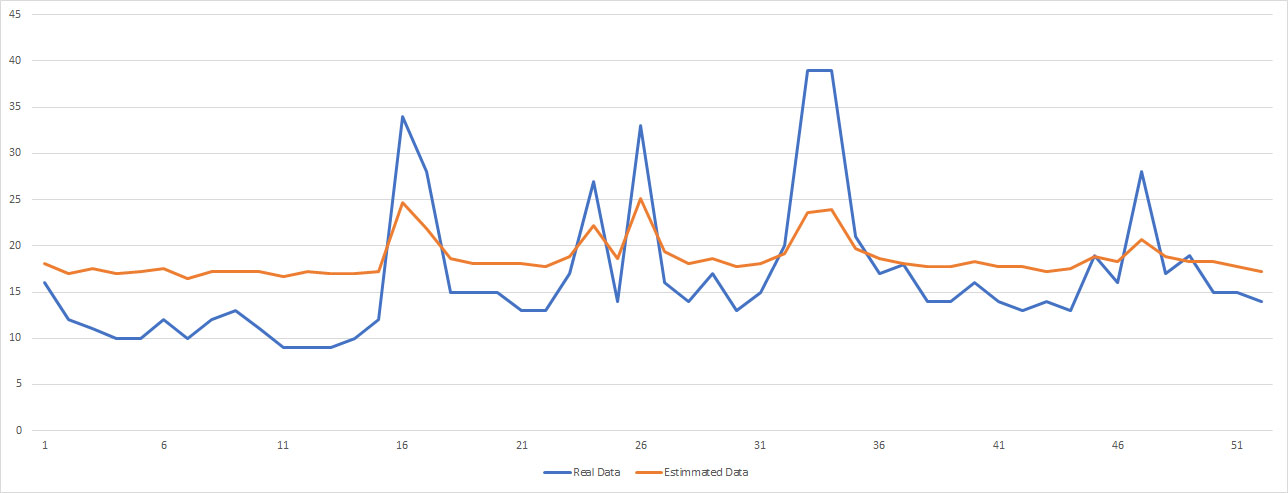
Curve-fitting models for EXO’s popularity are shown in Figs 11 and 12. The regression model using the second-degree exponential is given as:
with
with
Having compared the value of RMSE for three forms of regression model for each idol, we conclude that the Poisson regression models give the smallest values of RMSE consistently for four idols. Using the test data of news searches and YouTube searches 2015–2018, we can forecast the idol’s popularity in year 2019. In Figs 13–16, the blue and the red graphs show real data and forecasting model, respectively.
Forecasting result for BTS’ popularity with RMSE (Root mean square error) is 30.0285 With respect in weekly time steps. For BTS data observations, the general trend is positively increase, this causes the RMSE forecast model is greater than the historical model (Eq. (8)).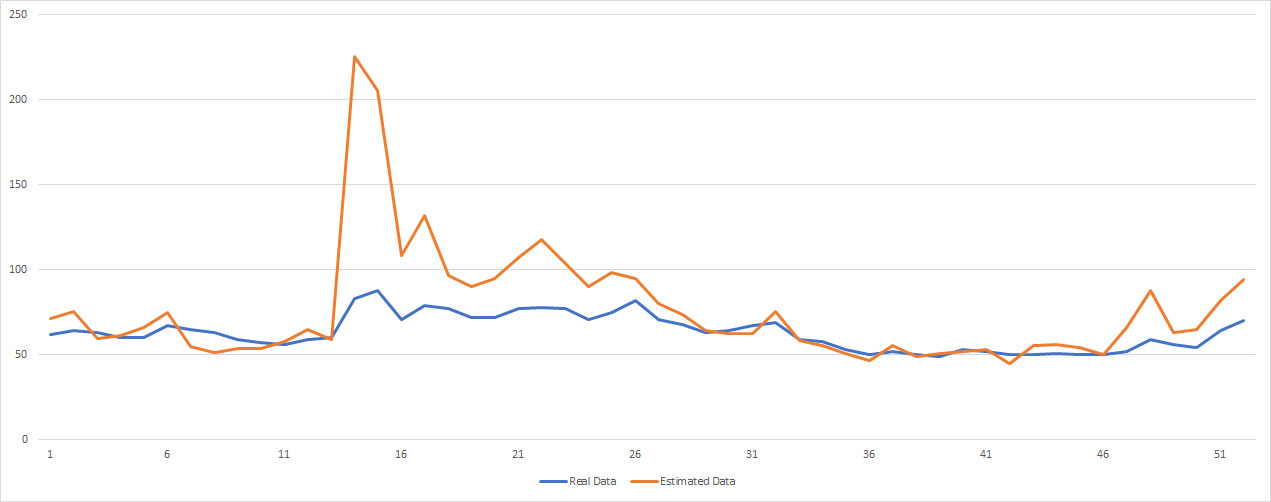
Forecasting result for EXO’s popularity with RMSE (Root mean square error) is 7.3488 With respect in weekly time steps, and all peaks in year 2019 can be predicted very well by this model.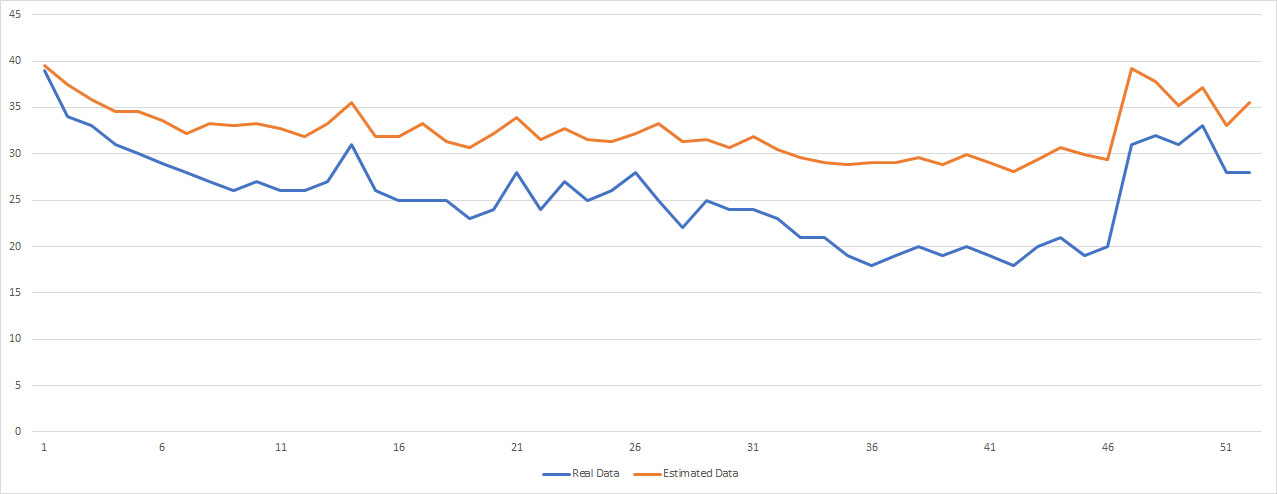
Figures 13–16 depict the forecasting results using test data for each idol. Generally, the result shows that the model covers every peak of the idol’s popularity. It is expected results since the inputs of the Poisson regression models are the news search and YouTube search.
Having analyzed the relationship between media and idol’s popularity, we consider the factors that affect their popularity by finding the peak’s gradient on the popularity index. Each peak on the popularity index represents a special event. Figures 17–20 respectively show some peaks in popularity of Selena Gomez, Taylor Swift, BTS and EXO.
List of events at each peak of Selena Gomez’s popularity
Using the real data about Selena Gomez’ popularity, we can see that each peak on the popularity scale represents a special event. Figure 17 shows each peak. Here is a description of each peak of Selena Gomez’ popularity:
Selena Gomez became a model cover of Marie Claire. Justin Bieber released “What Do You Mean” song, and people related it to Selena. Selena Gomez released some singles from the “Revival” album. Selena Gomez held her Revival Tour 2016. Selena Gomez won the American Music Awards 2016. A kissing picture of Selena Gomez and The Weeknd, a Grammy Award-winning artist, was widely spread. Selena Gomez announced her new upcoming album. Selena and Justin were dating again. Justin Bieber was dating another girl. People related it to Selena. #PrayforSelena were viral. Selena was reported to have been admitted for mental health treatment. Selena Gomez came back and performed at the Coachella Music Festival 2019. Her new single “Lose You to Love Me” was released.
Having compared visually the gradient peaks with the real data in Fig. 17, nine out of 12 peaks are covered by the estimated value. Table 2 also shows an extreme slope in the real data that causes an extreme slope in the estimated value. This leads to the conclusion that the model of Selena Gomez’ popularity generated by the Poisson regression is a good representation of the real data.
Selena gomez: Gradient of the peak popularity
Comparison of selena gomez’ peaks popularity between data and model 2015–2019 respect to daily time steps.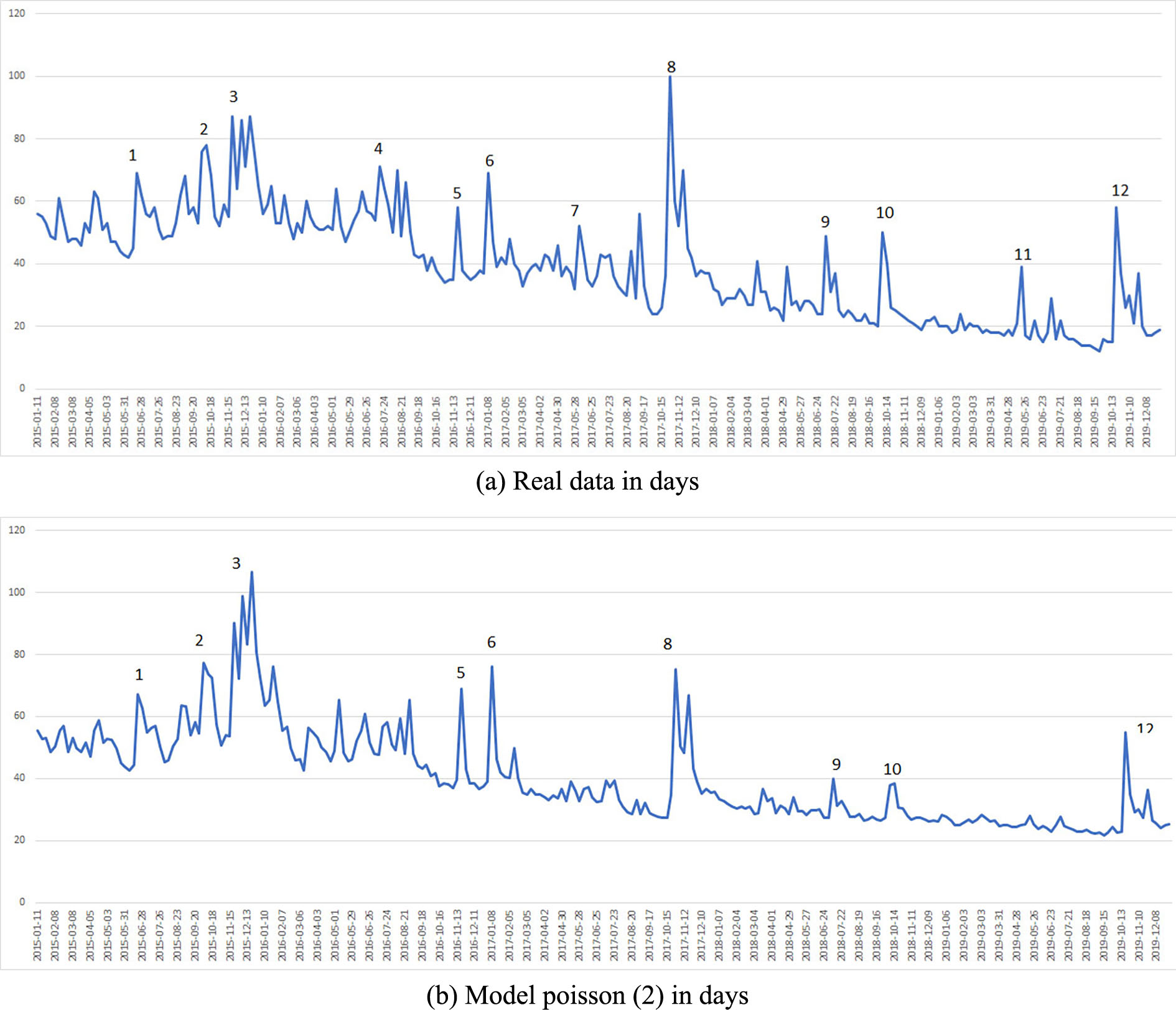
Here is a description of each peak of Taylor Swift’s popularity:
Taylor Swift released her new single “Bad Blood” and became a big winner at Billboard Music 2015. Taylor Swift released her new single “Wildest Dreams”. Taylor Swift kicked off the Grammy Awards 2016. Taylor Swift held a 4th of July party. She announced her upcoming new single. The Album “Reputation” was released. Taylor Swift released her new single, “ME”! Taylor Swift released her new single, “Lover”. Taylor Swift won an award in the American Music Awards 2019.
Taylor Swift: Gradient of the peak popularity
Comparison of Taylor Swift’s peaks popularity between data and model 2015–2019 respect to daily time steps.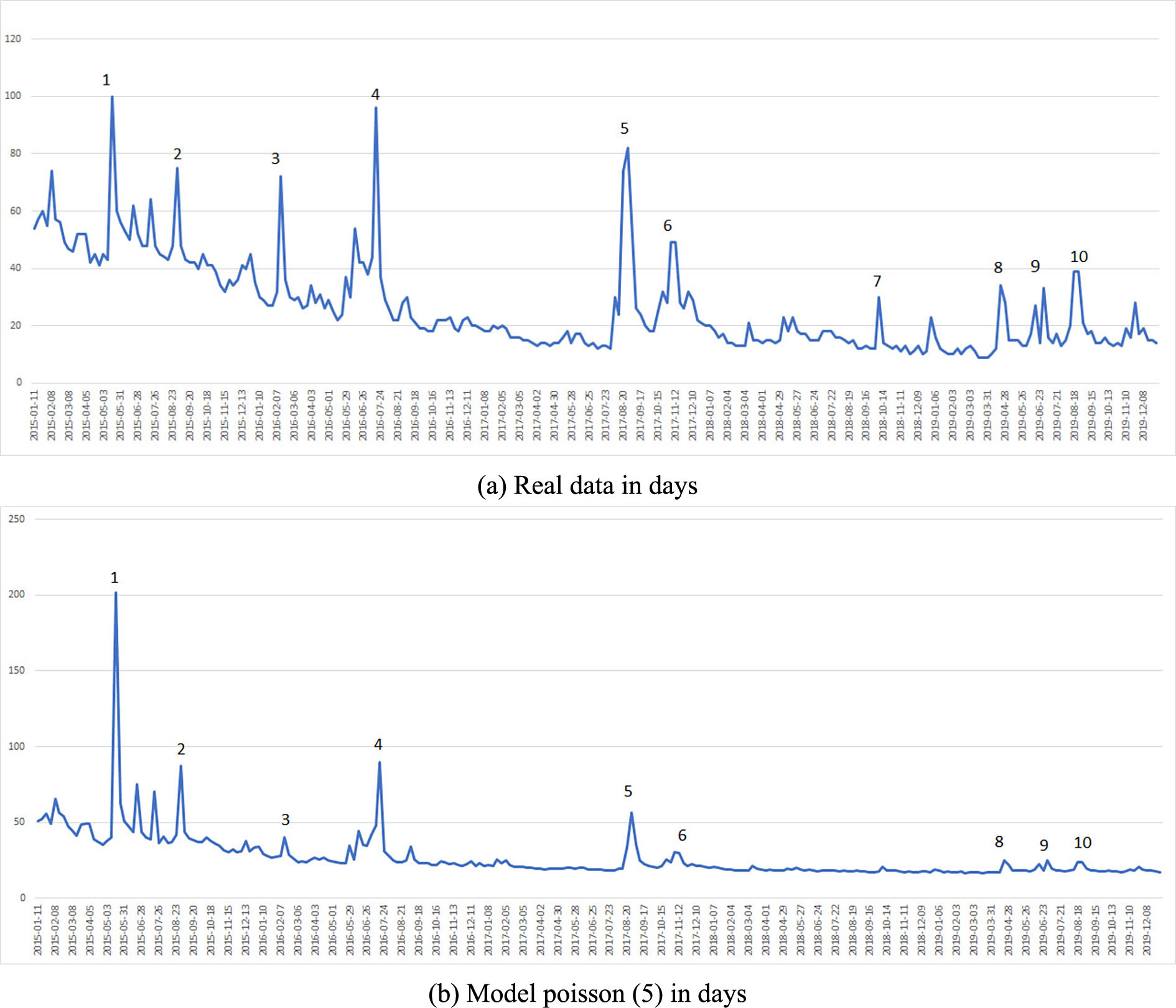
In Fig. 18, all peaks are covered by the estimated value. Table 3 shows the extreme slope in the real data causing the extreme slope in the estimated value. It can be concluded that the model of Taylor Swift’s popularity generated by the Poisson regression model is also quite representative of the real data.
Here is a description of each peak of BTS’ popularity:
BTS released a mini album “The Most Beautiful Moment in life, Part 2”. BTS released a special album, “The Most Beautiful Moment in life: Young Forever”. BTS released their second studio album “Wings”. BTS released an album “You Never Walk Alone”. BTS appeared in the Billboard Music Awards 2017 and won the Top Social Artist Award. BTS performed in the American Show: Dick Clark’s New Year’s Rockin’ Eve with Ryan Seacrest. BTS “Comeback Show” in Korea was announced. Their new single “Love Yourself: Answer” was released. BTS on 2019 Billboard Hot Tours beat Ed Sheeran, a famous music idol in America. BTS held their Love Yourself World Tour.
Gradient of BTS’ peak popularity
Comparison of BTS’ peaks popularity between data and model 2015–2019 respect to daily time steps.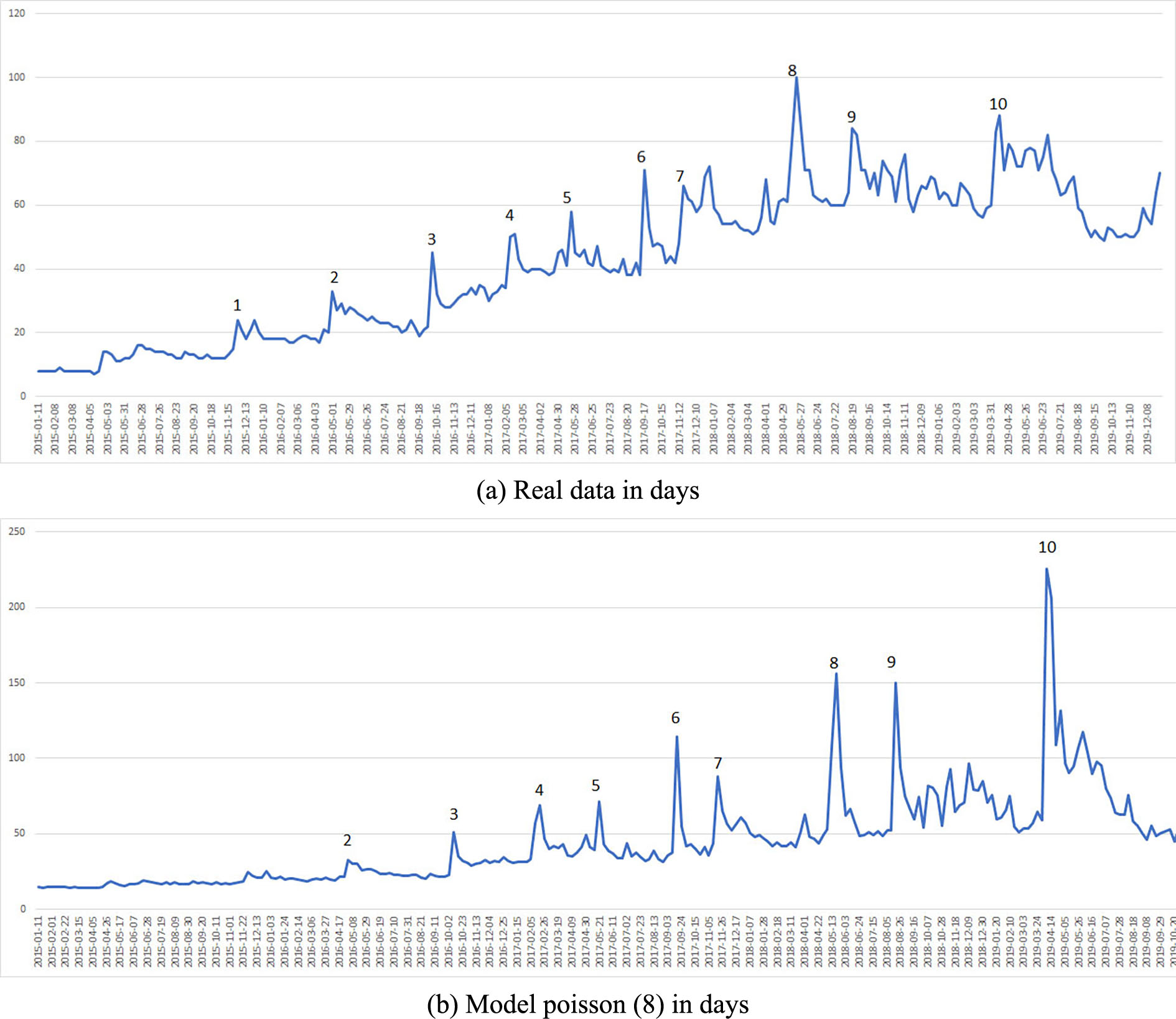
In Fig. 19, nine out of 10 peaks are covered by the estimated value. Table 4 shows the extreme slope in the real data causing the extreme slope in the estimated value. It can be concluded that the model of BTS’ popularity generated by the Poisson regression is also representative of the real data.
Here is a description of each peak of EXO’s popularity:
Gradient of EXO’s peak popularity
Gradient of EXO’s peak popularity
Comparison of EXO’s peaks popularity between data and model 2015–2019 respect to daily time steps.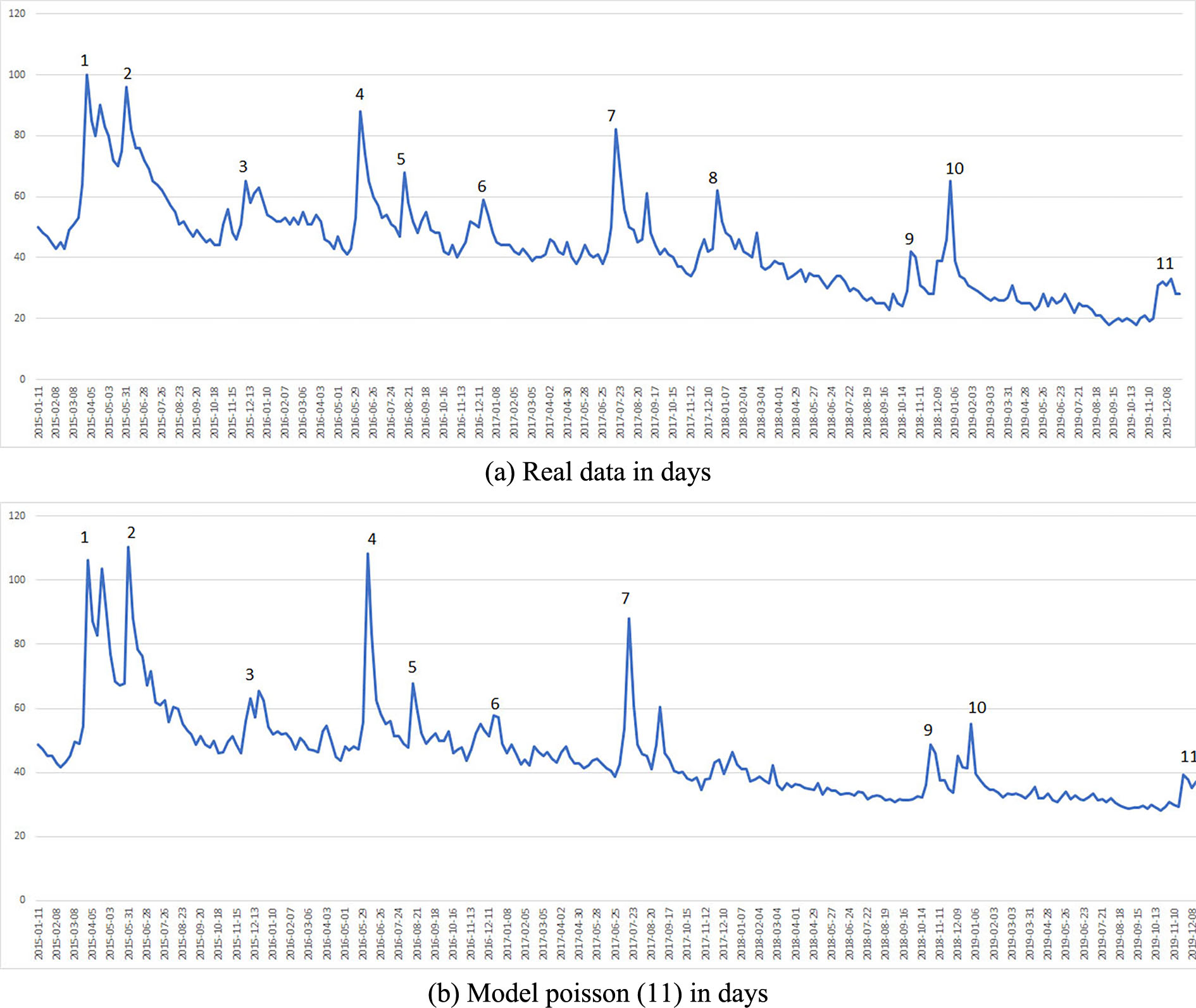
EXO’s second studio album (EXODUS) was released. EXO were the Highest Ranking Korean Artists on Billboard Music. Tao, a member of EXO, left the group. Vogue Korea issue, EXO X STAR WARS. EXO released their third studio album (EX’ACT). A repackaged edition of the “Lotto” album was released. EXO released their new album “FOR LIFE”. EXO released their new album “WAR”. EXO released their new mini album “UNIVERSE”. Some EXO members became magazine models for Vogue Korea. EXO announced a comeback with “Love Shot”. EXO released a new album “OBSESSION”.
In Fig. 20, all peaks are covered by the estimated value. Table 5 shows the extreme slope in the real data causing the extreme slope in the estimated value. It can be concluded that the model of EXO’s popularity generated by the Poisson regression is also quite representative of the real data.
Among the Poisson regression is the model that gives us the smallest value of RMSE. Once we have data on news and YouTube searches for certain idols, we can predict its impact on the idols’ popularity. Poisson regression can also cover almost all peaks of an idol’s popularity. Almost all special events that happen to the idol can be described in the model generated by the Poisson regression.
Footnotes
Acknowledgments
The first author acknowledges support from P2MI ITB 2020 and the second author acknowledges support from Telkom University. The authors would like to thank Dr Novriana Sumarti for the suggestion to improve the writing.