



Abstract
The article presents the main provisions of the socio-economic development assessment methodology for the Russian Federation regions, taking into account the characteristics of regional differentiation, developed under the leadership of S.A. Aivazian and with his direct participation.
Introduction
A theoretically substantiated approach to the assessment of socio-economic development of the Russian Federation regions is the construction of indices in various areas and an integral index of life quality based on the component analysis of indicators characterizing these areas. At the regional level, the advantages associated with the use of the principal component analysis and its modifications are most fully disclosed in the works (Aivazian, 2012; Makarov et al., 2014) when analyzing the quality of living conditions. In this article the possibility of developing this approach is considered. The novelty of the results obtained is determined by the fact that the indices of the main directions of socio-economic development for the Russian Federation regions and the integral index of living quality conditions are based on a common basis. The components of the base are the characteristics of differentiation formed by theoretically justified models of regional development. It includes scale of economy, technical efficiency of production, sectoral specialization index (based on the first principal components of the GRP structure), industrialization index (based on the second principal component of the GRP structure), technical efficiency trend. The position of a region in the basis of differentiation characteristics determines its economic uniqueness. The author’s methodology of forming regional development indices in the space of differentiation characteristics creates qualitatively new conditions for monitoring the development of the Russian Federation regions related to the concept of digital economy.
In addition to the traditional problem of constructing indices and ratings of regional development, it is possible to compare the economic nature of the indices themselves, as they are formed in a common space. Over time, such problems may become common for a network of computing centers, which is a key element of the digital economy (Kozyrev, 2018). All the more so because it is possible to predict changes in the positions of regions in the space of differentiation characteristics as a result of federal and regional investment projects. And to estimate, using indices constructed in the common basis, the impact of such projects on different directions of social and economic development. Therefore, the basis of regional differentiation characteristics may become one of the instruments of project management (Makarov, 2010).
Common basis structure
The basis
The indicator “number of economically active population” from Russian Statistical Agency (Rosstat) as the characteristic of economy scale. The basis includes the first and second principal components of the GRP structure. The GRP structure reflects features of technological interrelation of resource potential and results of production activity of the region. The principal components were built based on Rosstat’s indicators of the GRP sectoral structure (as a percentage of GRP) over the period from 2009 to 2016 years: agriculture, mining, manufacturing, construction, wholesale and retail trade, financial activities, real estate operations, state administration and military security, education, healthcare and social services, provision of other communal, social and personal services. To ensure that the empirical correlation matrix was not degenerate, data corresponding to hotels and restaurants, transport and communications, as well as production and distribution of electricity, gas and water were excluded. In addition, the share of agriculture in GRP was added to that of fisheries. The first principal component of the sectoral structure of GRP separates the regions with specialization in mining from other regions (sectoral specialization index). The second principal component separates manufacturing, evenly developed and developing regions (industrialization index), see (Fig. 1).
The first two principal components explain more than 78% of the total dispersion of the GRP structure for each year from 2008–2016 years. The dynamics analysis of loadings coefficients for the first and second principal components indicates their stability over time. Mutual location of most regions in the space of the above two indices is also characterized by sufficient stability in time (Aivazian et al., 2016).
The Russian Federation regions in the space of first two principal components of the GRP structure.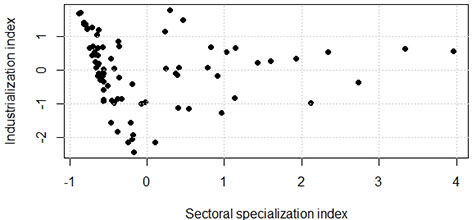
In the papers (Aivazian et al., 2019a; Aivazian et al., 2019b), it is proposed a statistical approach to the formation of indices for different directions of the regional socio-economic development which uses common basis structure. In this basis of differentiation characteristics eight indexes are constructed, characterizing the following basic directions of social and economic development for the Russian Federation regions: manufacturing of the goods and services, material well-being, quality of the population, quality of social sphere, internal safety, see Table 1. Each index is constructed on the basis of a group of indicators selected in the result of the analysis of the direct links graph obtained using partial correlation coefficients and constructed in the common basis so that it is maximally correlated with the index formed on the basis of the corresponding group of indicators. The peculiarities of social and economic development of regions in the main directions have been revealed, see (Aivazian et al., 2019a; Aivazian et al., 2019b).
Indices features according to data for the 2016 year
Indices features according to data for the 2016 year
In (Aivazian et al. 2019a) and (Aivazian et al. 2019b) it is presented a procedure for the formation of the integral indicator for the living quality conditions. In this procedure it is used the indices characterizing the main directions of socio-economic development
where
In this problem we have
As a result, the integral indicator of the living quality conditions has been estimated for the Russian Federation regions using the data for 2015–2016 years, which can be used to substantiate decisions aimed at increasing the level of socio-economic development of the Russian Federation regions. It is determined the relationships between the obtained integral indicator of living quality conditions with the regional development characteristics in the basic directions.