



Abstract
The article introduces a general method of construction of asymmetrical regular factorial main-effect designs in
Keywords
Introduction
It is both pleasant and honorable for the authors of this paper to participate in this special issue in commemoration of Professor Sergey Aivazian and his substantial contribution to applied statistics. The next two paragraphs are the reminiscences about Sergey Aivazian by one of the authors, Slava Brodsky. These memories are about Sergey Aivazian’s participation in organizing conferences on applied statistics, as well as about his work as a member of the editorial board of a journal section on applied statistics.
In the 70s and 80s, many people knew Sergey Aivazian from those conferences on applied statistical methods that he was conducting. Me and a number of my colleagues were their participants. Although the planning of the experiments is a preliminary stage for statistical analysis, I was among those who suggested that Sergey included works on the design of experiment into the program of his conferences. He approved that, and since then, his conferences have had included presentations on the design of experiment. I remember the 1979 conference in Tsakhkadzor. Aivazian was the head of the All-Union School of Applied Statistical Analysis. My colleagues and I made a presentation there (Brodsky et al., 1979). I remember that other scientists from various organizations also presented their works on the design of experiment at this conference. Of these, I remember well the participation of Valery Fedorov (who at that time was one of the leaders of that field of the applied statistics). At one point, Sergey and I played soccer against one of the local teams of the professional league. But that was only once as Sergey was usually playing tennis. Then there was another event in 1983. And works on the design of experiment were presented there too.
Sergey and I were not friends (I called him “Sergey Artemievich” – not Sergey, he called me “Vyacheslav Zinovievich” – not Slava), although we had known each other for a long time (I was then married to Tanya Golikova, and she and Sergey studied together at Moscow University). We closely communicated with him at the meetings of the mathematical section of the journal “Industrial Laboratory”, where we both worked on a volunteer basis for about 25 years. And almost all my memories of Sergey Artemievich come from there. It was the only journal in the USSR that published articles on applied statistics. There was something about the nature of this section that distinguished it from other editorial boards: close connection between reviewers an authors of works. If an article contained a sound idea, then nothing – not a confusing explanation, not bad writing – could stop it from being published (albeit after revision). Sergey Aivazian was among of those who supported this high level work with the authors.
Now about the article. It presents methods of construction of regular uniform main-effect (RUME) designs in runs. These methods are based on the mathematical theory of symmetrical factorial designs, which was elaborated in Bose’s (1947) and Rao’s (1946, 1950) seminal papers as well as in theirs and other authors’ subsequent works. Rao introduced a concept of hypercubes of strength
The designs constructed in the article involve many number of observations and many variables. An area of application of our results, as we see it, is basically a screening procedure when the researcher is trying to determine significant variables among others (see recent developments described in works of Pojic et al. (2015) and Yurata et al. (2020) where the authors emphasize usefulness of factorial designs for screening).
Section 2 of the article contains necessary definitions and results that are used throughout the paper.
Section 3 considers two-level RUME-designs that are constructed from points of finite Euclidean space
In Section 4, we investigate properties of the origin matrices for various particular cases. That allows to obtain new important results and construct new designs.
A summary of the results is given in Section 5.
Basic definitions and preliminary results
In this article, we consider symmetrical designs (that have equal numbers of levels for each factor) and derived from them asymmetrical designs (that have different numbers of levels). We follow definitions and results of theory of the factorial design of experiments developed originally by Brodsky (1976, 1983, 2013, 2019). Following him, we call a design uniform if every level of any factor occurs in the design equal for the given factor number of times.
Brodsky’s next definition is based on a fundamental concept introduced by Plackett (1946) – the condition of proportional frequency.
Let
holds for two arbitrary factors
For the uniform design, the condition Eq. (1) is equivalent to the following:
where
Thus, the condition Eq. (2) determines regular uniform main-effect (RUME) designs. It is known (Brodsky, 1976) that RUME-design allows to get a diagonal covariance matrix of the design for the main effect model providing transformation from factor levels of the designs to regressional variables had been specially chosen. (For 2-level variables, for example, such transformation substitutes one level of factor with
We will denote the design that includes the factors
When referencing factors with the equal number of levels, we will use a power sign. As appears from the condition Eq. (1), each RUME-design in
The nature of the frequency condition points to resemblance between RUME-designs and various combinatorial schemes. That has led to developing of a number of productive geometric methods aimed at constructing RUME-designs and based on the theory of finite Galois fields.
Let’s now state basic facts that support the use of finite projective geometries tools for constructing RUME-designs in
Denote points
where
Then put point
This correspondence means that we substitute columns of 2-level factors with one column of 4-level factor. We will call the resulting factor of the replacement procedure a reconstructed factor.
A design may include two “reconstructed” factors if and only if their forming planes do not intersect each other. We will call any RUME-design that includes reconstructed factors from a GFD a generalized geometric factorial design (generalized geometric RUME-design).
We do not know whether every RUME-design in
where
This paper presents methods of construction of generalized geometric RUME-design. All RUME-designs described in the literature as well as a number of new ones can be constructed using this method. Each design constructed in this way is called GFD or generalized geometric RUME-design and appears to be RUME-design.
Now we consider a method of construction of saturated designs, i.e. designs where a number of parameters to be estimated equals to a number of runs. Consider generalized geometric RUME-designs
We will call matrix
Elements of Number of Number of Any two elements of any row of There exists such one-to-one correspondence between rows of
The requirement 5) means that the rows of matrix
Suppose that positive integers
The offered method is grounded upon the following
It follows from the above that it is necessary and sufficient to divide points of
Choose
Element
There exist a number of different origin matrices matching a given design. For instance, an origin matrix can be constructed by using any multiplication table of the
In order to construct some design column, we are using linearly independent points of the corresponding plane. We will call them forming points. Each
We note here a few facts that considerably simplify construction of designs:
The design column (let it be the first) that corresponds to The design column that corresponds to If any column of the origin matrix is equal to sum of other columns, the corresponding column of the design is equal to the sum of corresponding columns of the design and the first column.
Designs 8
It is necessary to note that the Addelman-Kempthorne (1961) method with its generalization (Brodsky, 1981) allows to construct
The origin matrix
By origin matrix exploration, it is possible to obtain families of new generalized geometric RUME-design that cannot be obtained from
Origin matrix
exploration
The origin matrix
Consider the origin matrix
The given matrix is matching generalized geometric RUME-design
Consider an example (Brodsky, 1981) of constructing various asymmetrical main effect designs in 64 runs from the orthogonal arrays (64, 63, 2, 2). Consider each point of the complete design
Denote points
where
A Magic Finite Projective Geometry 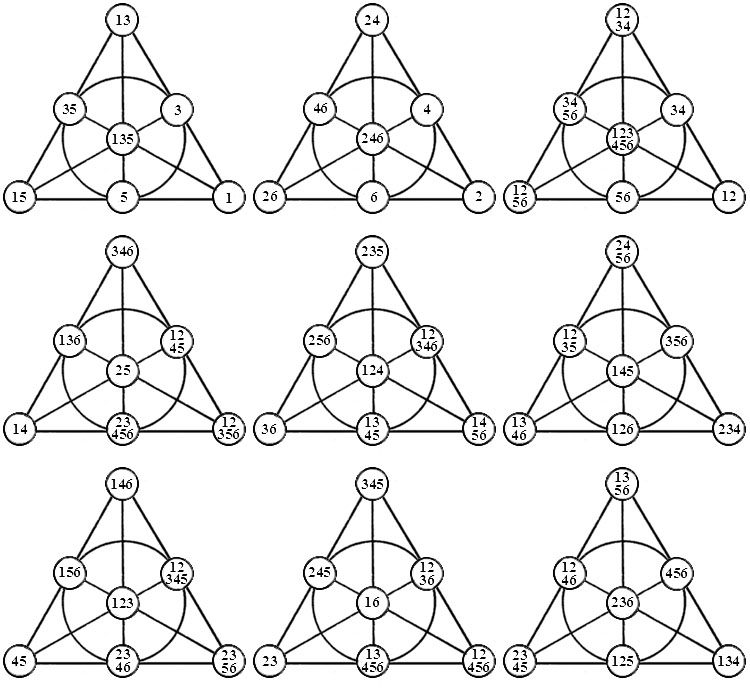
They are split into 9 subsets (displayed as triangles). Each subset contains 7 points. Only three of them are independent. Therefore, the seven points are located on a two-dimensional plane (2-flat). In any 2-flat, seven points are located on seven lines (1-flat). In Fig. 1, these lines passing through three points in each 2-flat are displayed as one circle and six line segments. For example, the left upper triangle in Fig. 1 represent a 2-flat containing seven points: 5, 35, 3, 135, 13, 15, 1. Points 1, 3, 5 can be chosen as linearly independent. The seven points are located on the seven lines: 15-35-13, 13-3-1, 15-5-1, 13-135-5, 15-135-3, 1-135-35, and 3-5-35.
The location of points of
The construction in Fig. 1 resembles a magic square and therefore is called a magic finite projective geometry
Any three points located on the same line in
Thus, each point in Fig. 1 is two-level factor, each line (1-flat) is four-level factor, each 2-flat is an eight-level factor.
This method produces the following four main effect designs:
Various designs of the form
Consider the following construction:
Here, nine 2-planes are arranged in three rows and three columns. Three points from any of horizontal rows form 1-plane (line). These lines will be called horizontal. Three points, identically placed in three 2-planes of any column (for example, points 136, 34, and 146 in 2-planes of the second column) form a line, too. These lines will be called vertical.
By using this arrangement, we construct the following RUME-designs:
The RUME-design
The RUME-design
The RUME-design
The RUME-design
The RUME-design
Six vertical lines 1236-345-12456, 246-13456-1235, 134-16-346, 145-125-24, 35-256-236, and 23456-1234-156 drawn up from 2-planes of the first column points; Line 1456-235-12346 drawn up from 2-plane of the points of the 2-nd row and the 2-nd column; Line 2345-124-135 drawn up from 2-plane of the points of the 3-rd row and the 2-nd column; Two lines: 2346-34-26 and 1256-245-146.
The RUME-design
The RUME-design
The RUME-design
The RUME-design
It is easy enough to show that generalized geometric RUME-designs
do not exist.
The generalized geometric RUME-design
Thus, for any
Consider the following origin matrix of generalized geometric RUME-design
For 3 first groups, lines consist of points 6[1]-56[2]-5[3], 5[1]-6[2]-56[3], 56[1]-57[1]-67[1], 5[2]-67[2]-567[2], 6[3]-7[3]-67[3], 7[1]-7[2]-*, 57[2]-57[3]-*, 567[1]-567[3]-*, where asterisk denotes necessary point of
Each group sets 21 points in
Origin matrix
exploration
Consider the following origin matrix of generalized geometric RUME-design:
R-plane contains 15 points of the form
Now we divide 15 columns of the matrix into 5 groups of 3 columns each: (1, 2, 3), (4, 5, 6), (7, 8, 9), (10, 11, 12), and (13, 14, 15). Here we will use the same notations as introduced before. Each group of columns sets 45 points in
By substituting three 8-level and eight 4-level factors for three 16-level factors of the GGFD
Composite designs in
runs
Compositeness is very important property of designs that researchers use in practice. After the experiments have been carried out, the response surface often proves to have more complicated form than it was assumed when the experiments were originally planned. So, it may be necessary to conduct an additional series of experiments. In this situation, keeping already carried out experiments inside of the new design is a natural desire. A design that includes the original series of experiments as a part of second series of experiments is called composite.
Construction of a composite design for
Let’s take the
Thus, when going from the original design
We will illustrate that by a simple example. Consider
Any
Conclusion
In the paper, we present a method of construction of geometric factorial designs