



Abstract
Customer satisfaction has become a key factor in strategic work of many institutions towards the increasing competition regarding student recruitment. This paper presents a systematic approach to identify customer needs for a Master’s Degree Program in Industrial Engineering based on target students’ needs in the view of new product development. The approach consists of two methods: Choice-based conjoint analysis and Kano model. Conjoint analysis is used to explore important scores of each attribute of the program, i.e., specialist concentration, class period, research type, teaching language, teaching format, and tuition fee. Also, the popularity of levels in each attribute are identified. Latent class model is used to identify different clusters of target customers. The result indicates two different segments of different preferences. The heterogeneity of needs and preference is characterized mainly in levels of specialist concentration preference as well as other attributes such as tuition fee. Other attributes such as interdisciplinary, cooperate program, work experience requirement and group (with presence/absence option) are analyzed by Kano model to identify their categories, i.e., how important they are. This research contributes in the literature as a pioneer in applying these two methods to gain customer perception insights about new Master’s curriculum development for education industry.
Keywords
Introduction
Currently, universities have experienced increasing competition due to the changes of students’ perspective and teaching environment such as the impact of COVID-19. As the number of master curriculum choices grow and prospective students have a wider variety of universities from which to choose, the need for universities to differentiate themselves from their competition is self-evident. The case-study institution is facing a challenge in master curriculum and would like to gain insights on what customers (i.e., prospective students) need for the new program development.
Industrial Engineering (IE) is an engineering profession that is concerned with the optimization of complex processes, systems, or organizations by developing, improving, and implementing integrated systems of people, money, knowledge, information and equipment (Sari, 2013). There are many sub-specialties involved in IE. In addition, besides name of the programs, there are other attributes that may influence customer decisions. Conjoint analysis is a useful market research approach for measuring the value that consumers place on features of a product or service, while Kano model is an approach to prioritizing features on a product roadmap based on the degree to which they are likely to satisfy customers (Crawford & Benedetto, 2010). In new product development, the heterogeneity of customer needs and preferences is required for the success of product marketing and demographic which are meaningful for customer segmentation (Shan et al., 2017). Customer segmentation was performed in this study by using conjoint analysis data for latent class analysis based on the importance level of attributes and part-worth of level attributes of each segment.
Thus, this research aims to identify customer needs for each segmentation in order to understand what target customers prefer by conducting conjoint analysis with Latent class clustering to estimate customer preference, and Kano model to estimate customer perception for new Master’s curriculum with difference levels in attributes. The results of this study can be an essential information for the case-study institution to develop new master’s degree programs. This paper contributes in the literature as a pioneer in applying these two methods to gain customer perception insights about new Master’s curriculum development for education industry.
The remaining of this paper is organized as follows. Sections 2 and 3 represent literature reviews and the methodology of Choice-Based Conjoint Analysis (CBC) and Kano Model (KM) design, respectively. Results of CBC and KM are illustrated in Section 4. Conclusions and future research are described in Section 5.
Literature review
Choice-based conjoint analysis
Discrete choice experiment
In this study, we construct choice-based conjoint analysis (CBC), also known as discrete choice experiment methodology because it models consumer behavior in real-life and include a “None” option for respondents. Klaiman et al. (2016) summarized CBC which has been rooted in Lancastrian consumer theory and random utility theory as follows:
Lancastrian consumer theory assumes that utility is derived from the attributes of products rather than from the product themselves. Random utility theory assumes that decision makers or consumers seek to maximize their expected utility given a budget constraint and specifies utility as a random variable.
The utility is studied as the value of preference unique to individuals. It defines higher or lower the utility associated with attributes or levels of attributes implies higher/lower the preference is given by the customer to respective products (Anand et al., 2018). The goal is to determine which combination of attributes is the most preferred to respondent choice decisions. When a product is decomposed into independent multi-attributes, its overall utility could be obtained by aggregating the part-worth utilities of attributes associated with their corresponding levels. The conditional logit model is applied for assuming that there is not difference among respondents and it results in the same coefficients for all respondents to be:
where the total utilities
To conduct customer segmentations, this study applies latent class analysis to observe customer demographic and preference in products. The preference components come from Choice-based conjoint in difference selection from survey. Latent class analysis (LCA) has been used to provide interpersonal heterogeneity in correlations among respondent’s selection for difference levels or attributes of product (Huang et al., 2017). To examine the degree of heterogeneity among individuals, LCA could yield the probability of choosing alternative
where
where
Here, log
Kano model (KM), proposed by Kano (1984), incorporates quantitative measures into customer satisfaction to provide decision support to product design. Kano classifiers are used as tangible criteria for categorizing customer needs (Crawford & Benedetto, 2010). Kano questionnaire provides a quantitative approach to investigate customer perception of 2 scenarios: delight for functional presence (Positive question) and disgust for dysfunctional absence (Negative question). The combination of functional and dysfunctional answer is then used to identify status of the attribute in the term of 1) Must-be (M) 2) One-dimensional (O) 3) Attractive (A) 4) Indifferent (I) 5) Reverse (R) or 6) Questionable (Q). All possible combinations of respondent answers and the corresponding type of product attribute are summarized in Table 1 (Ullah & Tamaki, 2011).
Kano evaluation
Kano evaluation
This section summarizes related research about how to identify customer needs for new product development, which can be divided into two parts: 1) factors affecting educational decision-making for attribute selection, and 2) product development for both educational and production industry research.
Educational factors for decision-making
The marketing mix is a set of controllable marketing tools. It helps define marketing options in terms of 7Ps (product, price, place, promotion, people, physical facilities, and processes) so that offering of products can meet a specific customer need. For example, Jonathan (2008) applied marketing mix 7Ps in considering a new higher education for MBA program. He grouped attributes according to each “P”, for example, specialist area and study units for “Product”, payment flexibility and tuition fee for “Price”, advertisement for “Promotion, etc. Also, Wongpoj (2016) studied levels of important factors for student’s decision making in choosing graduate programs by considering consumer behavior model and marketing mix 7Ps. He characterized 2 groups of factors: external and internal factors, and applied 5-Likert for his data collection.
Product development for education related products
For educational research, Wiklund and Wiklund (1999) studied how to develop courses by applying analytic hierarchy process (AHP) and conjoint analysis technique. It is known AHP generally used by decision makers to maximize subjective utility in decision analysis, while conjoint analysis is generally used to maximize customer preferences in marketing. The approach together transforms student’s need into quantified course attributes. Thus, the output of this study is a product of university course where teaching and learning aspect. Pukcarnon (2003) presented a process of developing industrial engineering curriculum for a case-study institution. The curriculum was designed by mainly applying quality function deployment (QFD) and analytic hierarchy process (AHP) technique. The output consists of two dimensions for student’s learning success: learning contents and learning experiences. QFD is a basically improvement tool with a quality approach in product development. Subsequently, AHP is integrated into QFD as a preferred method for solving subjective decision problems involving prioritizing the voice of the customer. Therefore, the integrating QFD-AHP method allows to analyze stakeholder requirement with impartiality and to be more effective curriculum. Boonyanuwat et al. (2013) applied quality function deployment (QFD) and analytic hierarchy process (AHP) for curriculum design for an industrial engineering program in Thailand and considered attributes such as contents, skills and students’ personality. None of the papers above had applied Choice-based conjoint analysis together with Kano Model to identify customer needs.
General product development
For production industry research, Conjoint analysis (CA) is often used in product development research. CA focus on a deeper level product analysis, assessing trade-offs between attributes, between the ranges of levels of attributes, and between various prices. It helps to optimize products in terms of their attributes including price. For example, Wang and Wu (2014) studied a hybrid framework customer preference and customer perceptions into the decision-making of smartphone product configuration. The smart phone is a product with functionally characterized by multileveled core attributes and optional attributes. Thus, they applied conjoint analysis to extract customer utilities of core attributes with multilevel each. Also, Kano model (KM) is applied to elicit consumer perceptions of optional attributes. Kano survey has pair of questionnaires, one assumed to presence and another one absence attributes. It offers a better understanding of how customer evaluates a product presence or absence for optional attributes. Another research, Rizzo et al. (2020) developed lactose-free milk by applying Maximum Difference scaling (MaxDiff), Adaptive choice-based conjoint analysis and Kano model. These techniques provided insight perceptions and purchase habits of consumers. The MaxDiff scaled the importance of product attributes to consumers. The adaptive choice-based conjoint provided insight into consumer purchase habits by simulating a purchase decision through an online interface. Furthermore, conjoint analysis is a useful measure for implement customer segmentation. Ullah and Tamaki (2011) studied energy label for communication to customers in refrigerators and washing machines. Heterogeneity consumer in products implied 4 classes observed by applying latent class analysis. Customers in each class have difference buying behavior in term of energy label, brand, capacity, and price in products. For better understanding in difference of these techniques, Wang and Wu (2014) and Popovic et al. (2018) illustrated the overall comparison between AHP, CA and KM, as shown in Table 2.
In this research, we view master curriculum as a product having different characterized attributes. For insights on how target customers value each attribute of the program, conjoint analysis and Kano model are selected as product development tools for data collection of customer needs. Then latent class model is used to identify different clusters of customers’ perspectives. To the best of our knowledge, these Conjoint analysis with latent class clustering and Kano model are not yet applied together in the education industry. Thus, this research contributed in the literature as a pioneer in applying these two methods for gaining customer perception insights for new Master’s curriculum development.
An overall comparison of AHP, CA and KM (Popovic et al., 2018; Wang & Wu, 2014)
An overall comparison of AHP, CA and KM (Popovic et al., 2018; Wang & Wu, 2014)
SWOT analysis of the current IE Master’s program of the case study institution.
The framework which integrates Choice-based Conjoint Analysis and Kano Model in this research are explained below.
First, SWOT analysis is used to help the case study institution identify strengths, weaknesses, opportunities, and threats of current program which can be summarized in Fig. 1. Then, a focus group interview involves a small number of students who contribute to open discussions for research. They can explore any attributes and levels for selections. In the questionnaire design method, Choice-based conjoint Analysis is used to extract customer utilities of the multileveled attributes while Kano Model is utilized to elicit customer perceptions of the attributes with only presence/absence option. The results are summarized and insights are interpreted for the case-study institution.
The selection of the attributes is an essential decision in the design experiment. We propose to use the marketing mix, which is a set of controllable marketing tools approach, to identify the needs of the service provider’s customers: product, price, place, promotion, people, physical facilities, and processes. Table 3 presents our research’s designed attributes mapped with their marketing mix, and their different levels which may influence interests of target customers, i.e., prospective students of master’s curriculum in industrial engineering.
Master’s degree curriculum’s attributes and their levels
Master’s degree curriculum’s attributes and their levels
Attributes and their levels for Choice-Based Conjoint Analysis
Choice-Based Conjoint task generation
Table 4 presents six attributes having levels which are not only Presence versus Absence and theses are attributes for CBC analysis. Note that for research type attribute, Thesis is a dissertation embodying results of original research and especially substantiating a specific view while the independent study (IS) is a less formally designed for students to investigate a topic related to the major field of study. For choice-based experiment, the total number of possible combinations for chosen attributes and their assigned levels is 4
We use R-Studio with package ’idefix’ to perform discrete choice experiment and generate the design matrix with effected coding as shown in Table 5.
Effects coding for design matrix generating
Effects coding for design matrix generating
Example of choice task generation
Generally, Vanniyasingam et al. (2016) recommended asking about 10 to 15 choice tasks, though this recommendation depending on the attribute list and sample size. Thus, questionnaire having 12 tasks were constructed. Table 6 presents an example of one question (out of 12 questions) from choice-based conjoint experiment. After all respondents answer all questions, utility function will be determined.
For CBC analysis, conditional logit model will be estimated using Maximum likelihood method. The results from this model show the total utility of the product as a function of the combination of all attributes shown in the equation below:
where
Johnson, the author Sawtooth Software’s choice-based conjoint (CBC) System, proposed a rule for determining the minimum sample size for CBC modeling set (Orme, 2006) in the equation below:
where
Based on heterogeneity from Choice-based conjoint survey response, latent class analysis is used for customer segmentation. The objective of this method is to identify whether customers’ opinions are in the same direction. If so, the overall model is enough. If not, we may be able to see different direction of answers which can identify subgroups of customers. the number of classes is crucial for latent class analysis (Zha et al., 2020). We attempt a range of classes from one to five classes by R-Studio using package “poLCA” (Linzer & Lewis, 2011). Model fitting is the best in the class with the lowest Bayesian Information Criterion (BIC) measurement values (Kosasih et al., 2017). After the number of classes is determined, then the next step is to perform choice-based conjoint analysis in each class to determine part-worth of levels and attributes of each class. Result from latent class model and choice-based conjoint analysis needs to be analyzed by looking the demographic characteristics of the respondents each class for customer segmentation.
Kano Model
The Kano Model is an approach to prioritizing attributes of a product based on the degree to which they are likely to satisfy customers. Each respondent will answer how customer feels when each attribute is present and absent from the Master’s program curriculum. After data is collected, Kano model can extract the influence of each attribute by identifying relative values to meet respondent satisfaction or not with satisfaction index (SI) and dissatisfaction index (DI). Where A, O, M, R and I represent the corresponding percentage of response among Kano categories mentioned in Section 2 as follow:
The target group for this research is engineering undergraduate students (4
Results
There are two main parts in this section: Choice-based conjoint and Kano model results. For Choice-based conjoint analysis part, we separate results into 2 sub-sections. First, Section 4.1 explains overall results from respondents and latent class analysis to explore if there are subgroups with different opinions, and if so how many groups and what are the characteristics of each of them. Section 4.2 explains results of Kano model for the attributes with only presence/absence options.
Choice-based conjoint analysis.
First, respondents who answered “No interest” to continue master’s degree are excluded in the analysis since they are not our target group. Thus, the remaining 104 respondents responds are used for Choice-Based conjoint analysis model. In the result of choice-based conjoint analysis, Conditional logit model is used for estimating discrete conjoint model’s utility function. The raw part-worth utilities are rescaled according to the zero-centered diffs method so that their sum within an attribute equals zero. Then, the adjusted part-worth are again rescaled so that the sum of the differences between maximum and minimum levels across all attributes for each respondent equals the number of attributes times a hundred. The two main results are utility for attribute levels and attribute relative importance (Garver & Divine, 2008).
Estimation of utility values and importance scores for overall model
The detailed results from conditional logit model for CBC analysis is shown in Table 7. The result shows that the most important attribute when considering master’s degree program in customers’ view is specialist concentration (importance score of 61%). The second most important attribute is tuition fee which account for 18%. Then, teaching language, teaching format and research type obtain importance scores of 11%, 5% and 4% respectively. The least important attribute with just 1% important weight is class period, which implies target customers do not care about this issue.
Detailed results from conditional logit model for CBC analysis
Detailed results from conditional logit model for CBC analysis
Value within one column (and within one attribute) within different according to Wald’s test (
For the findings in the most attractive combination of attribute’s levels for the highest utility, the best combination is specialist concentration in business data analytics (BDA), English teaching language, part-time class period, independent study (IS) research type, hybrid teaching and tuition fee of 63,500 Baht. Odd ratio in Table 7 represents the increasing (or decreasing if minus) probability for customer to choose the product. For instance, odd ratio of class taught in English is 1.1469 means if the class is offered in English language, the probability of target customers to apply for this program will be about 15% higher than Thai program.
After overall Choice-based conjoint analysis data are analyzed, then Latent class analysis is applied to segment respondents according to the similarities in their individual preferences. This will help provide deeper understanding about whether the answer trends are homogeneous among all responders, and if not, how many segments we can notice. The results show that two classes of respondents are identified based on minimum BIC (3,634.664). Table 8 and Fig. 2 illustrate the part-worth utility of each attribute level and the relative importance score of each attribute from the two segments. The attribute level with highest utility estimate value is chosen in each attribute as the most preferred master curriculum design (presented in Bold letter in Table 8). The main observations from each segment are described below.
Part-worth utility for each attribute level from two segments
Part-worth utility for each attribute level from two segments
Value within one column (and within one attribute) within different according to Wald’s test (
Segment 1: Supply Chain Systems specialist concentration with tuition fee less than 100K Baht
The first segment account for 45% of all respondents. The conditional logit model’s results from this segment is below:
This segment is named “Supply chain systems specialist with tuition fee does not reach 100K Baht” because it has the greatest relative importance score for specialist concentration as high as 58%, followed by tuition fee as 23%. The highest part-worth utility in specialist concentration is for Supply chain systems (SCS). Moreover, the tuition fee has significant negative (or non-preferred) utility in 100,000 baht. Considering relative importance scores of other attributes, these attributes have small importance value for class period (9%), teaching language (4%), teaching format (4%) and research type (2%). Thus, for this segment, the main decision is account for program concentration attributes which should be Supply chain systems and tuition fee less than 100,000 baht. Other attributes are not significant.
Segment 2: Business Data Analytics specialist concentration & English program
The second segment account for 55% of all respondents. The conditional logit model’s results from this segment is below:
This segment is similar to Segment 1 in terms of the highest relative importance score for specialist concentration (49%). In contrast, the wining specialist concentration is Business Data Analytics (BDA), while the lowest popularity is for manufacturing systems (MS) specialist. In comparison, this segment pays more attention to program language in the second preference (with importance score 17%) and then the third preference followed by tuition fee (with importance score 14%). This segment has higher preference if the program is taught in English. Thus, this segment is willing to pay tuition fee in 63,500 Baht but they have strongly non-preferred in 100,000 baht. It implies that 63,500 Baht possibility of offering English program as well. Other attributes, this segment has relative importance score toward teaching format (8%) and research type (8%). Teaching format has negative preference for online teaching format and research type has positive preference in independence study. The remain attributes is class period which the smallest importance score only 4%. Due to their primary preference, this segment is called “Business Data Analytics specialist concentration & English program”.
Segment 1 is characterized by covering variety of engineering fields and universities based on data collection. In comparison with Segment 2, respondents are specified in some related field of engineering and universities. Thus, the case-study institution should focus on developing strong faculty members specialized on either Supply chain systems or Business data analytics concentration. Moreover, tuition fees 100K Baht is the least preferred. Offering English program is more attractive for Segment 2 since, unlike segment 1, they are more willing to pay tuition fee 63.5K Baht. Thus, new master’s degree program with each specialist concentration appeal different characterized customers in the terms of teaching format, class period and research type. However, these attributes are not very important for their decision. Target customers seem to be fine with any of them.
Kano category results
Attributes’ relative importance scores for each segment.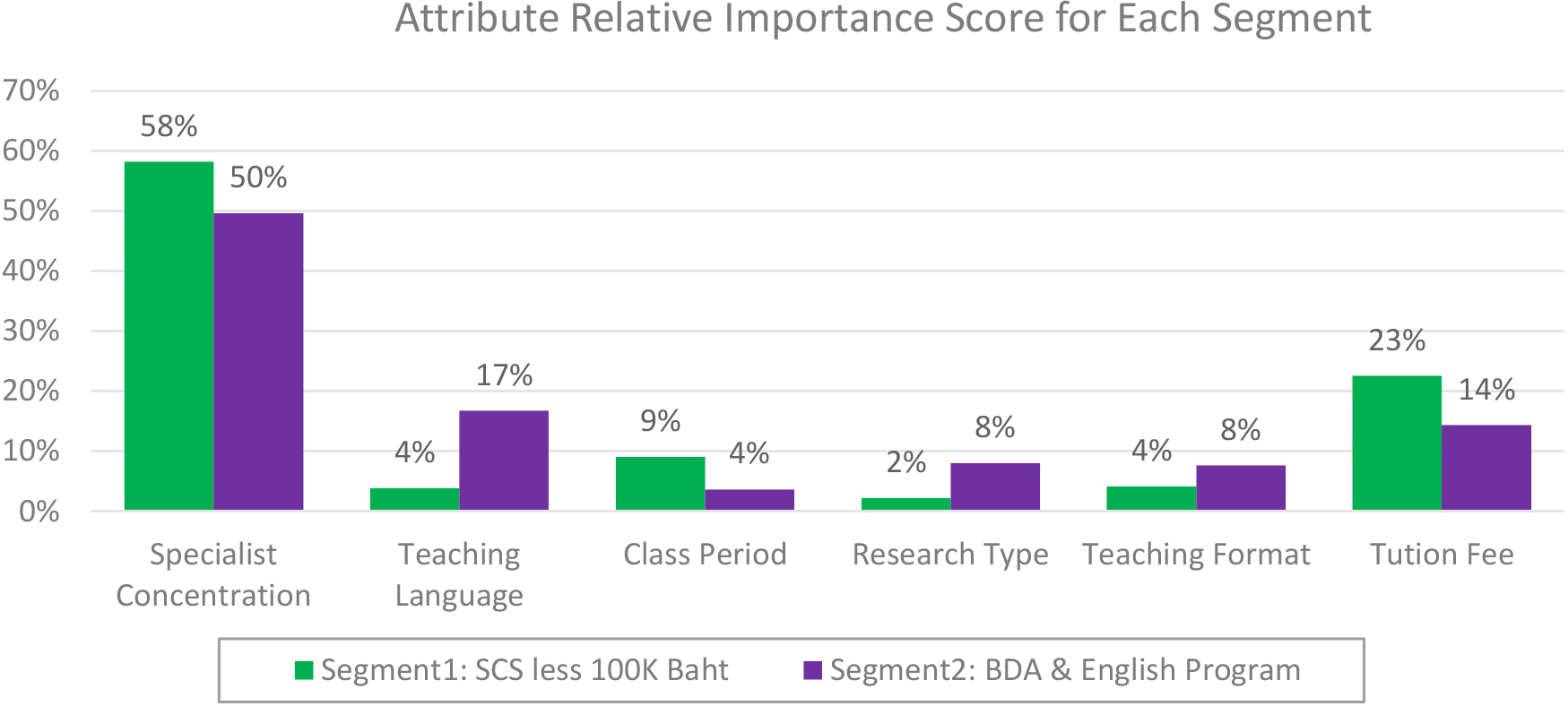
Kano classification results.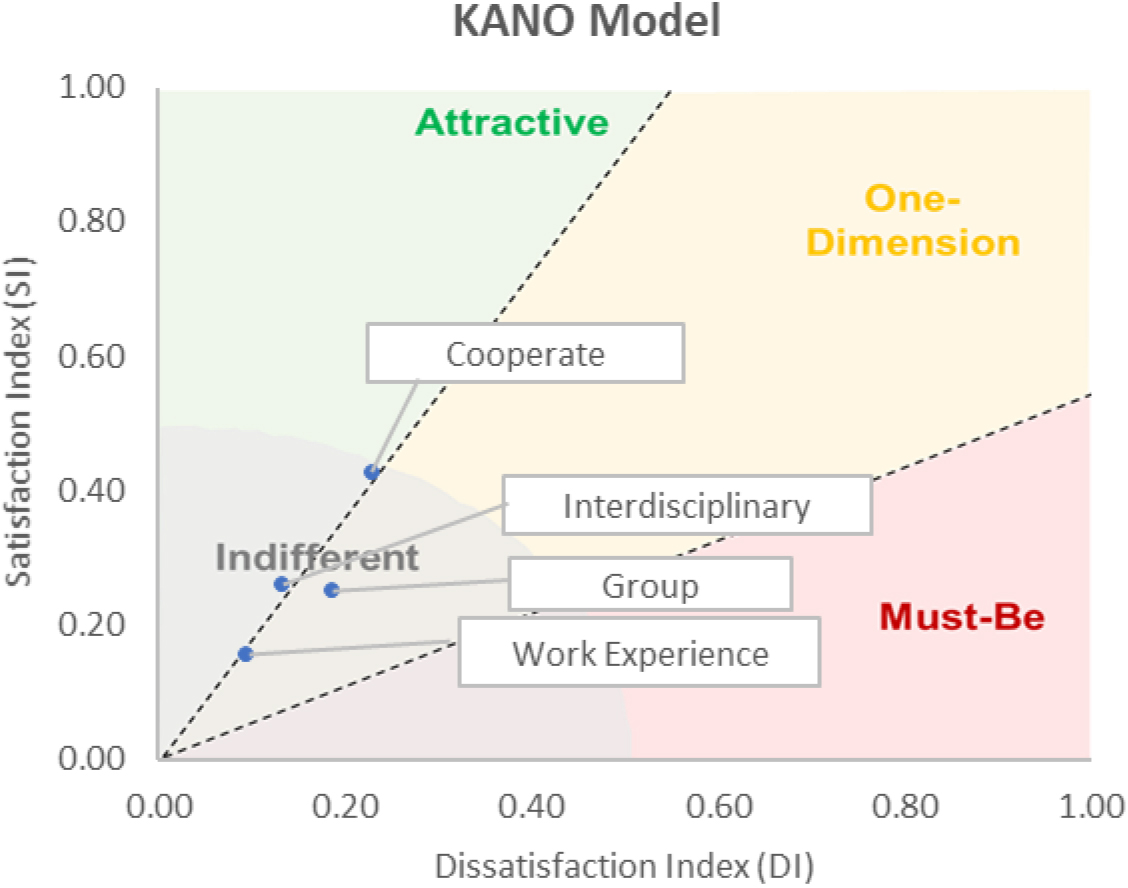
Kano model results are presented in Table 9 and Fig. 3. The results show that the maximum Kano percentage of all four attributes falls to “Indifferent (I)” category, implying these attributes does not contribute much to customer satisfaction regardless of whether they are present or absent in the product, i.e., master’s degree curriculum. These attributes are ranked for consideration by CSI value. Results show customer satisfaction ranking by group (management and technical group), work experience requirement candidate, corporate and interdisciplinary master school, respectively. However, the program executive may not need to pay much attention to these attributes since they do not affect target customers’ satisfaction of the curriculum.
Conclusions
In this paper, we presented methodology of applying choice-based conjoint analysis with latent class analysis to estimate preferences from different customer segmentation and Kano model to estimate customer perception for new master’s degree curriculum with multiple levels of attributes. The outcomes are used to identify target customer needs for master’s degree curriculum in Industrial engineering that contribute to a student’s decision to enroll graduate school. Results from quantitative conjoint analysis indicated that the two segments preferred different specialist concentrations. Target customer in Segment 1 prefer in Supply chain systems specialist concentration and have strongly negative preference if tuition fee is as high as 100K Baht. While customers in segment 2 prefer Business data analytics concentration with class taught in English. They are less price sensitive, compared to segment 1, as tuition of 63,500 Baht is more acceptable. From Kano model, it is found that interdisciplinary master school that require work experience candidate, coordination with other institutes or joint program do not contribute much to customers preference as they all fall into “indifferent” category. Overall, this paper illustrates insights from target customers of master’s degree curriculum using innovative features. Considering this heterogeneity of results from different segments, our findings can help program executives to gain insight on which types of specialist concentration they should develop to effectively tailor promoting strategies to each target segment.
For future work, the detailed design of all the courses which the focused specialist concentration should be considered. For other programs, methodology presented here can be used as a framework for their future curriculum development since understanding what customers would like to learn and what are important attributes of the program is very important. Overall, the results from this research had provided clearer directions on what to focus next for the new master’s degree program development for this case-study institution and can be applied in other programs in the future.