




Abstract
A two-parameter quasi Rama distribution which contains the Rama distribution as particular case has been proposed. Its statistical properties based on moments have been discussed. The hazard rate function, mean residual life function, mean deviations and stochastic ordering of the distribution have been derived and studied. The estimation of parameters using method of moments and maximum likelihood methods has been discussed. A simulation study has been presented to know the performance of maximum likelihood estimates. The goodness of fit of the proposed distribution on two datasets relating to failure times has been presented.
Introduction
Since the lifetime data are stochastic in nature, the search for a suitable distribution for modeling of lifetime data is very challenging. The analysis and modeling of lifetime data are required in almost every fields of knowledge including engineering, medical science, finance, insurance, demography, social sciences, physical sciences, literature etc., and during recent decades several researchers in Statistics and Mathematics tried to introduce lifetime distributions. In the search for a new lifetime distribution which can be used to model data from various fields of knowledge Shanker (2017) proposed a one parameter distribution named the Rama distribution which is defined by its cumulative distribution function (cdf) and probability density function (pdf) given by
Shanker (2017) studied its statistical properties, estimation of parameter using method of moment and method of maximum likelihood and applications to some real lifetime data. Recently, the Rama distribution has been extended by incorporating additional parameter by different researchers. Tesfalem and Shanker (2019) proposed a two-parameter weighted Rama distribution and discussed its characterization and applications. Subramanian and Shenbagaraja (2019) proposed a new version of Rama distribution and studied some properties and applications. Edith et al. (2019) introduced the two-parameter Rama distribution and studied some of the statistical properties and applications. Shanker et al. (2019) derived a two-parameter power Rama distribution and discussed its properties and applications. An inverted power Rama distribution with applications to lifetime data has been proposed by Chrisogonus et al. (2020). Generalized weighted Rama distribution has been suggested by Samuel et al. (2020). The exponentiated Rama distribution has been suggested by Chrisogonus et al. (2021). Mohiuddin and Kannan (2021) proposed a new generalization of the Rama distribution with application to model machinery data. Khaldoon et al. (2021) extended the Rama distribution using a suitable transformation and discussed its properties and applications.
While studying the goodness of fit of failure times data using the available two-parameter distributions, it has been observed that there are some datasets where available two-parameter distributions do not give good fit due to the theoretical nature or applied point of view of the existing distributions. It has been observed that there are some failure time’s data which are bimodal or multimodal in nature. For example, the exponential, the gamma and the Weibull distributions are useful to model data which are unimodal. Further, the stochastic nature of the failure time’s data is also one of the problems that several times the existing distributions do not provide good fit. Keeping in mind the theoretical properties, applied point of view and the stochastic nature of the data, an attempt has been made to modify the Rama distribution so that it can provide the good fit of the dataset where the classical two-parameter distributions, namely, the Weibull and the gamma does not fit well. The main objective of this paper is to propose a two-parameter quasi Rama distribution which contains the Rama distribution as particular case and provide good fit to the lifetime datasets where the well-known two-parameter classical distributions, the Weibull and the Gamma does not give good fit. Its statistical properties including moments, skewness, kurtosis, hazard rate function, mean residual life function, mean deviations and stochastic ordering have been derived and studied. The estimation of parameters using method of moments and maximum likelihood methods has been discussed. A simulation study has been presented to know the performance of maximum likelihood estimates. Applications and goodness of fit of the proposed distribution for two datasets have been discussed and compared with some well-known distributions including the classical Weibull and gamma.
The organization of the present paper is as follows: Section 1 is the introduction and motivation of the whole paper. Section 2 deals with the proposed quasi Rama distribution with the nature of its pdf and cdf. The descriptive measures based on moments have been discussed in Section 3. The reliability measures including hazard rate function and mean residual life function of the proposed distribution have been presented in Section 4. Mean deviations and stochastic orderings have been presented in Sections 5 and 6. The estimation of parameters using maximum likelihood method and the method of moments and a simulation study to know the performance of ML estimates have been presented in Sections 7 and 8 respectively. Sections 9 and 10 contain applications of the proposed distribution and conclusions.
The cdf and the pdf of the quasi Rama distribution QRD) are expressed as
where
At
The pdf of the QRD for values of parameters.
The cdf of the QRD for varying values of parameters.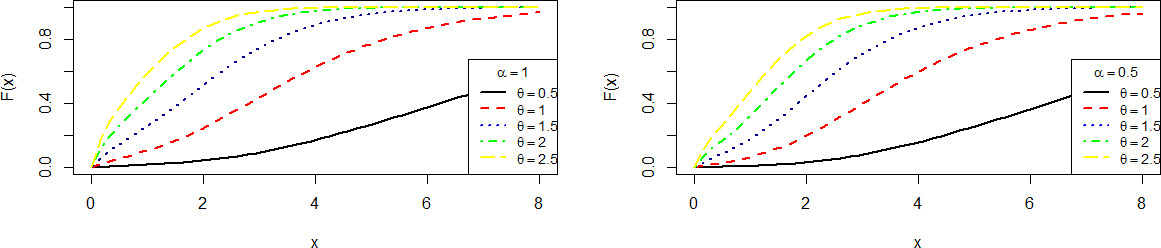
The survival function of the QRD for varying values of parameters.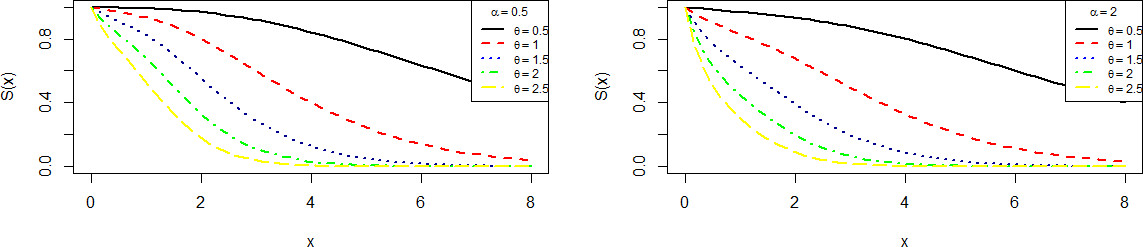
Behaviors of the pdf, the cdf and the survival function of the QRD are shown in the Figs 1, 2 and 3 respectively for varying values of parameters. From the graphs of the pdf, it is crystal clear that the QRD takes different shapes for various combinations of parameters and hence it has capability to model data of various natures. One of the interesting properties of the QRD is that for some values of parameters, it is bimodal and hence can be used for model bimodal data.
The
Taking
The moments based descriptive measures of the QRD such as coefficient of variation (C.V), coefficient of skewness, (
It can be easily verified that, at
Coefficients of variation, skewness, kurtosis and index of dispersion of the QRD for varying values of parameters.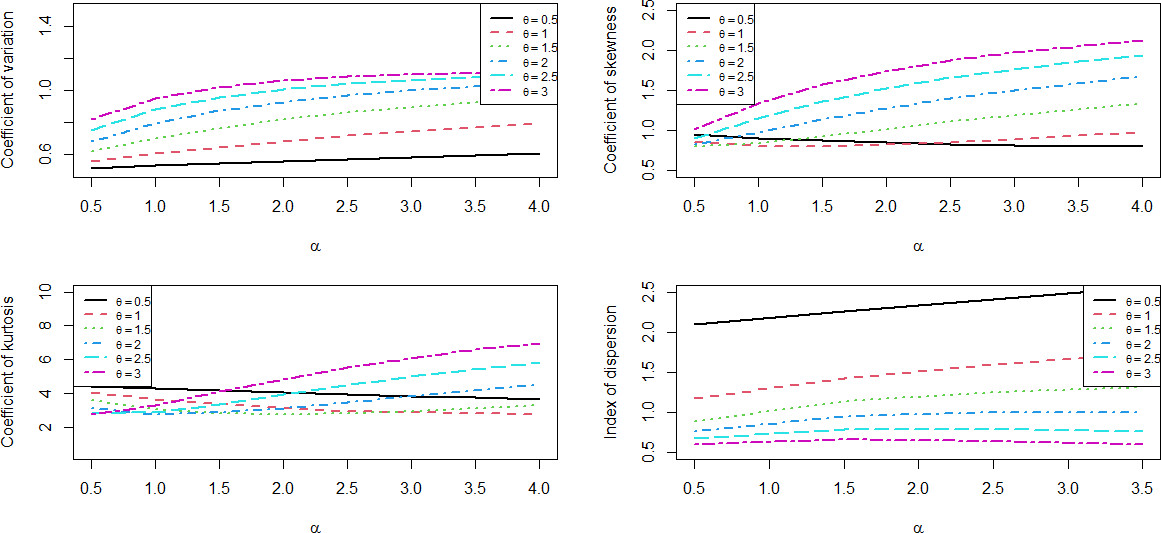
The behaviors of these descriptive measures are shown in Fig. 4.
Let
Now using the pdf and the cdf of the QRD, the hazard rate function,
Hazard rate function of the QRD for varying values of parameters.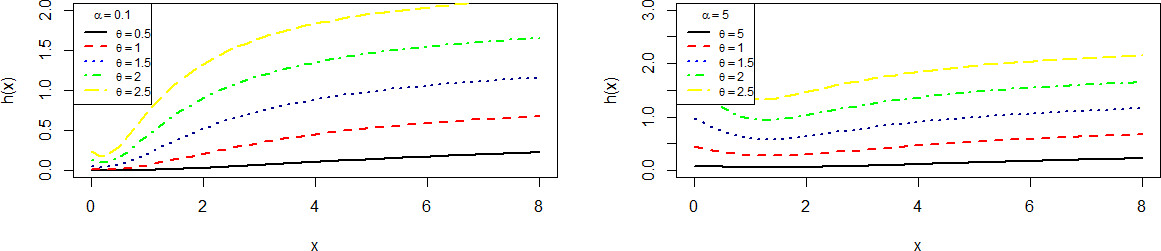
Mean residual life function of the QRD for varying values of parameters
Obviously,
The amount of scatter in a population is measured to some extent by the totality of deviations usually from mean and median. These are known as the mean deviation about the mean and the mean deviation about the median and are defined as
and
respectively, where
Thus
Stochastic orderings
Stochastic ordering of positive continuous random variables is an important tool for judging their comparative behavior. A random variable
stochastic order hazard rate order mean residual life order likelihood ratio order
The following results due to Shaked and Shanthikumar (1994) are well known for establishing stochastic ordering of distributions:
The QRD is ordered with respect to the strongest ‘likelihood ratio’ ordering as shown in the following theorem:
Proof: We have
Now
This gives
Thus for
In this section, the method of moments and the method of maximum likelihood for estimating parameters of the QRD have been discussed.
Method of moments
Since the QRD has two parameters to be estimated, the first two moments about origin are required to estimate its parameters. We have
Taking
Now, for real root of
This means that the method of moments estimate is applicable if
Using the moment estimate of
Thus the method of moment estimates
where
Let
where
The log-likelihood function is thus obtained as
The maximum likelihood estimates
These two log-likelihood equations do not seem to be solved directly. We have to use Fisher’s scoring method for solving these two log-likelihood equations. We have
The following equations can be solved for MLEs
where
A simulation study
BE and MSE for values
and
at
4
BE and MSE for values
BE and MSE for values
In this section, a simulation study has been carried to check the performance of maximum likelihood estimates by taking sample sizes (
Pdf and the cdf of the exponential, the QLD and the QAD
Pdf and the cdf of the exponential, the QLD and the QAD
ML estimates of the parameters of the considered distributions along with values of
As we observe from the graphs of the pdf of the QRD that for some values of parameters, the QRD shows bimodality. In this section, the goodness of fit of the QRD on one tri-modal dataset and one bimodal dataset has been discussed and compared with the exponential distribution, the Rama distribution (RD), the quasi-Lindley distribution (QLD) of Shanker and Mishra (2013), the quasi Akash distribution of Shanker (2016), the Weibull and the gamma distributions. The pdf and the cdf of these distributions are presented in Table 3. The following two datasets have been considered for testing the goodness of fit of the considered distributions.
Dataset 1: This censored tri-modal dataset contains 30 items that is tested when test is stopped after 20-th failure. The following data are available in Murthy et al. (2004), and the values are:
0.0014, 0.0623, 1.3826, 2.0130, 2.5274, 2.8221, 3.1544, 4.9835, 5.5462, 5.8196, 5.8714, 7.4710, 7.5080, 7.6667, 8.6122, 9.0442 , 9.1153, 9.6477, 10.1547, 10.7582.
Dataset 2: The following skewed to left dataset presents the lifetime of a certain device reported by Sylwia (2007), and the observations are:
0.0094, 0.0500, 0.4064, 4.6307, 5.1741, 5.8808, 6.3348, 7.1645, 7.2316, 8.2604, 9.2662 ,9.3812, 9.5223, 9.8783, 9.9346 ,10.0192, 10.4077, 10.4791, 11.0760, 11.3250, 11.5284 ,11.9226, 12.0294, 12.0740, 12.1835, 12.3549 , 12.5381, 12.8049, 13.4615, 13.8530.
Fitted plots of the distributions for the dataset 1.
Fitted plots of the distributions for the dataset 2.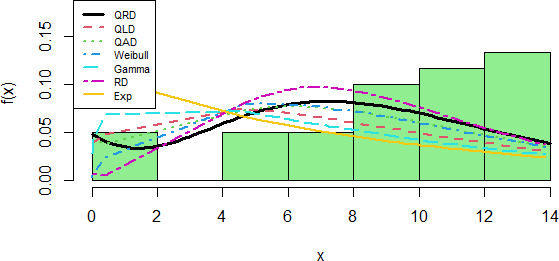
Profile plots of ML estimates for the dataset 1.
Profile plots of ML estimates for the dataset 2.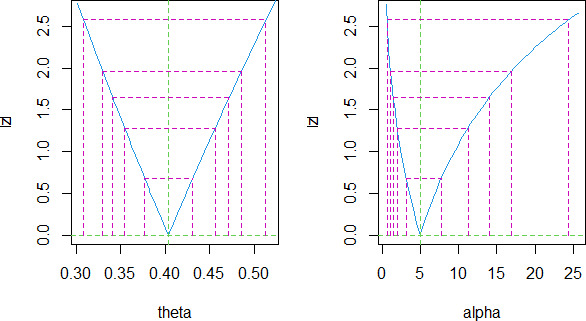
The corresponding maximum likelihood estimates of parameters along with Standard error (SE),
In this paper a two-parameter quasi Rama distribution has been proposed which includes the Rama distribution. Its statistical properties based on moments, hazard rate function, mean residual life function, mean deviations and stochastic ordering have been derived and studied. Method of moments and the method of maximum likelihood estimation of parameters have been discussed. A simulation study has been carried out. The goodness of fit of the proposed distribution has been compared with other one and two-parameter quasi distributions and two classical distributions, namely, the Weibull and the gamma and presented. As we have observed that the QRD gives better fit than two classical distributions the Weibull and the gamma over bimodal and tri-modal failure time’s datasets, it can be considered an important distribution over the considered distributions.
Since the QRD is a new distribution, it is hoped and expected that it will draw the attention of researchers for further works including its extension, modification and mixture and several new applications in different fields of knowledge.
Footnotes
Acknowledgments
Authors are grateful to the editor in chief of the journal and the anonymous reviewers for their valuable and constructive comments which improved the quality and the presentation of the paper.