



Abstract
To meet the needs of the growing population, the extraction capacity has outdone the regeneration capacity of renewable sources. So, the adoption of sustainable methods to generate energy should be seriously taken into consideration. However, the energy sector is facing numerous hurdles in implementing sustainable methods of producing clean energy. Existing research has identified a few factors that hinder the execution of sustainable energy development in South Asian Low and middle income countries (LMICs), but lacks a systematic investigation and is unable to decipher any causal relationship between the factors and their importance. This paper identifies the key factors that are being faced by the energy sector in the achievement of sustainable energy using existing literature and uses a Fuzzy Decision-making trial and evaluation laboratory (DEMATEL) to quantify the cause-and-effect relationship between the challenges. The results found were classified into financial factors, Operational Factors, and technical factors that were the key factors that act as a hurdle in the accomplishment of sustainable energy.
Introduction
For economies to develop economically and socially, energy is essential, but its production, transportation, and use determine the ecological impact on the local environment. The unprecedented growth of the population and the over-dependence on the electronic sector is further fueling the burden of the energy sector. Energy efficiency is imperative as the world’s fossil fuel supplies will run out in a few years, coal has been the main energy source worldwide, as well as the source of excessive carbon emissions that endanger the health of all living things, the emissions are contributing to global warming and increasing sea levels, the rising electricity price threatens to increase the debt burden of several nations. The Climate Change Intergovernmental Panel has estimated that to minimize the temperature rise to 2 degrees Celsius, the internationally agreed threshold to avoid the most severe and extensive effects of global warming, the world only needs to emit about 1000 gigatons of carbon dioxide from 2014 onward (International Energy Agency., 2014.). To decarbonize, one way is to replace fossil fuels with zero-carbon alternatives, such as wind, solar, hydro, geothermal, and tidal power; other options could be to increase nuclear power or use fossil fuels with carbon capture and storage (Sachs et al., 2019). To combat all these factors, a sustainable energy transition is necessary. An alliance between energy and sustainability is therefore crucial, to help countries formulate sustainable energy policies, using sustainable indicators and indices as tools to raise public awareness of energy-related issues (Muniz et al., 2020).
The current energy paradigm needs to undergo significant change to be sustainable, and a global system must be pursued and integrated into future technology selection, particularly in low and middle-income countries, which counters additional challenges as a result of continued economic expansion and a stronger need to enhance energy access and consumption levels (Jannuzzi, 2005). To achieve this, an instrument for measuring sustainability is needed. This led to the creation of a tool, the Global Reporting Initiative (GRI). The GRI illustrates the triple bottom line (economic, environmental, and social impacts) as a global standard of sustainability (Narula et al., 2021). GRI Standards can be used to prepare a sustainability report or to tailor a sustainability report to specific users or purposes, including providing information about climate change to customers (GRI – How to Use the GRI Standards).
The GRI guidelines promote sustainability reporting as an organization’s strategy for assessing and communicating its economic, environmental, and social impacts. It is used as a channel by organizations to respond to the demands of various stakeholders (Hahn & Kühnen, 2013). Environmental and sustainable reports can provide several benefits, including a boost to corporate reputation and brand value, gaining a competitive edge, maintaining transparency and accountability within the firm, legitimizing corporation activities, etc (Herzig & Schaltegger, 2006). However, in the process of implementing these standards, the low and middle-income countries face several challenges which hamper the transition toward a sustainable energy future. Literature has mostly explored the issues of sustainable energy in a single country, according to the extant literature, and has also failed to address a cause-and-effect relationship between the challenges which is required to understand how one barrier can act as the cause of one or more effects. Given this, and based on the literature analysis, this research constructs a system of challenges in the application of sustainable energy. The multi-criteria decision-making process is then utilized to determine the relationship between each element and the important influencing factors.
From the research gaps stated above, the following research questions need attention from the decision-makers:
What are the key factors that act as a barrier to implementing sustainable energy? Do these key factors influence each other? If yes, then how can we rank these barriers forming a cause-effect relationship?
Hence, Fuzzy DEMATEL is utilized to find a causal effect relationship between the barriers. The study is further divided into three sections. Firstly, to identify the research gap and the key influencing factors that act as a hindrance in the implementation of sustainability by analyzing the existing literature exists. Secondly, we gradually consolidate the data by merging expert perspectives to obtain a list of factors and assess the contextual relationship between the challenges with fuzzy DEMATEL. Finally, we analyze the research results and provide conclusions.
Literature review
The literature review is classified as follows: Section 1 consists of existing literature on sustainability in the energy sector. Section 2 states the work done in the energy sector using the Multi-criteria decision-making method. Section 3 describes the need for sustainability reporting in the energy sector. Based on the above-classified sections, Section 4 outlines the research gap, which is further analyzed in this paper.
Sustainability in the energy sector
Using efficient and environmentally friendly resources is an important part of ensuring that energy can be sustained both for current and future generations. Several conclusions can be drawn based on the findings of the challenges encountered in the implementation of sustainability in the sector. A framework developed by Painuly (2001) to identify and resolve barriers to the penetration of renewable energy sources found market failures and distortions to be major barriers and provided economic incentives and a guaranteed market as one of its solutions. Spalding-Fecher (2003) used Helio International Sustainable Energy Watch to assess indicators and data for South Africa, by evaluating the long-term viability of the energy sector, where it was found that, in terms of measurements for energy intensity and carbon emissions, the nation performed poorly and should look for other sustainable renewable energy sources besides conventional biomass. A study by Jannuzzi (2005) shows the Brazilian energy sector reforms and their impacts in areas such as energy efficiency, research, and development where it was learned that funding in research and development for energy efficiency is an important impact on institutional learning. A study by Bhattacharyya (2007) outlines the power sector reforms in five southeast Asian countries, using an economic model where political issues, acceptance of new rules by stakeholders, adaptation of the organizations, and proper transition management were identified as the key factors of reform success. The long-term viability of energy generation and consumption in Iran was analyzed by Karbassi et al. (2007) where the most important reason for energy inefficiency was found to be population growth, urbanization, high subsidies, and many more. A study on India’s energy consumption by Varun and Singal (2007) came to the conclusion that thermal power generation accounted for the majority of it and that the installation of renewable energy sources was hampered by high installation costs. According to Ma Z. Jacobson and A. Delucchi (2009), By 2030, wind, solar, and water resources might provide 100 percent of the world’s energy. A review by Shafie et al. (2011) discussed the present energy condition and policies in the Malaysian energy sector where due to their heavy dependence on non-renewable sources urgent action is needed in this regard to focus on potential renewable energy. In an examination by Chu and Majumdar (2012) the authors discussed the current energy landscape and suggested numerous research and development options for a sustainable and secure energy future for the world one of which was to accelerate the deployment and adoption of clean energy technologies. Schlör et al. (2013) examined whether the energy industry has progressed in line with the German government’s goals, and discovered that the energy system can be described using measurable, long-term indicators, and they have also identified places where political action is required. A systems dynamic model was validated by Blumberga et al. (2014) using a case study of historical data in Latvia which concluded that the model was consistent with the current data and was capable of generating future results. Dragos Paun (2017) analyzes the impact of switching to renewable energy on the financial performance of companies in Romania, and how the government can help the sector finance its high investment costs where results were found to be opportunistic based on the subsidies introduced by the government. Thrän et al. (2020) highlight the various stages of the German biogas industry’s development through the model of market phases. Papadis and Tsatsaronis (2020) explore whether technology options for decarbonization have been proven feasible energy sector in the future, the challenges to overcome, and solutions to those challenges, the result was found to be far from being satisfactory and suggested a carbon tax to be the most effective measure for the desired direction and global transition. Lastly, an examination by Siksnelyte-Butkiene (2021) investigated how the pandemic affected the energy industry and how that affected the creation of sustainable practices. Five primary sectors were found to be the most affected, with consumption and energy demand being the two most significant ones. Over the last few decades, extensive research has been done on sustainability in the Energy sector. The majority of studies have concentrated on the challenges facing a country, but not on the relationship between those challenges.
Multi-criteria decision-making in energy sector
This technique emerged in recent decades, and involves ranking by individuals, groups, or organizations for decisions making has developed tremendously since the 1990s, and various sub-fields have emerged, each with a substantial number of authors. A study by Nigim et al. (2004) applied two Multi-criteria decision-making (MCDM) tools, the analytic hierarchy process (AHP) and sequential interactive model for urban sustainability to prioritize locally available renewable energy sources. Streimikiene et al. (2012) employed ratio analysis-based multi-objective optimization and Technique for order performance by similarity to ideal solution (TOPSIS) methods to choose the most sustainable electricity production technologies. The analytic network process (ANP) was used by Kabak and Dagdeviren (2014) to prioritize strategic renewable energy sources in Turkey. A project finance selection using a moderate pessimism decision support model was evaluated by Garcia-Bernabeu et al. (2015). To prioritize four energy projects in the Indian energy sector Soni et al. (2016) used Fuzzy Promethee and Visual Promethee techniques. Dong and Huo (2017) adopted an integrated Fuzzy Delphi and Fuzzy DEMATEL approach to determine the financial obstacles to energy efficiency in small and medium businesses. Integrated MCDM with fuzzy preference connections was used to assess renewable energy resources in Turkey by Büyüközkan and Güleryüz (2017). Prioritization of alternate sources of renewable energy was studied by Çolak and Kaya (2017) employing AHP and TOPSIS methods. The best renewable energy source in Pakistan to invest in was identified using AHP, TOPSIS, and VIKOR methods by Ishfaq et al. (2018). Kaya et al. (2018) have aimed to lead the researchers focussing on energy sector applications using MCDM methods. The important influencing elements of sustainable development for conventional power generation were identified using a combination of Fuzzy Delphi, DEMATEL, and ANP by Dong et al. (2019). A comparison of renewable energy and conventional energy power plants was done by Muhammad and Kafait (2020) using the AHP technique. MCDM methodological approach was adopted by Spyridonidou and Vagiona (2020) to address the development of wind farms cost-effectively in Greece. To introduce a framework for renewable energy policy planning Alizadeh et al. (2020) used a hybrid MCDM approach by combining BOCR and ANP models. Researchers who employed MCDM to evaluate renewable energy technologies in a household was reviewed by Siksnelyte-Butkiene et al. (2020). Integrated Shannon’s entropy fuzzy MCDM approach was adopted by Saraswat and Digalwar (2021) to evaluate the sustainable energy alternatives in India. Narwane et al. (2021) also used ISM-DEMATEL, an integrated MCDM approach to interpretive structural modelling that aims to identify the constraints to the long-term development of biofuels. Again by using an integrated Fuzzy MCDM approach Saraswat and Digalwar (2021) evaluated the energy sources of sustainability. After reviewing the above works of literature it was found that none have used an MCDM technique to find a relationship between the existing barriers, which would be the focus of this study.
Sustainability reporting in the energy sector
To provide better transparency and accountability to the investor many countries have started publishing sustainability reports voluntarily. The energy sector is held accountable for the major emitter of carbon compounds and thus requires publishing regarding their efforts and innovations to reduce these emissions. Few literature reviews have been found in this area, where the need for sustainability reporting in the energy sector is highlighted. A study by Berthelot et al. (2012) studies how investors view the publication of sustainability reports in Canada where the sample size collected had 16.4% companies in the energy sector, the result of this paper showed that the energy sector was highly pollutant and needed a greater commitment of publishing sustainable reports. The status of environmental reporting in the wind energy sector of Spain was analyzed by Moseñe et al. (2013) where it was concluded that the disclosures lack effectiveness and reliability in the transparency of the sector. del Mar Alonso-Almeida et al. (2014) also analyzed the worldwide diffusion of GRI sustainability reporting focusing on the financial and energy sector from 1999 to 2011, it was found that the energy sector is at its expansive stage to be more sustainable and is expected to grow. The significance of Sustainability reporting in the energy sector is highlighted by Kowal and Kustra (2016). To examine the accuracy of climatic data, a qualitative content study of 21 energy sector businesses’ sustainability reports was conducted where it was confirmed by Talbot and Boiral (2018) that even though some improvements have been seen in disclosure practices to measure the emissions new reporting practices should be adopted. A critical analysis by Boiral and Heras-Saizarbitoria (2020) reveals that the assurance assertions in 337 sustainability reports from the mining and energy sectors do not establish a material, substantial, and reliable verification mechanism. What percentage of energy sector corporations in the European Union cover greenhouse gas and circular economy issues in their sustainability reports? were addressed by Janik et al. (2020) where it was found that the reports were focused on the emission issues rather than the circular economy issue. The level of engagement between stakeholders and firms was analyzed by studying 119 sustainability reports operating in the energy sector where it was implicated that many important insights have been developed by following GRI but are only limited to social aspects, a managerial tool is provided by Stocker et al. (2020) to categorize the stakeholder engagement strategy’s degree. al Hawaj and Buallay (2021) investigated the effect of sustainability reporting on a company’s success in seven distinct industries, where the energy sector was also included and was found to have a positive significant impact. To assist banking institutions in developing a strategy for reducing risk in loan decisions, reports from 17 energy-related companies were selected by Chatzitheodorou et al. (2021), the energy sector was chosen as the sample because it is a very environmentally sensitive industry, and it was determined that the sample companies needed to improve their business performance to lower their overall risk. Very little literature has been found relating to the energy sector and sustainability reporting which will be the focus of this study.
Research gap
The literature presented above has broadly focused on the need for sustainability and its importance. A sectoral analysis has been done but very few of them have specialized in the energy industry. The ones who have centered on the energy industry have identified the barriers to the successful implementation of renewable resources in the energy sector. Pathak et al. (2016) focused their study on the process of reforms introduced into the Indian power sector and the challenges that it faced, where one of the suggestions was to promote clean energy technologies by financial budgetary allocation. But Existing Literature has not distinguished one causal factor from another. Several factors contribute to the barriers to sustainability implementation, and they are all interrelated. Despite the use of case studies, empirical research, and other methodologies, many different ways have been employed to investigate the influencing aspects; nonetheless, the significant impacting elements have not been discovered utilizing multi-criteria decision-making. MCDM, a tool to rank the barriers and quantify the causal-effect relationship has also not been applied in a wider aspect. Even though the energy sector is considered the ‘dirty sector’, sustainability reporting has not been implemented in the sector completely. The extent of sustainability reporting in 19 energy sector companies in Bangladesh is depicted by Raquiba and Ishak (2020) where the result was very discouraging. Focusing on these research gaps this study will further analyze the relationship between the barriers to sustainable energy using the Fuzzy DEMATEL approach.
Research methodology
This section is divided as follows: First, there is fuzzy set theory, which converts language concepts into fuzzy numbers. Second, the triangular fuzzy numbers relationship is demonstrated. Third, the equations employed in the procedure. Fourth, the design of a questionnaire and data collection are demonstrated. Figure 1 depicts the steps taken to employ Fuzzy DEMATEL in this study.
Fuzzy number theory
Here, the fuzzy set
Explanation 1: The function is a constant mapping in the G to the [0, 1] interval. Explanation 2:
If the numbers fulfill the abovementioned criteria, they are termed fuzzy numbers. Fuzzy integers are represented by triangles, and fuzzy intervals are represented by trapezoids. If the triangular membership functions yielded satisfactory results, there is no need to utilize the more advanced methods. Table 1 shows the triangular membership function utilized in this investigation with the fuzzy DEMATEL approach.
Evaluation table for fuzzy DEMATEL
Evaluation table for fuzzy DEMATEL
Fuzzy DEMATEL technique.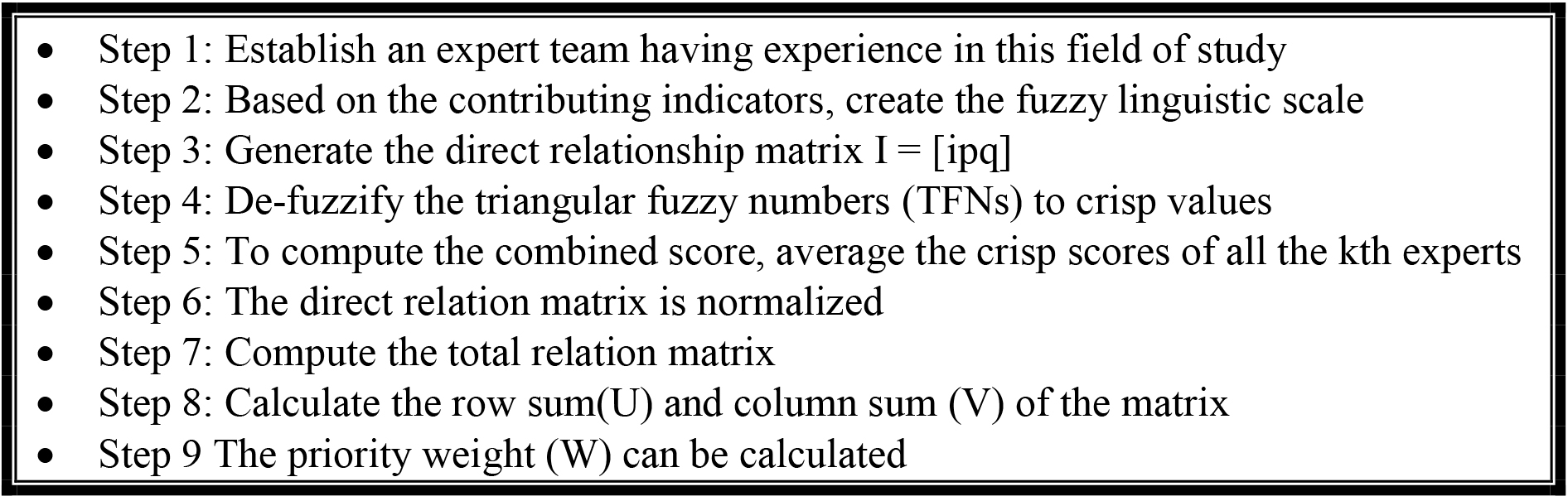
Triangular fuzzy numbers (TFNs) can be described as a number followed by three points representing as TFNs
TFNs are denoted as
For
Step1: Establish an expert team having experience in this field of study.
A decision-making group of ten industry experts was formed, which included five top management experts, two university professors, and three domain experts.
Step 2: Based on the contributing indicators, create the fuzzy linguistic scale.
Experts on the decision panel are required to provide their perspectives on various factors. A qualitative judgment was made by each expert about the challenges the energy sector faces in implementing sustainable development.
Step 3: Generate the direct relationship matrix
Here For For each expert, a c
Step 4: De-fuzzify the triangular fuzzy numbers (TFNs) to crisp values.
Standardizing fuzzy numbers
Where
Step 5: To compute the combined score, average the crisp scores of all the kth experts
Where
Step 6: The direct relation matrix is normalized. Here is the formula for formulating a normalized direct relation matrix
Step 7: Compute the total relation matrix.
Step 8: Calculate the row sum (U) and column sum (V) of the matrix by Eqs (19) and (20) correspondingly.
Where
Where
Step 9: The priority weight (W) can be calculated using Eq. (21) as shown below.
In this case,
Challenges in implementation of sustainable energy
The challenges identified from the literature sources are shown in Table 2 and their further classification into three major factors; financial factors, Operational Factors, and Technical Factors are shown in Fig. 2.
A total of 14 experts including 12 senior-level managers from the Energy sector and 2 academicians from similar research fields had filled out the questionnaire, shown in Table 3. Based on their knowledge and experience they were asked to fill in the data showing the relationship between one factor on the other. Like, the effect of the first factor on the third one is described as Very Low (VL) by the expert.
One of the experts’ original data examples
One of the experts’ original data examples
Using the original data, Eqs (14) and (15) are used, to obtain de-fuzzified values in Table 4.
Integrated crisp values
Table 4 is further normalized and made scale-free in Table 5, using Eqs (16) and (17).
Normalized initial direct relation matrix D
Classification of challenges.
The influence degree affected degree, centrality, and cause a degree of each factor are obtained using Eqs (19) and (20). Table 6 organizes and lists the numerical values of each index.
Total relation matrix – financial factors – matrix average (4.043)
The causal distribution of each factor is visually expressed in the coordinate system according to the cause degree of each factor in Table 7.
Cause-effect matrix
Similarly, the total Relation Matrix of Operational factors is as follows: Where Matrix Average is 4.665, Table 8 shows the cause and effect matrix of operational factors.
Cause-effect matrix
Similarly, the total Relation Matrix of Technical factors are as follows:
Where Matrix Average is 12.616, Table 9 shows the cause and effect matrix of technical factors.
Cause effect matrix
The cause group includes factors that influence other factors, whereas those who are influenced by others are classified as being in the effect group. However, improving one factor does not necessarily result in the improvement of the entire system, so it is crucial to recognize the dependence relationship to identify and remove obstacles in the cause group, which will then allow for the improvement of the effect group factors and, eventually, the entire system (Feng & Ma, 2020; Zhou et al., 2018). The financial considerations are ranked in order of importance based on the values of (Ui+Vi).: FF5
According to this ranking in financial factors in Table 7, the risk of corruption in the supply chain (FF5), is the most important cause in the implementation of sustainability in the energy sector. The supply chain of specific energy sources and their relevance in a given country are linked to the risk of corruption in the energy sector, The sociopolitical and institutional environment in which energy carriers are extracted, transformed, and used is critical in determining corruption risks (Lu et al., 2019).
By observing Table 7, the key factors that influence the implementation of sustainable energy can be shown. But to understand the relationship between these factors, a threshold setting is used to get a structural analytical result. The matrix average is calculated as 4.043, using which a relationship path diagram is obtained between the barriers.
Lack of Governmental support for sustainable solutions (FF2) is the second important cause of unsuccessful implementation of sustainable energy. Policies, schemes, and guidelines need to be formulated for the successful implementation of sustainability in the energy sector, and to improve its performance strict rules should be imposed to prevent and combat corruption activities (Narwane et al., 2021).
By the values of Ui-Vi, it can be seen that Political interference is the most affected barrier because to gather votes during elections local political parties promise to provide free electricity to the households which eventually is a loss to the state electricity boards.
Similarly for operational factors, the two main causes are ‘Interprets interventions effects and time lags differently’ (OF3) and ‘Lack of Flexible generation capacity’ (OF4). Interventions are underestimated with effects, leading to an overcorrection that then needs to be fixed in response to a perceived lack of response (Seadon, 2010). The incapacity to generate electricity at all times is a great challenge, especially when certain technologies are phased out simultaneously (Papadis & Tsatsaronis, 2020).
Similarly, the matrix average is calculated as 4.665 for operational factors, using which a relationship path diagram is obtained between the barriers.
Whereas the most affected barrier is ‘Poor Communication’ (OF7), which further involved two major issues, Lack of information and inappropriate media, where the society is unaware of their responsibility towards sustainability and the opportunities that come along with it (Yukalang et al., 2017).
Two major causes identified in the Technical factors are ‘less labor productivity and quantity’ (TF3) and ‘Lack of grid expansion’ (TF4). Low labor incentives also reduce productivity and efficiency, which ultimately hampers the final output. Also, the growing population has led to a high transmission and distribution network, where grid expansion isn’t increasing in the same way.
Likewise, the matrix average of technical factors is calculated as 12.616, using which a relationship path diagram is obtained between the barriers.
The most affected barrier here is ‘Organisational Politics’ (TF5), where organizations blame the government for not providing necessary incentives and not owning up to their inefficiencies.
Sustainability reporting must be enforced for organizations to be held accountable for their acts and to be more transparent in their actions. If the aforementioned sustainability challenges are addressed through the adoption of innovative sustainable energy technologies, the impact of reporting will assist an organization in improving its performance across all parameters of sustainability reporting, including economic, environmental, human rights, labor practices, and decent work, society, and product responsibility.
Conclusion and policy implications
Control of carbon emissions and following the path of sustainability is the need of the hour. The increase in the supply of clean energy will not only be beneficial for the environment but will also help organizations to be transparent and accountable for their actions. A responsible organization is more profitable in the long run than the irresponsible one. Clean and affordable energy would also help to reduce income inequality and other societal issues like poverty, hunger, etc. As a result, the goal of this research is to determine the most important components. hindering the achievement of sustainable energy as well as forming a causal relationship between the various factors. With the help of experts, The cause-effect relationship was quantified using a fuzzy DEMATEL. Where the risk of corruption in the supply chain, Lack of Governmental support for sustainable solutions, Interprets interventions effects and time lags differently, Lack of Flexible generation capacity, less labor productivity and quantity, and Lack of grid expansion were found to be the major barriers responsible for the successful execution of sustainable energy. Whereas the most affected factor was found to be Political interference, Poor Communication, and Organisational Politics. Through this relationship solutions to the major factors can be focussed upon and mitigate their most affected factors.
To overcome these obstacles, sustainable energy promotion policies are essential. Such as mandatory sustainability reporting for the energy sector in low- and middle-income countries, Restricting the usage of coal, and public and private collaborations in energy – production to support higher grid expansion investments. Organizations can also adopt sustainable energy policies by enforcing productive work incentives, becoming more responsible and accountable to the public, and scientific research and development of innovative energy technologies are vital for reducing environmental carbon emissions.
However, limitations do exist. First, this study was based on the decision maker’s judgments, therefore more multi-criteria decision-making techniques will be used in future studies more frequently to achieve more technical validity. Second, more decision-makers could be contacted to get more reliable outcomes. Third, solutions using innovative sustainable technologies to solve the key barriers and achieve the impact of sustainability reporting in performance haven’t been focussed further.