



Abstract
Understanding relationships between stress, resilience, mental wellbeing, and task-performance is critical for success in today’s sustainable workplaces. Thus, we aimed to analyse and develop a management framework to deal with this criticality. Inspired by Salutogenesis theory – prioritizing positive variables over the absence of negative ones, our emphasis was on resilience and mental wellbeing for stress management and improving task performance. Data from 445 employees was collected by a survey instrument employing standardised scales. Reliability and validity of constructs were established through the measurement model, while the structural model tested the strength of the relationships. Low stress and high resilience were identified as having a strong effect on mental wellbeing, which in-turn improved task-performance. This study highlights that resilience and mental wellbeing, in addition to stress management, significantly improves task performance for sustainable workplaces.
Introduction
Interactions of certain mental health dimensions like stress, mental wellbeing and resilience with task performance becomes crucial, impacting dynamics of both individual and organizational success within modern workplaces across industries. Globally, more than a billion people suffer from mental illness, causing disability and death, and $1 trillion in lost productivity from depression and anxiety; therefore, it is essential to understand the significance of mental health, which includes personal development, overcoming obstacles, contributing to community, and successful functioning (Cuijpers et al., 2023). Mental wellbeing is the degree to which people feel happy and content with their lives, which highly influences productivity at work, physical health, and overall happiness (Burford et al., 2017). Stress affects the body and mind and is caused by tension or worry in difficult conditions. Moderate stress helps with everyday duties, but high stress damages one’s physical and emotional wellbeing and necessitates coping mechanisms (World Health Organization, 2020). Resilience reduces lost productivity, promotes a pleasant atmosphere, and increases wellbeing, as proven by its immediate influence on emotional state, hence enhancing productivity and skill transfer (Freeman & Carson, 2007). The quantifiable actions of employee aligned to organization’s goals, is referred to as work performance (Curral, 2014) and task performance is job-related task, critical for organizational success. This knowledge helps to create and sustain a better work environment for productivity (Pradhan & Jena, 2017). In competitive industries, sustaining peak performance while under pressure and to understand market dynamics and consumer behaviour, is critical for organizational resilience and managing stress (Singh et al., 2019). Exploring the interrelations – resilience is found to be inversely related to burnout and positively related to job engagement. Given their anticipated high positive link, resilience may have an indirect impact on task performance (Cantante-Rodrigues et al., 2021). Also, psychological wellbeing maybe adversely associated with stress, whereas psychological wellbeing and resilience maybe favourably correlated. Therefore, improving resilience and stress management may enhance mental wellbeing (Klainin-Yobas et al., 2021). The relationship between low mental health and reduced productivity and task performance at workplace, highlights the need for continued research in this area, to provide meaningful policy suggestions (de Oliveira et al., 2023). A captivating theory – Salutogenesis, emphasizes the strong ‘Sense of Coherence’ (SOC) i.e. comprehensibility, manageability, and meaningfulness – which, linked to resilience, mental wellbeing, and stress management, indirectly contributes to skilfully managing tasks and challenges in various facets of life, subtly addressing task performance (Antonovsky, 1979).
Understanding resilience, stress, mental wellbeing, and task performance in the context of HR and leadership innovation for sustainable workplaces and organisational success is essential (Rana, 2021). Prior studies concentrated on individual characteristics, with very few studies investigating their interconnections. SEM prioritizes stable parameter values, model fit, validity, reliability, and collinearity diagnostics to ensure precise linkages in high-quality research (Bollen, 2011). Thus, the objective of this study was to evaluate the relations between these four constructs, develop a SEM framework, test validity and reliability.
Literature review
The section includes thorough examination of existing studies, articles and papers relevant to our study, covering the underpinning theory and constructs.
Underpinning theory
Upon exploring theories, we found that our research is highly compatible and inspired by the Salutogenesis Theory. This theory stresses that people can effectively manage life’s stressors by viewing them positively as understandable, controllable, and meaningful. It inspires people to prioritize positive variables over absence of negative ones, hence, resilience and mental wellbeing are highlighted as positive variables apart from stress management for improving task performance, rather than absence or elimination of various negative variables coercing mental health and performance at workplace (Antonovsky, 1996). Salutogenesis theory has major applications in a variety of domains, including intergroup conflict, politics, policymaking and architecture (Mittelmark et al., 2022).
Resilience
To overcome turbulent and uncertain times, organizations require resilience, which consists of three stages: anticipation, coping, and adaptation. Resilience helps recovery from crises and future success by managing the organisation’s fundamental competencies (Duchek, 2020). Competitive situations like in software companies, optimizing software increases resilience, leading to cost effectiveness and continuity of the product, service, and corporation as whole. Similarly dynamic workplaces demand leveraging big data with cloud computing efficiently, indicating policies due to workplace resilience (Kansal et al., 2016; Sachdeva et al., 2016). Another example, using sustainable supply chain methods promotes resilience, assuring adaptation and long-term success (Govindan et al., 2017). Individual resilience includes coping mechanisms and individual strengths, which is crucial for overall wellbeing both mentally and physically (Fullerton et al., 2021). Increased resilience is associated with the capacity to quickly bounce back or recover from stress. This relationship may be observed in mindfulness, emotional clarity, purpose in life, optimism, and active coping (Smith et al., 2018).
Stress
Anxiety, sleep disturbances, and cardiovascular problems are just a few of the symptoms that arise from stress. Stress is the intricate combination of physical, mental, and emotional reaction to a variety of factors such as work pressures, financial difficulties, and family problems. Unfortunately, they play a significant role in a wide range of health problems, with stress-related disorders making up a significant portion of primary care physician visits (Sujaritha et al., 2022). Achieving personal and organizational goals requires an understanding of and ability to manage stress. While some stress ‘eustress’ can be helpful, excessive stress ‘distress’, that may result from things like administrative style and work control can have negative effects on an employee’s mental and physical wellbeing. Hence, it is critical that workers enhance self-control, positive self-esteem, ongoing professional development, efficient project management, and delegation techniques (Panigrahi, 2016). Another example, situations like Industry 4.0’s fast changes necessitating upskilling, increases employees’ stress, who are juggling performance standards and uncertainty (Agarwal et al., 2022).
Mental wellbeing
As per PHAC and then WHO, a person who is in a state of mental wellbeing believes in their own skills, knows how to handle everyday stressors, works productively, and makes a constructive contribution to society (Manwell et al., 2015). Mental health ailments are disorder that impact feelings, ideas, actions, or overall functioning (de Oliveira et al., 2023). The financial implications of mental health problems among employees, lower productivity, and the critical role that a mentally healthy workplace plays in retaining talent and enhancing employee happiness all highlight the importance of mental wellbeing at work (Coppens et al., 2023). By creating a sense of purpose and community, which are essential for general mental health, addressing societal issues in business – such as with Society 5.0 – indirectly supports employee mental wellbeing (Agarwal et al., 2022). An Indian study on workplace mental health emphasizes interventions for young adults and highlights barriers such as guidelines, funds, awareness, and cultural blind spots, urging more research on providing supportive work environments and improving performance (Pandya et al., 2022).
Task performance
How successfully a person or group completes a work or project and meets its objectives is known as task performance. It’s essential for assessing work, determining an individual’s or team’s strengths and shortcomings, establishing objectives, giving feedback, and inspiring greater performance and fulfilment (Bhardwaj & Kalia, 2021; Bentley et al., 2019). Ostracism at work impairs performance, underscoring the need of developing strong relationships, being inclusive, and working as a team to lessen its effects. Successful companies depend on social ties and effective task performance (Chung, 2020).
Proposed hypotheses
Based on the literature review and underpinning theory the following hypotheses were proposed:
H1: Resilience negatively influences Stress. H2: Stress negatively influences Mental Wellbeing. H3: Resilience positively influences Mental Wellbeing. H4: Mental Wellbeing positively influences Task Performance.
Research methods
This section provides information on the methodology for data collection and analysis.
Measurement development
Based on the foundational theory and literature review, this study investigated the correlations between four constructs utilizing a quantitative descriptive research approach. For psychometric investigations on mental health, stress, and related subjects, descriptive study design has been proven to be appropriate. To ensure practicality and efficiency in acquiring data, a total of 445 respondents were chosen by convenience sampling from a variety of international organisations. In order to take part in the self-administered survey, participants had to be comfortable with English language. We had the participants’ informed consent, and their answers were kept private. Demographic data was collected to contextualize the sample in relation to the population, increasing the significance of the study. Factors such as income, education, marital status, and gender were taken into account. People who had either sought advice from a psychologist for any issue or were thinking about doing so made up the sampling units.
To ensure the validity and reliability of the results, the survey used well established measuring scales derived from reliable literature. Scales including – the Perceived Stress Scale which was developed to gauge how much people believe their lives are stressful based on their feelings and thoughts (Cohen et al., 1983); the Brief Resilience Scale which was created to assess a person’s ability to recover or bounce back from challenging circumstances (Smith et al., 2008); the Task Performance Scale, which measures how well an employee performs their primary job responsibilities and duties (Koopmans et al., 2013; Ramos-Villagrasa et al., 2019); and the Warwick-Edinburgh Mental Well-being Scale, which was created to determine mental health by assessing aspects such as satisfaction with life, joy, emotional functioning and more (Tennant et al., 2007). A model comprising of four hypotheses was proposed. AMOS software was utilized for data analysis using Structural Equation Modeling (SEM). Factor loadings for every item under the constructs were assessed, and the psychometric qualities and relationships of the constructs were carefully investigated. All constructs’ measurement models were examined to ascertain their convergent validity and reliability, and model fit was evaluated with a variety of fit indices. The direction and strength of the correlations in the model were examined.
Results
This section covers the study’s findings, including statistical analysis and outcomes.
Demographic distribution
The sample’s demographic characteristics are displayed in Table 1. Equal gender representation was shown by the sample, which included 220 male participants (49.4%) and 225 female participants (50.6%). In terms of marital status, the majority of people were married (55.7%), with those who were single (41.4%) following behind. Those who were widowed (1.8%) or divorced (1.1%) made up a lesser fraction. The sample was largely well-educated, with 66.5% of the sample having a master’s degree or higher, 29.9% having a bachelor’s degree, and 3.6% having just completed high school or a diploma. The group comprising the largest number of participants (32.6%) had household income exceeding Rs. 32 Lacs. This was followed by Rs 8–16 Lacs (19.1%), Rs 0–8 Lacs (18.7%), Rs 16–24 Lacs (15.5%), and Rs 24–32 Lacs (14.1%). The Indian Rupee (Rs. or INR) is the country’s national currency, with ‘Lacs’ representing 100,000 units. At the time of this research, one US dollar was about Rs. 83, or 83 INR (Forbes India, 2024).
Demographic
Demographic
Structural Equation Modeling (SEM) using various statistical tools were explored (Sahdev et al., 2022), and AMOS was found fit to be employed due to the multivariate nature of the proposed model for examination of the relationships between the model constructs (Verma, 2020).
Composite reliability evaluated the internal consistency of items for constructs, similar to Cronbach’s alpha but more precise in SEM. Formula being:
CR: Composite Reliability
Average Variance Extracted (AVE) measured variance captured by construct relative to error. Formula:
AVE: Average Variance Extracted
Regression showed relationship between variables with error. Formula:
Standard Deviation (SD) calculated dispersion around mean in dataset. Formula:
SD: Standard Deviation
Psychometric properties and corelations
Psychometric properties and corelations
Factor loading
The factor loadings of the items are mentioned in Table 3. The Measurement Model of all the constructs were above the acceptable limits as shown in Table 2. The reliability of all the constructs were above the threshold of 0.700, while convergence validity of each construct exceeded 0.500 (Hu & Bentler, 1999). The diagonal values in the bold (Table 2) are the square root of the AVE. The inter-construct corelation values are lower than the square root of the AVE. This signifies that the four constructs in Table 2 are discriminant to each other (Fornell & Larcker, 1981).
This was followed by testing the strength and direction of the proposed hypotheses using AMOS. The model fit indices were above the cut off limits indicating the robustness of the model. CMIN/DF
Hypotheses summary
Structural model.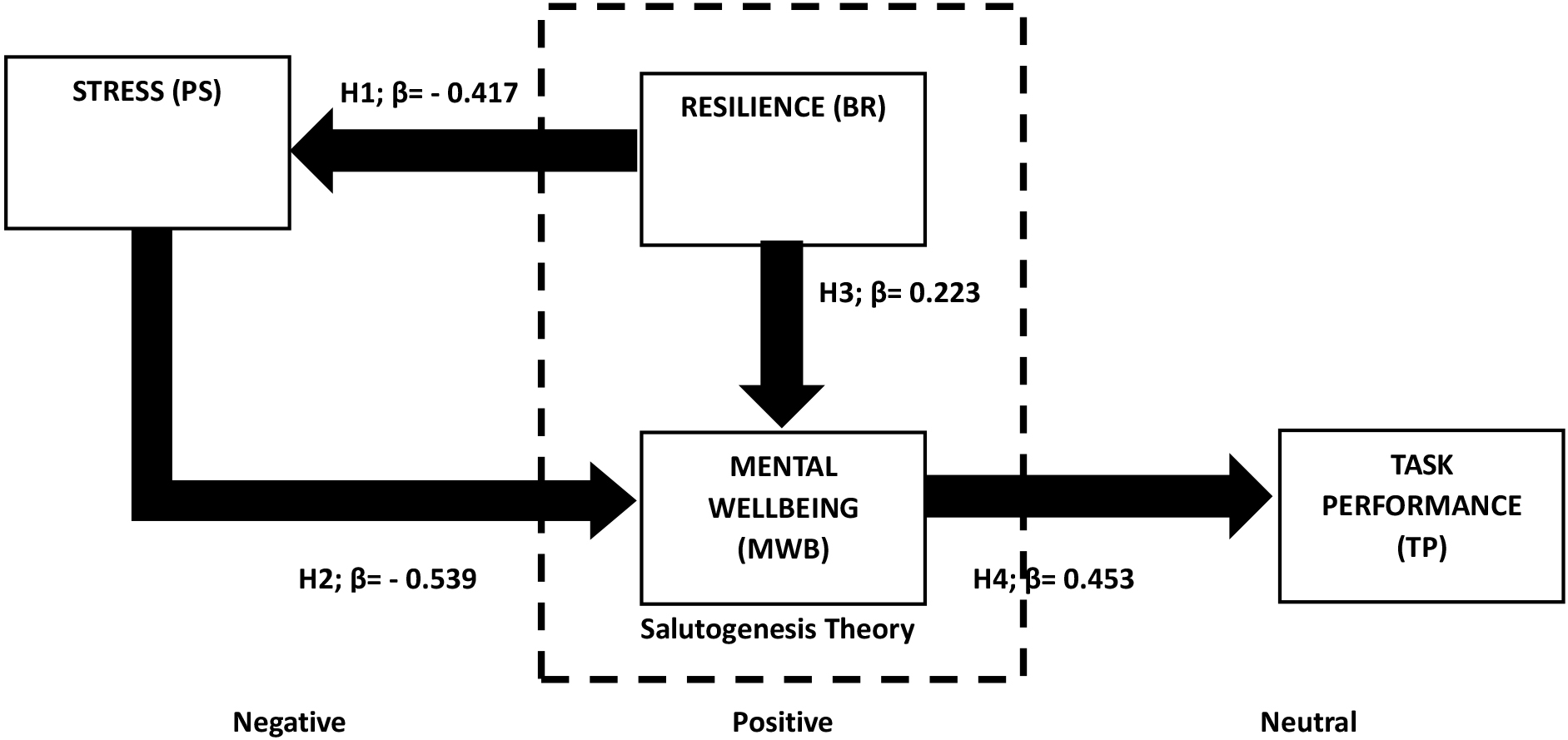
The literature review and the four hypotheses propose the following model as depicted in Fig. 1. The results with their unstandardized and standardised path estimates show (Table 4) that all the hypotheses are significant. Resilience influencing stress (H;
Stress management is aided by resilience, as indicated in research conducted in demanding industries (Singh et al., 2019). Better stress recovery is correlated with increased resilience, which is associated with personal resources like optimism and mindfulness (Smith et al., 2018). This is corroborated by our findings in hypothesis H1, which demonstrate the importance of resilience in stress reduction based on statistical data. Numerous research backs up the theory that stress has a harmful impact on mental health. The psychological wellbeing of an individual can be greatly impacted by stress from demanding employment and these effects can be lessened by using stress-reduction strategies, such as binaural beats (Masri et al., 2023). Reducing stress improves overall wellbeing, according to research. Hence our research hypothesis H2 supports this by demonstrating statistically supported inputs. Research backs up our hypothesis H3 that resilience has a favourable impact on mental wellness. Research indicates a connection between resilience and psychological wellbeing with insights like – the use of mindfulness and self-compassion can improve mental health, build resilience, and create a positive workplace (Klainin-Yobas et al., 2021; K & Sulphey, 2023). Numerous research back up the idea and hypothesis H4, that mental wellbeing has a progressive impact on task performance (Kapoor, 2019). Ostracism has a detrimental effect on productivity at work, highlighting the need of having healthy interpersonal relationships which comes from maintaining positive mental wellbeing of employees at workplace (Chung, 2020). Reduced productivity is correlated with low mental wellbeing, highlighting its importance and policy recommendations for the better (de Oliveira et al., 2023). Our research is further validated by the fact that interventions for increased mental wellbeing result in enhanced task performance (Pandya et al., 2022).
In keeping with the Salutogenesis theory’s guiding principle which concentrate on positive factors to improve health, this study underlines the importance of resilience and mental wellbeing in the office. The research illustrates the effectiveness of using strengths-based strategy by illustrating the interaction between these positive variables and their effects on task performance and managing stress. The results validate that building resilience and improving mental wellbeing may have favourable impact on overall task performance and reduce stress which in-turn may have a favourable impact on mental wellbeing. This supports the idea that fostering resilience and mental health resources at workplace, which in-turn reduces stress and increases employee wellbeing, may improve organizational outcomes. In light of the significance of utilizing positive factors to foster a sustainable, flourishing and productive workforce, this study offers empirical evidence for the implementation of Salutogenesis Theory in professional contexts.
Research findings have shown that effective managerial practices may require deeper awareness of the interactions between resilience, stress, mental wellbeing and task performance. With this understanding, leaders, HR and managers may create an innovative, sustainable, positive and effective workplace. Organizations may promote resilience by allocating resources for continuous learning programs, flexible work schedules, and crisis management strategies. These initiatives may strengthen resilience to withstand uncertain situations and improve adaptation. Organisations may adopt systematic programs designed to improve employees’ coping skills and promote attributes like flexibility and the capacity to solve problems in order to overcome obstacles. Additionally, companies may put in place efficient programs for stress management, provide resources to assist with stress reduction, use AI enabled tools and technology, adopt spirituality and emotional intelligence at workplace, encourage work-life balance, and hold workshops on stress awareness. The resilience of a company and its employee mental wellbeing can be enhanced by proactive stress management. So, it is suggested to create thorough policies and procedures to handle stress, promote open communication, and put methods in place to lessen stressors associated to the workplace (Kapoor, 2024). Mental wellbeing at the workplace may be increased by creating a welcoming environment, nurturing workplace culture that makes workers feel appreciated, giving employees access to mental health services, focussing on work-life balance, and promoting wellness with programs like mindfulness training. Setting mental health as a top priority may improve task performance and foster a happy workplace. Organizational objectives and worker wellbeing could be synchronized by managers. Establishing realistic and reasonable organizational objectives, balanced workload, creating possibilities for skill development, and recognizing accomplishments to promote a happy workplace. To raise employee spirits and motivation, organisations may promote cooperation and teamwork. Encouragement and acknowledgment for good performance and achievement maybe highly useful. They could also receive feedback and assistance when needed. It may be critical to conduct routine workplace monitoring and assessment. Organisations may maintain constant observation over the overall condition of the workplace, levels of stress among workers, and indications of poor mental health. To adjust tactics and gauge how effective employees are, feedback systems may be deployed. To sum up, strategic interventions and proactive measures may be quite essential for these issues to be managed effectively. Managers may improve task performance by fostering a work environment that emphasizes resilience, managing stress, and mental wellbeing via the implementation of focused programs and policies. This may lead to long-term success by improving employee satisfaction and organizational effectiveness even more.
Conclusion and limitation
This empirical study investigates various crucial aspects of stress, resilience, mental wellbeing, and task performance at workplace, in a comprehensive manner. Strong resilience successfully reduces stress and has a favourable influence on mental wellbeing, which in turn enhances task performance in professional settings. Optimizing task performance therefore requires appropriate stress management, resilience building, and mental wellbeing enhancement. Thus, there is a need to establish proactive measures to promote organizational effectiveness and provide a supportive work environment, which includes stress management programs, crisis management plans, mental health assistance and other techniques. These measures will encourage resilience, stress management, and mental wellbeing for better and optimal task performance. On understanding limitation of the study – Adoption of the convenience sampling approach could be replaced by randomization as sampling technique in further research, along with longitudinal surveys; Subsequent studies could examine related factors such as depression, abuse, contextual performance, unproductive work behaviour, and/or other variables so as to have a better knowledge of mental health and performance at the workplace.