




Abstract
This paper critically reviews the role of dairy farming policies and interventions required by the different government agencies and their associations. This article explains the divergence in formulation and implementation of dairy development policies and schemes (DDPS) in the Indian dairy sector. This paper is based on qualitative research representing a diverse range of epistemological, theoretical, and disciplinary perspectives. Review of Literature is to access databases from peer-reviewed journals and published survey reports of statutory and non-statutory bodies in the dairy farming sector. Dairy farmers/dairy entrepreneurs/milk producers are the respondents and information gathered through detailed telephonic interviews and audio recordings due to COVID-19 outbreak. Sample size ranges from 5–10 responses from stakeholders involved in dairy farming in Milk Supply Chain (MSC). Thematic Analysis (TA) is used for identifying, analyzing and interpreting patterns of text and its meaning (‘themes’) using NVIVO 10 software.
Benefit of this research are also academicians, researchers and agriculture scientists for further research in the field of dairy farming and MSC.
This paper develops a fair understanding about risks and challenges among small-medium size farmers in effective implementation of dairy development programmes and schemes.
Dairy producers,processors and enterprises are able to formulate better marketing strategies for future market expansion of desi cow milk.
Grounded Theory (GT), an iterative process based on the perception and concerns of respondents gathered from initial data is a novelty of this research. Study is only limited to qualitative approaches with small sample sizes. There is a need to investigate other statistical methods to validate the research.
Introduction
In India, the Dairy Sector as an integral part of national development contributes to twenty percent of GDP and twenty two percent of global milk production across the world of bovine population. It also played an important role in generating employment in the rural sector during COVID-19 situation where millions of families migrated to their native place in the lockdown period.
Sustainable agriculture and dairy policies support marginal and women farmers holding less than two hectares of agricultural land. Most of the milk is produced by animals reared by small-medium size farmers. This article develops insights into economical, political and environmental issues related to the informal sector in the A2 dairy supply chain. The significance of A2 milk compared to A1 milk depends upon the presence of beta-casein protein, consisting of a chain of amino acids. In the A1 milk variant, it is found at 67 the th position as peptide bond residue, Histidine form Beta-casomorphin, whereas in A2 milk, found at 67 th position as peptide bond residue Proline, which posses nutritive value (Polastrini et al., 2022).
This study is directed towards the formulation of a sustainable policy framework in an unorganized sector of A2 milk supply chain. This study was contributed to stakeholders in the dairy business for better marketing strategies and future market expansion.
The Indian dairy industry is segmented into both organized and unorganized sectors. The organized sector comprises dairy cooperatives and private processors (domestic and multinationals). It is estimated that it procures twenty-four per cent of the total milk production, in which cooperatives and private processors contribute a similar share of seventeen per cent.
The organized sector mainly dominates the Indian dairy industry due to resource-rich and extensive land farmers. Dairy farming and milk procurement in the informal sector are processed by small dairy farmers mainly for self-consumption. Sales are primarily generated from milk vendors or local milk traders, twenty-seven per cent of hallways (sweet-makers), small-scale dairy processors and household consumers (Sharma, 2015).
In the organized sector, nearly fifty per cent of milk is procured by the two states, v, iz. Gujarat and Karnataka, as against their share of only twelve percent in the national milk production (NDDB, 2016). In the informal sector, dairy processors dominate the domestic market in dairy-developed states like Maharashtra, Punjab, and Haryana.
Literature review
It is evident from the existing literature that there are no such guidelines to differentiate between the milk of A1 and A2 allele cow breeds found in India to assure the quality and safety standards for milk users, Food Safety Standard Authority of India (FSSAI) Regulations 2011. Adoption of modern techniques in dairy farming improve the quality standards upto some extent. There is a sudden increase in disposable income of households in urban populations, which leads to higher demand for premium products and expands the A2 milk supply chain. New entrants like private players, district or local co-operative milk marketing federations, declining interest in dairying business promotes A2 dairy farms as a profitable investment opportunity for small-medium sized farmers (CMIE Report, 2020).
The small-medium sized dairy farmers producing milk of indigenous cows (A2 milk) in rural areas, primarily depend on local suppliers, retailers and milk vendors for their distribution and transportation of milk, incur high expenditure and production cost (Sharma, 2015). The small dairy farmers cannot access financial assistance from commercial banks and credit cooperatives, due to the high-interest rate and complex banking formalities. Financial institutions and development schemes provide loans mainly to the agricultural sector, including animal husbandry and dairying, up to five percent (Birthal & Negi, 2012). Financial institutions are reluctant to lend them because of the higher transaction costs and lending risks (Miller & Jones, 2010; Chen et al., 2015), so they are more comfortable lending money from informal sources, viz. moneylenders, traders and input dealers, who often charge high-interest rates.
Objectives of the study
The objective of this study is to understand and to compare the awareness level of dairy farmers in the organized and unorganized sector about the A2 Milk Supply chain in the Indian dairy sector.
To identify the key drivers for enhancing the importance of indigenous cow milk as compared to exotic cow milk in the Indian dairy sector. To identify the awareness level among dairy farmers/suppliers about the government initiatives in promotion of indigenous (A2) cows breeds in dairy farming. To understand the awareness & satisfaction level of milk consumers about indigenous (A2) cows as value-added products to enhance customer satisfaction level for milk and dairy products. To understand the Impact of Pre-COVID-19 and Post-COVID-19 challenges in the Indian dairy sector.
Methods and materials
This study is based on an inductive and qualitative approach, data is collected from the ground where sentiments, opinions develop theory. This article is based on a repeated process of elaboration, verification and deduction. There is an existing knowledge about the subject on which data initially gathered and to emerging out the present issues.
Qualitative data analysis based on telephonic interview of participants
Qualitative data analysis based on telephonic interview of participants
The topic is related to developing a better understanding of sustainable dairy farming practices, awareness of the protection of the indigenous cow herd community and the usage of milk having health benefits. In this study, statistical analysis can be used to interpret the data gathered through surveys and field studies of the dairy sector, Which conceptualized and tested the statistical models.
This study gathered a limited number of data from a population subset (Table 1). The sample was selected based on research attributes and objectives for a given analysis. Here, data were collected from snowball and convenience sampling techniques through individual depth interviews. Snowball and convenience sampling methods were used to gather data from the initial participant to connect with other participants from different perspectives of stakeholders. An Individual Depth Interview (IDI) is an interaction and communication between a particular interviewer and a single participant (Creswell & Poth, 2016). Personal depth interviews generally take 15 minutes (telephone interviews) and 1.5 hours upto 3 Hrs. in different phases (prescheduled, face-to-face interviews) to complete, depending on the issues or topics of interest. In this case, interviews are gathered through audio-video conferencing google meet mode due to the COVID-19 period (Table 2).
Demographic details of participants gathered through telephonic interview
In this study, Grounded theory is used for data analysis. grounded theory is a social sciences phenomenon and methodology to explain the emic (insider) point of view and experience of participants from the field in natural settings. In this study grounded theory developed a framework on data gathered from dairy farmers/processors and stakeholders. Grounded theory is used in this study to shed light on the area of the dairy sector which remains unaddressed like the A2 dairy supply chain. It is the easiest approach to reporting and collecting data from the ground to maintain reliability and transparency in research (Turner & Astin. 2021).
In qualitative research, data analysis is needed to analyse data in text or images and interpret it meaningfully. It helps better provide insights into the problem and creates a conceptual framework for the related domain. It churns the ideas, opinions, and thoughts until saturation point. It is a simultaneous procedure that starts with data collection in the form of an interview or observation method, along with recording, analysis, and interpretation of the participant’s version by the interviewer. Text or data used in qualitative research is in-depth and voluminous. Hence, all the information gathered is segregated into small statements or sentences needed to winnow the data (Guest et al., 2012).
Thematic analysis is a qualitative phenomenon identifying themes. The process is mining the information till it reaches saturation by reading and reading the data. In this process, determining factors and constructing manifest the data’s sub-categories (Vaismoradi et al., 2016). In qualitative data, thematic analysis (TA) is used to identify and interpret the transcripts with patterns of meaning, i.e., themes, through coding procedures on participant narratives. Codes are the tiny units generating similar and exciting features related to the relevant research questions. TA of dairy farmers or producers through in-depth interviews broadly classified into following major themes after thorough review of transcripts.
Awareness Level which is further categorized into codes: consumer awareness level Dairy Development Programmes Farmers Awareness Level Organic dairy and Milk Products.
Theme (1) helps identify awareness among dairy farmers/producers/ processors about the type of milk they sell to their customers in the markets. Are they aware of the A1 and A2 type cow variants and their benefits? Is there any significant difference between the variants? They supply the milk with the same quality they offer to their customers.
Theme (2) explains dairy farming policies and their implementation in areas of concern like certification of milk and dairy products. Policies to restrain unfair trade practices and adulteration. Financial assistance to small and medium-sized farmers.
Theme (3) describes the role of government guidelines, certification and technology in dairy farming for the unorganized sector where most dairy farmers/processors/producers contribute to this agro-processing and dairy farming industry. The responses of famers/ processors/stakeholders are mentioned as follows and it facilitates to developing themes generated from the responses.
Theme (4): It explains the risk and challenges faced by the dairy farmers/processors/stakeholders in A2 dairy farming. Reasons for disruptions in supply chain and how to mitigate the risks involved in procurement and logistics activities.
Q1: In your opinion, what is the general health conditions of A2 Desi cows of different breeds in comparison to A1 exotic cow breeds in your dairy farm
Health benefits of A2 cows as compared to A1 milk cows., Better packaging means use of bottles instead of polythene/plastic packets. Encouraging the start-ups for ease of A2 dairy farming business., Financial assistance for small sized and medium-sized farmers for running dairy farming., Develop awareness among people for A2 milk consumption related to its health benefits., Production of less quantity of milk from A2 Cows in comparison to A1 milk., Less profit margin in case of A2 milk compared to A1 milk or normal milk.
Q2: According to you, what are the important factors for running an efficient dairy supply chain?
Q3: What are your expectations from the Government to promote and expand A2 milk dairy farming? Please explain.
Q4: What are the challenges and risks faced by you in running dairy farming?
Customers should be ready to pay more.
Government should create a market & awareness about health benefits of A2 milk
Yes, the government needs to fix the minimum msp for fodder and feed and green grass so that dairy farmers can reduce their A2 milk cost and the government needs to promote A2 milk dairy farmers. And support them with their current dairy farming policies with benefits reducing their restrictions on bank funding. Desi Cows must be mandatory for each farmer so that they can produce Maximum A2 milk. In that case A2 milk must be quite cheap according to the current scenario.
Majorly Govt should create awareness for A2 milk like they had done in “Swachh Bharat Abhiyan”
Create a market where we can sell our dairy products and get good profit
Governments make their policies easy and cheap. Government needs to arrange easy and cheap fund policies for A2 milk farmers. Also fix maps for milk and green fodder. Bank need to easy paper work don’t entertain to A2 milk
Encourage the farmer by providing fodder on a low cost.
Word tree
In this qualitative data, a word tree using NVIVO Version 14 represented awareness as a central theme, the side responses of the participants were coded as sub-themes, and the left hand illustrated the interviewer’s queries. The findings of the word tree and outcomes depicted a need to develop more awareness about A2 milk among consumers to create more demand in the domestic or rural markets. Producers or Dairy farmers are encouraged to promote indigenous dairy farming and processes. The government should frame policies to increase demand for A2 cow milk. There are twenty four codes within subcodes mentioned below as an output table of text frequency. The word tree predominantly surrounded the word in centre ‘Awareness’ and addressed the three other research questions. It helped to understand the producers’ opinion about dairy farming and their expectations and opinion in dairy farming.
Sentimental analysis
In qualitative research, the sentimental analysis explains the interviewed participants’ ideas, opinions and emotions. The study generated moderate sentiments based on beliefs and people’s feelings about the concern area. Sentiment codes are auto-generated, as shown in (Table 2). The first sentiment analysis was carried out on a dairy farmer file by selecting identify sentiments from the auto code wizard-like dairy and milk products, government regulations and procedures, public health and selecting code sentences.
The statement with sentiments and opinions of dairy farmers or producers in code or themes
The statement with sentiments and opinions of dairy farmers or producers in code or themes
From the table (Table 3), codes are extracted from statements (themes). Addition of codes and extracted codes reflects the relevance of the themes that farmers’ awareness level and dairy development programmes are the important factor of the study.
In the qualitative method, Codes are the subset of themes, which transcripts and translates from the data gathered from the participants. In this study there are a total 24 codes, predetermined codes are awareness level, dairy development programmes, farmers awareness level and organic dairy and milk products. Some are the expected codes based on previous literature and common sense of the researcher. Willingness to pay, nutritive value, financial support to farmers, consumer intention are some of them.Surprising codes are those codes which emerge in the initial stage of study and can not be anticipated in the beginning but observed later on. Certification and Adulteration are the surprising codes in the study.
In this study, (Fig. 1) the
Word cloud based on producers or dairy farmers perspective.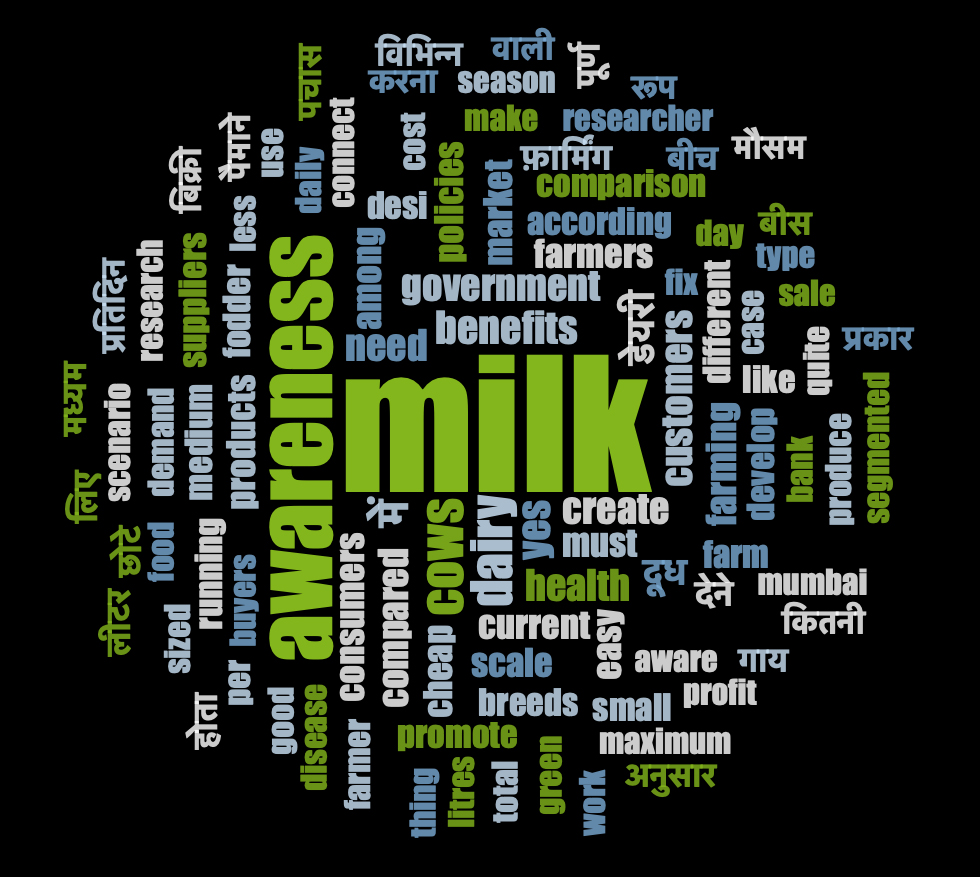
Producers or dairy farmers are willing to promote indigenous dairy farming if they get financial support from the government or cooperative societies. There is a need to develop awareness among dairy farmers, producers in the informal sector, especially small medium size farmers.
Government setting minimum selling price and developing an oligopolistic market for the dairy supply chain. Customers are also aware about benefits of cow milk, especially indigenous.
This article emerges the main themes on the awareness level of dairy farmers/processors and producers. Grounded theory exists in this context based on data gathered from the field survey. The Indian dairy sector, mainly rural dairy farmers, runs the business. Stakeholder and Institutional theories retrieved from the literature is to explain the culmination of such situations when the effect of production and consumption of goods and services influence the cost and benefits incurred by enterprise. Social Learning theory is the final outcome of understanding the behavior of dairy farmers/processors about indigenous milk and its benefits.
The Indian dairy sector faces enormous and multiple issues in supply chain and logistics. The findings suggest a need for a better understanding of dairy farmers or processes for adopting sustainable supply chain practices. In the food and dairy supply chain, business processes are an integrated framework of operational activities.
The dairy supply chain is based on a fast chain model with short life cycles of processed and delivered products. In this model, promptness and assurance of timely delivery change consumers’ perceptions of milk and dairy products’ quality, price, and safety (Trienekens et al., 2012). Indigenizing milk and dairy products requires mechanized systems instead of conventional dairy farming methods to offer an economical price and provide better solutions to protect raw products’ shelf life. The Indian dairy sector, as the most significant production in the world, needs to invest more in research and development for sustainable dairy farming practices. In the informal sector, there is a dire need to encourage the process of dairy farming through technological intervention. Farmers’ opinions from this study are to set up a milk chilling centre to reduce wastage and spoilage of milk. Government not only by setting up dairy development programmes and policies. But also to develop awareness among small- and medium-sized farmers and provide them financial assistance. Stakeholders and cooperative societies invest their resources to improve the productivity of indigenous milch animals by implementing genetic improvement programmes and provisions of genetic testing of different variants of indigenous milch species to protect them from extinction.