



Abstract
In this work a new magnetic nanocomposites based on Fe3O4-Hydrogel and Fe3O4@SiO2-Hydrogel were synthesized. The poly(styrene-alt-maleic anhydride) was used as hydrogel compound. The hydrogel has the strong ability to remove some organic and inorganic compounds like methylene blue from water samples. Fe3O4 nanoparticles have the magnetic character that could help to the separation of hydrogel from the water after removal process by a magnet. The morphology of the hydrogel, Fe3O4, Fe3O4-Hydrogel and Fe3O4@SiO2-Hydrogel was examined by scanning electron microscope (SEM). The structure of hydrogel and presence of the Fe3O4 and SiO2 particles in the hydrogel nanocomposite was verified by FT-IR spectroscopy. The synthesized nanocomposites were used to remove the methylene blue from wastewater samples. Central Composite Design (CCD) and response surface method were used to optimize some parameters that affect the magnetic character, removal ability and removal efficiency, so the time of removal (minute), pH and the amount of hydrogel (mg) as important parameters were optimized by designing experiments. Determination of removal efficiency was done by spectrophotometric method. Results showed that the Fe3O4@SiO2-Hydrogel had the more efficiency than Fe3O4-Hydrogel and the removal efficiency of methylene blue from water by synthesized Fe3O4@SiO2-Hydrogel was between 50–95% that in the optimized condition it was almost 95%. Relative standard deviation (RSD) for 5 replicates the removal of methylene blue with synthesized sorbent was 4%.
Introduction
One of the best methods for removing color from effluents is adsorption. This method has attracted considerable interest as a feasible procedure. Recently, a number of studies have been reported with regard to the adsorption equilibria and kinetic of dye removal processes using various adsorbents [1]. Adsorptive removal of various dyes to alleviate effluent pollution from industries is an important area of basic and applied research. Industries based on textiles, paper, leather, food, and cosmetics use very large amount of dyes, and waste from these industries is a major environmental concern [2, 3].
Methylene Blue (MB) has wide applications, which include coloring paper, temporary hair colorant, dyeing cottons, and wools. Although not strongly hazardous, it can cause any harmful effects, such as heartbeat increase, vomiting, shock, cyanosis, jaundice, quadriplegia, and tissue necrosis in humans. Color removal from effluents polluted with dyes of textile industries has been considered a challenge due to the difficulty of treating such wastewaters by conventional methods. The effluents of the manufacturing and textile industries are discarded into rivers and lakes, changing their biological life. The use of clean methods of low-priced and biodegradable adsorbents could be a good tool to minimize the environmental impact caused by textile effluents [4–6].
Hydrogels are crosslinked hydrophilic polymers that are swollen in water usually to equilibrium. Hydrogels find considerable applications and have been extensively studied, because they combine glassy behavior (in their dry state) with elasticity (when sufficient water is adsorbed). The behavior of highly swollen hydrogels is, of course, a function of the network characteristic (such as degree of swelling, diffusion coefficient, crosslink density, mesh size, etc.), which in turn is connected with chemical structures. Hydrogels have been used with widespread applications in different fields. The removal of color from textile wastewaters is a major environmental problem because of the difficulty of treating such waters by conventional methods. Some groups have used various adsorbents for the removal of acidic and basic dyes from aqueous solutions [7–9]. Poly styrene maleic anhydride (PSMA) is a synthetic polymer that is built-up of styrene and maleic anhydride monomers. The monomers can be almost perfectly alternating, making it an alternating copolymer, but (random) copolymerization with less than 50% maleic anhydride content is also possible. The polymer is formed by a radical polymerization, using an organic peroxide as the initiator. The main characteristics of SMA copolymer are its transparent appearance, high heat resistance, high dimensional stability, and the specific reactivity of the anhydride groups. The latter feature results in the solubility of PSMA in alkaline (water-based) solutions and dispersion [10, 11]. The magnetic nanoparticles have many uses such as magnetic drug target, magnetic resonance imaging for clinical diagnosis, recording material and catalyst, environment, etc. Iron oxide nanoparticles are iron oxide particles with diameters between about 1 and 100 nanometers. The two main forms are magnetite (Fe3O4) and its oxidized form maghemite (γ-Fe2O3). They have attracted extensive interest due to their superparamagnetic properties and their potential applications in many fields. Iron oxide nanoparticles play a major role in many areas of chemistry, physics and materials science [12–14]. There are many various ways to prepare Fe3O4 nanoparticles, which have been reported in other papers, such as energy milling [15], reducing [16], ultrasonic assisted impregnation [17], and using tridax procumbens leaf extract [18]. The preparation method has a large effect on shape, size distribution, and surface chemistry of the particles. It also determines to a great extent the distribution and type of structural defects or impurities in the particles. All these factors affect magnetic behavior. Recently, many attempts have been made to develop processes and techniques that would yield ‘monodisperse colloids’ consisting of nanoparticles uniform in size and shape. Magnetite and maghemite are preferred in biomedicine because they are biocompatible and potentially non-toxic to humans. Iron oxide is easily degradable and therefore useful for in vivo applications [19].
In this work Fe3O4 and Fe3O4@SiO2 nanoparticles were synthesized and as a novelty of work used as modifier of poly(styrene-alt-maleic anhydride) hydrogel. The synthesized nanocomposite hydrogel was used as removal agent of organic dyes from water samples. Fe3O4-hydrogel and Fe3O4@SiO2-hydrogel can remove methylene blue (80–90%) and (85–95%) respectively from water samples.
Experimental
Chemical and reagents
The chemical compounds, including FeCl3.6H2O, Ammonium iron II sulfate hexahydrate ((NH4)2Fe(SO4)2·6H2O), HCl, NaOH, Tetraethyl orthosilicate (TEOS), methylene blue and so were all purchased from Merck AG (Darmstadt, Germany). The rest of the materials were synthesis or analytical grade. All solutions and standards were prepared using distilled water.
Instruments
Spectrophotometric measurements were carried out with an Optima SP-300 Visible spectrophotometer (Tokyo, Japan). The infrared spectra of hydrogels were obtained with NEXUS870 model FTIR Spectrophotometer (Nicolet, USA) using KBr pellets. The pH of samples was analyzed by pH meter (UTECH pH510).
Synthesis of Fe3O4 and Fe3O4@Sio2
Fe3O4 was synthesized by co-precipitation of FeCl3.6H2O and (NH4)2Fe(SO4)2·6H2O as the following: 1 liter of doubly-distilled water was deoxygenized by argon gas; 10.81 g FeCl3.6H2O (0.04 M) and 7.84 g (NH4)2Fe(SO4)2·6H2O (0.02 M) were dissolved in 100 ml water (HCl 0.5 M). The dissolving process was done in the ultrasonic bath for 30 minutes. Then 60 ml NH3 (25%) gradually was added to the mentioned solution (at 80°C) that was mixed by mechanical stirrer (2000 RPM) for 60 minutes to synthesize the Fe3O4 (Scheme 1). Finally the synthesized Fe3O4 particles were collected by an electromagnet and separated from the solution.

Synthesize of Fe3O4 and Fe3O4@SiO2.
The synthesized Fe3O4 particles were modified by TEOS as the following: 2 g Fe3O4 was dissolved in the mixed solution including 170 ml ethanol and 40 ml water. 6 ml NH3 (25%) was added to the mixed solution and was dispersed by ultrasonic bath for 15 minutes and 2 ml TEOS was added to dispersed solution in the ultrasonic bath, then the solution was stirred by a magnetic stirrer for 12 hours (Scheme 1). Finally the Fe3O4@SiO2 particles were collected by an electromagnet and separated from the solution.
The Fe3O4-hydrogel composite was synthesized as the following: 1.2 g styrene-alt-maleic anhydride was dissolved in the 40 ml solution (20 ml water +20 ml THF). 0.6 g melamine (as a cross linker) was added to the solution. After 10 minutes 200 mg Fe3O4 was added to the solution and sonicated by ultrasound bath for 15 minutes. Then for completion of composition, formation the mixed solution was stirred for 24 hours under reflux condition at 90°C. Finally, HCl (0.1 M) was added to the solution until beginning precipitation of Fe3O4-hydrogel composite. After precipitation of Fe3O4-hydrogel composite, it was filtered and separated from the solution and was washed by bidistilled water (two times) and dried in vacuum oven (60°C) for 8 hours.
Fe3O4@SiO2-hydrogel composite was synthesized similar Fe3O4-hydrogel, except that in the Fe3O4@SiO2-hydrogel synthesis 200 mg Fe3O4-SiO2 was used instead of 200 mg Fe3O4.
Application of Fe3O4-hydrogel for remove methylene blue from water samples
Fe3O4-hydrogel and Fe3O4@SiO2-hydrogel were used for remove methylene blue from water samples as the following process: 20 ml methylene blue sample (20 mg/l) was mixed with Fe3O4-hydrogel or Fe3O4@SiO2-hydrogel (the amount of composite was selected according to the Table 1), after some minutes (according to the Table 1) the Fe3O4-hydrogel was collected by a magnet and was separated from the solution. The absorbance of methylene blue at 660 nm was measured by spectrophotometer before and after removal process and the removal percent was calculated as the equation 1.
The variables and values used for Central Composite Design (CCD)
The variables and values used for Central Composite Design (CCD)
Where, A0 is the methylene blue absorbance before removal process and A is the methylene blue absorbance after the removal process.
Morphology study
Figure 1 shows the SEM images of Fe3O4, Fe3O4@SiO2, Hydrogel, Fe3O4-Hydrogel and Fe3O4@SiO2-Hydrogel. It is clear that the Fe3O4 particles are in seed shape and in the 40–100 nanometer scales. The Fe3O4@SiO2 SEM image shows that SiO2 particles (seed shape) have been dispersed on the Fe3O4 particles and the Fe3O4@SiO2 (50–100 nm) were observed. The poly(styrene-alt-maleic anhydride) hydrogel SEM is observed as a no-porous and homogenous particles. Fe3O4-Hydrogel and Fe3O4@SiO2-Hydrogel SEM images show that Fe3O4 and Fe3O4@SiO2 particles placed between the hydrogel particles.

SEM images of Fe3O4 (A), Fe3O4@SiO2 (B), Hydrogel (C), Fe3O4-Hydrogel (D) and Fe3O4@SiO2-Hydrogel (E).
Figure 2 Shows the spectra of Fe3O4 and Fe3O4 modified by SiO2 (Fe3O4@SiO2) particles. In the Fe3O4 spectrum the sharp peak at 568.4 cm–1 corresponding to the bending vibrations of Fe-O and a peak at 3413.65 cm–1 correspond to stretching vibration of O–H [20, 21]. In the Fe3O4@SiO2 spectrum the sharp peak at 1072.36 cm–1 corresponding to the bending vibrations of Si-O and a peak at 794.46 cm–1 correspond to stretching vibration of Fe-O–Si [20, 21].
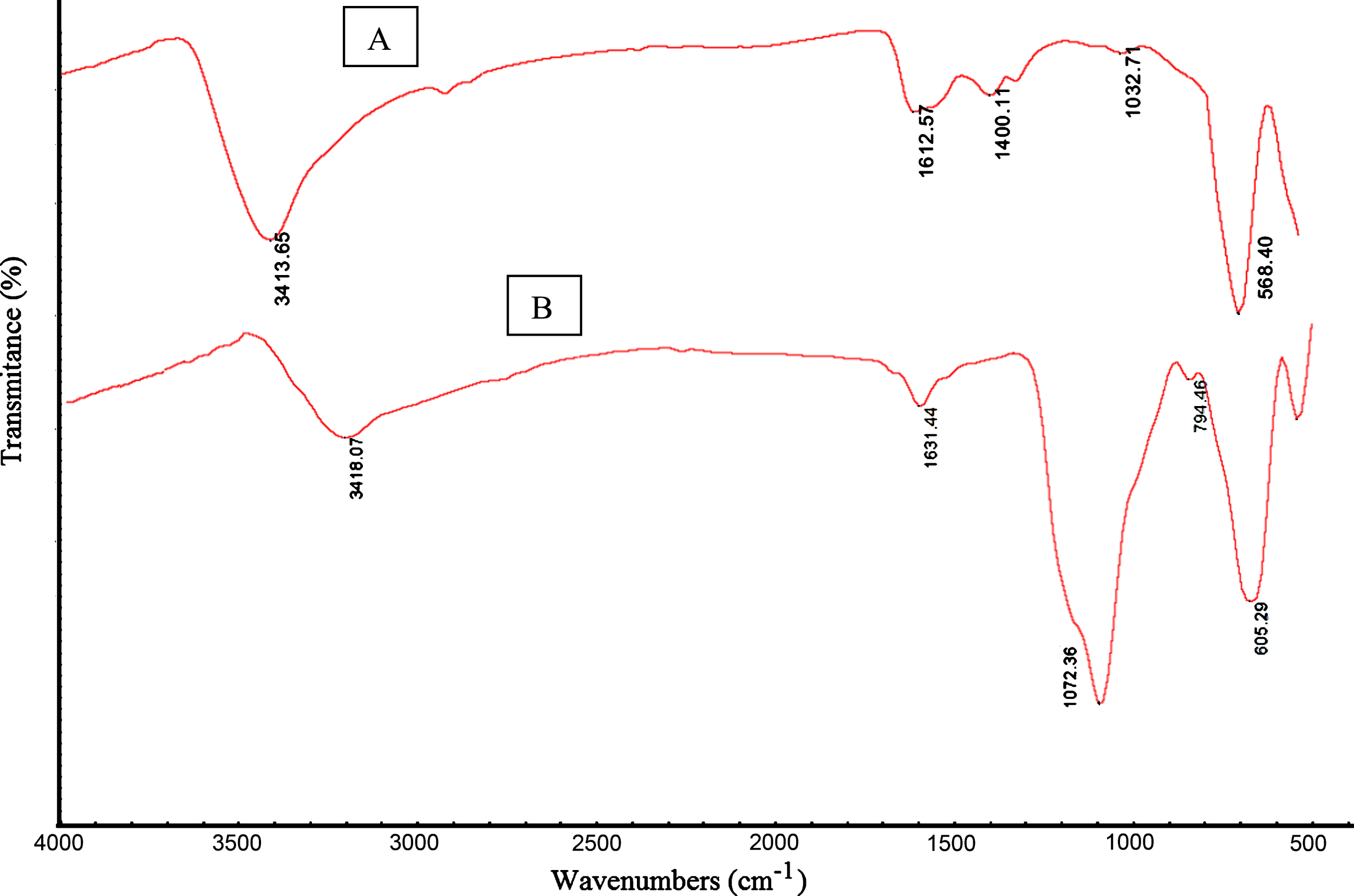
FT-IR spectra of the Fe3O4 (A) and Fe3O4@SiO2 composite (B).
Three factors affect the removal efficiency of methylene blue from water samples by Fe3O4-hydrogel. To study the effect of these factors on the removal efficiency an experimental design based on a central composite design (CCD) was used. A 3-factor-5-level experimental design in 8 cube point, 4 Center points in cube And 6 Axial points was used for optimization of removal efficiency. Table 1 shows the 3 processing variables as factors and levels, experimental design are given in terms of coded and uncoded. For each of the three studied variables, high (coded value: +2) and low (coded: -2) set points were chosen to construct an orthogonal design as tabulated. It helps for the estimation of the significant factors affecting removal efficiency. Table 2 shows the list of experiments in the CCD (un-coded Values) and removal efficiency. A EREGRESS software was used to perform statistical analysis. Initially, the full term second order polynomial response surface models were fitted to each of the response variables, according to the following equation:
List of Experiments in the CCD and the removal efficiency
List of Experiments in the CCD and the removal efficiency
Where Y is the responses (removal efficiency); F1, F2 and F3 are Fe3O4-hydrogel amount (mg), pH and removal time (minute) respectively, and b0 to b9 are the coefficient values obtained through multiple linear regressions. Where possible, stepwise deletion of terms was applied to remove the statistically non-significant terms, so simplifying the model. However, when the exclusion of such terms from the model decreases R2 (adjusted) and increases the estimator of the variance S, the term was included in the model. The statistically non-significant linear terms also remained in the model when the respective quadratic or interactive effects were statistically significant. The characteristics of the abstracted model, including R2 values, standard error and significant linear, quadratic and interaction coefficients are shown in Table 3. According to these results all three studied factors affect the removal efficiency and there are some interactions between these factors.
Some characteristics of the constructed models for removal efficiency
The three-dimensional (3D) plots based on the model function were used to predict responses to survey relation of each variable. Figure 3 shows response surface plots (3D plots) of removal efficiency versus pairs of variables (hydrogel amount, pH and time) while the other variable was kept in the center levels. As shown in Fig. 3 and according to the results presented in Table 3, there is a relation between the hydrogel composite amount, pH and removal time. Results showed that 1- in the interaction between pH and composite, the removal efficiency is increased by increasing of Fe3O4-hydrogel amount from 30 to 150 mg but, pH changing has no significant effect on the removal efficiency, 2- in the interaction between pH and removal time, the removal efficiency is increased by increasing of pH and removal time but, the removal efficiency increasing by increasing of pH is lower than removal time and 3- in the interaction between hydrogel composite amount and removal time, increasing of both factors cause to increase removal efficiency.
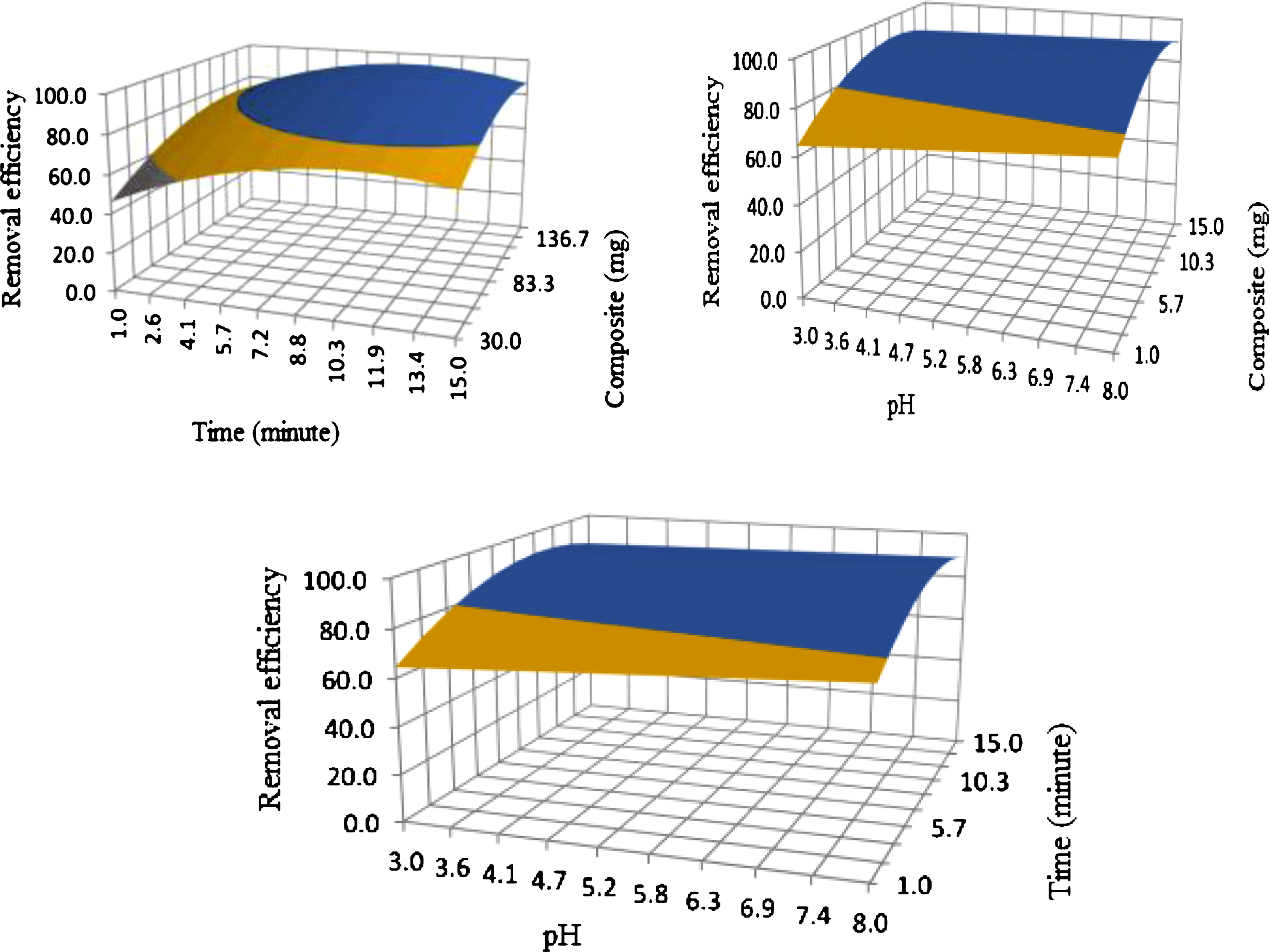
Response surface plots (3D plots) of removal efficiency versus pairs of variables.
Using the response surface plots and considering the removal efficiency the 150 mg of hydrogel composite was selected as optimum amount, the optimum removal time was 8 minutes that from 8 to 15 minutes the removal efficiency not changes significantly and the pH = 5.5 was selected as optimum pH for methylene blue remove from water samples by Fe3O4-hydrogle.
The removal condition, including hydrogel composite amount, pH and removal time were optimized for Fe3O4-Hydrogel. To evaluate the removal efficiency of Fe3O4@SiO2-Hydrogel at the optimized condition the methylene blue was removed from water sample by Fe3O4@SiO2-Hydrogel and the removal efficiency was compared with Fe3O4-Hydrogel. Results showed that at the optimum condition the removal efficiency of Fe3O4-Hydrogel was 80–85%, but the removal efficiency for Fe3O4@SiO2-Hydrogel was 95%, so using of Fe3O4@SiO2-Hydrogel as removal hydrogel can increase removal efficiency 10–15%. Figure 4 shows the UV-Vis spectra of 20 mg/l methylene blue before removal process and after the removal process by Fe3O4-Hydrogel and Fe3O4@SiO2-Hydrogel, it is clear that the Fe3O4@SiO2-Hydrogel has more removal efficiency than Fe3O4-Hydrogel.
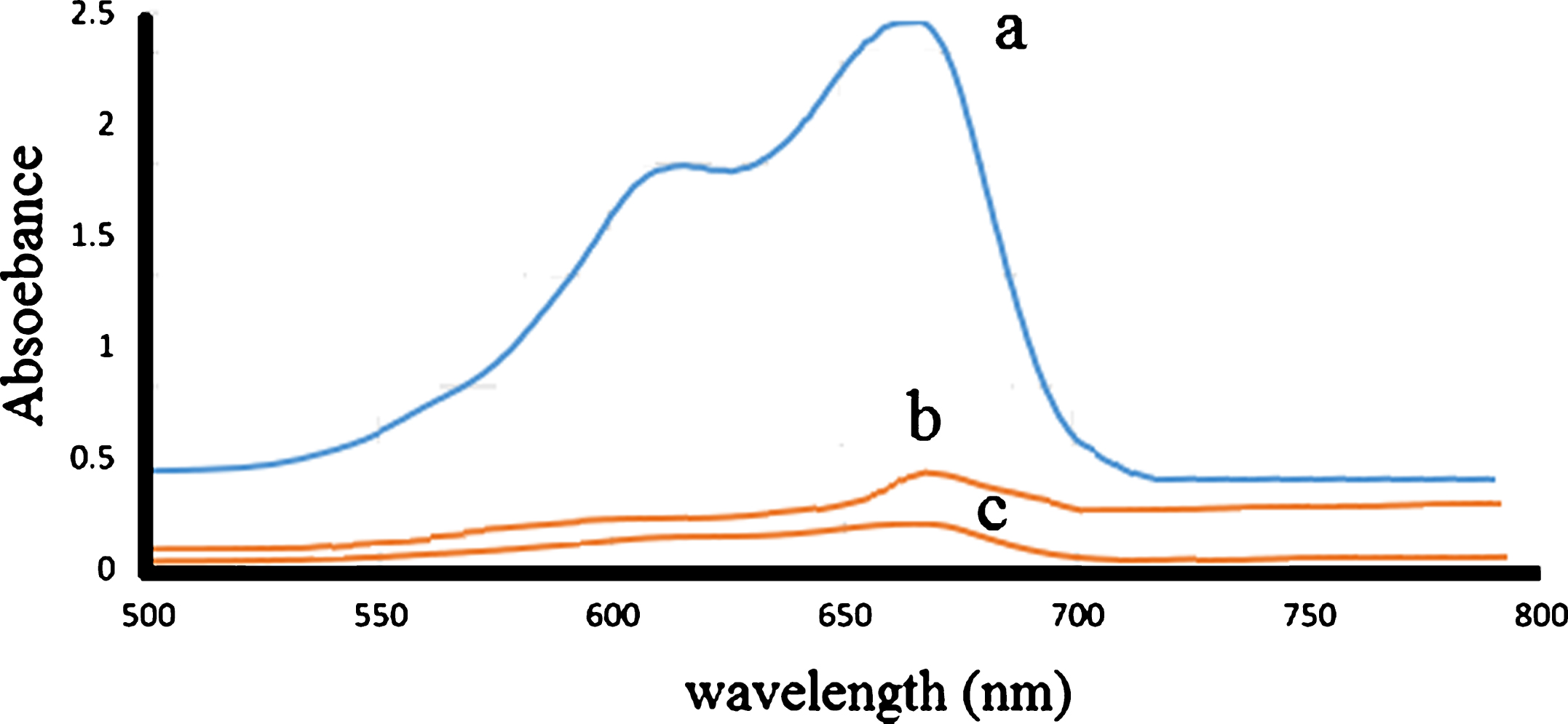
UV-Vis spectra of 20 mg/l methylene blue (a) before removal process, (b) after removal process by Fe3O4-Hydrogel and (c) Fe3O4@SiO2-Hydrogel.
The magnetic particles in the nano-scales were synthesized based on Fe3O4 and Fe3O4 modified by SiO2 (Fe3O4@SiO2) by chemical method. The synthesized Fe3O4 and Fe3O4@SiO2 were composed chemically with poly(styrene-alt-maleic anhydride) hydrogel to the conformation of Fe3O4-Hydrogel and Fe3O4@SiO2-Hydrogel. SEM images of Fe3O4, Fe3O4@SiO2, Fe3O4-Hydrogel and Fe3O4@SiO2-Hydrogel showed that Fe3O4 and Fe3O4@SiO2 have seed shape (40–100 nm) and could uniformly disperse between hydrogel particles. FT-IR spectra of nanoparticles showed that Fe3O4 could be modified easily by SiO2 using of TEOS. The synthesized hydrogel composites were used to remove organic dye (methylene blue) from water samples. In fact hydrogel remove the dye from water and magnetic character of Fe3O4 and Fe3O4@SiO2 help it to separate from water sample easily, in addition to Fe3O4 and Fe3O4@SiO2 could improve removal efficiency of hydrogel. Fe3O4@SiO2-Hydrogel has more removal efficiency than Fe3O4-Hydrogel that shows the effect of SiO2 particles on the removal process. The synthesized hydrogel composites are pH sensitive so it was necessary to be optimized for elimination of organic dye. The pH = 5.5 is the optimum pH for methylene blue remove from water by composite hydrogel. Results showed that the removal efficiency of methylene blue from waste water by synthesized Fe3O4@SiO2-Hydrogel was between 50–95% that in the optimized condition it was almost 95%. Relative standard deviation (RSD) for 5 replicates the removal of methylene blue with synthesized sorbent was 4%.
Footnotes
Acknowledgments
This work has been supported by grants from the Urmia University Research Counci and the Iran National Science Foundation (INSF) is gratefully acknowledged.