



Abstract
In this study by using the precursors of Zn5(CO3)2·(OH)6 and H3BO3, Zn3B6O12·3.5H2O type of a zinc borate compound is synthesised. A green sonochemical method of ultrasonic irradiation is used with several parameters such as; reaction temperature and reaction time. Synthesized zinc borate compounds are characterized by X-ray diffraction (XRD), Fourier-transform infrared spectroscopy (FT-IR) and Raman spectroscopy techniques. Then the surface morphologies are investigated by scanning electron microscopy (SEM). From the XRD results, the minimum reaction conditions to successfully synthesize Zn3B6O12·3.5H2O were found as 80°C – 50 min, 85°C – 40 min, 90°C – 40 min. The FT-IR and Raman spectroscopies showed that the synthesized products characteristic bands were in good agreement with the bands of boron compounds. SEM morphological analyses showed that synthesized compounds were in particularly thorn like and tubular with the particle sizes between 77– 296 nm. Also the reaction yields were calculated between 90.34– 97.12%.
Introduction
The complexes of boron with other metal elements are defined as metal borates. Each type of metal borate is used in specific applications. Zinc borates are the sub-class of metal borates. The usage areas of zinc borates can be listed as plastic, ceramic, paint, glass, electric insulation, wood, cement, medicine, construction, automotive and flame retardants. Moreover, zinc borates are used as a preservative in wood composites, as anticorrosive pigments in coatings and as polymer additives to promote char formation to suppress smoke and retard combustion [1–9].
Traditional production methods of boron compounds are categorized as solid-state and liquid-state synthesis. In solid-state method, the raw materials are mixed and generally reacted in high temperature furnace [10]. General synthesis procedure of zinc borates is based on the liquid-state method. In liquid-state method, the raw materials are dissolved in liquid medium separately and the reaction is affected by heat increase and magnetic or mechanic stirring. Different types of zinc borate hydrates are prepared at different parameters. The compound of Zn(B3O4(OH)3) is synthesized at the reaction temperature of 95°C and 24 hours reaction time [3]. At the same reaction temperature for 8 h, Shi et al. prepared the 2ZnO·3B2O3·3H2O using the sources of ZnO and H3BO3 [4]. Zheng et al., obtained the nanowhiskers of 4ZnO·B2O3·H2O using the modification agent of phosphate ester [11]. Gao and Liu, synthesized the complexes of Zn2B6O11·7H2O and Zn3B8O18·4H2O at the boiling points of mixture using the sources of borax and ZnO [12].
From the literature, it is seen that the hydrothermal synthesis of zinc borate compounds requires a high temperature (≥95°C), long reaction times (≥2 h) and several different modification agents (i.e., polyethylene glycol, oleic acid). For a successful synthesis of zinc borate is required minimum 80°C. As a novel method, the interaction between the raw materials occurs with the impulsion of ultrasound in sonochemical synthesis. Starting from the optimum molar ratio of Zn5(CO3)2·(OH)6 and H3BO3, which was determined in the study of Vardar et al., [13] the present study investigates the influence of reaction temperature and reaction time on the synthesis of zinc borate compounds. The method of sonochemistry is applied for the decrease in the reaction temperatures and reaction times with comparison to literature for a green chemical aspect. After the synthesis the compounds were identified by using the techniques of X-ray diffraction (XRD), Fourier transform infrared (FT-IR) spectroscopy and Raman spectroscopy, therewith surface morphologies and particle sizes were determined by scanning electron microscopy (SEM).
Experimental
Preparation and characterization of the raw materials
Zn5(CO3)2·(OH)6 was obtained from Alfa Aesar as “Zinc carbonate basis, 97%, Zn > 58% (CAS: 5263-02-5)” (Alfa Aesar GmbH & Co KG, Karlsruhe, Germany) and H3BO3 was obtained from Bandirma Boron Works as “Boric acid, 99.9% ” (Eti Maden, Ballikesir, Turkey). In the experiments Zn5(CO3)2·(OH)6 was used without pre-treatment on the other hand H3BO3 was ground by Retsch RM 100 agate mortar (Retsch GmbH & Co KG, Haan, Germany) to obtain a particle size below 75μm. Then raw materials were subjected to XRD analyses with PANalytical Xpert Pro (PANalytical B.V., Almelo, the Netherlands). PANalytical Xpert Pro uses a Cu-Kα tube (λ= 0.153 nm) and the analysis parameters were selected as 45 kV, 40 mA, step size of 0.03°, time step of 0.5 s, scan speed of 0.06°C/s, and 2 theta scan range of 7– 90°. For the identification of patterns, the Inorganic Crystal Structure Database (ICSD) were used.
Green sonochemical synthesis of Zn3B6O12·3.5H2O
In the study of Vardar et al., we determined the optimum molar ratio of Zn5(CO3)2·(OH)6 and H3BO3 as 1:5 (elemental mole Zn: elemental mole B) [13]. The expected reaction equation is given in equation (1):
For the synthesis a 100 mL capacity batch type glass reactor equipped with a temperature controller and a cooling jacket was used. For a purified liquid medium GFL 2004 (Gesellschaft für Labortechnik, Burgwedel, Germany) water purification system was used. For the synthesis, 0.1262 moles of H3BO3 was dissolved in 25 mL of purified water and heated to the target temperature then 0.0050 moles of Zn5(CO3)2·(OH)6 was added. Furthermore, for a better crystallization commercial zinc borate seed obtained from Melos A.Ş. (Melos A.Ş., Istanbul, Turkey) was added (1% w/w as H3BO3). The reaction took place with the help of a Bandelin Sonopuls HD 2070 (20 kHz) model ultrasonic homogenizer (Bandelin electronic GmbH & Co. KG, Berlin, Germany). After the determined reaction time the slurry was filtered and washed with purified water (70 – 80°C) in order to remove the unreacted H3BO3 from the synthesized compound. Then the filtrate was dried using EcoCELL 111 model oven (MMM Medcenter Einrichtungen GmbH, Planegg, Germany) working at 105°C. The scheme of the reaction procedure is shown in Fig. 1. The same experimental procedure was repeated at the reaction temperatures and reaction times of 80, 85, 90°C and 35, 40, 45, 50 and 55 min, respectively in order to investigate the effect of reaction parameters on the synthesized compounds.
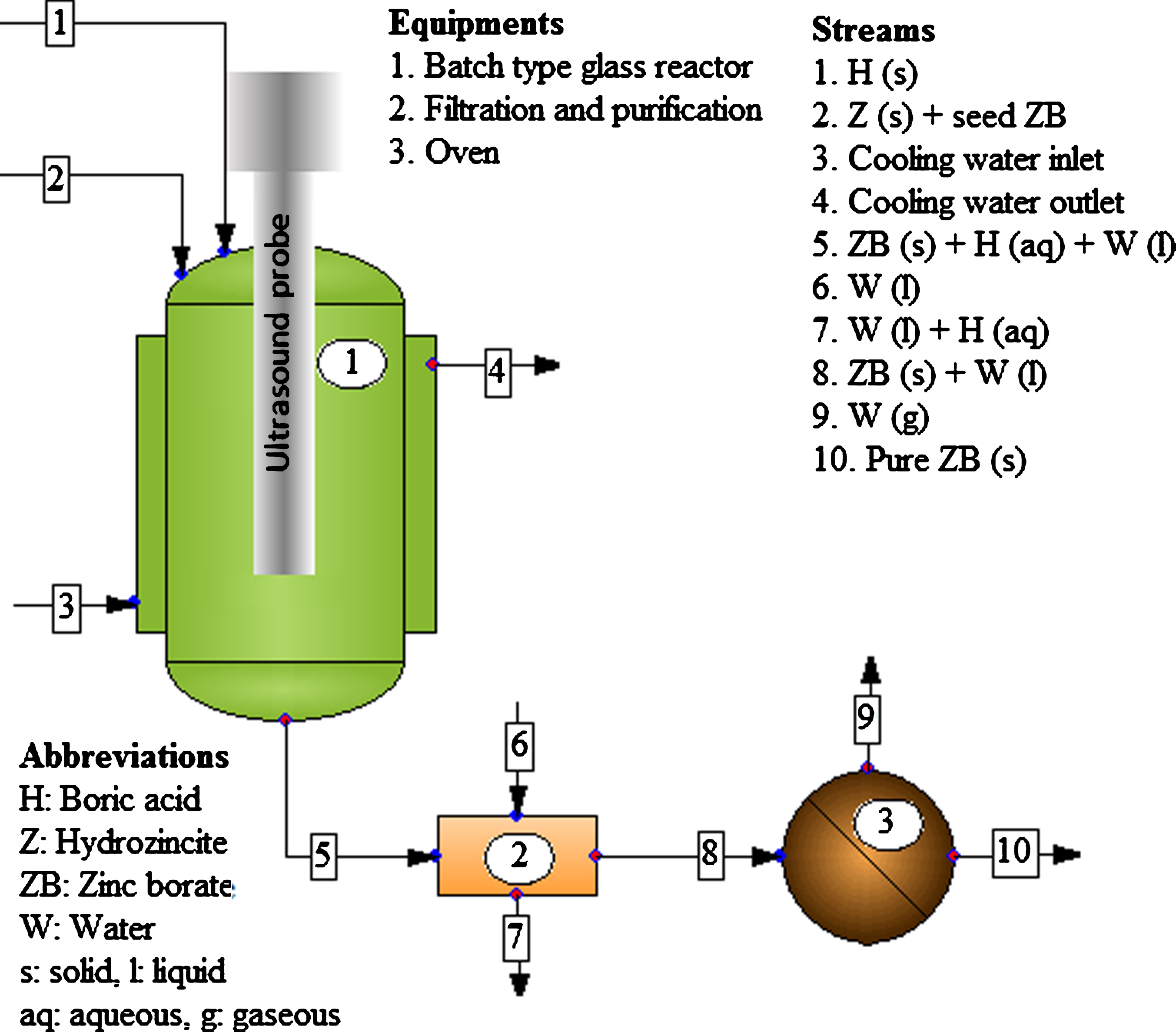
Reaction flowchart of the pure zinc borate synthesis.
For the XRD analysis, the same diffraction parameters of 45 kV, 40 mA, step size of 0.03°, time step of 0.5 s, scan speed of 0.06°C/s was used with the 2 theta range of 10 – 70°.
PerkinElmer Spectrum One model (PerkinElmer, MA, USA) FT-IR equipped with a universal attenuated total reflectance (ATR) sampling accessory (Diamond/Zn) was used. The analysis parameters were set to; resolution 4 cm-1, number of scans 4 and scan range 1800 – 650 cm-1.
Likewise, Perkin Elmer Raman Station 400F (PerkinElmer, CT, USA) model Raman spectrometer was used. The analysis parameters were set to; exposure time 4 s, exposure number 4, data interval 2 cm-1 and scan range 1800 – 250 cm-1.
CamScan Apollo 300 model Field-Emission SEM (CamScan, Oxford, UK) was used in the SEM analysis. At the beginning of the SEM analyses, synthesized compounds were coated with Au/Pt using a Polaron Range SC7640 model Sputter Coater (Quorum Technologies Ltd., East Sussex, UK). The surface morphologies of the synthesized compounds were investigated at 15 kV with using the back scattered electron (BEI) detector with the magnification of 20000.
Reaction efficiency calculation
In the calculation of reaction efficiency, three parallel experiments were conducted and the average of these repetitions is given as the results. In the efficiency calculations, Zn5(CO3)2·(OH)6 was defined as the limiting reactant. The overall reaction yield based on molar flow rates, YD, is defined as the ratio of the moles of product formed at the end of the reaction, ND, to the number of moles of the key reactant that have been consumed. NA0 and NA are the initial and final moles of the key reactant, respectively. For a batch system, the reaction yield was calculated using equation (2) [14].
Raw materials XRD results
From the results of the XRD analyses; zinc source of Zn5(CO3)2·(OH)6 was found as “Hydrozincite” with the reference code of 00-019-1458, boron source of H3BO3 was found as “sassolite” with the reference code of “01-073-2158” and commercial zinc borate seed was found as “zinc oxide borate hydrate (Zn3B6O12·3.5H2O)” with pdf number “00-035-0433”.
Synthesized zinc borate compounds XRD results
Synthesized zinc borate compounds XRD results are given in Table 1.
XRD results of the zinc borate compounds
XRD results of the zinc borate compounds
*Crystal formation was not completed.
From the XRD results it is seen that the synthesized zinc borate compound is the same as the zinc borate seed of Zn3B6O12·3.5H2O. At 80°C the zinc borate crystal formation was not completed before 50 min of reaction time and the XRD scores (An XRD score is a measure of the match of the peak intensities (%) and peak locations of the specimen to the pdf card pattern of the reference mineral. The XRD score of the analysed mineral is equal to 100 [15].) are increased with increasing reaction time from 50 to 55 min. At 85°C and 90°C, crystal formation time is decreased to 40 min and likewise in 80°C, the XRD scores are increased with increasing reaction time from 40 to 55 min. The compounds, which have the highest XRD scores at each reaction temperature is given in Fig. 2a. Detailed crystallographic data and the characteristic peak locations of Zn3B6O12·3.5H2O are given in Table 2. The obtained characteristic peaks were in good agreement with the literature [16, 17].

a. XRD patterns of the synthesized zinc borate compounds, b. XRD score graph with respect to reaction temperature and reaction time.
Crystallographic data and the characteristic peaks of the synthesized Zn3B6O12·3.5(H2O)
Using Statistica 8.0 software (StatSoft Inc., OK, USA), XRD scores were drawn with respect to reaction temperature and reaction time in order to investigate the effect of reaction parameters on the formation of zinc borate compound (Fig. 2b). In Fig. 2b, it is seen that the XRD scores are increased with increasing both reaction temperature and reaction time. And the highest XRD score is obtained with a value of 71 at 90°C reaction temperature and 55 min of reaction time.
Zn3B6O12·3.5H2O type of a zinc borate compound was synthesized via a hydrothermal route by the several authors and their reaction parameters were given in Table 3. From Table 3, it is seen that the method of ultrasonic irradiation decreased the reaction times slightly with compared to hydrothermal method.
The synthesis parameters of Zn3B6O12·3.5H2O type of zinc borate studied in the literature
FT-IR and Raman spectra of the compounds, which have the highest XRD scores at each reaction temperature is given in Fig. 3 and Fig. 4, respectively.

FT-IR spectra of the synthesized pure zinc borates.
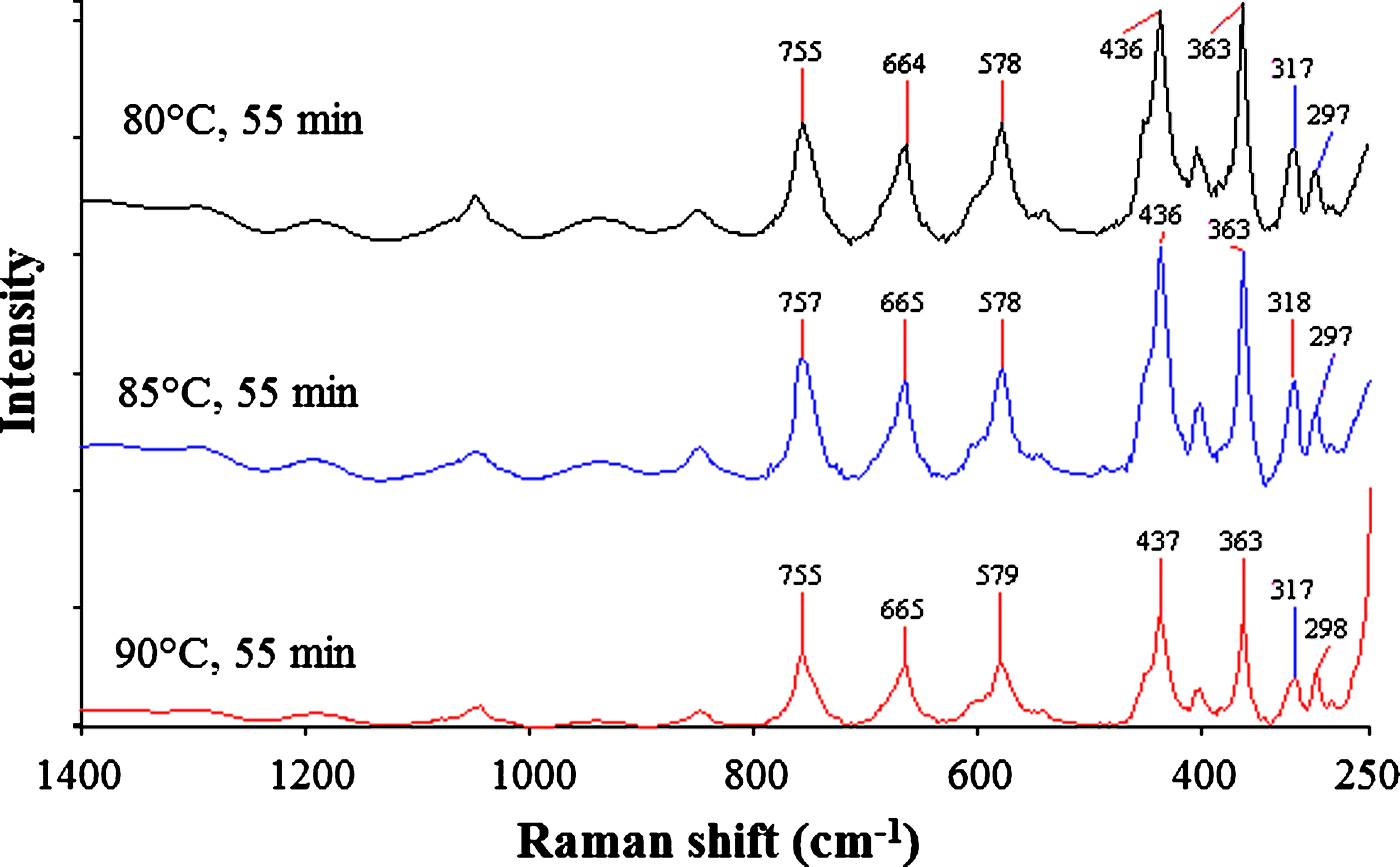
Raman spectra of the synthesized pure zinc borates.
According to the FT-IR spectra, the bands between 1413 and 1252 cm-1 are ascribed as the asymmetric stretching of the three-coordinate boron to oxygen [νas(B (3) -O)]. The bands between 1194 to 1114 cm-1 can be described as the bending of boron-oxygen-hydrogen [δ(B-O-H)]. The asymmetric stretching of the four-coordinate boron to oxygen bands [νas(B (4) -O)] is seen at between 1061 – 1060 cm-1. The symmetric stretching of three-coordinate boron to oxygen bands [νs(B (3) -O)] is seen between 931 – 930 cm-1. The bands between 860 – 793 cm-1 can be ascribed as the symmetric stretching of four-coordinate boron to oxygen [νs(B (4) -O)]. The vibrations belong to the [νp(B(OH)4)-] is seen at the band values between 752 – 751 cm-1. Finally bending of the three-coordinate boron to oxygen [γ(B (3) -O)] is identified at 659 cm-1. Obtained bands were in good agreement with the literature [20, 21].
According to the Raman spectra, νas(B (4) -O), νp(B(OH)4)- and (B (3) – O) / δ(B (4) – O) bands are seen at between 757 – 755 cm-1, 665 – 664 cm-1 and below 579 cm-1, respectively [22].
The SEM morphologies are given in Fig. 5. According to the analysis at 80°C, the particles obtained are mostly in tubular form. As the reaction temperature increased to 85 and 90 °C, the tubular shapes became round and thorn like. Also at all reaction temperatures uniform particle distribution is seen due to the method of ultrasonic irradiation. Both nanometer and sub-micro meter particle sizes exits in the analysis. At 80°C, the particle sizes are found between 127 to 296 nm, whereas at 85 and 90°C, the particle sized were found between 88 to 193 nm and 77 to 156 nm, respectively. The increase in the reaction time decreased the particle sizes.
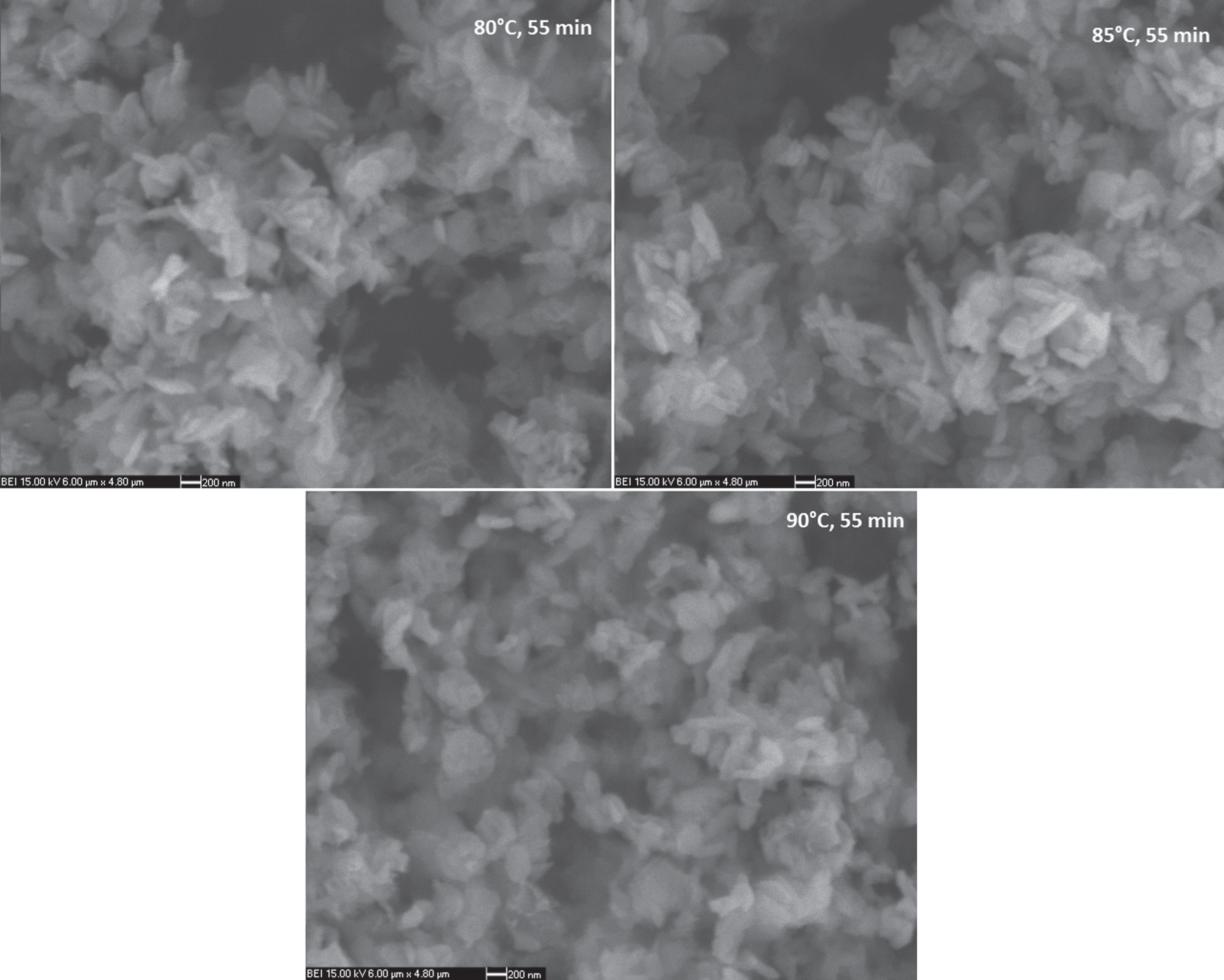
SEM morphologies of the synthesized pure zinc borate compounds (×20000).
In liquid state synthesis procedure given in the literature, the particles formed as one dimensional micro-rods of length 1.40– 3.08μm and width 346– 445 nm. With increasing temperature, rectangle-like particles were obtained at around 2μm [16, 17]. In solid state synthesis procedure, the obtained particles were not uniform in appearance. The particles sizes were in the range of 440 nm– 2μm. Also agglomeration could be seen with the effect of high temperature [23]. In ultrasonic synthesis procedure, a thorn-like morphology was observed with the particle size distribution between 130 – 506 nm [24]. By comparison with the previous studies of liquid and solid state, different morphological properties were obtained by the effect of sonochemical synthesis method. By comparison with the ultrasonic synthesis given in the literature more rectangular particles are seen different than thorn-like particles, as well as smaller particle sizes are obtained.
The reaction efficiencies calculated using Eq. 2, are given in Table 4. According to the results it is seen that the reaction efficiencies increased with increasing reaction time and reaction temperature and found between 90.34 – 97.12 %. The lowest reaction efficient value of 90.34±0.54% is obtained at the reaction temperature at 80°C and reaction time of 50 min, whereas the highest reaction efficient value of 97.12±0.68% is obtained at the reaction temperature at 90°C and reaction time of 55 min.
Reaction efficiencies of the zinc borate compounds
Reaction efficiencies of the zinc borate compounds
At the studies of Kipcak et al., the highest reaction efficiencies are found as 96.7%, 98.9%, 99.7% and 99.6% for the reaction between ZnSO4·7H2O-NaOH-H3BO3, ZnCl2-NaOH-H3BO3, ZnSO4·7H2O-Na2B4O7·5H2O-H3BO3 and ZnCl2-Na2B4O7·5H2O-H3BO3, respectively. So compared to previous studies that has done in liquid state method, ultrasonic irradiation gave nearly the same the reaction efficiency even at moderate reaction conditions [16, 17] and higher then the ultrasonic study of Ersan et al. [24], which the reaction efficiencies were found between 89– 95%.
In this research the synthesis of a zinc borate compound of Zn3B6O12·3.5H2O is aimed from a raw material of Zn5(CO3)2·(OH)6 via a novel green method of ultrasonic irradiation. Several reaction temperatures ranging from 80 – 90°C and reaction times 40 – 55 min were selected for the determination of best formation. In the hydrothermal studies given in the literature the minimum reaction conditions required for the zinc borate synthesis is given as 80°C reaction temperature and 2 h of reaction time. In our study, the same type of a zinc borate compound was synthesized in less than 55 min at several reaction temperatures with a very high reaction efficiency values at about between 90– 97%. The obtained spectra of both FT-IR and Raman were in good agreement with the literature. Tubular and round like shapes were obtained with the particle sizes between 77– 296 nm.