



Abstract
The optimum conditions of complex color reaction between Mg2+ and arsenazo-III (ASA-III) in the presence of polyvinyl alcohol were studied. In the medium of pH 10.0 ammonia-ammonium chloride, Mg2+ and ASA-III form a 1:2 purple complex and the maximum absorption peak is at 574 nm. At this wavelength, the absorbance (A) is linearly related with the concentration of Mg2+ over the range of 0.1–2.5 μg/mL and its equation: A = 0.4969 C (μg/mL)+0.0634, with a regression coefficient of 0.9993. The apparent molar absorption coefficient of method is 1.35×10⁴ L·mol–1·cm–1 and its detection limit is 76 ng/mL. Appropriate amount of polyvinyl alcohol can make sensitivity of the determination of magnesium increase 10.1%. The method was used to determine magnesium in potato and salt samples. The recovery of the standard addition was 99.6%–100.5%. The relative standard deviation was less than 5% for thirteen replicate determinations. The reliability of this method has been certified by parallel determination against atomic absorption spectrometric method.
Introduction
Magnesium is a necessary trace element for human body, almost involves in all the metabolic process. Trace element magnesium has a close relationship with the human body movement function [1, 2]. A series of complex biochemical reactions in human body maintain the life activity, and catalyzing these biochemical reactions requires thousands of enzymes (biological catalyst). Magnesium can activate the 325 enzyme system, which is involved in the body’s growth process, protein synthesis, muscle contraction and body temperature regulation and also affects the blood vessel’s tension and is closely related to neuromuscular and cardiac function [2, 3]. If the magnesium in human body lacks, it can lead to nervous tension, emotional instability, muscle fatigue, decrease in endurance, etc. Daily requirement of magnesium for people is about 300–700 mg, of which about 40% come from food and about 60% from drinking water that contains magnesium ions. Lack of magnesium element is bound to cause harm to human health [3]. In methods for the determination of magnesium, for the determination method of constant magnesium titration method is employed [4]. For the determination method of microamount and trace magnesium, there are isotope dilution mass spectrometry [5], fluorescence spectrometry [6], atomic absorption spectrometry [7–10], etc. However, they have the disadvantages of expensive equipment, complex operation and so on. Spectrophotometry has the characteristics of instrument with low cost, operation simplicity, high sensitivity, etc, it is one of determination methods with the high practical value at present. Although chlorophosphonazo I [11], chrome azurol S [12], acid chrome blue K [13] has been proposed for the determination of magnesium by spectrophotometry, the sensitivity and selectivity of the method is not ideal. Exploring the new analysis method of determination of magnesium is still very necessary. Arsenazo-III, [2, 7 – Bis (2 – arsenophenyl – 1 - azo) - 1, 8 – dihydroxynaphthalene - 3, 6 - disulfonic acid], C22H18As2N4O14S2, is an asymmetric chromotropic acid diazo derivative and has been ever used for the determination of rare earth elements [14]. In this paper, in the presence of polyvinylalcohol a new method for the spectrophotometric determination of magnesium has been established using arsenazo-III. Appropriate amount of polyvinyl alcohol can make sensitivity of the determination of magnesium increase 10.1%. Polyvinylalcohol has a sensitizing effect.
The optimum conditions of complex colour reaction were studied, the properties of the system were inspected, a new method for the spectrophotometric determination of magnesium was established and it was applied to the determination of magnesium in potato and sodium chloride with satisfactory results. This method is easy to operate and fast.
Experimental
Instrument and reagent
A 722S spectrophotometer (Shanghai Lengguang Technology Co., Ltd, China) equipped with 1 cm cells was used in the determination of absorbance.
Standard stock solution (1 mg/mL) of Mg2+ was prepared by dissolving 0.1658 g MgO (Beijing Chemical Plant, China) in 1 mL of concentrated hydrochloric acid (Beijing Chemical Plant, China) and the content was diluted to 100 mL. Then, the working solution 5 μg/mL were obtained by suitable dilution of the stock solution. 1 g/L of arsenazo-III (East China Normal University Chemical Factory) aqueous solution was prepared by dissolving 0.1 g of ASA-III in 100 mL of water. pH = 10 NH3-NH4Cl buffer solution was obtained by mixing 0.1 mol/L ammonia water and 0.1 mol/L NH4Cl in accordance with 5.49:1 (V/V) ratio. 0.1 g / L of polyvinylalcohol (PVA, Xiya Reagent, China) aqueous solution was used and the water is distilled water. Unless specially stated, all the reagents used in the experiment were of analytical reagent. The used water was distilled water throughout all study.
General procedure
10 μg of Mg2+ working solution were taken and put in a 10 mL calibrated flask, in turn 1.5 mL of 1 g/mL ASA-III solution, 1 mL of pH 10.0 NH3-NH4Cl buffer solution and 1 mL of 0.1 g/L PVA were added. The above solution was diluted with water to the mark and shaken well. After 3 min, the absorbance of Mg2+-(ASA-III) complex was measured at 574 nm on a spectrophotometer using 1 cm cells against a corresponding reagent blank as reference.
Procedure for sample analysis
Potato
After potato was washed and cut into strips, it was dried at room temperature (20±1°C). 10.000 g of the sample were weighed, placed in a beaker, and dried for 4 h in an oven at a constant temperature of 110°C. The dried sample was placed in a porcelain crucible, put in a muffle furnace and ashed at 500°C for 8 h. After the ashing of sample was complete, the door of the oven was opened for cooling to room temperature. Then, the sample was taken out. Water was added, the sample was made wetting and along the vessel wall 5 mL of 6 mol/L hydrochloric acid solution were added to dissolve the residue. It was heated and evaporated to a nearly dry. After the sample was dissolved using water, it was made to a constant volume of 50 mL with water. 2.00 mL of the test solution of potato were accurately taken and then the magnesium in the sample was determined according to the standard procedure.
Sodium chloride sample
12.5 g of sodium chloride sample was weighed and a small amount of water was used to dissolve. It was set with water to the mark of 100 ml volumetric flask as the test solution to be measured. 4.0 mL of the test solution were transferred to a 10-mL volumetric flask, the remainder was the same as the standard method for the determination of magnesium in the sample.
The recoveries experiments of the above samples were carried out, and atomic absorption spectrometry was used as contrast method to determine the contents of magnesium in the samples.
Results and discussion
Absorption spectra
Following the standard procedure, in the range of wavelength 340–1000 nm the reagent blank and complex absorption curves were prepared using water and the reagent blank without the addition of Mg2+, respectively, as reference. The experimental results illustrated that (Fig. 1) the maximum absorption wavelength of reagent blank against water is situated at 510 nm. A shoulder peak exists at 830 nm. The maximum absorption wavelength of complex against reagent blank is situated at 574 nm. The contrast is Δλ= 64 nm. In this study, the wavelength of determination was chosen as 574 nm.
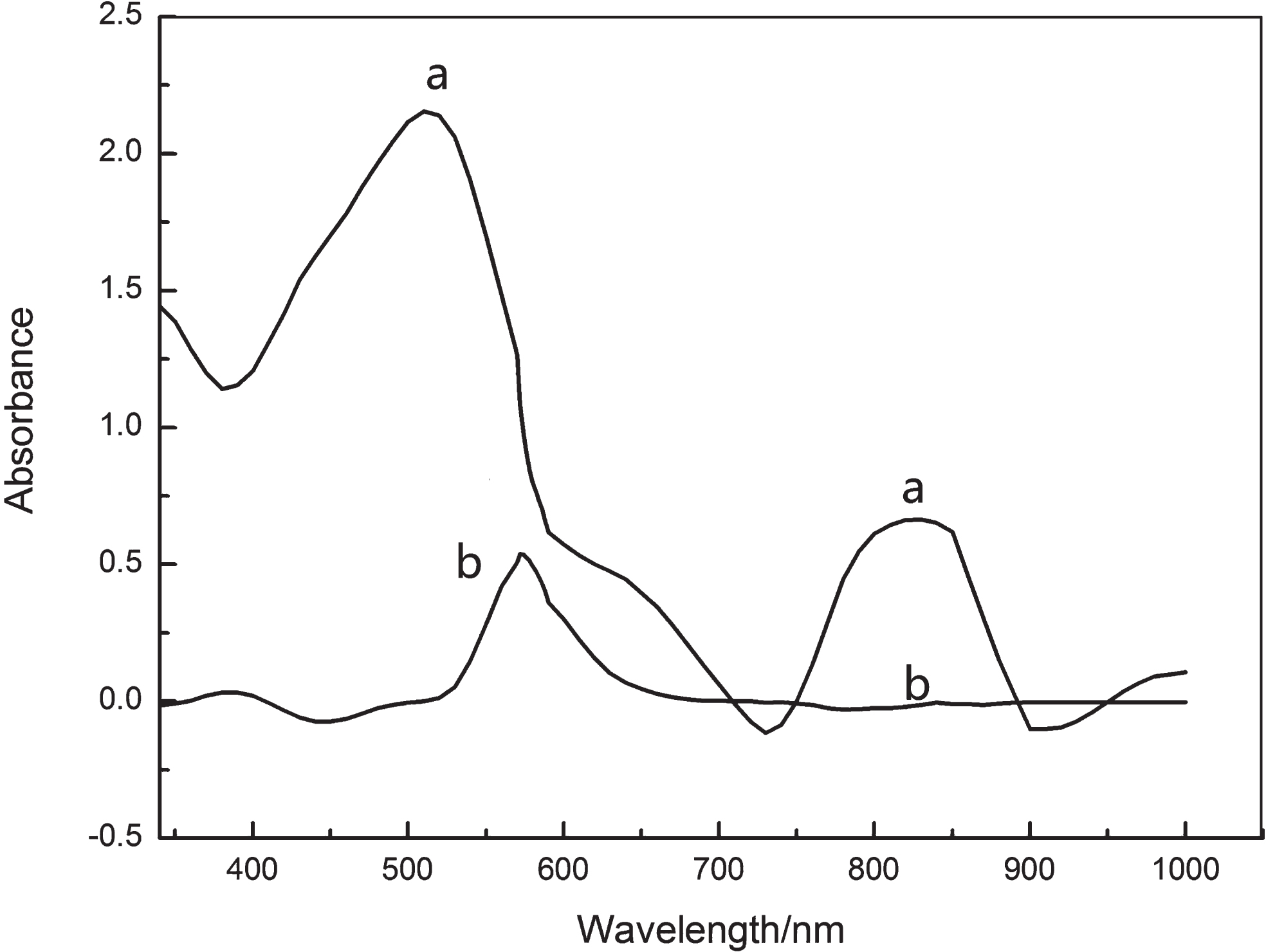
Absorption spectra: (a) reagent blank (against water); (b) complex (against reagent blank). [Mg2+] = 4.12× 10⁻⁵ mol/L; [ASA-III] = 1.93×10⁻⁴ mol / L; pH=10.0; [PVA] = 3.70×10⁻⁴ mol/L.
Effect of acidity
Experiments showed that within pH 8.0–9.0 the absorbance of complex gradually increased with increase in the pH. Within pH 9.0–10.5 the absorbance was larger and the fluctuation was smaller. After it, within pH 10.5–11.0 the absorbance gradually decreased. This study selected pH 10.0 as the experimental acidity. Within 0.8–1.2 ml of pH 10.0 NH3–NH4Cl buffer solution dosage, the absorbance of complex was larger and the fluctuation was smaller, 1.0 mL of the buffer solution was chosen as the experimental amount.
Arsenazo-III amount
The experiments indicated that the amount of arsenazo-III was in the range of 0–1.0 mL, the absorbance of complex increased gradually. Within 1.0–1.8 mL, the absorbance was maximum and the fluctuation was less. Then, within 1.8–2.5 mL, the absorbance decreased gradually. In order to ensure the appropriate sensitivity and take into account on the effect of the amount of chromogenic reagent on linear range, the dosage of the arsenazo-III was selected at 1.5 mL in this study.
Effect of polyvinylalcohol
The experiment found that the polyvinylalcohol has a sensitization effect on this system. When dosage of 0.1 g/L polyvinylalcohol solution was 0.9–1.2 mL, the increase in sensitivity was the maximum 10.1%. In this study, 1 mL of 0.1 g/L polyvinylalcohol solution was selected and employed for further work.
Effect of the addition sequence of reagent
The results showed that the addition order of the reagent had not effect on the experimental results. In this experiment, the sequence of addition was Mg2+ + (ASA-III) + NH3-H4Cl buffer solution + PVA.
Complex composition and stability
By using molar ratio method and equal molar continuous variation method the composition ratio of Mg2+ and chromogenic agent in the complex was measured to obtain to be 1:2. According to the standard procedure, the complex stability was determined. The results showed that in the presence of PVA the color development between arsenazo-III and Mg2+ can be complete in 3 min, the purple complex formed can be stable for 3.5 h and a variation of absorbance did not exceed 5%.
Working curve
Different amount of the Mg2+ standard solution were taken and the color development was made according to the general procedure for the determination of absorbance and for drawing working curve. The results indicated that under the optimum experimental conditions the Mg2+ concentration in the range of 0.1–2.5 μg/mL and the absorbance show a good linear relationship and Beer’s law is obeyed. Its linear regression equation is: A = 0.4969C(μg/mL)+0.0634, with a correlation coefficient of r = 0.9993. The apparent molar absorption coefficient of the method is ɛ574nm = 1.35×10⁴ L mol–1 cm–1. For thirteen parallel determination of 1.5 μg/mL Mg2+, the relative standard deviation obtained was 0.82%, indicating that the precision of the method is excellent and the reproducibility of experimental determination is good. For thirteen parallel determination of blank reagent, the detection limit of the method calculated by 3 S / K (S is standard deviation, K is the slope of working curve) is 76 ng/mL.
Method selectivity
The effect of fourty-six various substances including cations, anions, organic substances on the determination of 1.0 μg/mL Mg2+ was studied. The criterion for interference was an absorbance value varying by more than±5% from the expected value for Mg2+ alone. The results (multiple in mass, m/m) are as follows: Ag+ (0.1), Cd2+ (2), Zn2+ (2), Ca2+ (1), Cu2+ (0.5), Mn2+ (0.5), Fe2+ (0.2), Ni2+ (0.2), Co2+ (0.1), Pb2+ (0.1), Al3 + (2), Fe3 + (2), Bi3 + (0.5), Cr3 + (0.1), La3 + (0.05), Ti(IV) (0.01), H3BO3 (10), Cl– (100), NO2–(100), NO3– (80), BrO3– (60), Br– (5), I– (5), F– (2), MnO4– (0.1), SO42– (500), SiO42– (50), PO43– (50), WO42– (10), S2O72– (5), MoO42– (0.1), CH3COOH (100), glucose (100), urea (50), serum albumin (10), hemoglobin (10), citric acid (10), glycine (5) and amino acid (2), EDTA (2), ascorbic acid (10) lysine (1), alanine (1), tartaric acid (1), malic acid (0.1).
Sample analysis
This method has been successfully applied to the analysis of potato and sodium chloride samples. The results determined are shown in Table 1. It can be seen that the analytical results of the method is consistent with the ones of atomic absorption spectrometry, the recovery rate is between 99.6%–100.5% and the relative standard deviation was less than 5% for thirteen replicate determinations.
Analytical results of samples
Analytical results of samples
The optimum conditions and the system properties of spectrophotometric determination of Mg(II) with arsenazo-III in the presence of polyvinyl alcohol were studied. At the maximum absorption peak 574 nm, Beer’s law is obeyed over the range of 0.1–2.5 μg/mL for Mg (II) concentration. The apparent molar absorption coefficient of method is 1.35×10⁴ L. mol–1 .cm–1, and the detection limit is 76 ng/mL. Appropriate amount of polyvinyl alcohol has a sensitizing effect. This method has successfully been applied to the determination of magnesium in potato and sodium chloride with satisfactory results. This method has the characteristics that the instrumentation is cheap, the operation is simple and the sensitivity is high, etc.