



Abstract
The aqueous complexation of some lanthanides(III) and lanthanum(III) ions with quercetin and quercetinsulfanate are reported. The equilibrium stability constants for the formation of 1 : 1 monocomplexes Ln(III)-quercetin/quercetinsulfanate (Ln(III)=La(III), Ce(III), Pr(III), Nd(III), Sm(III), Eu(III), Gd(III), Tb(III), Dy(III), Er(III), Tm(III), Yb(III)) were determine in an acetic buffered solution. The measurements were conducted by spectrophotometric method at 293 K and I = 1(NaClO4). Structures of formed complexes were suggested with using DFT simulations.
Introduction
The 3,5,7,3′,4′-pentahydroxyflavone or quercetin is the typical representative of plant-derived flavonoids – a large family of natural polyphenolic compounds widely distributed in nature [1]. The numerous fruits, flowers and vegetables contain flavonoids, including quercetin [2]; they contain it not only in its free form, but also in the form of glycosides [3]. Like other flavonoids quercetin possess wide spectrum of biological properties such as antioxidant [4], antiviral [5], anticancer [6], immunosuppressive [7] and other [8] features. In addition, quercetin exhibit pronounced cardiovascular protecting activity [9, 10]. Due to the presence of all these properties quercetin found diverse application in medicine and pharmacology [11]. Moreover, quercetin can effectively chelate metal ions [12]. In literature describe solid complexes of quercetin with alkali [13], transition [13, 14], rare earth [15] and noble [16, 17] metals. Research linked to study of aqueous complexation between quercetin and La [18], Fe [19], Pb [20] has been demonstrated difficult behavior of current ligand. Some of these complexes have antioxidative and anti-tumour activities [13]. How we can see, complexation of metals by quercetin has already been reported, but information about Ln(III)-quercetin interactions in solution have not been satisfactorily elucidated. The aim of this study was to investigation and interpretation of equilibrium processes of formation monocomplexes species Ln(III) with quercetin (Qrc) and quercetinsulfanate (Qsn) in aqueous solution.
Experimental details
Reagents
The UV-Vis spectra were measured with the Leki SS2109-UV scanning spectrophotometer (Leki Instruments, Finland) using 1 cm quartz cells. Cell thermostating (±0.1 K) was performed with the Haake K15 thermostat connected to the Haake DC10 controller. The absorbance of process solutions was measured within 220–450 nm. All measurements were performed at 298 K.
All chemicals were of analytical grade: quercetin (Aldrich ≥95%, HPLC), CH3COONa, CH3COOH, H2SO4, NaClO4, LnCl3·6H2O, Ln = La, Ce, Pr, Nd, Sm, Eu, Gd, Tb, Dy, Er, Tm, Yb. All stock solutions were obtained by dissolution of dry salts and ligand weights. The metal salts and ligands were dissolved in distilled water. The concentration of ethanol did not exceed 2% in the final solution. Buffer solutions within the pH range from 4.60 to 5.60 were prepared with CH3COOH and CH3COONa. The accurate desired pH values were obtained by adjusting the molarities of the buffer components in suitable amounts. The complex formation process have been investigated spectrophotometrically.
Ab initio study
Calculations were performed using the GAMESS [21] program package with the Super-computer of the Institute of Space and Information Technologies (SFU). Geometry optimization was performed by density functional theory (DFT) with the functional PBE0 [22] under Grimme’s empirical correction [23]. The Def2-SVP [24] basis set was applied for C, O, H, S and La(III) atoms. The solvent effects were evaluated using the SMD solvation model [25]. The optimized geometries were visualized with the ChemCraft software.
Uv-vis measurements
Conditional stability constants (K′) for monocomplex species were calculated from the equations 1–2 [26]:
where
Calculations of all equilibrium constants and molar extinction coefficients were performed using Scilab 5.5 software [28].
The pure quercetin is poorly soluble in water. For effective complexation and extraction of lanthanides on practice, we need ligand with more high solubility. Therefore, our group has been investigated the complexation with soluble derivatives of quercetin. The simplest water-soluble derivative of quercetin is the quercetin-5’-sulfonic acid. The synthesis of sulfonate derivatives of quercetin was described in research [29]. At this work was used similar simple method: 10 ml of concentrated sulphuric acid was added 2.5 g of quercetin in 25 ml round-bottom flask, the solution was vigorously stirred for 2 h at 80°C (Scheme 1).
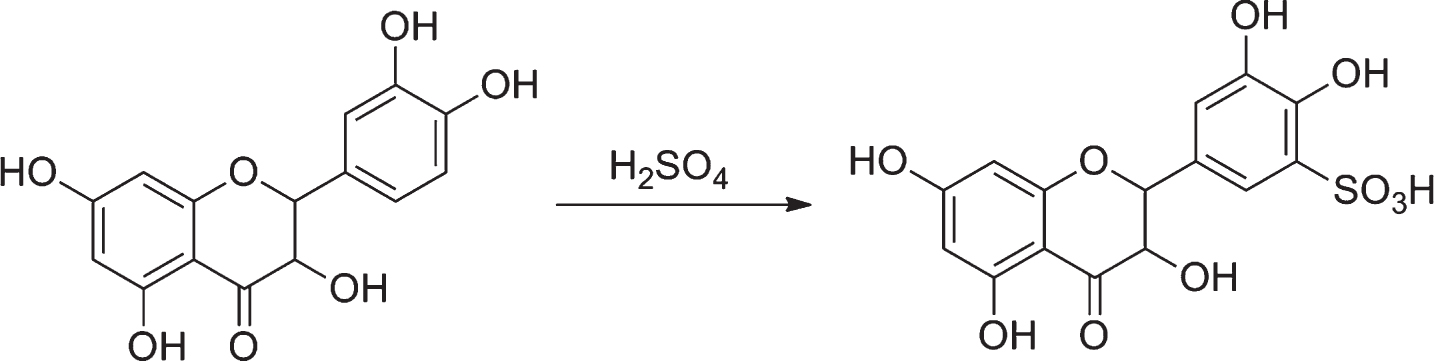
Reaction scheme of synthesis of quercetinsulfanate.
The obtained orange product was separated by centrifugation and recrystallized from water; yield – 75%.
Uv-vis study
As flavonoids are colored compounds, complexation process causes changes in color and in the electronic absorption spectra of the solution. The Qrc/Qsn-Ln(III) systems were study under the conditions of an excess amount of metal and a constant concentration of ligand. For all systems the buffer region was 4.60–5.60. All raw spectroscopic data are given in the Supplementary Material (Tables S1-S24).
Figure 1 shows typical spectra of quercetin at different concentration of Cerium(III). Figure S1 demonstrated that ΔA maximum remains invariant at 420 at different cerium concentration one might conclude that complex formation leads to the only product (monocomplex species) with rather negligible contribution from the polynuclear species CenLm. A similar reasoning is applied to each of studied system. The following equations [30]:
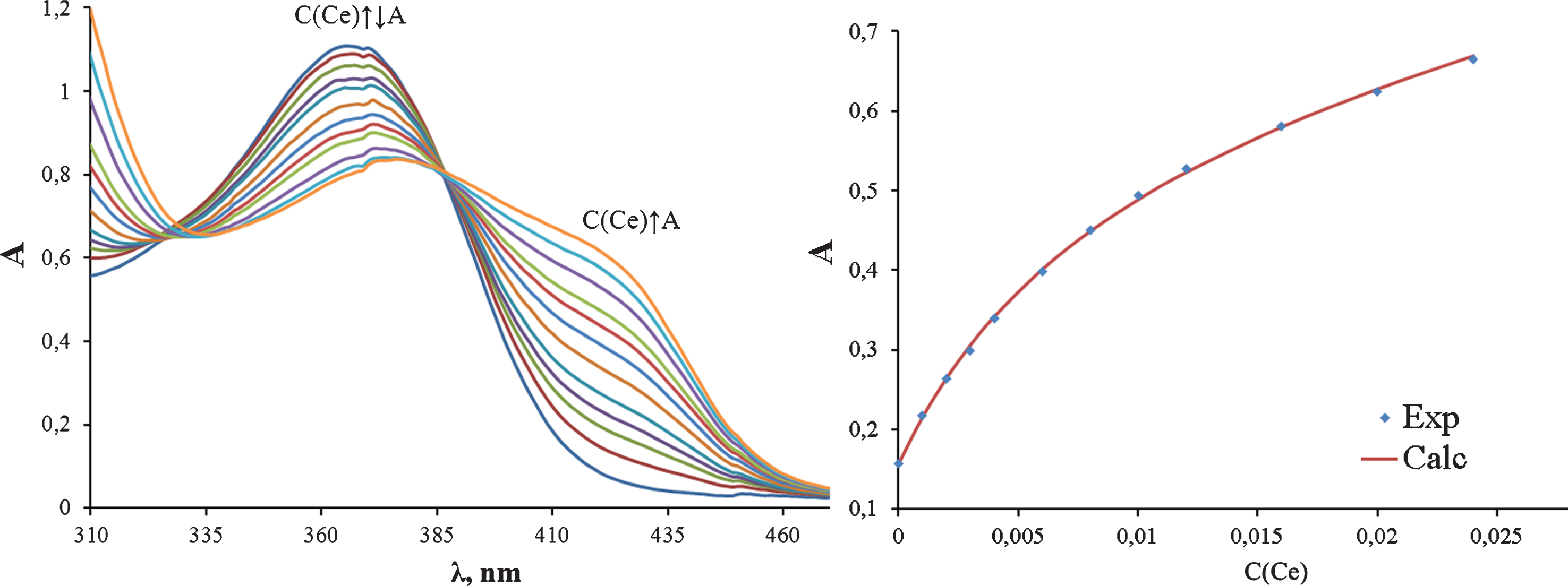
The UV–Vis spectra and absorbance at single wavelength (412 nm) for Ce(III)-Quercetin system; C(Quercetin) = 5.29·10–4 M; pH = 5.0, I = 1(NaClO4).
The obtained values of equilibrium constants and extinctions are given in Table 1 and Table 2. Although ΔA maximum for Qrc-Ln(III) spectra lie near 420 nm, all parameters for this systems were reproduce at 412 nm for the convenience of calculation at this wavelength. For receiving of more information about structures of complexes, some of systems has been study under various pH values. The results imply the linear correlation between logK′ and acidity of solution. This indicates that only one proton has been removed during the complexing process.
Conditional (K′), “true” (K) stability constants and value of extinction for Qrc-LnIII
Conditional (K′), “true” (K) stability constants and value of extinction for Qsn-LnIII
As can be seen the obtained values of “true” equilibrium constants lie within from 5 to 9 logarithmic units. The strongest and weakest interaction has been observed for YbIII and CeIII/LaIII complexes, respectively. Quercetin and quercetinsulfanate formed comparably strong complexes with Tm(III), Er(III), Tb(III) and Dy(III). The stabilities of the quercetin chelates with different lanthanides ions are somewhat lower than those of Qsn. Regarding all of other metal complexes of quercetin, current rare earth metals format more stable species. All of investigated complexes are much stable than monocomplexes Qrc with Ca2+, Mg2+, Co 2+ and Ni2+ [12].
According to [12] logK for LaIII-quercetin monocomplex in water/dioxan (1 : 1, v/v) media is 8.143 vs. 5.77 log units for our value. The difference in results more than 2 logarithmic units can be explain by numerous difference of solvent effects in water and in water/dioxane mixture.
The “true” stability constants of monocomplex species decrease in the order: Yb>Tm>Er> Tb>Dy>Eu>Pr>Sm>La>Nd>Gd>Ce and Tb>Dy>Tm>Er>Gd>Tb>Pr>Sm>Eu>Nd>Ce>La for Qrc and Qsn, respectively. Table 3 given as an example the various ratios of stability constants for some heterocyclic ligands and lanthanides. We may notice that the obtained orders of stability constants are typical for heterocyclic ligand. The LogK-Ln(III) and logK-Z/R relationship curve are shown at Fig. 2. The pronounced correlation for logK-Z/R is not observe, but all lanthanides separated by two groups: La-Eu (Z/R from 2.5 to 2.8) and Gd-Yb (Z/R from 3.0 to 3.3). Moreover, Gd-Yb group displayed the weak linear correlation of logK-Z/R relationship. This fact indicate that the electrostatic interaction higher for Gd-Yb group than for La-Eu group of metals.
The orders of stability constants of monocomplexes for different ligands with Ln(III)

The logK-Ln(III) and logK-Z/R curves for quercetinsulfanate(1) and quercetin(2).
For verification of chosen coordination model ab initio calculations at level Def2-SVP/DFT/PBE0/SMD were performed. All theoretical simulations were implemented for La(III)-complexes. This choice stems from the fact that La is the eponym of the lanthanide series and all theoretical results obtained for La(III) also can be extrapolated for all of other lanthanides. In addition, calculation of other lanthanides with using different modern quantum chemical programs and computational protocols are difficult problem for large systems like Ln-Qsn/Qrc complexes. No modern existing theoretical approaches allow obtain optimized structure for Qsn/Qrc complexes with metals from Ce to Yb.
According to [12] quercetin have three possible chelating sites and one linear structure. La(III)-Quercetinsulfanate may exist as seven tautomers. They are collected in Figure S2 and S3. All calculations of optimization structures were carried out on the model La(H2O)6L2+. For estimation of thermodynamic stable of tautomers absolute and relative energy for each of structures were calculated (Table S26 and S27). It was found that the 3-hydroxyl and 4-carbonyl chelating site (Fig. 3) is the most stable structure for LaIII-Qsn/Qsa monocomplexes. All other tautomers are of much greater energy (more than 20 kJ·mol–1).
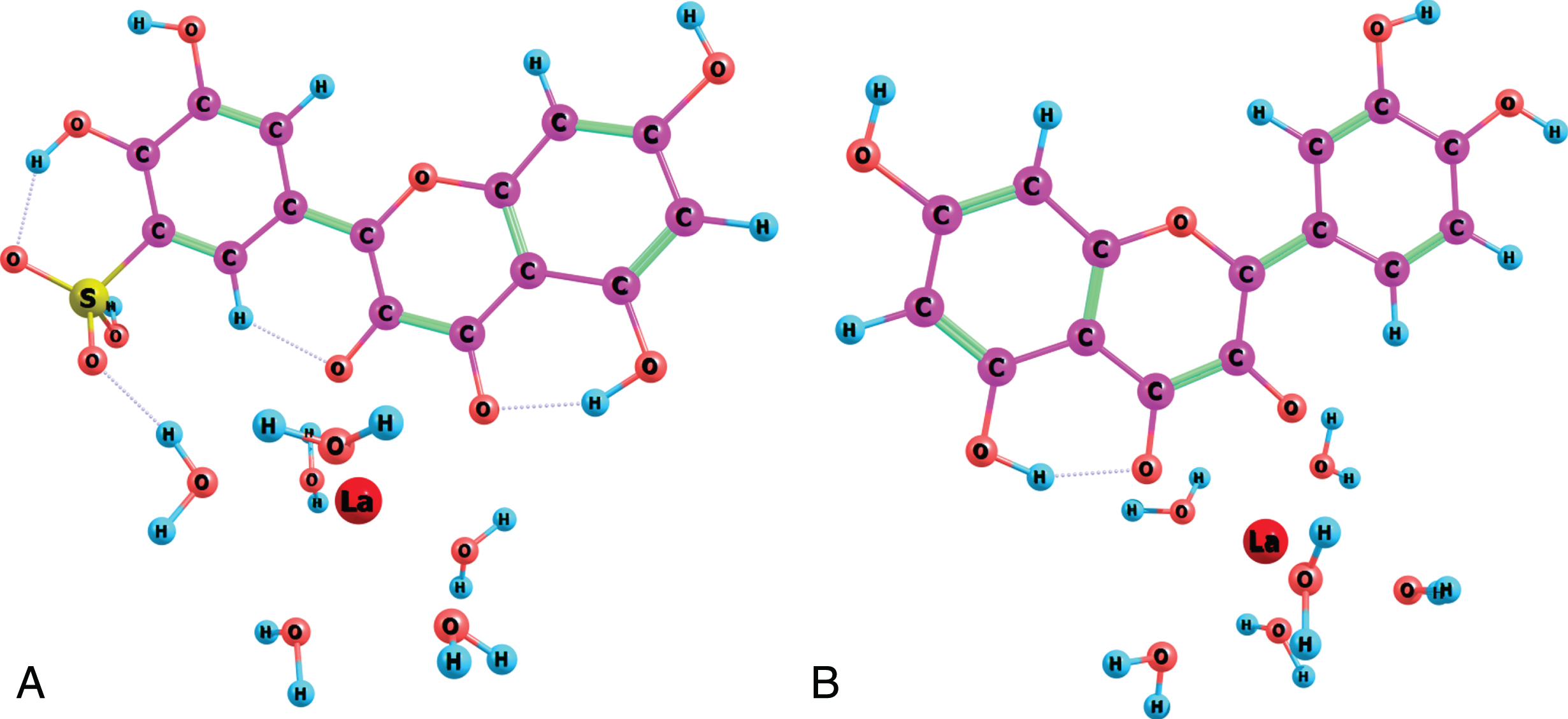
Optimization geometry of La(III)-Qsn(A) and La(III)-Qrc(B) complexes.
Within this study, the equilibrium processes between La(III) and 11 lanthanides with quercetin and quercetinsulfanate have been investigated in aqueous solution. The obtained complexes species has the monocomplex structure with logK from 5.4 to 8.6 logarithmic units. The DFT calculation shown that the LnIII coordinate with molecule of ligands via 3-hydroxyl and 4-carbonyl groups.
