



Abstract
A series of discrete compartmental Schiff base lanthanide(III) complexes of
Introduction
Macrocyclic compounds have attracted an increasing interest owing to their role in the understanding of the molecular processes that occur in different scientific fields, ranging from chemistry to biochemistry and medicine, from material science to hydrometallurgy [1–9]. Schiff bases have been extensively employed in the understanding of molecular processes occurring in biochemistry, material science, catalysis, encapsulation, activation, transport and separation phenomena, hydrometallurgy, etc [10–13]. They were among the first artificial metal macrocyclic complexes to be synthesized. The metal complexes containing synthetic macrocyclic ligands have attracted a great deal of attention because they can be used as models for more intricate biological macrocyclic systems: metalloproteins (hemoglobin, myoglobin, cytochromes, chlorophylls), corrins (vitamin B12) and antibiotics (valinomycin, nonactin). These discoveries have created supramolecular chemistry and its enormous diversity [14–18]. 2,6-Diformyl-4-methylphenol is a potential precursor to synthesize the compartmental Schiff base Macrocyclic ligands containing two bridging phenol groups. Compartmental macrocycles are relevant because they can accommodate two or more metal ions, connected in close proximity by appropriate bridging groups which, if paramagnetic, can interact with each other through the bridging donor atoms of the ligands in a ferromagnetic or antiferromagnetic way. By changing the type of ligand, the distance between the two chambers and/or the paramagnetic centers, it is possible to tune the magnetic interactions. Thus, the complexes, in which ferromagnetic interactions occur, may be good building blocks for the preparation of molecular magnets. In recent years, there has been immense interest in studying binuclear metal complexes using macrocyclic compartmental ligands derived from 2,6-diformyl-4-methylphenol and diamines [19–23]. An increasing interest has been directed towards lanthanide chemistry, owing to the possibility of using lanthanide compounds in biological studies, in material science and in chemical processes. These studies have produced technological developments and scientific and industrial applications [24–27]. Interest in exploring metal ion complexes with macrocyclic ligands has been continually increasing owing to the recognition of their role played by these structures in metalloproteins. Lanthanides offer an interesting series of easily available elements with a +3 oxidation state and other common physio-chemical properties, together with significant differences (i.e. the continuously decreasing ionic radius). The ionic radius allows them to reach high coordination numbers, with consequent unusual coordination geometry in comparison with d-elements [28–31]. The motivation for this is not only to understand the function of fundamental interactions in both coordination and biological mimics [32] but also to explore their potential for technological applications in a number of areas of material science, including use as magnetic and non-linear optical materials [21]. This paper deals with the design, synthesis and characterization of mononuclear lanthanide(III) complexes with the ligand
Experimental
Materials and methods
4,5-Dimethyl-1,2-phenylenediamine (Aldrich) was used as such for the synthesis of complexes. 2,6-Diformyl-4-methylphenol was synthesized by the literature methods [33]. The lanthanide(III) nitrates, namely, Pr(NO3)3.6H2O (99.8%), Nd(NO3)3.6H2O (99.8%), Sm(NO3)3.6H2O (99.8%), Eu(NO3)3.6H2O (99.8%), Tb(NO3)3.6H2O (99.8%), and Dy(NO3)3.6H2O (99.8%) (Indian Rare Earth Ltd.), and Pr(NO3)3.6H2O (99.8%), Gd(NO3)3.6H2O (99.8%), Ho(NO3)3.6H2O (99.8%), Er(NO3)3.6H2O (99.8%), and Y(NO3)3.6H2O (99.8%) (Aldrich) were used as such for the synthesis of complexes. p-Toluenesulfonyl chloride, p-cresol, tetraethylammonium perchlorate (Fluka), lithium hydroxide monohydrate, sodium dichromate dihydrate (LOBA), sodium carbonate, paraformaldehyde, formic acid, sodium hydroxide, sodium acetate, sodium sulfate anhydrous, and calcium chloride anhydrous (E. Merck) were used as purchased. Formaldehyde (38% v/v), glacial acetic acid, hydrochloric acid, sulfuric acid and fuming nitric acid (AR, E. Merck), were used as such. CDCl3 (Aldrich), KBr (FT-IR grade) (Aldrich) were used for recording NMR and IR spectra respectively. Acetonitrile, N,N-dimethylformamide, chloroform, dichloromethane benzene, toluene (E. Merck), and methanol (SD’s) were reagent grade and purified according to the literature method [34]. Diethyl ether, dimethyl sulfoxide, acetone and petroleum ether (60–80C) (E. Merck) were used as purchased. Double deionized water was obtained by distilling, distilled water over alkaline potassium permanganate. Absolute ethanol was prepared by double distilling rectified spirit over lime and the fraction boiling at 78C was collected. Super dry ethanol was prepared by distilling absolute ethanol over magnesium turnings activated by iodine and the fraction boiling at 78C was collected. Super dry methanol was also prepared by the same method by collecting the fraction boiling at 65C. N,N-dimethylformamide, distilled over P2O5 and stored over 4Å molecular sieves, was used for the electrochemical studies.
Physical measurements
Electronic absorption spectra were recorded on a Perkin-Elmer Lambda 3B UV-Vis spectrophotometer attached to a PC AT-286 and the spectra were recorded in the 900–190 nm range using PECSS software. The spectra of the complexes and the ligand were recorded in acetonitrile at 25C using a matched pair of Teflon stoppered quartz cells of path length 1 cm. IR spectra were recorded in a Perkin-Elmer RX-I FT-IR spectrometer in the range of 4000–400 cm-1 using KBr pellets. CHN microanalyses were carried out on a Perkin-Elmer 2400 CHNS/O analyzer and AD-6 Auto balance. Conductivity measurements of the complexes were carried out at 25±1C in N,N-dimethylformamide using Elico CM-180 conductivity meter and Elico Type CC-03 conductivity cell (cell constant 1.02 cm-1). FAB mass spectra were recorded on a JEOL-SX 102/DA 600 mass spectrometer/data system using argon (6 kV, 10 mA). The accelerating voltage was 10 kV and the spectra were recorded at room temperature. m-Nitrobenzyl alcohol was used as the matrix solvent and the mass spectrometer was operated in the positive ion mode. The EPR spectra were recorded on a Varian E-LINE Century series EPR spectrometer at 77 K. Magnetic susceptibility measurements were carried out on an EG & G PAR MODEL 155 vibrating sample magnetometer at 25C. The instrument was calibrated using pure nickel. 1 H NMR spectra were recorded on JEOL 200 MHz 1H NMR spectrometer in CDCl3. Electrochemical studies of the complexes were performed on a EG & G PARC model 273A potentiostat/galvanostat at 25C. A three-electrode configuration consisting of glassy carbon disc working electrode, a platinum wire auxiliary electrode, and Ag/AgCl reference electrode was used to record the cyclic voltammograms. The CVs were recorded using 10-3 to 10-4 M solutions of the complexes in dimethylsulfoxide containing 50 to 100 fold excess of tetraethylammonium perchlorate as the supporting electrolyte. All electrochemical studies were carried out in an atmosphere of oxygen free argon and the test solutions were flushed through argon for 30 min. before the voltammograms were recorded. Fluorescence study of the complexes were carried out on a Hitachi 650–40 Fluorescence Spectrophotometer in acetonitrile or N,N-dimethylformamide. Thermogravimetric studies were carried out using Stanton Redcroft STA-780 simultaneous thermal analyzer. The measurements were carried out on the platinum crucibles on sample size between 5–15 mg with high purity alumina as the reference. The heating rate was fixed at 10C/min.
Synthesis of the 18-membered dioxatetraaza diamine-diimine macrocycle (L1)
To a solution of 2,6-diformyl-4-methylphenol (1.64 g, 10 mmol) in 100 mL of methanol was added a solution of 4,5-dimethyl-1,2-phenylenediamine (1.36 g, 10 mmol) in 100 mL of methanol and the resulting red-orange solution was refluxed for 4 h, a shiny maroon red compound was separated out. The solution was cooled to room temperature (30C) and the product was filtered, washed with methanol, and dried under vacuum over anhydrous CaCl2 .
Characterization of the diamine-diimine macrocycle (L1)
Yield 1.47 g (56%) mp 302–304C. Analytically Calculated for C34H36N4O2: C, 76.6; H, 6.81; N, 10.52. Found C, 76.52; H, 6.77; N, 10.43. EI-MS (m/z, species): 532 M+ ion. 1H NMR (200 MHz, CDCl3) (ppm from TMS) a doublet at 4.4 ppm and a triplet at 6.2 ppm due to CH2 and N-H protons, respectively. The singlets at 2.35, 8.55, and 13.57 ppm are due to the aromatic methyl, azomethine and phenolic protons, respectively. 13C NMR (200 MHz, CDCl3) (ppm from TMS): 163.7, 155.7, 142.0, 136.2, 135.7, 132.5, 130.9, 129.5, 128.9, 126.6, 124.6, 118.2, 114.4, 47.2, 24.6, and 17.8. IR FT (KBr, cm-1): 1615 s, ν(C=N): 3404 sp ν(NH); 3386 s, ν(OH); 2847 w, ν(CH). UV-Vis (CH3CN) [λmax (nm)(ɛ (Lmol-1 cm-1))]: 374 (15) 539), 349 (14 786), 265 (33 969).
Attempted synthesis of complexes of L1
The metal-free macrocyclic ligand
General procedure for the synthesis of lanthanide(III) complexes of L2
To a solution of 2,6-diformyl-4-methyl-phenol (1.64 g, 10 mmol) and the respective lanthanide(III) nitrate hydrate (5 mmol) in 50 mL of methanol was added a solution of 4,5-dimethyl-1,2-phenylenediamine (1.36 g, 10 mmol) in 50 mL of methanol at room temperature (30C) and the solution was stirred on a magnetic stirrer. The color of the solution gradually changed from yellow to orange and then to deep red. Black crystals started depositing on the sides of the flask within 30 min. and the stirring was continued for 4 h. The solid product, which separated out, was filtered, washed with methanol followed by chloroform, and dried under vacuum over anhydrous CaCl2. All the complexes described below were isolated as black crystalline compounds and were soluble in DMF and DMSO (Scheme 1).
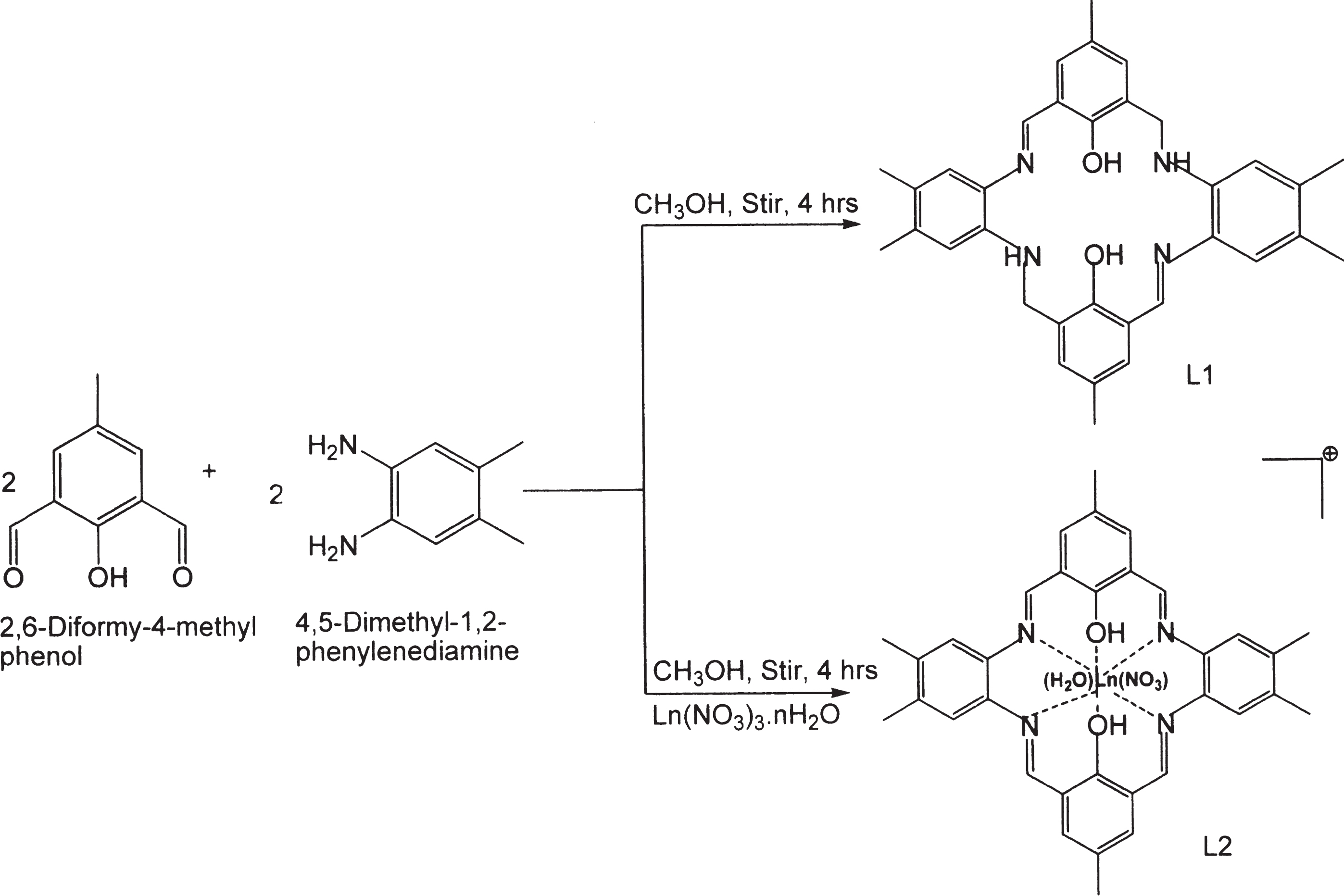
Synthesis of the ligand (
Yield 34.4%. Analytically Calculated for C34H38N7O14Pr (%): C, 45.79; H, 4.04; N, 10.99. Found: C, 45.01; H, 4.10; N, 10.85. FAB-MS (m/z, M+): 749 (C30H20N7O13141Pr). UV-Vis (CH3CN) [λmax (nm)( ɛ (1 mol cm-1))]: 281 (29 776), 360 (21 911). ΛM (dmf): 238.96 Ω-1cm2mol-1.
[Nd(L2)(NO3)(H2O)](NO3)2.2H2O (2)
Yield 42.9%. Analytically Calculated for C34H38N7O14Nd (%): C, 45.64; H, 4.03; N, 10.96. Found: C, 45.74; H, 4.11 N, 10.65. FAB-MS (m/z, M+): 752 (C34H38N7O14144Nd). UV-Vis (CH3CN) [λmax (nm)( ɛ (1 mol cm-1))]: 276 (30 385), 408 (16 550). ΛM (dmf): 220.74 Ω-1cm2mol-1.
[Sm(L2)(NO3)(H2O)](NO3)2.2H2O (3)
Yield 41.8%. Analytically Calculated for C34H38N7O14Sm (%): C, 45.30; H, 4.00; N, 10.80. Found: C, 45.60; H, 4.03; N, 10.62. FAB-MS (m/z, M+): 758 (C34H38N7O14150Sm). UV-Vis (CH3CN) [λmax (nm)( ɛ (1 mol cm-1))]: 286 (43 434), 410 (14 149). ΛM (dmf): 196.35 Ω-1cm2mol-1.
[Eu(L2)(NO3)(H2O)](NO3)2.2H2O (4)
Yield 37.8%. Analytically Calculated for C34H38N7O14Eu (%): C, 44.35; H, 4.13; N, 10.65. Found: C, 44.81; H, 4.39; N, 10.52. FAB-MS (m/z, M+): 760 (C34H38N7O14152Eu). UV-Vis (CH3CN) [λmax (nm)( ɛ (1 mol cm-1))]: 297 (37 301), 413 (15 454). ΛM (dmf): 205.74 Ω-1cm2mol-1.
[Gd(L2)(NO3)(H2O)](NO3)2.2H2O (5).
Yield 38.4%. Analytically Calculated for C34H38N7O14Gd (%): C, 44.98; H, 3.97; N, 10.80. Found: C, 44.88; H, 4.05; N, 10.78. FAB-MS (m/z, M+): 755 (C34H38N7O14157Gd). UV-Vis (CH3CN) [λmax (nm)( ɛ (1 mol cm-1))]: 286 (48 036), 414 (23 044). ΛM (dmf): 215.63 Ω-1cm2mol-1.
[Tb(L2)(NO3)(H2O)](NO3)2.2H2O (6)
Yield 32.7%. Analytically Calculated for C34H38N7O14Tb (%): C, 44.01; H, 4.10; N, 10.57. Found: C, 44.21; H, 4.03; N, 10.61. FAB-MS (m/z, M+): 769 (C34H38N7O14159Tb). UV-Vis (CH3CN) [λmax (nm)( ɛ (1 mol cm-1))]: 295 (37 051), 412 (14 218). ΛM (dmf): 223.65 Ω-1cm2mol-1.
[Dy(L2)(NO3)(H2O)](NO3)2.2H2O (7)
Yield 38.6%. Analytically Calculated for C34H38N7O14Dy (%): C, 43.82; H, 4.08; N, 10.53. Found: C, 43.31; H, 4.27; N, 10.77. FAB-MS (m/z, M+): 772 (C34H38N7O14162Dy). UV-Vis (CH3CN) [λmax (nm)( ɛ (1 mol cm-1))]: 290 (36 986), 438 (19 434). ΛM (dmf): 240.17 Ω-1cm2mol-1.
[Ho(L2)(NO3)(H2O)](NO3)2.2H2O (8)
Yield 37.7%. Analytically Calculated for C34H38N7O14Ho (%): C, 43.73; H, 4.07; N, 10.50. Found: C, 43.31; H, 4.27; N, 10.77. FAB-MS (m/z, M+): 773 (C34H38N7O14165Ho). UV-Vis (CH3CN) [λmax (nm)( ɛ (1 mol cm-1))]: 295 (37 051), 413 (15 454). ΛM (dmf): 239.18 Ω-1cm2mol-1.
[Er(L2)(NO3)(H2O)](NO3)2.2H2O (9)
Yield 38.9%. Analytically Calculated for C34H38N7O14Er (%): C, 43.64; H, 4.06; N, 10.48. Found: C, 43.01; H, 4.16; N, 10.74. FAB-MS (m/z, M+): 775 (C34H38N7O14167Er). UV-Vis (CH3CN) [λmax (nm)( ɛ (1 mol cm-1))]: 295 (37 051), 418 (20 566). ΛM (dmf): 240.74 Ω-1cm2mol-1.
[Y(L2)(NO3)(H2O)](NO3)2.2H2O (10)
Yield 39.6%. Analytically Calculated for C34H38N7O14Y: C, 47.61; H, 4.43; N, 10.43. Found: C, 47.91; H, 4.46; N, 10.64. FAB-MS (m/z, M+): 697 (C34H38N7O1489Y). UV-Vis (CH3CN) [λmax (nm)( ɛ (1 mol cm-1))]: 294 (28 448), 425 (19 026). ΛM (dmf): 199.07 Ω-1cm2mol-1.
Results and discussion
Infra-Red spectral data of lanthanide(III) complexes of L2
The infrared spectra of the complexes of
Characteristics Infrared absorptions (cm-1) of lanthanide(III) Complexes of L2
Characteristics Infrared absorptions (cm-1) of lanthanide(III) Complexes of
aFor reference see the text, abbreviations: sp = sharp, s = strong, w = weak, b = broad, vs = very sharp.
The molar conductivity of the lanthanide(III) complexes of
FAB mass spectra of the complexes of L2
The FAB mass spectra of the complexes contain peaks due to the species [Ln(
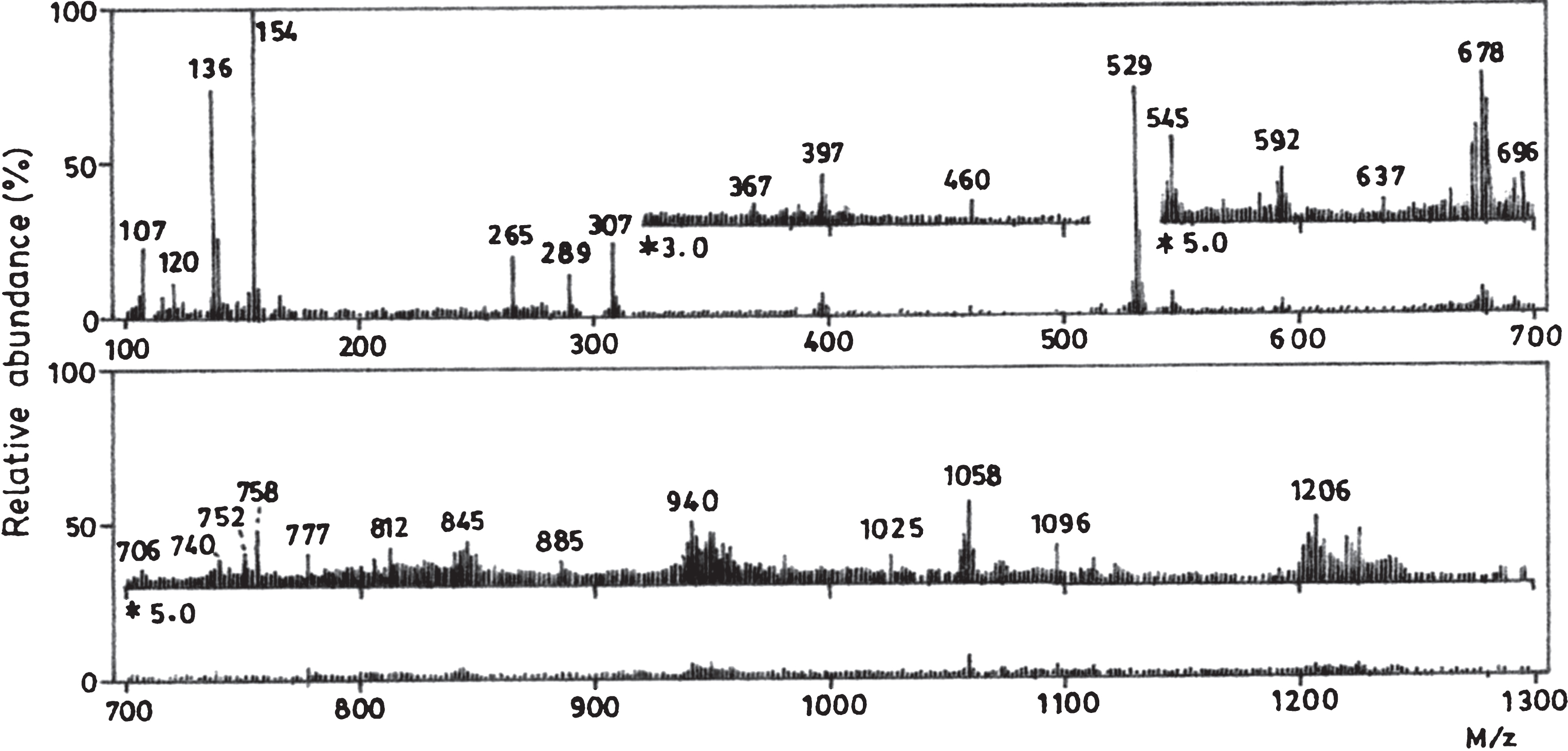
FAB Mass Spectrum of [Sm(
These sandwich complexes have been formed during the FAB fragmentation process. The peaks due to the sandwich complexe species are observed in the FAB mass spectra of [Sm(
Electronic absorption spectrum of
The EPR spectrum of [Gd(L2)(NO3)(H2O)](NO3)2.2H2O
The EPR spectrum of Gd(III) complex, recorded at liquid nitrogen temperature, is a typical spectrum of Gd(III) ion with a 4f7 electronic configuration (8S7/2). The EPR spectrum consists of a singly very broad line of g = 2.004, which is an indicative of strong Zeeman interactions and a weak crystal field with highly anisotropic g-factor [42]. The strong crystal field splits the eightfold spin degeneracy of the Gd(III) free ion into four doubly degenerate levels. As a result of transition of unpaired electron between these eight levels, additional line of g < 2.0 is observed. The broad EPR spectrum without any additional lines shows that there is a strong spin-spin interaction and the behavior is not due to strong crystal field [42, 43]. The EPR spectrum of [Gd(
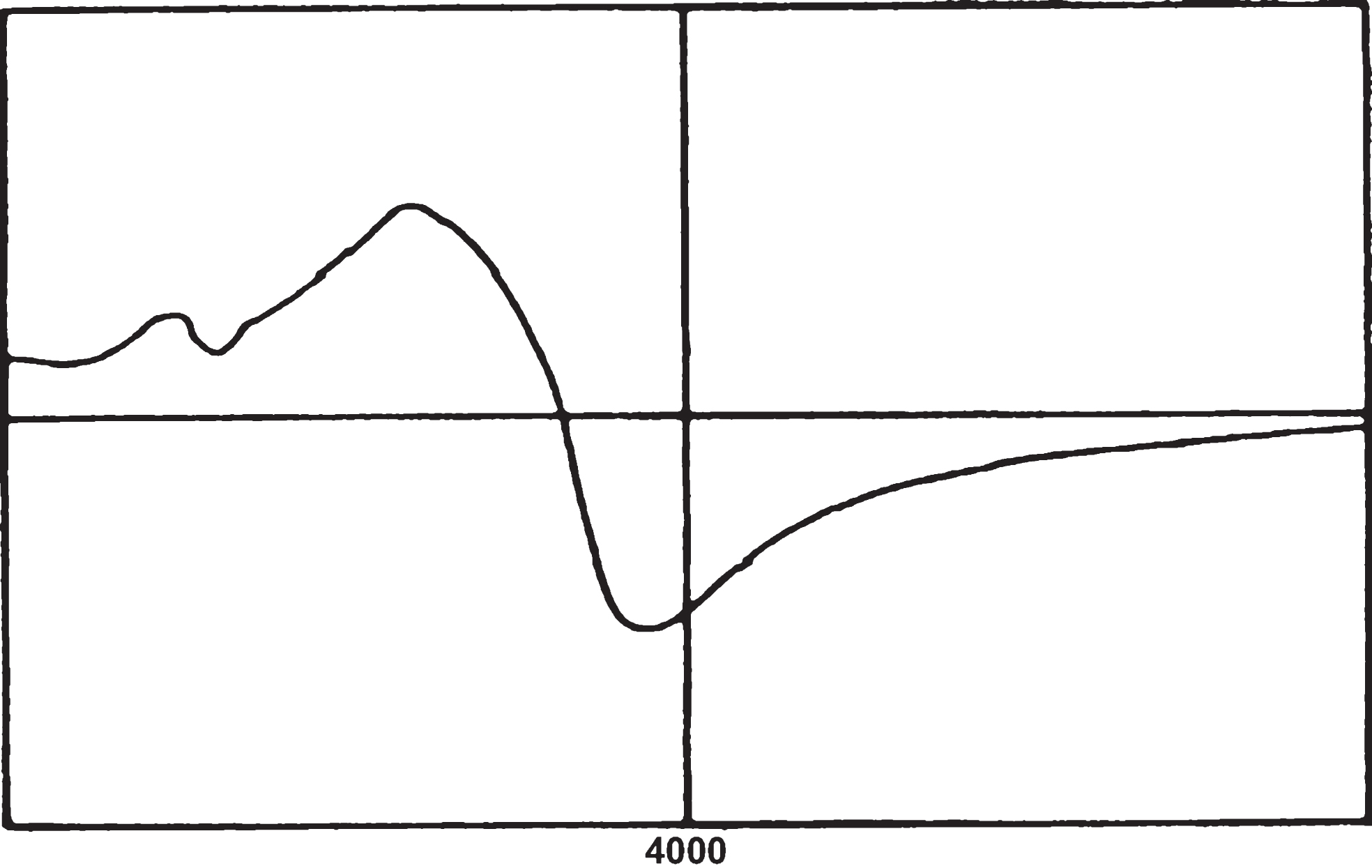
The EPR Spectrum of [Gd(
The cyclic voltammogram of the europium complex of
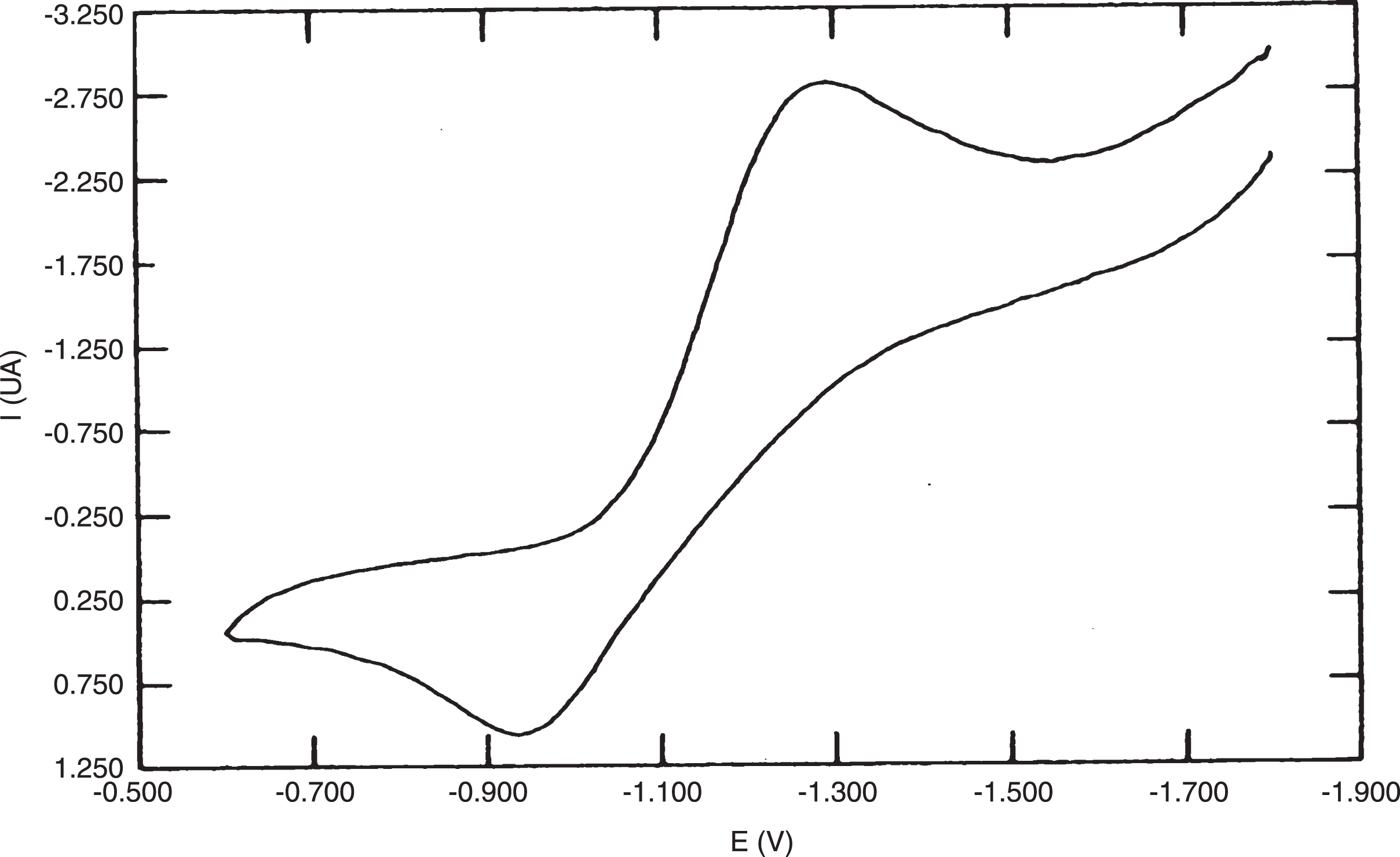
Cyclic Voltammogram of [Eu(
The magnetic moments of the lanthanide(III) complexes show that they are paramagnetic in nature. The μeff values of the complexes of Pr(III), Gd(III), Tb(III), and Dy(III) are 3.49, 7.94, 9.56, and 10.58 B.M respectively. These values are very close to the magnetic moments of the free metal ions [44].
Thermal stability of the lanthanide(III) complexes of L2
The TG-DTA studies of the ligand
Fluorescence studies
The emission spectra of the mononuclear complexes were recorded in acetonitrile and DMF. The excitation spectrum of Eu(
Conclusions
Experimental conditions such as solvent and temperature are important in the synthesis of macrocyclic complexes of lanthanides. But complexes of
Footnotes
Acknowledgments
The author would like to express his sincere thanks to the Department of Science and Technology, New Delhi for financial assistance. Dr. A.M. Edwin Suresh Raj, Imperial College, London, Dr. Balachandra Unni Nair, Scientist, CLRI, Chennai and Dr. S. Philip Anthony, Senior Assistant Professor, School of Chemical and Biotechnology, Sasthra University, Thanjavur are gratefully acknowledged for recording TG, Fluorescence and NMR spectra, respectively. The author would also like to acknowledge Dr. D. Suresh Kumar, Associate Professor, Department of Chemistry, Loyola College, Chennai, for his useful discussions.