A novel cation-stabilized iodocuprate, named {CuI3](1,3-bip)} (1), [1,3-bip = 1,3-bis(isoquinoline)propane] have been constructed from mixtures of bis(isoquinoline) and silver iodide in acetonitrile solution. Compound 1 was characterized by elemental analysis, IR spectra and X-ray crystallography. The dianions of 1 have planar triangular geometry with each halide atom being bound to the central trigonally coordinated copper atom. The optical band gap of 1 was estimated to be 2.5 eV. Interestingly, nearly 52% of contaminant (methylene blue aqueous solution (MB), 50 mL, 1.0×10⁻⁵ M) could be decolorized after exposure to visible light within 100 min, illustrating an impressive photocatalytic activity of compound 1. The thermal properties of 1 along with 1,3-bip have also been investigated.
As in past decades, much interest in recognition of the supramolecules has undergone a rapid development and has attracted considerable attention due to their fascinating structures and functionalities such as magnetism, molecular recognition, sensors, materials science, electrical conductivity, biology, optical properties, host-guest properties and catalysis [1–4]. Among the numerous families of supramolecular compounds, the family directed by organic cations with azotic heterocycles has occupied a crucial position in the chemical engineering and molecular science [5, 6]. The geometries of organic cations play an essential role in the construction of novel supramolecular complexes; so much effort has been devoted to the design and modification of the organic cations to control the products [7–9]. To date, plenty of heterocyclic nitrogen-containing organic cations have been widely used to construct supramolecular compounds with interesting structure and novel properties [10, 11]. Among them, isoquinoline derivatives refer to isoquinoline itself, are paid close attention because of their broad range of biological activities [12–15]. However, only a few have been made from halogenmetallates with isoquinoline derivatives, such as Song et al. have studied an iodocuprate of 1,4-bip and the thermal properties [16].
As an extension of this study, we carried out the reactions of CuI with 1,3-bip, and a new halogencuprate complex with the 1,3-bip dication, [1,3-bip][CuX3] was obtained therefrom. Herein we report its syntheses, crystal structures and thermal properties.
Experimental
Materials and methods
The dications 1,3-bis(isoquinoline)propane were prepared as the bromide salt by direct alkylation of isoquinoline with 1,3-dibromoalkane and acetonitrile served as the solvent for the reaction. The reaction route was shown in (Scheme 1). Other chemicals were obtained from commercial sources and used as received without further purification. The IR spectrum was recorded on a Shimazu IR435 spectrometer as KBr disk (4000–400 cm–1). Powder X-ray diffraction (PXRD) analyses were recorded on a Rigaku Dmax2500 diffractometer with Cu Kα radiation (λ= 1.54056Å) with a step size of 0.05°. A model NETZSCHTG209 thermal analyzer was used to record simultaneous TG curves in the flowing nitrogen atmosphere of 20 mL min–1 at a heating rate of 5°C min–1 in the temperature range r. t. –800°C using platinum crucibles. The photoluminescent spectra were performed on a Perkin–Elmer LS55 spectrofluorometer. The room-temperature optical diffuse reflectance spectrum of powder samples was obtained using a Shimadzu UV-2600 UV-vis spectrophotometer. The absorption spectrum was calculated from the diffuse reflectance spectrum by using the Kubelka-Munk function: a/S = (1–R)2/2R [17].
Synthesis of the 1, 3-bip cation (n = 3).
Complex synthesis
[CuI3](1,3-bip) (1). To the mixed solution of CuI(0.5 g) in 5 ml DMF/H2O, DMF solution of 1,3-bip·2Br(1 g) was added dropwise to obtain a clear yellow solution. The solution was then filtrated and slowly evaporated in a vial at room temperature. The light yellow crystals, which were suitable for X-ray single crystal diffraction analysis, were obtained after two days, dried in air. IR (KBr): 3037 (w), 2104(m), 1635(m), 1473(m), 1395(m), 1158(m), 823(s), 764(s), 476(m) cm–1. Anal calcd for C21H19N2CuI3: C, 33.92; H, 2.57; N, 3.77. Found, % : C, 33.90; H, 2.55; N, 3.86.
X-ray crystallography study
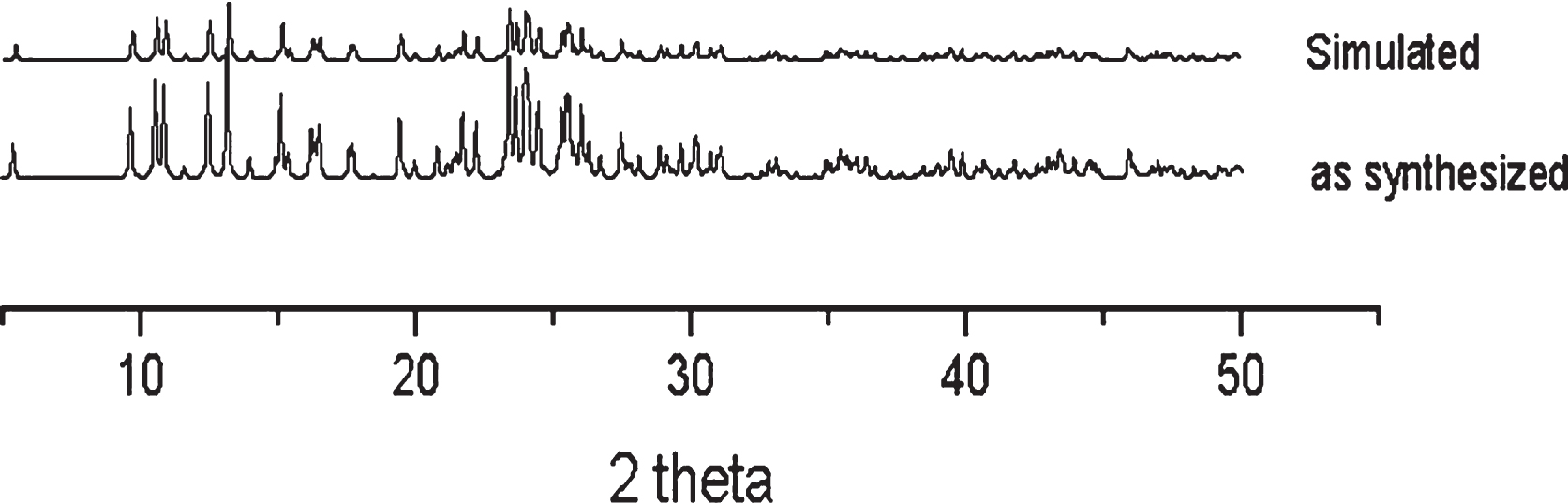
X-ray diffraction data for 1 were collected by using a Bruker Nonius Kappa CCD diffractometer at 290(1) K equipped with graphite–monochro-matized Mo-Ka radiation (λ= 0.71073Å). The structure was solved by direct methods and expanded using Fourier techniques. A numerical absorption correction was applied [18] Hydrogen atoms were placed at calculated positions and refined using a riding model. All parameters were refined against F2. All non-hydrogen atoms were refined with anisotropic displacement parameters. Crystallographic data and structural refinement details for 1 were summarized in Table 1. Important bond lengths and angles were given in Table 2. The simulated PXRD spectra were from the single-crystal data and the Mercury (Hg) program obtained from the Web site at http://www.iucr.org. The PXRD patterns were conducted on crystalline samples to confirm the phase purities of complex 1. As shown in Fig. 1, the experimental PXRD patterns of as-synthesized samples agree well with their simulated ones, indicating the phase purities of the bulk samples.
Power X-ray diffraction (PXRD) of complex 1.
Crystallographic parameters for compound 1
Compounds
1
Formula
C21H19N2CuI3
Formula weight
743.63
Crystal system
Triclinic
Space group
P–1
a/Å
7.6917(11)
b/Å
9.2638(13)
c/Å
16.347(2)
α/°
95.871(2)
β/°
93.139(3)
γ/°
98.151(2)
Volume, Å3
1144.1(3)
Z
2
Calculated density, Mgm–3
2.159
μ, mm–1
5.010
F(000)
694
Crystal size, mm3
0.10×0.12×0.16
Temperature, K
298
Reflections collected
8013
Independent reflections
4890 [R(int) = 0.0764]
Data/restraints/parameters
4890/0/244
Goodness-of-fit on F∧2
0.982
Final R indexes [I > 2σ(I)]
R1 = 0.0586, wR2 = 0.1171
Final R indexes [all data]
R1 = 0.0872, wR2 = 0.1302
Largest peak,
1.230
Hole(e Å–3)
–0.716
Selected bond distances (Å) and angles (°) for compound 1
(1,3-BIP)[CuI3]
(1)
I1-Cu1
2.5131(14)
I2-Cu1
2.5248(13)
I3-Cu1
2.5122(13)
I2-Cu1–I3
118.63(5)
I1-Cu1–I3
122.09(5)
I1-Cu1–I2
119.27(5)
Results and discussion
Description of crystal structure
Structure of (1,3-bip) [CuI3] (1)
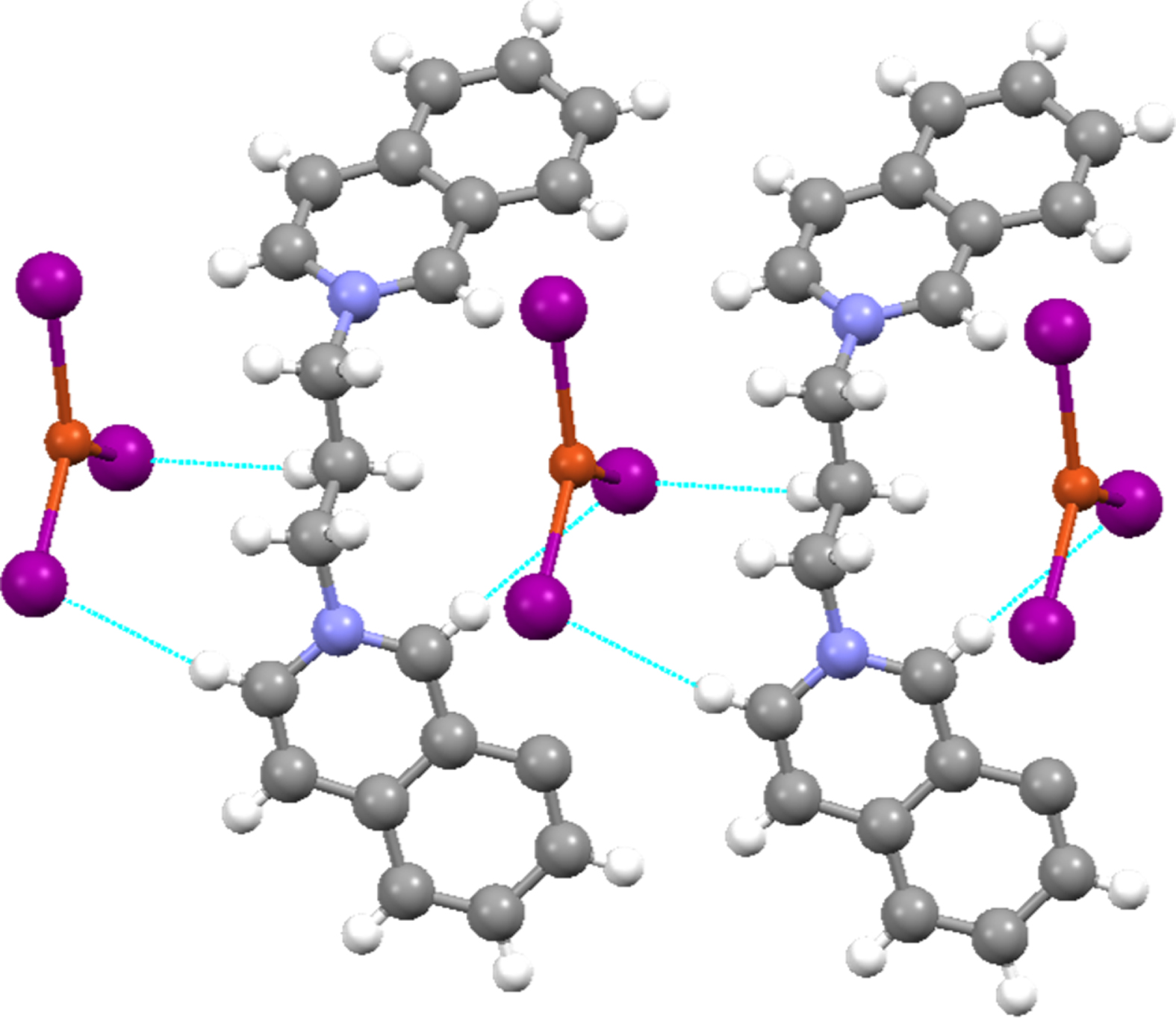
In the title compound, (1,3-bip)[CuI3], the asymmetric unit contains a 1,3-bip cation and a CuI3 anion (Fig. 2). In the anion, Cu-I bond distances lie in the range of 2.513–2.525Å. All of the atoms in the anion are essentially coplanar. In the crystal structure, an extensive network of C–HI hydrogen bonds links the cations and anions into an extended three-dimensional network, with the cations further aggregated through – stacking interactions (Fig. 1b). Other bond angle and lengths are compared with those found in the organic cation stabilized iodocuprate analogues [19, 20].
The perspective view and the C–HI hydrogen bonding of the structure of 1.
The optical property of 1,3-bip and complex 1
Figure 3a-b shows the absorption spectra of 1, 3-bip and 1 in 10–5 mol/L DMF solution. Both compounds present an intense absorption band centered at ca. 270 nm (267 nm for 1) and 335 nm (338 nm for 1). Such bands can be tentatively assigned to the π⟶ π * charge transfer transition. The band gaps (Eg) was determined as the intersection point between the energy axis and the line extrapolated from the linear portion of the absorption edge in a plot of Kubelka-Munk function F against energy E. Kubelka-Munk function, F = (1–R)2/2 R, was converted from the recorded diffuse reflectance data, where R is the reflectance of an infinitely thick layer at a given wavelength [21, 22]. Extrapolating the linear par of the rising curve to zero provides the onset of absorption at 2.50 eV for 1 as shown in Fig. 3c. The absorption lies in the energy range suitable for visible-light photocatalytic applications and shows that 1 can be regarded as semiconducting materials. The band gap of the title compound encouraged us to investigate its photocatalytic activity, which was evaluated for MB photodegradation under visible-light illumination.
Absorption spectra of 1,3-bip (a) and 1 (b) in DMF solution; (c) Diffuse reflectance UV-vis-NIR spectra of K–M functions vs. energy (eV) of compounds 1; (d) Photocatalytic degradation of MB solution under UV light irradiation with the use of compounds 1 and the control experiment without any catalyst.
To research the photocatalytic activity of complex 1 in detail, we selected aqueous solution of MB (methyl blue, 1.0×10⁻⁵ M, 100 mL) as models of dye water. The compounds 1 (50 mg) were added into MB aqueous solution. Then magnetically stirred in the dark for 30 min to ensure the equilibrium of adsorption/desorption. Afterward, under the irradiation of a 500 W Xe lamp the solution was kept continuously stirring with the aid of a magnetic stirrer. 3.0 mL sample was taken for analysis. The photodegradation process of MB without any catalyst had also been studied for the control experiment. The characteristic absorption of MB at about 664 nm (MB) was chosen to monitor the photocatalytic degradation process. Besides, the concentrations of MB (C) versus reaction time (t) of complexes 1 are plotted in Fig. 3d (wherein, C0 is the initial concentration of the MB and C is the concentration of the dye at any given time). As shown in Fig. 3d, the photolysis of MB itself under visible-light illumination was negligible. We can see that complexes 1 are vigorous for the decomposition of MB under the sunlight irradiation. Satisfyingly For complex 1, approximately 52% of MB have been decomposed after 100 min. illustrating an impressive photocatalytic activity of compound 1.
Thermogravimetric analysis
In order to investigate the thermal decomposition behavior of compound 1, the TG experiments were carried out up to 900°C in flowing nitrogen atmosphere, and the TGA curves were shown in Fig. 4. As shown in Fig. 4, the TGA curve for 1 displayed two distinct weight loss processes in the temperature range 265∼900°C. The first weight loss took place at 265°C and completed at 395°C, which probably corresponded to the thermal loss of an organic component, while the second stage ranging 395∼900°C mainly involved the decomposed of anion unit.
TG plots of compound 1.
Conclusions
The synthesis of a new iodocuprate complexes of 1,3-bip has been achieved via a direct method of complexation in solution. The new supramolecular system is thermally stable and has been characterized by X-ray crystallography. The complex has a monomeric structure in the solid state. Its crystal structure and thermal and optical properties have been investigated. Remarkably, nearly 52% of MB contaminant was decolorized after exposure to visible light within 100 min, illustrating an impressive photocatalytic activity of compound 1. Investigation of the use of the new cuprous complex in other field is underway and will be reported in due course.
References
1.
(a) SunS.S. and LeesJ.A., Coord Chem Rev230 (2002), 171; (b)
WuB.D.,
LiangJ.,
WangJ.Y. and AnC.W., Main Group Chem16(1) (2017), 67; (c)
SaghatforoushL.,
RudbariH.A.,
NicolòF.,
AsgariP.,
ChalabianF. and KatozianF., Main Group Chem12(4) (2013), 349.
2.
(a)
HollidayB.J. and MirkinC.A., Angew Chem Int Ed Engl40 (2001), 2022; (b)
Al-AnberM.,
EcorchardP.,
RüfferT. and LangH., Main Group Chem11(3) (2012), 205; (c)
ChengY.Z.,
TangY. and ZhangL.P., Main Group Chem13(4) (2014), 293.
3.
(a)
Al-FarR.,
AliB.F. and HaddadS.F., Main Group Chem7(4) (2008), 301; (b)
AliB.F.,
Al-FarR. and HaddadS.F., Main Group Chem8(3) (2009), 177; (c)
GuerreroL.,
MontalvoR.,
RiveroI.A. and BarbaV., Main Group Chem11(4) (2012), 259.
4.
(a)
LuJ.,
LiuH.T.,
ZhangX.X.,
WangD.Q. and NiuM.J., Z Anorg Allg Chem636 (2010), 641; (b) ElmaliF.T.,
AvciataU. and DemirhanN., Main Group Chem10(1) (2011), 17; (c)
YueJ.M.,
NiuY.Y.,
ZhangB.,
NgS.W. and HouH.W., CrystEngComm13 (2011), 2571.