



Abstract
A new, green, and simple cloud point extraction process of aluminum (III) from aqueous solution was investigated. The method is based on the complexation reaction of aluminum (III) with alizarin red S (ARS) at pH 5.0 and micelle-mediated extraction of the complex with nonionic surfactant Triton X-114. The enriched analyte in the surfactant-rich phase was determined spectrophotometrically at 515 nm. The optimal conditions including pH, reagent volume, surfactant concentration, temperature and centrifugation time were optimized. The proposed CPE method showed linear calibration within the range 5.0–300 ng mL–1 of aluminum (III) and the limit of detection was 1.0 ng mL–1 with a preconcentration factor of ∼100. The relative standard deviation (RSD%) and relative error (RE%) were found to be 1.70% and 1.78%, respectively. The accuracy of method was evaluated by the analysis of certified reference materials. The interference effect of some cations and anions was also studied. In the presence of foreign ions, no significant interference was observed. The method was applied to the determination of aluminum (III) in real food samples with a recovery for the spiked samples in the range of 95.0–102%.
Keywords
Introduction
Aluminum Al(III) is the most significant metal in the earth’s crust to which humans are frequently exposed and has several industrial applications [1]. The total concentration of Al(III) in natural samples water, food technology and pharmaceutical compounds increases due to the human activities in industry. The maximum permissible concentration of Al(III) is 200 μg L–1 in drinking water as recommended by the World Health Organization [2]. Recently, Al(III) has high potential toxic impacts in some human pathologies like Parkinson and Alzheimer’s disease due to accumulation of Al(III) in the brain [3]. Now It is very important to monitor and determine the trace level of Al(III) in environmental (water and food) and biological samples due to its toxic or adverse impact on human health [4].
Several analytical techniques such as ICP-MS [5], ETAAS [6], GFAAS [7] and FAAS [8] have been developed for direct determination of Al(III) in various samples. However, these techniques have less selectivity, sensitivity and precision. Due to, it has some disadvantages like operational costs, matrix effect and the concentration of Al(III) below LOD of the instrument. So, there is still a need for separation and preconcentration step prior to determination of Al(III).
Sensitivity and selectivity for trace levels of Al(III) can be improved by using several popular enrichment-separation techniques that pre-concentrate and separate Al(III) at trace levels, such as LLE [4, 9–12], CPE [13–21], SPE [22–24], coprecipitation [25, 26] and membrane filtration [27, 28]. The proposed CPE method was compared to a variety of other separation/preconcentration methods for determination of Al(III) reported recently in the literature. The distinct characteristics are summarized in Table 1.
Comparison between the proposed CPE procedure and other reported methods for Al(III) extraction and determination
Comparison between the proposed CPE procedure and other reported methods for Al(III) extraction and determination
aLOD: Limit of detection; bRSD: Relative standard deviation. cPF: Preconcentration factor and EF: Enrichment factor. dTIL-DLLME: temperature controlled ionic liquid-based dispersive micro-extraction; DES-UALPME: deep eutectic solvent based ultrasound-assisted liquid phase microextraction; USAEME: ultrasound-assisted emulsification microextraction; DLLME: dispersive liquid-liquid microextraction; LLME: liquid–liquid microextraction; CPE: cloud point extraction; SPE: solid phase extraction; SsμE: supramolecular solvent microextraction technique; FAAS: flame atomic absorption spectrometry; ETAAS: electrothermal atomic absorption spectrometry; GFAAS: graphite furnace atomic absorption spectrometry; ICP-OES: inductively coupled plasma-optical emission spectrometry; SPF: spectrofluorimetry; SP: spectrophotometry; 8-HQ: 8-hydroxyquinoline; Quinaldine: 2-methyl-8-hydroxyquinoline; PAN: 1-(2-pyridylazo)-2-naphthol; PMBP: 1-phenyl-3-methyl-4-benzoyl-5-pyrazolone; [C4mim] [PF6]: 1-butyl-3-methylimidazolium hexafluorophosphate, Morin: 3,5,7,2′-4′ pentahydroxy flavone; XB: Xylidyl Blue; CNTs: carbon nanotubes; ECR: ErioChrome Cyanine-R; THF: tetrahydrofuran.
The use of micellar systems such as CPE for separation and preconcentration has attracted considerable attention in the last few years mainly because it agrees with the “green chemistry” principles. Green chemistry can be defined as those procedures for decreasing or eliminating the use or generation of toxic substances for human health and for the environment [29]. CPE is a green method for the following reasons: (a) it uses as an extractor media diluted solutions of the surfactants that are inexpensive, resulting in the economy of reagents and generation of few laboratory residues; and (b) surfactants are not toxic, not volatile, and not easily flammable, unlike organic solvents used in liquid–liquid extraction [30–34].
CPE extraction technique is one the most popular sample pretreatment approach. CPE consist of three simple steps: (1) solubilization of the analytes in the micellar aggregates; (2) clouding; (3) phase separation for analysis. When a surfactant solution is heated over a critical temperature, the solution easily separates into two distinct phases: one contains a surfactant at a concentration below, or equal to, a critical micelle concentration; the other is a surfactant-rich phase. The hydrophobic compounds initially present in the solution and bound to the micelles are extracted to the surfactant-rich phase. This CPE technique is based on the mixing either cationic/anionic surfactant with nonionic surfactants, formation of covalent hydrophobic chelates of the respective metal ion with suitable reagents. All these methods have some limitations. While, CPE offers many advantages such as cost effective, easy and rapid related to sample preparation. These techniques also overcome the few drawbacks of conventional techniques [35, 36].
In the present work, CPE method based on micelle mediated was developed for the preconcentration and spectrophotometric determination of Al(III) after the formation of a complex with ARS chelating agent in acidic medium using non-ionic (Triton X-114). The factors influencing the efficiency of CPE extraction and spectrophotometric determination were systematically studied. The proposed CPE method was simple, selective and sensitive for the accurate determination of Al(III) in food samples without interferences. Thus, the proposed method was successfully applied to the determination of trace level of Al(III) in different food samples with satisfactory results.
Apparatus
All absorption spectra were made using Varian UV–Vis spectrophotometer (Cary 100 Conc., Australia) equipped with a 5.0 mm quartz cell was used for absorbance measurements. This spectrophotometer has a wavelength accuracy of±0.2 nm with a scanning speed of 200 nm min–1 and a bandwidth of 2.0 nm in the wavelength range of 200–900 nm. Adwa AD1000 pH-meter (Romania) combined with a glass- electrode was used to measure the pH-values of prepared buffer solutions. A centrifuge with 50 mL calibrated centrifuge tubes (Isolab, Germany) were used to accelerate the phase separation process. A thermostated water bath with good temperature control was used for the CPE experiments. Milli-Q purification device (Millipore, USA) was used to obtain deionized/bidistilled water that used for preparation of solutions. All laboratory glass or plastic wares were kept in HNO3 (10% v/v) overnight, rinsed and cleaned with bidistilled water.
Reagents and solutions
Stock solution of 1000 mg L–1 Al(III) was prepared by dissolving Al(NO3)3.9H2O (Fluka, Germany) in deionized water. Working standard solutions used were prepared daily by further dilution from the metal stock solution.
The non-ionic surfactant polyethylene glycol tert-octylphenyl ether (Triton X-114) (Sigma–Aldrich, USA) was used without further purification. Aqueous 0.2% (v/v) solution of Triton X-114 was prepared by dissolving 0.2 mL of Triton X-114 in 100 mL of bidistilled water in 100 mL volumetric flask with stirring. A 0.1% w/v solution of ARS (Sigma-Aldrich, USA) was prepared by dissolving 0.1 g of ARS in 100 mL of absolute ethanol/water (Merck, Darmstadt, Germany) on daily basis. The solution pH values were adjusted by a series of buffer solutions including acetate buffer solution pH range from 4.0–6.0, phosphate buffer solution (pH 7.0) and ammoniacal buffer solution pH range from 8.0–10 as given in the literature [37]. H2O2, (30%) and HNO3 (65% v/v) solutions (Merck Darmstadt, Germany) were used. The solutions of various cations and anions used for the interference study were obtained from the respective high purity inorganic salts (Sigma-Aldrich, USA) by proper dilution in bidistilled water.
The certified reference material (CRM); NIST SRM 1643e (trace element in water) from (National Institute of Standards and Technology), Giathersburg, MD, USA) was used for validation of the proposed method. To study the interference effect, high purity inorganic salts of various matrix cations and anions were used (Sigma-Aldrich, USA). Bidistilled water was used for preparation of their solutions.
Procedure
An aliquot of 10 mL of solution containing 250 μg L–1 Al(III) ion was transferred to a 50 mL centrifuge tube, Add 5.0 mL of acetate buffer solution (pH 5.0). after adjusting the pH of the solution to 5.0, 2.0 mL of the 0.1% w/v% ARS solution was added. This was followed by the addition of 1.0 mL of (0.2% v/v) surfactant Triton X-114 surfactant solution to extract the complex into micellar solution. The solution was diluted to the mark (50 mL) with bidistilled water. This system was heated in a water bath at 50°C for 10 min. To separate the two phases, the mixture was centrifuged for 10 min at 4000 rpm. After cooling in an ice-bath for 5.0 min, the surfactant-rich phase became a viscous phase, which could then be separated by inverting the tubes to discard the aqueous phase. The surfactant-rich phase of this procedure was dissolved and diluted to 0.5 mL with methanol and transferred into a 0.5 mL quartz cell. The absorbance of the solution was measured at 515 nm. The blank solution was submitted to the same procedure with Al(III).
Application to real food samples
Fruit juices samples
The experimental CPE preconcentration method was successfully applied to samples of fruit juices including orange, apple and grape juices which were preserved in aluminum containers, obtained from the local market (Cairo, Egypt). Prior to analysis, a 0.45 μm Millipore cellulose membrane filter was used to filter samples before acidifying them with (1.0 % v/v) HNO3 and storing them at 4.0°C. 50 mL of fruit juice sample was added in a beaker containing 10 mL of HNO3 (65% v/v) and 5.0 mL of H2O2 (30% w/v) solutions to oxidize fruit samples organic content. Mixture was refluxed for 1.0 h approximately at 100°C on a hot plate and then the obtained solution was evaporated to approximately dryness. The residue was dissolved with water and diluted to 50 mL with deionized water and acetate buffer solution was added to adjust the samples pH to 5.0. Then the preconcentration CPE procedure was completed as previously described. The same preconcentration procedure was utilized to the CRM (NIST SRM 1643e trace element in water). The concentrations of Al(III) ions were evaluated spectrophotometrically.
Food samples
The preconcentration CPE procedure was repeated using different food samples (tomato paste, onion, potato, rice, spinach, lettuce, cabbage and apple) which obtained from cairo city markets, Egypt. Food samples were cleaned with tap water and double distilled water and dried to a constant weight in an oven at 100°C to constant weight. In a Teflon beaker, 10 mL concentrated (65% v/v) HNO3 and 3.0 mL (30% w/v) H2O2 were used to digest 1.0 g of dried food sample and the solution was evaporated to near dryness by heating for 2.0 h at 150°C. A 10 mL of deionized water was mixed with the samples after evaporation and the resulting mixtures were filtered through filter paper. The pH of the sample solution was adjusted to 5.0. The filtrates were completed to 50 mL with deionized water and stored in polyethylene bottles. The concentrations of Al(III) in final solutions were determined using the preconcentration CPE procedure.
Results and discussion
To check the specificity of ARS for Al(III) complexation in food samples, the experiments were performed on standard solution of Al(III) and food samples spiked with Al(III). Fig. 1 shows the absorption spectra of a standard solution of Al(III) complex with ARS which extracted by CPE at pH 5.0 and has a maximum absorbance at 515 nm in surfactant-rich phase and the complex formed without CPE was measured at 507 nm against a reagent blank.
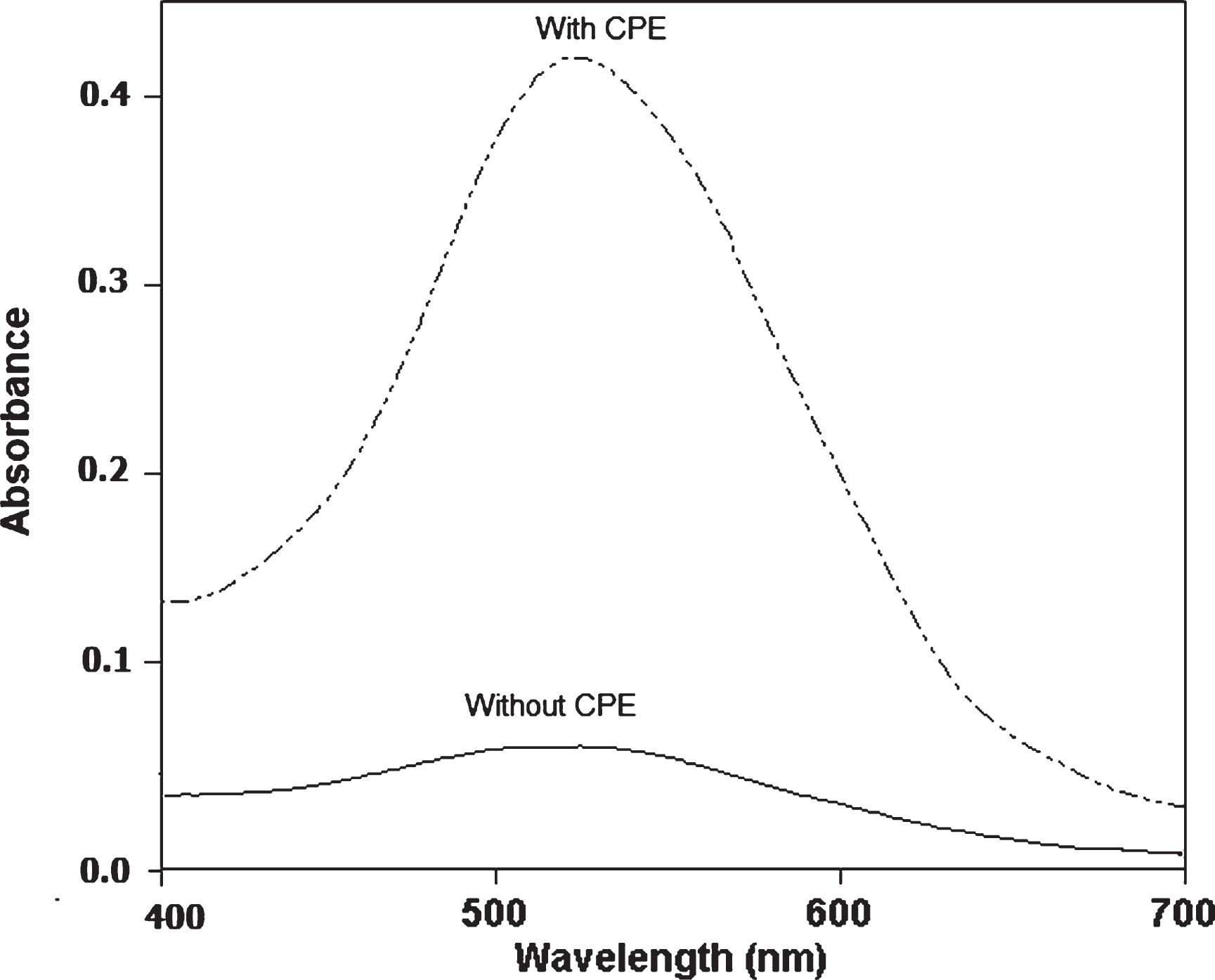
Absorption spectra of Al(III)-ARS complex without and with CPE. Conditions: ARS, (0.1% w/v); Triton X-114, (0.2% v/v) and pH 5.0.
Effect of pH
Cloud point extraction of manganese was performed in different pH buffer solutions. The separation of metal ions by the CPE method involves prior formation of a complex with sufficiently hydrophobic character to be extracted into the small volume of surfactant-rich phase, thus obtaining the desired preconcentration. Extraction yield depends on the pH at which complex formation is carried out. Fig. 2 shows the effect of pH on the absorbance of Al(III)-ARS complex within the pH range of 3.0–8.0. The absorbance increases with an increase in pH up to 5.0. Hence the optimum pH value of 5.0 was chosen. In addition, the influence of the buffer volume was assessed, while the other experimental variables, except buffer solution volume, remained constant. The results have shown that if 5.0 mL or larger volume of acetate buffer solution was added in 50 mL solution, no obvious variation took place in the absorbance. Therefore, it was concluded that addition of 5.0 mL of buffer solution (pH 5.0) throughout the course of experiment would serve the purpose.
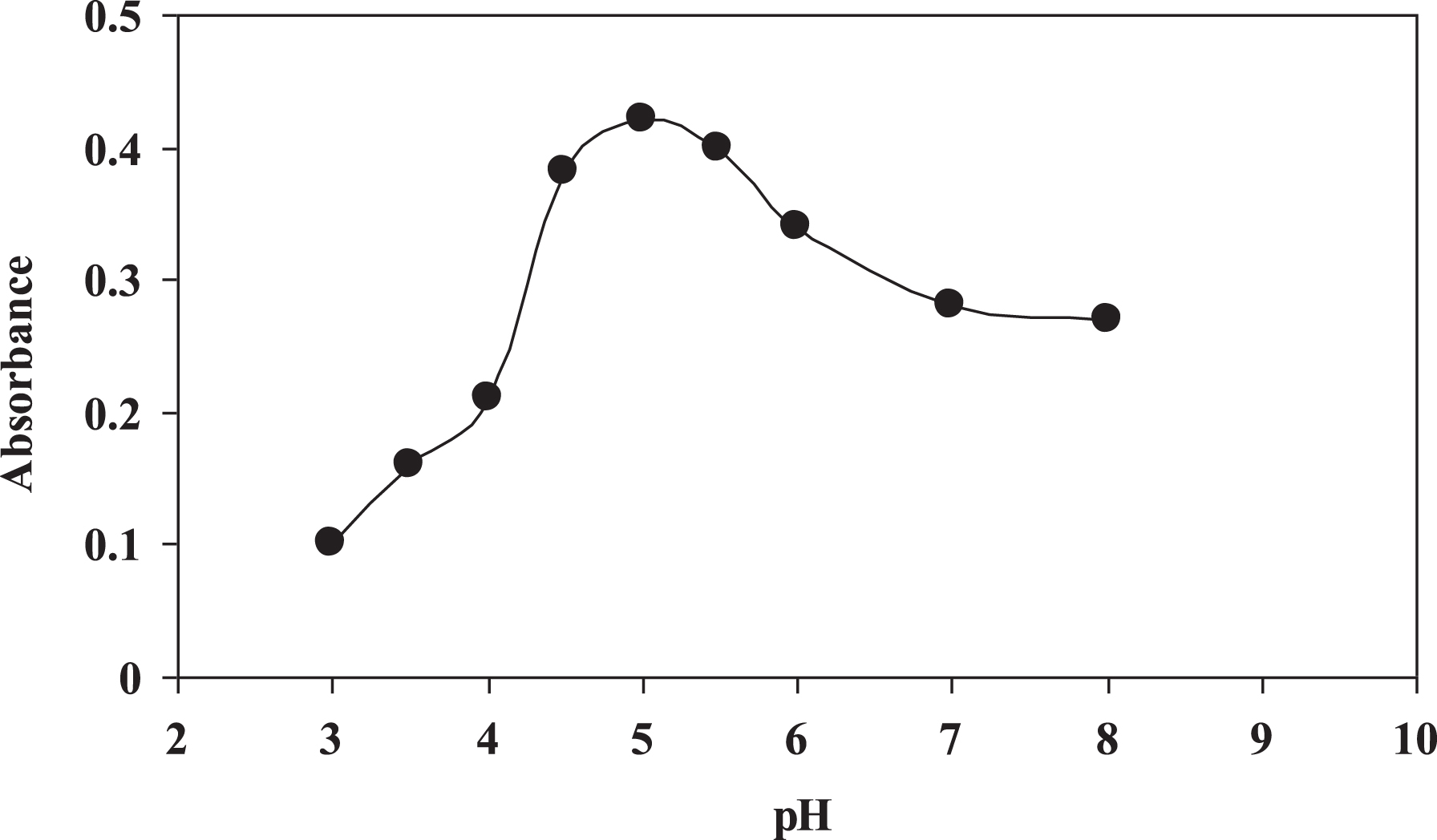
Effect of pH on the absorbance after CPE. Conditions: Al(III), 250 ng mL–1; ARS, (0.1% w/v) and Triton X-114, (0.2% v/v). Other experimental conditions are described under procedure.
The concentration of ARS has significant influence on the extraction of the complex to obtain quantitative results. Different volumes of ARS (0.1% w/v) were used within the range of 0.25–4.0 mL to 50 mL solution containg 250 μg L–1 Al(III), (0.2% v/v) Triton X-114 at pH 5.0 and the absorbance values were determined spectrophotometrically. Fig. 3 illustrated that, the absorbance raised by increasing the ARS concentration up to 2.0 mL and reached near 100% quantitative extraction efficiency and higher concentrations of ARS has no obtained change in the absorbance. Hence, 2.0 mL of ARS was chosen as the optimal concentration in further studies.
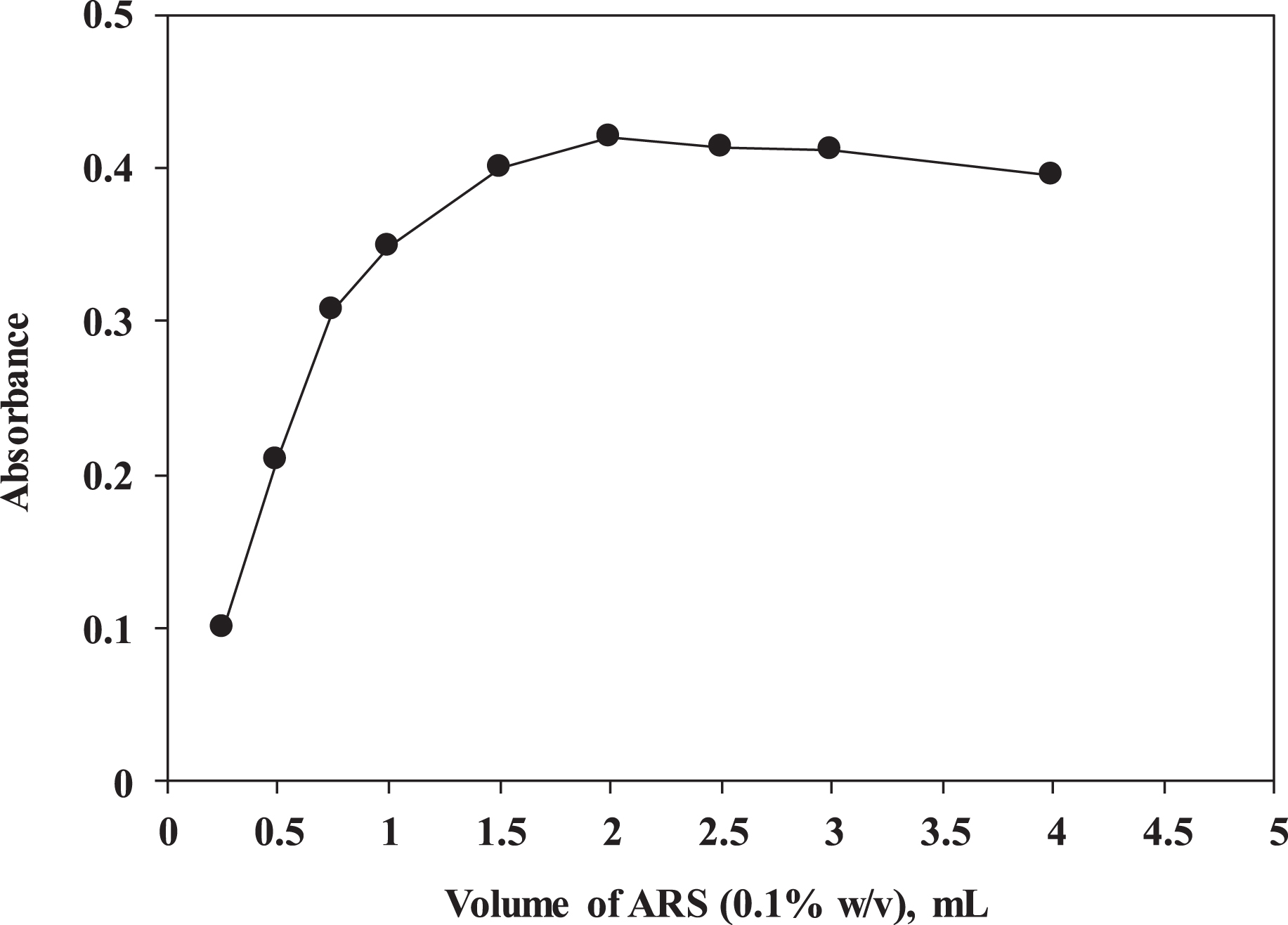
Effect of volume of ARS (0.1% w/v) on the absorbance after CPE. Conditions: Al(III), 250 ng mL–1; pH 5.0 and Triton X-114, (0.2% v/v). Other experimental conditions are described under procedure.
A successful CPE would be one which maximizes the extraction efficiency through minimizing the phase volume ratio, thus maximizing its concentrating factor. Three non-ionic surfactant (Triton X-114 Triton X-100 and Tween-80) were tested, and the experimental results show that the Triton X-114 was the best one of the three tested surfactants for the extraction of Al(III)–ARS complex. The variation in absorbance of Al(III) within the Triton X-114 concentration range of 0.05–0.5% v/v was examined. The absorbance of the complex was increased by increasing the Triton X-114 concentration up to 0.2% (v/v). So, a concentration 0.2% (v/v) was chosen as the optimum surfactant concentration to achieve factor and the highest possible absorbance. The results are shown in Fig. 4.

Effect of Triton X-114 concentration on the absorbance after CPE. Conditions: Al(III), 250 ng mL–1; pH 5.0; and ARS, (0.1% w/v). Other experimental conditions are described under procedure.
To achieve easy phase separation and efficient preconcentration, it is imperative to optimize the equilibration temperature and incubation time. It was desirable to employ the shortest equilibration time and the lowest possible equilibration temperature, as a compromise between completion of extraction and efficient phase separation. The influence of the equilibration temperature was investigated by varying the temperature from 30 to 70°C. The results demonstrate that in the temperature at 50°C, the extraction efficiency for the Al(III)–ARS complex was constant. Therefore, an equilibration temperature of 50°C was chosen for further experiments. Higher temperatures lead to the decomposition of the complex and the reduction of extraction yield. The dependence of extraction efficiency upon incubation time was studied in the range of 5.0–20 min. An incubation time of 10 min was enough for the separation process. A centrifuge time of 10 min was selected as optimum at 4000 rpm, as complete separation occurred within this time and no appreciable improvements were observed for longer periods.
Effects of diluent
High viscosity of the surfactant-rich phase is drastically decreased using diluting agents. For the spectrophotometric method, the addition of a diluent into the surfactant-rich phase is often needed to obtain a homogeneous solution with compatible viscosity. Methanol, ethanol, acetone, N, N-dimethylformamide, and acetonitrile were tested as diluent solvents. Surfactant-rich phase was found to be freely soluble in methanol. Therefore, methanol was chosen to have appropriate amount of sample for transferring and measurement of the absorbance of the sample and a suitable preconcentration factor. Hence the surfactant-rich phase was completed to 0.5 mL by methanol. Therefore, a preconcentration factor of 100 was archived using the proposed CPE method.
Interference studies
In view of the high selectivity provided by spectrophotometry at the characteristic absorption wavelength of 515 nm, the only interference may be attributed to the preconcentration step. In order to perform this study, interfering ions in different concentrations were added to a solution containing 250 ng mL–1 Al(III) solution and were applied the proposed CPE method. The tolerance limits were determined for a maximum error of±5.0% and the results are given in (Table 2). These results demonstrate that the common coexisting ions did not have significant effect on the extraction and determination of Al(III). Since commonly present ions in food samples did not affect significantly the recovery of Al(III), the method can therefore be applied to determination of Al(III) in different food samples.
Effect of interferent ions on preconcentration and recoveries of 250 ng mL–1 Al(III) (n = 3)
Effect of interferent ions on preconcentration and recoveries of 250 ng mL–1 Al(III) (n = 3)
aMean±standard deviation.
The calibration graphs were obtained by preconcentrating 50 mL of standard solutions containing known amounts of the analyte in the presence of ARS and Triton X-114 in a medium buffered at pH 5.0 for CPE of Al(III), and under the experimental conditions specified in the procedure. Linear relationships between the absorbance measured and the concentration of the metal in solution were obtained. Table 3. summarizes the analytical characteristics such as regression equation, linear range, and limits of detection and quantification, reproducibility and preconcentration and enhancement factors. The limit of detection, defined as CL = 3SB/m (where CL, SB and m are limit of detection, standard deviation of the blank, and slope of the calibration graph, respectively) was 1.0 ng mL–1. Because the amount of Al(III) in 50 mL of sample solution is measured after preconcentration by CPE in a final volume of 0.5 mL, the standard solutions are preconcentrated by a factor of 100. The enhancement factor calculated as the ratio of the slope of the calibration graph obtained after preconcentration procedure with CPE to the slope of calibration graph without CPE was also approximately 156. The relative standard deviation (RSD%) and relative error (RE%) for six replicate measurements of 250 ng mL–1 of Al(III) were found to be 1.70% and 1.78%, respectively. Analytical characteristics of the proposed method are shown in (Table 3).
Optimum conditions and analytical characteristics of the proposed method with and without CPE
Optimum conditions and analytical characteristics of the proposed method with and without CPE
aA = a + bC, where C is the concentration of Al(III) in ng mL–1. bPreconcentration factor is defined as the ratio of the initial solution volume to the volume of surfactant rich phase.
The reliability of the proposed CPE method were investigated by applying the proposed method to estimate Al(III) in real food samples; fruit juice (orange, apple and grape) and food (rice, tomato paste, white bread, onion, potato, spinach, lettuce, cabbage and apple) samples using standard addition method by adding different amounts of Al(III) to the samples. The results were recorded in (Table 4). High recoveries of Al(III) ranged between (95–102%) indicated that the proposed method was reliable, and accurate. The validity and applicability of the developed CPE method were estimated by applying the method under optimum conditions on certified reference materials (CRMs); (SRM 1643e trace element in water). The results are illustrated (Table 5). The obtained results were closed to the reported certified values which indicated that the developed CPE method used to the estimation of Al(III) in fruit juice and food samples which confirm the accuracy and validity of the proposed method.
Determination of Al(III) in real food samples using the proposed CPE method (n = 3)
Determination of Al(III) in real food samples using the proposed CPE method (n = 3)
aAverage of three determinations with 95% confidence level. bNot detected.
Validation of the proposed CPE method using certified reference materials (N = 3)
aMean±standard deviation.
A new, rapid, reliable, easy to use, safe environmentally friendly and inexpensive cloud point extraction methodology was successfully applied for preconcentration and determination of trace amount of Al(III) in different food samples by spectrophotometric detection. ARS is a very stable, and selective complexing reagent. Triton X-114 is relatively low-cost and low toxicity. The proposed method showed good precision (RSD% was found to be 1.70%), accuracy and sensitivity (lower LOD value of 1.0 μg L–1) for the determination of trace aluminum metal in various food samples. High extraction efficiency was obtained with PF and EF values of 100 and 156, respectively. The developed method showed high efficiency and reliability for estimation of Al(III) in real food samples compared with other preconcentration methods.
Conflict of interest
The author wishes to confirm that there are no known conflicts of interest associated with this publication.