



Abstract
The controllable stannic oxide nanoflowers had been synthesized by hydro-thermal method through changing synthesized reagent and temperature, in this paper. Then the structure and micromorphology were characterized by X-ray diffraction (XRD) and scanning electron microscopy (SEM). Finally, the photocatalytic degradation ability of prepared products was studied by ultraviolet absorption method. The results showed that the prepared products were pure stannic oxide crystals with rutile structure, micromorphology of flower, good dispersibility, uniform size and strong photocatalytic degradation ability.
Introduction
Stannic oxide (SnO2) is an intrinsic n-type semiconductor belonging to the category of transparent conducting oxides, which has a wide band gap of 3.6 eV [1]. Many studies have been showed that interstitial tin and oxygen vacancies are easily formed and dominate the defect structure of SnO2, which explains the tendency of this material for non-stoichiometry and its properties is to maintain n-type conduction [2]. Due to these peculiar properties, tin oxide has been found to be applied in lithium-ion batteries [3, 4], solar cells [5], chemical sensor [6, 7], optoelectronic devices and photocatalyst [8, 9]. So, it has caused the interest of many researchers, and the research on it is also more and more deeply. However, the change of external environmental parameters and reaction conditions (such as temperature, solvent) will change the morphology of stannic oxide to a certain extent [10–12], which will form SnO2 nanoparticles [13, 14], nanowires [15], nanocones [16], nanomicropheres [17], nanotubes and nanorods [18, 19], and other micro structure, which broaden its application fields. Although many different structures have been reported via different methods, there are only a few reports regarding its photocatalytic properties.
In this paper, we want to controlled synthesize stannic oxide semiconductor nanomaterials with micro structure of flowers through changing the reaction temperature and solvent on the basis of previous experimental conditions via hydro-thermal method, which method has many advantages of simple, good operability, relatively low temperature, reaction in a closed environment to avoid evaporation of components and so on [20], and it has played a significant role in the control of synthesis and structure of products, which would further improve the performance of products, and broaden its application field.
Experimental section
Reagents and instruments
Triphenyltin chloride (Ph3SnCl), sodium hydroxide, ammonia and ethanol were all of analytical reagent grade, which purchased from Beijing Chemical Factory (Beijing, China). Ultrapure water produced from the Milli-Q Plus system (Millipore, Bedford, MA, USA) was used for preparing all solutions. The used instruments included in magnetic stirring apparatus (S22-2, Shanghai Si Le Instrument Co., Ltd., China), vacuum drying oven (DZF-6090, Shanghai Jing Hong Laoratory Instrument Co., Ltd., China), centrifuge (TGL-15B, Shanghai An Ting Scientific Instrument Factory, China), and so on.
Characterization
Phase identification and crystal structure of products were performed via X-ray diffraction (D8 FOCUS, Bruker, Germany), and a scanning speed of 2θ= 8° per min, the working voltage and current were 40 KV and 30 mA, respectively. Microstructure and morphology of the products were observed by scanning electron microscope (S-4800, Hitachi, Japan) with 10 KV working voltage.
Synthesis
SnO2 nanoflowers were synthesized by hydro-thermal method in alkaline medium using triphenyltin chloride as resource of tin, whose microstructure were controlled by using different alkali with different contents under the conditions as follows:
The fist sample was produced as follows: 0.0385 g (0.1 mmol) Ph3SnCl dissolved in the mixed solution with 15 mL anhydrous ethanol and 15 mL ammonia (that is to say, the volume ratio of ethanol and ammonia was 1:1), then, 4 mg (0.1 mmol) sodium hydroxide and 5 mL ethylene glycol were added into the former solution and stirred 30 min. After that, the above solution was added to 50 mL reaction kettle and heated to 180°C in the oven keeping 24 h. Then, another sample was prepared according to the order of reactions above and heated to 180°C in the oven keeping 24 h expect of changing the reaction medium to 10 mL anhydrous ethanol and 25 mL ammonia (that is to say, the volume ratio of ethanol and ammonia was 2:5) without any sodium hydroxide. When the reactions were finished, samples were cooled to room temperature, the samples were extracted with ethanol and distilled water, and then dried in the oven for 3 h under the temperature of 60°C. Finally, the reaction obtained products were characterized to observe the structure.
Results and discussion
Analysis of XRD
Figure 1 showed the XRD of obtained products in ethanol and ammonia mixed solution, comparing these two patterns with the standard XRD cards of SnO2 (JCPDS card, No. 41-1445), these two spectrums both could be in good agreement with that of standard SnO2, and showed many standard diffraction peaks, without any other obvious peaks, and the indexes of diffraction peaks about crystal lattice parameters a = 4.738 Å, c = 3.187 Å were very good, which revealed that the products were pure phase SnO2 with tetragonal rutile structure. But the characteristic peak of product 1 was more obvious than that of product 2, which revealed the crystallinity of the product 1 was higher.

XRD of the samples produced in ethanol and ammonia mixed solution (1: with NaOH, 2: without NaOH).
Figure 2A was the SEM of SnO2 products, which produced in ethanol and ammonia mixed solution (the volume ratio of ethanol and ammonia was 1:1) with 0.1 mmol sodium hydroxide in it, from which we could see the obtained SnO2 products were all nanomicrospheres with rule shape and without any aggregation, the products particles were well dispersed and had even size, which were in accordance with the microspheres we prepared before [17]. Figure 2B was the SEM of SnO2 products, which produced in ethanol and ammonia mixed solution (the volume ratio of ethanol and ammonia was 2:5) without sodium hydroxide in it, from which we could see the structure of obtained SnO2 products changed to nanoflowers from nanoparticles and nanomicrospheres, it is possible belonging to the tetragonal rutile structure of SnO2, in this structure, lattice plane (110) and (001) have the lowest and highest surface energy, the crystal grain will grow partially to one-dimensional structure of nanorods, with the enlargement of crystal grain without any aggregation, the structure of nanoflowers will be formed finally. From Fig. 2B we could see the obtained SnO2 nanoflowers products had even structure without any impurity, which showed that SnO2 nanoflowers with high purity, good dispersion and even size could be obtained in ammonia and ethanol reaction medium (the volume ratio of them was 5:2).
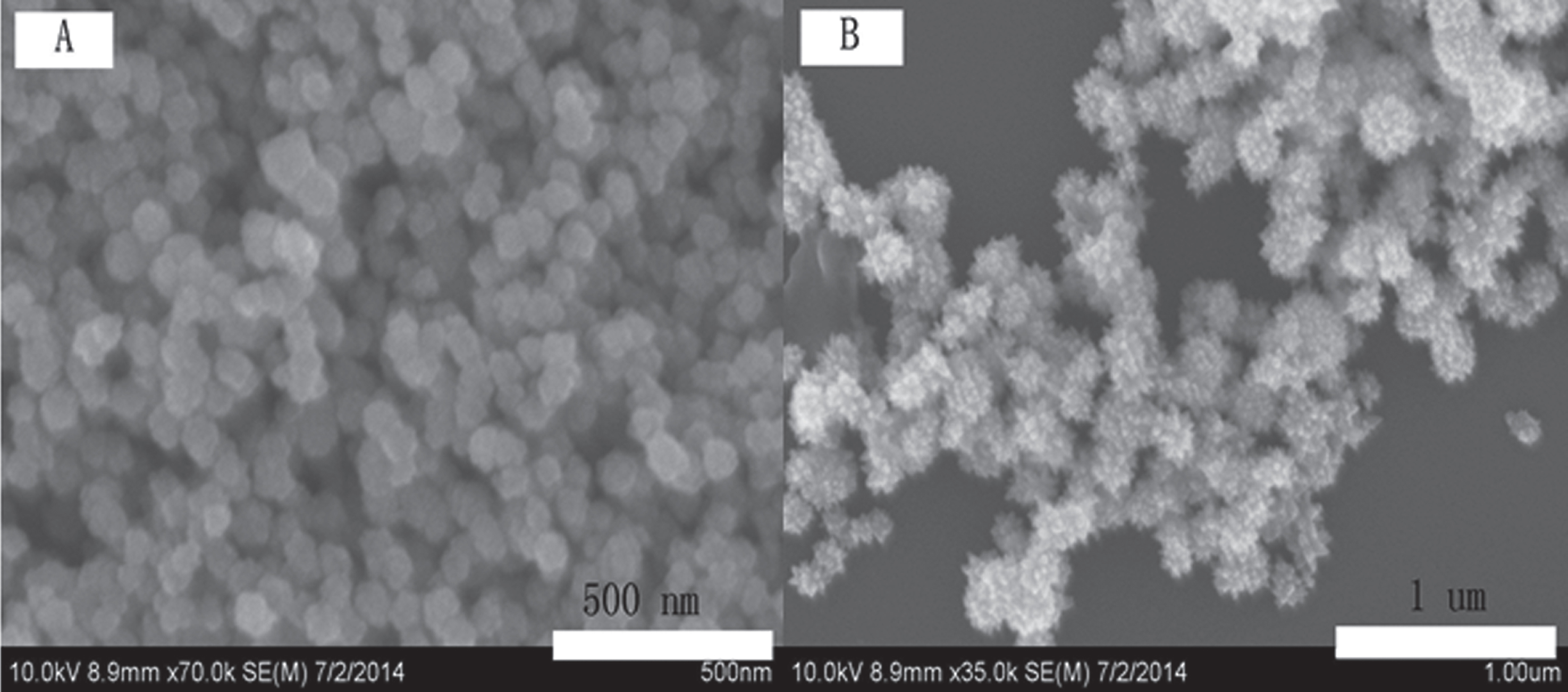
SEM of the samples produced in ethanol and ammonia mixed solution (A: with NaOH, B: without NaOH).
Experiment for degradation of organic dye rhodamine B was made by obtained SnO2 nanoflower samples under the irradiation of ultraviolet light (500 W), the absorption spectra as shown in Fig. 3. As can be seen, the characteristic peak of rhodamine B was 554 nm, the characteristic peak intensity of rhodamine B decreased gradually with the increase of illumination time, which indicated that the rhodamine B molecules were degraded. When the irradiation time reached 180 min, the degradation rate reached 97.3%, which indicated that the prepared SnO2 nanoflowers had good photocatalytic effect under the irradiation of ultraviolet light. Comparing with that of the prepared products before, the photocatalytic degradation ability of nanoflowers prepared in this paper was better than that of nanomicrospheres [17], but not better than that of nanoparticles [13], this mainly reason is that particles have bigger specific surface areas which can help to improve the separation and combination of carrier and increase the utilization efficiency of carrier, which directly increase the photocatalytic efficiency of samples.
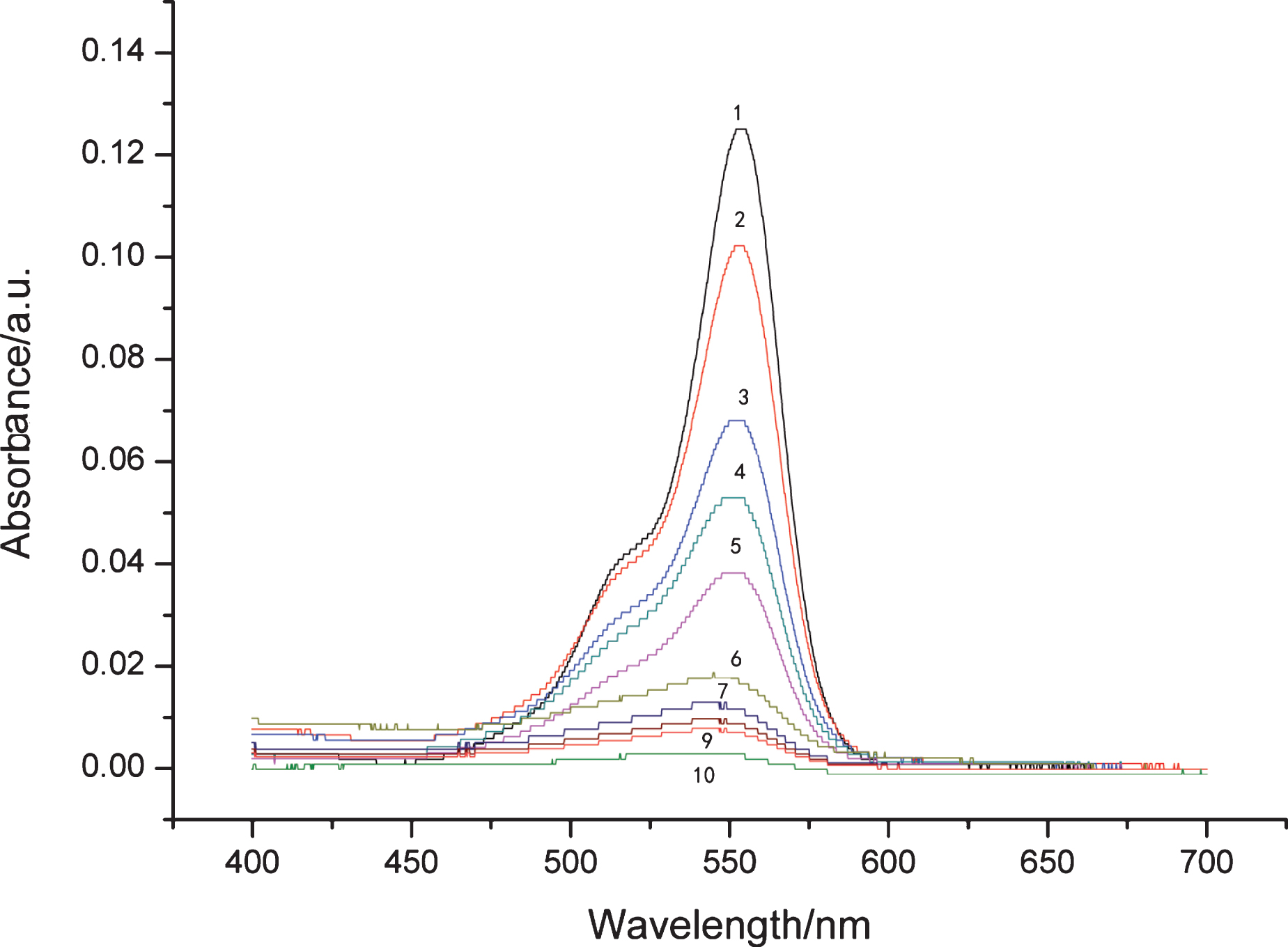
UV absorption spectra of photo degradation to rhodamine B by SnO2 nanoflower (curve1: 0 min, curve2: 20 min, curve3: 40 min, curve4: 60 min, curve5: 80 min, curve6: 100 min, curve7: 120 min, curve9: 160 min, curve10: 180 min).
In this paper, controllable stannic oxide semiconductor nanoflowers had been synthesized via hydro-thermal method through changing the reaction conditions, in which, the alkaline medium was provided by ammonia but not by sodium hydroxide. After that, the structure and micromorphology of the nanoflowers were characterized by XRD and SEM, finally, the photocatalytic property of prepared products was tested. The experimental results showed the prepared nanoflowers samples were pure typical crystal of SnO2 with tetragonal rutile structure, and with good crystallinity, uniform size, good dispersion and good effect of photocatalytic degradation to organic dye rhodamine B, which revealed that the micromorphology of products was greatly affected by reaction conditions such as reaction reagents or temperature, which further affected the photocatalytic performance. This study provides theoretical basis and practical experience for further widening the application field of products with different micromorphology, and then makes them to be used for the degradation of different environmental pollutants.
Footnotes
Acknowledgments
This work were supported by the Youth Backbone Teacher Training Project of Henan Higher Education Institutions in 2017 (2017GGJS282), the Science and Technology Development Plan Project of Henan Province (182102310611, 192102210159), Postdoctoral Science Foundation of Henan province in 2018 (001803005), the Postdoctoral Foundation (BHJF001) and Startup Project of Doctor Scientific Research (BSJH001) of Shangqiu Medical College, the Youth Fund of Shangqiu Medical College in 2019 (Controllable construction and photocatalytic activity of MxOy/graphene/SnO2 nanocomposites) and the Higher School Key Scientific Research Project of Henan Province (19B140004).