



Abstract
Due to the use of organic solvents is associated with environmental pollution, toxicological and safety concerns, alternative extraction methods have been investigated. In this study, the efficacy of application of β-Cyclodextrin (β-CD) and ultrasound-assisted extraction (UAE) as an eco-friendly, cost-effective and safe method for extraction of bioactive compounds from pomegranate peel compared to the aqueous extraction method was studied. The response surface method (RSM) was used to optimize extraction conditions. Designed experiments were done based on the Box-Behnken design with three independent variables, including temperature (30, 50 and 70°C), time (10, 25 and 40 min) and concentration of β-CD solution (0, 0.9 and 1.8%). The optimum extracting temperature and time and β-CD concentration were 55.7°C, 15.38 min, 1.8% respectively. In the optimum condition, the following characteristics of extracted bioactive compounds were obtained: total phenolic compounds 158.10 (mgGAE/gDW) with an extraction efficiency of 65.20%, total flavonoids 82.30 (mgQE/gDW) with an extraction efficiency of 60.30%, total flavonols 69.40 (mgQE/gDW) with an extraction efficiency of 58.50%, total anthocyanin 0.52 (mgC–3–gE/gDW) with the extraction efficiency of 42.60%. The Hydrogen Peroxide Radical scavenging activity was 22.90% and the DPPH Radical scavenging activity was 74.40%. The result of the HPLC analysis indicated that β-CD solution improved extraction efficiency of bioactive compounds. As a result, Aqueous β-CDand UAE can effectively be used in recovering bioactive compounds from by-products of fruit processing and therefore for functional foods and nutraceutical applications.
Keywords
Introduction
Researchers today are trying to access new and inexpensive natural bioactive compounds, so in recent years much attention has been paid to agricultural waste [1]. In Iran, 35% of agricultural production is converted into waste, including, factory waste and juice and concentrate production centers that have beneficial and health-promoting compounds and can be used in the food industry. Phenolic compounds are the most important compounds remaining in these wastes that the extraction of these natural compounds and their application in the food industry will produce beneficial food products with high health properties [2]. Pomegranate (Punica granatum L.) is one of the most important indigenous fruits that is cultivated and processed in Iran [3]. In the pomegranate fruit juice factory the high percent of this fruit converts to the waste that varies from 30 to 60 percent depending on its varieties. This high percent of waste in pomegranate fruit encourages researchers to use it as a beneficial compound resource [4]. Pomegranate peel has broad therapeutic applications including anticancer, anti-inflammatory, anti-diabetic, and renal protection. All of these health effects are due to the presence of high levels of phenolic compounds in the pomegranate fruit peel [5]. To use the benefits of bioactive compounds in pomegranate peel, the hard/cellulose skin of the pomegranate should be disintegrated. However, the extraction of bioactive compounds from agricultural wastes with conventional methods requires a long time and a lot of solvents that are toxic and have a lot of environmental problems. New alternative extraction methods (green extraction) were developed with shorter extraction time, lower organic solvent use and less contamination effect [6]. Although water is effective in extracting of some bioactive compounds, it is inefficient in the extraction of large series of other bioactive compounds. Therefore, the use of a food grade extractor to increase the efficiency of extraction of bioactive compounds from plant residues is considered necessary. β-CD is one of the useful extractor for bioactive component extraction [7, 8]. Cyclodextrins are cyclic oligosaccharides that are generally known to be safe (GRAS) 1 and are used in the food industry due to their efficiency in the formation of an inclusion complex with bioactive compounds and increased stability, solubility, and bioavailability of these compounds in the food industry [9]. The spatial structure of cyclodextrin produces a hydrophilic surface and hydrophobic cavity, which leads to the creation of an inclusion complex [10–12]. The application of the new sonication is one of the most important methods for the extraction of valuable compounds from plant sources, which has higher efficiency, lower extraction time and lower solvent consumption compared to conventional methods [6]. Green extraction is an effective and eco-friendly method for the extraction of natural and valuable compounds [7, 8]. Replacing organic solvents with water extraction method without having a negative effect on the extraction product is one of the most important issues in the field of extraction of phenolic compounds that can be done using the β-CD solution [13]. Compared to organic solvents, the use of the new green extraction method with the use of β-CD solution with ultrasound is safe method with minimal use of harmful chemical compounds and shorter extraction time with minimal risk of toxicity and contamination of the product and the environment [14]. In order to optimize the extraction conditions in this study, including concentration of β-CD, extraction time and temperature, response surface methodology (RSM) has been widely used By establishing a mathematical model, RSM evaluates multiple parameters and their interactions using quantitative data, effectively optimizing complex extraction procedures in a statistical way, thus reducing the number of experimental trials required.
The aim of this study was to examine the potential of β-CD and sonication to enhance the efficiency of the aqueous extraction. To the best of our knowledge extraction of bioactive compounds of pomegranate peel in presence of β-CD and sonicationhas not been reported in the literature so far.
Material and methods
Materials
The healthy and ripe pomegranate fruits (Punica granatum, Malas Fars variety) were purchased for peeling from the local market in Urmiacity. Potassium acetate from Qualikems (India), Folin-Ciocalteu, aluminum chloride, methanol from the Merk Co. (Germany), β-Cyclodextrien, Gallic acid, quercetin, sodium carbonate, DPPH (2,2-diphenyl-1-picrylhydrazy), and Other required standards were purchased from Sigma (USA). All chemical compounds and reagents were of analytical grade.
Sample preparation
First the pomegranate fruits washed with distilled water and completely dried. In the next step, pomegranate peel was carefully removed and completely dried at room temperature (away from direct sunlight) for 14 days until it reached a constant weight. The dried pomegranate peel was completely crushed using a mill, and then was passed through a 40-micron mesh sieve to obtain a uniform powder. Some chemical parameters of pomegranate peel were analyzed (Table 1)
Gross chemical composition of pomegranate peel (on dry weight basis)
Gross chemical composition of pomegranate peel (on dry weight basis)
For extraction of bioactive compounds from pomegranate peel, ultrasonic bath (4.5L, ROHS, KOREA) (DSA100-SK2) with a constant frequency of 40 KHZ and 100 watts was used. The β-CD solution with different concentrations (0, 0.9 and 1.8 %) (Table 2) was used for extraction of bioactive compounds. To obtain the β-CD solution at the indicated concentrations, the desired amount of beta-cyclodextrin was mixed with distilled water at 50°C for 30 minutes. A 10 g of dried pomegranate peel powder was weighed and extracted with 10 mL of the mentioned β-CD solutions (1:10) in accordance with the set temperature and time conditions (Table 2). To keep away bioactive compounds from light during the extraction process, the containers were completely covered with aluminum foil. The extract was centrifuged at a speed of 3000 rpm for 15 minutes and supernatants were stored in eppendorf tubesuntil further tests (Fig. 1).
List of experiments and independent variables
List of experiments and independent variables
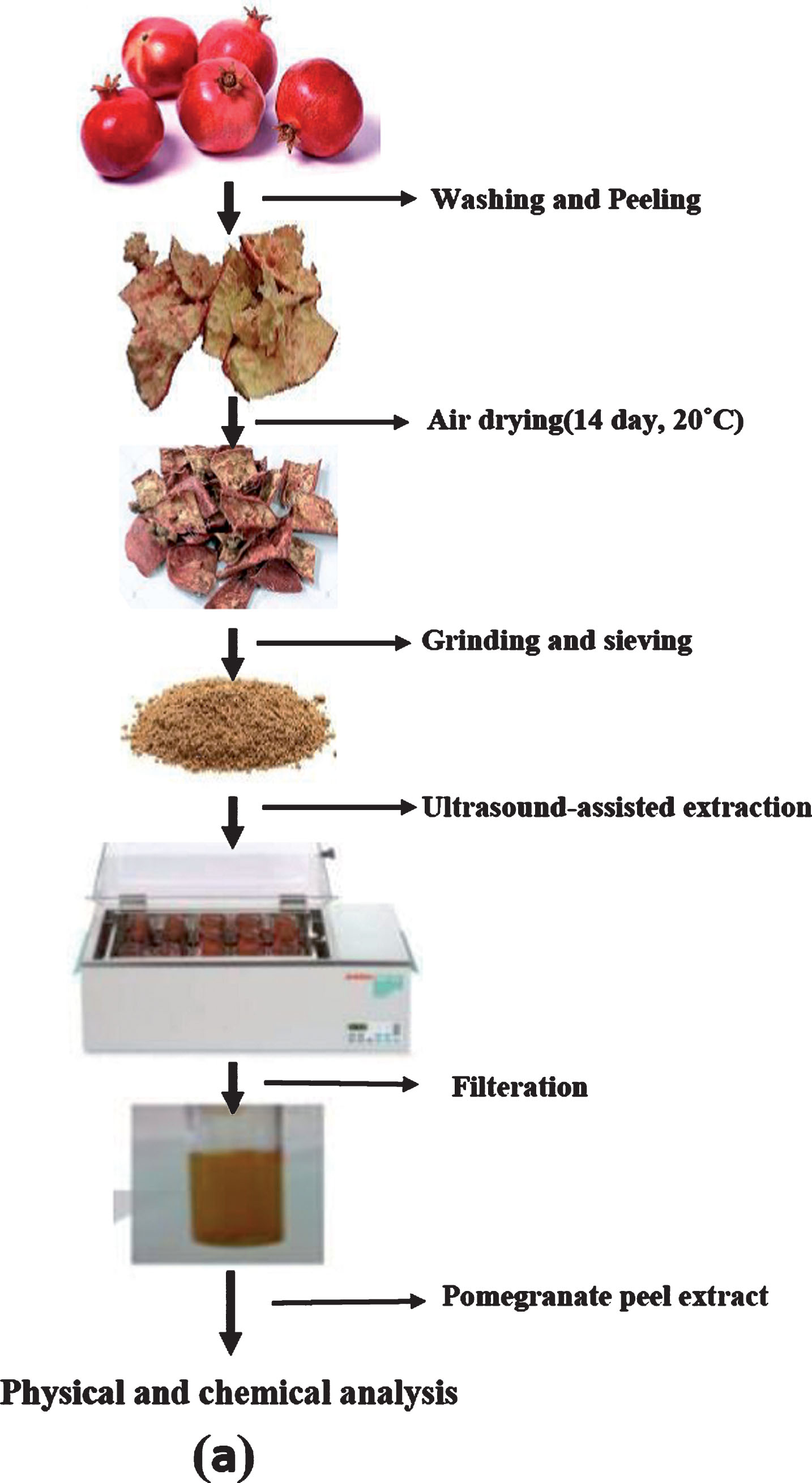
Extraction processes of bioactive compounds of pomegranate peel.
Total phenolic compounds measurement
Measurement of the total phenolic compounds was done by the Folin-Ciocalteu method. A 100μl pomegranate peel extract with 500μl of Folin-Ciocalteu reagent was completely mixed. After 3 to 5 minutes, 400μl of sodium carbonate 7.5% was added to the mixture and after complete vortex (for 30 minutes) was kept at room temperature and in a dark place. The absorbance of each sample was then read at 765 nm. Gallic acid was used as standard. Total phenolic compounds were calculated from the standard curve in mg of gallic acid equivalent per g of dried plant material (mgGAE/gDW) [15].
Total flavonoids measurement
The total flavonoids were determined by colorimetric method with aluminum chloride. About 0.5 mL of each extract was mixed with 0.5 mL of 2% aluminum chloride solution and then added 3 mL of 5% potassium acetate. And then was placed at room temperature for 40 minutes, and then each sample absorbance was recorded at 517 nm. The quercetin solution was used as a standard. Total flavonoids were calculated from the standard curve in mg quercetin equivalent per g of dried plant material (mgQE/gDW) [16].
Total flavonols measurement
Total flavonols was determined according to the colorimetric method with aluminum chloride according to the proposed method for flavonoids. Absorption of the samples in this method was recorded (at 440 nm) after 150 minutes of storage in a dark place at room temperature. Quercetin was used as a standard too. The total flavonol content was reported from the standard curve in mg quercetin per g of dried plant material (mgQE/gDW) [17].
Determination of DPPH radical scavenging activity
The antioxidant activity of the extracts was measured based on the ability of extracts for discoloration of 2-2-1-picyril hydrazil (DPPH). A 10μl extract were mixed with 3.5 mL DPPH solution (0.1 mM) and after 30 minutes of storage in a dark environment at room temperature, sample absorbance was recorded at 517 nm [18]. The antioxidant activity was calculated according to the following equation:
To determine the hydrogen peroxide scavenging activity, 0.1 mL of extract was mixed with 3.4 mL of phosphate buffer solution (0.1 M, pH = 7.4) and 600μl of 43 mM hydrogen peroxide. After 10 minutes, the absorbance of the sample was recorded at 230 nm [19]. The Hydrogen peroxide (H2O2) scavenging activity was calculated using the following equation:
The total monomeric anthocyanins of the extract were measured by spectrophotometric method with the aid of dilutions of the sample in buffers at pH 1 and 4.5. The absorbance of diluted solutions was recorded at 700 and 520 nm wavelengths [20]. The amount of absorbance of sample (A) was calculated by the Equation 3 and the amount of total anthocyanins was calculated by the Equation 4:
For chromatographic analysis, high performance liquid chromatography equipment (KNAUER made in Germany) equipped with a K-UV 1500 detector and an automatic sampler was used. A column of Eurospherium 5×4.6×250 (C18) with a particle diameter of 5μm was used for the separation of bioactive components.The mobile phase contains 1% aq. acetic acid solution (Solvent A) and acetonitrile (Solvent B), the flow rate was adjusted to 0.7 ml/min, the column was thermostatically controlled at 28°C and the injection volume was kept at 20μl. A gradient elution was performed by varying the proportion of solvent B to solvent A. The gradient elution was changed from 10% to 40% B in a linear fashion for duration of 28 min, from 40 to 60% B in 39 min, from 60 to 90% B in 50 min. The mobile phase composition back to initial condition (solvent B: solvent A: 10:90) in 55 min and allowed to run for another 10 min, before the injection of another sample. Total analysis time per sample was 65 min. HPLC chromatograms were detected using a photo diode array UV detector at three different wavelengths (272, 250 and 310 nm) according to absorption maxima of analyzed compounds. Each compound was identified by its retention time and by spiking with standards under the same conditions. The quantification of the sample was done by the measurement of the integrated peak area and the content was calculated using the calibration curve by plotting peak area against concentration of the respective standard sample (Gallic acid, Caffeic acid, Chlorogenic acid, Cinnamic acid and Apigenin) [21].
Efficiency of extraction of bioactive compounds measurement
The extraction efficiency of bioactive compounds was calculated using Equation 5, where C1 is the amount of bioactive compounds (total phenolic compounds, total flavonoid, total flavonols, total monomeric anthocyanin) in extracted extract was measured according to the method that was indicated in this study, C2 is the amount of bioactive compounds compounds (total phenolic compounds, total flavonoid, total flavonols, total monomeric anthocyanin) in pomegranate peelwas indicated in Table 1.
The parameters of the process of extraction of bioactive compounds from pomegranate peel were optimized using response surface method. For this purpose, the Box-Benhken design, including three variables of temperature, time and concentration of β-CD solution were used in 15 treatments and 3 replications at the central point. The levels of independent variables are listed in Table 2. The statistical significance in the regression equation was considered at 95% confidence level (p < 0.05), and data analysis and drawing of three-dimensional graphs were done with Design expert. 7.5.1 software. For this purpose, quadratic mathematical equations were fitted using regression analysis on dependent variables in the following model:
In the above equation, Y expresses the desired responses, including total phenolic compounds, total flavonoids, total flavonols, total monomeric anthocyanin, Hydrogen Peroxide Radical scavenging activity, DPPH Radical scavenging activity and extraction efficiency of bioactive compounds and βn representing regression coefficients. These coefficients express linear, binary, and interactive effects of variable process factors. The values of A, B and C also represent independent variables.
The effect of independent variables on the responses based on a statistical model
Modeling involves determining the quantitative relationships between the independent variables and the desired responses based on the experimental data. The appropriate model was chosen based on the significance of the F test at two levels (P≤0.01 and P≤0.05), the lack-of-fitting test, the values of R2 and adjusted R2 and the coefficient of variation. Table 3 shows the responses based on independent variables and Table 4 shows the analysis of variance of estimated coefficients of the proposed model. According to ANOVA, it can be seen that the fitted model for all parameters is significant. In order to study the effect of parameters in the study, according to the analysis of variance table (Table 4), the sentences without significant F-test, were deleted from the model and other sentences with significant differences were retained in the model. Finally, among the various parameters, the parameter that had the highest sum of squares, had been chosen as the most effective parameter [22].
Characteristics of pomegranate peel extract for each run
Characteristics of pomegranate peel extract for each run
EE: Extraction efficiency (%); TP: Total phenols (mgGAE/gDW); TF: Total flavonoids (mgQE/gDW); TFL: Total flavonols (mgQE/gDW); TA: Total monomeric anthocyanin (mgC–3–gE/gDW); DPPH Radical scavenging activity(%); S.A (H2O2): Hydrogen Peroxide Radical scavenging activity(%).
Analysis of variance of estimated coefficients of proposed model
aSignificant at 0.1% level; bSignificant at 1% level; cSignificant at 5% level; nsnot significant (p > 0.05); TP: Total phenols (mgGAE/gDW); TF: Total flavonoids (mgQE/gDW); TFL: Total flavonols (mgQE/gDW); TA: Total monomeric anthocyanins(mgC–3–gE/gDW); DPPHRadical scavenging activity(%); S.A(H2O2): Hydrogen Peroxide Radical scavenging activity(%).
According to the Table 4, the linear analysis of temperature (A) and β-CD concentration (C) at P≤0.01 and interaction effects of temperature and β-CD concentration and the effect of temperature at P≤0.05 on the analysis of variance were significant. Parameters that did not have a significant effect were deleted from the model. By examining the numerical values of the coefficients for temperature and β-CD concentration, it can be concluded that β-CD had a more positive effect than the temperature of the total phenolic compounds extraction, but the second-order effect of temperature was significant. Therefore, considering the significant parameters, the general equation of the quadratic model for total phenolic compounds was reported in the Equation 7.
The R2 value of the predicted model for the total phenolic compounds is 0.98 and the P-value of the lack-of-fit test is also 0.34, so the proposed model in the Equation 6 provides an appropriate fit for the response (Table 4). Research has shown that pomegranate peel contains 16 types of phenolic acids, 12 types of flavonoids, 35 types of hydrolysable tannins, 8 types of proanthocyanins and 8 anthocyanins. Phenolic acids comprise the major compounds in pomegranate among bioactive compounds [23]. The effect of independent variables on the phenolic compounds of the pomegranate peel extract is shown in the 3D plots (Fig. 2). As it can be seen, with increasing temperature from 30 to 50°C, the extraction of polyphenolic compounds increased, but with increasing temperature up to 70°C, a decreasing trend was observed in total phenolic compounds. The reason for the increase in the amount of total phenolic compounds with the increasing temperature is that in fact, higher temperatures can result in softening of the tissue, degradation of the connections of phenolic compounds with proteins and polysaccharides, and increasing the dissolution of phenolic compounds, which can improve mass transfer and improves the extraction of these compounds [24]. It is also probable that one of the reasons for increasing the amount of phenolic compounds at higher temperatures is the decomposition of heavy polyphenols into low molecular weight types [25]. However, the reason for the decrease of polyphenolic compounds at temperatures above 50°C can be due to the polymerization reactions of these compounds at a higher temperature [26]. Other researchers in their research investigated the process of extraction of phenolic compounds and stated that at higher temperatures, the phenolic extraction rates were decreased, all of which was due to the polymerization reactions of the phenolic compounds themselves [27, 28]. Increasing time also increased the amount of extraction of phenolic compounds, as the increase in time increased the transport time of the mass, but this effect was not significant, which was probably due to the solvent saturation with the extracted compounds over time. In a study to optimize the extraction of phenolic compounds from coconut skin, a similar result was obtained, so that, with increasing extraction time of 20 to 60 minutes, no significant difference was found in the amount of phenolic compounds [29].
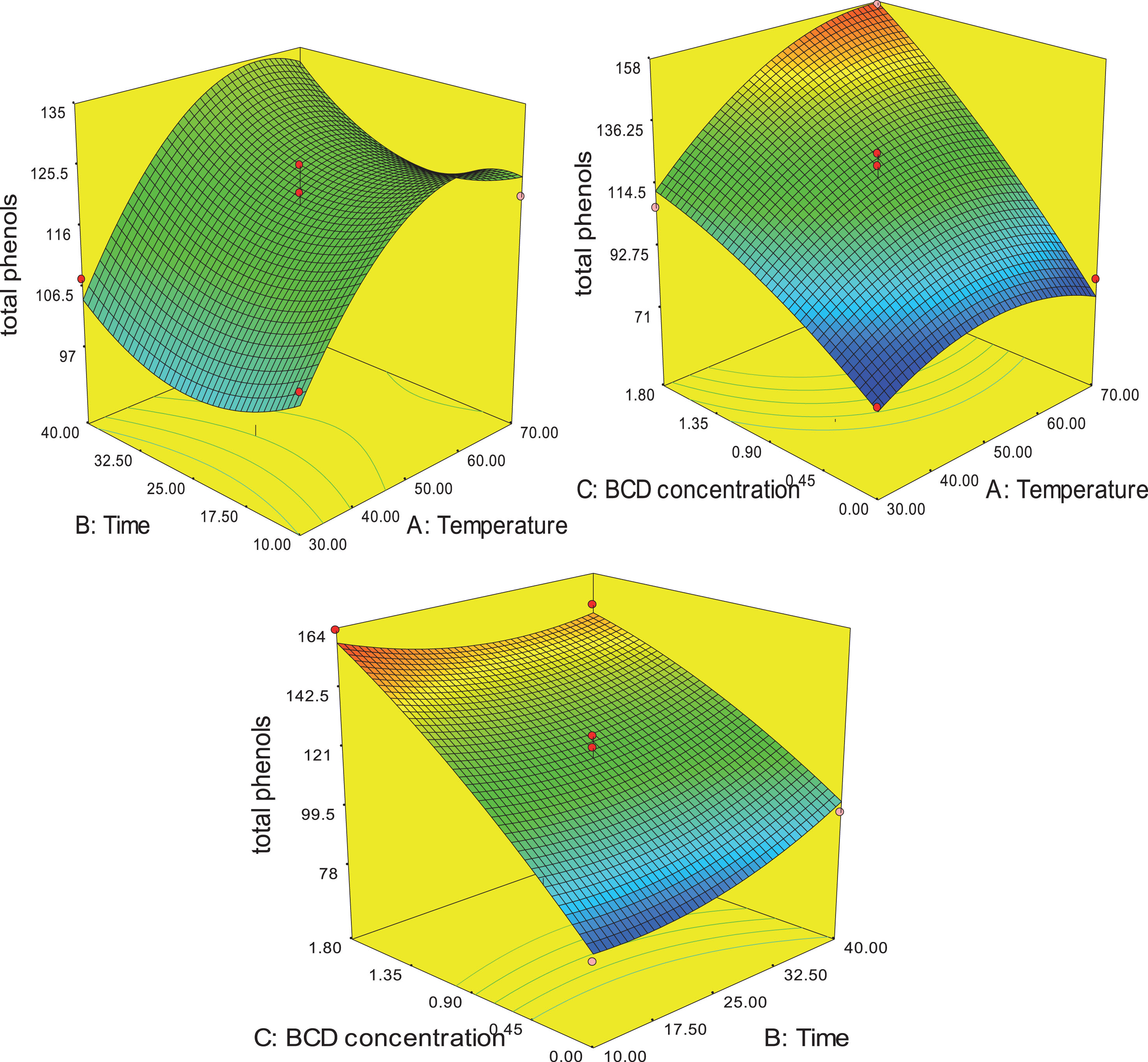
The interaction effect of independent variables on total phenolic compounds.
In the case of the effect of β-CD concentration on the extraction of phenolic compounds (Fig. 2), the increase in the concentration of β-CD in the solvent increased the total phenolic compound extraction significantly (p < 0.05). The highest amount of polyphenolic compounds was found at 1.8% β-CD concentration. It seems that the combination of phenolic compounds with β-CD due to the inclusion complex through its lipophilic cavity with hydrophilic polyphenols increases their solubility in water [30]. Because most polyphenolic compounds are non-polar aromatic compounds that have low solubility in water, so the extraction of these compounds with polar solvents like water is so poor. In other studies, the interactions between β-CD and phenolic compounds as a result of β-CD infiltration in the cell membrane of phenolic compounds have been investigated. In this case, the biochemical and biological properties of the guest molecules also effectively change, and hence the permeability, solubility and bioavailability of the phenolic compounds increase [31, 32]. The required concentration of β-CD solution to form the inclusion complex between β-CD and the bioactive compounds in plant sources depends on the maximum solubility of this compound in water. In this study, the maximum concentration of β-CD solution used in the extraction process was considered 1.8%, which is based on the maximum solubility of this compound in water [33]. The size of the non-polar cavity β-CD is suitable for the replacement of aromatic and heterocyclic compounds with a molecular weight of 200–800 g/mol. The molecular weight of phenolic acids and flavonols is 354–194 and 440–302 g/mol, respectively. Therefore, the β-CD hydrophobic cavity is an appropriate medium for the creation of an inclusion complex with these compounds, resulting the extraction of these compounds is increased [7]. Similar investigations have been done to increase the extraction efficiency of polyphenolic compounds from various grape varieties [34], Sideritis scardica [35], the pulp and fruit of red grapes [7], and apple peppermint [36], all of which resulted in an increase in the extraction efficiency of polyphenolic compounds using β-CD during the extraction process. Among the different experiments in this study, the highest total phenolic compound extraction (163.09 mgGAE/gDW) with extraction efficiency of 67.31% was obtained at 50°C and 10 min and a βCD concentration of 1.8%. The lowest extraction (72.65 mgGAE/gDW) with extraction efficiency of 29.98% was obtained at 30°C and 25 minutes, and βCD concentration of 0.00%.
According to the analysis of variance (Table 4), the linear effect of temperature (A) and β-CD (C) and the quadratic effect of temperature had a significant effect on total flavonoid and total flavonol extraction (P≤0.01). Parameters that did not have a significant effect were deleted from the model. By studying the numerical values of the coefficients for temperature and β-CD concentrations, it can be concluded that the temperature parameter has a more positive effect on the extraction of these compounds than β-CD concentration. Considering the significant parameters, the Equation 8 shows the quadratic model for total flavonoids.
The R2 value of the predicted model for the total flavonoid is 0.96 and the P-value of the lack-of-fit test is also 0.077. Therefore, the proposed model in the Equation 8 provides an appropriate fit for the total flavonoid (Table 4). Regarding the amount of total flavonol according to the significant parameters, the general equation of the quadratic model for the total flavonol was reported in the Equation 9.
The R2 value of the predicted model for the total flavonol is 0.97 and the P-value of the lack-of-fit test is also 0.052. Therefore, the proposed model in the Equation 8 provides an appropriate fit for the total flavonol (Table 4).
Flavonoids are polyphenol compounds that are abundant in plants, vegetables and fruits. Its types include the flavonols, flavones, flavonones, anthocyanins, and isoflavones. Flavonoids have antimicrobial, antiviral, anti-atherosclerotic, cardioprotective, anti-diabetic, and anti-oxidant properties [37]. Regarding the effect of independent variables (Fig. 3), it has been observed that the extraction of flavonol and flavonoid compounds from pomegranate peel has been increased with increasing of temperature and β-CD concentration. Due to the fact that flavonoid compounds are a part of the phenolic compounds, so the factors affecting the extraction of total phenolic compounds will affect the extraction of flavonoids too. With an increase in temperature from 30 to 50°C and an increase in the process time from 10 to 20 minutes, an increasing trend is observed in the extraction of flavonoids and flavonol compounds, because the increase in temperature increases the solvent penetration coefficient and increases the solubility of the bioactive compounds, also increasing the extraction time increases the mass transfer time [38]. But after this temperature (50°C) and time (20 min), the amount of extraction of flavonoids and flavonol compounds is decreasing, which is due to solvent saturation at higher time and temperatures. Also disintegration of these compounds is occurs at high temperatures [26]. Although increasing the time increases the extraction of bioactive compounds, but this increase persists for a certain time, and then there is a decreasing trend in the amount of extraction, which can be explained by the fact that at longer times the sample was mostly affected by the temperature and ultrasound waves, therefore, the sustainability of bioactive compounds is affected [39]. Temperature is a very important factor in extractive processes. Mild temperatures are very suitable due to the lack of a negative effect on bioactive compounds and their biological activity [40]. Also, by increasing the concentration of β-CD in the solvent, it is observed that flavonoids and flavonols are extracted effectively, resulting in an inclusion complex between the structure of these compounds and β-CD, which increases their solubility in water and thus increases the extraction efficiency. In a study, the use of β-CD solution in the extraction of catechins and epithecines from red grape pomace had a selective effect on the extraction of these compounds. The amount of extraction of these compounds by using β-cyclodextrin from grape pomace was similar to that obtained by organic solvent [41]. Also, in another study, β-CD solution was very effective in extracting flavonols and flavan-3-ols from dry powder of grape pomace [7]. In another study on the extraction of flavonoids from apple pomace using β-CD, the total flavonols compounds were extracted in 72.80 mg/100 g levels while this extraction was 31.40 mg/100 g by using anaqueous extraction [36]. According to the results of this study, the highest total flavonoids extraction (104.18 mgQE/gDW with extraction efficiency of 76.40%) was observed at 50°C, 40 minutes and β-CD concentration of 1.8% and the lowest extraction (13.60 mgQE/gDW with extraction efficiency of 9.97%) was obtained at 30°C, 25 min and water solvent free of β-CD. In the case of total flavonols, the highest amount of extraction (88.54 mgQE/gDW with a yield of 74.70%) was observed at 50°C, 40 minutes, and β-CD concentration of 1.8% and the lowest amount of extraction (4.37 mgQE/gDW with 3.68% extraction efficiency) was obtained at 30°C, 25 min and water solvent free of β-CD.

Interactive effects of independent variables on total flavonoids (a) and total flavonols (b).
According to the analysis of variance (Table 4), β-CD concentration (C) at the level of P≤0.01 and the second-order effect of temperature and time at the level of P≤0.05 had a significant effect on the total monomeric anthocyanin extraction. Parameters that did not have a significant effect were deleted from the model. By examining the numerical values of the coefficients for temperature and β-CD concentrations, it can be concluded that the β-CD concentration had the most significant effect on the extraction of total anthocyanin from pomegranate peel.
Therefore, according to the significant parameters, the general equation of the quadratic model for the total anthocyanin was reported in the Equation 10.
The R2 value of the predicted model for the total anthocyanin was 0.9 and the P-valueof the lack-of-fit test was 0.59, so the proposed model in the Equation 9 provides suitable fit for the total anthocyanin (Table 4). Anthocyanins are the largest group of plant phenols. Anthocyanins are low molecular weight flavonoids and include 15 carbon atoms and two aromatic rings linked together by a carbon bridge [42]. Anthocyanins are food pigments that are used widely in the food industry due to their color, low toxicity and biological properties, but the low stability of anthocyanins has limited use in food industry. Research shows that pomegranate peel has more monoglucoside anthocyanins than diglucoside anthocyanins that the most important of them are cyanidine-3-glucoside, cyanidine-3, 5-diglucoside, pelargonin-3-glucoside, and pelargonin-3,5-O-diglucoside [43]. According to the Fig. 4, it is observed that with an increase in temperature from 30 to 50°C, as well as an increase in extraction time from 10 to 20 minutes, the anthocyanin extraction rate is ascending, but after that a decreasing trend is observed in the anthocyanin extraction. Temperature is one of the effective factors in the extraction efficiency, so the increase in temperature increases the solvent penetration coefficient and, on the other hand, the time also increases the time of mass transfer. Therefore, the ascending trend of extraction of anthocyanin from pomegranate peel appears to be quite logical by increasing the time and temperature according to the response surface graphs. According to the results, it seems that at longer times and higher temperatures, due to the high sensitivity of anthocyanins to the temperature, the amount of extraction is reduced. In the study of extraction of anthocyanin from Hibiscus sabdariffa, it has been reported that anthocyanin extraction has been decreased at higher temperatures and longer times [44]. In another study, reduction in the anthocyanin extraction from red grapes at higher temperatures was reported due to the thermal degradation of anthocyanins at higher temperatures [45]. Increasing temperature, increases solvent penetration and thus improves extraction efficiency. On the other hand, the application of high temperatures due to thermal degradation of bioactive compounds reduces the extraction efficiency. Double effect of temperature on the extraction of bioactive compounds in several studies has been studied and similar results have been obtained [46]. Also, the results of this study indicate that with increasing β-CD concentration up to a certain range (1.35%), the anthocyanin extraction rates increased significantly, but then there was a very slow decrease in the amount of extraction. In a study, the cyanidine-3-glucoside (the most anthocyanin type in the cherry puree) stability through the creation of inclusion complex with β-CD was investigated. According to the results, the anthocyanin complex (cyanidine-3-glucoside) with β-CD caused more anthocyanin thermal stability and a reduction in the rate of degradation [47]. As mentioned, the most important functional feature of the β-CD compound is its ability to create an inclusion complex with a wide range of molecules due to the three-dimensional hydrophobic cavity in its structure. The creation of an inclusion complex between the guest and host molecules is caused by hydrogen force, Van der Waals force, and electrostatic interactions [10]. The creation of such interactions influences some of the physicochemical properties of anthocyanins, such as water solubility and stability [12]. Previous studies have shown that the thermal stability of the anthocyanin-rich extracts is improved through interaction with the β-CD molecule [48]. According to the results of this study, the highest total monomeric anthocyanin extraction (0.76 mgC–3–gE/gDW) was observed at 50°C, 25 minutes and β-CD 0.9%, where the extraction efficiency was 61.29% and the lowest total monomeric anthocyanin extraction (0.16 mgC–3–gE/gDW) was carried out at 30°C, 25 minutes and β-CD 0.00% with 12.58% extraction efficiency.
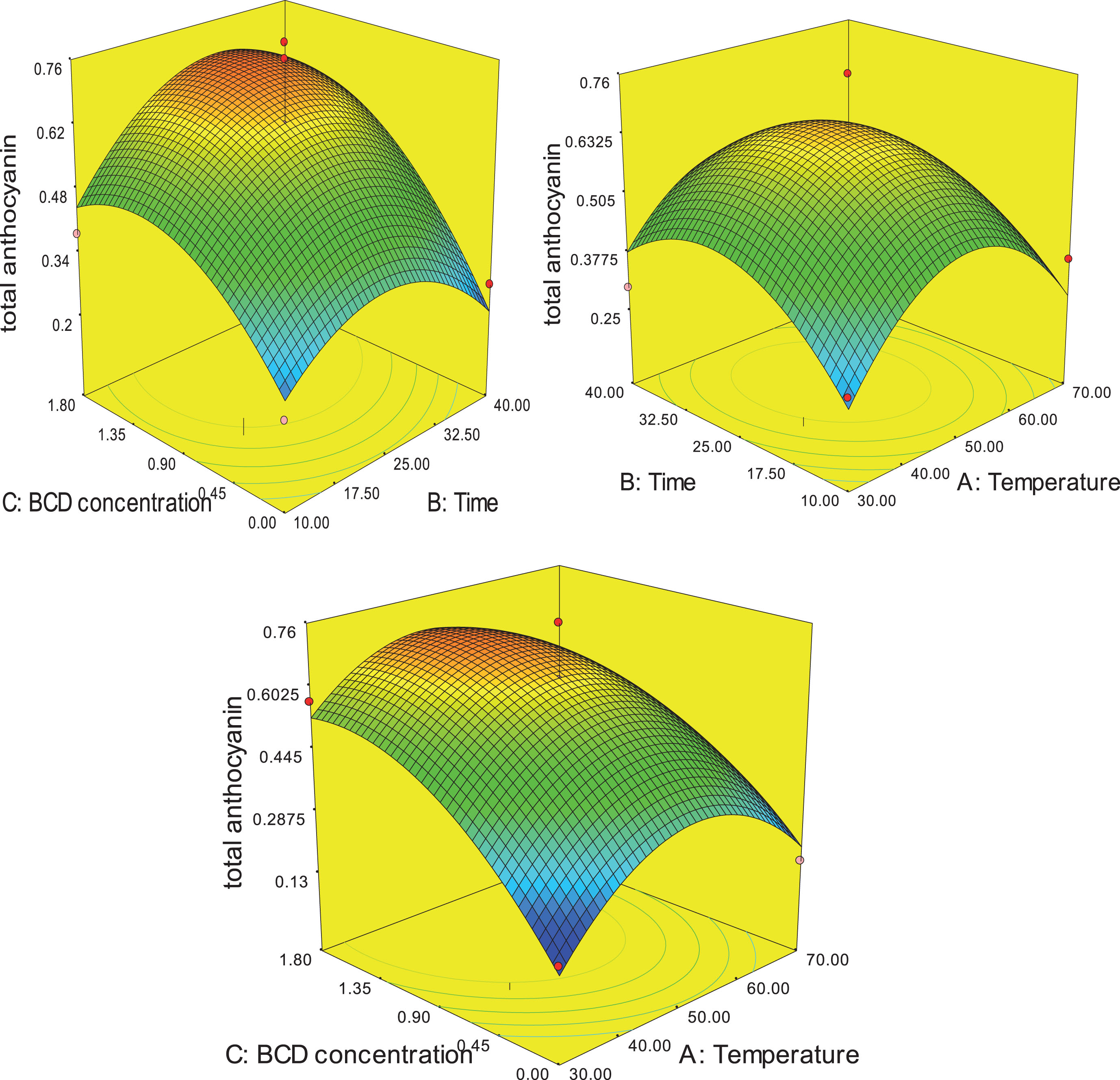
Interactive effects of independent variables on total monomeric anthocyanin.
Hydrogen peroxide is a weak oxidizer that can deactivate certain enzymes directly through oxidation of the thiol (–SH) group and can also quickly pass through the membrane and enter the cell. Hydrogen peroxide reacts with ions in radical hydroxyl form, which may be the source of many toxic effects [49]. According to the analysis of variance, β-CD (C) had a significant and positive effect, and the temperature had a significant and negative effect (P≤0.01) on the scavenging of hydrogen peroxide. Therefore, considering the significant parameters, the general equation of the quadratic model for the scavenging of hydrogen peroxide was reported in the Equation 11.
The R2 value of the predicted model for the Hydrogen Peroxide Radical scavenging activity is 0.91 and the P-value of the lack-of-fit test were 0.092. Therefore, the presented model in the Equation 10 provides fit for the desired response (Table 4). Several studies have been carried out on the antioxidant activity of the extract of various parts of the pomegranate. Among the various components, pomegranate peel extract has the highest antioxidant activity, which correlates with high levels of phenolic compounds in this part [50]. According to the results (Fig. 5), the Hydrogen Peroxide Radical scavenging activity was increased by increasing the temperature from 30 to 50°C and then decreasing, which is probably related to the amount of phenolic compounds of extract. In the previous studies, it has been shown that there is a positive correlation between pomegranate antioxidant activity and phenolic, flavonoid and anthocyanin composition [51]. By investigating the phenolic content and antioxidant capacity of the extracts in the present study, it is clear that the phenolic compounds can be an important factor in their antioxidant activity. The antioxidant activity of pomegranate peel extract is probably due to the ability of hydroxyl groups of phenol compounds for liberating hydrogen. In addition, antioxidant compounds are able to stop the free radical cycle in the process of oxidation [52]. Regarding the correlation between the antioxidant property of the extracts and the phenolic contents, it has been shown in this study that reduction in the antioxidant properties of the extracts is usually accompanied by a decrease in the amount of phenolic compounds in the extract. Therefore, it seems that the conditions and factors which change antioxidant property, change phenolic compounds too. Due to hydroxyl groups, phenolic compounds have the ability to neutralize free radicals and can act as hydrogen or an electron carrier [53]. Many researchers have reported that the phenolic compounds have a significant effect on antioxidant activity that this is due to the ability of these compounds to give hydrogen to active radicals such as DPPH and inactive their activity [40].

Interactive effects of independent variables on scavenging of hydrogen peroxide radical (a) and DPPH antioxidant activity (b).
As previously mentioned, polyphenols in combination with the hydrophobic cavity of Cyclodextrins are dissolved in water more effectively. Therefore, increasing the polyphenols solubility in water may be responsible for their better antioxidant capacity that facilitates free radicals removing. Therefore, in environments with a higher content of polyphenols, the antioxidant capacity improves. In a study, encapsulation of essential oil with β-CD increased its antioxidant activity [54]. According to the results of this study, the highest Hydrogen Peroxide Radical scavenging activity(23.06%) was observed at 50°C, 10 min and β-CD concentration of 1.8% and the lowest (17.76%) was at 70°C, 25 minutes and a water solvent without β-CD, and the highest DPPH Radical scavenging activity (80.04%) was observed at temperature 50°C, 10 min, and β-CD concentration of 1.8% and the lowest (47.11%) was observed at 50°C, 25 min and water solvent without β-CD.
In the process of extraction of bioactive compounds from pomegranate peel, the maximum amount of total phenolic compounds, total flavonoids, total flavonols, total monomeric anthocyanin, Hydrogen Peroxide Radical scavenging activity and DPPH Radical scavenging activity were achieved as the target of the test in the statistical analysis. Optimum conditions were performed using numerical optimization technique. For this purpose, the goals of optimization, response levels and independent variables were set. The best conditions were obtained using the desirability function. The optimum conditions for extracting were 55.76°C, 15.38 min, and β-CD concentration 1.8%. In this condition, the following amounts for all responses were obtained; the maximum total phenolic compounds of 158.08 (mgGAE/gDW) with extraction efficiency of 65.24, total flavonoids 82.31 (mgQE/gDW) with an extraction efficiency of 60.36%, total flavonol 69.46 (mgQE/gDW) with an extraction efficiency of 58.56%, total anthocyanin 0.53 (mgC–3–gE/gDW) with an extraction efficiency 42.64%, Hydrogen Peroxide Radical scavenging activity 22.93% and DPPH Radical scavenging activity 74.49%. The desirability obtained in optimal conditions for the variables and responses was 0.76.
Optimum extracts analysis (type and amount of bioactive compounds) by HPLC
After determining the optimal conditions for the independent variables and the responses, an extraction of pomegranate peel process was done under optimum conditions with β-CD solution and one extraction process was done in optimal conditions using water solvent without using β-CD. Finally the main bioactive components of extracts that extracted in the optimum condition with β-CD and without β-CD were analyzed by HPLC. Table 5 shows the retention time and concentration of 5 main bioactive compounds of pomegranate peel extract that have extracted by two different extraction methods. According to the results of HPLC analysis (Table 5), in the pomegranate peel extracts that have been extracted with β-CD under optimal conditions, five types of phenolic compounds, including Gallic acid, Caffeic acid, Chlorogenic acid, Cinnamic acid and Apigenin were identified. The maximum amount of phenolic compounds was Chlorogenic acid (307.26 mg/L) and the lowest was Cinnamic acid (2.7 mg/L). In the case of extracts that have been extracted with water without β-CD, it is observed that only two types of phenolic compounds were found: Gallic acid (3.47 mg/L) and Chlorogenic acid (146.04 mg/ L) (Fig. 6). Thus, the results of the HPLC analysis clearly indicate the increasing ability of extraction of bioactive compounds using the β-CD. As it was said, β-CD, by making the inclusion complex with bioactive compounds, can increase the solubility of these compounds and increases their extraction efficiency.
Polyphenols composition in pomegranate peel by HPLC quantification analysis (mg/L)
Polyphenols composition in pomegranate peel by HPLC quantification analysis (mg/L)
N.D: not detected.

The HPLC chromatograms of phenolic compounds of pomegranate peel extract, extracted β-CD as solvent(a) and water as solvent (b).
This study, the first of its kind, optimized β-CD and ultrasound-assisted extraction (UAE) based bioactive compound extraction from pomegranate peel. The optimum conditions for extraction were 55.76°C, 15.38 min, and β-CD concentration at 1.8%. In this condition, the following amounts for all responses were obtained; the maximum total phenolic compounds of 158.08 (mgGAE/gDW) with extraction efficiency of 65.24, total flavonoids; 82.31 (mgQE/gDW) with an extraction efficiency of 60.36%, total flavonol 69.46 (mgQE/gDW) with an extraction efficiency of 58.56%, total anthocyanin; 0.53 (mgC–3–gE/gDW) with an extraction efficiency of 42.64%, Hydrogen Peroxide Radical scavenging activity; 22.93% and DPPH Radical scavenging activity at 74.49%. This emerging “green” extraction technology using low-cost bio-resources could provide an environmentally friendly and economical alternative to traditional extraction methods for natural bioactive compounds.
Footnotes
Generally recognized as safe.