Two coordination polymers named [Co(tib)(H2O)3]· ipa·2H2O (1, H2ipa = iso-phthalic acid) and [Cu3(tib)2(BTB)2]·DMF·2H2O (2, H3BTB = 4,4′,4′′-gbenzene-1,3,5-triyl-tribenzoic acid, DMF = N,N-dimethylformamide) were constructed using a solvothermal method by reaction of metal salts with the 1,3,5-tris(1-imidazolyl)benzene (tib) ligands and different carboxylate linkers as the co-ligands. The two complexes have been characterized by X-ray diffraction as well as the elemental analyses. Subsequently, the protective effect of compounds 1 and 2 on the acute lung injury and its related mechanism was explored. Firstly, the enzyme linked immunosorbent assay (ELISA) was performed to detect the release of the inflammatory cytokines. Then, the partial pressure of oxygen (PaO2) and the partial pressure of carbon dioxide (PaCO2) was measured with blood gas analysis.
An important cause of acute lung injury is infection. Infective factors stimulate the mononuclear-macrophage system and cause the synthesis and release of a large number of cytokines, leading to excessive inflammatory reactions, resulting in loss control of the body’s normal inflammatory response as well as the reaction of cytokines [1, 2]. The disorders of a large number of toxic substances can extensively destroy the structure and function of various tissue cells. Pathogenic factors activate immune cells, leading to the abnormal release of inflammatory mediators, causing a variety of spatial and temporal inflammatory responses in the body [3, 4], which promotes lung injury and plays an important role in the pathogenesis of acute respiratory failure.
Coordination polymers (CPs) have received much attention not only for their charming structures and distinctive topologies, but also for their numerous potential applications as functional materials in magnetism, electric conductivity, gas adsorption and separation and so on [5–8]. The structural types of CPs are susceptible to many factors, involving the nature of metal ions, organic ligands, counterions, ratio of metal and ligand, and coordination and cocrystallization of solvents. Therefore, it has become an important topic to employ the appropriate factors to design and construct CPs with desired properties [9–11]. Among these factors, the coordination geometry of metal ions and the structural characteristics of polydentate organic ligands play a paramount role. Systematic studies of diverse ligands, leading to different structures in the formation of coordination polymers, are thus important and of intense interest. Owing to their natural characteristics, the tripodal multidentate ligands are prominent for constructing porous CPs with aesthetic topological structure. Recently, a triangular N-centered ligand, namely, 1,3,5-tris(1-imidazolyl)benzene (tib), has been investigated intensely in the fields of the mixed-ligand coordination polymers [12–14]. Dozens of coordination polymers, with interesting properties and aesthetic topology structures, have been reported by using the polycarboxylate as the mixed ligands, because three nitrogen atoms of TIPA ligand can adjust coordination orientation along the C–N bonds connecting phenyl and imidazolyl. Herein, we focus on the possibility of creating new structures by varying the type of metal ions and the length of the carboxylic acid ligands. In this study, two coordination polymers named [Co(tib)(H2O)3] · ipa·2H2O (1, H2ipa = Iso-phthalic acid) and [Cu3(tib)2(BTB)2]·DMF·2H2O (2, H3BTB = 4,4′,4′′-benzene-1,3,5-triyl-tribenzoic acid) were constructed using a solvothermal method by reaction of metal salts with the 1,3,5-tris(1-imidazolyl)benzene (tib) ligands and different carboxylate linkers as the co-ligands. The two complexes have been characterized by X-ray diffraction as well as the elemental analyses. The structural solution and refinement results based in the crystal data collected at room temperature show that complex 1 is a two-dimensional network which is further joined together by hydrogen bonds to generate a 3D supramolecular framework, and complex 2 is a 4-nodal (3,3,4)-connected 3D topology framework with the Schläfli symbol 83484·102284·122. In biological research, the acute lung injury was constructed and compounds 1 and 2 were given for treatment. Then, the ELISA assay was performed to detect the content of the IL-1 and TNF-α. The data suggested compound 1 showed higher activity than compound 2 on the reducing of the allergy response of the immune cells and exert the anti-acute respiratory failure ability. Besides, the PaO2 and the PaCO2 in animal model after compound treatment was measured with blood gas analysis. The results indicated the outstanding treatment effect of compound 1 against acute respiratory failure, which is better than compound 2.
Experimental
Chemicals and measurements
Co(NO3)2·6H2O (99.6% pure), Cu(NO3)2·3H2O (99.9% pure), H2ipa (98% pure), tib (97% pure), H3BTB (96% pure) were purchased from Beijing Bailingwei reagent company. All the solvents used in this work were obtained from the Tianjin Guangfu chemical reagent company at the analytical pure, and they were utilized with no further purification. We utilized the elemental vario micro elemental analyzer to obtain elemental results for N, C, H element content.
Preparation and characterization for [Co(tib)(H2O)3]·ipa·2H2O (1) and [Cu3(tib)2(BTB)2]·DMF·2H2O (2)
For complex 1, a mixture of tib (13.8 mg, 0.05 mmol), H2ipa (17 mg, 0.1 mmol), and Co(NO3)2·6H2O (29.1 mg, 0.1 mmol) in DMA/H2O (8 mL, v/v, 3 : 1) was sealed in a Teflon-lined stainless steel container at 90°C for 72 h. Pink block crystals of 1 were obtained in 63% yield (based on tib) after the reaction mixture was cooled down to ambient temperature. Anal. Calcd for C23H26CoN6O9 (1): C, 46.87; H, 4.45; N, 14.26%. Found: C, 46.92; H, 4.86; N. 14.50%. IR (KBr, cm–1): 3425(s), 1625.876(s), 1564(w), 1526(m), 1462(m), 1350(s), 1084(m), 737 (m).
For complex 2, a mixture of Cu(NO3)2·3H2O (48 mg 0.2 mmol), H3BTB (43.9 mg, 0.1 mmol), tib (13.8 mg, 0.05 mmol), DMF (2 ml) and H2O (4 ml) was sealed in a Teflon-lined stainless steel container and heated at 90°C for 3 d. When cooled to room temperature blue block crystals of 2 were obtained in 52% yield (based on the trans-tib ligand). Anal. Calcd for C87H69Cu3N13O17 (2): 59.40; H, 3.95; N, 10.35; %. Found: C, 59.16; H, 3.86; N. 10.55%. IR (KBr, cm–1): 3423(s), 1619 (s), 1574(s), 1516(m), 1464(w), 1350(s), 1201(m), 926(m), 776(s).
The single crystal X-ray data of the two complexes were obtained by utilizing the Oxford Xcalibur E diffractometer. The intensity data was analyzed by utilizing the CrysAlisPro software and converted to the HKL files. The SHELXS program on the basis of direct approach was utilized to create the initial structural models, and the SHELXL-2014 program on the basis of the least-squares approach was modified. The whole non-H atoms were mixed with anisotropic parameters. Then we utilized the AFIX commands to fix the whole H atoms geometrically on the C atoms that they attached. For the highly disordered guest solvents in the frameworks of complexes 1 and 2, they could not be well modeled in the electronic maps via the structural refinements. Final refinement was performed with modification of the structure factors for contribution of the disordered solvent electron densities using the SQUEEZE option of PLATON. Table 1 details two complexes’ refinement details as well as crystallographic parameters.
Refinement details and crystallographic parameters for complexes 1 and 2
Identification code
1
2
Empirical formula
C23H22CoN6O7
C84H58Cu3N12O14
Formula weight
553.39
1650.04
Temperature/K
293.15
293.15
Crystal system
monoclinic
monoclinic
Space group
P21/n
P21/c
a/Å
11.3672(13)
8.1296(4)
b/Å
14.2458(12)
28.9634(10)
c/Å
21.013(2)
19.0236(6)
β/°
89.916(2)
94.106(2)
Volume/Å3
3402.8(6)
4467.8(3)
Z
4
2
ρcalcg/cm3
1.080
1.227
μ/mm–1
0.545
0.771
Data/restraints/parameters
8136/0/340
7878/0/511
Goodness-of-fit on F2
1.067
1.066
Final R indexes [I> = 2σ (I)]
R1 = 0.0716, ωR2 = 0.2130
R1 = 0.0449, ωR2 = 0.1353
Final R indexes [all data]
R1 = 0.0912, ωR2 = 0.2264
R1 = 0.0592, ωR2 = 0.1518
Largest diff. peak/hole / e Å–3
0.92/–1.36
0.50/–0.77
CCDC
1958697
1958698
ELISA
Stock solutions of 1 and 2 were prepared in DMSO (Sigma Aldrich) at a concentration of 1000μM, which were sterilized by filtration through Millipore filter (0.22μ M) before use, and diluted by cell culture medium to various working concentrations. To evaluate the protective activity of the compounds 1 and 2 against acute respiratory failure, 30 SD rats (male, 3–4 weeks, 100–120 g) were used in this experiment for the construction of the acute respiratory failure animal model. All the rats were purchased from Model Animal Reaserch Center of Nanjing University (Nanjing, China). All the experiments performed in this study were approved by the Ethics Committee of the Affiliated Hospital of Nanjing University (Nanjing, China). In brief, the rats were divided into four different groups, the control group, acute respiratory failure model group model group, compound 1 treatment group and the compound 2 treatment group. In the mode and compounds treatment group, LPS was given through intravenous injection to replicate rat acute lung injury model. 3 hours before and after LPS injection, compounds 1 and 2 was given for treatment. Two days later, the rats were anesthetized and the blood was collected and the content of the IL-1 and TNF-α was measured with ELISA detection kit. This preformation was conducted in triplicate.
Blood gas analysis
The PaO2 and the PaCO2 in animal model after compound treatment was measured with blood gas analysis. This experiment was carried out under the guidance of the manufactures’ instruction. In short, the SD rats were used for the construction of the acute respiratory failure animal model. LPS was injected into the rats at the concentration of 5 mg/mL, and then the compounds 1 and 2 was given for treatment 3 hours before and after LPS injection. After that, the rats were anesthetized and the common carotid artery intubation was performed to collect the blood for the blood gas analysis.
Results and discussion
Molecular structures
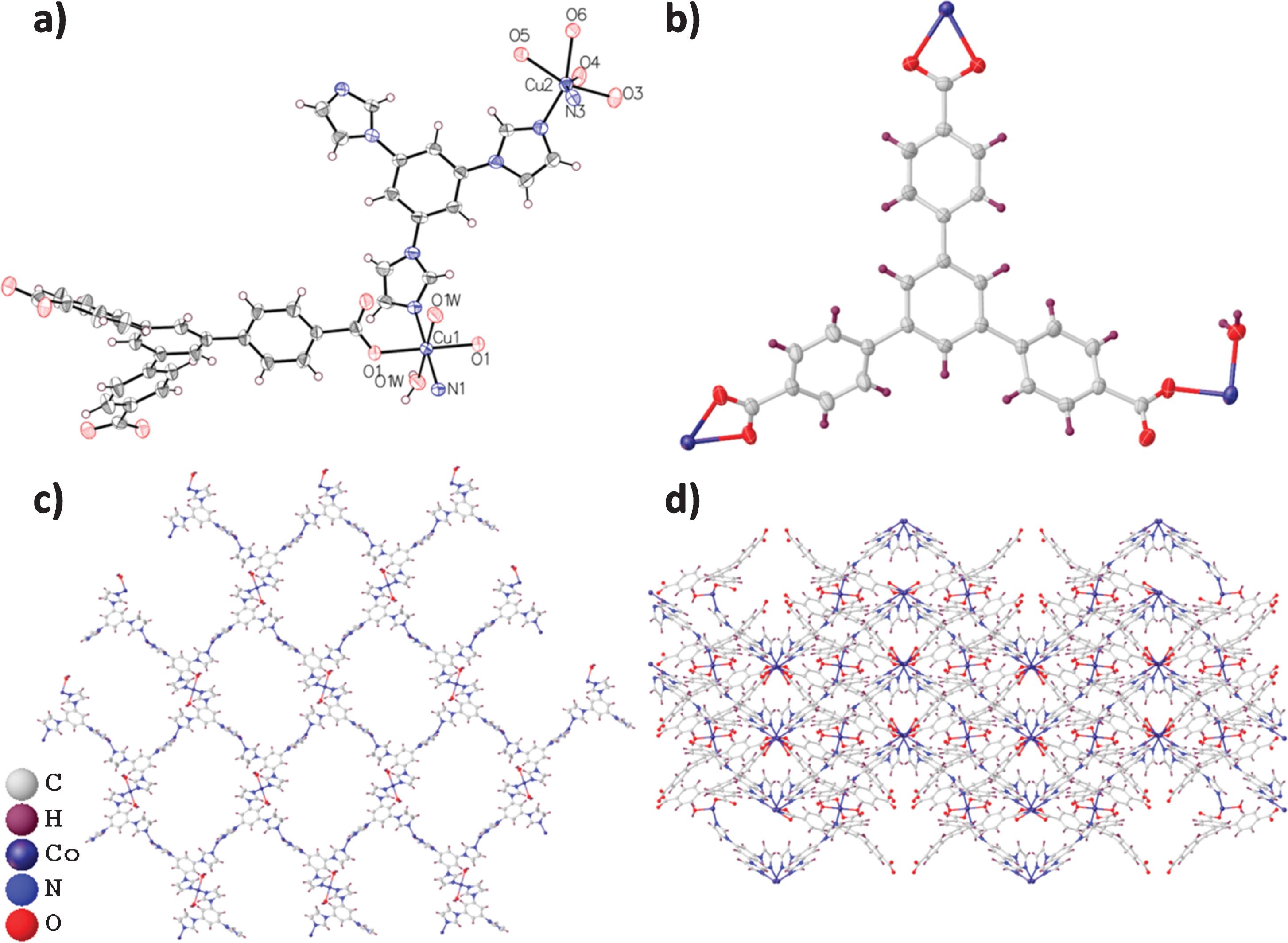
By reaction of Co(NO3)2·6H2O, H2ipa and the tib ligands a mixed solvent of DMA and water, pink block-shape crystals of 1 with a moderate high yield were found at the bottom of the Teflon-lined stainless steel container. The chemical composing of 1 was found to be [Co(tib)(H2O)3]·ipa·2H2O based on the single crystal X-ray study combined with the elemental analysis. The structural solution and refinement results based on the single crystal data collected around room temperature shows that complex 1 crystallizes in the monoclinic space group P21/n and reflects a 2D layered framework structure based on the six-coordinated Co(II) ions as nodes. The asymmetric structure unit of 1 is composed of one cystallographic independent Co(II) ions, one fully deprotonated ipa2– anion serving as the charge balance ion, one tib ligand, three coordinated water molecules as well as two lattice disordered water molecules as revealed via the elemental analysis, all of which contribute to a neutral framework structure. In Fig. 1a, the Co1 atom located on the normal site is surrounded by three imidazole N atoms (N1, N3A, N5B) from three distinct tib and three terminal water molecules (O1W, O2W, O3W) in a distorted octahedral arrangement. The Co(II)-O bond distances are in the region of 2.112(3) to 2.171(3) Å and the Co(II)-N bond lengths are in the range of 2.194(4) to 2.255(3) Å, which are comparable with those of the Co(II)-containing coordination polymers based on the similar O-donor and N-donor co-ligands. Each tib joins three Co(II) atoms using its three imidazole groups, and in turn each Co(II) connects three tib ligands to generate a 2D network with triangular channels along the b axis (Fig. 1b). It is worth noting that partially deprotonated ipa2– ligand acts as a counteranion and locates between two adjacent layers. There are hydrogen bonds between the coordinated water molecules and the counteranions, and the π–π interactions between the counteranions and the tib ligands could also be found with a center to center distance of 3.556 Å (Fig 1c and Fig. 1d). So the H-bond interaction and π–π interactions eventually contribute to a 3D supramolecular structure of 1.
(a) The basic repeating unit for 1. (b) The 2D layered network of 1. (c) The H-bond interactions between the adjacent layers. (d) The the π–π interactions between the counteranions and the tib ligands.
The complex 2 could be afforded by the solvothermal reaction of Cu(NO3)2·3H2O and two C3-symmetrical O-donor H3BTB and N-donor tib ligands in a mixed solvent of DMF and water, which was formulated as [Cu3(tib)2(BTB)2]·DMF·2H2O based on the single crystal X-ray study combined with the elemental analysis. The structural solution and refinement results based on the single crystal data collected around room temperature shows that complex 2 crystallizes in the monoclinic space group P21/c and reflects a 3D framework structure based on the six-coordinated Cu(II) ions as nodes. The asymmetric structure unit of 2 is composed of two cystallographic independent Cu(II) ions (one Cu1 ion and one Cu2 ion), one deprotonated BTB3– anion, one tib ligand and one coordinated H2O molecule, all of which contribute to a neutral framework structure. In Fig. 2a, the Cu1 atom located on the 2-fold axis is six-coordinated by two O atoms from two BTB3– ligands, two N atoms from two tib ligands and two O atoms from two H2O molecules and exhibits regular octahedral coordination structure. Four O atoms lie in the equatorial plane and two N atoms are at the top of the octahedron. Meanwhile, the Cu2 atom sitting on a normal position also adopts six-coordinated by two N atoms from two tib ligands, four O atoms from two BTB3– ligands to form distorted octahedral geometry. Three O atoms and one N atom lie in the equatorial plane, one N atom and one O atom are at the top of the octahedron. BTB3– ligand acts as a tridentate ligand to bridge three Cu(II) atoms using its carboxylate groups adopting a (κ1)–(κ2)–(κ2)–μ3-BTB coordination mode (Fig. 2b). Finally, the Cu-tib 2D layer structure is further linked by BTB3– to form a 3D structure of 1 (Fig 2c and Fig 2d). The solvent accessible volume is 1147.2 Å3 per 4583.1 Å3 unit cell volume (24.8% of the total crystal volume). The results of topological analysis show that 1 is a (3,3,4,4)-connected 4-nodal 3D net with a point symbol of 83484·102284·122 by considering Cu1,Cu2, tib, and BTB3– as four-, four-, three-, and three-connectors.
(a) The basic repeating unit for 2. (b) The coordination patterns for the H3BTB ligand. (c) The 2D Cu(II)-tib layer. (d) The 3D porous framework of 2.
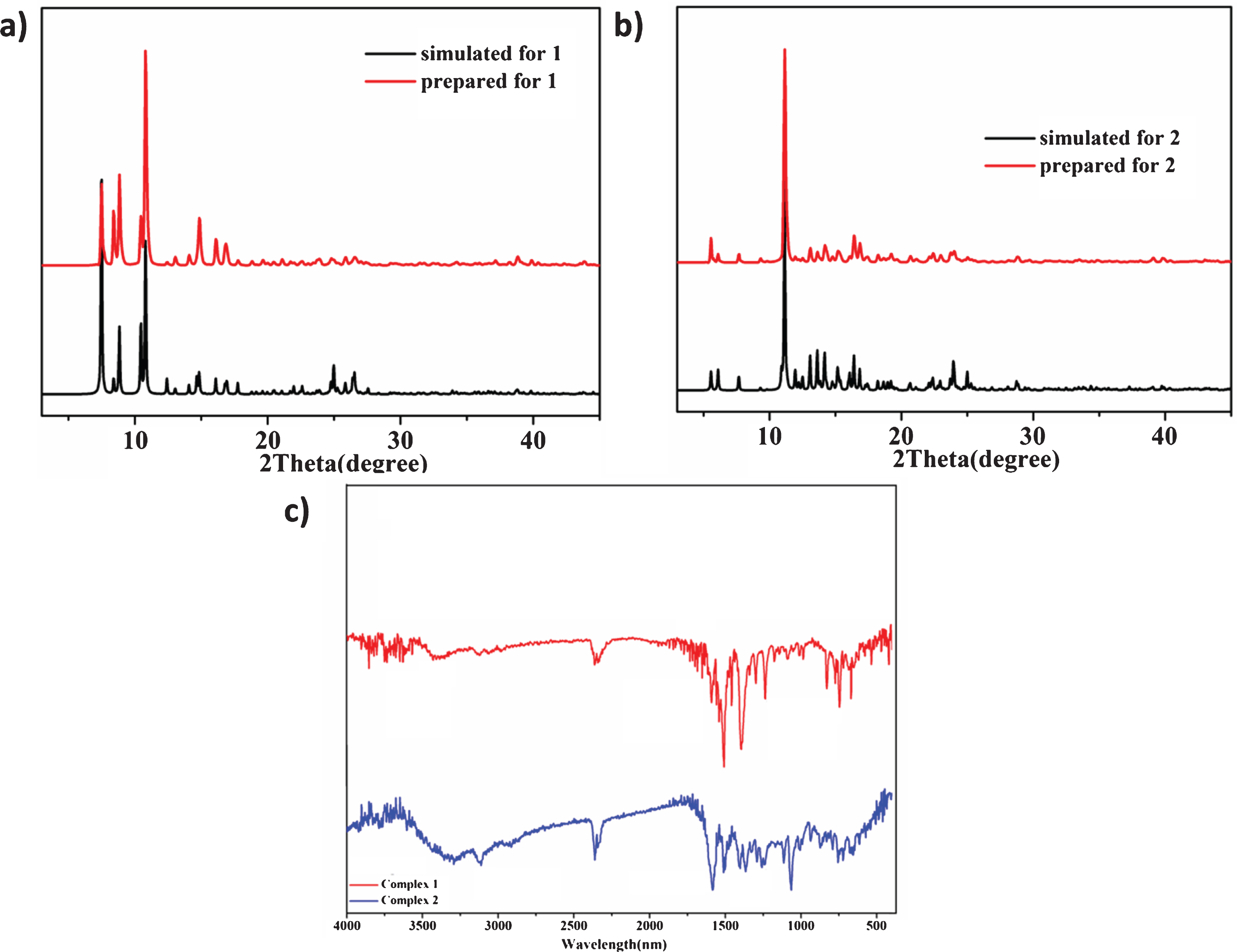
To check the phase purity of the products, powder X-ray diffraction (PXRD) experiments have been carried out for these complexes. The peak positions of the experimental and simulated PXRD patterns are in good agreement with each other, indicating that the crystal structures are truly representative of the bulk crystal products. The differences in intensity may be owing to the preferred orientation of the crystal samples (Fig. 3a and 3b). In the IR spectra of complexes 1–2, they show strong and broad peak around 3424 and 3423 cm–1 relates to the O–H stretching vibration modes of hydrogen bonds (Fig. 2c). There is no absorption band around 1700 cm–1 for 1–2, which indicates that the carboxylate groups of organic ligands are completely deprotonated. The asymmetric and symmetric stretching vibrations of carboxyl groups 1625, 1349 cm–1 for 1, 1619, 1350 cm–1 for 2 and the separations (Δν= [νas(COO)–νs(COO)]) between these bands indicate the presence of monodentate (276 cm–1 for 1 and 269 cm–1 for 2) coordination modes of the carboxylate groups. The bands at 1525 cm–1 and 1516 cm–1 for 1 and 2 are assigned to the CN absorption in the imidazole ring of tib ligand, respectively.
(a) The PXRD patterns for complex 1. (b) The PXRD patterns for complex 2. (c) The FT-IR spectra of complexes 1 and 2.
Influence of compound on the content of the IL-1 and TNF-α in acute respiratory failure animal model
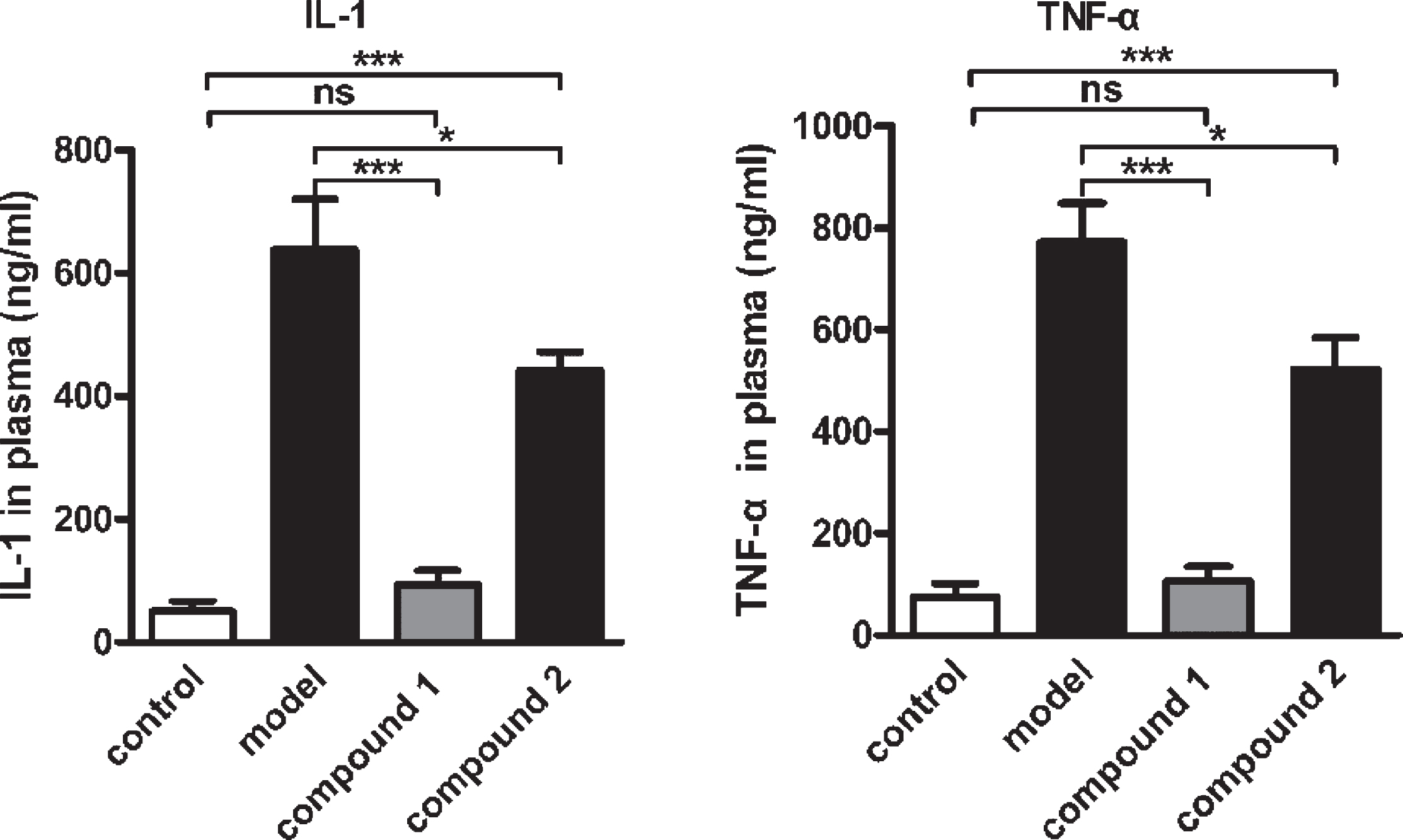
After the successful synthesis of the compounds 1 and 2, their protective effect on the acute respiratory failure animal model was evaluated by measuring the content of the IL-1 and TNF-α in plasma. The rats were injected with LPS to replicate rat acute lung injury model, followed by compound treatment. As the results showed in Fig. 4, we can see there was a significant higher level of the IL-1 and TNF-α in the model group, which indicating the abundance of inflammatory response in the model group. However, after compounds treatment, the IL-1 and TNF-α in plasma was reduced and compound 1 showed a stronger inhibitory effect than compound 2.
Compound 1 inhibited the IL-1 and TNF-α in acute respiratory failure animal model stronger than compound 2. LPS was used to replicate rat acute lung injury model, and compound was given for treatment. The IL-1 and TNF-α in plasma was detected by ELISA detection kit. *means p < 0.05, ***means p < 0.005.
Influence of compound on the PaO2 and the PaCO2 in animal model
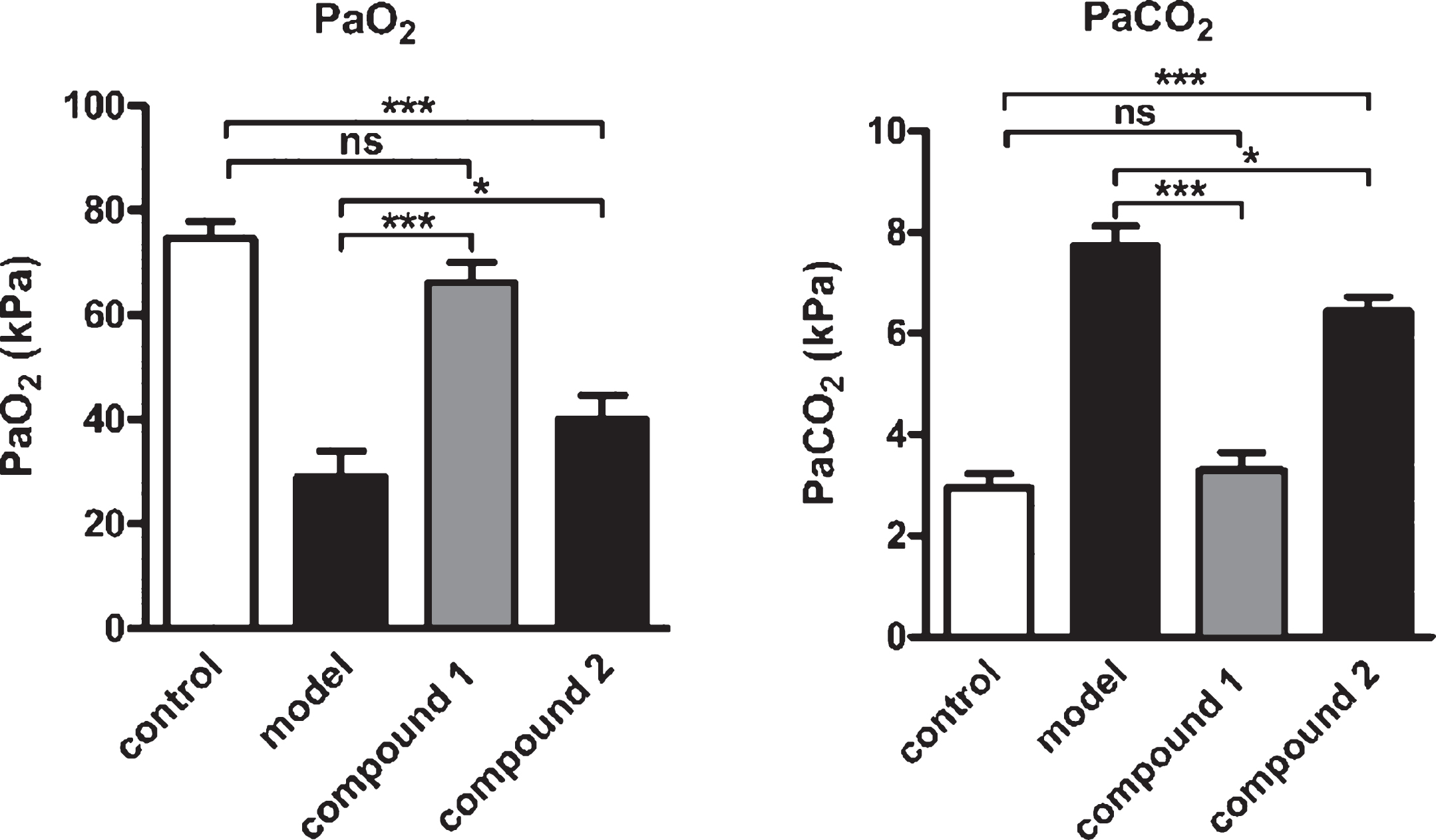
In the previous study, we have revealed that the excellent treatment effect of compound 1 against the acute respiratory failure reflected as the inhibitory effect on the abundance of inflammatory responses. While, in clinic, the PaO2 and the PaCO2 were the most common indicators of the function of lung. Thus, in this experiment, the PaO2 and the PaCO2 was measured via blood gas analysis. In Fig. 5, we got this information, after compounds treatment, the PaO2 was up-regulated and the PaCO2 was significantly reduced, and compound 1 showed higher activity than compound 2.
Compound 1 increased PaO2 and reduced PaCO2 in acute respiratory failure animal model stronger than compound 2. LPS was used to replicate rat acute lung injury model, and compound was given for treatment. The PaO2 and the PaCO2 was measured via blood gas analysis. *means p < 0.05, ***means p < 0.005.
Conclusion
In summary, we have successfully prepared two coordination polymers using a solvothermal method by reaction of metal salts with the 1,3,5-tris(1-imidazolyl)benzene (tib) ligands and different carboxylate linkers as the co-ligands. The two complexes have been characterized by X-ray diffraction as well as the elemental analyses. The structural solution and refinement results based in the crystal data collected at room temperature show that complex 1 is a two-dimensional network which is further joined together by hydrogen bonds to generate a 3D supramolecular framework, and complex 2 is a 4-nodal (3,3,4)-connected 3D topology framework with the Schläfli symbol 83484·102284·122. In biological study, the treatment function of compounds 1 and 2 against acute respiratory failure was evaluated. Firstly, the acute lung injury rat model was constructed and compounds were given for treatment. After that, the ELISA assay was performed to detect the content of the IL-1 and TNF-α in plasma. The data suggested compound 1 showed higher activity than compound 2 in reducing of the allergy response of the immune cells and exert the anti-acute respiratory failure ability. Besides, the PaO2 and the PaCO2 in animal model after compounds treatment was measured with blood gas analysis. The results indicated the outstanding treatment effect of compound 1 against acute respiratory failure, which is better than compound 2.
References
1.
WuX., BenovA., DarlingtonD.N., KeeseeJ.D., LiuB. and CapA.P., Effect of tranexamic acid administration on a cute traumatic coagulopathy in rats with polytrauma and hemorrhage, PLoS One14 (2019), e0223406.
2.
KheiryM., DianatM., BadaviM., MardS.A. and BayatiV., p-Coumaric acid protects cardiac function against lipopolysaccharide-induced acute lung injury by attenuation of oxidative stress, Iran J Basic Med Sci22 (2019), 949–955.
3.
DuanC., YuY., YangP., ZhangX., LiF., LiL. and XiH., Engineering New Defects in MIL-100(Fe) via a Mixed-Ligand Approach To Effect Enhanced Volatile Organic Compound Adsorption Capacity, Ind Eng Chem Res59 (2020), 774–782.
4.
TangS., WangZ., YuanD., ZhangY., QiJ., RaoY., LuG., LiB., WangK. and YinK., Enhanced photocatalytic performance of BiVO4 for degradation of methylene blue under LED visible light irradiation assisted by peroxymonosulfate, Int J Electrochem Sci15 (2020), 2470–2480.
5.
SuJ., ShengZ., LiuA., HanY. and ChenY., A group-based binary splitting algorithm for UHF RFID anti-collision systems, IEEE T Commun68 (2020), 998–1012.
6.
LiY.L., ZhaoY., KangY.S., LiuX.H. and SunW.Y., Syntheses, Structures, and Sorption Properties of Metal–Organic Frameworks with 1,3,5-Tris(1-imidazolyl)benzene and Tricarboxylate Ligands, Cryst Growth Des16 (2016), 7112–7123.
7.
LiW.H., WangJ.R., ChengH.J., YinW.Y., LiC., ShuY., YanS.Q., TangX.Y., MaY.S. and YuanR.X., Coordinated imidazolyl group site-directed assembly of Cd(II) coordination polymers based on tri-imidazolyl ligands, J Solid State Chem271 (2019), 222–229.
8.
LiuY., WangX., ZhaoJ., LinH., XuN., ZhangJ. and YuB., A series of flexible bis(pyridyl)-bis(tetrazole)-modulated coordination polymers: Construction, electrochemical properties, dye adsorption and magnetic properties, CrystEngComm271 (2019), 222–229.
9.
WangJ., PanY., LuL., XiongY.F., FangL., LuoW., WuX. and KumarA., Zn(II)-based metal-organic frameworksderived from dicarboxylate ligand and N-donor ligands as luminescent sensors for selective detection of picric acid, J Mol Struct1196 (2019), 194–200.
10.
YuM., XuanF., LiJ. and LiuG.X., Four Zinc(II) coordination polymers with dicarboxylate and Tri(4-pyridylphenyl)amine ligand: Syntheses, crystal structures and physical properties, J Mol Struct1199 (2020), 127005.
11.
FooM.L., MatsudaR., HijikataY., KrishnaR., SatoH., HorikeS., HoriA., DuanJ., SatoY., KubotaY., TakataM. and KitagawaS., An Adsorbate Discriminatory Gate Effect in a Flexible Porous Coordination Polymer for Selective Adsorption of CO2 over C2H2, J Am Chem Soc138 (2016), 3022–3030.
12.
FanJ., SunW.Y., OkamuraT., TangW.X. and UeyamaN., Novel Metal-Organic Frameworks with Specific Topology from New Tripodal Ligands: 1,3,5-Tris(1-imidazolyl)benzene and 1,3-Bis(1-imidazolyl)-5-(imidazol-1-ylmethyl)benzene, Inorg Chem42 (2003), 3168–3175.
13.
FanJ., ShuM.H.,
OkamuraT, LiY.Z., SunW.Y., TangW.X.
and
UeyamaN.,
Solvent effect on the structure and topology of metal-organic frameworks with the rigid tripodal star ligand 1,3,5-tris(1-imidazolyl)benzene and lead(II) nitrate, New J Chem27 (2003), 1307–1309.
14.
MukherjeeS., SamantaD. and MukherjeeP.S., New Structural Topologies in a Series of 3d Metal Complexes with Isomeric Phenylenediacetates and 1,3,5-Tris(1-imidazolyl)benzene Ligand: Syntheses, Structures, and Magnetic and Luminescence Properties, Cryst Growth Des13 (2013), 5335–5343.