



Abstract
Two new isomorphic and heterogeneous coordination polymers (CPs), namely {[RE (L) (H2O) 2] · (Hbipy) · H2O} n (RE = Yb(
Introduction
The chemistry of coordination polymers (CPs) involving rare earth metal ions has been an active research area in recent years owing to their potential applications in the areas of catalysis, ion exchange, proton conductivity, intercalation chemistry and material chemistry [1–5]. Assembly of CPs allows for a wide choice of various parameters including versatile functions of aromatic ligands as well as diverse electronic properties and coordination preference of the rare earth metal ions [6–8]. Nowadays, there is a growing interest in employment of aromatic sulfonate ligands attached by various functional groups, such as amine, hydroxyl, and carboxylate groups, for construction of CPs with varying topologies [9–11]. Furthermore, the structure-dependent properties have been further expanded through the multifunctional ligands, such as sulfonate-phenol ligands [12]. The synergistic combination of the unique characteristics of the functional groups can expand the number of possible geometrical combination between the O-donors and allow for bridging the rare earth metal ions with new coordination modes, so as to improve the characteristic coordination behaviors of ligands and provide the CPs with unusual structures and intriguing features [13–15].
We are interested in the sulfonate-phenol ligands because they can exhibit discriminative coordination abilities [16, 17]. Na2H2L is an important kind of sulfonate-phenol ligands. This is based on the following considerations: (i) it is a rigid aromatic ligand and plays the role of a bridging rod; (ii) owing to the presence of two kinds of functional groups, a variety of binding modes can offer new building blocks for the construction of diverse topological structures; (iii) the functional groups are the potential interaction sites of O–H⋯O hydrogen bonding for the construction of specific supramolecular networks. However, the reports on metal sulfonate-phenol CPs are still rare [12].
In this work, we use a bisulfonate molecule attached by two phenol groups as ligand, Na2H2L. The sulfonate groups possess weak coordination ability to rare earth metal ions, and the introduction of the phenol groups could improve its characteristic coordination feature and crystallinity of its coordination polymer, in addition to forming hydrogen bonds. This publication describes the syntheses, crystal structures, thermal stability, and luminescence of two new 1D phenol-sulfonate CPs.
Experimental
Materials and general measurements
All reagents commercially available were of reagent grade and used without further purification. Elemental analyses were performed on a Perkin-Elmer 240C instrument. Powder X-ray diffraction patterns were performed on a RIGAKU DMAX2500PC diffractometer. Thermogravimetric analyses were carried out on a NETZSCH STA 449C analyzer with the temperature range of 25C–900C, at a heating rate of 10C min–1 under a nitrogen atmosphere. Luminescence spectra for the solid samples were recorded at room temperature. Fluorescence spectra were obtained using a Perkin Elemer LS55 fluorescence spectrometer and an Edinburgh Instruments FLS980 in the NIR range.
Synthesis of compound 1
A mixture of Yb(NO3)2·6H2O (0.049 g, 0.2 mmol), Na2H2L (0.056 g, 0.2 mmol), and bipy (0.079 g, 0.4 mmol) in H2O (10 ml) and ethanol (10 ml) was put into a Teflon-lined stainless-steel reactor (25 mL) and heated at 140C for 5 d. After cooling to room temperature, the yellow blocked crystals were collected. The single crystals were obtained in ca. 60% yield based on Yb. Elemental Analysis Calculated (%) for C16H17N2O11S2Yb (
Synthesis of compound 2
Compound
X-ray crystallographic measurement
Single crystals of compounds
Crystal data and structure refinement for compounds 1 and 2
Crystal data and structure refinement for compounds
Selected bond lengths (Å) and bond angles (°) for compounds
Symmetry codes for compound
Hydrogen bond lengths (Å) and bond angles (°) for compounds
Structure descriptoin of compounds 1 and 2
Compounds

(a) The molecular structure of compound
Each L4– ligand adopts one coordination mode: (i) sulfonate groups of L4– ligand connect two different ytterbium ions via bidentate-chelating and monodentate modes, respectively, to form a μ2-bridge; (ii) phenol groups of L4– ligand bind with two different ytterbium ions via bridging and monodentate modes, respectively, to form a μ2-bridge. That is to say, the L4– ligand acts as a pentadentate mode to combine three ytterbium atoms (Fig. 1c). This coordination mode is different with those of the reported L4– complexes [24, 25]. The L4– is a versatile ligand and is able to adopt many types of coordination modes. The two sulfonate groups are coordinated to terbium in different forms; one sulfonate group adopts a bidentate coordination mode, the other is in unidentate form. The dimers are bridged by a unidentate sulfonate oxygen atom to form a chain structure [24]. The biphenol groups are easy to coordinate with alkaline earth metal ions. The biphenol groups can chelate to one barium center. The sulfonate group coordinates to two different Ba2 + ions via a μ2η2-coordination mode. The other sulfonate adopts a μ3η3-coordination mode [25].
Two adjacent ytterbium atoms are linked by two bridging phenol groups of L4– ligands, with the Yb⋯Yb distance of 3.8142 Å. The Yb⋯Yb distances, when bridged by phenol groups only, are slightly shorter than those, when bridged by phenol groups and bidentate carboxylate groups. The interconnection of ytterbium ions by L4– ligands results into a 1D chain along the b axis (Fig. 2a). Each 1D chain is interlinked with neighboring chains via hydrogen bonds involving of coordinated and lattice water molecules (O11—H11D⋯O4i, O11—H11B⋯O7ii, O10—H10B⋯O11iii, O9—H9A⋯O6iii and O9—H9B⋯O1ii). There exist hydrogen bonds that interlink coordinated water molecules with lattice water molecules, and link water molecules with sulfonate oxygen and phenol oxygen atoms in L4– ligands, with the hydrogen bond distances in the range of 2.686(3) Å–3.316(3) Å (Table 3). These hydrogen bonding interactions can extend the 1D chains into a 2D supramolecular layered structure (Fig. 3).
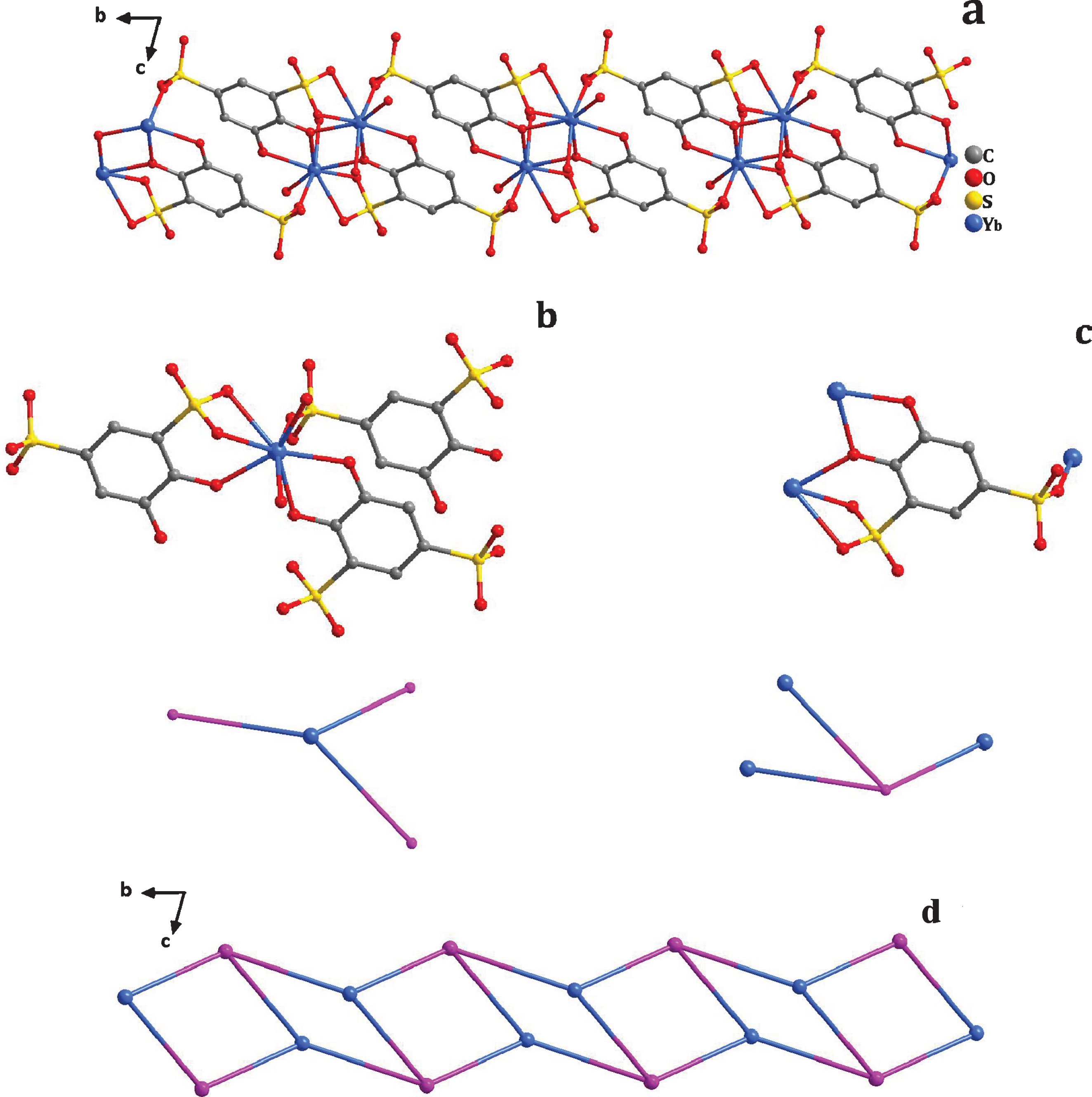
Schematic representation of (a) 1D chain structure; (b) the three-connected Yb node (bule); (c) the L4– ligand-based three-connected node (violet); (d) (3, 3)-connected topological wavy ladder-like chain.
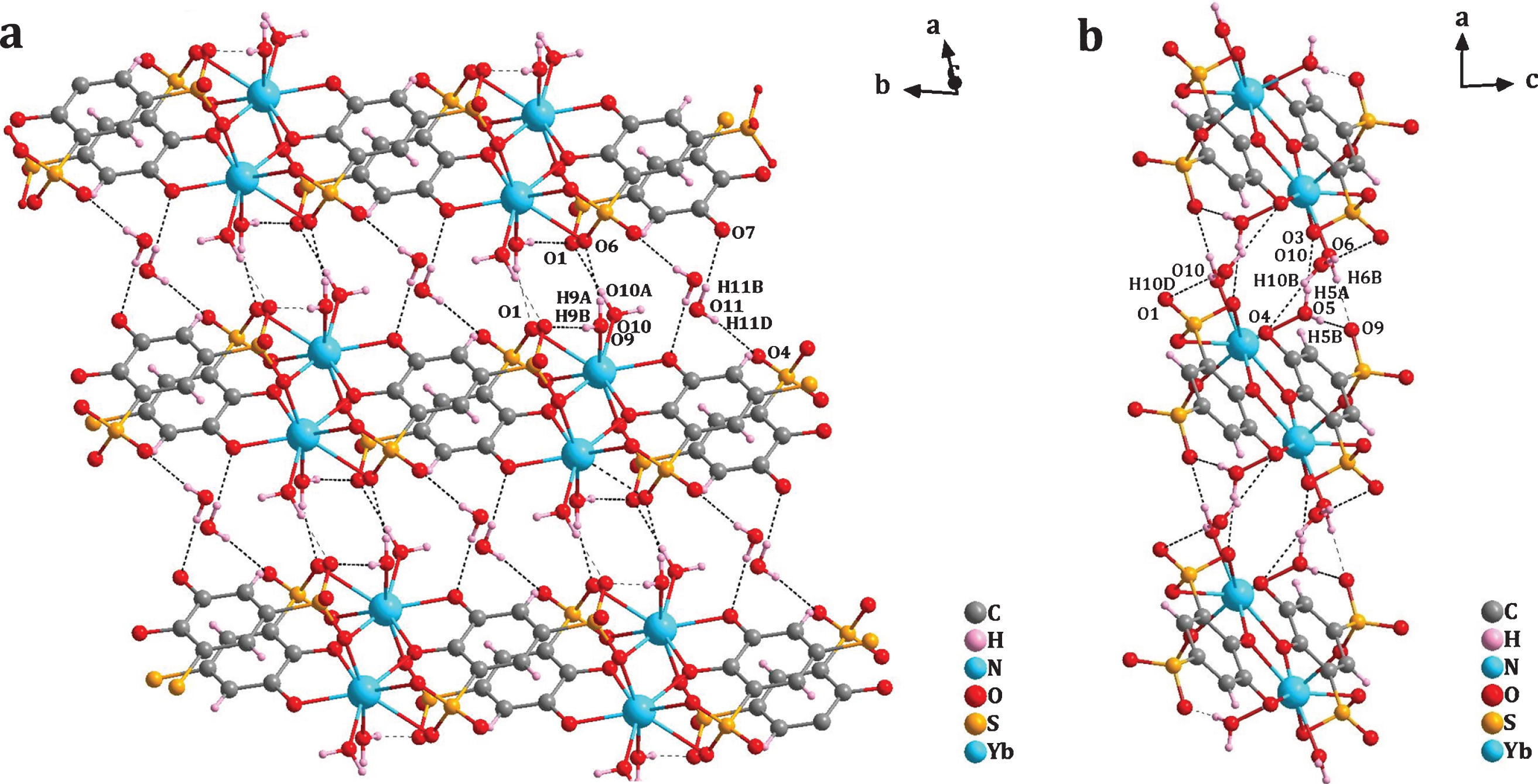
1D chains connected by hydrogen bonds involving of water molecules to form a layered structure (a) along c axis and (b) b axis.
Many metal complexes with various topologies based carboxylate or sulfonate ligands, especially multifunctional ligands, are known [5, 26–28]. However, for rare earth metal ions, they are easy to form isostructural complexes [29–31]. Rare earth metal coordination complexes are currently of great interest for the syntheses of novel molecular materials with luminescent properties. Two isostructural complexes with the formula [Ln2(DMF)2(OAc)2(HL)2]n (Ln = Dy, Eu H3L = N′-(2-hydroxybenzylidene)pyridine N-oxide-carbohydrazide) were solvothermally synthesized. Two centrosymmetric Ln ions are connected by a pair of μ2-η2:η1-CH3COO– anions, leading to a centrosymmetric {Ln2} subunits. Furthermore, these separate {Ln2} subunits are periodically extended by HL2– connectors, generating a two-dimensional layer structure [30]. A successful synthetic approach to rare earth metal complexes is the employment of bridging multifunctional ligands and chelating N-donor ligands. The reaction of several Ln(NO3)3·6H2O salts with 9-anthracenecarboxylic acid (9-HAC) and bipy in a mixture of CH3OH/H2O has allowed the isolation of the dinuclear complexes, such as [Ln2(9-AC)4(9-AC)2(bpy)2] (Ln = Nd, Eu, Gd, Tb, Er, Yb) [31].
From the topological point of view, each ytterbium ion is surrounded by three L4– ligands, thus, the ytterbium centers define as 3-connected nodes (Fig. 2b). Likewise, the L4– ligand serves as a linker to bridge with three neighboring ytterbium ions. In this way, the L4– ligands act as 3-connected nodes (Fig. 2c). Therefore, compound
As shown in Fig. 4, the peak positions of simulated and experimental PXRD pattern are in agreement with each other, which suggests the good phase purity of compounds
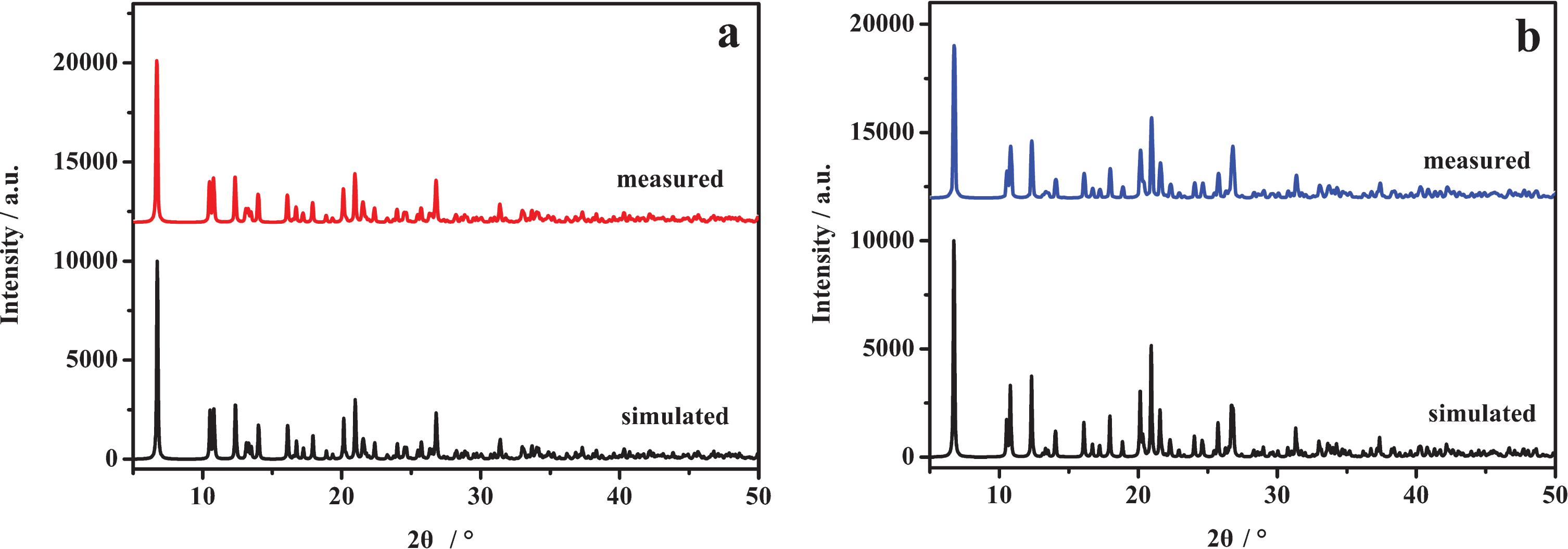
(a) The simulated and measured PXRD patterns for compound
Thermal gravimetric analyses(TGA) of compounds

TGA curves for compounds
The solid state luminescence of compounds
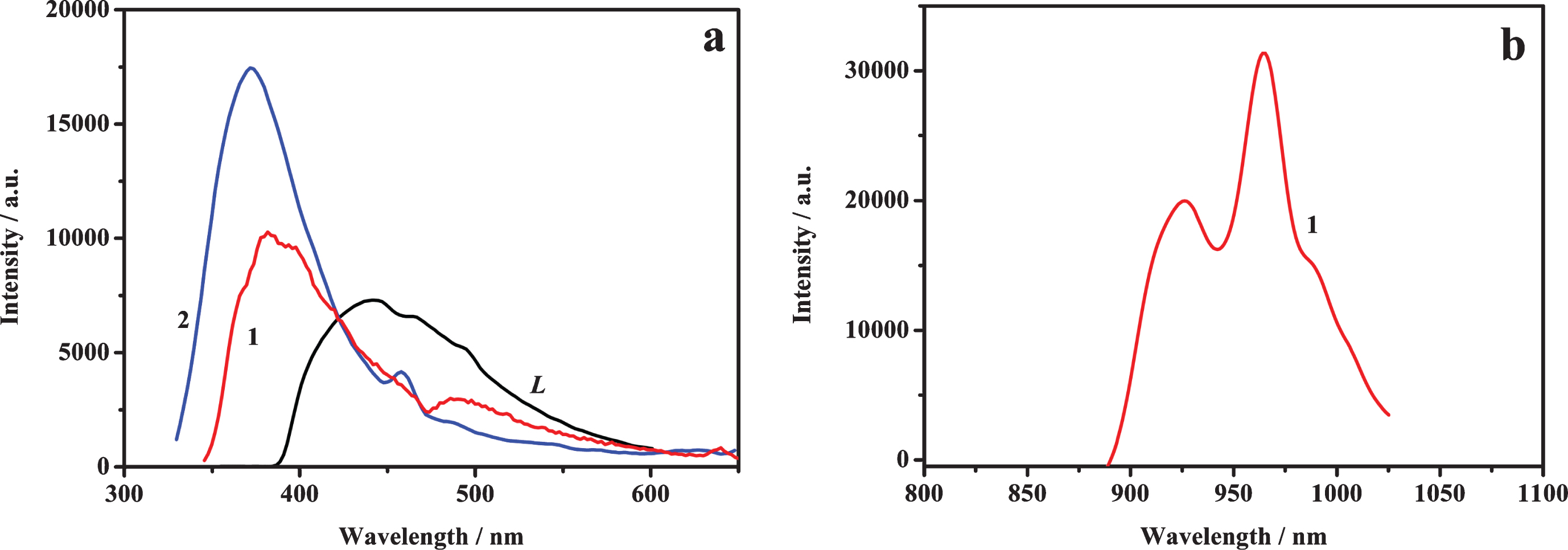
(a) Solid state emission spectra of free Na2H2L, compounds
In summary, two new CPs, {[RE(L)(H2O)2]·(Hbipy)·H2O}n (RE = Yb, Y), were synthesized by hydrothermal methods. The phenol groups possess bridging and monodentate coordination modes, and the sulfonate groups adopt μ1 and μ2 coordination modes, respectively. The whole L4– anions act as the pentadentate ligands to form wavy ladder-like chain structures. The hydrogen bonds involving of water molecules can interlinker the adjacent 1D chains to generate 2D layered structres. The fluorescence of compounds
Appendix A. Supplementary material
CCDC 1974121 and 1972684 contain the supplementary crystallographic data for compounds
Funding
This work was supported by Scientific research fund project from The Educational Department of Liaoning Province (No. L2019010).
Footnotes
Acknowledgments
We thank The Educational Department of Liaoning Province (No. L2019010) for financial support.