



Abstract
The synthesis and characterization of new pyran derivatives (
Introduction
Cancer is presently responsible for about 25% of deaths in developed countries and for 15% of all deaths worldwide [1, 2]. It can therefore be considered as one of the foremost health problems, with about 1.45 million new cancer cases expected yearly. Antitumor chemotherapy is nowadays a very active field of research, and a huge amount of information on the topic is generated every year [3, 4]. Although there is a large amount of information available dealing with clinical aspects of cancer chemotherapy, we felt that there was a clear need for an updated treatment from the point of view of medicinal chemistry and drug design.
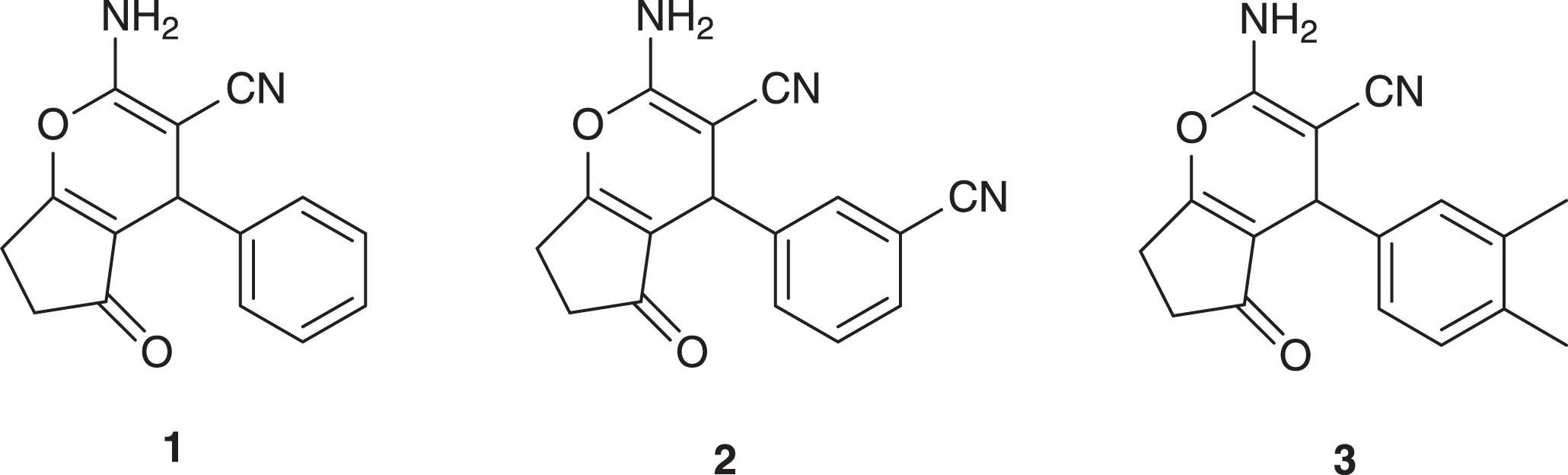
Pyran derivatives are one important class of heterocyclic structures found in many synthetic and natural occurring products, and have received considerable attention in recent years due to their remarkable spectra of biological activities, such as antibacterial, antifungal, anticonvulsant, anti-inflammatory, antimicrobial, herbicidal, and antitumor properties [5]. Based on the above considerations, and in a continuation of our interest in the synthesis of pyran derivatives with anticancer activity, the objective of this study was to synthesize a new series of pyran (
Chemical structures of compounds
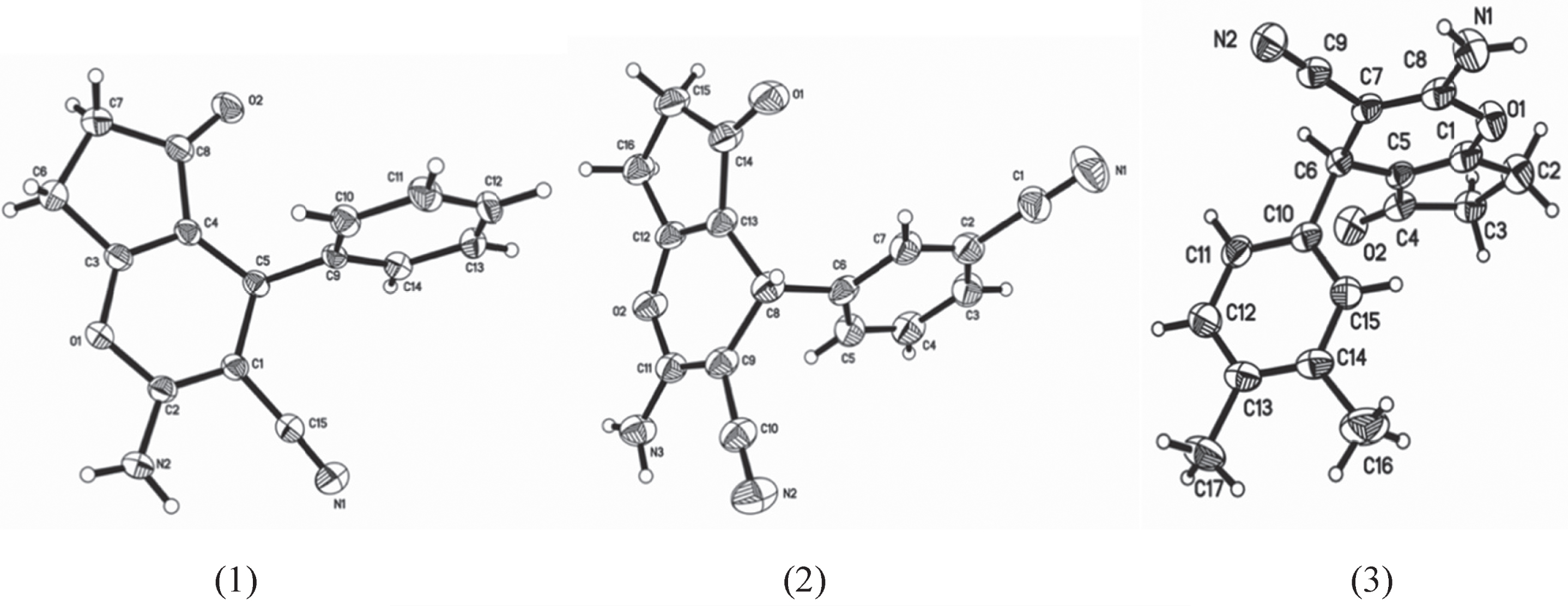
Molecular structural unit for compounds
Apparatus and materials
IR spectra (400–4000 cm–1) were obtained using a Brucker Equinox-55 spectrophotometer. 1H NMR spectra were obtained using a Varian Inova-400 spectrometer (at 400 MHz). Mass spectra were obtained using a micrOTOF-Q II mass spectrometer. The melting points were taken on a XT-4 micro melting apparatus, and the thermometer was uncorrected.
Synthesis and characterization of compounds 1–3
Compounds
2-Amino-5-oxo-4-phenyl-4,5,6,7-tetrahydro-cyclopenta[b]pyran-3-carbonitrile (
2-Amino-4-(3-cyano-phenyl)-5-oxo-4,5,6,7-tetrahydro-cyclopenta[b]pyran-3-carbonitrile (
2-Amino-4-(3,4-dimethyl-phenyl)-5-oxo-4,5,6,7-tetrahydro-cyclopenta[b]pyran-3-carbonitrile (
Crystal structure determination
Suitable single crystals of compounds
Crystal data and structure refinements for compounds 1 –3
Crystal data and structure refinements for compounds
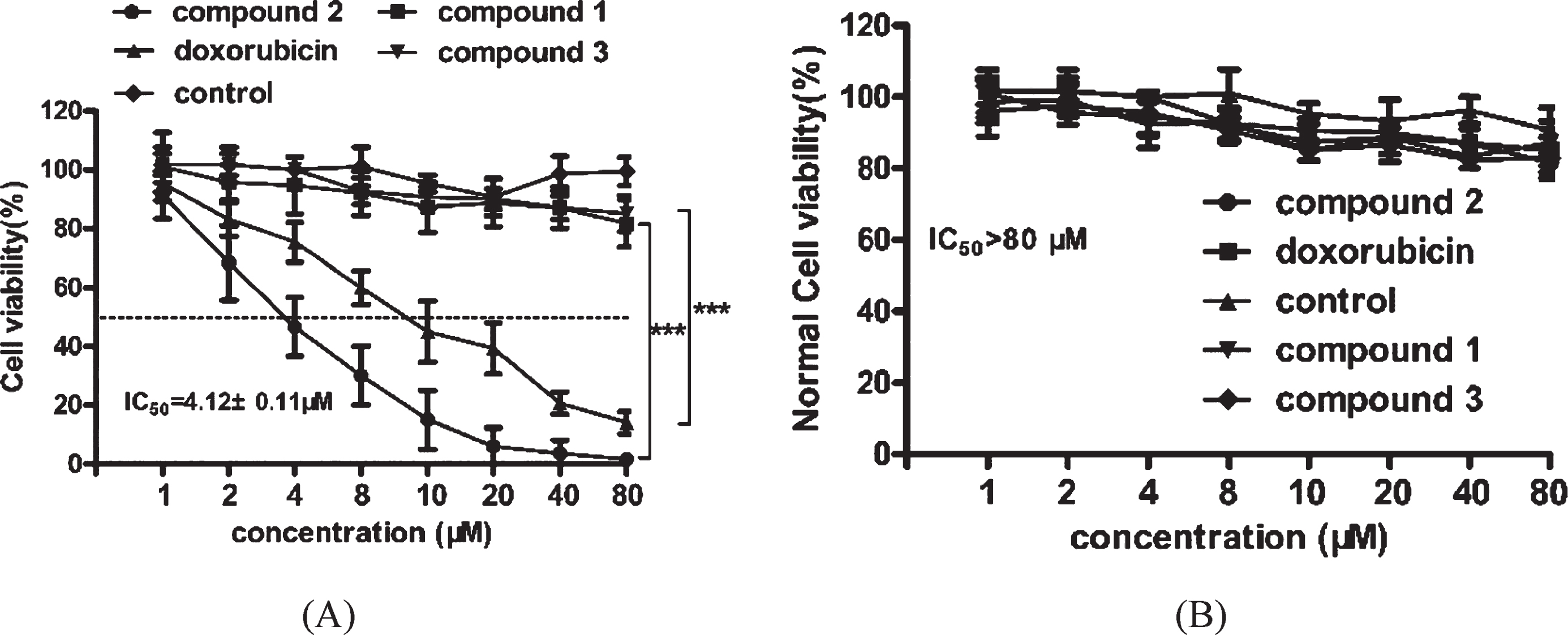
To detect the anti-proliferation activity of compounds
RT-PCR
After treated with compounds
Simulation details
Autodock Vina v1.2 has been utilized to study the binding mode of compounds
Results and discussion
Molecular structure
The structures of the three compounds were measured by X-ray diffraction crystal structural analysis. The results revealed that compounds
The three molecular structural units of the compounds
Moreover, the three compounds all exhibited layered supra-molecular structures under the interactions of hydrogen bonds. The N–H⋯O, N–H⋯N and N–H⋯O, N–H⋯N, N–H⋯O and O–H⋯O hydrogen bonds could be found in the packing structure of the compounds
Hydrogen-bond geometry (Å, °) for compounds 1 –3
Hydrogen-bond geometry (Å, °) for compounds
We selected the single crystals of compounds
Reduced proliferation activity of human ovarian cancer cells CAOV3 and normal cells after compounds treatment. The human ovarian cancer cells CAOV3 and normal cells were seeded into 96 well plates and treated with compounds
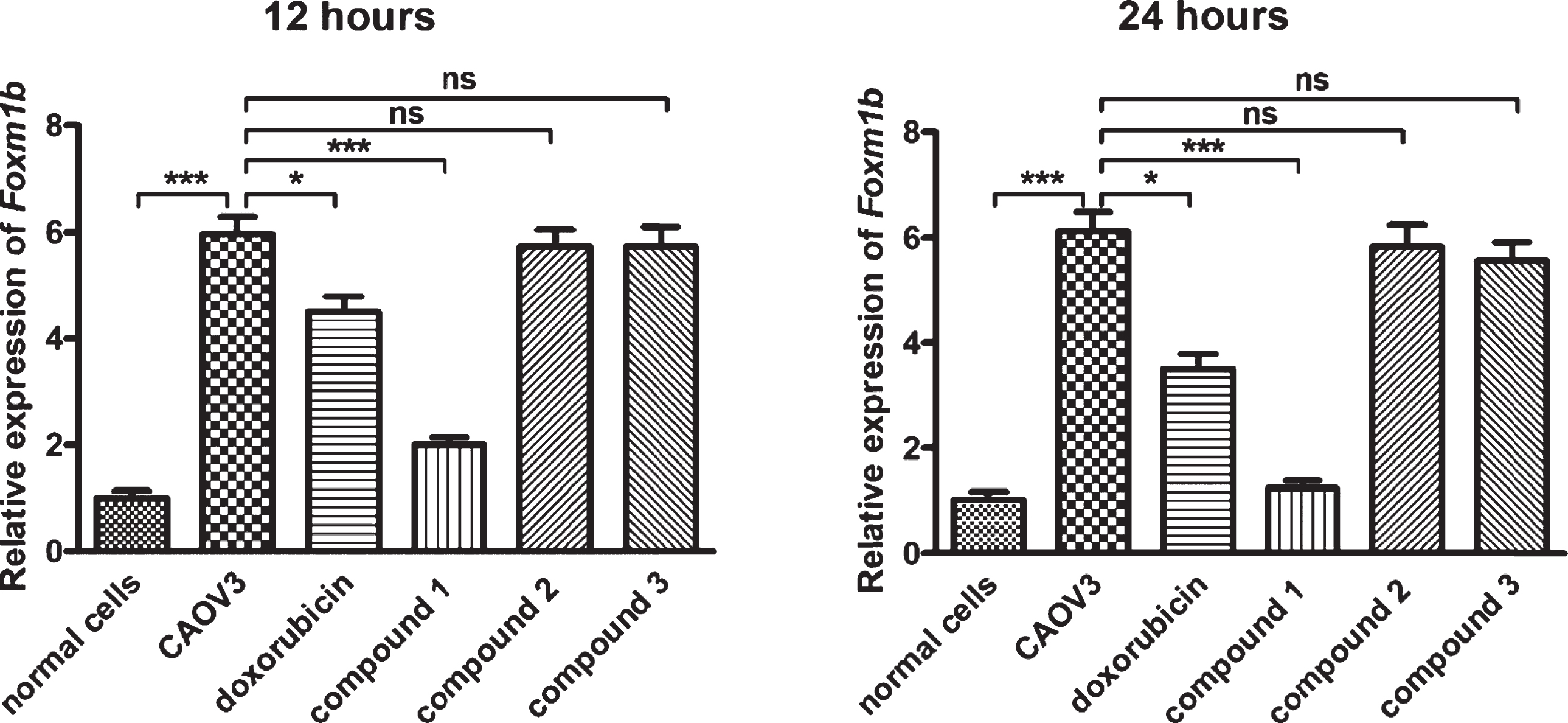
In the previous research, we have confirmed the excellent inhibitory effect of compounds on the CAOV3 human ovarian cancer cells proliferation. And the previous researches indicated that the Foxm1b plays a vital important role in the CAOV3 human ovarian cancer cells. Thus, to explore the specific mechanism of the compound on CAOV3 human ovarian cancer cells, the relative expression level of the Foxm1b in the CAOV3 human ovarian cancer cells was measured with RT-PCR. From the results showed in Fig. 3, after compound

Inhibited expression level of the Foxm1b in the CAOV3 human ovarian cancer cells after compounds treatment. The human ovarian cancer cells CAOV3 were seeded into 96 well plates and treated with compounds
The molecular docking measures the potential interactions between chemical compounds and protein receptor, as well as the corresponding strength. Such interactions are generally formed between either polar atoms (oxygen, nitrogen and chloride, etc.) on ligand or on protein to the polar hydrogens on the protein or on the ligands. Before doing the autodocking calculation the quantum chemistry calculation has been performed to provide the stable structure, as a starting point, the structure from the X-ray measurement has been optimized by density functional theory under the B3LYP/6-31 g* theory of level. The comparison between experiment and calculation has been shown in Table 3 for selected structural parameters. As can be seen from the results, the maximum deviation for bond is 0.02 angstrom, the maximum deviation for angle is a little large which is about 3 degree, for dihedral the deviation is significant (about 15 degrees), such large deviations for angle and dihedral can been attributed to the different constrains in experiment and calculation, for experiment, each molecule is surrounded by neighbouring molecules while in calculation only single molecule has been considered in the gas phase. Considering during the autodock calculation, only single molecule will be inserted into the receptor protein, so the optimized structure from DFT calculation will be used as the input configuration for the autodock calculation.
Comparison of selected structural parameters between C-ray measurement and DFT calculation for compound 1 , the DFT calculation was implemented in the gas phase without constrains
Comparison of selected structural parameters between C-ray measurement and DFT calculation for compound
A maximum number of binding modes has been set as 25 for the autodock calculation, the lowest affinity energies are –5.7, –6.3 and –6.1 kcal/mol for the three compounds. The results can be rationalized by the compound and receptor protein have different binding strengths. As shown in Fig. 4, all three compounds could form polar interactions, the polar interaction presented by compound
The polar interactions of compounds
We have synthesized and evaluated the anti-tumor activity of pyran derivatives