




Abstract
Potassium borates are one of the minor groups of boron minerals with its distinct non-linear optical properties. In this study, potassium borate compound of santite (KB5O8·4H2O) are synthesized using potassium carbonate (K2CO3) and boric acid (H3BO3) with a new and rapid method of microwave irradiation. The synthesized minerals are characterized by various analysis techniques of X-ray diffraction (XRD), Raman spectroscopy and scanning electron microscope (SEM). Three parameters of “microwave power level”, “reaction times” and “reaction stoichiometric constants (elemental potassium to boron ratios)” are determined for the optimum synthesis of potassium borate within the four step. At the end of the step 4, optimum products are obtained as santite type potassium borate. Synthesized potassium borates Raman bands are in mutual agreement with the boron compounds and the overall reaction yields to potassium borates are very high compared with the lower reaction times.
Introduction
The boron reserves of the world are majorly located in Turkey, Russia and USA. The total amount of these reserves are known as 1.2 billion tons, 72.2% of which is present in Turkey, 8.5% in Russia and 6.8% in USA. Boron is used in many fields in the industry. The main ones are glass, detergent industry, glaze and enamel, flame retardants, agriculture and metallurgy [1, 2].
Potassium borate minerals are found in small quantities in nature and basically divided into two types: potassium tetraborate (K2B4O·4H2O) and potassium pentaborate (KB5O8·4H2O). K2B4O·4H2O has wide use in contact lenses, glass industry and oil additives. KB5O8·4H2O, on the other hand, leads the conversion of laser radiation into ultraviolet rays with its distinct non-linear optical properties [3–5]. KB5O8·4H2O crystals are colorless, optically biaxial and chemically stable. Because of these optical and chemical properties, they are used in many research and applications.
Boron minerals can be produced by two different methods of hydrothermal and solid-state syntheses. The hydrothermal synthesis is based on the dissolution of the any salt and boron sources separately in a liquid medium inside the reactor, and the start of the reaction with the aid of temperature. The reaction takes place in the reactor filled with liquid and the hydrated borates can be produced accordingly [6–9]. In the Solid-state method, the boron and salt sources are mixed homogeneously at their solid form, and then they react with each other at a high temperature furnace in an air atmosphere [10–12]. In the microwave method which used in this study can be included in the solid-state method, the boron and potassium sources are mixed homogeneously at their solid form, and then they react with each other at a microwave furnace in an air atmosphere [10].
Among the boron minerals, magnesium borates [6, 8], copper borates [7] and zinc borates [9] can be given as examples of hydrothermal synthesis and dehydrated magnesium borates [10], magnesium-type boracite [11] and lanthanum borates can be given as examples of solid-state synthesis. In the literature only a few studies were conducted for the synthesis of potassium borates [2, 13–18]. Despite the few studies of hydrothermal and solid-state synthesis of potassium borates, it is seen that the microwave synthesis of potassium borates was not studied in the literature. In this study, the rapid production of crystalline potassium borates, where the novelty come from the synthesis method, is aimed with the method of microwave energy. After the synthesis, the samples were characterized by using the techniques of X-ray diffraction (XRD), Raman spectroscopy, scanning electron microscopy (SEM) and reaction yields were also calculated.
Experimental
Preparation and identification of the reagents
Potassium carbonate (K2CO3) 99% purity, which is used as a source of potassium in synthesis studies, was obtained from Sigma-Aldrich (Sigma-Aldrich Chemie GmbH, Taufkirchen, Germany) and used in synthesis without pre-treatment. On the other hand, boric acid (H3BO3) 99.9% purity, which is used as a source of boron was obtained from Bandırma Boron Works (Eti Maden, Balıkesir, Turkey) was prepared for synthesis by passing through the crushing, grinding and sieving stages respectively. The grain size below 75μm (above 200 mesh) was used. Obtained raw materials are identified by PANalytical Xpert Pro (PANalytical B.V., Almelo, The Netherlands) X-ray diffractometer (XRD), which has a Cu-Kα tube, with the operating parameters of 45 kV and 40 mA.
Microwave synthesis of magnesium borate hydrates
The prepared raw materials are pelleted with Manfredi brand OL57 (Manfredi S.r.l., Torino, Italy) model hydraulic press apparatus under 100 bar pressure prior to mixing homogeneously and the pellets are taken on the watch glasses and reacted in the microwave oven with an 800 W maximum output working at 2450 MHz (Robert Bosch Hausgerate GmbH, Munich, Germany).
These syntheses are made through 4 steps. As a first step, the potassium: boron elemental
mole ratio (K:B) is taken 1:5 as theoretical expected reaction stoichiometric constant
given in Eq (1). Then experiments are carried out with 180, 360 and 600 W power with the
reaction times of 2, 5 and 8 minutes.
After finding the optimum power and time, in the second step mole ratio scanning is done with the model ratios between 1:2 and 1:8. In the third stage, a wider interval of time between 2 to 12 in 180 W, 1 to 8 in 360 W and 1 to 5 in 600 W, is scanned using the optimum mole ratio determined in stage 2. At the fourth and the last stage, the products of the optimum mole ratio, power and time are purified by using 96% purity ethyl alcohol, and for the removal of excess of boric acid, which was not reacted in the synthesis. Used ethyl alcohol purified from the unreacted boric acid by using a rotary evaporator (Laborota 4000 efficient; Heidolph Instruments GmbH & CO. KG, Germany).
Reaction yield based on moles, the overall yield,
Y
D
, is defined as the ratio of moles of
product formed at the end of the reaction,
N
D
, to the number of moles of limiting
reactant, A, that have been consumed. NA0 and
N
A
are the initial and final moles of
consumed reactant, respectively. For a batch system [19]:
Using K2CO3 as limiting reactant, three parallel syntheses were conducted as average reaction yields were calculated.
To identify the synthesized potassium borate minerals, XRD, and Raman Spectroscopy techniques are used. XRD parameters were set as in previously mentioned in the “Preparation and identification of the reactants” section. After XRD, obtained samples are analyzed with Raman spectroscopy technique for the specific bands of the samples under the visible region with the parameters of 4 second experiment period and 4 repetitions in the range of 1800 cm–1 - 250 cm–1 on the Perkin Elmer Raman Station 400F (PerkinElmer, MA, USA).
For surface morphology analysis of the synthesis products, the Hitachi TM3030Plus SEM device (Hitachi Ltd. Corporation, Tokyo, Japan) is used. Analyzes were made at 15 kV and imaging and magnifications rates were 1000, 5000 and 10000.
XRD scores of the step 1 and 2 synthesized potassium borates
XRD scores of the step 1 and 2 synthesized potassium borates
 = Sassolite, pdf # = 01-073-2158,
H3BO3.
= Sassolite, pdf # = 01-073-2158,
H3BO3.  = Santite, pdf # 01-072-1688,
KB5O8.4(H2O).
= Santite, pdf # 01-072-1688,
KB5O8.4(H2O).
X-ray diffraction results of raw materials and synthesized products
XRD results of raw materials are showed that, the potassium carbonate used consists of three different powder diffraction file (pdf) coded of “00-016-0820”, “00-049-1093” and “01-087-0730” potassium carbonates with the same formula of K2CO3. Boron source of boric acid is identified as sassolite with pdf no of “01-073-2158” with the formulae of H3BO3.
XRD scores (when all of the peak intensities (%) and peak locations matched perfectly with the pdf card number of reference mineral, the XRD score of analyzed mineral is equal to 100) [11] of the syntheses in the first and the second step and the third and the fourth step for the synthesis of potassium borate by using microwave method are given in Table 1 and Table 2, respectively.
XRD Scores of the Step 3 and Step 4 Synthesized Potassium Borates
XRD Scores of the Step 3 and Step 4 Synthesized Potassium Borates
= Sassolite, pdf # = 01-073-2158,
H3BO3. = Santite, pdf # 01-072-1688,
KB5O8.4(H2O).
In the first stage of syntheses, where K:B ratio of 1:5 was used as constant and reaction times are varied as 2, 5 and 8 min, with three different power levels of 180, 360 and 600W, it is seen that the crystal product of santite is synthesized with the formulae and pdf no of “KB5O8·4(H2O)” and “01-072-1688”, respectively at 180 and 360 W power. The product of santite is the same product obtained by Asensio et al. (2016) [2], where the detailed crystallographic data of Santite is given in Table 3. Moreover, the crystal products contained excess sassolite with the pdf no of “01-073-2158”. The highest XRD score for 180 W was 66 in 8 minutes and 67 in 5 minutes for 360 W. At 600 W power the product turned to amorphous phase. In the second stage, where power was selected 360 W and time was selected as 5 min as constants, K:B ratios were varied between 1:2 and 1:8, the best XRD score is obtained as 67 when potassium: boron mole ratio was taken 1:5.
Crystallographic data of Santite [2]
In the third stage of experiments, where K:B ratio was taken as constant of 1:5, santite is synthesized with excess sassolite as occurred in the first and the second step. The highest XRD scores for 180 and 360 W are obtained in 12 minutes and 5 minutes with the values of 75 and 67, respectively. Again in 600 W amorphous formations is observed. In the fourth stage of the experiments, which is the purification stage, the highest XRD scores is obtained as 79 and 78 at 180 W –12 minutes and 360 W –5 minutes, respectively. The XRD patterns of step 4 products are given in Fig. 1.
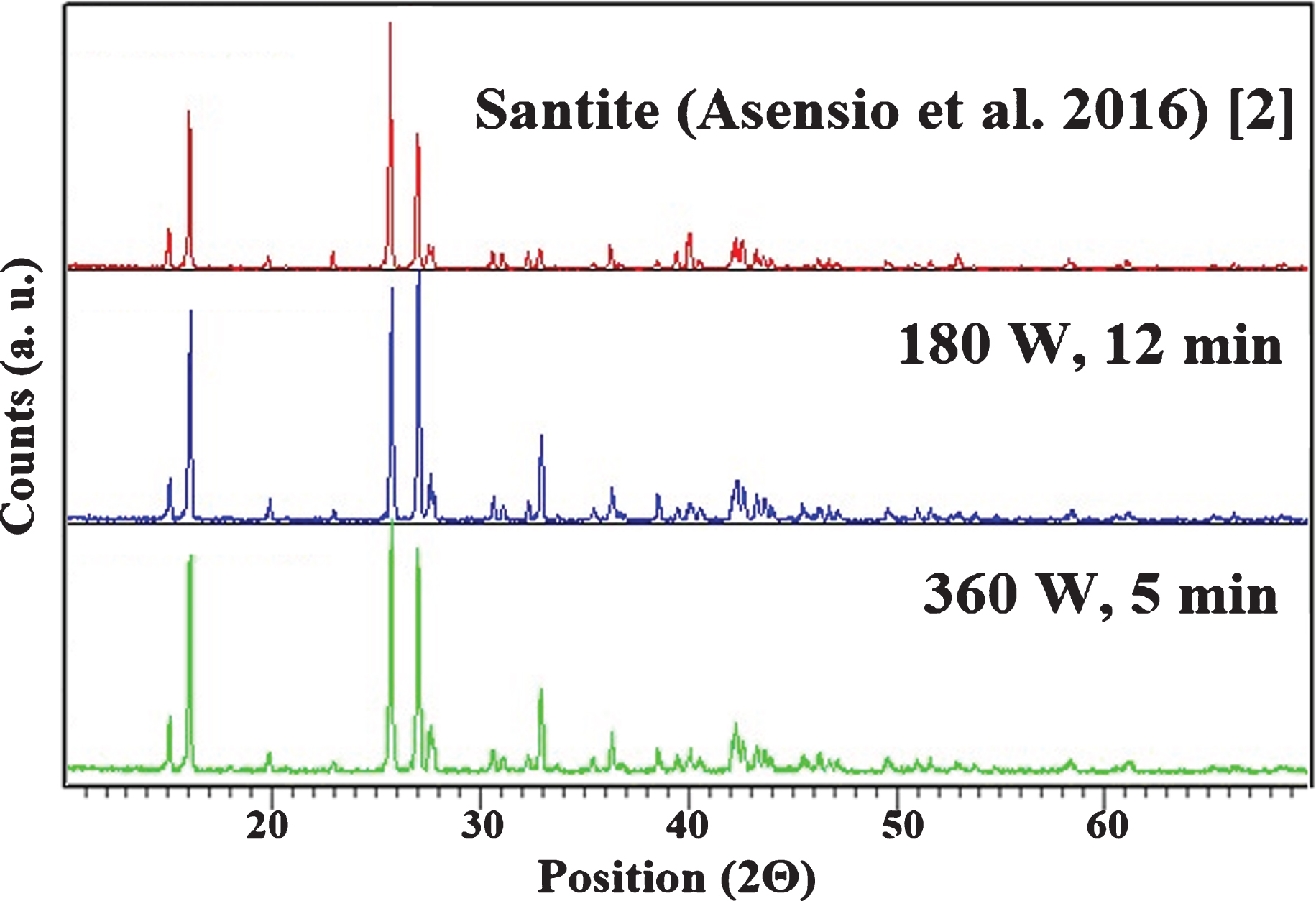
XRD patterns of the optimum synthesized and purified potassium borates.
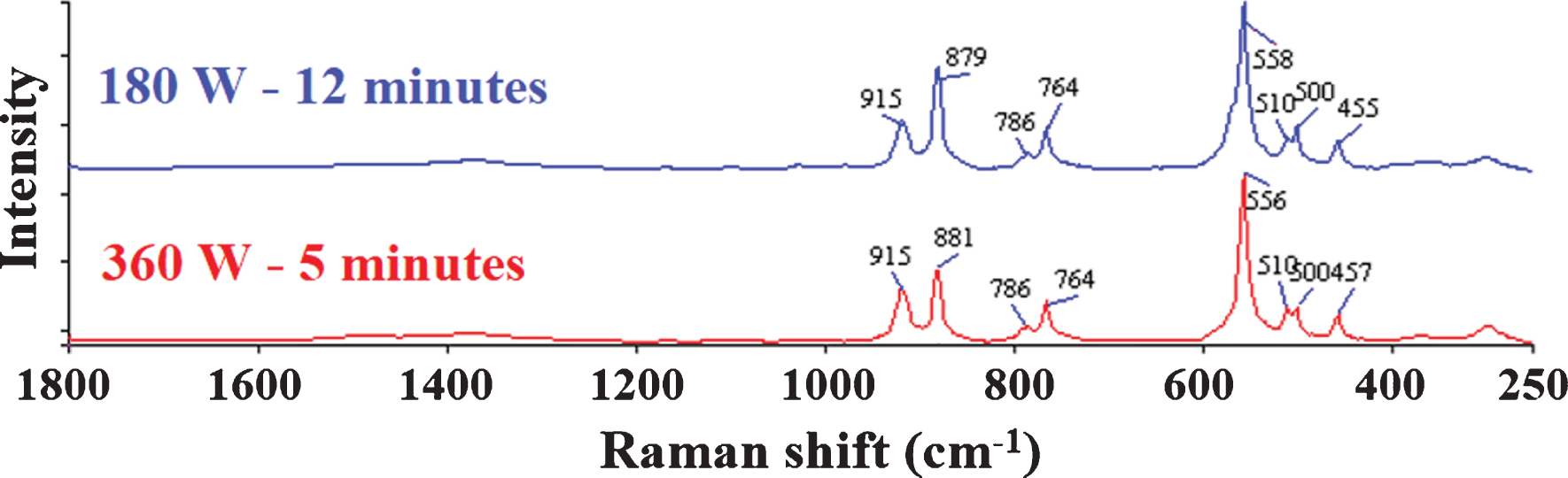
Raman spectroscopies of the optimum synthesized and purified potassium borates.
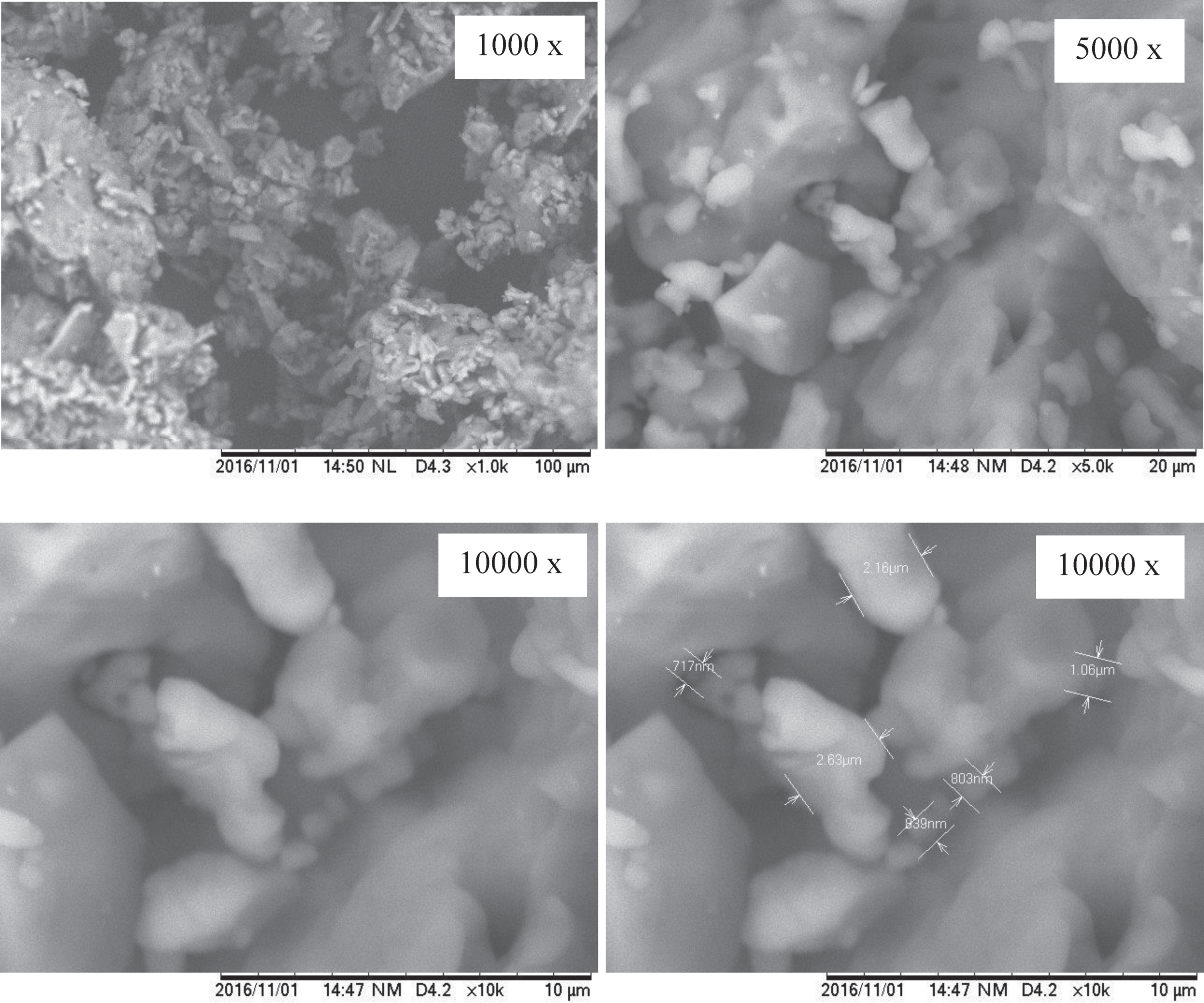
SEM morphologies of the optimum synthesized and purified potassium borate at 180 W –12 minutes.
Raman spectroscopies of the synthesized and purified potassium borates at 180W –12 min and 360 W –5 min are given in Fig. 2. According to the spectra the peaks between 915 to 879 cm–1 corresponds to the three coordinated symmetrical stretching of boron to oxygen [νs(B(3)-O)] bands. Four coordinated symmetrical stretching of boron to oxygen [νs(B(4)-O)] bands are obtained at the peaks between 786 to 764 cm–1. The bands between 558 to 556 cm–1 corresponds to the tetraborate anion, which includes two BO3 planar triangles and two BO4 tetrahedrons [νp[B4O5(OH)4]–2]. The peaks between 512 to 500 cm–1 is the band of composed of two six-member rings which consist of two BO3 planar triangles and one BO4 tetrahedron [νp[B5O6(OH)4]-]. Bending of four coordinated boron to oxygen bands are seen at the peaks between 457 to 455 cm–1. Obtained band were in mutual agreement with the study of Asensio et al. (2016) [2].
SEM images of the optimum synthesized and purified potassium borate obtained at 180 W and 12 min reaction time is given in Fig. 3. According to the image obtained the particles have partly soft and rectangular edges, some particles are agglomerated and the particles sizes are changed in between 717 nm to 2.63μm.
Overall potassium borate yields are obtained after the excess boric acid amounts purified and found as, 69.2±0.8% and 65.5±0.7% at 180 W –12 minutes and 360 W –5 minutes’ reaction times, respectively.
Conclusions
In this study, from the raw materials of K2CO3 and H3BO3 a potassium borate compound of, santite (KB5O8·4H2O) was synthesized via microwave method. Several microwave power levels were studied along with the several reaction times and reaction stoichiometric amounts of potassium to boron (K:B) for the best crystal formation. The synthesized potassium borate compounds are characterized by XRD and Raman spectroscopy techniques and the compound’s XRD pattern and Raman spectroscopy were in mutual agreement with the study of Asensio et al. (2016). From the SEM images that the particle size of the compound obtained was in between 717 nm to 2.63μm. Moreover, overall potassium borate yields are found between 69.2±0.8% and 65.5±0.7%, which was a high value compared with other synthesize methods even such a lower reaction times.