



Abstract
Various classes of molecules like diethers, succinates, diesters, amido esters are currently being used as internal donors on MgCl2 supported titanium catalysts for isotactic polypropylene as an alternative to phthalate donors owing to their potential health risk laid down by REACH legislation. In the present paper, design and synthesis of a few novel amido ester internal donors with single chiral center
Introduction
Ziegler Natta (ZN) catalyst with MgCl2 support is one of the most demanding catalysts for the industrial production of polyolefins especially Polypropylene (PP) [1–3]. PP considering the largest demanded polyolefin due to their varied characteristic features like stiffness, transparency, impact resistance are generally applied for market segments like packaging materials, automotive, moulded products etc [4–6]. Despite considerable attention being paved by researchers towards their development by the homogenous system, the industrial production of polyolefin was mainly triggered by a heterogeneous system. Many reports were well documented that improved stiffness (measuring isotacticity) of PP which was brought by the introduction of electron donors in the supported ZN system with MgCl2 as support and TiCl4 as catalytic center [7–10]. MgCl2 surface has two unsaturated acidic sites; stereospecific 104 plane and also 110 plane, which is aspecific and imparts atacticity PP [11–13]. Two types of Lewis base (LB) electron donors played a significant role in improving the PP isotacticity (from 40% to nearly 98–99%) for the supported ZN system. The LB acting as an internal donor (ID) is typically added during the catalyst preparation and it is well understood that these donors co-adsorb nearby to open surface Ti leading to sufficient steric hindrance to Ti centers for enhancing the isotacticity by discriminating two enantiofaces of propene molecule in the insertion step [14–16]. The other LB acting as an external donor (ED) is added during the polymerization process to cover the MgCl2 sites where the ID leached out with strongly acidic co-catalyst (trialkyl aluminium) [17–19].
Currently, industrial research on ID is mainly focusing on developing phthalate-free type PP catalysts since the PP from the phthalate class of donors is carcinogenic. In this regard, many classes of non-phthalate based IDs covering succinate esters [20–22], diethers [23–25], amido esters [26–28], malonates [29, 30], glutarates [31], silyl diol esters [32] etc. are explored. It is observed that the catalyst with a different class of IDs prevails with varied features on the polymer formed. For example, diether bonds typically on 110 planes of MgCl2 by chelating mode, and in general exhibits narrow molecular weight distribution(MWD) while the diester class of molecules tend to bind to both unsaturated 104 and 110 sites through bridging mode leading to medium MWD [33, 34]. Among the ester classes, amido ester
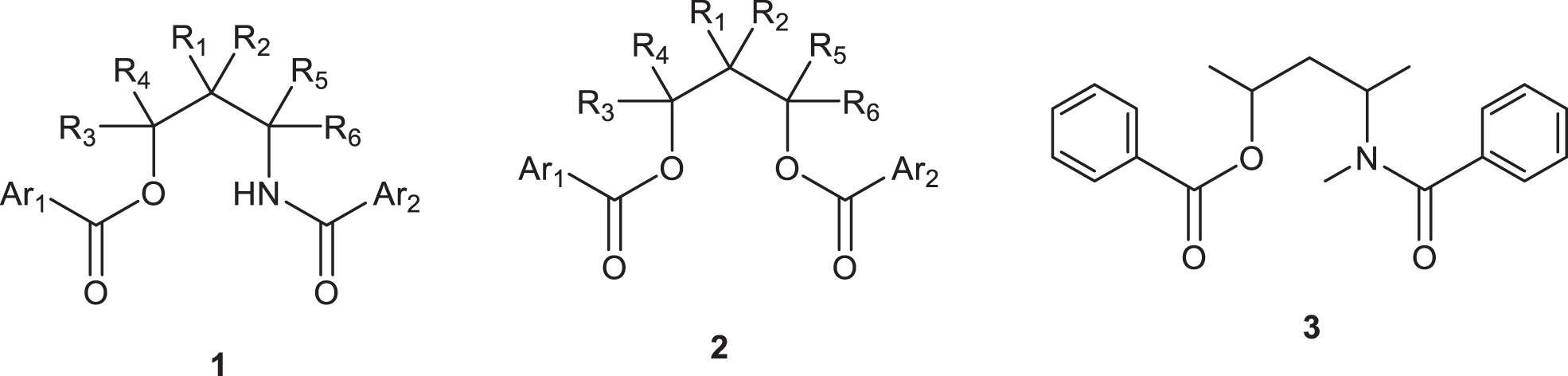
Representative structure of internal donors
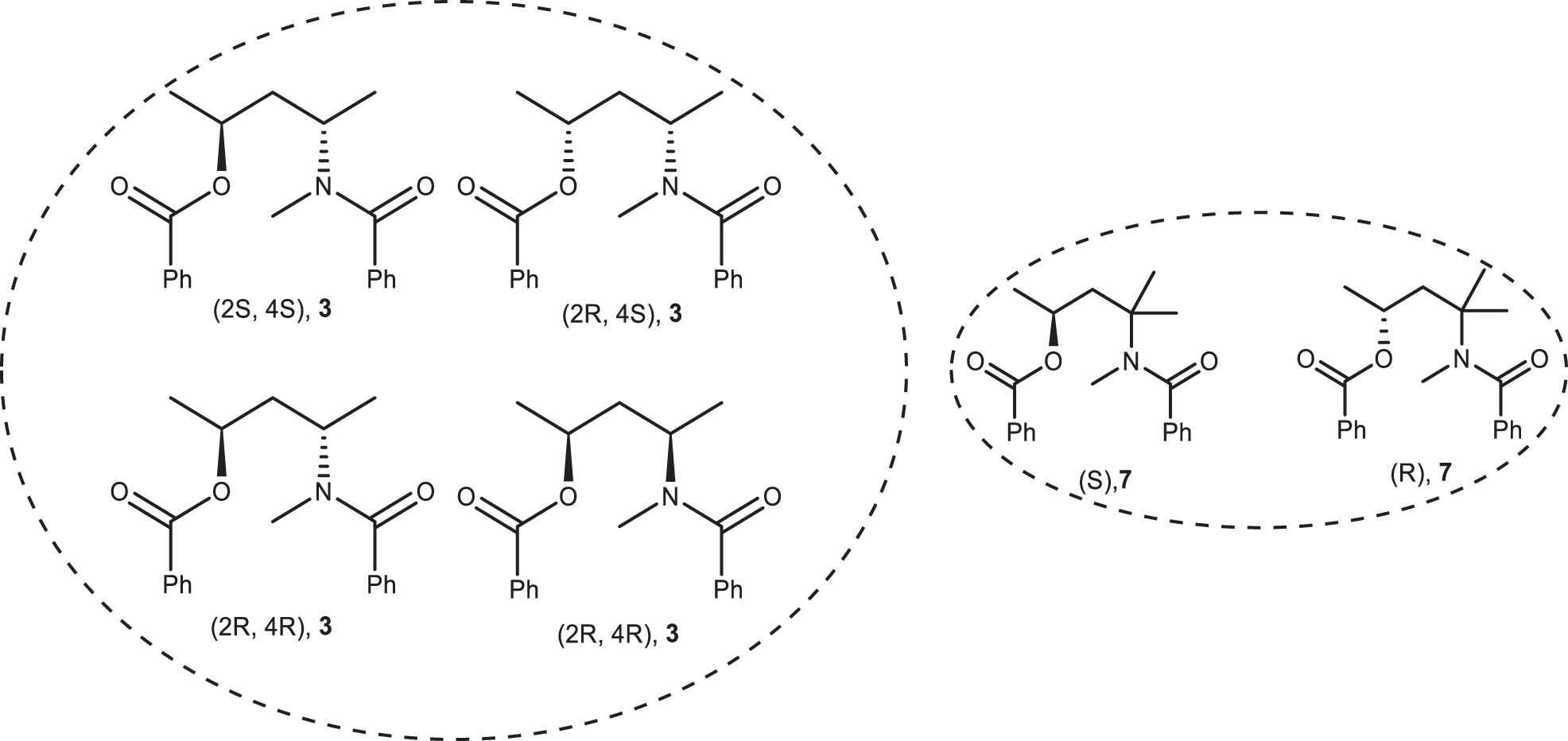
Isomeric species of internal donors
The paper also briefly described the supported ZN catalyst preparation with TiCl4 and MgCl2 support with the presented donors and subsequent evaluation for iPP.
Our research on ID
All these molecules were synthesized by an easy two-step protocol starting from α-enone (mesityl oxide) as given in
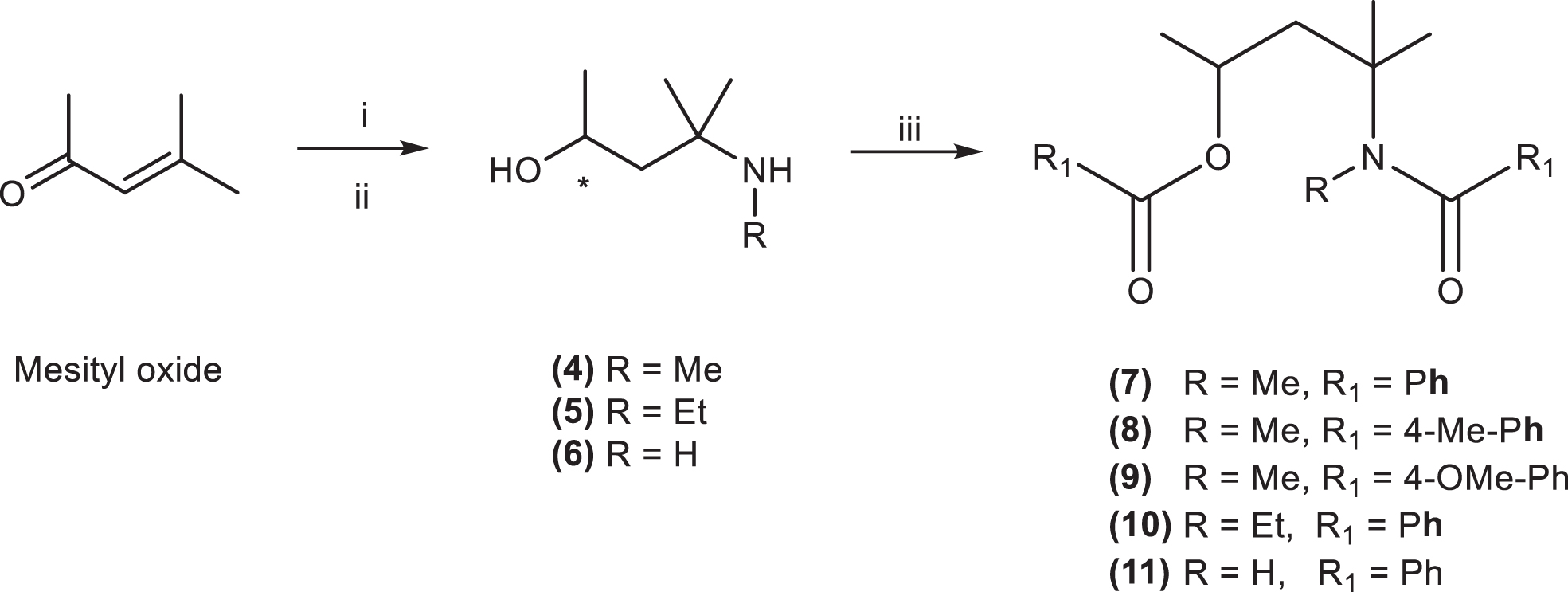
Synthetic scheme for amido esters: i) RNH2, –5°C-RT, 15 h ii) Ni/Al alloy, NaOH (25%) , 10°C-RT, 18 h iii) R1COCl, DMAP, TEA, 10°C RT, 15 h.
These molecules were applied as ID for the catalyst preparation. The ID incorporated MgCl2 support was prepared by reacting butyl magnesium support [36] with TiCl4 and ID in chlorobenzene with the aid of activating agent N, N-dimethyl benzamide at 115°C by employing BA/Mg ratio and ID/Mg ratio as 0.1 mol/mol and 0.15 mol/mol respectively. After decanting the solvent, the TiCl4 addition process was repeated three times.
All the prepared catalysts were evaluated for propylene polymerization with the aid of ED; diisobutyl dimethoxy silane (DiBDMS, Si/Ti: 11.3 mol/mol) and triethylaluminium as co-catalyst (Al/Ti: 160 mol/mol). It was found that only
Gas-Phase propylene polymerization of prepared supported ZN catalyst
Polymerization temperature: 70°C, Polymerization time: 1.0 h, cocatalyst used: TEAL: Al/Ti: 160 mol/mol, ED used: DiBDMS: Si/Ti: 11.3 mol/mol, propylene pressure: 24 bar H2/C3 (mol%) : 1.0%. *Weight of catalyst: 10 mg.
All the newly synthesized IDs
Materials and methods
All reagents and solvents were laboratory grade chemicals purchased from Sigma Aldrich, SD Fine Chem and were used without additional purification. 1H and 13C NMR spectra were recorded on Bruker 300 MHz (300 and 75 MHz, respectively) and Agilent 600 MHz (600 and 150 MHz respectively) spectrometers in CDCl3 containing 0.05% Me4Si as the internal standard. Column chromatography was carried out on silica gel (200–400 mesh). Purity analysis of intermediates was performed on GC (Agilent 7890) with FID detector using Agilent HP-5-, 30 m×0.320 mm (Internal diameter)×0.25μm thickness fused silica capillary column. Mass analysis of intermediates and final donors were performed on GCMS; Thermo scientific, ITQ 1100, Trace GC ultra with AI 3000 injector and LCMS; Waters 2695 separation module, with 2996 photodiode array detector, ESCi multimode ionization injector respectively. Xylene soluble measurement: reflux in xylene, cooled to 15°C, filtered, solvent evaporation (ASTM D5492 eq. to ISO 16152).
TiCl4 was purchased from Alfa Aesar (99%) , chlorobenzene was purchased from Sigma Aldrich (99.9%) and dried with molecular sieves (4Å). Dry n-heptane was used as such from the solvent purification system and always degassed before use by bubbling dry nitrogen through the liquid. N, N-dimethyl benzamide was purchased from Alfa Aesar (98% purity).
Polymerization grade propene was obtained from the PP plant, (Sabic, Geleen, Netherland). The contents of critical impurities (CO, COS) were less than 10 ppb, water and oxygen levels were under 1 ppm. Triethyl aluminium (TEAL), a co-catalyst was purchased from Sigma Aldrich (99% purity). n-Heptane was purchased from Aldrich (99% spectrophotometric grade). Before the polymerization, the removal of water and oxygen was conducted inside the reactor by stripping. About 10% of the heptane was stripped-off by high-purity nitrogen (70°C, 40 min) to remove H2O and O2. The contents of O2 and H2O in the nitrogen were under 0.5 ppm. Butyl support was prepared according to the literature method [36].
Synthesis and Characterization
General procedure for the amino alcohol (4–6)
Mesityl oxide (1 eq) was cooled to 10°C To this, aq. solution of alkyl amine (1.1 to 1.45 eq.) was gradually added and stirred overnight at 20–25°C. To the aminoketone so formed, 25 wt% aq. NaOH solution (10.70 eq) was added at 10–15°C. Ni/Al alloy (2.85 eq) was gradually added to the resulting mass at 10–15°C in about 2–3 h. After the addition of Ni/Al alloy, the reaction mass was stirred at room temperature overnight. It was filtered over a high flow bed and the cake thus obtained was washed twice with dichloromethane (250 mL×2). Organic layers were separated and the combined organic layer was dried over anhydrous sodium sulphate and concentrated under reduced pressure to get the crude amino alcohol. Crude amino alcohol was further purified by fractional vacuum distillation (60–80°C, 0.5 bar) to obtain the pure product
4-Methyl-4-(methylamino)pentane-2-ol (4). Mesityl oxide (30 gm, 0.3 mol), 40 wt% aq solution of methylamine (25.6 gm, 0.33 mol), 25 wt% aq. NaOH solution (513 mL), Ni/Al alloy (72.6 gm, 0.85 mol).
Yellow oil;
4-(Ethylamino)-4-methyl pentane-2-ol (5). Mesityl oxide (30 gm, 0.30 mol), 70 wt% aq solution of ethylamine (23.2 gm, 0.36 mol), 25 wt% aq. NaOH solution (513 ml), Ni/Al alloy (72.6 gm, 0.8 mol).
Yellow liquid;
4-(Amino)-4-methyl pentane-2-ol (6). Mesityl oxide (30 gm, 0.30 mol), 25 wt% aq. solution of ammonia (29.6 gm, 0.43 mol), 25 wt% aq. NaOH solution (513 ml), Ni/Al alloy (72.6 gm, 0.85 mol).
Pale yellow liquid;
General procedure for the synthesis of amido-esters (7–10)
To a stirred solution of amino alcohol
4-Methyl-4-(N-methylbenzamido)pentan-2-yl benzoate (7).
Pale Yellow liquid,
4-(N, 4-dimethylbenzamido)-4-methylpentan-2-yl 4-methylbenzoate (8).
Pale Yellow oil,
4-(4-Methoxy-n-methylbenzamido)-4-methylpentan-2-yl 4-methoxybenzoate (9).
White solid,
4-(N-ethylbenzamido)-4-methylpentan-2-yl benzoate (10).
Pale yellow low melting solid,
Procedure for the synthesis of 4-Benzamido-4-methyl pentane-2-yl benzoate (11). To a stirred solution of 4-amino-4-methyl pentane-2-ol (6) (10 gm, 0.085 mmol) in dichloromethane (70 mL) was added pyridine (20.2 gm, 0.25 mol), and the reaction mass was cooled to 0 to 5°C. To this, a solution of benzoyl chloride (25.0 gm, 0.18 mmol) in dichloromethane (30 mL) was slowly added in 15 min. After addition, the reaction mass temperature was slowly raised to room temperature and stirred for 15 hrs. The reaction mass was quenched in water (250 mL) and extracted with dichloromethane (100 mL). The organic layer was separated, washed with water (150 mL), dried over anhydrous sodium sulphate and concentrated on rota vapour under reduced pressure to give the crude material which was purified by column chromatography using hexane to hexane/EtOAc as eluent to obtain
White solid,
Synthesis of supported ZN catalysts (3’, 7’-11’)
TiCl4 (250 mL) was added to the reactor and heated to 100°C. Butyl-support [36] (5.5 gm) in heptane (30 mL) was added to the reactor while stirring. The temperature was raised to 110°C and N, N’-dimethyl benzamide (BA/Mg=0.15, 5.7 mmol, 1.71 gm) in 3 mL of chlorobenzene followed by ID (ID/Mg=0.10, 3.8 mmol) in 2 mL of chlorobenzene were added. 5) The temperature was raised to 115°C and was maintained for 90 min. The supernatant fluid was decanted after settling and the solid residue was washed with chlorobenzene (100 mL) at 100°C. The supernatant fluid was decanted after settling. A mixture of TiCl4 (125 mL) and chlorobenzene (125 mL) was added and heated up to 115°C; the temperature was kept for 30 min under stirring. The supernatant fluid was decanted after settling and this operation was repeated two more times. The solid residue was washed with heptane (125 mL×6). The catalyst was dried and stored under nitrogen (Yield: 3.5–4.5 gm).
Propylene polymerization process
Solutions of both the co-catalyst (triethylaluminium (1.219 M in heptane); Al/Ti 160) and ED (DiBDMS (0.162 M in heptane), Si/Ti: 11.3) were added to the reactor with nitrogen-flushed pipettes at ambient temperature and ambient pressure. The amount of heptane was adjusted to be 3 mL in total. Then approx. 100 gm of propylene/hydrogen mixture (99 vol.% propylene, 1 vol.% hydrogen, viz. a 1 vol.% hydrogen pressure) was dosed to the reactor after which the reactor was heated to 50°C. A suspension of catalyst (5 mg of a 14.6 wt.% suspension in mineral oil) mixed with approx. 5 gm of inert homo-PP powder was dosed to the reactor by a 16 bar liquid propylene flow. After 1 min, the temperature and pressure were slowly increased to 70°C and 24 bar over 10 min. After this, all conditions were kept constant for one hour. After 1 h the reactor was vented to 15 bar within 2 min, the stirrer was turned off and the reactor was cooled down and vented to ambient conditions within 1–2 min. At ambient conditions, the reactor was opened and the polymer was collected.
Conclusion
A new family of amido esters with the single chiral center in the backbone was synthesized via the two-steps method by mimicking the structural motif of
Footnotes
Acknowledgments
The authors gratefully acknowledge Martin Zuideveld, Nicole Weekers (SABIC, Netherlands) for supporting catalyst preparation and polymerization studies.
Conflict of interest
The authors declare that there is no conflict of interest.