



Abstract
Nowadays, different structures of organic macrocyclic compounds are considered because of their attractive applications. One of the main problems in the synthesis of these materials is their long reaction time but low reaction yield. The use of catalysts can be effective in solving this problem. Among the catalysts, nano-copper chromite can be a good choice due to its good performance in the synthesis of organic compounds. In addition, the Response Surface Methodology was used to investigate the effective parameters in the synthesis more precisely. Based on the previous results of the synthesis and experiments, the catalyst content from 0% to 5% to raw material and reaction time between 24 and 96 h was chosen for the design of the experiment. After determining the reaction yield results, a suitable model was selected and its accuracy was evaluated. Results showed for yields above 95% with minimum catalyst (2.29%) the reaction time of 88 h and for minimum time (65 h), 3.85% of the catalyst is required. This yield with copper chromite nanocatalysts approximately compared to conventional methods for the synthesis of calix[4]resorcinarene was doubled.
Keywords
Introduction
Ring compounds with several aromatic rings, which are synthesized by the ring-closure mechanism (macrocylisation), are called macrocyclics or cyclic oligomers. The well-known members of this family are calixarenes, cyclodextrins, porphyrins and crown ethers [1–3]. One of the most famous calixarenes is calix[4]resorcinarenes, which are synthesized by the condensation reaction of resorcinol with various types of aldehydes in the presence of acids [4, 5]. The notable structural feature of calix[4]resorcinarenes, i.e. bowl-shaped cavities with aromatic walls, has led to widespread application of these compounds in supramolecular chemistry. Due to the upper hydrophilic edge (hydroxyl groups) and the lower hydrophobic edge (alkyl groups), calix[4]resorcinarenes are easily functionalized through electrophilic substitution reactions of aromatic rings as well as acylation and alkylation of hydroxyl groups [6, 7]. calix[4]resorcinarenes have antibacterial properties and have been used in the medical and food packaging industries. In addition, these compounds can be used as host–guest complex templates [8], phase transfer catalysts, liquid crystals, as extractants [9], modifying agents [10] and sensors [11, 12]. Due to the importance of these materials, the main problem in their synthesis is long reaction time and low product yield that should be solved [13–16].
Nanoparticles have been recently used as a suitable framework for the synthesis of catalysts. Nano catalysts have a higher surface to volume ratio than bulk catalysts. The higher surface area of grains affects their physical properties. There has been a growing interest in recent decades in transition metal oxide nano crystals and mixed-metal oxides due to their catalytic, optical and electrical properties and also applications in hydrogen production and many other engineering and scientific areas. Among transition metals, chrome and copper compounds are of great importance in the copper chromite (CuCr2O4.CuO) catalysts due to multiple applications. These catalysts are used in oxidation, hydrogenation, dehydrogenation, etc. [17, 18]. Copper chromite nano catalyst is prepared by hydrothermal and co-precipitation methods and the like. In the meantime, chemical co-precipitation is extensively used because of simple reaction conditions, high purity and ease of separation and lower cost [19]. This catalyst in nano scale has been widely used in the synthesis of organic compounds and acceptable effects in chemical reactions are reported [20–22].
In this research, due to high yield, simple preparation, facile separation and purification of the catalyst, the use of nano-copper chromite catalyst is introduced for the synthesis of calix[4]resorcinarenes. This method can also be used for the synthesis of other calix compounds. Since the fictionalization of calix[4]resorcinarene increases its potential for the preparation of multifunctional compounds with higher yield, novel methods have received great attention for the synthesis of calix[4]resorcinarene. Also for a closer look at the effects of the parameters on the reaction yield and optimizing the reaction conditions, Response Surface Methodology (RSM) is used.
Experimental
Reagents
Resorcinol, acetaldehyde, ethanol (99%) and hydrochloric acid (37%) were purchased from Merck Company (Germany). Argon gas was purchased from an Iranian company. Copper chromite (CuCr2O4.CuO) nano catalyst with an average particle size of 50 nm was synthesized according to our previous work [23].
calix[4]resorcinarene synthesis
calix[4]resorcinarene was synthesized according to the method reported previously [1]. 75 mL distilled water and 37.5 mL HCl 37% were added to a 0.15 M (16.5 g) resorcinol solution, 75 mL ethanol and different percentage of copper chromite (CuCr2O4.CuO) nano catalyst in a 250 mL two-necked flask under argon atmosphere. Then 0.15 M (6.6 g) acetaldehyde was added dropwise to the reaction mixture for 30 min at 15°C. Milky sediment was obtained after rising the reaction temperature to 50°C and stirring for another 1 h at the same temperature. The reaction mixture was then cooled down to the ambient temperature. The reaction mixture was stirred under an argon atmosphere for completing the reaction. The reaction mixture was then filtered and the precipitate was re-crystallized in water and ethanol for further purification and reaction yield was calculated.
Fourier-transform infrared (FTIR) spectrum was recorded to confirm the structure of synthesized calix[4]resorcinarene. The results of completely characterization of the synthesized calix[4]resorcinarene have been fully reported in our previous research [24].
Design of experiments
RSM was used to study statistical and mathematical methods to optimize the factors influencing the reaction [25, 26]. The data obtained from the appropriate experiments are used by the central composite design (CCD) of RSM to estimate the optimized condition and regression model equation. The optimization of the two variables of reaction time and catalyst amount in the synthesis of calix[4]resorcinarenes was done through CCD of RSM. The ranges and levels of variables (catalyst weight and reaction time) investigated in the research are given in Table 1. The levels of the parameters varied from –1 to +1 and zero levels of the variables indicate the centre values.
The levels of variables in RSM
The levels of variables in RSM
The results were analyzed by applying the response plots and analysis of variance (ANOVA) in Design Expert Version 7.0 software [27, 28]. Design Expert software suggested 16 experimental runs according to Table 2. All the 16 synthesizes were done and yields of reaction were calculated.
Synthesis conditions design and response of RSM
Fourier-transform infrared spectroscopy (FTIR, BOMEMMB-Series 1998) with a spectral resolution of 4 cm–1 and a scanning rate of 21 cm–1, is used to study the chemical structure of products. Precipitates were filtered by a Buchner funnel and a vacuum pump (VE135, VALUE, China) operated with a power of 0.33 hp. Design Expert software version 7.0 used to help optimize the process.
Results and discussion
FTIR spectroscopy of calix[4]resorcinarene
The product was dried in a vacuum oven (6 h, 50°C, 0.04 mm Hg) white solid, mp 360°C. To ensure the correct synthesis of all 16 samples, four synthesized samples at different times were selected and FTIR spectroscopy was done. The FTIR spectra of samples 12, 6, 15 and 8, synthesized at 24, 44, 69 and 96 h, respectively, have been compared (Fig. 1) [29]. IR spectrum, KBr, ν, cm–1: 3367 (O–H), 2972, 2929, 2874 (C–H Aliphatic), 1518 (C = C Aromatic), 1118, 1096 (C–O), 1424, 1372 (CH3). All the spectra were the same and indicating the correct synthesis of calix[4]resorcinarene.

Synthesis method and FTIR spectrum of calix[4]resorcinarene synthesized at different reaction times.
According to the results of yield from the synthesized experiments (Table 2) and quadratic model, the ANOVA was conducted for yield results and presented in Table 3. Results of ANOVA in Table 3 showed that the ‘lack of fit F-value’ is not significant relative to the pure error and the p-values lower than 0.0001 indicated that the model and model terms were statistically significant. These indicated that the quadratic model was valid for this research. Also high value and closeness of the regression coefficient (R2 = 0.984) and adjusted regression coefficient (
Analysis of variance (ANOVA) for the response of the yield percentage of calix[4]resorcinarenes
Analysis of variance (ANOVA) for the response of the yield percentage of calix[4]resorcinarenes
Relationship between the response (yield of reaction) and the independent variables (reaction time and amount of catalyst) in terms of coded factors and actual factors are expressed by the quadratic models 1 and 2, respectively.
To ensure the accuracy of the selected model, the normal probability diagram was plotted as shown in Fig. 2; the normal probability diagram shows the fit and distribution of the data obtained by the software. If the graph is linear and the data are scattered on or near the line, and the smaller amount of data are far from the straight line, the data correspond to the normal probability distribution, and the correct model is chosen unless this model is not suitable. As can be seen in Fig. 2, data are near the straight line and there are no data out of standard and a proper linear regression model is seen [30, 31].

The normal probability diagram.
The graph of the predicted values and the actual values obtained from the experimental results is shown in Fig. 3 This diagram actually shows the accuracy of the chosen model versus the results. Since the results are as close as possible to the line, the accuracy of the model is indicated. As can be seen in Fig. 3, the results are near to the predicted line, especially at high yields where three data points are found on the trend line. Therefore, the accuracy of our model is verified [31, 32].
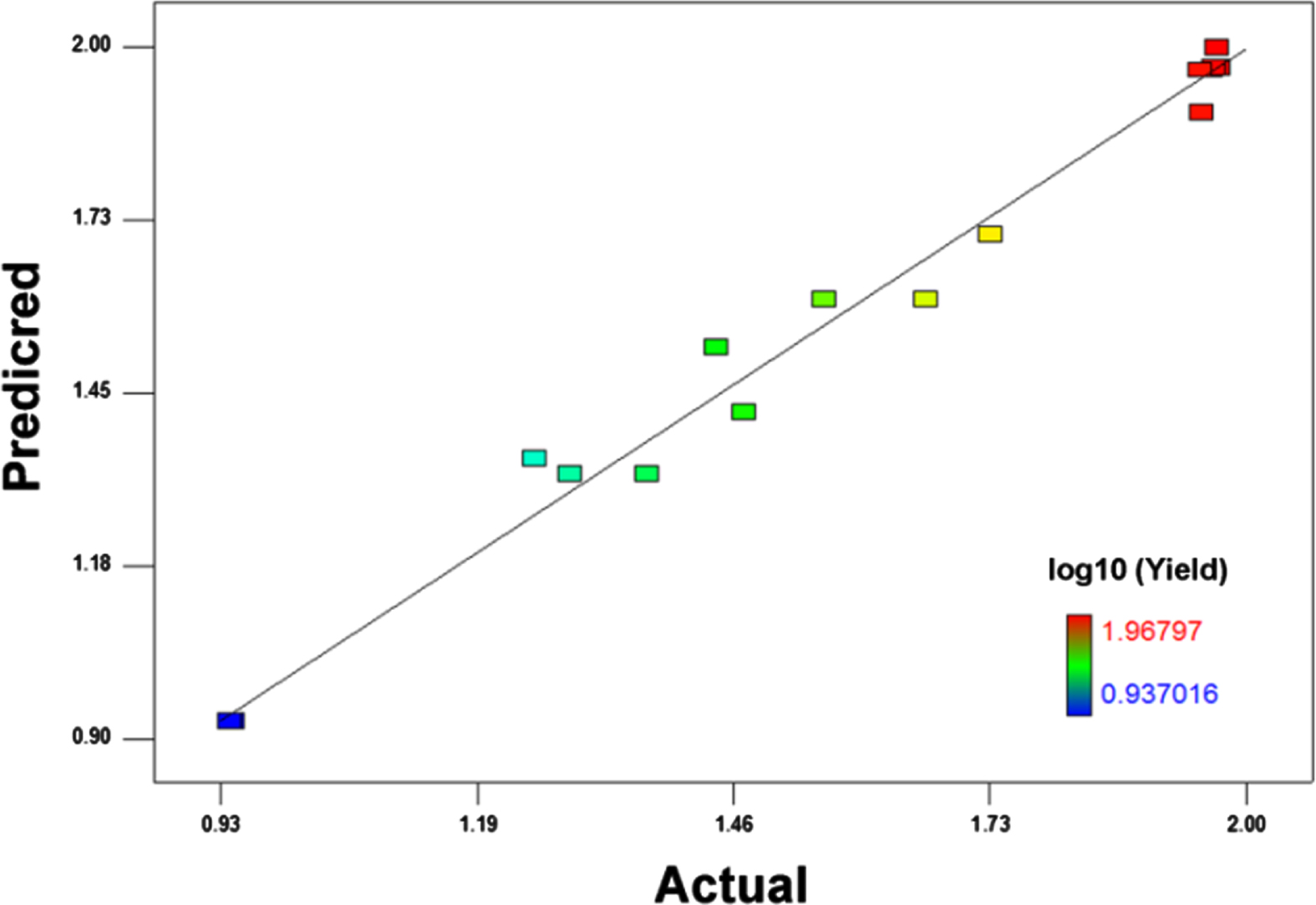
The diagram of predicted verses actual.
Figure 4 shows the dependence of the catalyst content (Fig. 4-a) and reaction time (Fig. 4-b) on the reaction yield. As can be seen, by increasing the catalyst content and reaction time the reaction yield increased and then started decreasing. This increase is about 3.75% for the catalyst value and 84 h for the time.
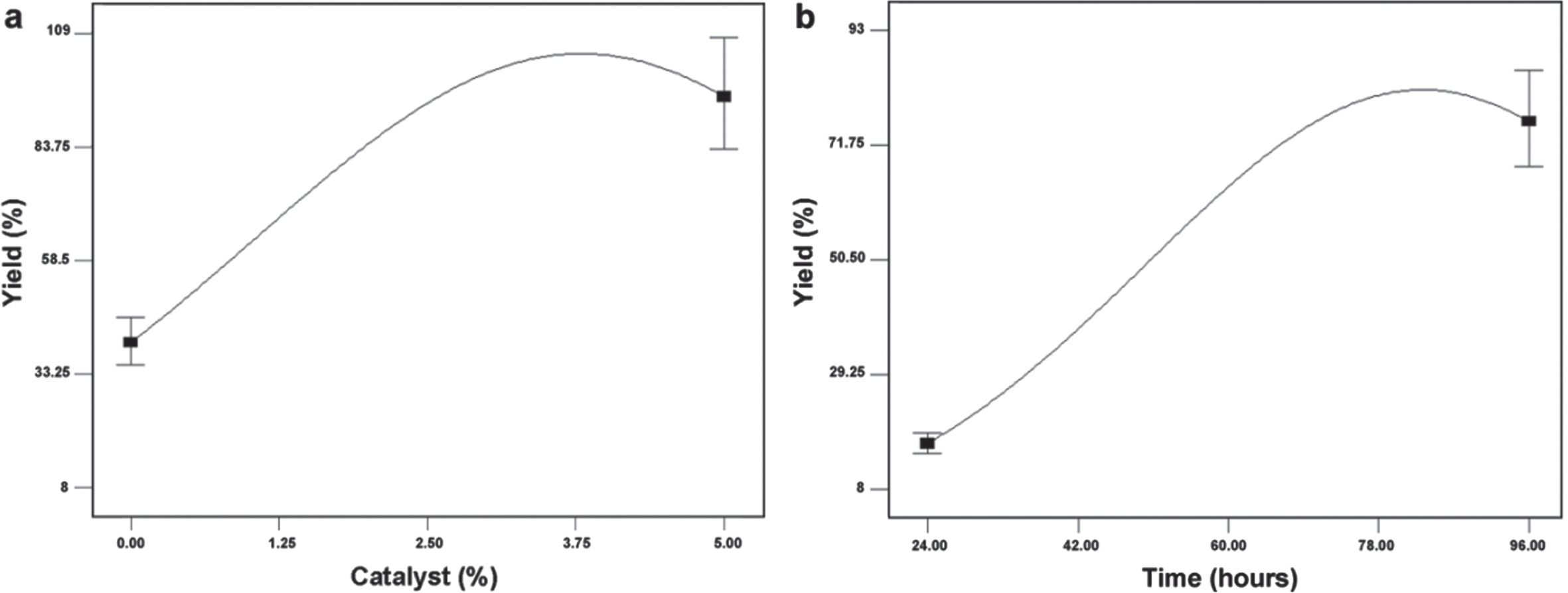
Dependence of (a) amount of catalyst and (b) reaction time with error bars to yield.
The results in Fig. 4 show only the effect of one parameter on a constant value of the other parameter and cannot give a precise idea of the influence of the parameters that are working in parallel.
For better understanding the interactions of the parameters affecting the reaction yield, from the test results, a contour plot was prepared and presented in Fig. 5. This graph illustrates favorably the interactions of the synthetic parameters that simultaneously influence the synthesis process. The red areas in this graph indicate high yields and as moving from red to yellow, green and blue areas, the reaction yields decrease [33]. This graph can indicate well the timing of the synthesis of calix[4]resorcinarene with the specified amount of catalyst to achieve the highest yield, which is economically important for the design of experiment.
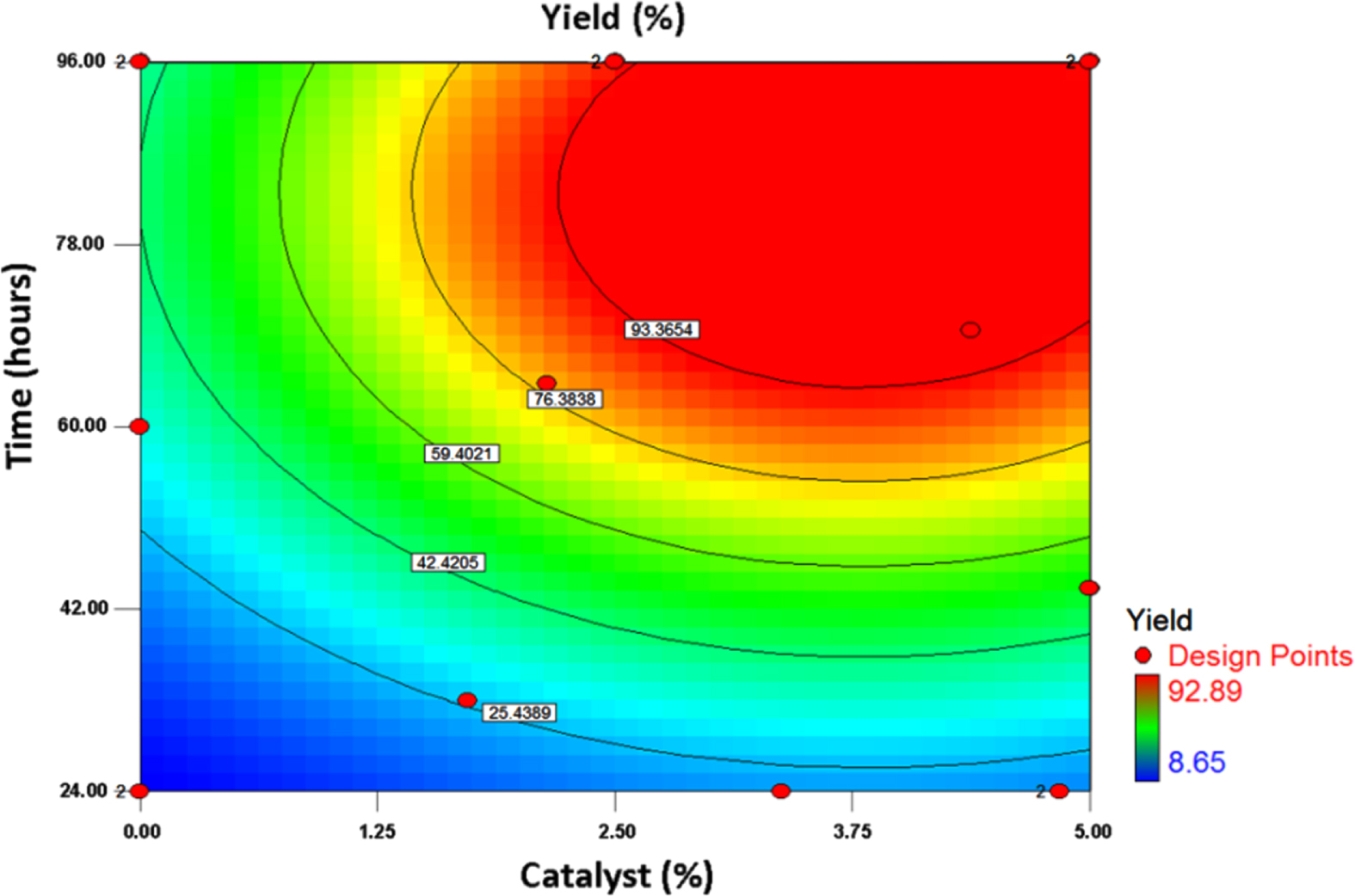
Contour plots of optimal design for calix[4]resorcinarene synthesis.
The curves in Fig. 5 indicate points with the same reaction yield and the midpoints of the two curves are the ranges of variations. The point in this diagram plays the most pronounced role of reaction time on yield, and increasing the amount of catalyst from a certain amount does not have a significant effect on increasing yield (optimum value) and the lines go almost parallel to the catalyst axis. Figure 5 has the advantage of achieving a predetermined yield with different amounts of catalysts and reaction times, which can be selected according to the time and material constraints [34]. Therefore, according to the specific value of yield, the synthesis conditions can be obtained by drawing horizontal and vertical lines. The method helps to estimate the value of the yield reaction based on the desired values of the variables.
Figure 6 illustrates the response surface and contour plot for the influence of catalyst and reaction time on the yield of calix[4]resorcinarene synthesis. This figure shows more effective role of reaction time on synthesis yield.

Response surface of three-dimensional plot indicating the effect of interaction between catalyst and reaction time on yield.
To obtain the optimum synthesis conditions, for example, with minimum amount of catalyst and reaction time, the contour plot was plotted in the range of 24–95 h and 0% to 4.45% catalysts (Fig. 7). By drawing the tangent line to the maximum yield range curve and the perpendicular line to this line at the lowest point, the optimal point is obtained.
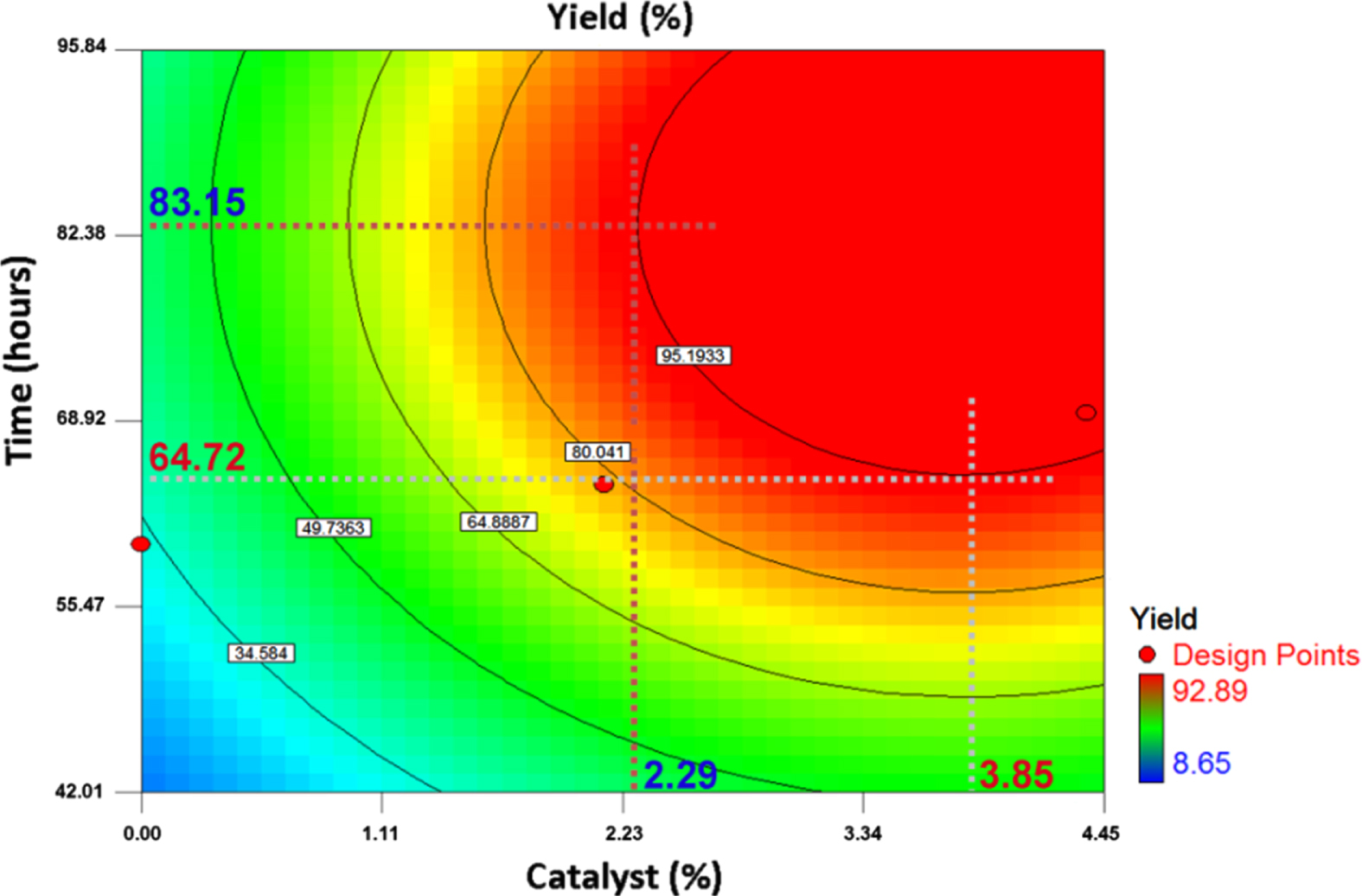
Contour plots for determine optimum condition.
As can be seen, it takes 83 h to achieve a yield above 95% with a minimum catalyst value (2.29%) and for the shortest time (about 65 h), approximately 3.85% of the catalyst is required. The amount of catalyst can help to progress the reaction but in a limited way and more amount of catalyst is without a positive result. Therefore, too much catalyst will not be more effective.
In this research, for increasing the yield of calix[4]resorcinarene synthesis, copper chromite nano catalyst was used. In order to determine the effect of synthesis parameters of calix[4]resorcinarene, the experimental design by Expert Design software with the variables of catalyst amount and reaction time was chosen. After confirming the selected model, the interactions of the parameters affecting the reaction yield in the contour plots were determined. Results showed the time has a greater effect on the yield and to achieve a yield around 95%, about 65h and 3.85% catalyst are required. Also, using the contour plots, the dependence of yield on variables on synthesis can be obtained.
Footnotes
Acknowledgments
We are sincerely grateful to the Ahvaz Branch, Islamic Azad University, for the financial support of this project.
Competing interests
The authors declare that they have no competing interests.