



Abstract
The development of small molecule based drugs as an antimicrobial agent is an important area of research nowadays. In the present work, two new molecular entities based on dialkylated erythrosin B has been synthesized via Arbuzov type of rearrangement using dialkyl sulphite as a reagent in the presence of Et3N. Ethyl and methyl based dialkylated derivatives of erythrosin B were characterized using 1H NMR, 13C NMR and HRMS data. Keeping in mind the biological safety of erythrosin B, synthesized derivatives were checked for their antimicrobial activity against the microbial strains Escherichia coli (E.coli). The two were found to be effective against the E. coli with the antimicrobial activity similar to that of Ampicillin. Further, the trend of antimicrobial activity has been supported by DFT data analysis and it was observed that compound, B with low HOMO (–5.93 eV) and LUMO (–3.11 eV) energies is a better antimicrobial agent than compound A.
Introduction
In the era of modernization, across the world every corner of society is changing very fast due to change in life style, food habit, industrialization, pollution, etc. All these changes are resulting in the generation of various human health issues. Most of the health issues are related to various types of bacteria. To treat bacterial infections, the high use of anti-bacterial drugs is a common trend. The extensive use of the antibacterial drugs results in anti-bacterial drugs resistance in most of the bacteria in some period of times. To overcome this problem various types of low cost antibacterial drugs development is going on in number of R & D labs. These materials are of various types such as ionic liquid, polymers, molecular species; they are used as anti-corrosive coating, food preservative, in treatment of water and air as well as in the field of biomedical [1–3].
Among all, the molecular species are of great interest for the researchers. Xanthene and xanthene based molecular species are an important class of fluorescent compounds due to its better photo physical properties, stability and better solubility in the most of common organic solvents. In all known xanthene derivatives, fluorescein is an important compound and has been extensively studied due to its wide range of applications, fluorescent probing is also the part of it [4]. In the fluorescein moiety, xanthene skeleton and pendant benzoic acid group are orthogonal to each other [5]. While with the absorption of light, the excited electron is constricted in the xanthene moiety (fluorophoric part of the dye). Hence, all ensuing photo physical, as well as photochemical activities are due to the xanthene moiety [6]. Fluorescein is almost inactive as a photodynamic sensitizer; however, it has high importance in fluorescence immunoassays. Photodynamic therapy (PDT) is used for the regulation of abnormal tissue growth, such as rheumatoid arthritis, vitiligo, pathological myopia, macular degeneration, and retinal microbial infestations [7, 8]. Other xanthenes dyes, such as rose Bengal B, erythrosin B and eosin Y are reported to have high PDT activity in comparison to that of pure fluorescein [9, 10], leading to the fact that these halogenated versions of fluorescein could be of much biological relevance. Halogenated fluorescein cognates are reported to have noticeable antibacterial activity [11]. Erythrosin B has been claimed to have antimicrobial activity against gram-positive and gram-negative oral bacteria [12]. It is proven to be medically safe and has the approval to be used orally [13]. Its biologically safe nature renders it to be used in the medical field.
ErythrosinB, has been widely used in foods, drugs and cosmetics since its approval by the US Department of Agriculture in 1907. It is iodinated fluorescein, which exhibits high molar absorptivity = 532 nm (96.6×10³ Lmol–1cm–1) [14] and long-lived triplet state leading to high production of singlet state at physiological pH in water, which corresponds to its dianionic protolytic form [14–16]. Erythrosin B is reported to be a successful photo sensitizer in photodynamic inactivation of micro organisms (PDIMO) for treatment of dental plaque [17, 18]. In spite of the remarkable photodynamic properties, Erythrosin B is highly hydrophilic, which results in its low affinity to cell membranes. However, the addition of an alkyl substrate to the carboxylic group forms an ester and elevates its hydrophobicity due to the presence of alkyl substituent and decrease of the charge [19]. Less bioavailability of erythrosin justifies the benefits of the introduction of alkyl groups [20]. So, in the present work we alkylated both the sites i.e. hydroxyl and carboxylic sites to increase the biological relevance of erythrosin B. We opted the synthetic protocol of alkylation via Arbuzov type of rearrangement [21–25] using dialkyl sulfite which alkylate the erythrosin B molecule on both the sites. The synthesized dialkylated erythrosin B derivatives were tested for their antimicrobial activity against E. coli. Antimicrobial activity of the synthesized compound was checked with that of standard drug ampicillin used for various bacterial infections since 1964. But it has been reported to show gastrointestinal side effects in up to 20% patients on the use of ampicillin [26]. So, the more antimicrobial promising tools are always a need of an hour.
Experimental section
Materials and methods
Chemicals and Instrumentals
Fluorescein was purchased from Sigma Aldrich and was used directly without any purification. All the required chemicals were of high grade from TCI Chemicals, and no purification was done for further use. Solvents used were analytically pure and need no drying or purification. Reactions were monitored by TLC using Merck Millipore DC Kieselgel 60 F-254 aluminium sheets. 1H-NMR and 13C-NMR spectra were recorded on Brucker Advance II-400 MHz instruments with tetramethylsilane as an internal standard. High-resolution ESI mass analyses were performed on Xevo G2-XS QTof.
Synthesis and characterization of dimethylated erythrosin B (methyl 2-(2,4,5,7-tetraiodo-3-methoxy-6-oxo-6H-xanthen-9-yl)benzoate) (A)
Arbuzov type of rearrangement protocol has been used to synthesize dimethylated Erythrosin B via in situ generation of methylmethanesulfonate. The reaction of dimethyl sulfite was carried out with erythrosin B. In an evacuated 50 ml round bottom flask fitted with the condenser in oil bath, nitrogen gas was purged. Erythrosin B (0.500 g) was added to the round bottom flask, in which dimethyl sulfite (3 4 ml) was added along with triethylamine (0.5 ml). The reaction was carried out at 130°C for 12 hours. The reaction was monitored using TLC (in Chloroform), and the reaction mixture was purified through column chromatography in chloroform solvent. The pure compound after rota-evaporation was washed with hexane and diethyl ether followed by drying in vacuum. (Orange solid, Yield = 91%, 1H-NMR-(500 Hz): 8.35-8.33 (d,1H), 7.82-7.75 (m,2H), 7.59-7.55 (d,1H), 7.31-7.30 (m,2H), 3.97 (s,3H), 3.71 (s,3H); 13C-NMR: 174.58, 165.19, 163.49, 158.91, 153.57, 147.31, 138.35, 138.24, 137.62, 133.40, 133.24, 131.68, 130.63, 130.55, 129.79, 120.88, 105.93, 86.13, 82.34, 61.21, 52.71, 52.61; MS (EI+): [M + H]+ = 864.65, [M + 2H]+ = 865.699 (Fig. S1-S3).
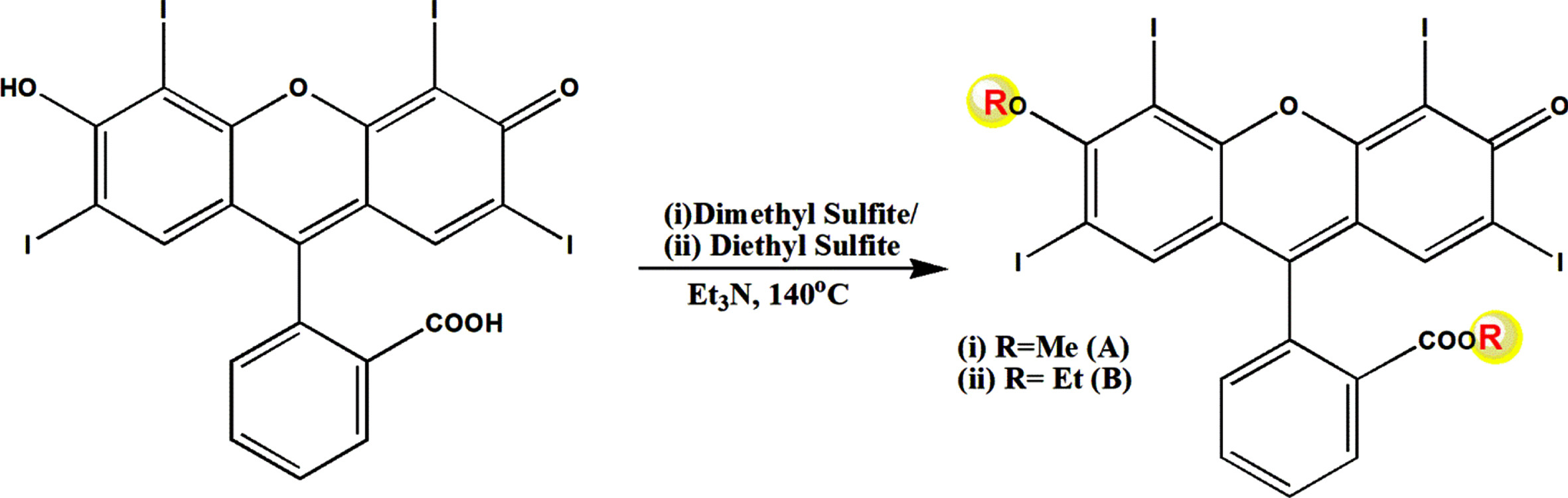
Synthesis Scheme of dialkylated Erythrosin B.
The reaction of diethyl sulfite was carried out with Erythrosin B. In an evacuated 50 ml round bottom flask fitted with the condenser in oil bath, and nitrogen gas was purged. Erythrosin B (0.5 g) was added to the round bottom flask, in which then diethyl sulfite (3-4 ml) was added along with triethylamine (0.5 ml). The reaction was carried out at 135 °C for 12 hours and monitored using TLC (in Chloroform). Then the reaction mixture was purified through column chromatography in chloroform solvent. The pure compound after rota-evaporation was washed with hexane and then with diethyl ether. Then, the compound was vacuum dried. (Orange Red solid, yield = 85%) [1H-NMR- (500 Hz): 8.33-8.34 (d,1H), 7.76-7.82 (m,2H), 7.58-7.56 (d,1H), 7.34-7.26 (m,2H), 4.19-4.14 (m,3H), 3.97 (s,1H), 3.75 (s,1H); 13C-NMR: 173.70, 164.27, 161.96, 158.04, 152.71, 137.38, 137.31, 136.75, 136.67, 132.43, 132.37, 132.24, 130.77, 129.69, 129.58, 129.49, 128.95, 119.92, 119.36, 104.96, 60.86, 51.79, 14.61, 12.99 (Fig. S4-S5).
Antimicrobial studies
Bacterial culture
The microbial strains Escherichia coli (E.coli) used in this study were procured from the Microbial Culture Collection Centre (MTCC), and the Institute of Microbial Technology (IMTECH), Chandigarh, India. The cultures of E. coli were maintained on Mueller–Hinton (MH) agar plates and stored at 4°C for the duration of this investigation. For the minimum inhibitory concentration (MIC) assay, few colonies of each culture were picked and seeded in 20 ml of MH broth and incubated at 37°C for 24 hours with gentle shaking (200 rpm). The bacterial growth was monitored through optical density at 600 nm.
Agar well diffusion assay
The antimicrobial activity of compound A and B were shown on agar well diffusion bioassay. Concisely, 50l of logarithmic phase growing E. coli culture (∼105 CFU/ml) was spread over MH agar plates. Wells were punched into agar plate through sterile 1 ml tip. Separately, different concentration of compound A and B were prepared in phosphate buffer saline (PBS) and then different concentrations of these compounds were added into designated wells. Simple PBS and ampicillin solution (80g/ml), a well-known standard antibacterial drug was added as negative and positive controls, respectively. The plates were incubated at 37°C for 24 h. The Antibacterial activity of the tested compound A and B was assessed from the measurement of the diameter of clear zone of inhibition formed around the wells.
Time-kill kinetic assay
The time-kill assays of compound A, compound B and standard antibacterial drug ampicillin against E. coli, was determined by incubating them with 105 CFU of bacteria, suspended in 20 ml MH broth for 24 hours under constant shaking (200 rpm). The concentration of the tested compounds and Ampicillin was kept at its MIC value. 100μL of each of the bacterial suspensions were drawn and spread on MH agar plates at different time intervals (0 h, 4 h, 8 h, 12 h, 16 h, 20 h, and 24 h). The Petri plates were incubated for 24 hours at 37°C, and the numbers of colonies were counted. The untreated bacterial cells were used as control.
DFT study
The geometry optimization of Erythrosin B and its dimethylated and diethylated derivatives was performed without any symmetry restriction using densityfunctional theory (DFT) at the B3LYP/LanL2DZ level of theory as implemented by Gaussian 09 package [27].
Results and Discussion
In the present work, we have designed new antimicrobial tool based on erythrosine B, keeping in view that it has less bioavailability and high hydrophilicity [20]. In order to make it more biologically relevant it needs further modification [19]. So, we pursued our alkylation protocol via S-centred Arbuzov type of rearrangement and synthesized novel dialkylerythrosin B, by alkylation in one shot at both hydroxyl and carboxyl sites leaving behind highly biologically relevant non-ionic molecule by increasing its hydrophobicity. Synthesized compounds A and B were characterized using 1H NMR, 13C NMR and HRMS. There are four protons attached to benzoic acid moiety and two protons attached to the xanthene moiety. In 1H NMR spectrum of dimethylated erythrosine B the proton attached to the C (say C1) next to the carbon bearing carboxylic group emerges out as doublet at 8.35-8.33. However, two different multiplets were observed for two different H’s attached to the two carbons next to C1 in row. The rest one proton on benzoic acid moiety gave doublet at 7.59-7.55. Similarly two protons attached to xanthene moiety were expected to give two singlets. However, there is merging of signal and mixed signal at 7.82-7.75 was observed. Three protons of each methyl group attached to hydroxyl and carboxyl via alkylation were observed to be singlets at 3.71 and 3.97 respectively. In 13C NMR, as expected twenty two signals for twenty two carbons were observed. The presence carbon of carboxylic group appeared at 165.19. The two carbons of methyl groups attached to hydroxyl and carboxylic showed peaks at 52.71 and 52.61 respectively. In HRMS data, the peak for [M + H]+ was observed at 864.6529 which matches the theoretical value i.e. 864.694 upto one decimal place and [M + 2H]+ was observed at 865.699 which approximately matches theoretical value i.e. 865.702. Similarly the characterization data for dimethylated compound was in accordance to the expected values. Further, we tested both the dialkylated derivatives for their antimicrobial activity against E. coli.
Antimicrobial activity
The antibacterial activities of compound A and compound B were tested against E. coli a bacterium which is generally associated with diarrhoea from contaminated food or drinking fouled water. The MIC values of these compounds against the E. coli species were estimated using the agar well diffusion assay and standard broth micro-dilution method recommended by the Clinical and Laboratory Standards Institute.
Agar well diffusion assay
Agar well diffusion assay results of the compounds A and B revealed significant antibacterial activity as evident from standard agar well diffusion bioassay and the observations summarized in Table 1. (Fig. 2). Except for phosphate buffer saline (control; well no 1), all the other incubated with different concentrations of compounds A and B (well no 2, 3, and 4) showed significant clear zone of inhibition against E. coli. Results obtained from the agar well diffusion assay show that all the tested compounds indeed exhibit antimicrobial activity which could be attributed to increasing the oxidative stress generated by these tested compounds.
Agar well diffusion assay- Zone of inhibition (in cm) of compound A and compound B against Escherichia coli. Amp and saline were used as positive and negative control respectively
Agar well diffusion assay- Zone of inhibition (in cm) of compound A and compound B against Escherichia coli. Amp and saline were used as positive and negative control respectively
Saline *(Negative* control). Ampicillin **(positive control).
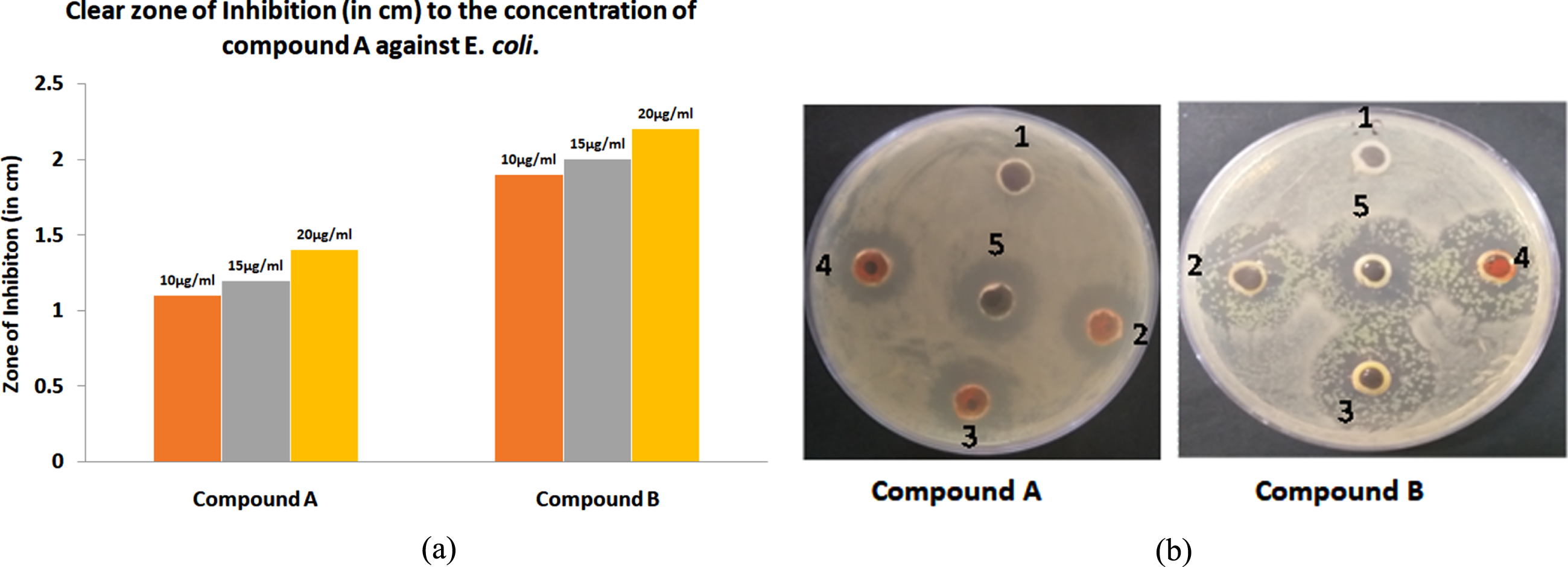
(a) Antimicrobial activity of compound A and B against E. coli microorganisms. A clear zone of inhibitions observed for varying quantity A and B. 2(b) The clear zone of inhibition (in cm) is represented in the histogram. Well 2, 3, &4 were loaded with different concentration of A and B in the range of 0-20μg/ml, respectively Well, 1 and 5 were used as a negative (saline), and positive (Ampicillin, 80μg/ml) controls respectively.
The results obtained were in accordance with our previous work reported on eosin Y that diethylated derivatives were showing good anti-microbial activity in comparison to diethylated derivatives [28].
In order to study the efficacy of A and B compounds, time-kill assay studies were executed. It was perceived that colony-forming units (CFUs) of the E. coli promptly reduced after treatment with A and B compounds at MIC value respectively (Fig. 3). In the time-kill assay, a reduction in E.coli cells after 24 hours resulted in a decrease to 2.70 log units (Fig. 3) as compared to control (4.44 log units, 24 hours). It was observed that the maximum killing of E. coli, cells with A and B compound was observed after 12 hours in comparison to the used control. The anti-microbial activity of erythrosine B and combined effect of erythrosine B and ultrasonic treatment was studied by Bastarrachea et al. [29] against gram positive bacteria Listeria innocua. It was reported that erythrosine B has log CFU/ml value around 6.2 and the similar effect was observed in combination with ultrasonication. However, the present work provides better anti-microbial activity by the noticeable decrease in log CFU/ml value i.e. up to 2.70; therefore, there is a decrease in colony forming units. Then, it can be strongly interpreted that the A and B effectively inhibited the growth of E. coli bacterial strains, thus highlighting its bacteriostatic effect. Experimental results showed that compound A and B are very well potent chemicals for their bactericidal and inhibitory activities, which have been applied in the medical and biological field.
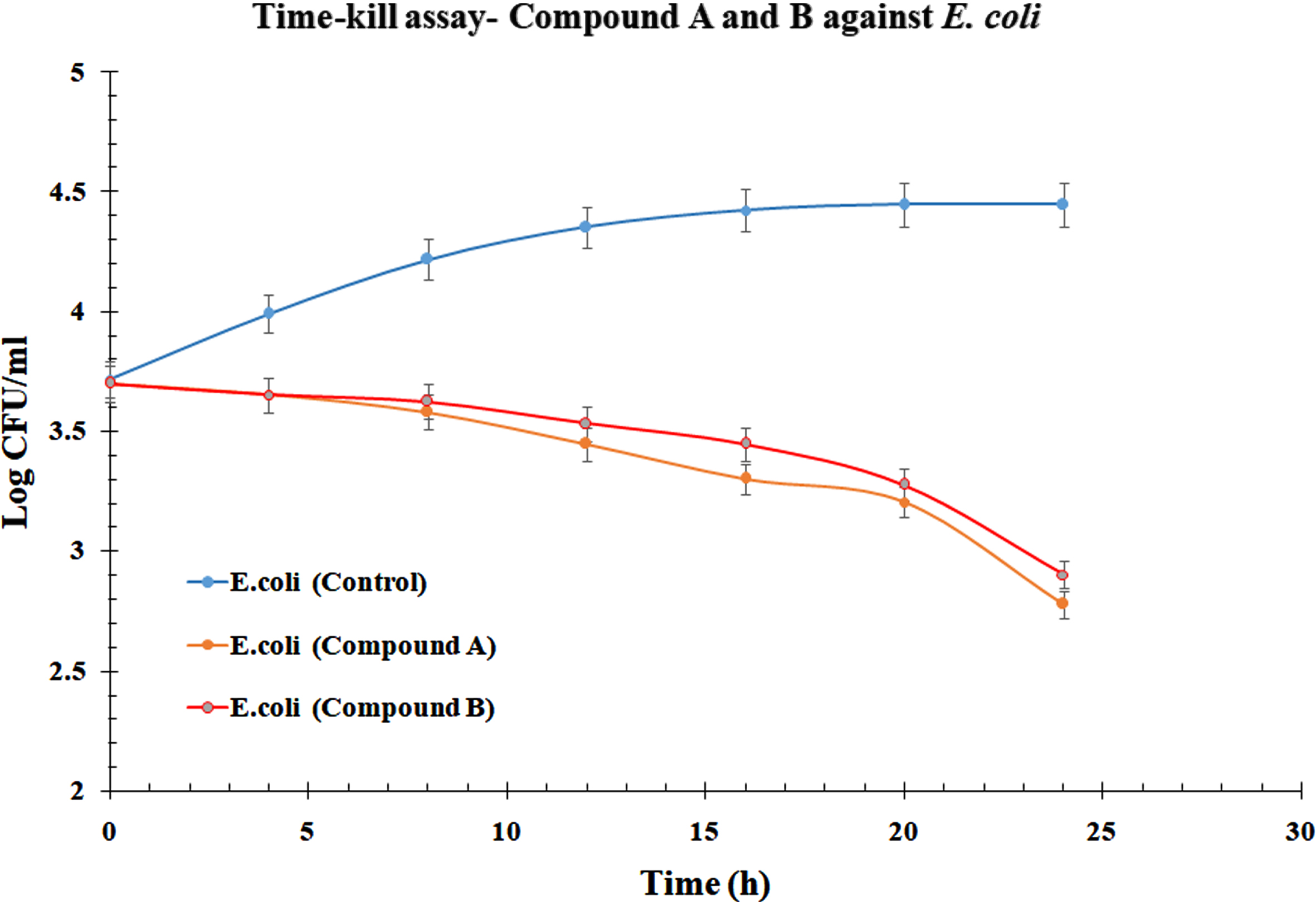
Time-kill assay of Compounds A and B against E. coli cells.
The electron donating and accepting ability of a compound can be presented by considering its HOMO and LUMO energies and are important to describe the intramolecular charge transfer. ELUMO–EHOMO gap indicate the chemical reactivity and kinetic stability of a compound where a large band gap implies less electronic excitations, higher molecular stability and low reactivity in chemical reactions and vice versa. The interactions or reaction happens between the HOMO of one moiety with the LUMO of another one. In Erythrosin B and its dimethyl and diethyl derivatives, the HOMO is primarily located on6-hydroxy-3H-xanthen-3-one and iodo substituents, while the LUMO is located on6-hydroxy-3H-xanthen-3-one which indicates that aromatic moiety and π-conjugated backbone is susceptible to donating or accepting electrons. The calculated HOMO and LUMO energies are listed in Table 2 and shown in Fig. 4. Erythrosin B and its dimethyl and diethyl derivatives show similar energy gap (2.82 eV) due to common molecular backbone, however show changes in the energies of HOMO and LUMO. It is noted that dimethyl and diethyl derivatives have HOMO energies (Ionization Potential) of –5.99 and –5.93 eV making backbone more electron-donating compared to erythrosin B whose HOMO energy is –6.02 eV. On the basis of these observations it can be concluded that even though molecules are with same HOMO-LUMO band gap, they can show different level of antimicrobial activity. In the present case, compound B (diethyl erythrosin B) is with the lowest level of HOMO (–5.93 eV) and LUMO (–3.11 eV) energies, and is able to show the maximum antimicrobial activity.
Energies (eV) of HOMO, LUMO, and energy gap of the erythrosin B and its dimethylated and diethylated derivatives
Energies (eV) of HOMO, LUMO, and energy gap of the erythrosin B and its dimethylated and diethylated derivatives
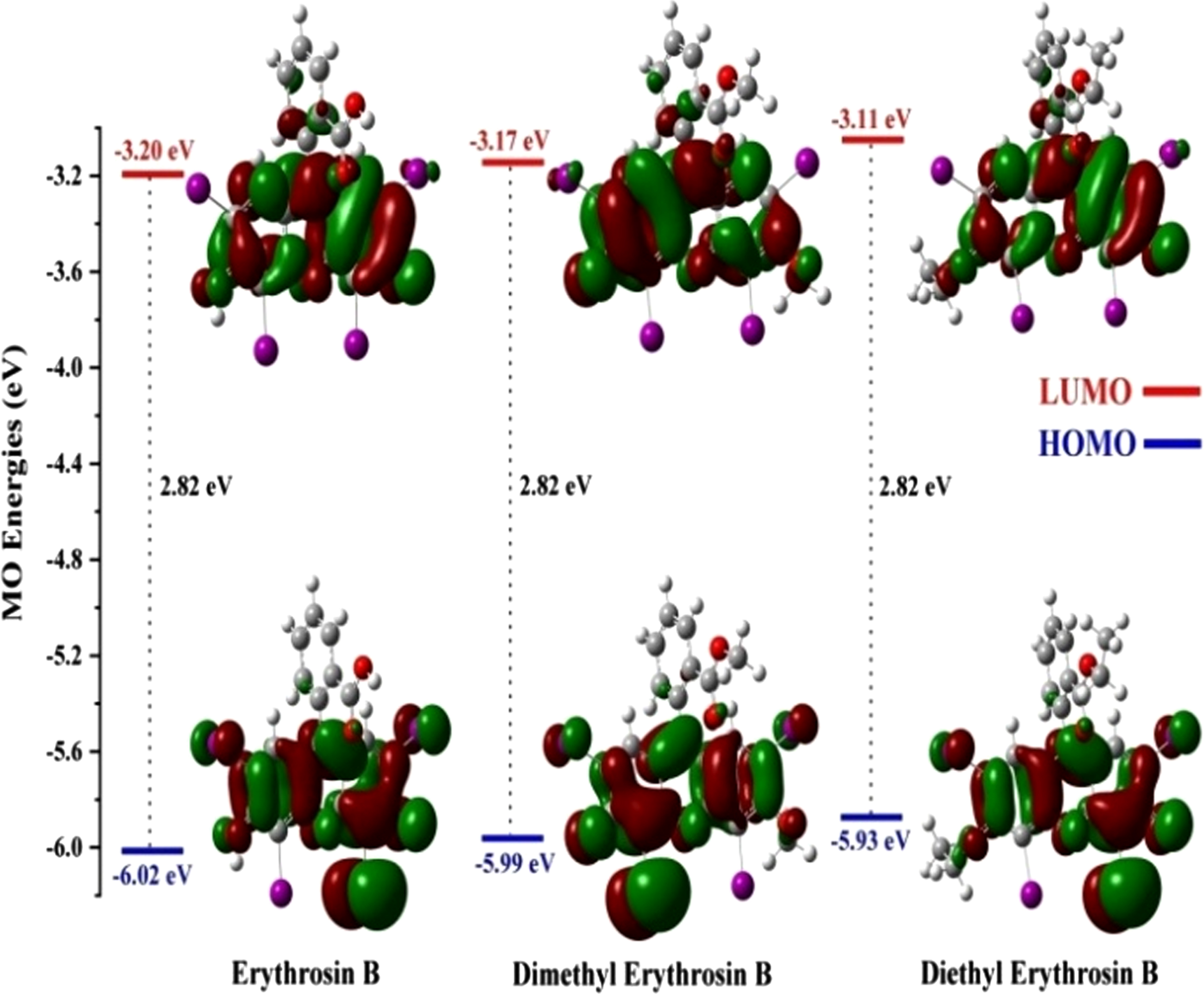
Frontier molecular orbitals of erythrosin B and its dimethyl and diethyl derivatives.
In summary, we synthesized dimethylated and diethylated erythrosin B using S-centred Arbuzov type of rearrangement via insitu formation of alkyl alkanesulfonates on using dialkyl sulfites. The synthesized compounds were believed to have good antimicrobial activity, and the same was checked against E. coli. The results revealed that the compounds A and B were found to have good antimicrobial activity, and diethylated erythrosin B was having activity similar to that of Ampicillin. Further, DFT study analysis supported the fact that any molecular species with low energies of HOMO (–5.93 eV) and LUMO (–3.11 eV) (for compound B) can act as a better antimicrobial agent. Erythrosin B being the safest dye in the biological field and has excellent medical applications. Its dialkyl derivatives can be more promising antimicrobial tools in comparison to the traditional Ampicillin, which is reported to have side effects on human health.
