



Abstract
We explored solvent effect on the stability, dipole moment, polarizability and first hyperpolarizability of Fe(CO)4B12N12 complexes at MPW1PW91/6-311G(d,p) level of theory. These complexes were considered in the low spin states. The self-consistent reaction field theory (SCRF) based on conductor-like polarizable continuum model (PCM) was employed to illustration of the solvent influences. The relations between the parameters with solvent polarity functions (McRae and Suppan functions) were given. Also, relations of the wavenumbers values of the stretching of carbonyl ligands with the Kirkwood–Bauer–Magat equation (KBM) were provided.
Keywords
Introduction
Isolobality of Fe(CO)4 organometallic fragment with CH3+ organic fragment leads to preparation of the various compounds and structure and bonding of these compounds have been illustrated [1–3]. Fe(CO)4 fragment interacted with various ligands [4–8]. Many researches have been reported about the metal–π ligand complexes in organometallic chemistry [9].
The BN nano-cages and carbon bucky balls are iso-structural. the chemical vapor deposition (CVD) technique is useful for preparation of these molecules [10]. These molecules are used in therapeutic owing to the biocompatibility [11]. These compounds are challenger for carbon based fullerenes in the subsequent group electronics. B12N12 nano-cluster has been synthesized by laser desorption time-off light mass spectrometry [12, 13]. Serval quantum mechanical (QM) calculations of interactions between B12N12 nano-cage and different molecules have been published [14–19].
Solvents plays remarkable role in chemistry and alter the molecular activities by the interactions of solute and solvent molecules [20–22]. Various computational investigations have been are useful to illustration the solvent effect in the electronic structure [23, 24]. Various researches have reported about of solvent influence on the spectroscopic, electronic and structural properties of organometallic and inorganic compounds [25–46].
In this research, we illustrated the solvent polarity influence on the electronic and optical properties of Fe(CO)4B12N12 complexes at mPW1PW91/6-311G(d,p) level of theory.
Computational methods
The Gaussian 09 software package [47] was employed for our calculations in this study. The standard 6-311G (d, p) basis set is considered for all elements [48, 49]. All calculations were done by the parameter hybrid functional with adapted Perdew-Wang exchange and correlation (mPW1PW91) [50]. This functional provides better results than B3LYP [51–54]. The optimized structures correspond to the local minima on the potential energy surfaces are confirmed by vibrational analysis.
The first order hyperpolarizabilities values of optimized geometries were calculated at the identical level of theory for optimization. Total static first hyperpolarizability β was calculated from the following equations:
upon computing the individual static components:
In the basis of the Kleinman symmetry [55]:
Therefore:
Solvent effects were studied with self-consistent reaction field (SCRF) method, using the conductor-like polarizable continuum model (CPCM) [56, 57].
Results and discussion
Energetic aspects
Figure 1 shows the two modes interaction of Fe(CO)4 and B12N12 nano-cage. Table 1 reports the energy, relative energy and solvation energy values of these complexes at the mPW1PW91/6-311G(d,p) level of theory. These complexes are considered in the low spin states. Selected solvents in this study are acetone, ethanol, methanol, acetonitrile (MeCN), dimethylsulfoxide (DMSO) and water. Energy values reveal that
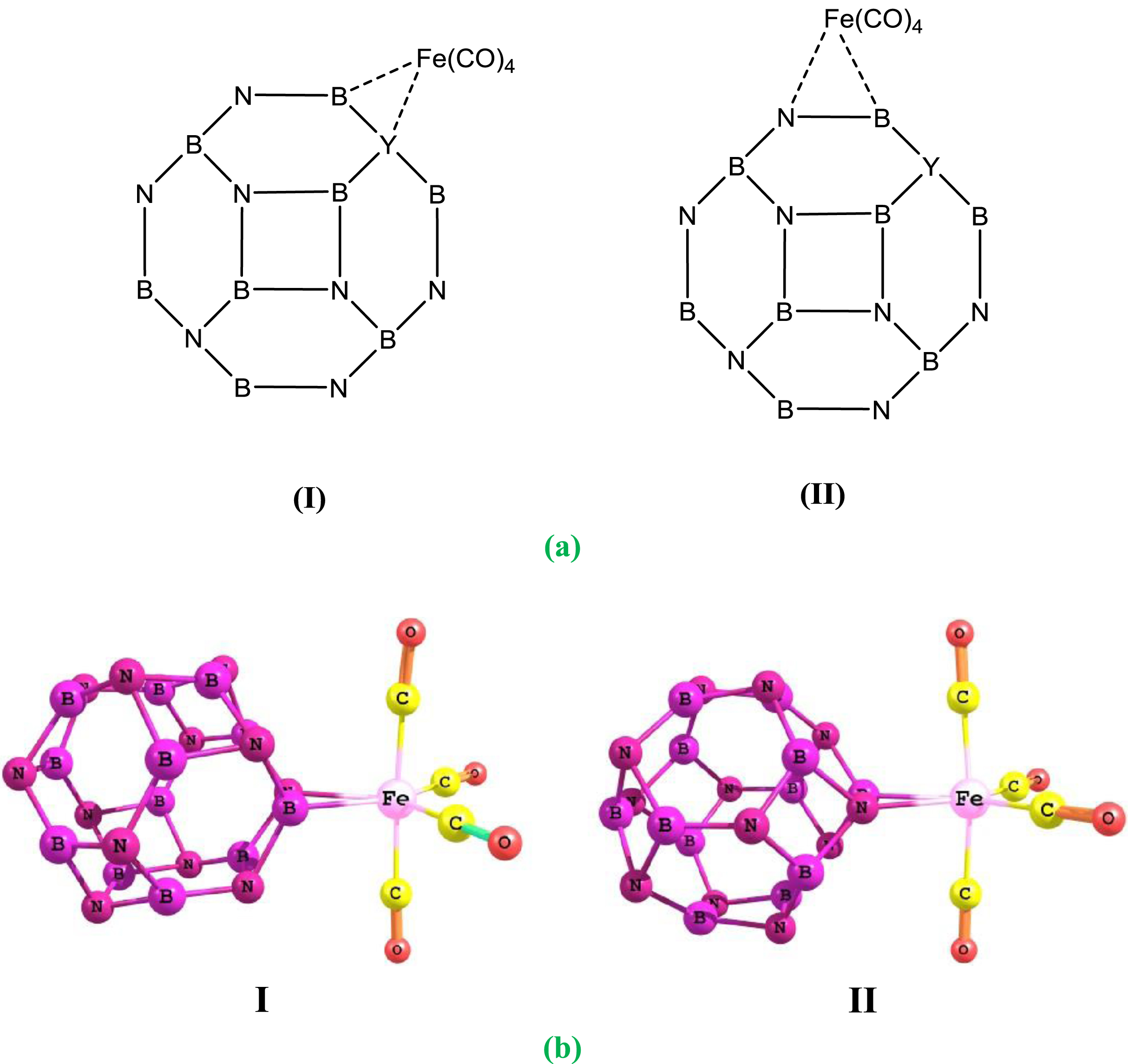
(a) Front view and (b) 3-D structures of two modes coordination of Fe(CO)4 fragment to B12N12nano-cage.
Energy (E, a.u), relative energy (ΔE, kcal/mol) and solvation energy (ΔEsolv, kcal/mol) of two isomers of Fe(CO)4B12N12 complexes. ɛis dielectric constant of solvents
On the other hand, larger ΔE values are observed in solution phase than gas phase. There is larger ΔE values with increasing of solvent polarity. ΔE values and dielectric constant of solvents are fitted in a quadratic equation:
The solvation energies values are given in Table 1. There are smaller ΔEsol values with increasing of dielectric constant of solvents. Also, solvation is more significance for II-structure than I-structure. ΔEsol values and dielectric constant of solvents are fitted in a quadratic equation:
Dipole moment values of the complexes are computed in gas and various solvents (Table 2). It can be observed larger polarity II-structure than I-structure. Computed dipole moment values are larger in solution phase than gas phase. These values enhance with increasing of dielectric constant values.
Dipole moment (μ, Debye) and isotropic polarizability (αiso,a.u) values of two isomers of Fe(CO)4B12N12 complexes
Dipole moment (μ, Debye) and isotropic polarizability (αiso,a.u) values of two isomers of Fe(CO)4B12N12 complexes
Dipole moment values and dielectric constant of solvent are fitted in a quadratic equation:
Then, we consider the McRae function (FMcRae(ɛ)) [58] and Suppan function (FSuppan(ɛ)) [59]. These functions have the equations of:
The relationship between μ and these solvent polarity functions are:
As a result, there are good correlations between the dipole moment with McRae and Suppan functions in the studied systems.
Isotropic polarizability values of the studied complexes are calculated in gas and various solvents (Table 2). The calculated values show higher isotropic polarizability II-structure than I-structure. There are larger isotropic polarizability values in solution phase than gas phase.
Isotropic polarizability values and dielectric constant of solvent and dielectric constant of solvents are fitted in a quadratic equation:
The linear correlations between αiso and the solvent polarity functions (FMcRae(ɛ) and FSuppan(ɛ)) are:
It can be seen, there are good correlations between the isotropic polarizability values with McRae and Suppan functions in the studied systems.
Hyperpolarizability
The βtot, βx, βy, βz values of the two isomers of Fe(CO)4(B12N12) complex in different solvents are given in Table 3. The βtotal values of
Total first hyperpolarizability and its components (esu) values of two isomers of Fe(CO)4B12N12 complexes
Total first hyperpolarizability and its components (esu) values of two isomers of Fe(CO)4B12N12 complexes
These values show larger activities NLO in solution phase than gas phase. Therefore, solvent polarity reveals a significant role on the first hyperpolarizabilities in dipolar molecules. On the other hand, βtotal values of
An empirical linear relationship between βtot and Onsager function is useful to exploration the solvent effect on first hyperpolarizability [60]:
There is good relationship between β tot and the Onsager function for I-structure. This equation is typical for a dipolar reaction field interaction in the solvation process [60–63]. Thus, the electronic reorganization in solution for molecule reveals an important impact on the provided first hyperpolarizabilities.
The linear correlations between βtot and the solvent polarity functions (FMcRae(ɛ) and FSuppan(ɛ)) are:
There are good relations between the first hyperpolarizabilities values with McRae and Suppan functions in the I-structure.
The vibrational modes of carbonyl groups in the Fe(CO)4B12N12 complexes are presented in Fig. 2. The computed wavenumbers of these vibrations are listed in Table 4. The wavenumbers of these vibrations are smaller in solution phase rather than gas phase. These values reduce in more polar solvents.

Vibration modes of carbonyl ligands in Fe(CO)4 fragment to B12N12nano-cage.
Wavenumbers of the stretching of carbonyl ligands (cm–1) of two isomers of Fe(CO)4B12N12 complexes
Also, it can be found the larger ν90 and ν91 values for II-isomer than I-isomer. In contrast, the smaller ν92 and ν93 values for II-isomer than I-isomer.
The theoretical study of the solvent-induced ν(CO) shifts is considered by Kirkwood–Bauer–Magat equation (KBM) [64]:
In this equation, ν(CO)gas and ν(CO)solution are the wavenumber of stretching of carbonyl ligands in the gas phase and solution phase, respectively, ɛ is the dielectric constant of the solvent, and C is a constant depending on the dimensions and electrical properties of the solute dipole.
There are good correlations between solvent-induced stretching vibrational frequency shifts of υ(CO) with (ɛ –1)/(2ɛ+1) of the KBM equation:
I-isomer:
II-isomer:
So, nonspecific interactions, steric impacts, and hydrogen bonding have negligible effects in carbonyl group shift in numerous solvents [65].
In our research, the influence of solvent polarity on structure, electronic and optical properties Fe(CO)4B12N12 complexes was investigated at mPW1PW91/6-311G(d,p) level. Computed solvation energy values indicated enhanced stability of the Fe(CO)4B12N12 complexes in polar solvents. Good relations were provided between dipole moment and isotropic polarizability with McRae and Suppan functions. There were good correlations between the first hyperpolarizabilities values with McRae and Suppan functions in the