



Abstract
New di-and tri- n-butyl tin(IV) hydroxamate complexes of composition [n-Bu2Sn(C6H3(3-NH2)(4-Cl)CONHO)2](I) and [n-Bu3Sn(C6H3(3-NH2)(4-Cl)CONHO)] (II) have been synthesized by the reactions of n-Bu2SnCl2 and n-Bu3SnCl with potassium 3-amino-4-chlorido benzohydroxamate(KHL) in predetermined metal:ligand 1:2 and 1:1 molar ratios respectively in MeOH+THF solvent medium and characterized by physiochemical, spectroscopic (IR,1 H and 13 C NMR) studies and mass spectrometry. The bidentate nature of hydroxamate ligand involving bonding through carbonyl and hydroxamic oxygen atoms (O,O coordination) has been inferred from IR spectra. The distorted octahedral and trigonal bipyramidal geometry around tin for (
Introduction
Hydroxamic acids constitute medically important class of organic bio-ligands [1–3] in which hydroxylamine (NH2OH) is inserted into carboxylic acid group forming RC(O)NHOH. The biological importance of hydroxamic acids is reflected in their metal organic derivatives to exert a subtle influence on medicinal applications [4–7]. Hydroxamic acids (HAs) have gathered considerable importance as supporting ligands in coordination chemistry and biology because of their potential as therapeutics agents. The hydroxamic acids display different tautomeric forms and flexible bonding modes [8]. Numerous spectral studies have shown that hydroxamic acids preferably form metal complexes through the hydroxamide form rather than the hydroximic form [9].
Structure of potassium 3-amino -4-chloridobenzohydroxamate(KHL).
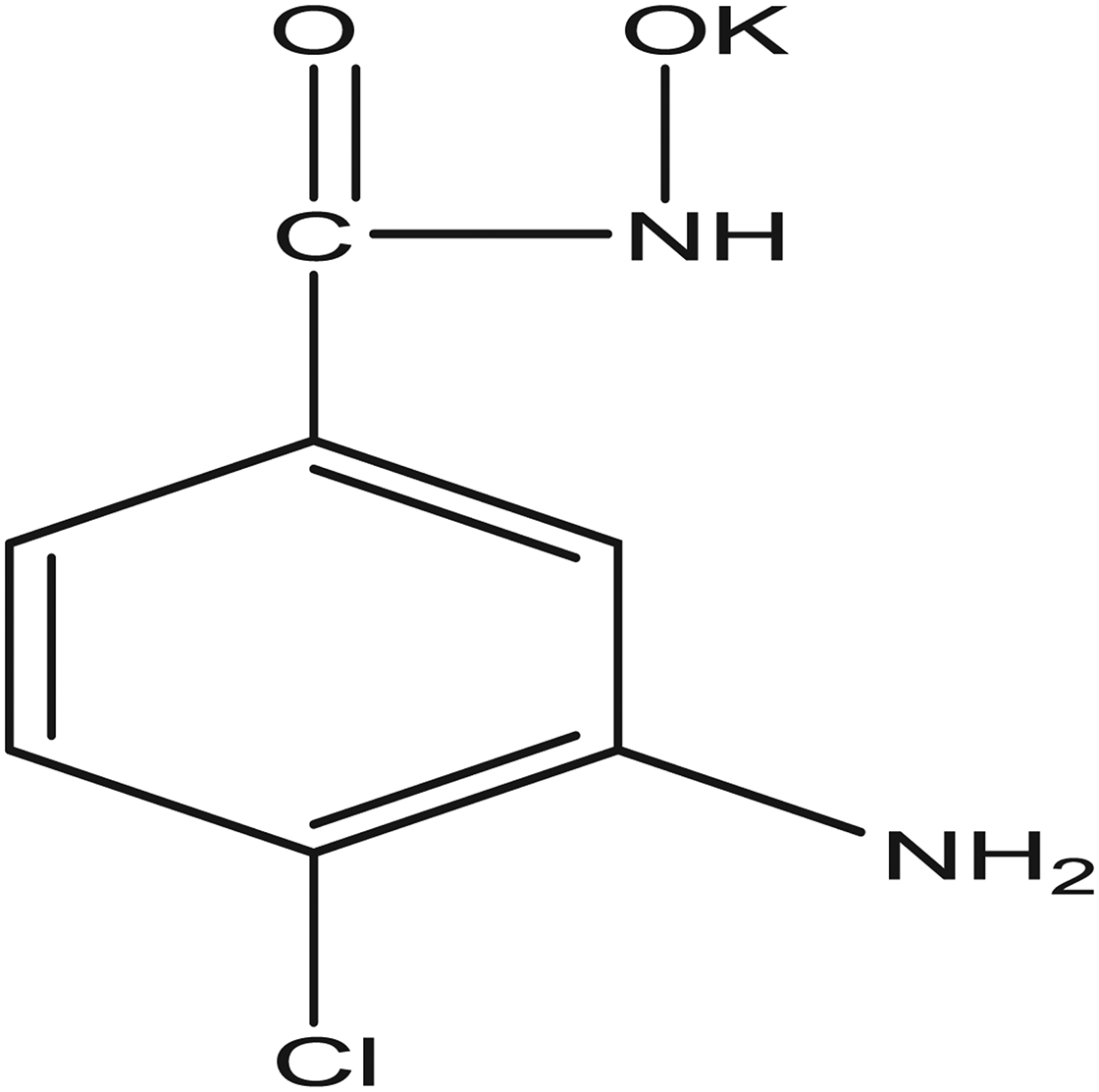
The chemistry of organotin (IV) compounds has been reported to display numerous potential applications in healthcare as anti-inflammatory, antituberculosis, anti-leishmaniasis and antibacterial agents [10–13]. The nature and number of organic groups attached to tin affect the properties of complexes especially the biological activity. As a part of our continuous interest in coordination chemistry of organotin(IV) hydroxamates [14–18] we report, herein the synthesis and characterization of di-and tri n-butyl tin(IV) complexes of a di-substituted hyroxamate ligand potassium 3-amino-4-chloridobenzohydroxamate containing electron donating as well as electron withdrawing substituents. The hydroxamic acids with electron donating substituent form more stable complexes by increasing the localized negative charge on oxygen atoms while those with electron withdrawing substituents exhibit higher biological activity [19]. Compared to numerous reports on transition metal hydroxamates [20–23] scattered reports describe tin and organotin(IV) hydroxamates [24, 25]. The newly synthesized complexes have been screened for in vitro antibacterial activity against some pathogenic bacteria, E.coli, P.Aeruginosa Bacillus cereus & Staphylococcus aureus
Experimental
Materials and physical measurements
All the solvents and chemicals were of reagent grade. The potassium 3-amino-4-chlorido-benzohydroxamate was synthesised by reported method [26]. The tin content in complexes was determined as tin dioxide by treating the complex with conc. H2SO4 (2 Volume) and conc. HNO3 (3 Volume) [27]. The chloride ion is determined by Volhards method [28]. The carbon, hydrogen and nitrogen analyses were obtained on Eager 300 NCH System Elemental Analyzer. IR spectra were recorded as KBr pellets on Nicolet-5700 FTIR spectrophotometer. The pellets were prepared in a dry box to avoid the action of moisture. 1 H and 13 C NMR spectra of complexes were recorded on BRUKER AVANCE II 400 spectrometer using TMS as an internal standard and DMSO (deuterated) as solvent. Electrospray ionization mass spectral measurements of complexes were recorded in chloroform(deuterated) with WATERS,Q-TOF MICROMASS(ESI-MS) mass spectrometer. The cyclic voltammetric experiment was performed on Autolab Potentiostat 128 N electrochemical analyzer in single compartmental cell of volume 10–15 mL containing a three-electrode system comprising of a Pt-disk working electrode, Pt-wire as auxiliary electrode and Ag/AgCl as reference electrode. The supporting electrolyte was 0.4 M KNO3 in milli-Q water and methanol-H2O (5:95) electrolyte system.
Synthesis
Antibacterial Activity
The ligand potassium 3-amino-4-chloridobenzohydroxamate and organotin(IV) complexes [n-Bu2Sn(C6H3(3-NH2)(4-Cl)CONHO)2](I), [n-Bu3Sn(C6H3(3-NH2)(4-Cl)CONHO)](II) were screened in vitro for their antibacterial activity on selected Gram positive bacteria S. aureus, B.cereus and Gram-negative bacteria Escherichia coli and P.aeruginosa at different concentrations in DMSO solution employing the standard Minimum Inhibitory Concentrations (MIC) method as recommended by National Committee for Clinical Laboratory Standard (NCCLS). MIC is the lowest concentration of the antimicrobial agents that prevents the development of visible growth after overnight incubation The commercial antibiotic tetracyclin was used as standard for the comparison of results.
The in vitro anti-bacterial activitiy of organotin(IV) hydroxamates through MIC assay are assayed in a 96-well micro-titre plate (tissue culture grade) by two fold serial dilution method using oxidation reduction colorimetric indicator dye Resazurin, for the determination of drug resistance and minimal inhibitory concentration of test complexes against different microorganisms. The dye, blue in its oxidized state turns pink when reduced by viable cells indicating the growth of bacteria. The lowest concentration of test complex that prevented this colour change was considered as MIC according to CLSI M07-A9 [29]. A stock solution of test ligand and complexes was prepared in DMSO (500 μg/mL) for two fold serial dilution. For MIC assay of each test complex; a row of twelve wells was used out of which last two wells were taken as control (no test complex added). The 100 μL of the Muller-Hinton broth was placed in each of the ten wells except the first well which contained 200 μL of broth and 500 μg / mL of the test complex. From the first well (containing test complex), 100 μL broth was withdrawn with a sterile tip, and same was added to the 100 μL of the broth in the 2nd well. The contents were mixed four times. In this way a range of two-fold serial dilution were prepared (500–7.81 μg / mL). Resazurin prepared as 0.02 % weight/volume in distilled water sterilized by filtration and stored at 4°C for one week was added to each well. The broth in each of the wells was inoculated with 20 μL of the bacterial culture and the contents were mixed by ten clockwise and ten anticlockwise rotations on a flat surface. Thereafter, the plate was incubated at 35°C for 24 h in case of bacteria. To evaluate the role of solvent in biological screening if any, separate studies were carried out with DMSO which did not show any activity. The results were compared with standard anti-bacterial drug tetracycline. All the experiments were carried out in triplicate [30].
Results and discussion
The reactions of n-Bu2SnCl2 and n-Bu3SnCl with potassium 3-amino-4-chlorido-benzohydroxamate (1:2 and 1:1) molar ratio respectively in MeOH/THF under reflux afforded white and light brown complexes in agreement with elemental analyses according to the equations:

Synthesis of complexes.
The complexes are stable in air and soluble in MeOH, CHCl3 and DMSO. The molar conductance values of the millimolar solutions of complexes in methanol (0.72 and 0.66 Scm2mol−1) are indicative of their non-electrolytic nature [31].
The formation of complexes has been ascertained from a comparison of their IR spectra with that of free ligand recorded in 4000–200 cm−1 region. The uncoordinated potassium 3-NH2-4-Cl benzohydroxamate ligand has shown two distinct ν(N-H) vibrations at 3481 and 3362 cm−1 due to asymmetric and symmetric N-H vibrations of amino substituent and at 3219 cm−1 attributed to characteristic ν(N-H) mode of hydroxamate group. The absorption bands at 1626 cm−1 have been assigned to ν(C = O) mode and at 1303 cm−1 and 965cm−1 to ν(C-N) and ν(N-O) modes respectively.
The [n-Bu2Sn(C6H3(3-NH2)(4-Cl)CONHO)2](I) displayed bands at 3450,3362 and 3212 cm−1 and [n-Bu3Sn(C6H3(3-NH2)(4-Cl)CONHO)](II) at 3470,3363 and 3215cm−1 due νasym(NH2), νsym(NH2) and ν(N-H) modes of amino substituent and hydroxamate group respectively (Table 1). The absorption bands due to ν(C = O) at 1623 and 1624 cm−1 and ν(C-N) at 1301 and 1301 cm−1 modes have appeared nearly at the same wavenumber as in free ligand respectively suggesting weak bonding through carbonyl group. An explanation to these observations may be offered as that in the presence of both the electron donating and electron withdrawing substituents at the phenyl ring, the carbonyl double bond character is not weakened upon chelate ring formation.
IR spectral data of di-and tri-n-butylltin(IV)hydroxamates.
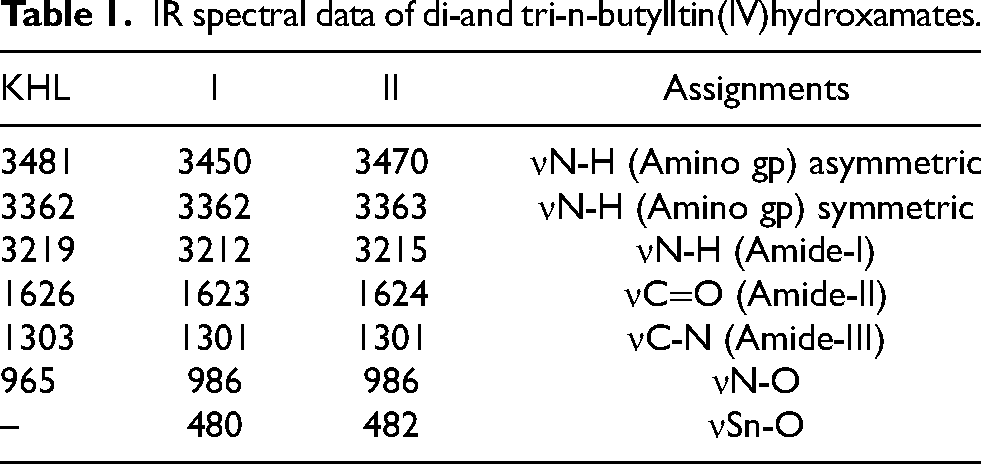
IR spectral data of di-and tri-n-butylltin(IV)hydroxamates.
The absorption band due to ν(N-O) mode has been observed to shift to higher wave number relative to free ligand occurred at 986 and 986cm−1 indicating bonding through hydroxamic oxygen atom of NHO- group upon complexation. The bidentate nature of the ligand involving bonding through carbonyl and hydroxamic oxygen atoms (O,O) of CONHO group has thus been indicated. The new bands observed at 480 and 482 cm−1 in (I) and (II) respectively may be assigned to νSn-O mode based upon previous reports [18, 32].
A comparison of room temperature 1 H NMR spectra of (I) and (II) with that of potassium 3-amino-4-chlorido-benzohydroxamate recorded in DMSO has further supported their formation. The ligand exhibited signals due to aromatic protons at δ 7.07–7.47 range, –NH2 substituent at aromatic ring at δ 6.98–7.0 and –CONH at δ 8.08 ppm. Complexes [n-Bu2Sn(C6H3(3-NH2)(4-Cl)CONHO)2] (I) and [n-Bu3Sn(C6H3(3-NH2)(4-Cl)CONHO)] (II) exhibited respective resonances due to aromatic protons, NH2 substituent and–CONH at δ 7.22–7.48;7.14–7.19 and 8.03; δ 7.24–7.47;7.15–7.17 and 8.0 ppm respectively. The signals due to aromatic protons have undergone moderate downfield shifts suggesting deshielding upon complexation. The resonances due to n-Bu group attached to tin metal have occurred in δ 0.88–1.70 ppm range in complexes (Table 2).
1 H NMR data of di- and tri-n-butyltin(IV) hydroxamates.

1 H NMR data of di- and tri-n-butyltin(IV) hydroxamates.
The 13 C NMR spectral pattern of (I) and (II) in [(CD3)2SO] is supportive of their composition in consistent with 1 H NMR spectra. The free potassium 3-amino-4-chlorido-benzohydroxamate exhibited resonances due to aromatic ring carbons, C-NH2 and CO at δ 114.19–143.26, 144.56 and 166.26 respectively. Complex [n-Bu2Sn[C6H3(3NH2)(4Cl)CONHO)2](I) exhibited the respective resonances and due to Bu-Sn at δ 115.92–129.09, 144.43, 166.20 and 13.65–25.78 respectively. Complex [n-Bu3Sn(C6H3(3-NH2)(4-Cl)CONHO)](II) displayed these resonances at δ 115.92–129.01, 144.32, 166.13 and 13.82–29.00 respectively. The small upfield shift in the position of carbonyl signal on complexation is indicative of coordination through carbonyl oxygen to tin metal (Table 3).
13 C NMR data of di- and tri-n-butyltin (IV)hydroxamates.

13 C NMR data of di- and tri-n-butyltin (IV)hydroxamates.
For di- and triorganotin(IV) compounds, empirical relationships between 1J(119Sn,13 C) and the corresponding C-Sn-C angle θ have been proposed by Lockhart et al. [33, 34]. The C-Sn-C bond angle (θ) can be calculated by following Lockhart and Manders equation:

In tetra-coordinated organotin compounds (θ ≤ 112°) 1Js are predicted to be smaller than about 400 Hz; for penta-coordinated tin (θ= 115–130°), 1Js fall in the 450–670 Hz range and for hexacoordinated tin (θ≥135°) 1Js generally larger than 670 Hz [35]. The tin-carbon J coupling, (1J(119Sn, 13 C)(1J), have been reported to depend on the C-Sn-C angle for tetra-, penta- and hexa-coordinated di- and tri-alkyltin(IV) compounds [36, 37].
From above equation, for complex (I) (1J = 710 Hz) and (II) (1J = 520 Hz) C-Sn-C bond angle (θ) have been calculated to be 139°03′ and 122°36′ respectively which are lying in the range of reported C-Sn-C angles for hexa and penta coordinate complexes [38, 39] indicating distorted octahedral (hexa-coordinate) and trigonal bi-pyramidal (penta-coordinate) geometry around tin in respective complexes.
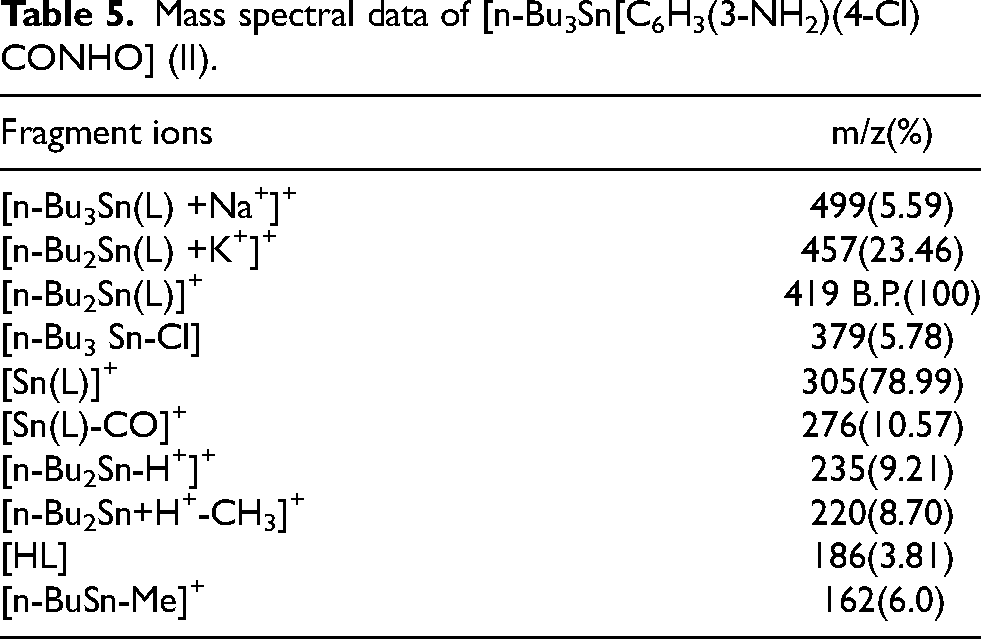
The ESI-MS of [n-Bu2Sn(C6H3(3-NH2)(4-Cl)CONHO)2]/ [n-Bu2Sn L2](I) (mass = 652) displayed the most intense peak at m/z(%) 652 (100) corresponding to [n-Bu2 Sn2(L)2+ 2Na]+ The fragment ions at m/z(%) 513(7.25), 457(6.17) 419(43.39),404(6.48), 305(12.53) 262(4.48) and 186(3.86) in (I) corresponded to [n-Bu Sn(L)2-Cl]+, [Sn(L)2-Cl]+, [n-Bu2 Sn(L)]+, [n-Bu2 Sn(L)-NH2]+, [Sn(L)]+, [L + 2K++[H]+]+and [L +[H]+]+ respectively. Complex [n-Bu3Sn(C6H3(3-NH2)(4-Cl)CONHO)]/ [n-Bu3SnL](II) (mass = 476) at m/z(%) 419(100) corresponding to [n-Bu2 Sn
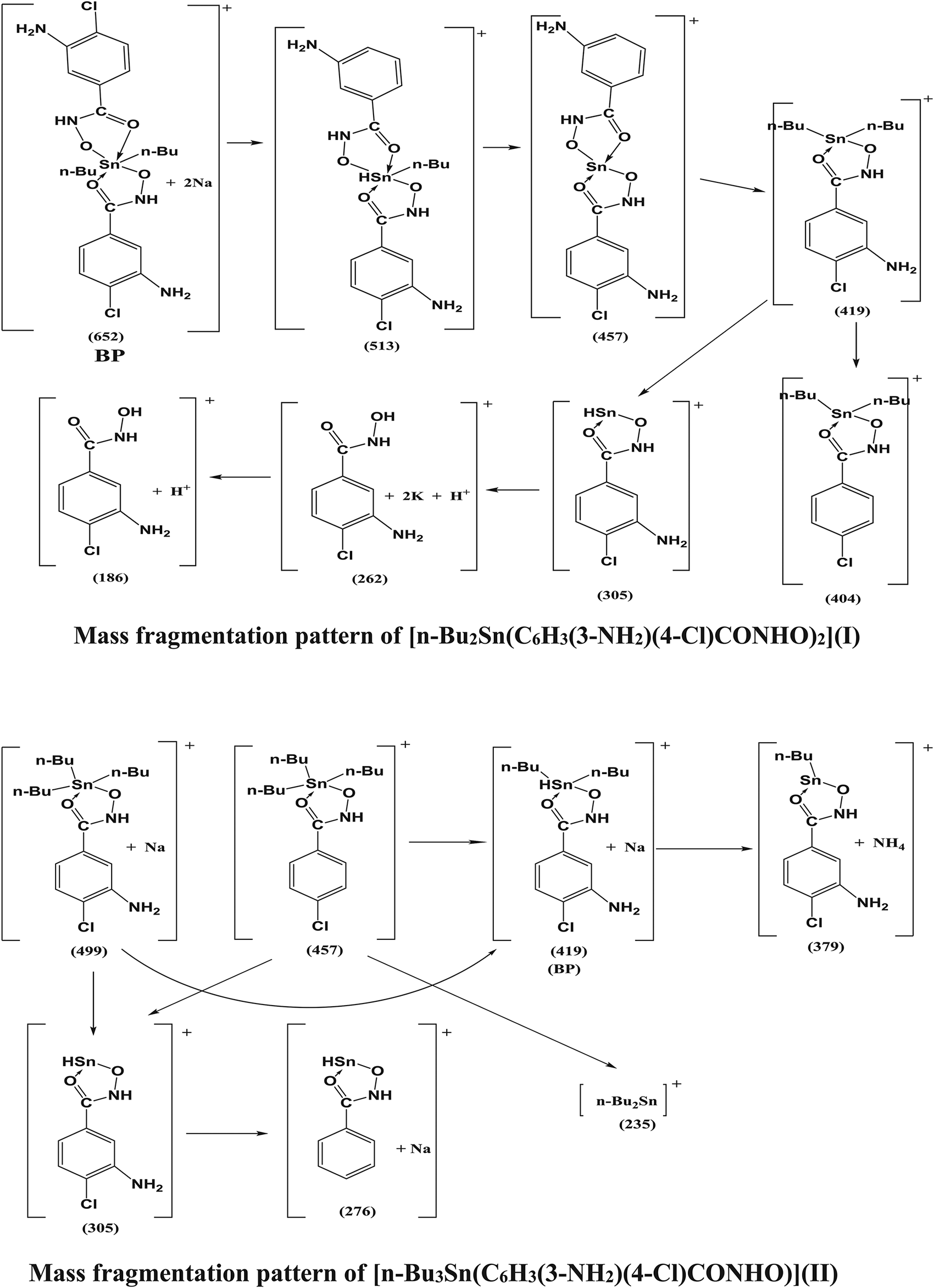
Mass spectral data of [n-Bu2Sn (C6H3(3-NH2)(4-Cl)CONHO)2](I).
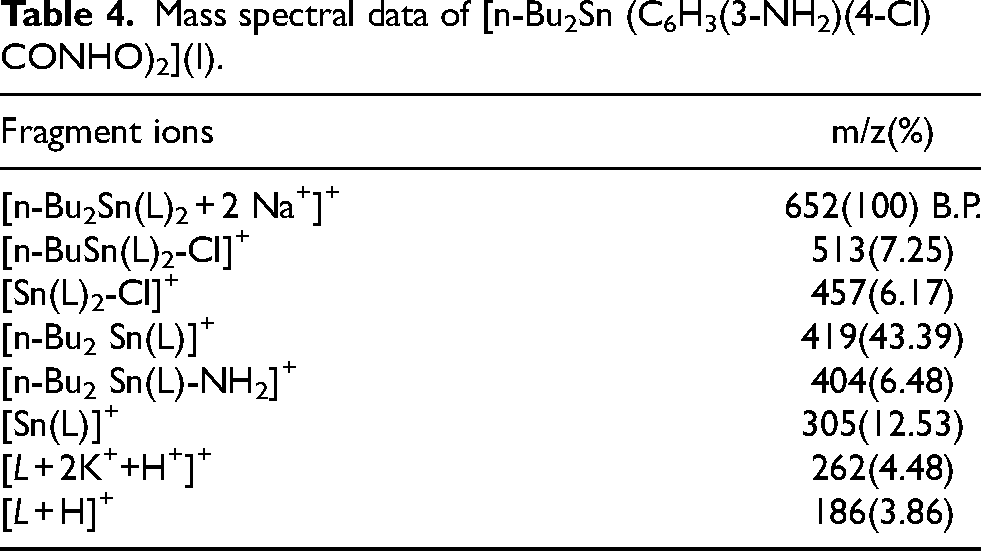
Mass spectral data of [n-Bu2Sn (C6H3(3-NH2)(4-Cl)CONHO)2](I).
Mass spectral data of [n-Bu3Sn[C6H3(3-NH2)(4-Cl)CONHO] (II).

The cyclic voltammetric measurements were carried out using 2 mM solution at room temperature in the forward scan in which potential is swept negatively from starting point to switching point and then scan direction was reversed in potential range –2.0 to +2.0 V with a single scan rate of 100mVS−1 [15]. The solution was degassed with N2 prior to use and kept under N2 atmosphere throughout the experiment. The cyclic voltammogram of potassium 3-amino-4-chloridobenzohydroxamate displayed one feeble Epccath and one moderate Epaoxd peak at –0.4858 and –0.6176 V respectively ascribed to quasi-reversible redox couple. Complex [n-Bu2Sn[C6H3(3-NH2) (4-Cl)CONHO)2](I) exhibited irreversible two electron reductions at –0.3735 and –0.8520 V with no anodic peak indicative of two sequential one electron reductions. The first step may be ascribed to be centred on the hydroxamate ligand followed by the second reduction with Sn-O bond cleavage. Complex [n-Bu3Sn(C6H3(3-NH2)(4-Cl)CONHO)](II) showed a feeble reduction at –0.4199 V.
Antibacterial activity
Of biologically active metallopharmaceuticals, organotin(IV) compounds exhibit biological potential depending upon the nature of the organic ligand (the easily dissociable ligand facilitates the transportation of complex across the cell membrane) and the nature and number of organic groups attached to tin [24]. The biological applications of organotin(IV) complexes derived from a variety of ligands have been reported [44–48]. Organotin(IV) hydroxamates have widely been investigated for their cytotoxicity [44–48] while reports on their antimicrobial activities are rather scarce [49, 50]. Hence, in vitro antimicrobial potential of new organotin(IV) hydroxamates towards Gram-positive bacteria Bacillus cereus and Staphylococcus aureus, Gram-negative bacteria P. aeruginosa and Escherichia coli has been studied by the MIC method recommended by National Committee for Clinical Laboratory Standards (NCCLS). The commercial antibiotic tetracyclin have been used as standard drugs for comparison of results.
Over the last few years, the microbial resistance to various antibiotics has become a serious healthcare issue. The trend of biological activity has been reported as dimethyltin > dibutyl tin > diphenyl tin [18]. The uncoordinated potassium 3-amino-4-chlorido benzohydroxamate inhibited the gram +ve bacteria (B.cereus and S.aureus) at MIC 62.5 μg/mL and gram –ve bacteria (E.coli and P.aeruginosa) at MIC 250 and 125 μg/mL respectively. Complex [n-Bu2Sn[C6H3(3-NH2)(4-Cl)CONHO]2](I) exhibited appreciable inhibitory effect towards studied bacteria at MIC 15.62–62.5 μg/mL range. The B. cereus and P.aeruginosa are prominently inhibited at MIC 15.62 μg/mL. Complex [n-Bu3Sn[C6H3(3-NH2)(4-Cl)CONHO](II) has also shown enhanced inhibitory activity against all the bacteria at MIC 31.25 –125 μg/mL. Of the two complexes, [n-Bu2Sn[C6H3(3-NH2)(4-Cl)CONHO]2] (I) has shown the pronounced growth inhibiting activity against the test bacteria than (II) (Table 6). The enhanced antibacterial activity of complexes may be ascribed to an efficient diffusion across the cell membrane [51–54] and hydrophobicity of hydroxamate ligand in consonance with Overtone’s concept and Tweedy’s chelation theory [55, 56] whereby the polarity of the central metal ion gets reduced by sharing its positive charge with the ligand upon complexation. This inhibits the activity of essential enzymes for microbial growth and their reproduction by blocking their interaction with DNA.
Antibacterial activity data of di- and tri n-butyltin(IV) hydroxamates (μg/mL).
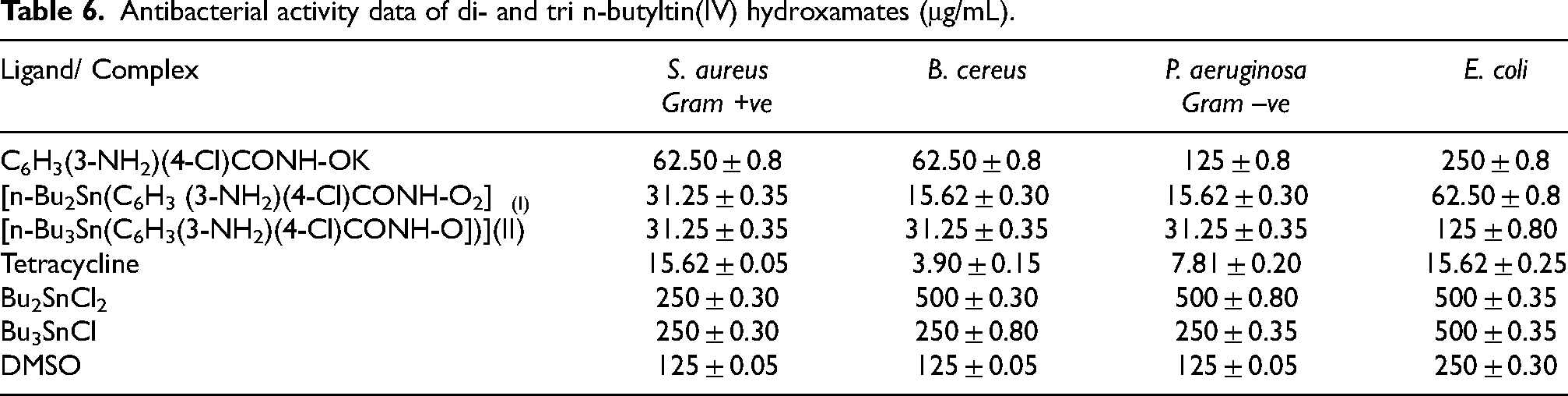
Antibacterial activity data of di- and tri n-butyltin(IV) hydroxamates (μg/mL).
The standard drug tetracycline inhibiting test bacteria at MIC 3.90–15.62μg/mL range is more effective against B. cereus and P. aeruginosa at 3.90 μg/mL and 7.81 μg/mL respectively.
The new di-and tri-n-butyl tin (IV) complexes of substituted benzohydroxamic acid (3-amino-4-chloridobenzohydroxamate) of stoichiometric composition [n-Bu2Sn(C6H3(3-NH2)(4-Cl)CONHO)2](I) and [n-Bu3Sn(C6H3(3-NH2)(4-Cl)CONHO)](II) have been synthesized and in conformity with elemental analysis characterized by IR,1 H and 13 C NMR specta and mass spectrometry. The IR spectra has suggested chelation of ligand through hydroxamic and carbonyl oxygen atoms (O, O) coordination. A distorted octahedral geometry around tin in (I) and trigonal bipyramidal in (II) has tentatively been proposed. The complexes are redox active undergoing an overall two electron metal centred reductions. The in vitro antibacterial activity assay of (I) and (II) on selected Gram +ve bacteria S. aureus, B. Cereus and Gram-ve bacteria E. coli& P.aeruginosa by MIC method has shown promising antibacterial activity than the parent ligand offering a great potential as new antibacterial agents.
Footnotes
Acknowledgments
Authors thank Sophisticated Analytical Instrument Facility (SAIF) Panjab University Chandigarh for recording