



Abstract
Mercaptopurine with the scientific name of 1.7-dihydro-6H-purine-6-thione and brand name of Purinethol, is among cancer treatment drugs. Accordingly, it is used to prevent the formation and expansion of cancer cells, the high solubility of which is effective on their better performance. In this study, using the calculations of Density functional theory (DFT) at level PW91/6-31(d), the stability of the drug structure in green and aqueous solvents was investigated, and by performing both NBO (Natural band orbital) and NMR (Nuclear magnetic resonance) calculations, the amount of molecular stability was calculated and no decay of the structure was found. Thereafter, in the laboratory section, the absorption spectrum of UV-Vis were investigated in both aqueous and alcoholic solvents and solubility of the drug. DFT calculations and laboratory results indicated the preservation of electronic properties of the drug structure in aqueous and alcoholic solvents as well as the increased solubility of the drug in alcoholic solvents compared with aqueous. Correspondingly, this is very important in the drug’s design and synthesis of similar drugs with less harm.
Keywords
Introduction
Mercaptopurine (MP) is increasingly prescribed as medicine for human and animals [1]. Moreover, it is used to make chemotherapy drugs and its main application is in the treatment of leukemia such as chronic lymphocytic leukemia and Hodgkin’s bread lymphoma [2]. Notably, this drug is as complicated as other chemotherapy drugs and has some side effects such as Lanphopeni, Clopeni, Tromboplast, and Anemi [3]. So, the investigation of the structure and behavior of Mercaptopurine in different solvents is very important. Considering that the solvent can change the physical, chemical, and electronic properties; therefore, it was shown that the behavior of solout in the solvent can reveal valuable information about the type and amount of the interaction of solout with solvent, as well as distribution of solout around the solvent, which has recently been investigated [4–6]. The spectral properties of Mercaptopurine, similar to many aromatic compounds that have donor and acceptor groups in their structures, are sensitive to solubility [7–10]. One of the important characteristics of each drug that should be determined, is maintaining both the structure and electronic properties of its structure in different solvents as well as the amount of solubility of the drug. Accordingly, it was found that by increasing solubility, the performance of the drug will improve. [11] Several studies have been previously conducted on Sodium Diclofenac solubility in different solvents using a Spectrophotometer. As a result, the best solvent system for the preparation of an injectable form of the drug has been suggested. [15–12] Moreover, some studies have been conducted on evaluating the physical and chemical stability of different skin products of Tertinoen. As well, different methods of drug release have been compared with each other [16]. In addition, the design of Methildopa drugs and penicillin with fewer complications was done, followed by optimization calculations, frequency calculations, and other quantum calculations in Gaussian. [17–18].
To investigate the structural properties of Mercaptopurine molecule, DFT calculations were used (Fig. 1). Besides, the chemical shielding of drug’s structure atoms and the amount of resonance as well as the stability of molecules in different aqueous and green solvents, were calculated by SCRF, NMR, and NBO calculations. Thereafter, to investigate the solubility of Mercaptopurine in aqueous and Ethanol solvents and Methanol, the research was conducted in the laboratory phase. In this regard, when the solubility of a molecule increases, the adsorption rate increases, as well. Using UV-Vis spectroscopy, the adsorption rate of Mercaptopurine solutions in water, Methanol, and Ethanol was investigated.

Structure of Mercaptopurine.
Using Gaussian 09 software and DFT method at level PW91/6-31(d), Mercaptopurine structure in water, Ethanol, and Methanol solvents was optimized. Thereafter, NMR and NBO calculations were performed to evaluate the stability of the structure and its electronic properties.
Materials and methods
Using Mercptopurine with the purity of 99%, which was purchased from Merck Company, the solutions with a concentration of 10–4M were provided in three different solvents of water, Ethanol (99%), and Methanol (99%) from Sigma Aldrich. Subsequently, the UV-Vis spectroscopy in the range of 200 to 400 nm was used to evaluate the solubility of the drug in both aqueous and alcoholic solvents using Spectrophotometer Cary, conc300, UV-made in Germany.
Results and discussion
Stability of the structure calculations in solvents
One of the methods used for designing drugs and reducing their harm is the choice of a Reference medicine. In the next step, its structural properties such as stability energy, electronic properties, and other effective parameters on the drug structure should be calculated. Finally, the laboratory measurements and its synthesis should be done via changing drug’s side effects, modifying the drug, and re-examining the structural parameters and the proximity of the results to the reference drug. In this study, although the change of side effects and the design of new drugs have not been evaluated, it has been attempted to identify the structural information of the drug reference anticancer, as Mercaptopurine. Correspondingly, these results will be useful in future research and design of novel anticancer drugs with fewer harms. In the calculation phase, considering the stability of the drug structure in solvents, the purpose was to study the energy of the structure as well as the stability and maintenance of the structure in green solvents (Ethanol and Methanol) and water. Accordingly, it should be noted that green solutions are used in drug’s synthesis.
By optimizing the Mercaptopurine structure in water, Methanol, and Ethanol environments using DFT method, it was shown that it maintains its stability structure in different solvents (Table 1). Additionally, the energy values of structural stability in water, Methanol, and Ethanol differ in the table about 0.05 kcal/mol, which indicates the stability of the structure in the solvent’s environment.
Calculation of energy for Mercaptopurine at PW91/6-31G (d) in terms of kcal/mol.
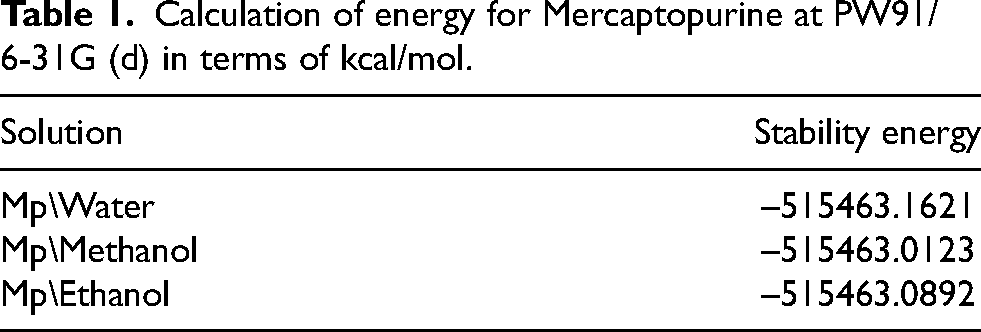
Calculation of energy for Mercaptopurine at PW91/6-31G (d) in terms of kcal/mol.
At this stage, some important parameters like σiso were obtained using NMR calculations, indicating the amount of Electron density around the atoms, which shows the chemical shielding. The purpose of this study was not only obtaining the amount of chemical shielding around atoms, but also to compare this value in the case of the side effect of C3 = S1 atoms, when the drug is located in the aqueous and green solvents (Synthesis). Of note, maintaining the degree of chemical shielding around the atoms after exposure to different solvents indicates the stability of the molecule’s chemical properties in different solvents for the synthesis or the function of the drug. NMR calculations performed on the drug’s structure showed that the chemical shielding values (σiso) (Equations 1 and 2) for sulfur atoms in C3 = S1 bond in aqueous, Ethanol, and Methanol solvents as 567.7852, 569.7621, and 451.0528, respectively, in ppm unit. Correspondingly, this indicates the electronegative properties of sulfur atom (Sulfur) relative to carbon in the S1 = C3 bonding


According to the results shown in Table 2, σiso and Δσiso for C3 = S1 bonding, which is known as the structural side effect of the drug, are located close to each other in aqueous, Ethanol, and Methanol environments in range. Accordingly, this indicates the preservation of the chemical properties of the structure during the synthesis or the function in the above-mentioned solvents.
NMR parameters in (ppm) for (C3 = S1) bonding in the computational level of PW91/6-31 G (d) in Mercaptopurine aqueous and organic solutions.
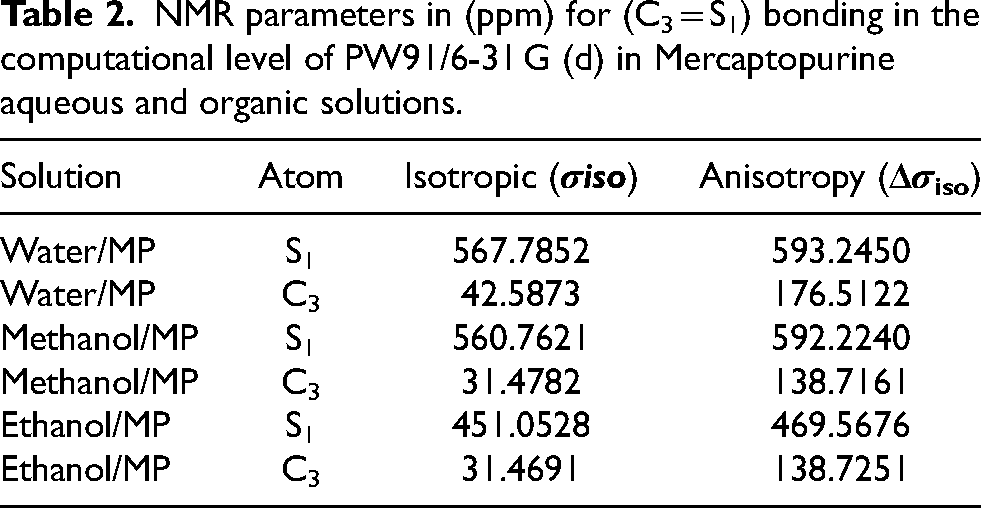
To identify the hybridization of atoms and to determine how to transfer the charge (Donor-Acceptor) electrons in orbitals, NBO calculations were used. Thereafter, the dual nature of the C3 = S1 bond and its resonance with the N4–C3 bonding in both water and green solvents were investigated. As a result, the above-mentioned calculations showed that the non-bonded electron of sulfur atom (Lp) had resonance bonding with anti-bond orbitals (*σ) in the C3 = S1 bonding (Table 3); indicating that the S1 = C3 linking has no dual nature and resonance with C3–N4 bond. NBO calculations showed that the drug’s structure in aqueous, Ethanol, and Methanol solvents retains its electronic properties. So, the nature of the structure as well as its chemical and physical properties do not change much.
Resonant energy values and Donor/Acceptor for Mercaptopurine structure in both organic and aqueous solvents on thePW91/6-31G (d) surface.

Resonant energy values and Donor/Acceptor for Mercaptopurine structure in both organic and aqueous solvents on thePW91/6-31G (d) surface.
An amount of resonant energy (E2) of electron transfer between pairs of sulfur non-bonded electrons and C3–N4 anti-bonded orbitals was located in aqueous solvents Methanol and Ethanol, ranged from 4.43 to 3.42 and from 25.36 to 25.49 kcal/mol, respectively, indicating the preservation of the chemical properties of the drug’s structure in different solvents.
After the DFT calculations on the structure of the drug molecule and the results of the calculations that showed the stability of the structure as well as no decay of molecules in aqueous, Ethanol, and Methanol solvents, the computational part of the paper represents electronic properties such as structural, resonance, and chemical density. In this regard, the lack of significant change was observed in these properties, indicating the stability of the physical and chemical properties of molecules in the solvents. Subsequently, the solubility of the drug in the above-mentioned solvents was investigated using laboratory methods. The more the solubility of the drug in the desired solvents, the better the performance of the drug, which uniformly exists in the solvents. Next, in order to investigate the dissolution rate of the drug in the solvents, the absorption of the resulting solutions was measured by UV-Vis spectroscopy. Correspondingly, the increased absorption rate indicates uniform dispersion of the solvent in the solvent along with more absorption of wave lights.
Using Mercaptopurine with the purity of 99% as well as pure Methanol and Ethanol solvents with the purity of 99%, the solutions with concentrations of 10–4 Molar were prepared, which contained water/drug solution, Ethanol/drug, and Methanol/drug. Thereafter, the absorption spectrum of the previously prepared solutions was between 200 and 400 nm. Based on the results (Table 4) obtained from UV-vis spectrum, the adsorption rate of the solutions is as follows: (0.89) Ethanol/drug>(0.864), Methanol/drug> (0.0587) water/drug.
Absorption rate of Mercaptopurine in the green solvents.
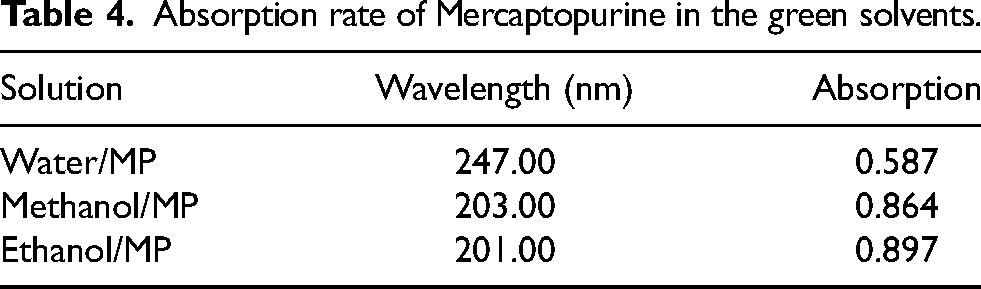
Absorption rate of Mercaptopurine in the green solvents.
The results show that Mercaptopurine in the green solvents (Ethanol and Methanol) has more absorption rate than in water solvents, indicating more solubility and diffusion of this drug in alcoholic solvents (green). As well, the importance of this issue is because of the stages of this drug’s synthesis in the green solvents and also due to the reason that the drug maintains its function in the presence of the prepared solvents (Fig. 2).
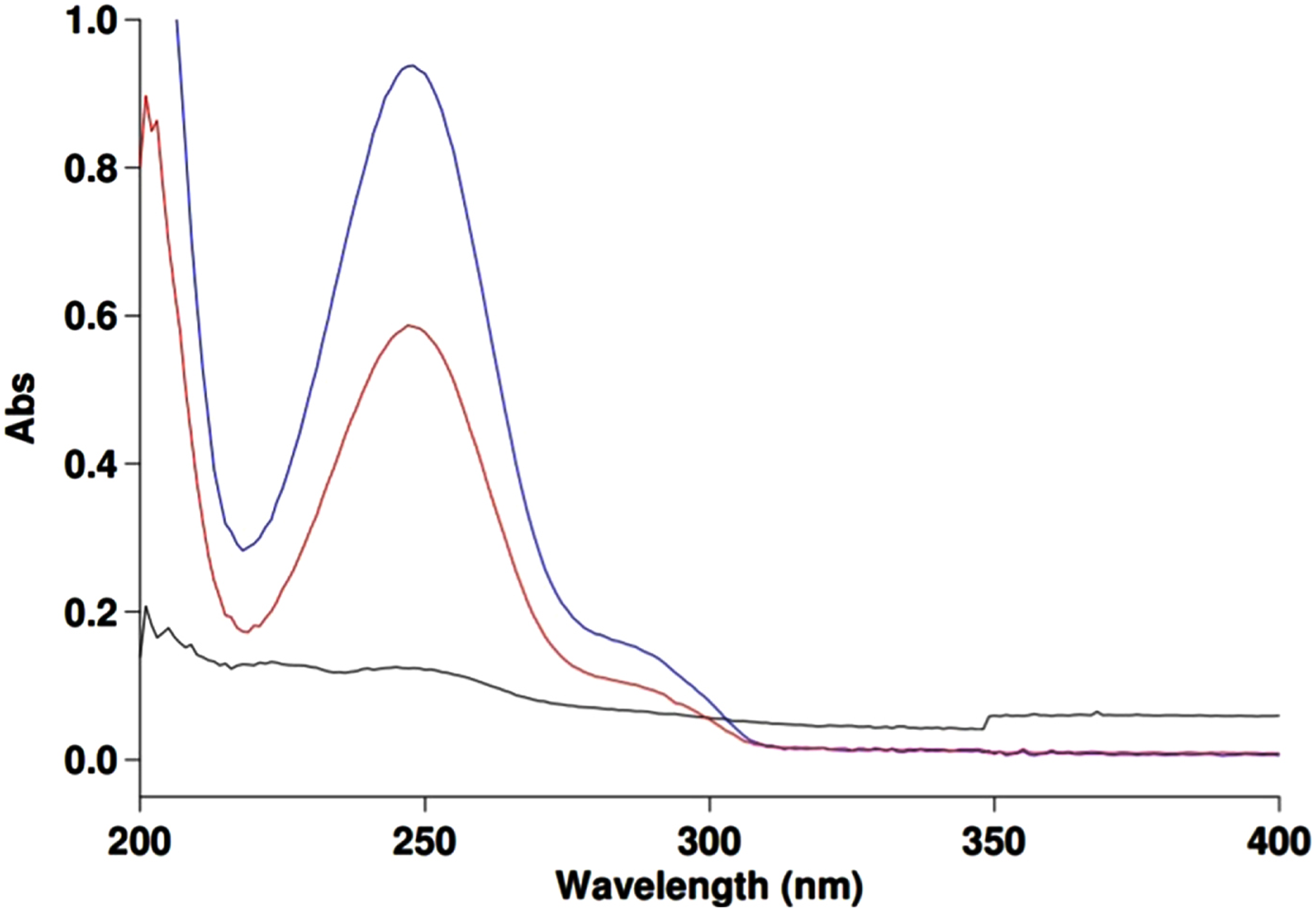
UV-Vis absorption diagram of Mercaptopurine in water, Methanol, and Ethanol solvents.
To investigate the stability and preservation of the molecular structure of Mercaptopurine in the green solvents (Methanol and Ethanol), DFT calculations at level PW91/6-31(d) and laboratory studies were performed. Based on the results obtained from NMR and NBO, it was shown that the molecule at the side effect site, i.e. bond S1 = C3, maintains its chemical shielding around the atoms as well as its chemical resonance to a large extent. Accordingly, this indicates the stability and preservation of the physical and chemical properties of the molecule in both Ethanol and Methanol solvents. In addition, Laboratory investigations of UV-Vis of drug molecule in the green solvents had solubility as well as water; and also with the increase in Alkil groups, its solubility has also increased, showing the balanced distribution of molecules in solvents as well as a better performance of the drug. In the current study, the solubility of the drug was examined from the absorption parameter and the increase in absorption indicates an increase in the solubility of the drug. The results of this study show that the green solvents can be used for synthesis and even for designing drug by changing the side effects of Mercaptopurine. in future research by changing the structure of the purine molecule and comparing its electronic properties with drug Mercaptopurin,the possibility of drug synthesis with similar properties and less side effects will be investigated.