



Abstract
An in-situ thermal behavior study was conducted on the metallic tantalum under two conditions. The experimentation was carried out on tantalum pellets which were heated progressively “underwent reaction and under continuous pumping or under controlled monoxide pressure” in a graphite resistance high temperature X-ray diffractometer up to 2300 K. Through the in-situ study, a thermodynamic analysis showed that this involved the formation of Ta2O, Ta2O5 (low temperature modification) and Ta2C likely to be formed between 293 and 2300 K, in agreement with a reaction mechanism that we established to occur in four stages.
Introduction
The oxidation states of tantalum range from +5 to +7, and the oxyanions formed can be either mononuclear, or polynuclear. The main group chemistry of oxygen in tantalum is therefore a function of the oxidation state and the oxyanions formed. Thereby the tantalum – oxygen system comprises several oxides: Ta4O, Ta2O, TaO, TaO2 and Ta2O5. However, only the pentoxide Ta2O5 has been formally identified by several authors, which is why the phase diagram of this system does not contain the other oxides.
In order to understand the behavior of the tantalum metal in the presence of oxidizing agents, many investigations have been carried which led to conflicting results, both kinetically and structurally. A variable number of reaction steps have been proposed to report the oxidation phenomenon of the metal.
Thus, several studies have investigated the Tantalum oxidation [1–15] after which it has been established that oxidation was a complex phenomenon dependent on temperature and pressure, the reaction mechanisms proposed to account for the metallic tantalum reactivity differ from one author to another. It should be noted that all these mechanisms have been proposed based on the analysis and / or identifications made on quenched products. Contradictions often occur between the information obtained and those resulting tempered products, contradictions that can be the source of controversy, we felt it necessary to undertake in situ study of the metallic tantalum’s thermal behavior and maintained under vacuum controlled by carbon monoxide X-ray diffractometry pressure at high temperatures.
The in situ recorded diffractograms concern a thin layer of the sample examined. As this superficial thin layer is precisely the one that reacts faster with the gaseous phase, we have the right to expect an accurate identification of compounds formed at the same time as the hot metal reacts and propose the reaction mechanism actually happening in high temperature.
Material and methods
The device implemented has been described elsewhere [16]; it is essentially constituted of a graphite resistance furnace to work easily up to 2300 K as well as under dynamic vacuum than under controlled pressure. This furnace is secured in a PW 1050 Philips goniometer vertical axis, itself fixed on a PW 1011 Philips diffractometric unit including a copper anticathode (λ1 = 0.15405 nm).
The furnace enclosure is linked to devices for quantifying pressure or to the control of gas introduction. The temperature of the sample is measured using a pyrometer MECI PM130, with an uncertainty of 30 K between 1073 and 2300 K. The samples used in this study were made from polycrystalline tantalum metal supplied by Johnson-Matthey (Specpure quality); the shaping was made by plain axial compression under a 100 MPa to get a cylinder-shaped pellet of 3 mm thick and 8 mm diameter. The pellet gotten was afterward placed in the graphite sample holder, any interaction between the sample and carbon being avoided by a washer and a tungsten jacket. After which, the sample was removed upward in the heating area of the furnace. The test consists of performing a series of steps by heating under vacuum or under CO pressure: a diffractogram is systematically registered at each level. The indexation of the observed phases and the calculation of crystalline parameters of their unit cell were performed using Affin and Index programs based on a least-squares calculation.
Results
A crystalline parameter ‘a’ equal to 0.3308 nm characterizes at no heated state the metallic tantalum with a cubic structure [17, 18] highly crystallized constituting each of the three starting pellet. The first test consisted primarily in a slow heating under dynamic vacuum (1088≤T (K)≤1508). The diffractograms recorded at high temperature revealed a decrease in the relative intensity (Ir) of the metallic phase diffraction peaks and the presence of new peaks that we have attributed to hemioxide Ta2O in a cubic structure [19] and a variety “low temperature” of pentoxide β-Ta2O5 in a monoclinic structure [20]. The intensity (Ir) of this pentoxide peaks increases with the heating at a same time as decreases the proportion of the metal, and that up to 1298 K, temperature at which the Ta2O phase disappears and appears the hemicarbide Ta2C on hexagonal symmetry [17, 22]. The recorded diffractograms at different temperatures in a first anneal (1618≤T (K)≤1933) allowed us to notice that it occurs, at the surface of the pellet, successively: the disappearance of the metal and its replacement by α-Ta2O5 in a tetragonal symmetry [22], from the beginning of the annealing; the increasing of the β-Ta2C proportion at the expense of the 2 oxides Ta2O5 between 1618 – 1723 K; and the reappearance of the metallic phase from 1833 K concomitant with the decrease in the proportions of the two pentoxides and hemicarbide until it disappears around 1933 K.
At low temperature, the surface of the pellet is formed only by the metallic phase.
A second vacuum annealing revealed the absence of the metal reactivity except the thermal expansion of its “a” parameter (0.3316≤a (nm)≤0.3369 for 293≤T (K)≤2278).
Therefore, we set out to study the metal behavior under CO atmosphere and have realized a third isothermal annealing (T = 2033 K) in which we conducted successive introductions of low amounts of CO: this caused the replacement of the metal by carbide β-Ta2C which was replaced than by the stoichiometric monocarbide TaC (a = 0.4457 nm at 293 K).
We present in Table 1 below the synthesis of this test.
Cell parameters of the phases formed during the first test under PCO
Cell parameters of the phases formed during the first test under PCO
We used a second pellet to make another try, however this time with a quick temperature rise (1343≤T (K)≤1828). Our observations are similar to the previous ones: disappearance of the metal and its replacement by the hemicarbide phase then the reverse reaction from 1883 K. The second annealing performed under vacuum until 2108 K also revealed the absence of the metal reactivity. At this temperature, we performed an introduction of CO, this latter was immediately absorbed by the pellet and caused the replacement of the metal by β-Ta2C than this latter by TaC. We present, in Fig. 1 below, the various phases that have emerged versus temperature.
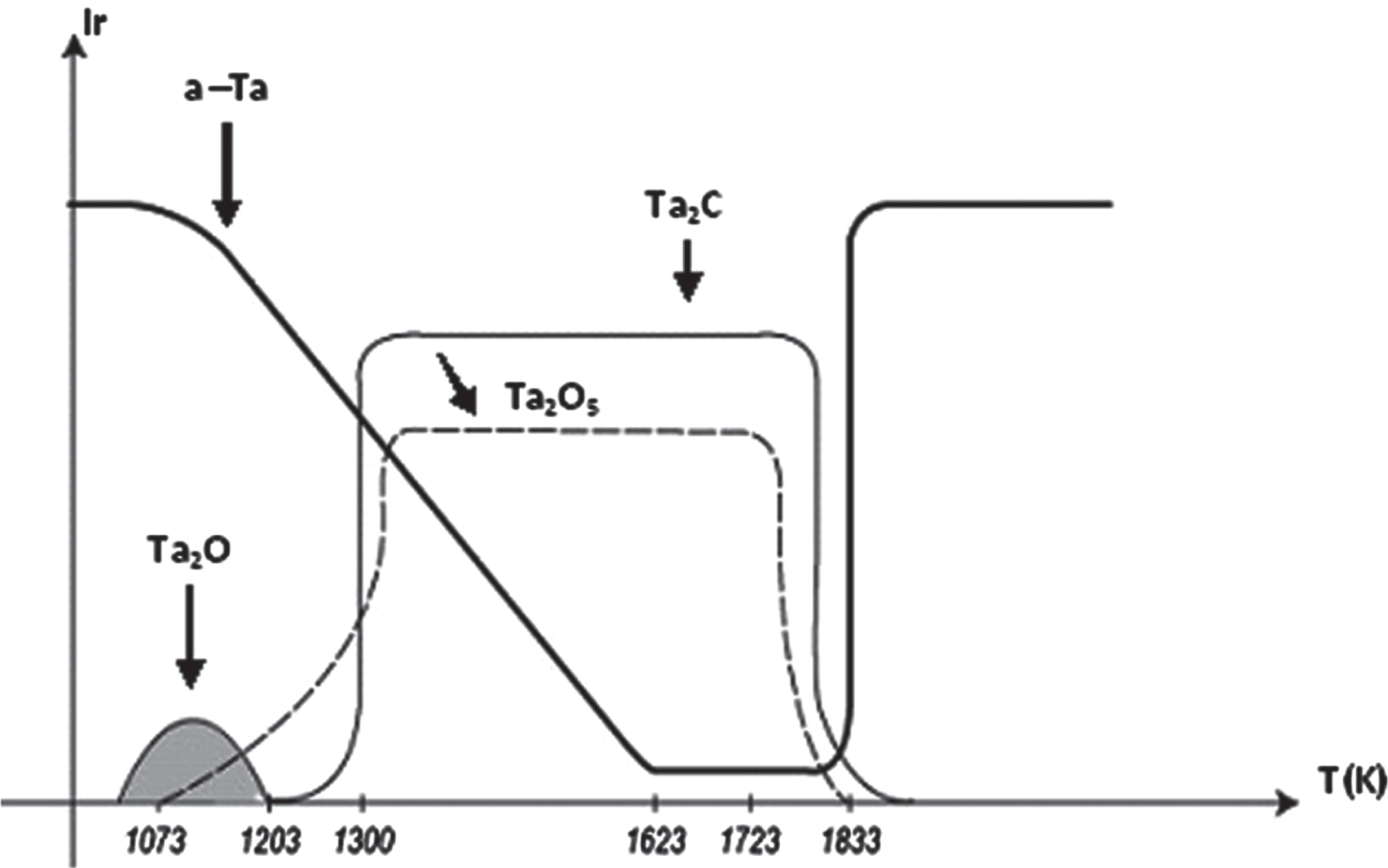
Schematic representation of the phases formed on the surface of a tantalum pellet heated under dynamic vacuum (10- 2≤P(Pa)≤30 10- 2).
We present in Table 2 below the synthesis of this second test.
Cell parameters of the phases formed during the second test under PCO
A third pellet confirmed all of the previous observations: surface oxidation at first, followed by carburization. We present in Table 3 the summary of this test.
Cell parameters of the phases formed during the third test under PCO
Interpretation of the kinetic results
Principal models of tantalum oxidation
The oxidation of the tantalum by oxygen or carbon dioxide has been the subject of kinetic investigations [2, 4, 10] after which, four reactional steps were proposed that occur between 973 and 1153 K: dissolution of oxygen in the metal and formation of a primary solid solution TaOx with body centered cubic structure
formation, from this solid solution, of sub oxide Ta2O
formation of pentaoxide Ta2O5 from the sub oxide Ta2O
formation of pentaoxide from the solid solution TaOx
The tantalum metal behavior is quite different in the presence of CO or CO/CO2 mix [11]; Indeed, it was proposed different reactional steps from the preceding: it is a CO(g) carburizing and CO2(g) oxidation at 1373 K according to the following steps: formation of the hemicarbide Ta2C
formation of the monocarbide TaC
These two previous reactions generate enough CO2 (g) which penetrates inside the sample to oxidize the metal according to:
Finally, the carburization of that pentoxide happens
This is a deep reactional mechanism change where the CO2(g) produced by the carburization is able to diffuse inwards to oxidize the metal.
The reaction mechanism proposed in this study
The observation of metal that oxidizes then carbide at high temperature can be understood in the light of thermodynamics. According to results from of Turkdogan [23] and Kubaschewski [24], the oxidation of tantalum by the reaction: (4 Ta(s) + 5 O2(g) ⟶ 2 Ta2O5 (s)) requires such low O2 partial pressures (10- 61≤PO2 (Pa)≤2,5 10- 17 in the interval of 500 < T(K) < 1400) that this material oxidizes spontaneously and so much more easily in low temperature. Obviously, the formation of a lower oxide such as Ta2O is, under these same conditions, very easy. We agree here with the conclusions of previous studies of the tantalum oxidation by CO2 [11] or by oxygen [25] according to which a low O2 pressure stabilizes the sub oxide Ta2O and inhibits the Ta2O5 direct formation.
After the partial oxidation of the pellet, the hemicarbide Ta2C appears from 1298 K in a dynamic vacuum of 2.7 10- 2 Pa, the carburizing agent being CO. We are considering, in accordance with the Boudouard reaction, the existence of a carbon C* transfer from the hot parts of the resistor to the sample and due to the CO2 existing in the residual atmosphere (CO2(g) + C*(s) ⟶ 2CO(g)); this reaction is, according to the thermodynamic data [23, 24], spontaneous above 978 K: It is the CO thus formed which is the principal carburizing agent of our samples.
According to Fig. 1, the Ta2C compound coexists with the metal and the Ta2O5 from 1298 K, this carbide is therefore formed from one or the other according:
We used Turkdogan’s data [23] and evaluated the lowest CO pressures so that the two previous reactions took place at 1298 K assuming that the residual atmosphere (2.7 10- 2 Pa) consisted in a CO/CO2 mix, we ended up with pressure values close to (2.44 10- 2 Pa and 2.68 10- 2 respectively for the two reactions) which clearly show that under our conditions, these two reactions are almost concomitant. Our observation of the tantalum which simultaneously oxidizes and carbide agrees perfectly with the phase stability diagram of the Ta-O-C system that we have plotted with Turkdogan’s data at 1400 K under a residual pressure of 10- 2 Pa (Fig. 2).
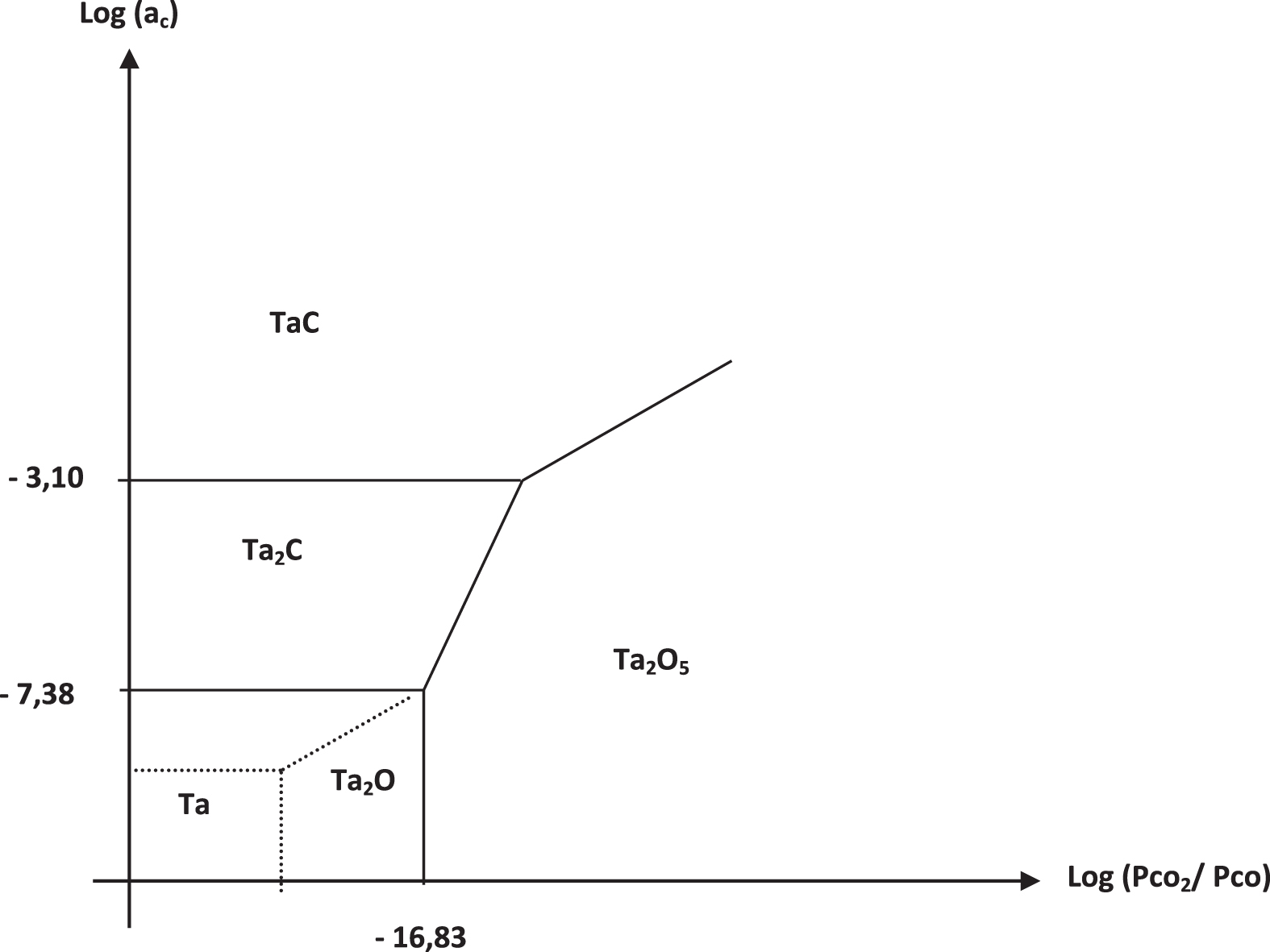
Solid phase predominance diagram of Ta-O-C system at 1400 K under a residual pressure of 10- 2 Pa.
The general appearance of this diagram remains unchanged at any temperature as clearly shown in the values reported in Table 4.
Solid phase predominance diagram coordinates of Ta-O-C system at different temperatures
The study of Figs. 1 and 2 allows us to propose the succession of the following reactions to report the thermal behavior of tantalum under vacuum. It consists of two main stages which are a compromise of the previous models proposed: the oxidation by the residual oxygen (equations 1 to 3), which agrees with the first proposed model in the bibliography and a carburization by carbon monoxide consistent with the second model. formation, from the metal, of the sub oxide Ta2O
formation of pentoxide Ta2O5 from the sub oxide Ta2O or from the metal
carburation of the metal
carburation of the pentoxide
Under pressure of carbon monoxide, the carburation continues by
The α-Tantalum metallic phase
Tantalum is a refractory metal that exists in two stable forms: the cubic α variety [17, 17, 26] and the tetragonal β variety [27]. This metal has rarely been investigated at high temperatures; the experimental studies which were devoted to it dealt only with certain thermo-physical properties, this is the case of the Milosevic’s article [28] relative to the variations of the electrical resistivity and the thermal capacity Cp between 300K and 2300K and of the Takahashi’s article [29] which concerns the variations of Cp between 80K and 1000K.
Under our experimental conditions, tantalum showed two distinct behaviors when hot: stage 1 of ‘reactivity’ which corresponds to the oxidation then to the partial metal carburization up to 1833K, the temperature from which the process reverses and induces the reappearance of the metal, this is stage 2 ‘absence of reactivity’.
We have shown in Fig. 3 the cubic lattice parameter variations of the α-Ta phase as a function of temperature. The experimental points corresponding to the metal in a reactivity state are distributed substantially along the straight line 1 (symbol ■ in Fig. 1) with an average coefficient of linear expansion α1 = 10.5 10- 6 K- 1 and along straight line 2 (symbol ▴) with an average coefficient α2 = 7.5 10- 6 K- 1 for the stable metal at high temperatures.

Lattice parameter variation of tantalum as a function of temperature.
The existence of 2 distinct straight lines which reflect the expansion of the tantalum lattice cannot be attributed to the inevitable errors made during the determination of the reticular distances or the temperature measurements. A more satisfactory explanation consists in admitting that this anomaly results from variations in composition: oxygen atoms (or carbon atoms when the temperature exceeds 1773K) can indeed enter into insertion by occupying a few octahedral sites of the metal centered cubic lattice forming thereby a solid solution of insertion in atomic proportions that can reach 7.5% in carbon [26] or even 30% in oxygen [30]. The same type of solid solution is found with the groups IVB and VB metals whose oxygen atomic ratios are 28.6, 20.6, 24 and 3.5% respectively for zirconium [31], hafnium [32], titanium [33] and niobium [34].
The increase observed in the cell parameter of cold metallic tantalum (Fig. 1) is essentially due to contamination by oxygen. As with the groups IVB and VB metals, tantalum plays a ‘getter’ role towards to oxygen. It is indeed well known that the insertion of oxygen or carbon in these metals stabilizes their form at high temperatures: the systematic reappearance of the metal above 1833K is explained, in our opinion, by a rapid carbon depletion of the hemicarbide phase then in oxygen of the pentoxide in order that the reappearing metal remains sufficiently contaminated by oxygen which then gives it a certain stability which explains the lack of the sintered metal reactivity.
The Ta2C phase manifests itself in 2 forms: the ‘low temperature’ variety called α-Ta2C rhombohedral (structure type C6, space group Pıotam) and the ‘high’ variety called β-Ta2C hexagonal (structure type L’3, space group P63/mmc) [17]. The structure of α-Ta2C can be described as a compact hexagonal stack of tantalum atoms where carbon occupies half of the octahedral sites giving this carbide a lamellar structure where, between the tantalum planes, alternately follow a layer of carbon and an unoccupied plane [35, 36]. The phase transition between the 2 forms is considered to be reversible and lies in the interval 2123 K – 2453 K [17, 37–39]. We have represented in Figs. 4a, 4b and 4c the variations, as a function of T, of the parameters a and c as well as those of the volume of the α-Ta2C variety hexagonal cell.
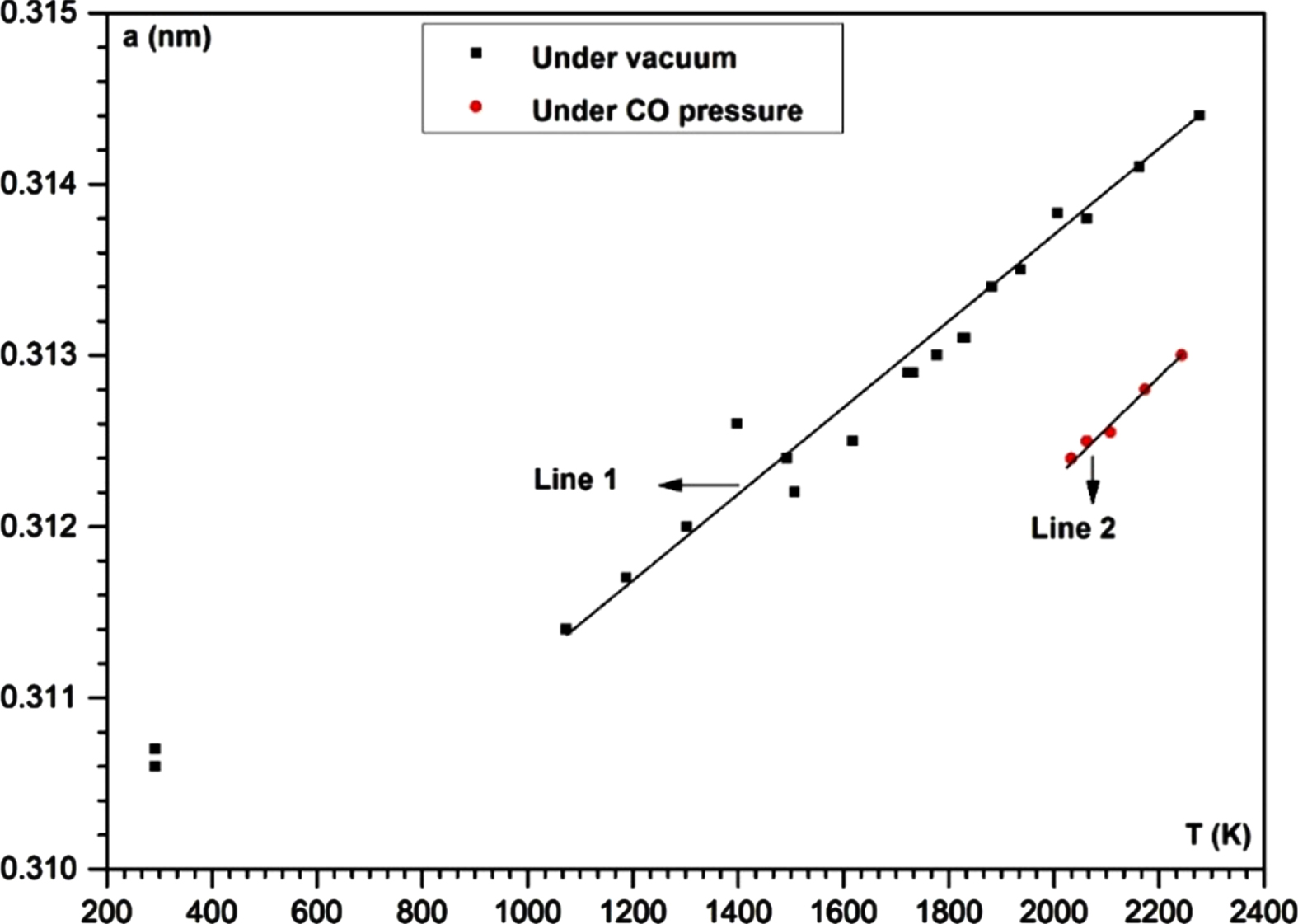
The variation of the α-Ta2C lattice parameter ‘a’ as a function of temperature.
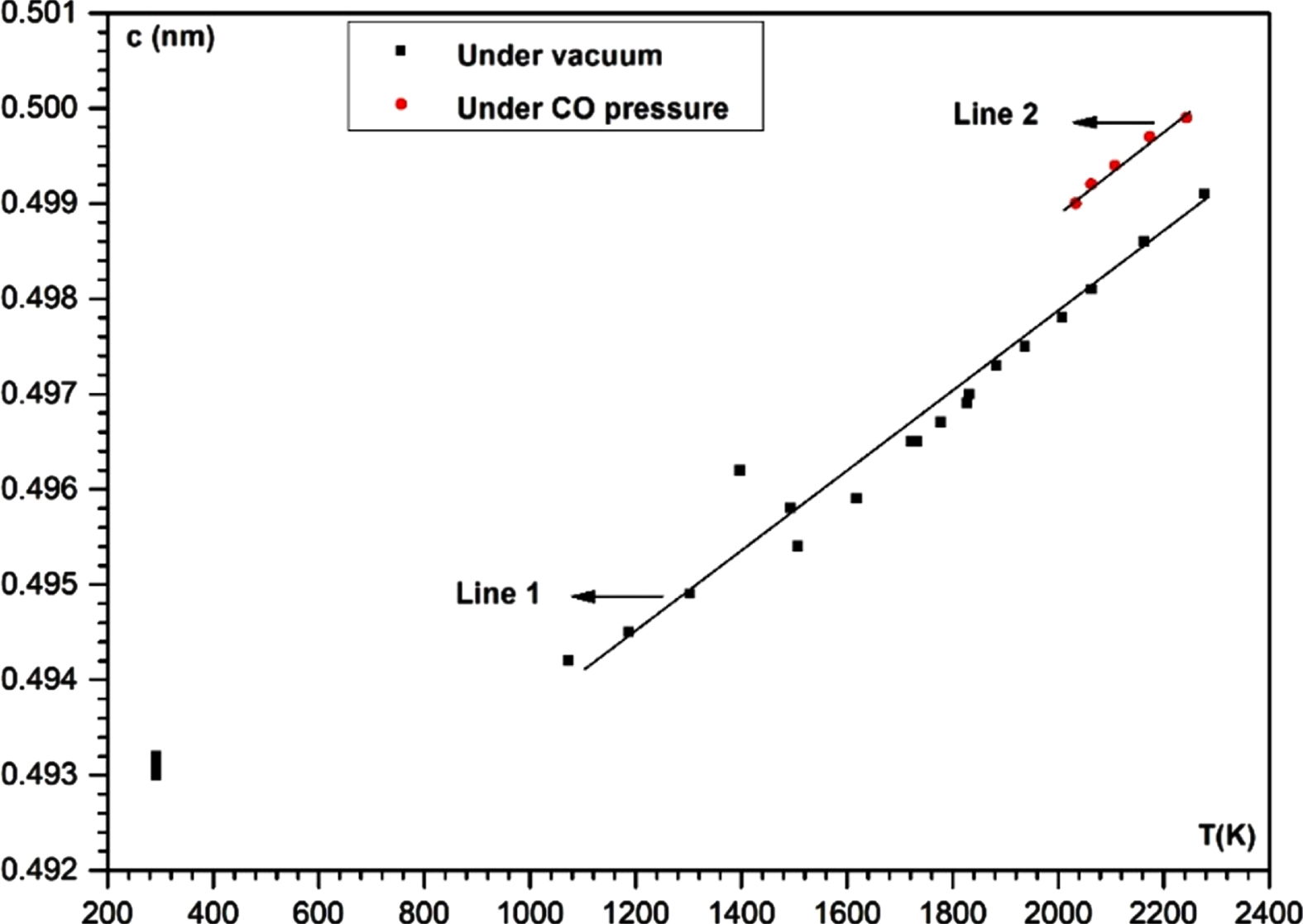
The variation of the α-Ta2C lattice parameter ‘c’ as a function of temperature.
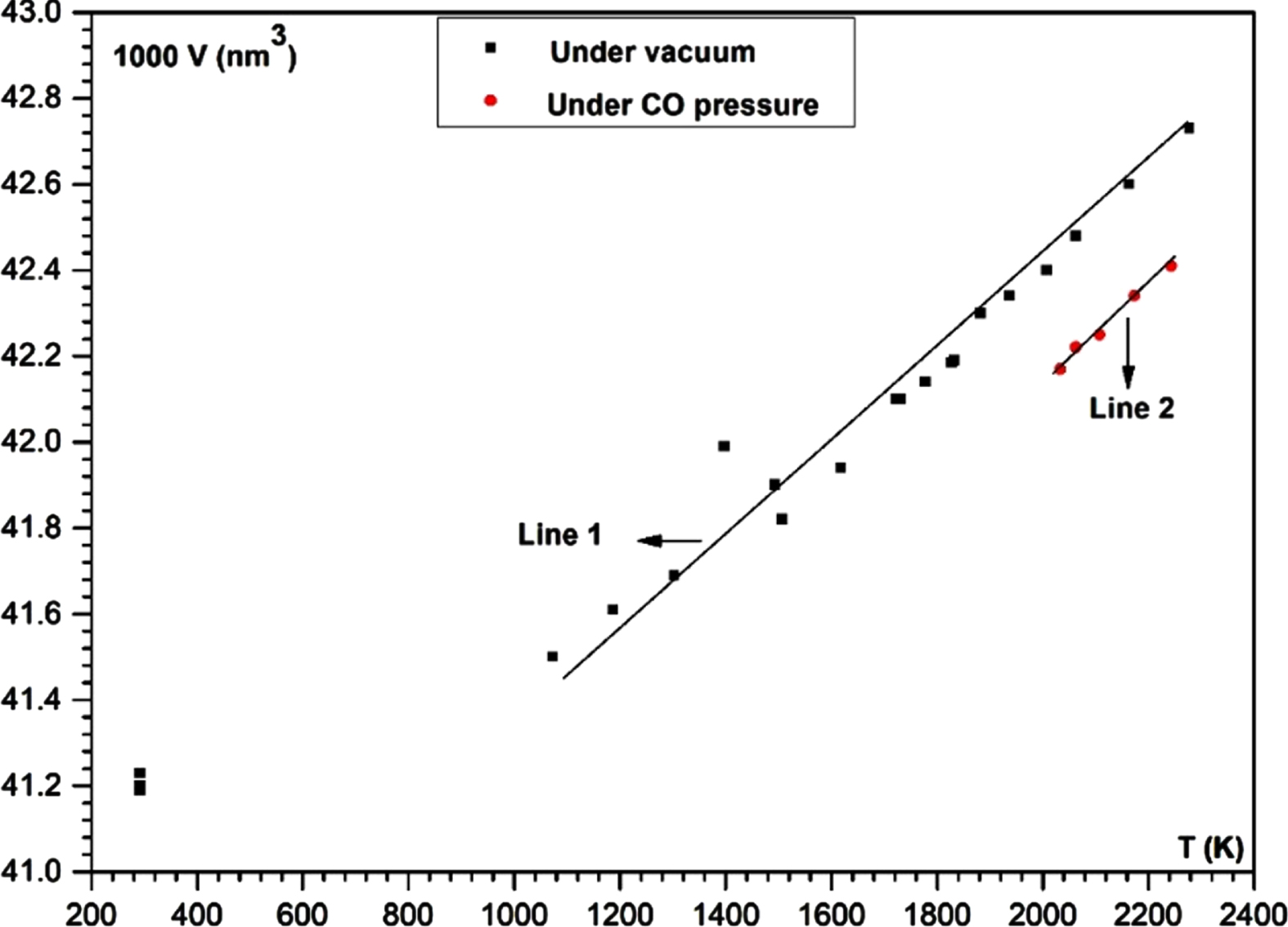
The variation of the α-Ta2C unit cell volume as a function of temperature.
According to these 3 Figures, these variations are made substantially according to very distinct lines: Line 1 for the hemicarbide that we obtained under vacuum, whatever the phases which coexist with it, and line 2 for the hemicarbide which manifested itself alone under CO pressure. These straight lines are characterized by linear dilation coefficients values which confirm the relationship αv = 2αa + αc as clearly shown by the following values:
– Line 1: αa = 9.1 10- 6 K- 1 | αc = 9.8 10- 6 K- 1 | αv = 28.1 10- 6 K- 1
– Line 2: αa = 9.1 10- 6 K- 1 | αc = 8.8 10- 6 K- 1 | αv = 27.1 10- 6 K- 1
Tantalum monoxide TaCx crystallizes in an NaCl-type cubic structure (FCC) and is stable over a wide range of composition with a lower limit that varies from one study to another (0.58≤x≤1 [10, 17, 41, 42]). The melting point of TaCx is between 3813K and 4258K [17, 41, 42].
Moreover, and unlike most transition metal monocarbides, the TaCx monocarbide exhibits a linear variation of its lattice parameter ‘a’ with composition ‘x’ in accordance with Vegard’s law.
According to literature, this law results in two possible equations which result from the compilation of numerous experimental values obtained before 1961 (equation 1 called Storms [17]) or before 1967 (equation 2 called Bowman [43]).
We have represented in Fig. 5 the variations of the parameter ‘a’ taking into account recent experimental values (Table 5) and have deduced a 3rd equation (very close to the two previous ones) which we have used to propose a composition at the TaCx phase obtained in this work.
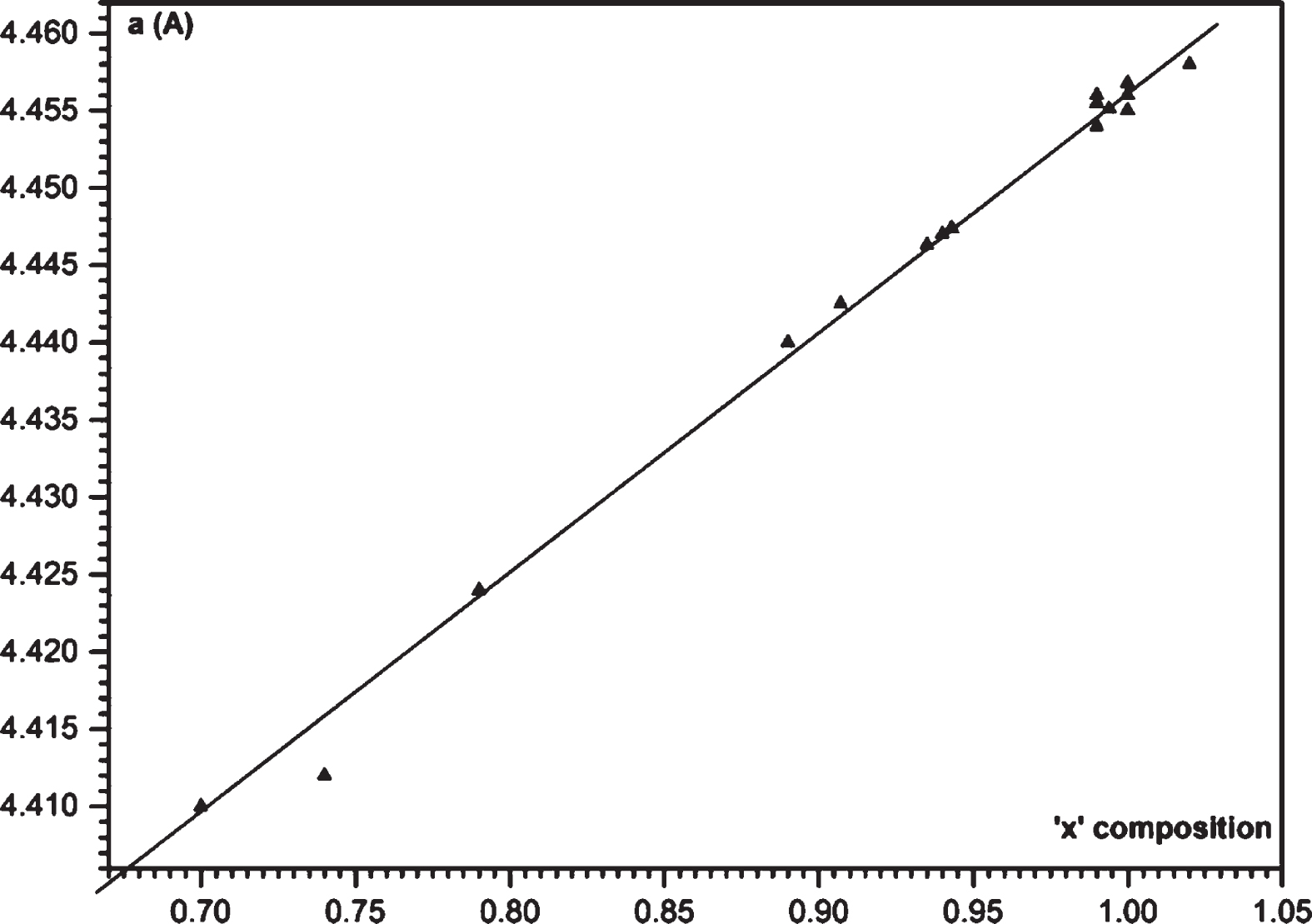
The carbide TaCx lattice parameter variation as a function of composition “x” at 293K.
The TaCx lattice parameter variations as a function of composition at 293K
a (nm) = 0.429087 + 0.01673 x | (0.72≤x≤0.990) equation 1: Storms
a (nm) = 0.430070 + 0.01563 x | (0.71≤x≤0.994) equation 2: Bowman
a (nm) = 0.430360 + 0.01524 x | (0.70≤x≤1.020) equation 3: Our work
Figure 6 represents the variations of the lattice parameter of the ‘monocarbide’ phase as a function of temperature. We can see there a linear thermal expansion of the cubic lattice of this stoichiometric phase (0.44558≤a (nm)≤0.44571 at 293K) first along the straight line 1 (with average coefficient of linear expansion α1 = 6.45 10- 6 K- 1) in the interval 293≤T (K)≤1623, then along the straight line 2 (α2 = 8.15 10- 6 K- 1) above 1623K. This slope change in the vicinity of 1623K reflects a variation in composition which has already been discussed in the literature. Indeed, according to Storms [17] and Jun [49], the carbon content of the tantalum monocarbide decreases when the temperature increases and is explained by the vaporization of carbon at high temperatures.
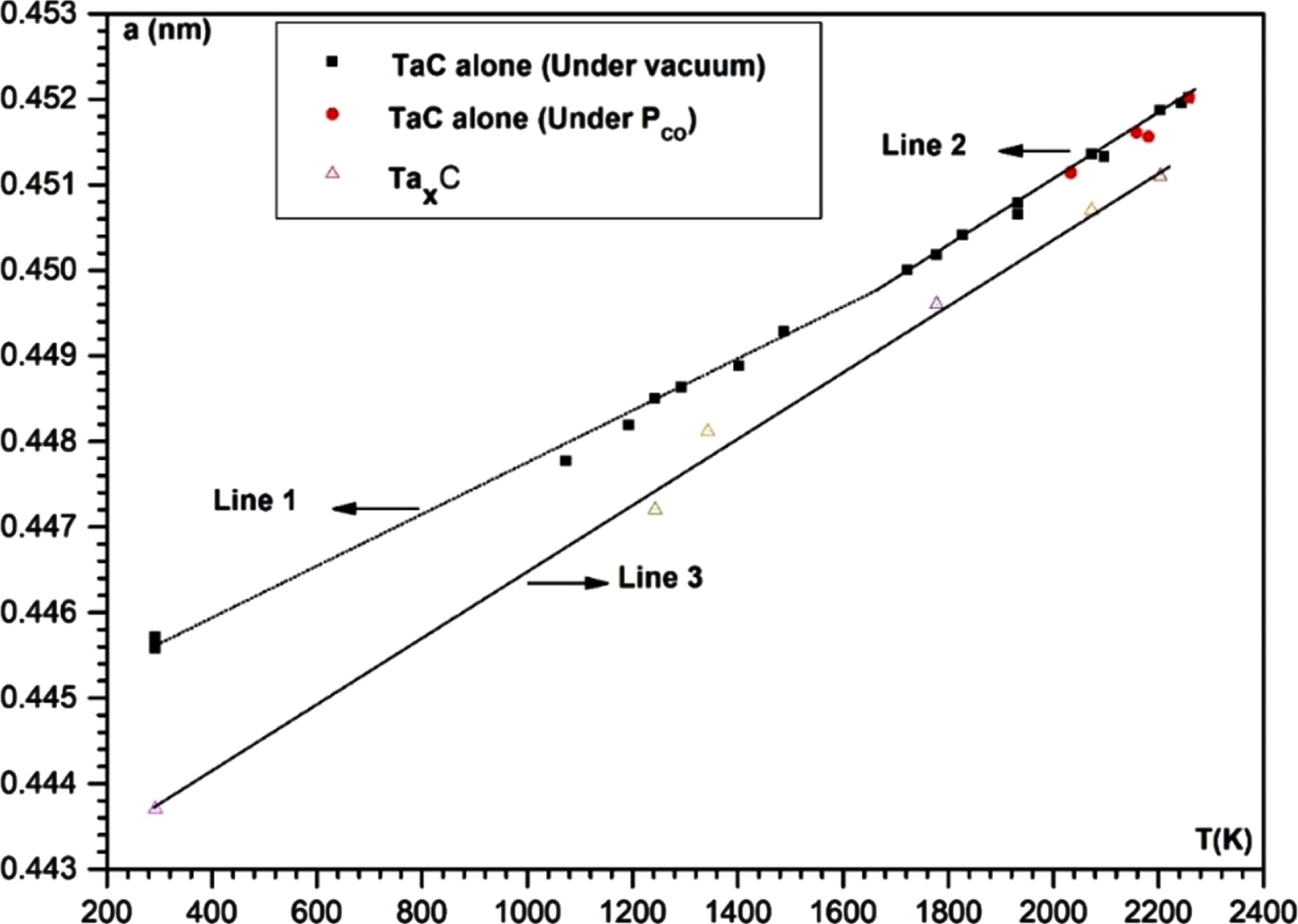
The monocarbide lattice parameter variations as a function of temperature.
Given equation 3 and the extrapolation of line 2 at 293K (a0 = 0.4444 nm) we deduce the TaC0.92 composition for the monocarbide phase above 1623K.
We can also observe in Fig. 6 a linear expansion along line 3 (α3 = 8.73 10- 6 K- 1) for the lacunar monocarbide which appeared in the presence of carbides, this lacunar phase has a lattice parameter at 293K (a0 = 0.4437 nm) which corresponds, according to equation 3, to the composition TaC0.875.
Our experimental observations between 293 and 2300 K led us to the following conclusions: The tantalum metal spontaneously oxidizes under dynamic vacuum more easily in low temperature. The oxidation is followed by a partial carburization due to the CO gas produced by the Boudouard reaction: (CO2(g) + C*(s) ⟶ 2CO(g)). Beyond 1816 K, only the metallic phase persists and is gradually purified of oxygen. A suitable thermodynamic treatment justifies the different reaction steps proposed to interpret the reactivity of the under vacuum metallic tantalum. Tantalum is characterized by two behaviors when hot: a linear thermal expansion (α1 = 10.5 10- 6 K- 1) at the end of which the metal showed a ‘getter’ role toward the oxygen then another expansion, also linear (α2 = 7.5 10- 6 K- 1) for the metal thus inhibited. A linear expansion of the α-Ta2C hemicarbide lattice according to two straight lines: Under vacuum: (line 1); αa = 9.1 10- 6 K- 1 | αc = 9.8 10- 6 K- 1| αv = 28.1 10- 6 K- 1
Under PCO: (line 2); αa = 9.1 10- 6 K- 1| αc = 8.8 10- 6 K- 1| αv = 27.1 10- 6 K- 1
A lattice parameter of the TaCx monocarbide cubic lattice which follows Vegard’s law according to the equation (a (nm) = 0.430360 + 0.01524 x) and a composition which depends on the heat treatment and the existing phases: the ‘TaC’ compositions between 293K and 1623K and ‘TaC0.92’ above 1623K when this phase is alone on the pellets surface and finally the ‘TaC0.875’ composition in the presence of carbides.
Moreover, a correlation can be made with group IVB and VB transition-metal (such as hafnium, zirconium, niobium and titanium) where it is well known that the insertion of oxygen or carbon in these metals has the effect of stabilizing their shape at high temperatures.
Footnotes
Acknowledgments
This work was supported by the authors themselves.
Declaration of Interest statement
All the authors declare that they have no conflicts of interest.