



Abstract
Natural or synthetic substances can be used to create smart medications, which can enhance cognitive performance in healthy individuals. They are frequently used to boost memory, concentration, creativity, intelligence, and motivation in the fiercely competitive world of today.To achieve optimum results, the drug should be applied to the target site at the appropriate concentration, with as few or no adverse effects as possible due to off-target actions. Recent studies have shown that such drugs, which are often used in chemotherapy, can reduce the level of discomfort cancer patients endure. In this study, metal complexes that can carry silver nanoparticles with electrical and optical properties were formed.
This article examines the potential of man-made silver N-heterocyclic complexes as smart drugs. Following the synthesis of new carbene species from the Xthantine compound, metal complexes were produced for this use. The chemical structures of these carbenes and metal complexes were investigated using a variety of methods, including melting point studies, conductivity, 1H-NMR and 13C-NMR, LC-Mass, FT-IR, TGA, and UV-vis spectrophotometry. These metal complexes differ mostly due to their solubility in water. Using the disk diffusion method, the antimicrobial and antibacterial properties of silver(I)-NHC complexes were examined against Gram-positive and Gram-negative bacteria as well as fungi. It has been observed that the antimicrobial activity of 7,9-bis(2-cyanoethyl)-1,3-dimethyl-2,6-dioxo-2,3,6,7-tetrahydro-1H-purine-9-ium silver(I)bromide compound is high. These data suggest that this compound has strong antibacterial properties.
Introduction
Theophylline (THP) is a molecule that has at least one amino (NH) functional group as the basis of its heterocyclic structure [1, 2]. Due to their quick tautomerization [3] capabilities, THPs can interact with many substances due to their nitrogen atoms being situated at two distinct ends [4]. THPs can bind to other substances known as tails, which then react via these nitrogen atoms. These reactions produce new carbene species, which are then stabilized by large-volume ions like hexafluorophosphate [5] or small-volume ions like chlorine and bromine [6]. Their interest has recently increased due to the stability of carbene, and its features have also been utilized in the production of metal complex reactions [7]. As shown in Fig. 1a, b, and c, several N-Heterocyclic carbenes (NHC) utilized in organic chemistry are classified as ligands that do not actively contribute to chemical processes [8].

Displays many compounds as linked metal ligands, pNHC, and traditional NHC.
The protic NHC compounds [9] (Fig. 1a, b), which contain an acidic proton in one of the nitrogen atoms in the NHC molecule of the diamine [10], are the most significant aspect of these ligands. These are deprotonated compounds that have p-NHC ligand complexes like THPs added to the protonation process, and they are found in the ring nitrogen atom [11] (Fig. 1c). In a neutral environment or at its base, THPs perform as a monodentate type ligand that uses N7 atoms to coordinate the metal ions [12].
THP ions are created by attaching two distinct nitrogen atoms as a tail to the THP, and their structures are revealed using spectroscopy. The compound’s crystal structure, THP (C7H8N4O2.H2O), was determined using direct methods in powder-crystal X-ray diffractometry [13]. With the help of X-ray diffractometry, it has been discovered that the THP molecule exhibits strong interactions such as -N-H— O, -C=O— H, and -C-H— π (Fig. 2) [14]. The water molecules inside the crystals form endless molecular chains via hydrogen-linked chains that pass via tunnels formed by the THP molecules surrounding the central axis. Via hydrogen bonds, these water chains are linked by strings of THP [15].
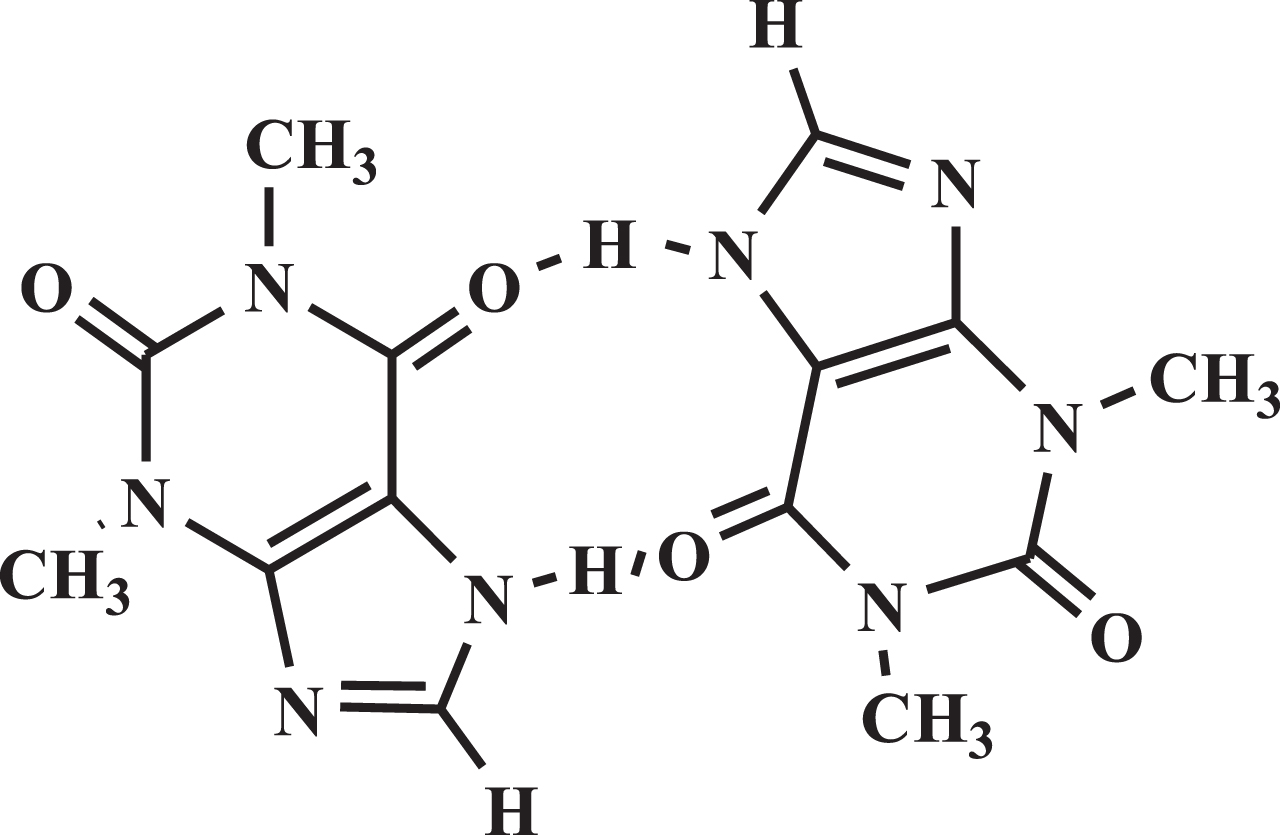
A general representation of the THP compound’s potent interactions.
In the THP monohydrate crystal, the molecules of the two THPs that are adjacent to the centerline combine to form a dimer with two distinct hydrogen bonds. In a crystal, water molecules move via tunnels along the axis to build countless hydrogen-linked chains. These chains have parallel architectures and are joined by cross-linked hydrogen bonds (Fig. 2). Thus, parallel two-dimensional hydrogenated layers are created [16]. THP compound uses in the medical field have included anti-inflammatory properties [17], anticancer potential [18], and potential for treating neurological illnesses [19].
Ag(I)-NHC complexes with THP have been studied in the past several years as a potential ligand for usage in biological applications [20, 21]. A highly significant role for alkali metals, particularly silver (Ag+) ions, may be found in many biological processes, including cellular diversity [22], pH, and adjusting electrolyte balance [23]. Low-oxidation transition metals have been used to cleave electron-rich olefins through reactions of complicated molecules [24]. This characteristic has been used in earlier investigations to produce functionalized Ag(I)-NHC complexes with various characteristics [25]. The industry has shown a lot of interest in pincer systems of carbene compounds recently [26–28].
Because of their strong σ-transmitter and weak π-receiver characteristics, NHCs are exploited in modern medicinal science [29, 30]. Low toxicity and high thermodynamic determination of carbene bonds are two of its most significant characteristics. Ag(I)-NHC complexes have been proven to be biologically efficient as antibacterial agents for both in vitro and in vivo applications [31–33] as well as having successful anticancer studies [34, 35]. Several researchers from the past few years detail the uses of silver(I)-NHCs in medicinal Compounds, taking advantage of Ag+’s potent antibacterial properties against a range of microbes [36, 37]. As a result, they have been researched for use in microorganisms. Numerous studies have defined the cytotoxic effects of substances and the mechanisms of effectiveness against germs. This article discusses the synthesis of novel carbene complexes and their use in antibacterial applications [38].
Theophyllinium salts were produced in this work as a result of interactions between the THP molecule and several substituents, including propane nitrile, ethyl propanoate, and ethane amine. These salts may be dissolved in water. Ag(I)-NHC complexes involving interactions of ligands
In this study, theophylline salts that are water-soluble were synthesized as a result of the attachment of several substituents, including propane nitrile, ethyl propanoate, and ethan amine to the THP molecule. The following compounds were produced: 3,3’-(1,3-dimethyl-2,6-dioxo-1,2,3,6-tetrahydro-7H-λ4-purine-7,9-diyl)dipropane nitrile bromide (
Materials
THP (C7H8N4O2≥99 %), 2-bromoethanamine (C2H6BrN≥99 %), 3-bromopropanenitrile (C3H4BrN≥98 %) and ethyl 3-bromopropanoate (C5H9BrO2≥98 %), C4H10O≥99 %, D2O≥99 %, CDCl3≥99 %, DMF≥99 %, C2H5OH≥99 %), KPF6≥99 %, Na2CO3≥99 %, and Ag2O≥99 %, hexane (C6H14≥99 %) and ethyl acetate (C4H8O2≥99 %).
Gram-positive bacteria Bacillus cereus (ATCC 11778), Staphylococcus aureus (ATCC 25923), Gram-negative bacteria Escherichia coli (ATCC 25922), Listeria monocytogenes (ATCC 19115), and fungi species Candida albicans (ATCC 10231) were used The antibacterial activity of it was investigated by Trakya University’s Technology R&D Application and Research Center.
Instrumentations
NMR spectra were studied using a Varian As 300 Mercury and different polarity solutions. The Fourier transform infrared spectroscopy (FTIR) spectra were measured using Four-Point Probe Devices (Qiatek, FFP 4), an ATI Unicam 1000 spectrometer, and an EXSTAR 6300, while the Perkin Elmer TGA 400 thermogravimetric analysis instrument (features a 60 ml/min flow rate and a 10 C/min heating rate in an air atmosphere) was carried out using a Perkin Elmer TGA 400. Melting points were measured using a piece of Electrothermal-9200 equipment. Leco True Spec Micro, Shimadzu LC-MS/MS 8040, and Malvern Panalytical Empyrean devices were used to measure the elemental analysis, the mass analysis, and the X-Ray diffraction (XRD) examination of powder [41].
Antimicrobial efficiencies of synthesized
The Institute of Clinical Laboratory Standards has measured the antibacterial efficacy of produced carbenes and Ag(I)-NHC complexes in an agar dilution medium. The McFarland scale was set to 0.5 and an antibiotic medication called ampicillin was utilized in these culture media where Dimethyl sulfoxide solvent was used for stock solutions of compounds. Tryptic soy broth (TSB) is used to cultivate a variety of Gram-positive and Gram-negative bacteria and fungi for 24 hours at 37 °C. Using a sterile 0.45 m filter, the antimicrobial solution and the stock solutions were filtered. The outcomes for bacteria and fungus were compared after the incubation times of 24 and 48 hours, and their effectiveness was assessed. Values for viability percent were calculated using absorbance data at 600 nm.
Results and discussion
NHC synthesis methods
The reactions of the substances 2-bromopropannitrille (
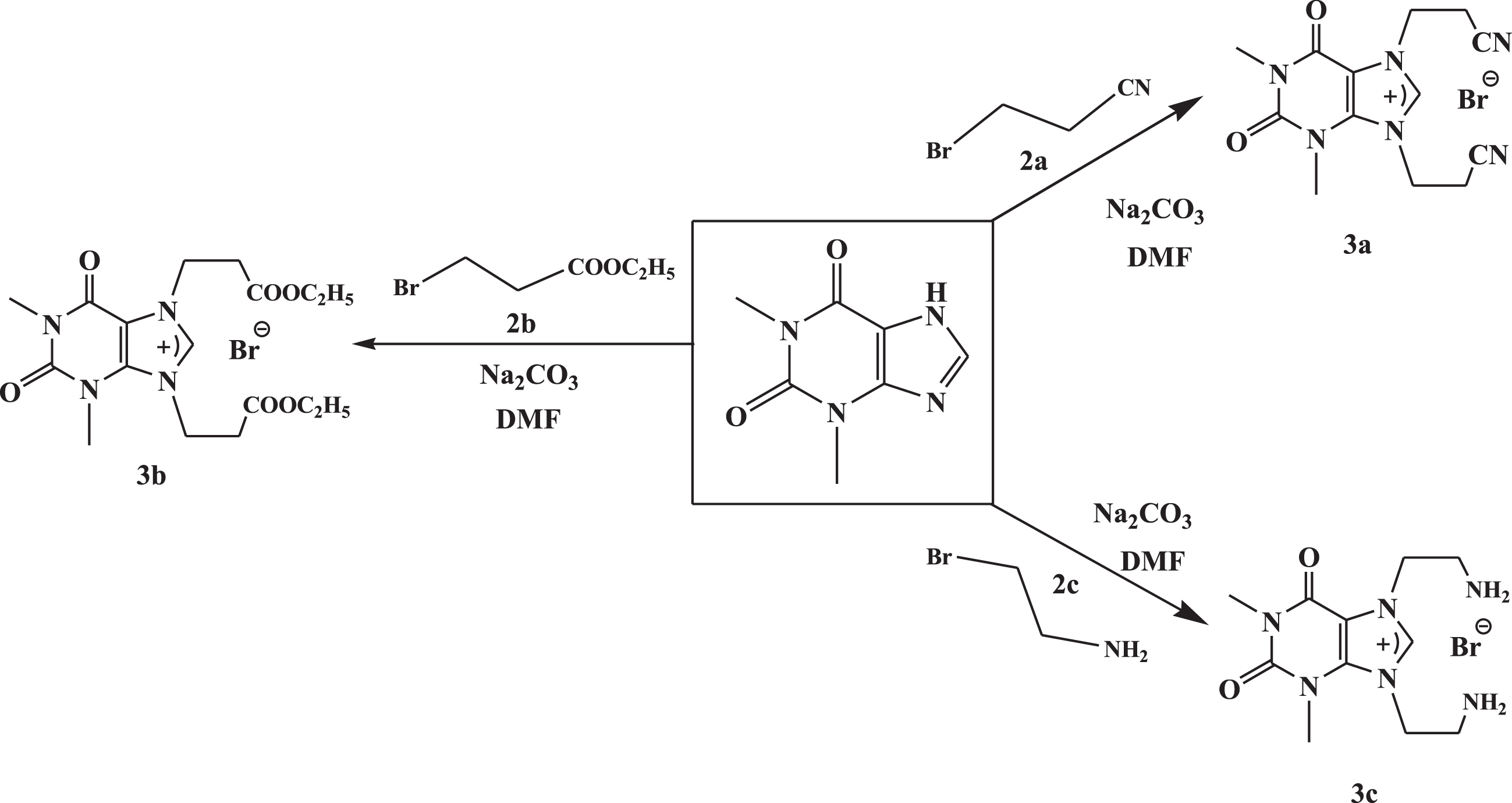
Synthesis method of carbene compounds.
After the NHC pioneer compounds interacted with Ag2O, Ag(I)-NHC complexes were produced from the compounds as 7,9-bis(2-cyanoethyl)-1,3-dimethyl-2,6-dioxo-2,3,6,7-tetrahydro-1H-purin-9-iumsilver(I)bromide (
TGA analysis
Using a Perkin Elmer TGA 400 instrument, TGA values from entire instances in powder structure were conducted, with additional details provided (see supporting materials). TGA analysis was carried out on powder samples at a certain concentration in order to ascertain the quantitative presence of metal and organic components [42].
Ag(I)-NHC complexes (
The third stage, where temperatures range from 600 to 798 °C, is where practically all of these compounds have been carbonized. About 13.09% of the NHC portion is made up of ashes. Complexes
Water, nitrile, and theophylline weight losses in the compound
XRD analysis
XRD analysis is a bulk approach that provides significant information on the catalyst and its support’s bulk composition. The carbon support is addressed by the first peak, which is located in the low 2 areas ((see supporting materials). Accordingly, the carbon variant displayed the reflections typical of a face-centered linear crystal structure. The addition of Ag+ metal to the NHC complex, which features face-centered linear reflections, is represented by the difference between 2 degrees 44 [8, 9].
These studies demonstrate produced compounds with XRD values of
Conductivity tests of NHC and their complexes
In an H2O media, conductivity measurements of NHC and their complexes were measured at 10–3 M. Compounds
Using a four-point probe device, the solid-state conductivity of the compounds
Antimicrobial test results
In a 5 mL sterile tube, sterilized LB broth was measured out. The tube containing the LB broth solution received an addition of a constant culture microbe. These mixes were shaken overnight at 37 °C after being cultured. These Ag(I)-NHC complexes were then transferred to a 10 ml sterile tube and given the name “
The efficacy of newly produced NHC compounds against fungi was evaluated using the widely used medication fluconazole. Compounds
MICs values against the bacteria and fungi resistance of compounds 3a– c and 4a– c
MICs values against the bacteria and fungi resistance of compounds
Compounds
It has proven possible to produce carbene derivatives by alkylating THP utilizing a variety of synthetic techniques. As a result of the interaction of several carbene species with the Ag2O molecule, Ag(I)-NHC complexes were created. Each synthesized compound’s structure was revealed independently. Different chemically structured carbene compounds were created in the first step, and then these carbenes’ metal complexes were created in the second.
There were some alterations in the 1H-NMR and 13C-NMR analyses between the peaks of the initial raw materials and the carbene compounds, but the metal complexes’ NMR investigations revealed that the carbene’s hydrogen peak had vanished and its carbon had changed from 140– 160 ppm to 180– 200 ppm.
It produced distinct peaks in the nitrile (-C≡N), carbonyl (-C=O), and amine (-NH2) regions in FTIR analysis.
The first stage of the TGA study reveals that the atmosphere is humid. The second phase included entirely separating the organic component of the chemical structure from its surroundings. The metal component was still present in the environment in the third stage. The theoretically estimated values and experimentally derived values generally differ by 1– 2%, and it has been discovered that these values are fairly close to the information in the literature.
It was discovered by LC-Mass analysis that carbene masses typically peaked in the [M +] area. On the other hand, it was found that metal complexes produced identical findings in the [M + H] + region, with a difference of between 3 and 5 per thousand.
The percentage values of the element’s nitrogen (% N), carbon (% C), and oxygen (% O) have been found to differ between the theoretically calculated and experimentally calculated values by 3– 5% in element analysis. The difference between these numbers was found to be reasonably close to the data found in the carbene synthesis literature.
For nitrogen (% N), carbon (% C), oxygen (% O), and silver (% Ag), the percentage values between the theoretically calculated values and the experimentally discovered values were found to be between 1– 5%. These findings are in close agreement with those of elemental analysis and XRD analysis, it has been found.
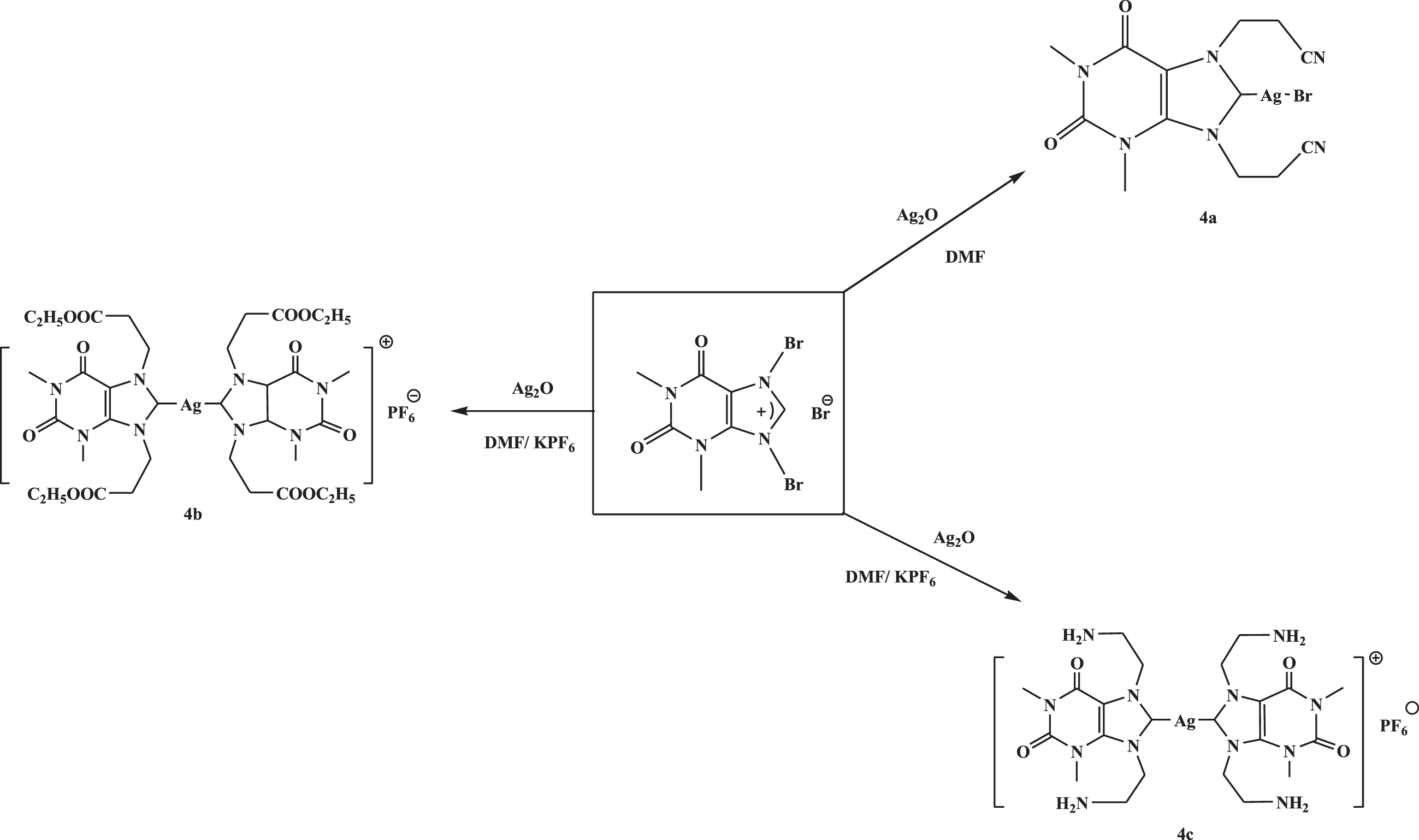
Synthesis method of Ag(I)-NHC complexes.
It has been found in conductivity analysis that the conductivity values of the liquid and solid organic components give conductivity values based on their chemical characteristics at a specific concentration. Conductivity levels in metal complexes increased under the influence of silver.
When the analysis’s overall findings are considered, it becomes clear that using the chosen synthesis techniques, symmetrical carbenes, and metal complexes can be produced from the starting chemical.
Each of these novel compounds, which have not yet been documented in the literature, had their measured antibacterial activity examined. Silver-linked metal complex
Footnotes
Acknowledgments
Trakya University Research Fund’s research grant (TUBAP-2014-106) was gratefully accepted.
Author contributions
Whole authors have participated in the writing of the manuscript unanimously.
Conflict of interest
The authors report they have no conflict of interest.