




Abstract
Polycyclic aromatic hydrocarbons (PAHs) are a large group of cyclic aromatic hydrocarbons that have been listed as hazardous substances by the US Environmental Protection Agency and the World Health Organization. Edible oils are one of the important food sources of PAHs, which are created during the processes of drying oil seeds or refining edible oils. The aim of this research was to evaluate PAHs (Naphthalene, Fluorene, Phenanthrene, Anthracene, Fluoranthene, Pyrene, Benzo[a]pyrene, and Benz[a]anthracene) in industrially produced edible oils (sunflower, corn, canola, olive and sesame) and traditional oils (press) (yellow animal oil, olive, sesame and sunflower oil) in Iran, and these samples were randomly prepared, sampled and analyzed from the stores of West Azarbaijan province (Urmia, Iran). PAHs were extracted from oily samples by solid phase microextraction method and analyzed by Gas Chromatography-FID.
The highest concentration of PAHs (μg/L) were related to different oils as the follow: naphthalene (4.61 in animal yellow oil), Fluorene (0.75 in canola), Phenanthrene (0.21 in canola), Anthracene (0.01 in animal yellow oil), Fluoranthene (2.53 in canola), pyrene (2.67 in canola), Benz[a]anthracene (0.44 in corn) and Benzo[a]pyrene (0.45 in canola). The concentration of Benzo[a]pyrene was compared with the European Union (EU) limit value (μ>2) using one-sample t-test. In industrial canola oil, with an average concentration of 2.593μg/kg, Benzo[a]pyrene was higher than the European Union standard of 2μg/kg. Some of the studied aromatic hydrocarbons could not be detected in some oils.
Keywords
Introduction
Polycyclic aromatic hydrocarbons (PAHs) or polynuclear aromatic hydrocarbons are a large group of cyclic aromatic hydrocarbons of stable aromatic compounds (including more than 100 compounds) with two or more benzene aromatic rings joined together. These compounds are listed as dangerous substances by the American Environmental Protection Agency (AEPA) and the World Health Organization (WHO). PAHs are atmospheric pollutants that are known as carcinogens [1, 2]. Among the most important sources of the emission of these compounds are natural activities, household heaters (coal or wood stoves, barbecues, oil cooking lamps), gas appliances, tobacco smoke, cooking smoke and fumes, meat Grilled and fried food mentioned. Generally, in food, PAHs are formed from carbohydrates at high temperatures and in the absence of oxygen or reduced pressure. Although the production of these compounds at temperatures of 100 to 150°C has also been reported, but these compounds generally are produced in high temperature. For example, Benzo[a]pyrene is produced in the concentration of 0.7 to 17 (ppm) from the heating of starch at temperatures of 370 to 650°C. It has also been found that PAHs (such as Benzo[a]pyrene) can be formed from amino acids and fatty acids [3, 4]. The most important food sources of PAHs contain oils and fats, smoked products (meat and fish, oysters), seasonings (spices), dried fruits and grains (in contact with pollution from burning or transportation) [5]. Also, contamination with PAHs in edible oils occurs during the drying process of oilseeds or contamination during the extraction process by solvent [6, 7]. In most methods of oil extraction from common oilseeds (such as soybeans and sunflowers), a purification process is carried out, which causes a significant reduction in the concentration of PAHs, but in some seeds for retaining of bioactive compounds, oils are extracted by cold pressing (crude mustard oil, flower oil, black pepper, cow’s tongue flower, etc.), So in these type oils there is not much reduction in the PAHs concentration. Therefore, these oils can be an important source of PAHs [8]. PAHs can be absorbed by the human body in different ways. The main ways of receiving PAHs in humans are food, environment (air, water and soil), and smoking. In people who are not in highly polluted environments (not working in the production of PAHs or substances related to them) and non-smokers, food is the main way to get PAHs [9].
The Occupational Health and Safety Administration (OSHA) in the United States have set the average permissible limit of polycyclic aromatic hydrocarbons in the air at 0.2 mg/m3. This department has announced the permissible limit of these substances in oils of 5 mg/m3 in a period of eight hours. PAHs are absorbed through the pulmonary system, digestive system and skin and cause damage to the target organs [10].
To detect and measure volatile organic compounds, hydrocarbons and especially polycyclic aromatic hydrocarbons, there are several methods, one of the most important of which is chromatography (gas chromatography and liquid chromatography) [11–15]. Yu et al. (2014) analyzed polycyclic aromatic hydrocarbons in edible oils and fats using high-performance liquid chromatography (HPLC). The total content of PAHs in edible oils was 639.96–18.00μg/kg [16].
In most cases, food cannot be directly injected into the GC without preparation. The first step in GC analysis is sample preparation. In some cases, it is even necessary to separate and purify the desired compound from other impurities, and one of these separation methods that has found more use is solid phase extraction (SPE). Solid-phase microextraction (SPME) is an advanced type of solid-phase extraction and is a balanced system that is a preconcentration, sample preparation and solvent-free technique. SPME is a very powerful method for sample preparation that concentrates, extracts, and enters the sample into the chromatographic device in one step. In addition, it is an extraction method that is completely solvent-free, and for analysis by it, only 1 ml of sample is sufficient [17, 18]. Barranc et al. (2002) used the solid phase extraction coupled with liquid chromatography to the determination of polycyclic aromatic hydrocarbons in edible oils, the quantitative range obtained for most PAHs was less than 1 ng/g [19].
Analysis of PAHs by chromatographic methods is of particular importance and has a long history. Since these substances pose a serious threat to human health, they have been tested and investigated by many researchers for the past. Larsson et al. (1987) studied PAHs in crude and refined vegetable oils and the efficiency of refining processes in removing PAHs in crude vegetable oils. The samples included crude oil (coconut, soybean and rapeseed oils), refined and deodorized oil from three Swedish oil production lines, and plants that were used to produce margarine, which contained twenty types of PAHs, that crude oil, coconut oil had the highest level of PAHs. However, the level of PAHs in refined coconut oil was very low. This shows that the use of activated carbon has been effective in removing PAHs in coconut oil. It is relatively low in crude soybean and rapeseed oils, but the concentration of PAHs varies. The highest concentration of Benzo[a]pyrene in some coconut oils was 11.7μg/kg, soybean oils contained different concentration of Benzo[a]pyrene, which reached up to 3.4μg/kg and the average limit of Benzo[a]pyrene in 13 margarine samples was equal to 0.6μg/kg [20].
Investigating the concentration of polycyclic aromatic hydrocarbons in oils produced by industrial and traditional methods in Iran, which has not been studied much, to produce a healthy product has so importance. Yet no standard has been written in this regard by the standards department in Iran, so this research has a new aspect and is important. Therefore, in this research, the solid phase microextraction method was used to extract PAHS from oils. The analyzed oils included oils prepared by traditional and industrial methods. The obtained results confirmed the importance of the type of extraction and the type of oil seed in the concentration of PAHs in the oils.
Materials and methods
Chemicals
The 6 types of industrial oil tested were prepared from different companies as follows: canola oil (Famila Co., Iran), sunflower oil (Aftab Co., Iran), olive oil (Oila Co., Iran), sesame oil (Oila Co., Iran), corn oil (Bahar Co., Iran) and sunflower oil 2 (Ladan Co., Iran). 4 types of traditional oils, including traditional olive oil, traditional sesame oil, traditional sunflower oil, and animal yellow oil, were also obtained from a traditional oil store in Urmia (Iran). Traditional oils were extracted by cold pressing and mechanical pressure on seeds and oily fruits.
Devices and equipment
Gas chromatography instrument include the following characteristics; Agilent 6890N gas chromatography machine, made in America, equipped with flame ionization detector (FID), HP Chemstation software in Windows environment, Split/Splitless injection valve with HP-5 capillary column with a length of 30 meters and an inner diameter of 0.32 mm and the thickness of the stationary phase was 0.25 micrometers (95% dimethyl polysiloxane-cross bond 5% phenyl) from the American Restek company.
SPME to extract PAHs
In order to extract PAHs from the oil, 5 ml of the oil sample were poured into a sample container (vial) with a capacity of 10 ml along with a small magnet and it was placed in a water bath and on a heater-magnetic stirrer. Next, the microextraction syringe entered the container containing the sample and was fixed in the upper space of the container. Then the fiber was removed from the syringe and exposed to contact with the upper space of the sample for 5 minutes (optimal extraction time) (Fig. 1A). Then the fiber was drawn into the syringe and the microextraction syringe was removed from the vial and immediately transferred to the injection valve of the gas chromatograph instrument and injected into the injection port. It should be mentioned that the fiber extraction was made of polydimethylsiloxane (PDMS) manufactured by Sapelco Co. (USA) with a diameter of 60 microns.
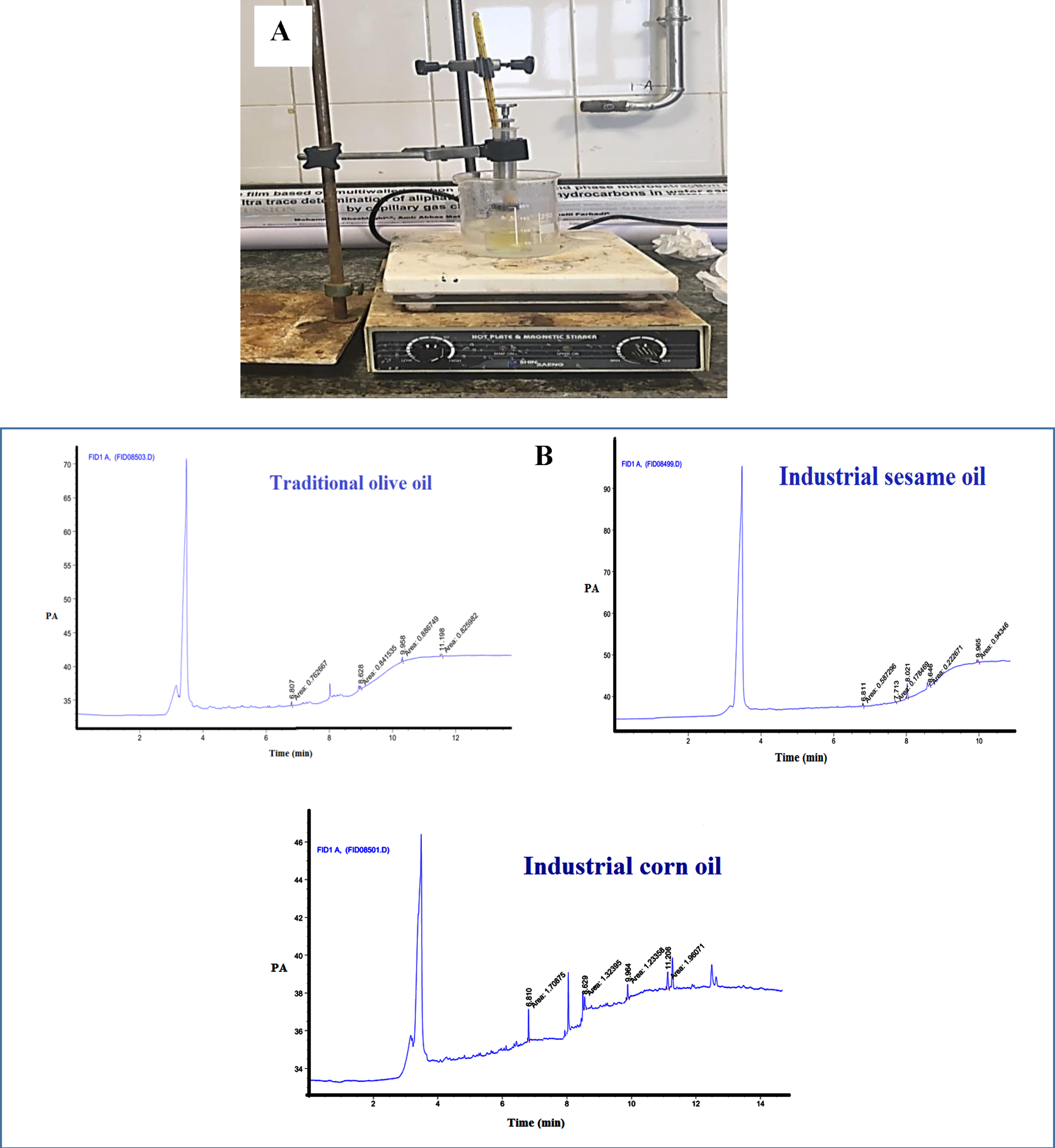
Solid phase microextraction (A) and chromatogram of PAH compounds extracted from three types of oil samples (B).
Due to the wide range of retention times of analytes separated by gas chromatography, temperature programming system was used for separation. In the first stage, the initial temperature of the column was kept at 100°C for one minute, then it increased to 300°C at a rate of 30°C/minute and remained at this temperature for 2.5 minutes. Nitrogen was used as a carrier gas and Make up Gas, whose flow rates were 1.1 ml/minute and 45 ml/minute, respectively. The temperature of the injection valve and the detector were both set at 260°C. The injection of analytes was done in Splitless mode. Figure 1B shows examples of chromatograms related to PAHs extracted from oil samples.
Statistical analysis
In this study, the independent variables included types of industrial oils (6 types of oils) and traditional oils (4 types of oils) and the dependent variables were the concentration of PAHs (naphthalene, Fluorene, Phenanthrene, anthracene, Fluoranthene, pyrene, Benzo[a]pyrene and Benz[a]anthracene) which was obtained by gas chromatography analysis. The results of all tests were obtained from the average of three repetitions. Statistical analysis was performed based on a completely random design using Minitab software version 18/1 and to determine the significant difference between the data and compare the averages, Tukey’s multi-range test was used at the 95% confidence level (P < 0.05). The one-sample t-test was used to compare the averages of Benzo[a]pyrene hydrocarbon with the limit set in the European Union [21] for oils and fats at the 95% confidence level (<2μ). The graphs were drawn using the Excel version-2016 software.
Results and discussion
The statistical analysis used to check the concentration of PAHs in different oils (industrial and traditional) is one-way analysis of variance. To compare the average hydrocarbon Benzo[a]pyrene with the maximum permissible limit of the European Union standard, the t-tech test of the sample was used. The main goal of this test is to compare the averages of several groups of industrial and traditional oils. The average value of 8 types of polycyclic aromatic hydrocarbons identified in the analytes is shown in Table 1. According to the results of Table 1, Phenanthrene and Anthracene compounds have been detected in only one oil sample, so it is not possible to compare the oils with each other. Phenanthrene hydrocarbon was detected only in industrial canola oil, which averaged 0.21 (μg/L), and Anthracene hydrocarbon was detected only in traditional yellow animal oil, which averaged 0.01 (μg/L).
Average (±standard deviation) concentration
Average (±standard deviation) concentration
*ND: Not Detected.
Table 2 shows one-way analysis of variance to investigate the concentration of Naphthalene, Fluorene and Fluoranthene in 10 types of oil in two groups of oils prepared by industrial and traditional methods. Based on the results, Naphthalene was detected only in 5 types of oil (industrial sunflower oil, industrial canola oil, industrial olive oil, yellow animal oil and traditional sunflower oil), the difference in Naphthalene concentration in different samples is significant (P < 0.05). Fluorene was detected in 9 types of oil, and the difference in the concentration of Fluorene in different samples was significant (p < 0.05). Fluoranthene was also detected in all industrial and traditional oil samples, which shows that measures should be taken to reduce this PAH in oil samples. The concentration of this substance was different in different samples, and the highest concentration was in the samples of industrial canola oil and traditional sunflower oil.
One-way analysis of variance to check the concentration of Naphthalene, Fluorene and Fluoranthene
One-way analysis of variance to check the concentration of Naphthalene, Fluorene and Fluoranthene
Tukey’s test (at 95% probability level) was used to determine the difference between different groups of oil and the difference in the concentration of different PAHs in different oil samples. The results of Tukey’s test are shown as bar graphs in Fig. 2. In this figure, different letters on the columns indicate the significance of the difference in means at the 95% probability level. According to the results, the highest concentration of Naphthalene hydrocarbon in traditional yellow animal oil is with an average concentration of 4.61μg/kg. Fluorene hydrocarbon was present in almost 90% of the samples, the highest concentration of which is related to industrial canola oil with an average concentration of 0.75μg/L. The only hydrocarbon that was present in all the samples was Fluoranthene, which was the highest with an average concentration of 2.53μg/kg. Unfortunately, Fluoranthene hydrocarbon is in the category of weakly carcinogenic and tumorigenic hydrocarbons according to the standards of the American Environmental Protection Agency (EPA) and the International Agency for Research on Cancer (IARC).
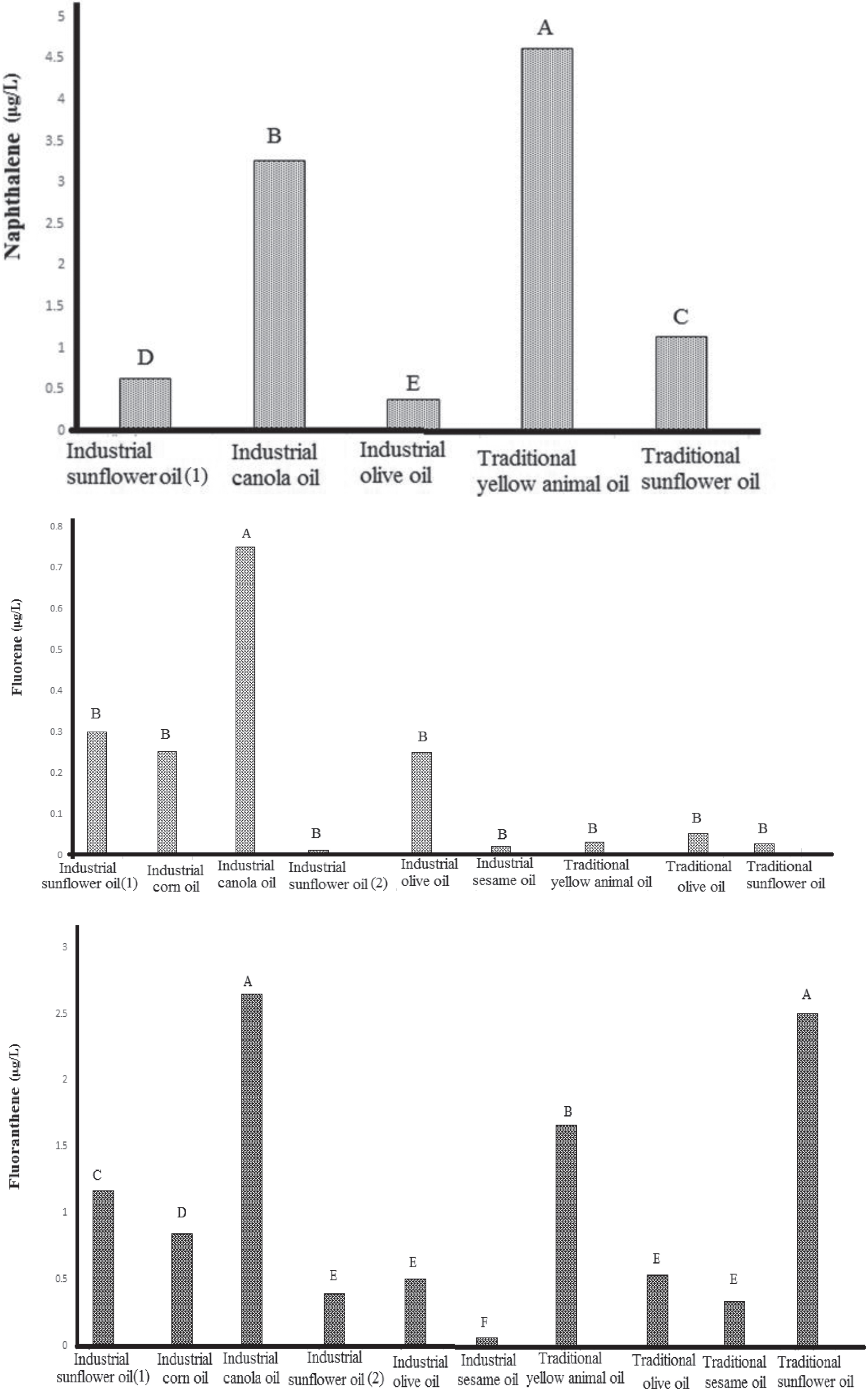
The difference in concentration of Naphthalene, Fluorene and Fluoranthene in different oil samples using Tukey’s test (at 95% probability level).
In a similar study, Princewill-Ogbonna and Adikwu (2015) investigated the levels of polycyclic aromatic hydrocarbons in edible vegetable oils in Omaha, Nigeria, 13 total standard PAHs (naphthalene, Acenaphthylene, Phenanthrene, Anthracene, Fluoranthene, pyrene, Benz[a]anthracene, Chrysin, Benzo[b]Fluoranthene, Benzo[k]fluoranthene, Benzo[a]pyrene outside the EPA priorities were investigated. In the obtained results, Benzo[a]anthracene 619.2μg/kg was found in the refined oil. The concentration of anthracene was 4824μg/kg and fluorine was 1584μg/kg in the unrefined oils that were heated for 1 minute. Most of the PAHs were below the detection limit (1.44μg/kg) [22].
In another study, Hossain and Salehuddin (2010) analyzed PAHs in edible oils by gas chromatography coupled with mass spectrometry. In this research, polycyclic aromatic hydrocarbons were measured in 9 edible oils that were divided into three categories. These three categories included soybean oil, mustard oil, and coconut oil, and in this experiment, they measured 8 types of polycyclic hydrocarbons, most of which were carcinogenic, including: naphthalene, anthracene, Phenanthrene, Fluorene, pyrene, chrysene, Benzo[a]pyrene and Benzo[a]anthracene which were identified and measured. All the carcinogenic PAHs were not present in these oils. There were a small number of them (carcinogenic PAHs) in these oils, which were acceptable and allowed. The concentration of naphthalene, Fluorene, Phenanthrene, anthracene, pyrene, chrysene, Benzo[a]anthracene and Benzo[a]pyrene hydrocarbons was in the range of 0.2 to 2.5 ng/kg [23].
Table 3 shows one-way analysis of variance to investigate the concentration of Pyrene, Benzo[a]pyrene and Benz[a]anthracene in 10 types of oil in two groups of oils prepared by industrial and traditional methods. Based on the results, pyrene was detected in 4 types of oil (industrial sunflower oil, industrial canola oil, traditional yellow animal oil and traditional sunflower oil), and the changes were significant (p < 0.05). Based on the results, Benzo[a]pyrene was detected in 5 types of oil (industrial sunflower oil, industrial corn oil, industrial canola oil, industrial sesame oil and traditional olive oil) and its changes in different oil groups are significant. Also, Benzo[a]anthracene was detected in 6 types of oil, and the changes of Benzo[a]anthracene were not significant (p > 0.05).
One-way analysis of variance to check the concentration of Pyrene, Benzo[a]pyrene and Benz[a]anthracene
One-way analysis of variance to check the concentration of Pyrene, Benzo[a]pyrene and Benz[a]anthracene
Tukey’s test (at 95% probability level) was used to determine the difference between different oil groups and the difference in concentration of Pyrene, Benzo[a]pyrene and Benz[a]anthracene in different oil samples. The results of Tukey’s test are shown as bar graphs in Fig. 3.
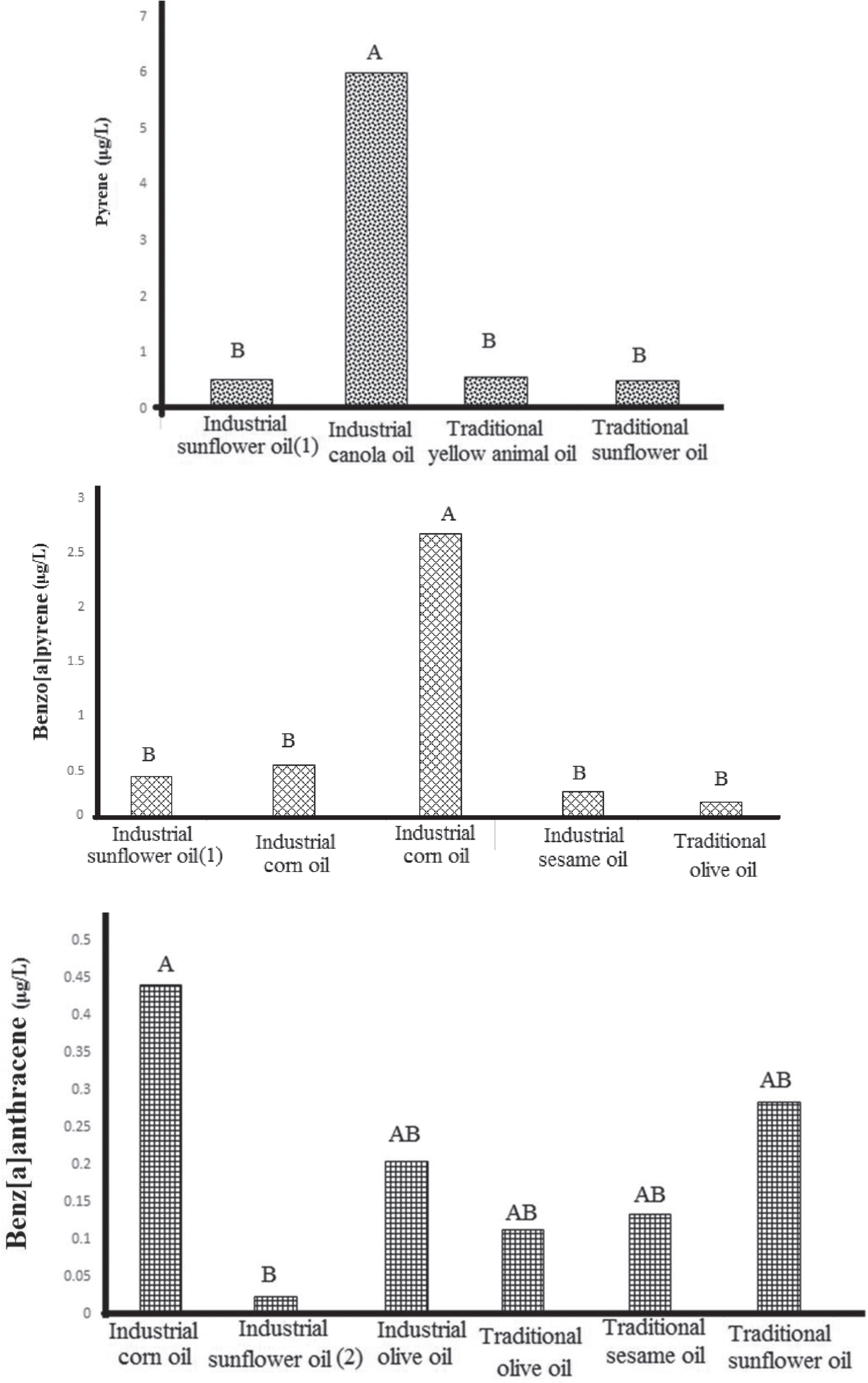
The difference in concentration of Pyrene, Benzo[a]pyrene and Benz[a]anthracene in different oil samples using Tukey’s test (at 95% probability level).
Like fluoranthene, pyrene hydrocarbon is considered by (EPA) and (IARC) as weak carcinogenic and tumorigenic hydrocarbons. Based on the results, pyrene was detected in almost 40% of the samples, and the highest average concentration is related to industrial canola oil with an average concentration of 2.673μg/Kg. The hydrocarbon Benzo[a]anthracene, which is a weak carcinogen (EPA) and (IRAC), was present in almost 60% (W/W) of the samples. The highest concentration of Benzo[a]anthracene is related to industrial corn oil with an average concentration of 0.44μg/Kg.
In a similar research, Olatunji et al. [24] investigated polycyclic aromatic hydrocarbons in edible oil, focusing on the effect of temperature on the purification of radical hydrolysis products and the dangerous factor in health. In this study, sunflower and soybeans had the lowest concentration of Benzo[a]pyrene 1.95μg/kg and Benzo[k]fluoranthene 2.12μg/kg [24].
In another study, Shi et al. (2016) investigated polycyclic aromatic hydrocarbons in vegetable oils and olive oil by GC-MS in China. The concentration of PAHs was determined in 21 edible oils and 17 oil seeds, and almost all PAHs, especially light PAHs (LPAHs), were found in all tested samples. The concentration of 16 PAHs in soybean oil samples was 15 times higher than the target oil samples [25].
Benzo[a]pyrene hydrocarbon has been introduced by the International Agency for Research on Cancer (IRAC) and the US Environmental Protection Agency as the most carcinogenic polycyclic hydrocarbon, therefore, due to the importance of this issue, the obtained concentration value was determined using the test One sample was analyzed. In this analysis, the average concentration of oils in which Benzo[a]pyrene hydrocarbon was detected was compared with the permissible limit of Benzo[a]pyrene in oils and fats (Table 4). Based on the experiments, Benzo[a]pyrene was detected in only 5 samples of oils (traditional olive oil, industrial canola oil, industrial sunflower oil, industrial sesame oil, industrial corn oil), and the average of Benzo[a]pyrene in these samples was compared with EU standard (2011/8335) in terms of (μg/kg) (Fig. 4). The EU limit for oils and fats is equal to 2 (μg/kg), and the average concentration of Benzo[a]pyrene with a 95% confidence interval was significant in four samples (μ<2) and It was lower than the permitted level of the standard, but there were no significant changes in the case of industrial canola oil (μ>2) and its level was higher than the permitted level of the standard. The samples in which the Benzo[a]pyrene hydrocarbon was detected include traditional olive oil, industrial canola oil, industrial sunflower oil, industrial sesame oil and industrial corn oil. In the analysis of sample t-test, the changes in traditional olive oil and sunflower, sesame and industrial corn oils, was significant (μ<2), but in the case of industrial canola oil, there were no significant changes (μ>2). In industrial canola oil, with an average concentration of 2.59μg/kg, it exceeds the standard of the European Union, which is 2μg/kg, and is highly carcinogenic and tumorigenic.
One-sample t-test of Benzo[a]pyrene and comparing with standard (EU) No 835/2011
One-sample t-test of Benzo[a]pyrene and comparing with standard (EU) No 835/2011

The average concentration of Benzo[a]pyrene compared to its limit in the European Union (Standard 833/2011).
In a similar study, Van der Wielen-Hustinx et al. (2011) investigated Benzo[a]pyrene in high-fat foods and food supplements, which from 2002 to 2004, about 1350 samples of oil and food supplements were measured. The level of Benzo[a]pyrene has been analyzed using this method. In 30% of edible oils, the concentration of Benzo[a]pyrene is more than 1.2μg/kg (which was applied by the Dutch Food Safety Organization until April 1, 2005 and includes measurement uncertainty). Regarding food supplements, more than 30% of samples contain high levels of Benzo[a]pyrene, ranging from 1.2 to 135μg/kg [26].
Considering the importance of PAHs and its impact on health, the following solutions are provided to control the concentration of these substances in edible oils. 1. Control during cultivation of oilseeds: In general, controlling the concentration of PAHs during the cultivation of oilseeds should control and minimize the concentration of PAHs in the soil, because PAHs are considered primary soil pollutants and its spread through its roots is possible. Because these materials are sensitive to light and oxidation, using advanced oxidation techniques such as photo-oxidation, ozone treatment, and Fenton oxidation during the cultivation of oilseeds can be a suitable method to reduce PAHs [27]. 2. Control of raw materials: preventing the entry of raw materials contaminated with PAHs into the oil extraction factories, so that at least oil seeds with less PAHs are used. 3. Control during the process: Among the factors that can have a great effect on reducing PAHs during the process is heat control in the process of drying oilseeds, which should not use direct heat. Especially in the case of olive oil at temperature of higher than 200°C, PAHs are produced. Using methods such as neutralization and deodorization to remove volatile substances such as PAHs, which, if applied to hot oil at low pressure for a certain period, will reduce these pollutants. Also, during the purification process in the decolorization stage, the use of activated charcoal can also reduce PAHs, but it should be noted that in some cases, due to the use of active soil contaminated with PAHs, the decolorization process leads to an increase in PAHs [28]. Another thing that should be taken into account during the process of extracting oil seeds is that the use of supercritical fluid extraction technique is not a suitable option for separation. 4. Use of inhibitors: the best inhibitors to reduce PAHs in food and oils are antioxidants. Among antioxidants, natural antioxidants are the most suitable. Adding natural antioxidants such as rosemary extract, tea polyphenols, and Chinese Bombay antioxidants have a great effect, especially if added to special frying oils, it reduces PAHs in oils [29].
Conclusion
In this research, the concentration of 8 types of PAH in 10 types of oil (6 types of industrial oil and 4 types of traditional oil) was studied. The analysis of PAHs was done with a gas chromatography device, and the solid phase microextraction method was used to extract PAHs. Based on the results obtained from 10 oil samples, 8 types of polycyclic aromatic hydrocarbons including: Naphthalene, Fluorene, Phenanthrene, Anthracene, fluoranthene, pyrene, Benzo[a]pyrene and Benz[a]anthracene were identified. The highest concentration of Naphthalene hydrocarbon in traditional yellow animal oil was with an average concentration of 4.61μg/Kg. Fluorene hydrocarbon was present in almost 90% of the samples, the highest concentration of which was related to industrial canola oil with an average concentration of 0.75μg/Kg. Phenanthrene hydrocarbon was detected only in industrial canola oil with an average of 0.21μg/Kg, and Anthracene hydrocarbon was detected only in traditional yellow animal oil with an average of 0.01μg/Kg. The only hydrocarbon that was present in all samples was Fluoranthene, the highest concentration of which was 2.53μg/Kg. Pyrene was detected in almost 40% of the samples, and the highest average concentration was related to industrial canola oil with an average concentration of 2.67μg/Kg. Benz[a]anthracene was present in almost 60% of the samples. The highest concentration of Benz[a]anthracene was related to industrial corn oil with an average concentration of 0.44μg/Kg. The samples in which Benzo[a]pyrene hydrocarbon was detected were: traditional olive oil, industrial canola oil, industrial sunflower oil, industrial sesame oil and industrial corn oil. The concentration of Benzo[a]pyrene was studied using the one-sample t-test and compared with the standard of the European Union. In this analysis, the concentration of Benzo[a]pyrene in traditional olive oil and sunflower, sesame and industrial corn oils was lower than the permissible limit, but in the case of industrial canola oil, the concentration of Benzo[a]pyrene was higher than the permissible limit.
Compliance with ethical standards
Conflict of interest
Author A (Isa Fathollahy) declares that he has no conflict of interest. Author B (Babak Baglari) declares that he has no conflict of interest. Author C (Sajad pirsa) declares that he has no conflict of interest.
Ethical approval
This article does not contain any studies with human participants or animals performed by any of the authors.
Informed consent
Informed consent was obtained from all individual participants included in the study.
Permission and/or credit for reproduced images
All authors declare that there are no reproduced images.
Funding
No funding was received for this study.
Author contribution
Isa Fathollahy conceived of the presented idea. Babak Baglari developed the theory and performed the computations. Isa Fathollahy and Sajad Pirsa verified the analytical methods. Babak Baglari discussed the results and contributed to the final manuscript. Babak Baglari conducted the experiment. Sajad Pirsa wrote the manuscript and revised it.
Data availability statement
Due to the nature of this research, participants of this study did not agree for their data to be shared publicly, so supporting data is not available.