



Abstract
In this work, we reported isotopic effect in H2@X12N12 and H2O@X12N12 (X = B and Al) molecules at LC-ωPBE/6-311 G(d,p) level of theory. Zero-point energies values (ZPEs) of H2, H2O, H2@X12N12 and H2O@X12N12 molecules were calculated. Isotopes influenced the excess energies attained by molecules due to compression. The changes in ZPE of H2@X12N12 and H2O@X12N12 and those isotopic molecules intensely surpass those of the H2 and H2O molecules, subsequent in the great deuterium and tritium isotope effects. The excess of compression energy (Δ ɛ) obtained by the molecule under compression was sensibly, about 5.00–2.60 (X = B) and 1.48–2.63 (X = Al) kcal/mol. Larger kH/kD and kH/kT values were found in the presence of X = B than X = Al. These outcomes were recommended as a probe for analysis molecular compression of enzymatic positions; they may be significant for exploring extremely great experimental isotope effects in various enzymatic reactions, where they were ascribed to the tunneling.
Keywords
Introduction
A valuable method for illustration of the reaction mechanisms is compression-induced isotope effects. Mass-dependent isotope effects on the chemical reactions are attributed only from the changes in ZPE of isotopic species [1–5]. It is used as an explicit tool exploring the reaction mechanisms, classical or tunneling; the last is recognized to toughly depend on the molecular motion, which influences the activation barriers, governing their quantum permeability. Deuterium and 13C pressure induced isotope effects do not observed on the reaction of oxidation of benzyl alcohol by yeast alcohol dehydrogenase YADH [6, 7]. Enzymatic reactions of hydrogen (deuterium) atom transfer in the oxidation of linoleic acid by soybean lipoxygenase illustrated the huge isotope effect [8, 9]. This irregular isotope effect was a noteworthy happening in chemistry.
Compression of the molecules and the atoms is influences their properties [10]. For examples, electron affinities, ionization potentials, and vibrational frequencies are modified due to this effect. Vibrational frequencies enhance the differences of zero-point energies (ZPEs) of isotopic molecules, which outcome to growing isotope effects. These effects induced by compression are apparently the merely income to amount molecular compression; they are considered to be significance for exploring molecular machines-enzymes, which are recognized to motivate enzymatic reactions by compression of reagents [11]. In a computational study, isotope effects Induced by molecular compression have been reported on the hydroxyl ion and hydrogen and water molecules, H2@C60, H2O@C60, and OH - @C60 molecules [12]. As a result, similar study in the inorganic nano-cages can be interesting. In the basis of our knowledge, this investigation has been not reported.
XnYn(X = Group III, Y = Group V elements) nano-structures have been attracted much attentions in last ago years [13–28]. The XY bond causes XnYn nano-cages to indication a reactivity form dissimilar in compared to carbon analogue [29]. Valuable chemical and physical properties of these molecules have been explored [30–42].
In the present work, we interested to computational realization of the induced isotope effect on the compressed hydrogen and water molecules in B12N12 and Al12N12 nano-cages (H2@X12N12 and H2O@X12N12; X = B and Al) were calculated.
Computational methods
Optimization and vibrational analysis of the considered molecules were provide by the Gaussian 09 package [43]. All calculations were done with the Long range-corrected version of wPBE hybrid function (LC-ωPBE) method [44–47] and standard 6-311 G(d,p) basis set [48–51]. This method has been revealed to be accurate for vibrational and electronic properties in neutral and charged systems [52, 53]. No imaginary frequencies obtained for molecules.
The ZPE of compressed molecule (ɛc) was provided as subtract of the caged molecule and the free cage ZPE values:
for H2:

for HOH

The excess of compression energy Δ
ɛ that was the excess of ZPE acquired by compressed molecule under compression is considered as the difference between the ZPE of compressed and free molecules:

In this equation, ɛf considers as ZPE of the free molecule.
The compression-induced isotope effect on ZPE of hydrogen and deuterium molecules was considered as:

Likewise, the compression-induced isotope effect on ZPE of HOH and HOD molecules was provided as:

Isotope effect on ZPE of free molecules was provided as:


Isotope effects on the dissociation rate constants of free and compressed molecules were the following equations:
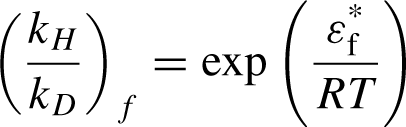
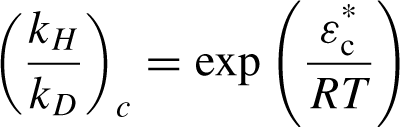
The same equations are usable similarly for tritium molecules and tritium isotope effects.
Results and discussion
Optimized geometries of the H2@X12N12 and H2O@X12N12 (X = B, Al) molecules are presented in Fig. 1 at the LC-ωPBE/6-311 G(d,p) level of theory.
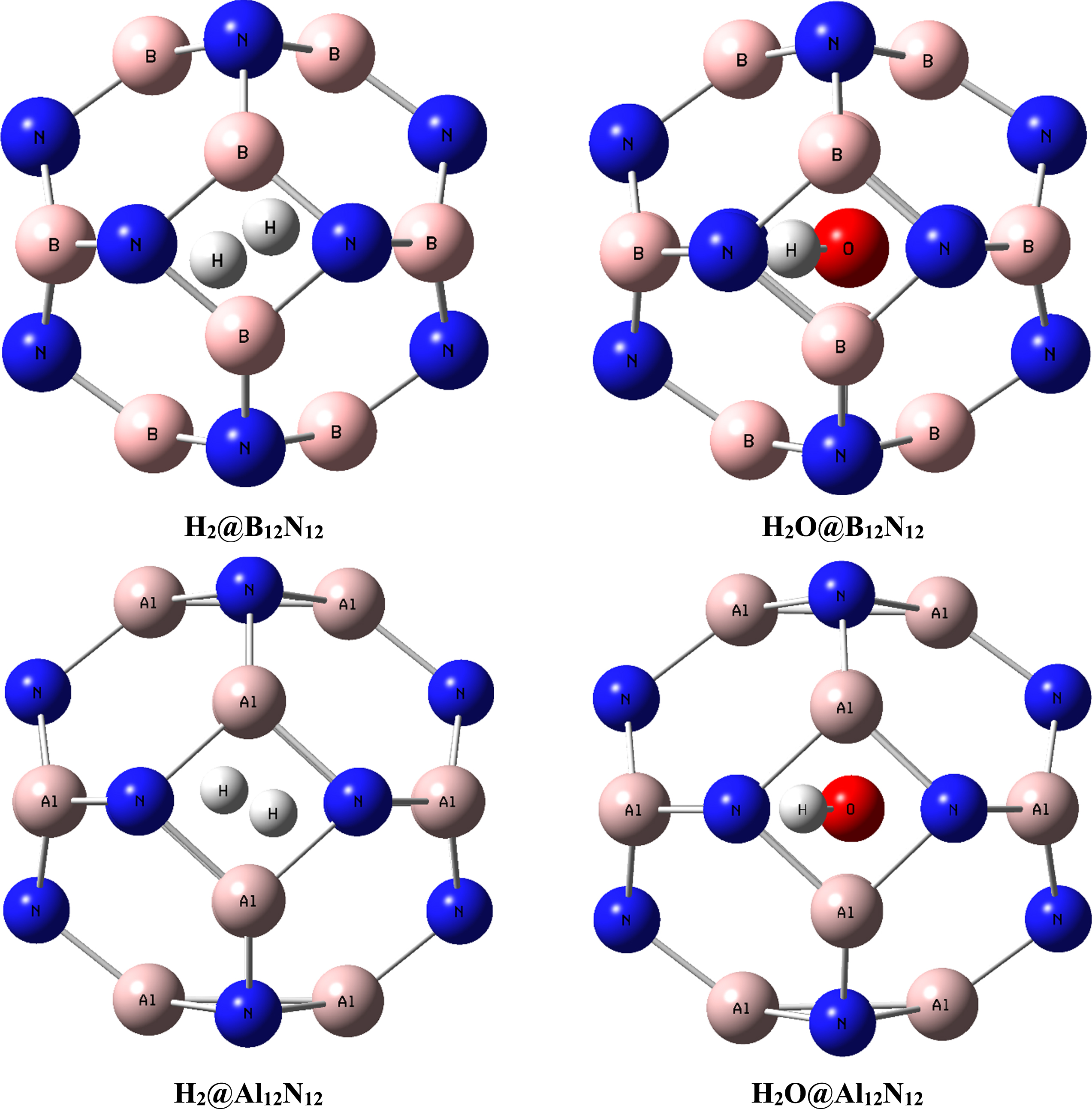
Optimized geometries of structure of H2@X12N12 and H2O@X12N12 (X = B and Al) molecules.
H-H and O-H bond distances are 0.746 and 0.958 Å for H2 and H2O molecules respectively. H-H bond distances are 0.713 and 0.751 Å for H2@B12N12 and H2@Al12N12 molecules, respectively. O-H bond distances are 0.951 and 0.984 Å for H2@B12N12 and H2@Al12N12 molecules respectively. It can be found, H-H and OH bonds are shorter in H2@B12N12 and H2O@B12N12 molecules than free H2 and H2O molecules. In contrast, H-H and OH bonds are longer in H2@Al12N12 and H2O@Al12N12 molecules than free H2 and H2O molecules. Longer H-H and OH bonds are found in compressed Al12N12 than similar compressed B12N12 molecules.
Polarity
Hydrogen molecules, H2@B12N12 and H2@Al12N12 molecules have zero dipole moment values there for these molecules are nonpolar. Calculated dipole moment values of water, H2O@B12N12 and H2O@Al12N12 molecules are 2.12, 1.95 and 2.97 Debye, respectively. It can be found; polarity of free water is larger H2O@B12N12 molecule. In contrast, polarity of free water is smaller H2O@Al12N12 molecule.
Energetic aspects
Zero-point energies
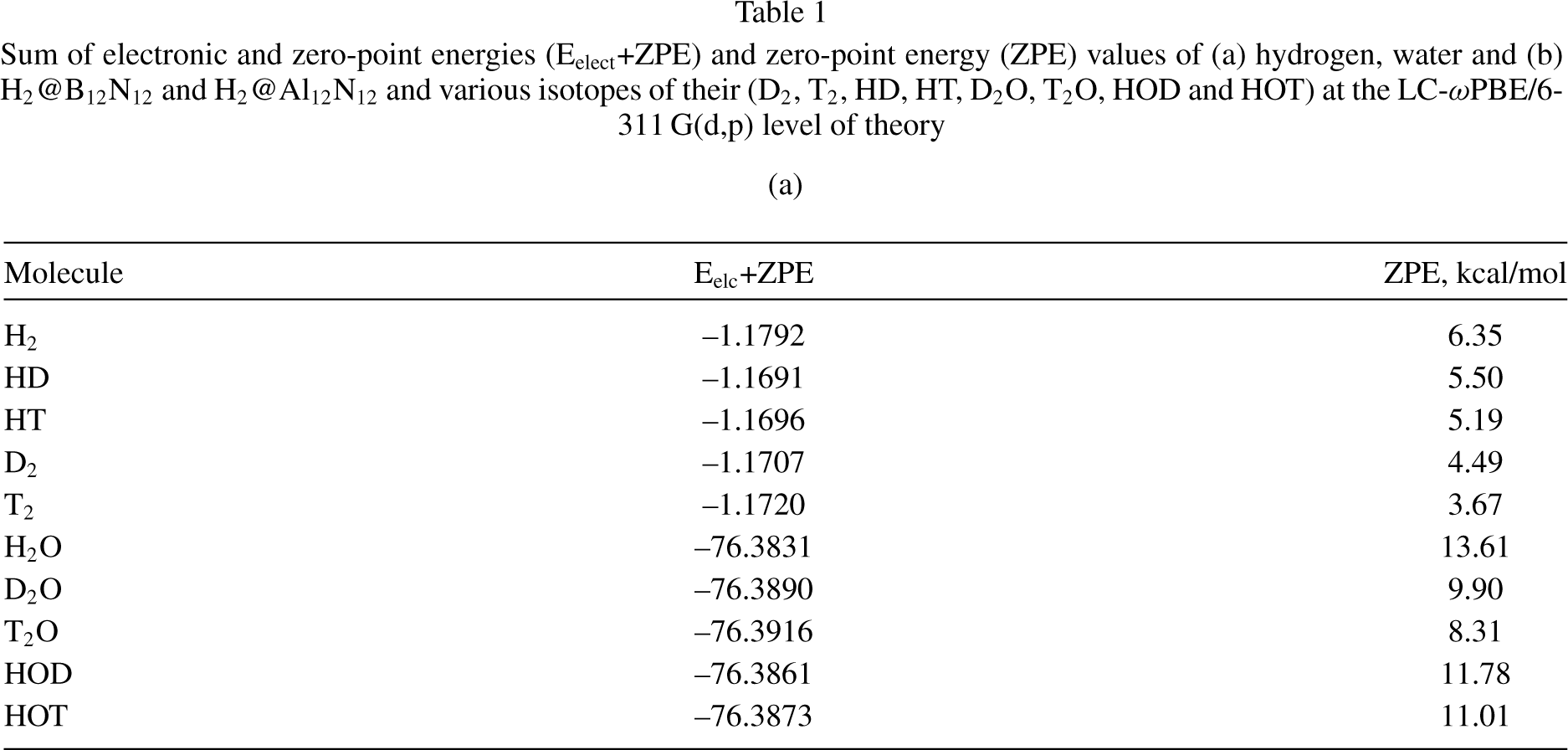
Sum of electronic and zero-point energies (Eelect+ZPE) and zero-point energy (ZPE) values of H2@B12N12 and H2@Al12N12, hydrogen, water and various isotopes of their (D2, T2, HD, HT, D2O, T2O, HOD and HOT) are listed in Table. Evidently, the compression of H2, D2, T2, HD, HT, H2O, D2O, T2O, HOD and HOT molecules in X12N12 increases their ZPE (Fig. 2). Larger ZPE values are observed in the presence of X = B than X = Al.
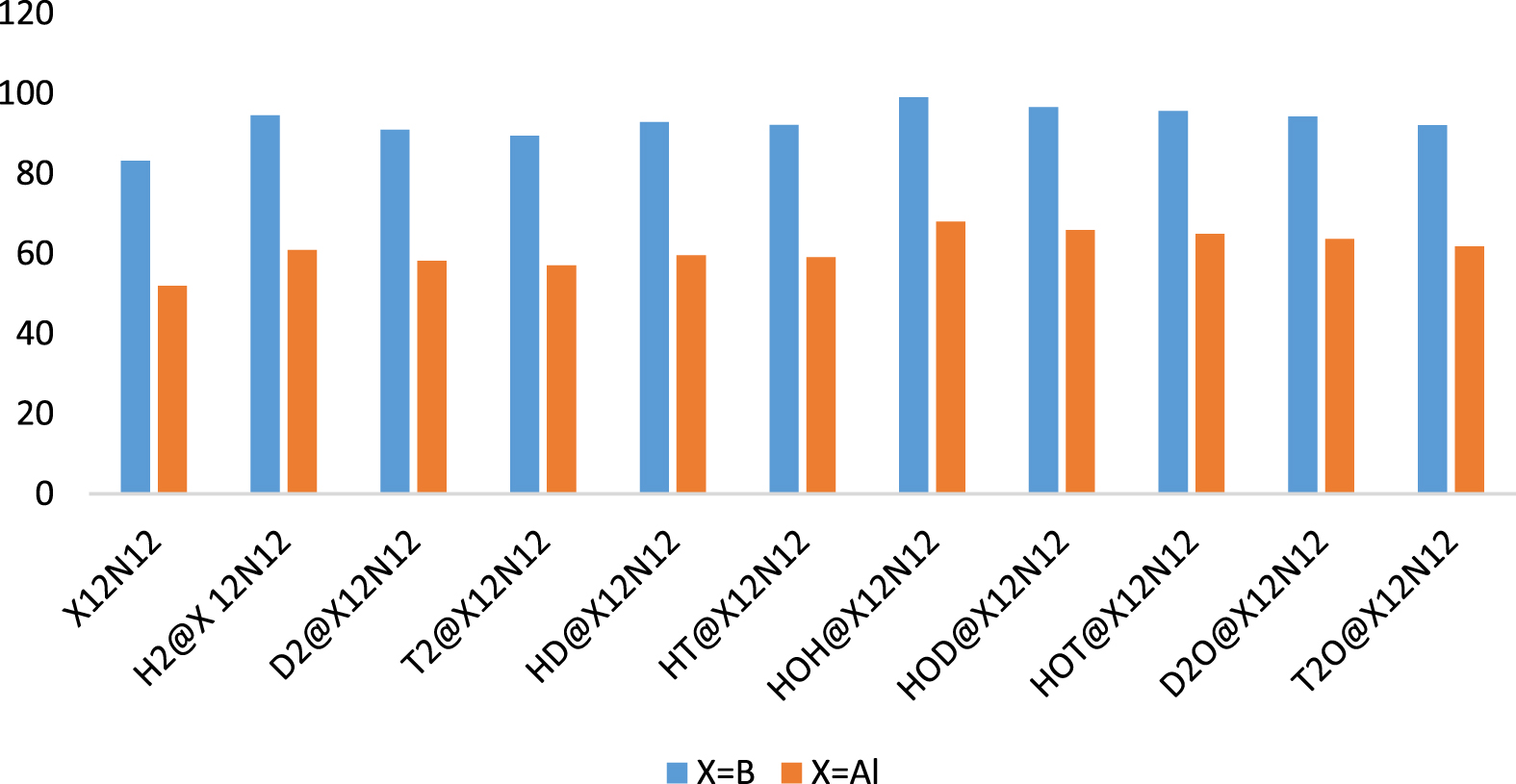
Diagrams of ZPE values of compression H2, D2, T2, HD, HT, H2O, D2O, T2O, HOD, HOT in X12N12 (X = B and Al) molecules.
Sum of electronic and zero-point energies (Eelect+ZPE) and zero-point energy (ZPE) values of (a) hydrogen, water and (b) H2@B12N12 and H2@Al12N12 and various isotopes of their (D2, T2, HD, HT, D2O, T2O, HOD and HOT) at the LC-ωPBE/6-311 G(d,p) level of theory
Sum of electronic and zero-point energies (Eelect+ZPE) and zero-point energy (ZPE) values of (a) hydrogen, water and (b) H2@B12N12 and H2@Al12N12 and various isotopes of their (D2, T2, HD, HT, D2O, T2O, HOD and HOT) at the LC-ωPBE/6-311 G(d,p) level of theory

Compression energy (Δɛ) obtained by the molecule under compression is defined as:



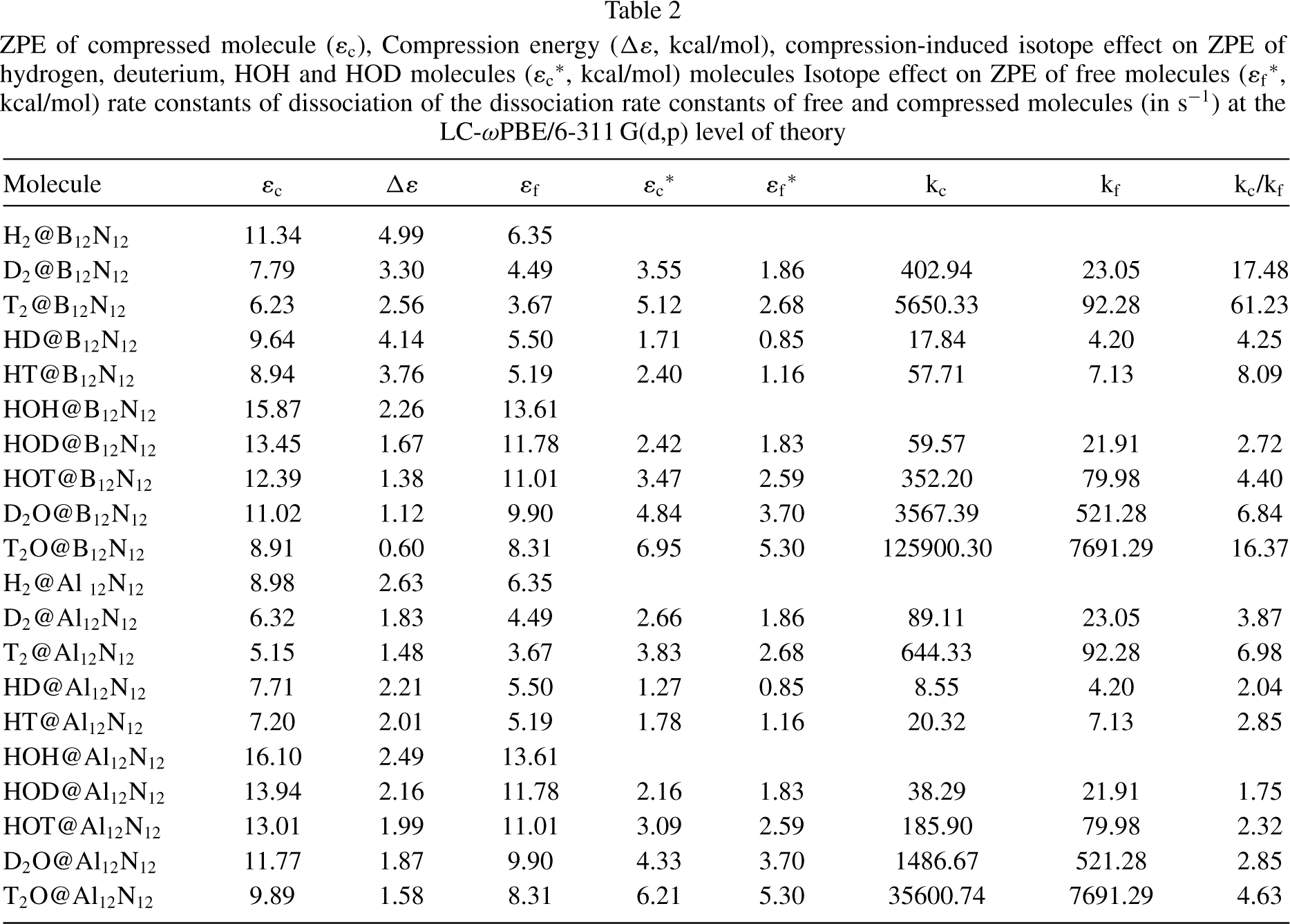
The excess of compression energy Δɛ obtained by the molecule under compression is moderately noteworthy, about 5.00–2.60 (X = B) and 1.48–2.63 (X = Al) kcal/mol. It is notable that ɛc nearly linearly rises with increasing of Δɛ:
X = B:
For: H2, D2, T2, HD, HT; Δɛ= 0.4729 ɛc –0.4086; R2 = 0.998
For: H2O, D2O, T2O, HOD, HOT; Δɛ= 0.2366 ɛc –1.5112; R2 = 0.9984
X = Al:
For: H2, D2, T2, HD, HT; Δɛ= 0.2963 ɛc –0.0649; R2 = 0.9927
For: H2O, D2O, T2O, HOD, HOT; Δɛ= 0.1447 ɛc + 0.1462; R2 = 0.9955
It quantitatively confirms an obvious declaration: the more compression makes the more change in ZPE of isotopic molecules and greater isotope effect.
Furthermore, the greater vibration rouses the more repulsive potential of the inner wall of the cage. Therefore, the averaged place of hydrogen atom is nearer to the internal wall of the cage and involvements stronger repulsion than D and T atoms. Explicitly, these changes in amounts and locations of isotopic atoms are accountable for the compression-induced isotope effects.
The isotope effects on the rate constants of dissociation of compressed molecules rise in compared to those of free molecules (Tables 2). Consequently, for molecular hydrogen and water molecule, kH/kD rise under compression (Fig. 3). For tritium molecule, the effect kH/kT is anticipated to be greater. Obviously, the isotope effects are certain means for examination of molecular compression. Larger kH/kD and kH/kT values are observed in the presence of X = B than X = Al.

Diagrams of kH/kD values of compression D2, T2, HD, HT, D2O, T2O, HOD, HOT in X12N12 (X = B and Al) molecules.
ZPE of compressed molecule (ɛc), Compression energy (Δɛ, kcal/mol), compression-induced isotope effect on ZPE of hydrogen, deuterium, HOH and HOD molecules (ɛc *, kcal/mol) molecules Isotope effect on ZPE of free molecules (ɛf *, kcal/mol) rate constants of dissociation of the dissociation rate constants of free and compressed molecules (in s - 1) at the LC-ωPBE/6-311 G(d,p) level of theory
Computational realization of the induced isotope effect on the compressed hydrogen and water molecules in B12N12 and Al12N12 nano-cages (H2@X12N12 and H2O@X12N12; X = B and Al) at LC-ωPBE/6-311 G(d,p) level of theory indicated: H-H and OH bonds were shorter in H2@B12N12 and H2O@B12N12 molecules than free H2 and H2O molecules. In contrast, H-H and OH bonds were longer in H2@Al12N12 and H2O@Al12N12 molecules than free H2 and H2O molecules. Longer H-H and OH bonds were found in compressed Al12N12 than similar compressed B12N12 molecules. H2O@B12N12 molecule indicated smaller polarity than free water. In contrast, H2O@Al12N12 molecule revealed more polarity than free water. Compression of H2, D2, T2, HD, HT, H2O, D2O, T2O, HOD and HOT molecules in X12N12 increased their ZPE. Larger ZPE values were found in the presence of X = B than X = Al. Δɛ value (excess of compression energy) was fairly noteworthy, about 5.00–2.6 (X = B) and 1.48–2.63 (X = Al) kcal/mol. ɛc values almost linearly increased with increasing of Δɛ values. kH/kD and kH/kT values enhanced under compression. Larger effect kH/kT was found for the tritium molecule. Larger kH/kD and kH/kT values were provided in the presence of X = B than X = Al.