



Abstract
Heavy metals are one of the most important environmental pollutants. One of the methods of absorbing heavy metals from industrial wastewater is the use of synthesized nanosorbents. The high cost and low efficiency of some common industrial wastewater treatment processes have created limitations. One of the interesting methods is the absorption process by carbon nanotubes as a new method. The present research aims to investigate the application of Al nanoparticles coated with polyaniline and functionalized modified multi-walled carbon nanotubes (MWCNT) for removal of Ni2+ and Zn2+ from a simulated industrial effluent. In the present study, the effect of absorption process time, pH, nickel and zinc ion dose, adsorbent dose and temperature on the efficiency of heavy metal absorption was investigated. The concentration of metal ions was measured using the ICP model ES-710. FTIR spectra for modified MWCNT nanotubes and polyaniline-coated alumina nanoparticles were recorded before and after adsorption using a PerkinElmer Spectrum One FTIR vacuum oven. X-ray diffraction patterns were obtained by XRD Rigaku Ultima IV, Japan, and SEM and TEM micrograph analysis were performed by FESEM TESCAN MIRA 3 and PHILIPS CM300, respectively.The maximum removal efficiency of nickel and zinc cations using nano alumina coated with polyaniline was obtained at pH 10 and 8, respectively. The maximum removal percentage of these two metal ions using functionalized MWCNTs can also be obtained at pH 7 and 8. The optimal concentration of metal ions for the highest removal efficiency of studied cations using surface modified alumina nanoparticles and functionalized MWCNT was obtained at 800 mg/L and 100 mg/L, respectively. In addition, the adsorption efficiency decreased with increasing process temperature. The obtained results showed that surface MWCNT with carbonyl, carboxyl and hydroxyl functional groups together with alumina nanoparticles modified by polyaniline can be considered as a potential adsorbent for absorbing nickel and zinc cations from simulated industrial effluents.
Introduction
The need for healthy and pollution-free water is vital given the world’s industrialization and population explosion [1]. Wastewater disposal from industrial section is known as a major problem in most countries around the world [2]. The fact that water pollution with industrial heavy metals is a well-known and challenging issue for environmental protection efforts is no secret [3, 4]. The import of heavy metals into various sources of drinking water supply is one of the major problems of water quality, especially in industrial areas [5]. The metals in industrial effluents include lead, nickel, copper, zinc and cadmium, which can have negative effects on humans and the environment, even in small amounts [6]. Pollution of lakes and streams with heavy metals released from various industries including battery production, textile, paper production, mining, electroplating, and pharmaceuticals can cause bioaccumulation in living organisms [7]. Thus, the introduction of effective methods to remove heavy metals from industrial wastewater become an attractive research field in recent years [8–11]. The wastewater purification methods may divide into different categories: electrochemical purification, chemical/physical precipitation, membrane filtration [10], coagulation, ultrafiltration, reverse osmosis, ionic exchange, and adsorption on active carbon have been used to treat these wastewaters [12]. Due to the effectiveness, simplicity, quickness, and cost-efficiency of the adsorption-based methods, they are considered one of the most effective techniques to eliminate heavy metals from industrial wastewater [8, 11]. Using cheap adsorbents such as products derived from industrial and agricultural wastes, coal, clay materials, biological wastes, and forestry residues are economical candidates for the elimination of heavy metal ions [16, 17]. However, the enhancement of the adsorption rate and capacity of natural adsorbents is an open research topic in this field. Due to the importance of the aspect ratio parameter in the adsorption capacity of an adsorbent, nanoparticles are attracted much attention in recent years [18, 19]. In recent decades, nanotechnology has opened a new chapter in human life [20]. In fact, higher active sites of nanoparticles to adsorb metal ions lead to exhibiting good adsorption efficiency. Furthermore, the surface functionalization of the nanoparticles can improve their adsorption capacity and separation rate [21]. Nano-alumina (Al2O3) is introduced as a relatively low-cost and highly effective adsorbent for eliminating heavy metals [22]. Moreover, nano-alumina has a high resistance to chemical agents and is widely used as a catalyst for some chemical reactions [23]. Based on the high efficiency of alumina nanoparticles for the removal of heavy metals [24], these nanoparticles might also be incorporated as nano-fillers in polymer-based membranes to enhance the removal capacity of the prepared nanocomposites [25, 26]. MWCNT (modified multi-walled carbon nanotubes) -based nanoparticles are another widely used adsorbent because of their thermal and chemical stability, excellent mechanical properties, large aspect ratio, and unique chemical structure. Due to the low reactivity of the MWCNT’s walls, surface modification processes are commonly used to introduce some oxygen functional groups (carboxyl, carbonyl, and hydroxyl) on the surface of the nanoparticles. The functional groups bonded on the surface of the MWCNT nanoparticles can increase the number of active adsorption sites and improve the heavy metal adsorption capacity of the modified nanoparticles [27]. Previous studies show that the use of modified carbon nanotubes is a suitable solution as an effective adsorbent for removing heavy metals from water environments. Carbon nanotubes and alumina nanotubes coated with polyaniline have occupied an important place in the field of absorbing heavy metals from wastewater. They have exceptional mechanical and chemical properties, strength, exchange capacity, electrical conductivity and thermal stability. The high surface area combined with numerous intermolecular interactions gives them an advantage over other adsorbents in the removal of heavy metals. The effectiveness of these materials in removing pollutants depends on various factors such as pH, concentration, contact time, etc. therefore the present study aimed to compare the efficiency of modified MWCNT and the nano-alumina coated with polyaniline in adsorbing nickel and zinc cations from an aqueous solution. The effect of adsorption parameters such as the adsorption time, adsorbent/adsorbate concentration, acidity, and process temperature, were also investigated to determine the optimum condition. Additionally, thermodynamic investigations were performed to study the adsorption mechanisms of the heavy metals on the synthesized adsorbents.
Experimental section
Reagents
All the chemicals were purchased from Merck Co., Germany. The alumina nanoparticles coated with polyaniline and modified multi-walled carbon nanotubes were used for experiments.
Synthesis of nanoparticles
In this research, co-precipitation method was used to prepare alumina nanoparticles, so that first, the effect of aluminum salt and precipitating agent on the specific surface of the resulting aluminas was investigated. Then, under optimal conditions, the effect of reaction temperature on phase changes and its specific surface was studied. Also, carbon nanotubes were synthesized by chemical vapor deposition (CVD) method and iron/alumina catalyst containing zinc.
Methods
To coat the nanoparticles with polyaniline, 1.6 g potassium dichromate oxidant was added to 200 ml 1 molar H2SO4 acidic solution and exposed to a magnetic stirrer to obtain a uniform solution. Thereafter, to disperse it evenly in the solution, 100 mg of alumina nanoparticle was added. After the complete mixing of alumina, 2 ml of pure aniline monomer was injected into the solution and stirred by a magnetic stirrer for 5 hours at ambient temperature. In a short interim after monomer injection, the solution color changes and turned green. Over time the solution color becomes darker, which is a polymer formation and reaction progression sign. The polymer formed by Watman filter paper was separated and washed three times with distilled water (DW) and dilute sulfuric acid (to eliminate cations), eventually dried in Oven at 60°C for 8 hours [28]. Since the raw MWCNTs were not effective for metal adsorption [29], oxidized MWCNTs were used for better dispersion in solutions and polymers. To remove impurities during synthesis, nanotube purification before the dedication factor is necessary. Carbon nanotubes purify by both physical and chemical methods, even though, usually, physical methods perform along with chemical methods. During chemical purification, carbon nanotubes were also factored in. Chemical oxidation is the most common method for creating oxygenated functional groups. Therefore, to modify the nanotubes, after washing them with 10% HNO3 and twice DW, the nanotubes were functionalized in a solution containing 65% HNO3 at 120°C for 48 hours. The functionalized nanoparticles were washed several times by DW and using a vacuum pump to the extent that their pH was equal to the pH of the DW for washing. Then, the nanoparticles were dried at 100°C for 2 h in Oven [30].
In the present study, the effect of the adsorption process time (10, 30, 60, 90, and 120 min), pH (1–14), the dosage of nickel and zinc ions (100, 200, 400, 600, and 800 mg/L), adsorbent dosage (0.01, 0.05, 0.1, 0.5, 1 and 2 g/L), and temperature (15, 25, 30, 40 and 50°C) on the efficiency of heavy metals adsorption studied. To adjust the solution pH, 0.01 N potassium hydroxide along with 0.01 N sulfuric acid was employed. All of the solutions were prepared at different temperatures in 200 mL Erlenmeyer flasks. A 100 ml solution with a known dosage of the heavy metals and a certain concentration of the nanoparticles was prepared in a 200 ml flask. The solutions were mechanically stirred at 180 rpm for a certain contact time at 25°C. A solution without the nanoparticles was used as the control sample to determine the amount of the heavy metal cations adsorbed on the flask walls. The metal ions concentration was measured using ICP model ES-710 [31]. All of the tests were repeated 3 times to investigate the repeatability of the obtained results. The final adsorption capacity of the metal ions on the adsorbent surface (qe) and the removal efficiency (% E) obtained through Equations 1 and 2, where C0 (mg/L) and Ce (mg/L) are the initial and final dosages of the nickel and zinc ions, V(L) is the total volume of the mixture, and m(g) is the mass of nanoparticles in the mixture [32–34].


To appraise the adsorption mechanisms on the surface of the used adsorbents, Langmuir (Equation 3) and Freundlich (Equation 4) isotherm models were investigated [35, 36].


FTIR spectra for modified MWCNTs nanotubes and alumina nanoparticles coated with polyaniline before and after adsorption were recorded using FTIR PerkinElmer Spectrum One vacuum oven. X-ray diffraction patterns analyzed through XRD Rigaku Ultima IV, Japan. SEM and TEM micrograph analyses were carried out by FESEM TESCAN MIRA 3 and PHILIPS CM300, respectively. Samples were collected from the effluent of Tarom industrial town, Zanjan Province, Iran. Sampling was performed in combination in a manner that one liter of wastewater was taken every half hour. In the final Stage, 5 liters of wastewater were collected and comprehensively mixed [37].
Adsorbents characterization
The XRD spectra of modified MWCNTs nanotubes and alumina nanoparticles (with reference code JCPDS Card 29-0063) coated with polyaniline adsorbent before and after adsorption of Ni and Zn were depicted in Fig. 1.

Typical XRD pattern of modified MWCNTs nanotubes (a) and alumina nanoparticles coated with polyaniline (b) before and after adsorption of Ni and Zn.
In Fig. 1 (a), the one characteristic resolved peak at a 2θ angle of 24.6° indicates the presence of oxygenated functional groups in modified MWCNTs nanotubes. 30.7°, 34.8°, 37.6° and 55° peaks related to the absorption of zinc metal and 35.7° and 39.8° peaks related to the absorption of nickel-metal by modified MWCNTs nanotubes. In Fig. 1(b), the four characteristic resolved peaks at 2θ angles of 32.8°, 37.3°, 39.4°, and 45.5° indicate the presence of polyaniline groups in alumina nanoparticles coated with polyaniline. 33.2°, 35.1°, 37.4°, 47.2°, and 54.1° peaks related to the absorption of zinc metal and 37.3° and 43.1° peaks related to the absorption of nickel-metal by alumina nanoparticle coated with polyaniline. Figures 2 (a and b) illustrated the TEM and SEM of the modified MWCNTs nanotubes. Uniform nanofibers shall observe in those nanotubes. The nanofibers have 19 to 39 nm lengths on average. Figures 2 (c, d, e), and 2(f) demonstrated the TEM and SEM of nanotubes’ micrographs after Ni and Zn adsorption, respectively. Figures 3 (a and b) depicted the TEM and SEM of the polyaniline-coated alumina nanoparticles. Figures 3 (c, d, e), and 3(f) presented the TEM and SEM micrographs of the nanoparticles after Ni and Zn adsorption, respectively. Results showed considerable change in nano-adsorbent morphology before and after the adsorption process.
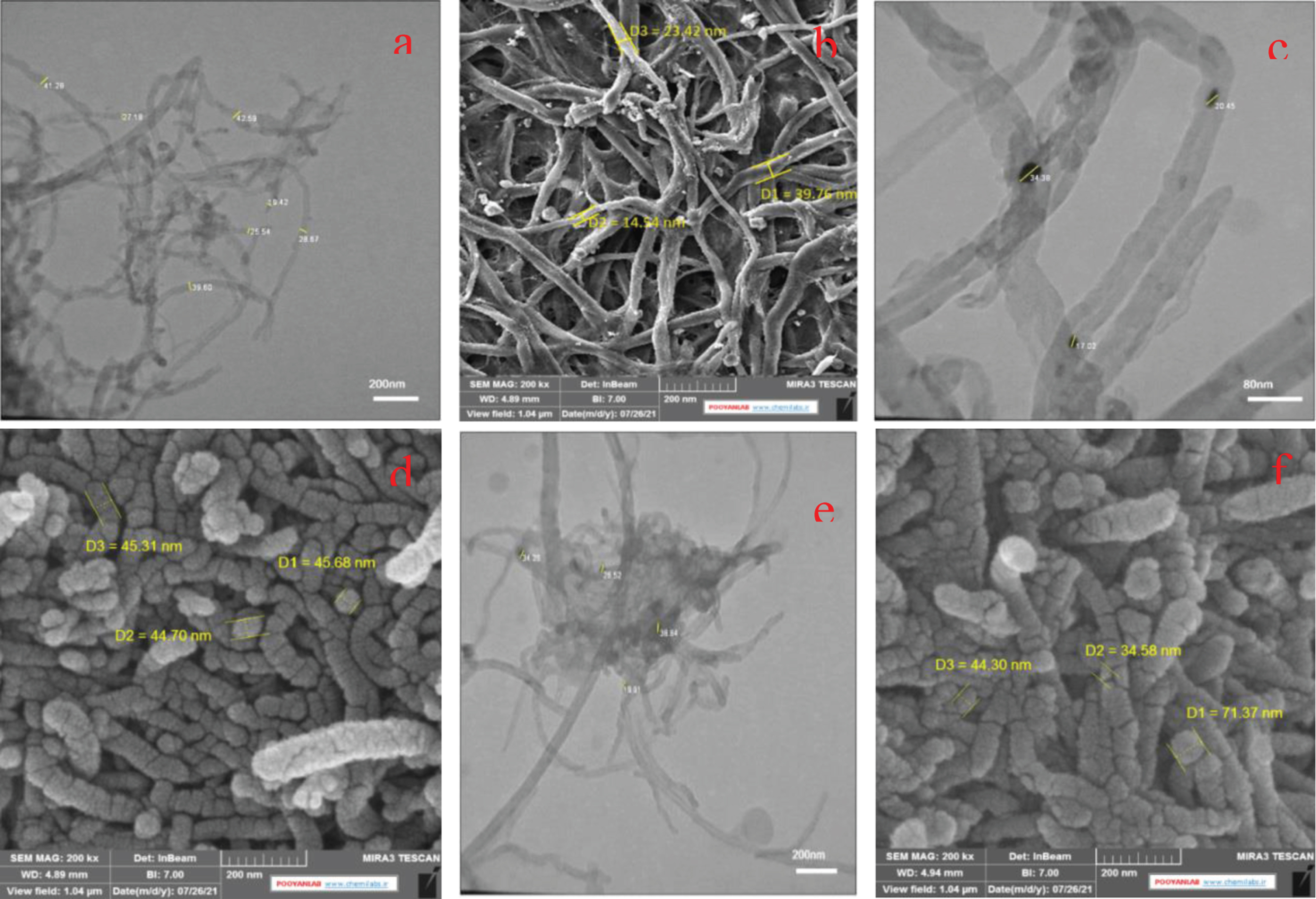
(a and b) TEM and SEM of modified MWCNTs nanotubes, (c and d) after Ni adsorption, (e and f) after Zn adsorption.

(a and b) TEM and SEM of an alumina nanoparticle coated with polyaniline, (c and d) after Ni adsorption, (e and f) after Zn adsorption.
FTIR spectra of modified MWCNTs nanotubes and polyaniline-coated alumina nanoparticles before and after Ni (II) and Zn (II) adsorption are presented in Fig. 4.

Modified MWCNTs nanotubes FTIR spectra of polyaniline-coated alumina nanoparticle (a) before and (b) after adsorption of Ni (II) and Zn (II).
As evident from parts (a) and (b) of the figure, zinc and nickel adsorption on modified MWCNTs surface and polyaniline-coated alumina nanoparticles led to a significant change in FTIR spectrosols shape. According to the figure, the nickel-containing sample with tensile vibration and bending of O-H bonds related to adsorbed moisture showed peaks in 3414 cm–1 and 1620 cm–1 waves for modified MWCNTs nanotubes and 3433 cm–1 and 1624 cm–1 waves for polyaniline-coated alumina nanoparticles [38]. The flexural vibration of C–H bonds in the MWCNTs and the structure of wavenumber 1384 cm–1 have shown a small peak. In the same way, the flexural vibration of C–H bonds in the polyaniline-coated alumina and the structure of wavenumber 1381 cm–1 have shown a small peak [39]. The symmetric and asymmetric tensile vibration of Ni–O bonds were in 474 cm–1 and 613 cm–1 waves of modified MWCNTs absorption bonds, and polyaniline-coated alumina was in 490 cm–1 and 609 cm–1 waves [40]. The presence of this peak along the removal or weakening of related MWCNTs and polyaniline-coated alumina peaks confirms the formation of a layer of nickel oxide structure on the modified MWCNTs nanotubes surface and the coating that prevents entry of infrared radiation to the carbon nanotubes used in the test. In the spectrum related to MWCNTs-Zn sample and polyaniline-Zn-coated alumina, in addition to C–H and O–H bonds vibrations in 1388 cm–1, 1639 cm–1, and 3475 cm–1 waves, an absorption peak observed in wave number 555 cm–1 for modified MWCNTs and in 1384 cm–1, 1627 cm–1 and 3444 cm–1 waves, an absorption peak in wave number 547 cm–1 for polyaniline-coated alumina related to the tensile vibration of ZnO bonds in the structure of zinc oxide observed [41]. Therefore, the peak existence along the removal or weakening of MWCNTs and alumina coated with polyaniline-related peaks confirms the formation of a layer of zinc oxide structure on the modified MWCNTs nanotube surface.
It is well known that the initial acidity of effluent is one of the major parameters affecting the metal dissolution in the solution and the adsorption capacity of an adsorbent [42]. To investigate the effect of pH on the adsorption, the pH of the experiment batches was adjusted in the range of 1–14. The results of these studies are presented in Fig. 5. It can be seen from the figure that the pH has a considerable role in the metal ions removal efficiency. The nickel cation removal efficiency using alumina coated with polyaniline nanoparticle and modified MWCNTs nanotubes is increased until pH = 10, pH = 8 respectively and then decrease as the pH of the solution arises. The zinc cation removal efficiency using alumina nanoparticle coated with polyaniline and modified MWCNTs nanotubes is increased until pH = 7, pH = 8 respectively and then decrease as the pH of the solution arises. This can be justified regarding the negative charge of the used nanoparticles increased at higher pHs and hence the electrostatic interaction between the adsorbent and adsorbate becomes stronger [43, 44]. The pH of the solution is one of the most important factors that affect the absorption process. In fact, the pH of the solution changes both the solution chemistry and the surface coupling sites of the adsorbent. A change in pH leads to a change in the charge profile of adsorbed species, which subsequently affects the interaction between adsorbed and adsorbent species [60].

The effects of pH on nickel and zinc ions adsorption efficiency using polyaniline-coated alumina nanoparticles and modified MWCNTs nanotubes (temperature = 25°C, initial concentration of nickel and zinc cations were 3.27 and 4.13 mg/L, respectively, dosage = 0.1 g/L, contact time = 60 m.
To evaluate the concentration influence of the synthesized nanoparticles on the adsorption efficiency, the dosage of modified nano-alumina and functionalized MWCNT nanoparticles was adjusted at 0.01, 0.05, 0.1, 0.5, 1, and 2 g/L. Concerning Figure 6, the removal efficiency values have a direct proportion with the initial concentrations of surface-modified nano-alumina and functionalized MWCNT nanoparticles. The maximum removal of the nickel and zinc ions using the modified MWCNTs nanotubes was 83% and 80%, respectively, and the maximum removal percentage of these cations using the nano-alumina coated with polyaniline nanoparticles was 89% and 80%, respectively. Indeed, by arising the adsorbent concentrations, the adsorption active site also arises [48, 49]. As a result, the concentration of synthesized nanoparticles has an effect on the absorption efficiency, so that the increase in the concentration of the adsorbent leads to a higher absorption efficiency. The reason for this is that with the increase in the adsorbent dose, the absorption active sites also increase, so the percentage of heavy metal removal by the studied adsorbent increases.

The effects of dosage on adsorption efficiency using polyaniline-coated alumina nanoparticles and modified MWCNTs (contact time = 60 min, pH = 10 and 8 respectively related to adsorption of nickel and zinc cations on the polyaniline-coated nano-alumina, pH = 8 and 7 respectively related to adsorption of nickel and zinc cations on the modified MWCNTs, initial concentration of nickel and zinc cations were 3.27 and 4.13 mg/L, respectively, temperature = 25°C).
percentage of nickel ions from an effluent.
Since the adsorption time is an important parameter for the heavy metal removal from an effluent, various adsorption times in the experiments of the present study in the range of 10–120 min were carried out. The results of these studies are presented in Figure 7. According to this figure, the maximum removal percentage of nickel and zinc cations by alumina coated with polyaniline nanoparticles was obtained in approximately 30 and 60 min, respectively, and then ions efficiency decreased after this time. According to the results, the maximum removal percentage of nickel and zinc cations by modified MWCNTs nanotubes obtained in approximately 120 min could be due to the fact that at the initial adsorbing times, the vacant active sites, as well as the adsorbate dosage gradient, were high [51, 52]. By contacting the processing time, the active sites were occupied by the metal cations, and the adsorption rate decreased [53]. Naturally, as time elapses due to the increasing contact chance of metal ions with adsorbent particles, the absorption rate increases. Hence when the contact time between adsorbents and solutions containing metal ions ascends, the absorption rate of metal ions rises.

The effects of process time on the adsorption efficiency of heavy metals using polyaniline-coated alumina nanoparticles and modified MWCNTs nanotubes (pH = 10 and 8 respectively related to adsorption of nickel and zinc cations on the polyaniline-coated nano-alumina, pH = 8 and 7 respectively related to adsorption of nickel and zinc cations on the modified MWCNTs, initial concentration of nickel and zinc cations were 3.27 and 4.13 mg/L, respectively, temperature = 25°C, and dosage = 0.1 g/L).
The initial heavy metal concentration is another important parameter in the adsorption process. The effect of the initial dosage of nickel and zinc cations was evaluated for the concentration of the heavy metals from 100 to 800 mg/L (Fig. 8). It is clear that the nickel and zinc cations removal percentage using the alumina nanoparticles coated with polyaniline was decreased with increasing the initial dosage of the heavy metals. The result is in good agreement with the results obtained by Yang et al. [45, 54]. The higher cation adsorption at the more initial concentrations can be related to the higher driving force of the adsorption process in the presence of more ion concentrations [55]. Also, the stabilization of absorption at high concentrations of nickel and zinc can be justified by the fact that the absorbent surface has a fixed number of active absorption sites that are available for the absorption of more metal ions at low concentrations, but with the increase in solution concentration, the number of saturated sites decreases. Finding and the absorption process of elements on the absorbent surface slows down [62].

The effects of heavy metals’ initial concentration on adsorption efficiency using polyaniline-coated alumina nanoparticles and modified MWCNTs (pH = 10 and 8 respectively related to adsorption of nickel and zinc cations on the polyaniline-coated nano-alumina, pH = 8 and 7 respectively related to adsorption of nickel and zinc cations on the modified MWCNTs, temperature = 25°C, process time = 60 min, and dosage = 0.1 g/L).
The effects of process temperature on the adsorption of heavy metal ions and the synthesized adsorbents investigated in the temperature ranged from 15–50°C (Fig. 9). An increase in the temperature led to the decrease in the removal percentage of Ni (II) and Zn (II) ions by using alumina nanoparticles coated with polyaniline and modified MWCNTs nanotubes, and this is a sign of the exothermic absorption process. Physical absorption usually occurs when the adsorption process considerably decreases with an increase in temperature. Also, the decrease in absorption phenomenon may be due to the rapid molecules moving at higher temperatures resulting in less time to interact between the adsorbent active places and the absorbent molecules [56].

The effects of temperature on the adsorption process of the heavy metals on the polyaniline-coated alumina nanoparticles and modified MWCNTs (pH = 10 and 8 respectively related to the adsorption of nickel and zinc cations on the polyaniline-coated nano-alumina, pH = 8 and 7 respectively for adsorption of nickel and zinc cations on the modified MWCNTs, contact time = 60 min, dosage = 0.1 mg/L, and initial concentration of the heavy metals were = 3.27 and 4.13 mg/L, respectively).
Figures 10–13 presented the experimental data fitting plots on the Langmuir and Freundlich isotherm models. According to the results, the R2 value of the Langmuir and Freundlich for isotherm models of the Ni (II) with modified MWCNTs nanotubes are 0.936 and 0.613, respectively. The R2 content of the Langmuir and Freundlich for isotherm models of the Zn (II) with modified MWCNTs nanotubes are 0.893 and 0.656, respectively. Therefore, both the Zn (II) and Ni (II) adsorption follow the Langmuir model.
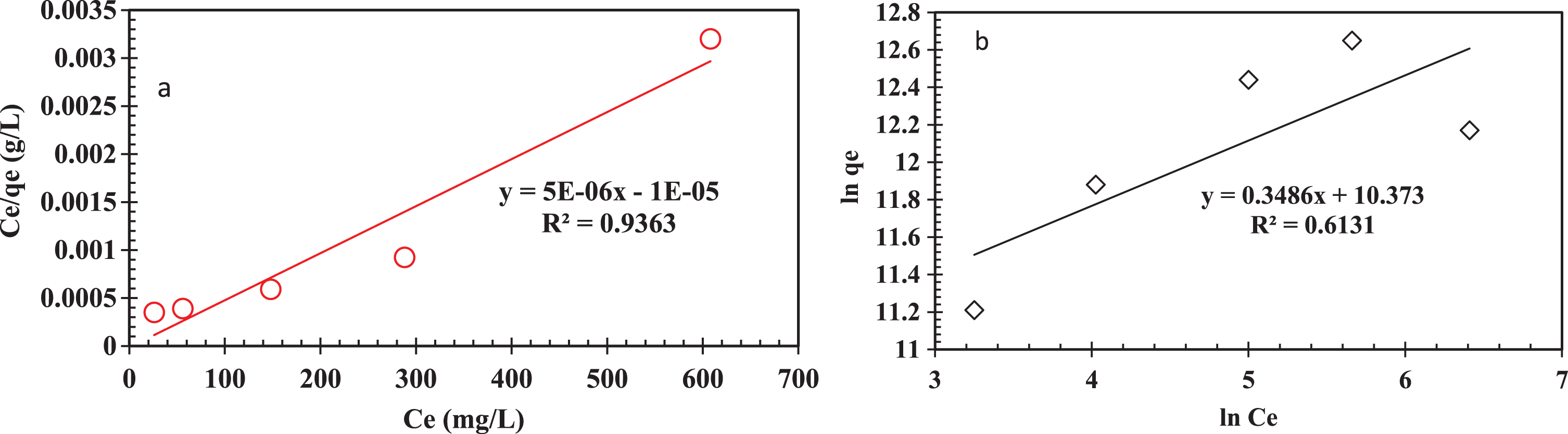
(a) Langmuir and (b)Freundlich isotherm models for the nickel cation adsorped on the functionalizedMWCNT.
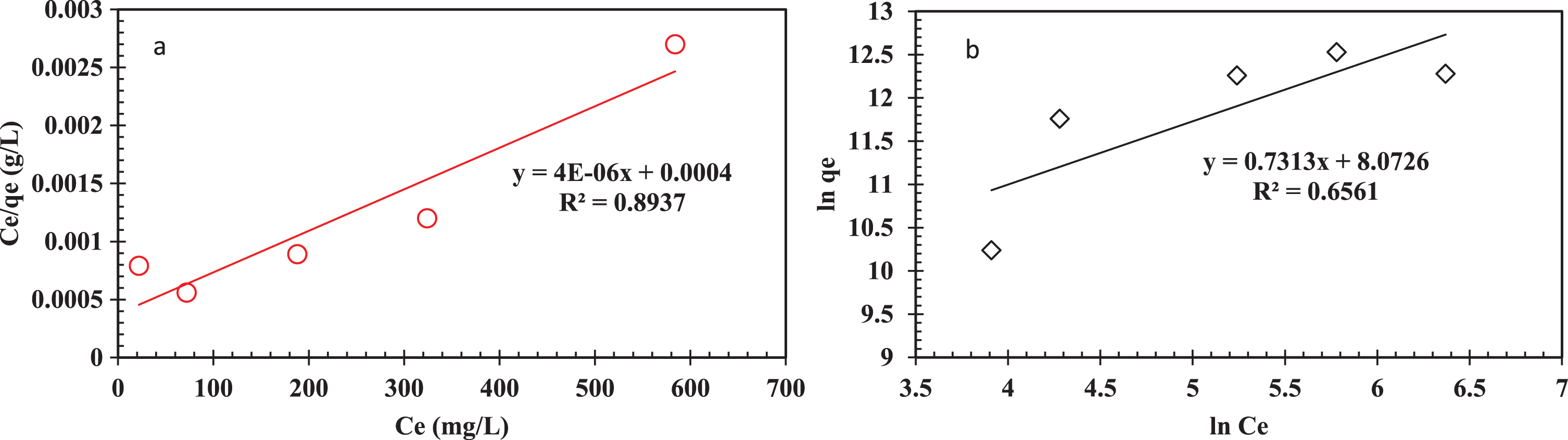
(a) Langmuir and (b) Freundlich isotherm models for the zinc cation adsorped by the functionalized MWCNT.
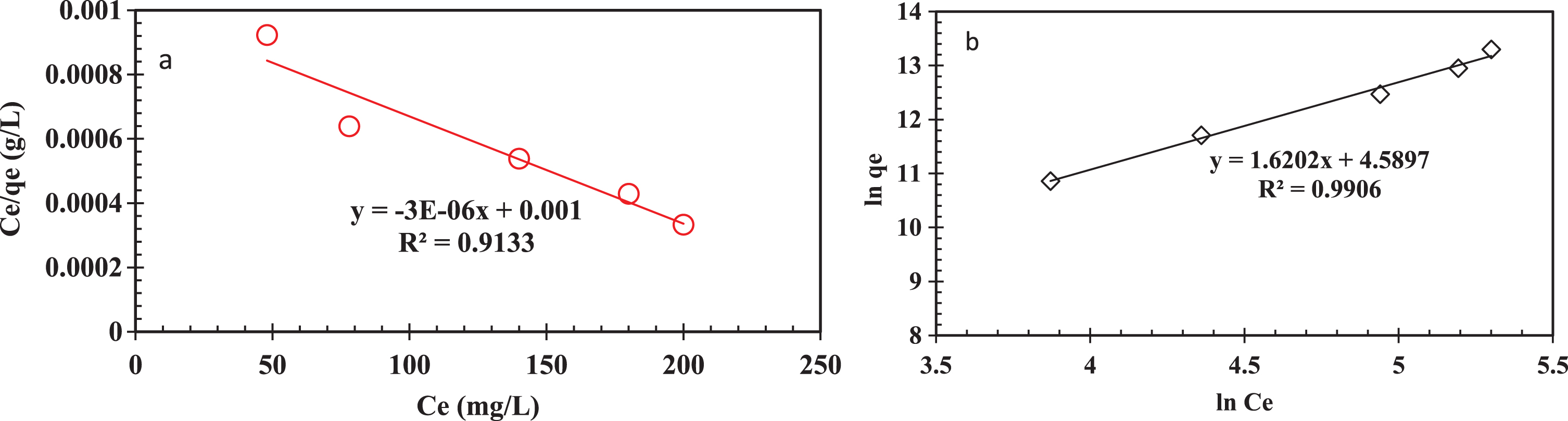
(a) Langmuir and (b) Freundlich isotherm models for the nickel cation adsorbed by the functionalized MWCNT.
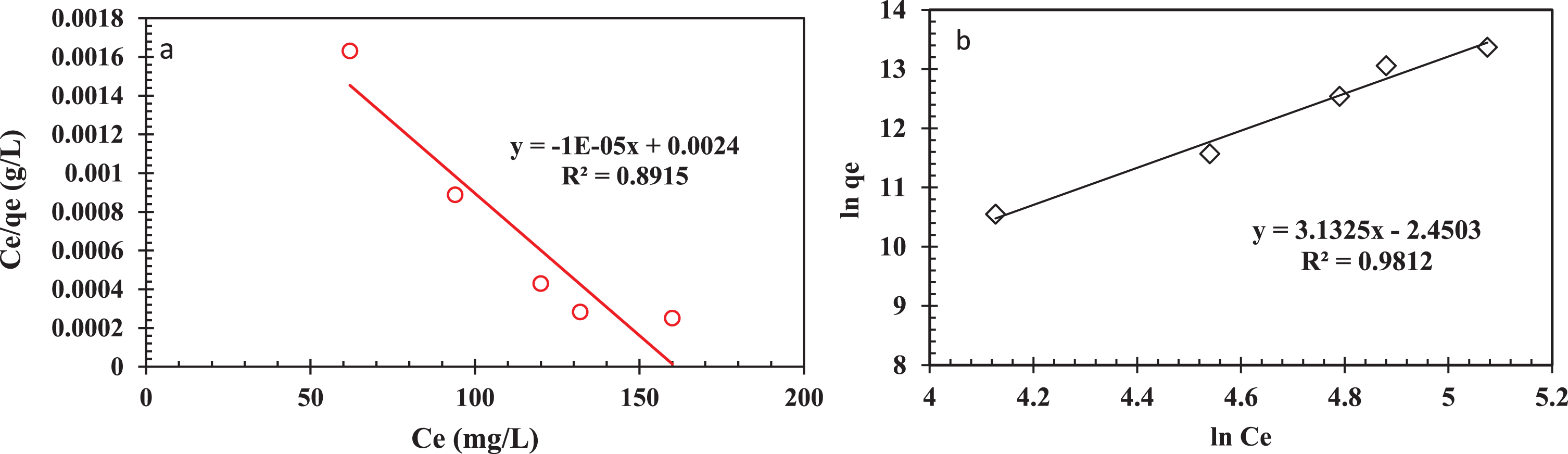
(a) Langmuir and (b) Freundlich isotherm models for the zinc cation adsorbed by the functionalized MWCNT.
This model assumes that a monolayer on a homogeneous surface of an adsorbent formed, as was observed in previous pieces of research [57–59]. The R2 value of the Langmuir and Freundlich isotherm models of Ni (II) with polyaniline-coated alumina nanoparticles are 0.93 and 0.99, respectively. The R2 content of the Langmuir and Freundlich isotherm models of the Zn (II) with alumina coated by polyaniline nanoparticles are 0.89 and 0.98, respectively. Hence it can be concluded both Ni (II) and Zn (II) absorption follow the Freundlich model.
The maximum removal efficiency of the nickel and zinc cations using the polyaniline-coated nano-alumina could obtain at pHs 10 and 8, respectively. The maximum removal percentage of these two metal ions using the functionalized MWCNTs could also obtain at pHs 7 and 8, as well. Concerning the outcomes, the optimum adsorbent dosage for maximum removal of heavy metals using the nano-alumina coated with polyaniline and functionalized MWCNTs was obtained at 2 mg/L. Yang et al. [45] claimed the higher adsorption efficiency of nickel cations at higher pHs is due to the hydrolysis of the cations. They proved the adsorption of the cations at the higher pHs due to its low constant value cannot attribute to the precipitation. Lu et al. [46], in the study of zincand nickel removal by single-walled carbon nanotube modified with sodium hypochlorite, showed that increases in pH from 1 to 8 raise the zinc adsorption and retain the adsorption amount in the pH ranging from 8 to 11. In the study performed by Vukovic et al., the best adsorption rate for carbon nanotubes modified with ethylenediamine-9 was reported to be. The maximum adsorption rate for oxidized multi-walled carbon nanotubes was at a pH between 6 and 10. The results of the aforementioned studies show an increase in the pH value, which confirms the results of the present study [47].
Bhat et al. [50] demonstrated the initial dosage increment of γ-alumina nanoparticles (adsorbent) led to enhance in lead (II) adsorption in an aqueous solution. The investigation conducted by Agarwal et al., demonstrated that the increase in γ-alumina and MWCNT nanoparticles (adsorbents) has a positive effect on the removal, which is consistent with the results of the present study.
The maximum removal efficiency for Ni (II) and Zn (II) using polyaniline-coated nano-alumina was obtained at 30 and 60 min, respectively, and The maximum removal efficiency for these two cations using modified MWCNTs was received at time 120 min. The results of Rodríguez et al., (2020) [53] study indicated that with increasing contact time, the removal percentage of copper, manganese, and zinc metals by MWCNTs nanotubes increased, which is consistent with the present study.
The optimum metal ions concentration for the highest removal efficiency of the under-studied cations using surface-modified alumina nanoparticles and functionalized MWCNT obtained at 800 mg/L and 100 mg/L, respectively. In addition, the adsorption efficiency decreased by arising the process temperature.
According to the thermodynamic study, the Langmuir and Freundlich isotherm models can describe the data obtained from the adsorption of heavy metals using modified MWCNTs and surface-modified nano-alumina, respectively. The obtained results showed that surface MWCNT with carbonyl, carboxyl, and hydroxyl functional groups, together with alumina nanoparticles modified by polyaniline, can be considered as potential adsorbents for the adsorption of nickel and zinc cations from simulated industrial effluents.
The findings of the present research indicate the acceptable use of Al nanoparticles with polyaniline and functionalized modified multi-walled carbon nanotubes (MWCNT) to remove Ni2+ and Zn2+ from industrial wastewater. These adsorbents are introduced as excellent adsorbents in the field of wastewater treatment due to their remarkable mechanical and surface characteristics, mechanical and magnetic properties, and high stability. But its use is limited due to the accumulation of active sites by the absorbent material. Hence, the activation of carbon nanotubes offers the advantage of increasing the sites with functional groups, which in turn increases their adsorption efficiency for the removal of heavy metals from water and wastewater. Therefore, these adsorbents can be used to treat industrial wastewater and remove heavy metals from water.
Considering that due to time and budget limitations, it was not possible to investigate the efficiency of Al nanoparticles with polyaniline and functionalized modified multi-walled carbon nanotubes (MWCNT) for the removal of other heavy metals such as lead, cadmium, cobalt, etc. in this research, it is suggested that The issue should be considered in future studies. It is also suggested to investigate the efficiency of Al nanoparticles with polyaniline and functionalized modified multi-walled carbon nanotubes (MWCNT) in removing petroleum hydrocarbons, fluoride and chemical compounds such as chlorophenol in future studies.