



Abstract
The Internet of Agents (IoA) is an emerging field of research that aims to combine the advantages of multi-agent systems and Internet of Things (IoT), by adding autonomy and smartness to, traditionally, dummy things used in IoT. Multi-agent systems can be used to model distributed systems of smart grids, such as smart grid operations, power system control, electricity market, and monitoring and diagnostic. Trust management can be considered a key component for successful interactions between autonomous agents in IoA, especially when agents cannot assure that potential interactions’ partners share the same core beliefs, or make accurate statements regarding their competencies and abilities. When interactions are based on trust, trust establishment mechanisms can be used to direct trustees, instead of trustors, to build a higher level of trust and have a greater impact on the results of interactions. This paper presents a trust establishment model that uses a multi-criteria (multidimensional) approach to help trustees in IoA environment to adjust their behaviors to improve their perceived trustworthiness, to attract more interactions with trustors. It calculates the necessary improvement per criterion when only a single aggregated satisfaction value is provided per interaction, where the model attempts to predicted both the appropriate value per criteria and its importance. The proposed model is evaluated through simulation, and results indicate that trustees empowered with the proposed model have higher levels of trust and better chances to be selected as interaction partners when such selection is based on trust.
Introduction
Open, dynamic multi-agent systems (MASs) are increasingly popular for modeling systems that are common in virtual contexts, such as E-Commerce, smart building systems, and smart transportation systems, where entities act in a flexible and autonomous way in order to realize their objectives [34]. Interconnecting agents of different MASs representing various modern systems such as smart buildings, smart transportation systems, and Smart Grid (SG), through web-like technologies or using Internet-like architecture, can be referred to as Internet of Agents (IoA). IoA is viewed as an extension of the concept of Internet of Things (IoT) by augmenting internal reasoning and intelligence capability to, traditionally, naive things [31]. Agents of IoA not only can interact directly with other agents in the same or different MASs, but also they can interact with other systems directly or through a mediator [30] .
Traditionally, large, centralized electrical generators produce electricity, which is transferred in bulk to substations that in turn distribute electricity to residential, commercial, and industrial customers [43]. The electrical system that generates, transmits, distributes, and controls electricity is usually referred to as the grid [11]. There is a global interest recently for using renewable energy, not only to replace fossil fuels for their negative environmental impacts but also to meet future demands for electricity [19]. Even though the price reduction of these renewable sources further encourages adoption of such sources, large-scale adoption of renewable sources can be challenging and require complex control of diverse sources and storage [19], as renewable sources can be both discontinuous and distributed [35].
The term Smart Grid (SG) refers to an electric system that uses information and communication technologies integrated with a highly intelligent and distributed control across electricity generation, transmission, substations, distribution and consumption [11]. SG represents a paradigm shift from the traditional centralized electricity generation and one-directional power flow into more reliable and sustainable energy systems [19]. They can be considered as the next generation electricity network [11] and expected to be consumer friendly, efficient, reliable, secure, flexible enough to enables markets and accommodate various generation and storage options [33].
New energy technologies and electrical-powered devices come with embedded electronic intelligence that controls their operations and can interconnect them to the grid [23], which can grow into distributed ecosystems with a large number of intelligent, heterogeneous components interacted at the electricity and information levels to provide multidimensional services [43]. For example, distributed energy sources can be evaluated not only based on the price per unit they provide but also their stability, as well as, their environmental impacts. The importance of each dimension can vary from one consumer to another.
In addition to the applications of MASs in micro grids [21, 20, 10], MASs can be used in different categories of power engineering [29] in the context of SGs, such as modeling and simulation [15], planning [12], network management [9], SG operation [5] , electricity market [38], automation of substations [45], restoration [22], reconfiguration [25], load shedding [46], monitoring and diagnostic [27], and protection [39]. Interconnecting agents of different MASs of a SG, as well as, agents of other modern systems through IoA, enhances the services that could be derived from the interactions of agents.
In IoA, when agents cannot assure that potential interactions’ partners share the same core beliefs about the system, or make accurate statements regarding their competencies and abilities, trust is considered essential for making interactions effective. It is argued that when interaction are based on trust, trusted agents have better chances of being chosen as interactions partners and can raise the minimum reward they can obtain for their transactions [7]. However, trust often has to be acquired at a cost, which may be compensated if improved trustworthiness leads to further profitable interactions [37]. Therefore, trustees need to be equipped with a rational reasoning that can trade off the cost of building and keeping trust in the environment with the future anticipated gains from holding the trust acquired. Existing trust establishment models allow trustees to adjust their behavior based on explicit feedback, such as such as [40] or based on implicit feedback such as [3], but they do not address scenarios where services are multidimensional, and trustors can assign different weights for each dimension. In this work, we propose a multi-criteria (multidimensional) approach to help agents in IoA environment, such as SGs, to establish trust and help trustees to adjust their behaviors to improve their perceived trustworthiness, to attract more interactions with trustors.
We would like to highlight that the term trust establishment is used in different ways in the literature of trust management. Many researchers in the domain of ad-hoc networks, such as [36], use the term to refer to trustworthiness evaluation of potential interaction partners. Others in the domain of service-oriented computing, such as [26], use it to refer to the bootstrapping or the cold start problem. With this in mind, few works in the literature address trust establishment to mean directing trustees to become more trustworthy. Furthermore, in the literature, IoA also referred to as Internet of Smart Things [41], Web of Things [8], Web for Agents [42], Agents of Things [30] as well as IoA [49]. Also, other terms for SG used in the literature, such as FutureGrid, smart power grid, and intelligent grid [14].
The paper is organized as follows: an overview of most relevant related work is presented in the following section followed by a general overview of the IoA system used assumptions in Section 3. We present the details of the proposed model in Section 4. Performance analysis, including performance measures, simulation environment, and parameters is described in Section 5. The last section presents discussions.
Related work
Most related work to trust management of IoA for SGs can be found in the field of trust managements for Internet of Things (IoT), as well as trust management for MASs. Though previous research has suggested and analyzed several mechanisms for trustworthiness evaluation, slight consideration has been paid to trust establishment. Recent surveys such as [50, 32, 13, 47] provide more insight on existing work in the field of trust modeling for MASs and IoT from the perspective of trustors, which is not directly related to this work.
From an architectural point of view, we can differentiate between centralized and distributed models. Typically, a central entity manages or facilitates trust establishment of all agents in the first approach, but each agent performs its trust establishment related operations without a central entity in the second approach. A centralized architecture goes well with online crowdsourcing, such as Amazon Mechanical Turk (AMT). Typically the central authority implements a calculation engine to derive the necessary trust establishment actions, as in the Social Welfare Optimizing Reputation-aware Decision making (SWORD) [51]. The model acts as a delegation broker for trustors to dynamically balance the workload between similar trustees SWORD [51].
Decentralized models are more complex than centralized ones. Each trustee is capable of handling trust establishment related information locally and derives the necessary adjustments as needed, using its own computation engine tailored to its requirements without depending on a central entity. Distributed Request Acceptance approach for Fair utilization of Trustees (DRAFT) [48] is considered as the decentralized variant of SWORD. In fact, most trust establishment models in the literature of for MASs were proposed for distributed environments such as [1, 3, 48].
Trustees should be able to model the behavior of potential interaction partners. For this purpose, they may exploit different methods to build such model; these methods referred to as computation engines or paradigm type. To the best of our knowledge, existing trust establishment models are numerical models. They do not have any explicit representation of cognitive attitudes to describe satisfaction, but they use numerical aggregation of past interactions and presents a set of subjective probabilities that trustors will be satisfied in a future interaction. Some numerical trust models, such as [2], use a deterministic approach where trustworthiness scores are calculated from handcrafted formulas. This approach enables models to aggregate the essential factors they have been considered in their models such as time factors and context and criteria similarity rate. Other numerical trust models, such as the Fuzzy-logic-based Trust Establishment model (FTE) [1], use fuzzy logic where common parameters of trust establishment model can be represented by fuzzy sets, while membership functions describe in what degree a parameter belongs to each set, and fuzzy rules are used to predict the satisfaction of trustors and appropriated performance adjustment of a trustee. Machine learning, more specifically reinforcement learning, is also used as the base of trust establishment model in Reinforcement Learning based Trust Establishment (RLTE) [3].
Trust establishment models can depend on a single criterion or multiple criteria. In single-criterion approach, trustees receive or calculate a single aggregated value that represents the subjective opinions of and interactions partner. In the multiple-criterion approach, trustees tend to receive or calculate different aspects of their interactions along with the corresponding evaluation values. This help trustees to learn about the needs of trustors per criteria in order to make informed decisions on updating their performance if necessary. Generally speaking, multiple-criterion approach can be more complicated than the single one and demands higher computational power. However, it can lead to more accurate modeling of trustors. Unlike the multi-criterion model described in [4], most existing trust establishment models [6, 51, 48, 3, 1, 2] use single-criterion approach.
Trust establishment models have different assumptions regarding processing capacity of trustees. Some models, implicitly or explicitly, assume that trustees can service an infinite number of requests from trustors during a time unit without negatively affecting their performance. This assumption is referred to as the Unlimited Processing Capacity (UPC), which may be justified in computerized services or resources like P2P systems [51]. However, when the number of requests a trustee effectively fulfill per unit time is limited, the trustee can be overloaded with requests and not only its performance may decline, but also its reputation [48]. Instead of the accept-when-requested approach assumed in [6, 3, 1, 40, 4, 2], SWORD [51] and DRAFT [48] assume limited capacity trustees.
Feedback of transactions from trustors can be explicit or implicit. Explicit feedback can be more accurate if trustors are not lying. However, they may generate extra communication overhead. Explicit feedback used in [6, 40, 4]. The use of implicit feedback can be appropriate for situations where explicit feedback is not possible or not desirable. Models presented in [3, 1, 2] use implicit feedback. SWORD [51] and DRAFT [48] do not use feedback from trustors.
A useful thread of research which can be a starting point for this research direction of developing models for trustees to establish trust is the use of trust gain as an incentive mechanism for honesty in e-marketplace environments as in [52].
The Reputational Incentive (RI) model described in [6] is based on the notion that untrustworthy trustees will have less chance of being selected, and so must work for fewer compensations than trustworthy ones in order to remain competitive. However, in doing this, those trustees obtain less reward(s) from interactions, while having to expend the same efforts performing the task. The potential losses or gains associated with reputational changes can provide an incentive for trustees to select a particular performance level when interacting with trustors. The model uses accumulated reputation, represented as real numbers, as the single-criterion to adjust the performance of trustees. Each trustee builds its own models of interactions’ partners. To maintain an effective operation, it continuously monitors the trustee’s reputation and adopts learning techniques using handcrafted formulas with the purpose of adjusting respective parameters tailored to the current situation.
The model presented in [40] targets selling agents (trustees) for the e-commerce application to help them better understand the needs of buying agents (trustors) based on direct Boolean feedback from buyers to indicate whether or not they are satisfied with results of the interaction. Trustees use reinforcement learning to categorize buyers based on two criteria; namely price and quality. Trustees attempt to classify trustors as price-sensitive, who are more interested in a low price than high quality, or quality-sensitive who are interested in high quality more than in a low price, or balanced buyers who consider price and quality equally important. Each trustee builds and maintains its own models of interactions’ partners. First-time buyers assumed to be neutral. When buyers change their behavior, the model responds by updating their categories.
Based on RLTE [3] a trustee
FTE [1] uses fuzzy logic where retention of a trustor
System overview
In this section, we will present some common notation and outline the necessary components and assumptions we make about the underlying trust establishment model, which will be referred to in the remainder of this work.
Agent architecture
Based on agent’s architecture described in [37], we assume that each agent has an embedded trust management module. The module stores models of other agents and interfaces with the communication module and the decision selection mechanism. The trust management module includes an evaluation sub-components, which is responsible for evaluating the trustworthiness of other agents, and an establish sub-components, which is responsible for determining the proper actions to establish the agent to be trustworthy to others.
Agents and tasks
We assume an IoA system consisting of
Each agent has its own trust management module, responsible for all trust related modeling. Each trust management module has a trust evaluation module and a trust establishment module. Figure 2 presents a general agent architecture with trust management module. Agents are independent, mobile, if needed, autonomous enough to identify specific actions to take, and sufficiently intelligent to reason about their environments and to interact directly with other agents in the IoA system. Also, we assume a set of possible tasks
The general architecture of IoA.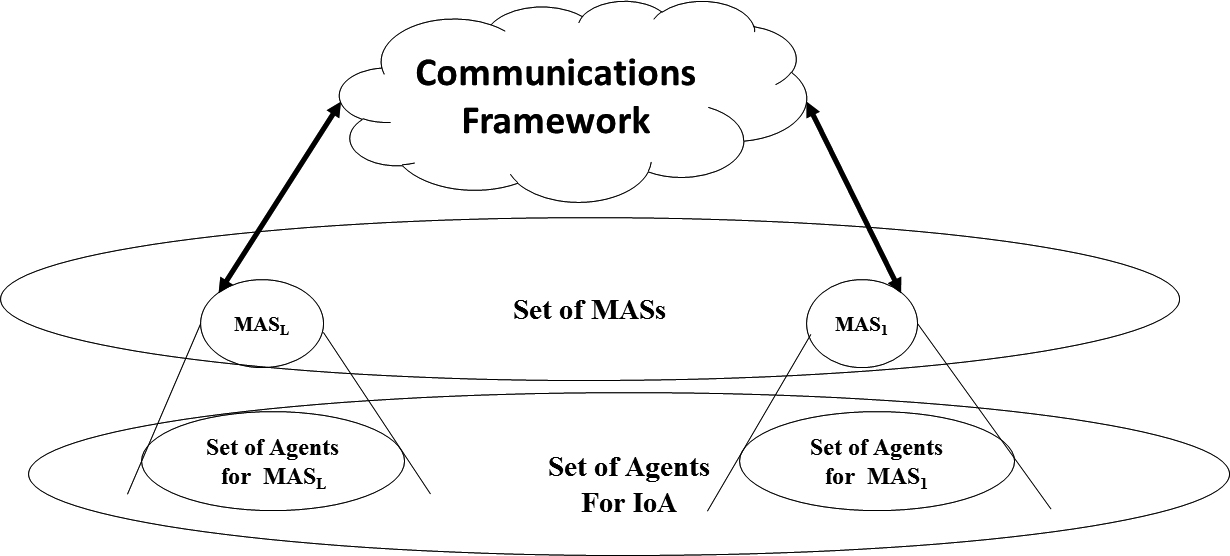
General agent architecture with trust management module.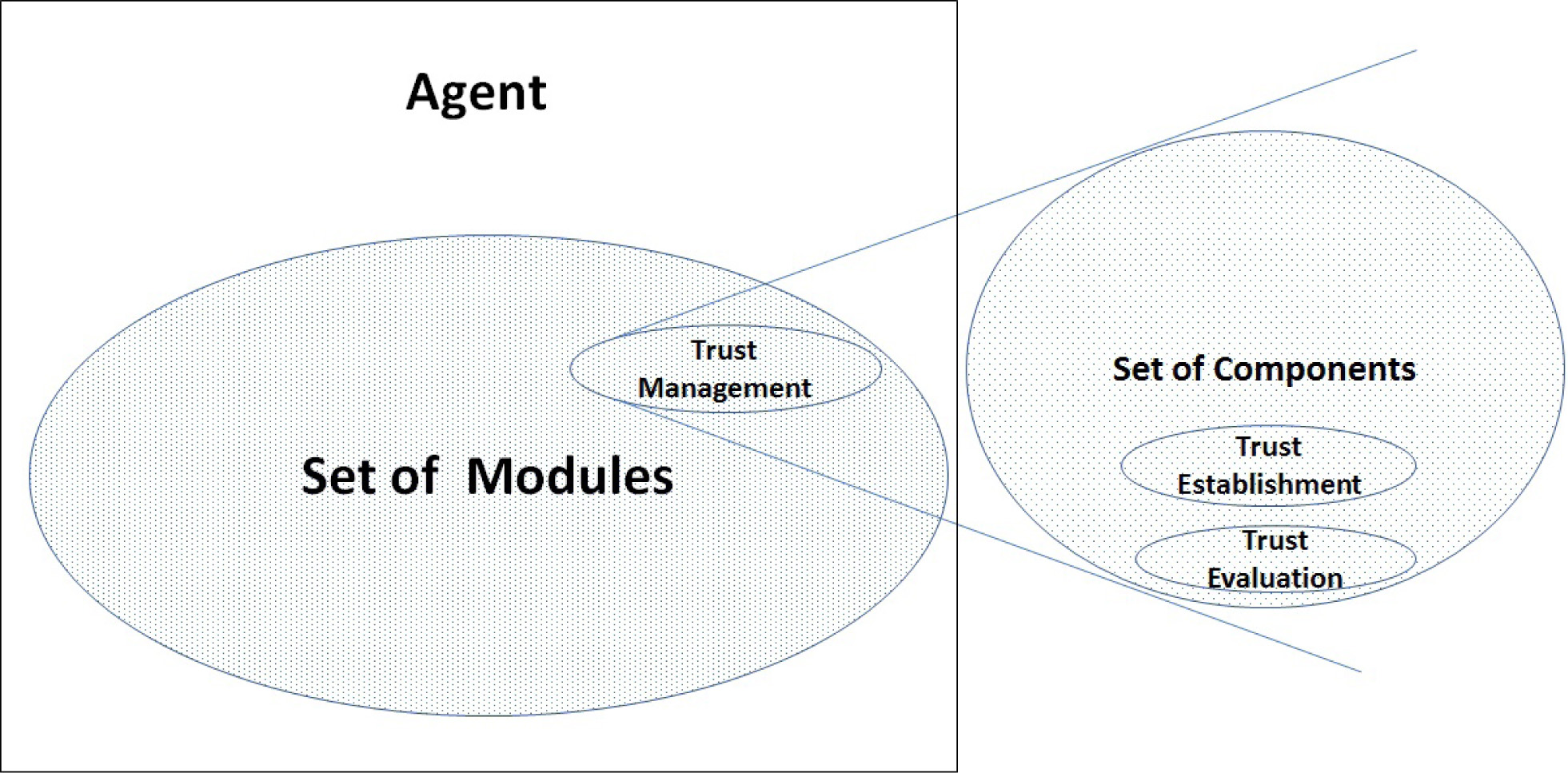
A trustor
After interacting with a trustee
where
Satisfaction represents the fulfillment of trustor’s requirements by interacting with a particular trustee. The aggregation of satisfaction over various interactions represents the direct trustworthiness evaluation of a trustee. The use of demand and weight in Eq. (3) allows for different interpretation of UG between trustors and trustees. In the literature, various approaches were used to model the trustworthiness of trustees, based on the fulfillment of trustor’s requirements such as [18, 16]. Because of the distributed nature of IoA, no central entity or authority exists to facilitate trust-related communications.
General trust evaluation process.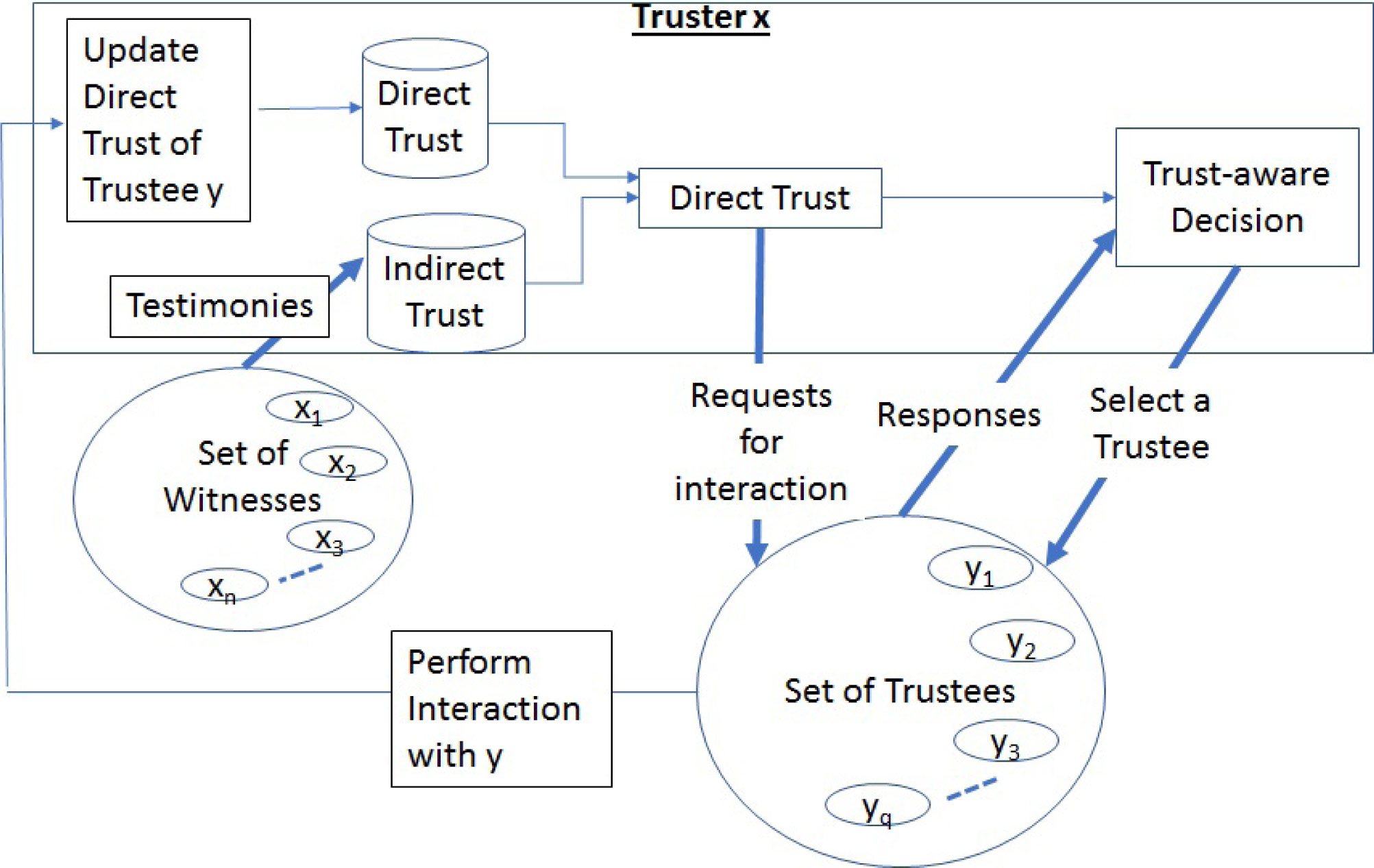
As our focus in this work is on trust establishment, we do not discuss how trust evaluations are formed or how they are used. Instead, we assume the existence of a trust evaluation model and a decision-making model based on trust. Each trustor
After bootstrapping, trustors select partners to interact with based on the utility gain expected to be gained from the transaction. Such value is calculated as
Figure 3 presents the general trust evaluation process by trustors and Fig. 4 presents the general trust establishment process by trustees with UPC and explicit feedback from trustors.
Overview
A relatively similar concept to trust establishment can be found in the field of marketing, known as “Customer Satisfaction”. Customer Satisfaction can be viewed as the overall evaluation of the service or product provider, with the possibility of returning to the service provider in the future [28]. Customer satisfaction is considered an important factor in customer retention. Customer retention, in turn, has a very substantial effect on profitability [17], positive reputation and the reduction of marketing [28]. Despite the apparent differences between customer satisfaction as a marketing-related technique and trust establishment for IoA in SGs, the basic idea and the principle objective seem to be similar. Both attempt to model demand fulfillment of their transaction partners in order to achieve future profit.
General trust establishment process with UPC and explicit feedback.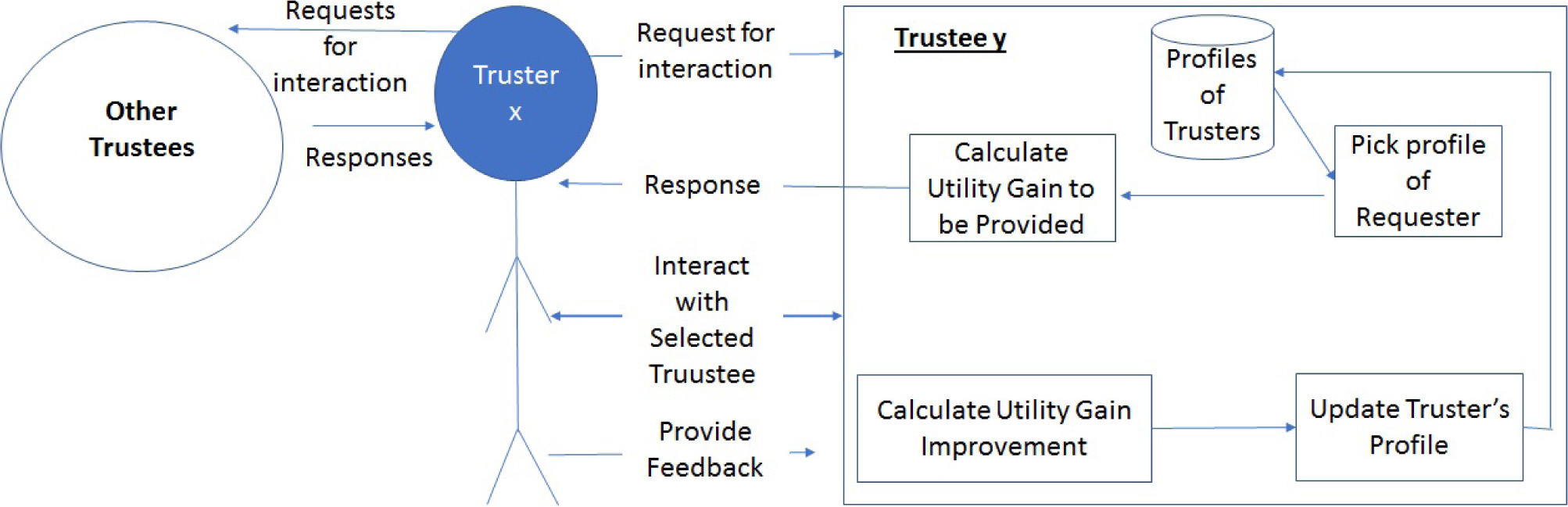
MCTE calculates the utility gain improvement per criterion in response to request req made by trustor
The proposed trust establishment model uses the provided feedback from trustors regarding how satisfied they were with recent transactions, to adjust the behavior of trustee(s). If a trustor
Let us define the relative weight (
The satisfaction Eq. (3) can be rewritten as:
When the change in satisfaction is greater than or equal to the corresponding proportional change in utility gain for a particular criterion, this indicates that
Let us define satisfaction change as
where
Let us define the proportional utility gain change per criterion as
Then
Note that the relative weight in Eq. (6) is a prediction calculated by
The improvement efforts calculated by
The satisfaction level of The relative weight of the criterion under consideration The most recent proposed utility gain improvement
To help a trustee decide which set of criteria needs to be enhanced for a particular trustor, the model uses the aggregated satisfaction feedback provided by the trustor and the relative weight of individual criteria to classify criteria into four distinct sets, show on Table 1, based on the following two rules:
Satisfaction rule: When satisfaction level of the last transaction is bellow the average satisfaction of Relative weight rule: For a particular trustor
Distinct sets based on satisfaction feedback
Distinct sets based on satisfaction feedback
When trustor
The The The We refer to It is clear that the value of those factors are application dependent. As a general guideline, we propose that
Because
To reduce the effect of trustors with extreme demands and help defend against potential misleading information provided by a particular trustee, the proposed model considers the general needs of all interaction partners. The provided utility gain improvement for a particular trustor
where
The engagement factors
An increase in the average satisfaction rate indicates a general trend of satisfaction among trustors. In this case,
The general trend of satisfaction function of
Consequently, the
and the
The natural logarithmic function used as it has negative values for input parameters in (0, 1) and its value changes quickly in that range, bur slower after that
The effectiveness of various models needs to be assessed under different environmental conditions, research that present performance analysis of trust establishment models evaluate them in a proprietary manner based on simulation, as it is challenging to obtain suitable real world data sets for the comprehensive evaluation. Simulation experiments differ among various works, not only in the simulation parameters but also in nature. Generally, there is no agreed on benchmarks to enable comparing different results.
The effectiveness of various models needs to be assessed under different environmental condition. However, it is challenging to obtain suitable real world data sets for the comprehensive evaluation, and there is no agreed on evaluation framework or benchmarks to enable compare different models. Therefore, existing researches that analyze the performance of trust establishment models use proprietary simulation. With the absence of agreed on benchmarks, simulation experiments differ among various works, not only in the simulation parameters but also in nature.
We compare the performance MCTE with RI [6], as it is the one mostly used for comparisons in related literature such as [3, 1, 2].
Performance measures
If interactions are based on trust, trustworthy trustees will have a greater impact on the results of interactions’ results. In such situations, building a high trust may be an advantage for rational trustees. Rational trustees need to trade off the cost of building and keeping trust in the community with the future gains from holding the trust acquired. Therefore, to study the performance of the proposed model, we use the following measures:
Trustworthiness estimation: This metric is calculated as the average direct trustworthiness estimation for all trustees that use a particular model. We agree that exact trustworthiness estimation is highly dependent on the adapted trust evaluation model used by trustors, however we include this metric in this study as indicator in situations where trustors use a general purpose, probabilistic evaluation model. Average delivered utility gain: This measure indicates the efforts needed to achieve the enhancement in the percentage of overall transactions. It is arguable that an honest trustee
where
Total number of good transactions in the system: When comparing different trust establishment models, the higher the number of good transactions, the more successful the model in predicting the needs of trustors. This metric is calculated as the summation of all transactions took place in the system where the demands of trustors fulfilled completely. Other metrics like percentage of good transactions and the average number of good transactions per trustee, can be seen as derived metric form this one, or just a different presentations based on this metric. Total number of bad transactions in the system: When comparing different trust establishment models, the lower the number of bad transactions, the more successful the model in predicting the needs of trustors. This metric is calculated as the summation of all transactions took place in the system where the demands of trustors are not fulfilled completely, i.e either fulfilled partially or not fulfilled at all. Other metrics like percentage of bad transactions and the average number of bad transactions per trustee, can be seen as derived metric form this one, or just a different presentations based on this metric. Number of transactions in a competitive environment: A primary objective of
We use a scenario-simulator approach [44] to compare the performance of different models. Scenarios are pre-generated and not modified during the simulation phase. The generation of scenario files encodes different parameters, such as the number of trustees, the number of trustors, the profile of each agent and so on. These scenarios are then given to the simulator. Thus, multiple simulations, implementing different models, can be run from the same scenario. By fixing every aspect of a scenario run, the only differences between runs will be trust establishment specific.
Generally speaking, a scenario is a sequence of request for interactions followed by interactions. Each request specifies a service name and the agent seeking that service. The choice of a trustee to interact with will be made at simulation runtime by trust evaluation model. The value for different dimensions of the selected trustee’s response is determined by the trust establishment model at simulation time.
For the general simulation, each scenario is simulated, separately, with all trustees use the same trust establishment model. However, for comparing the number of transactions, we repeat the same experiments with the exists of an equal number of trustees using each model, where trustees are randomly set to either use MCTE or the RI model [6] at creation time, and they do not change that.
For simulation, we use the discrete-event MAS simulation toolkit MASON [24] with trustees providing services, and trustors consuming services. We assume that the performance of an individual trustee in a particular service is independent of that in other services. Therefore, without loss of generality, and in order to reduce the complexity of the simulation environment, it is assumed that there is only one type of services in the simulated system. All trustees offer the same service with, possibly, different performances. Network communication effects are not considered in this simulation. Each agent can reach each other agent. The simulation step is used as the time value of interactions. Transactions that take place in the same simulation step are considered simultaneous. Locating trustees and other agents are not part of the proposed model, as agents locate each other through the system. Trustors can request any number of trustees to bid. No trust certification mechanism exists, and third party witnesses are assumed, to be honest.
For trust evaluation, as the evaluation is not the part of our model, trustors use a simple probabilistic trust evaluation
Direct trust, or direct experience, is the aggregated percentage of satisfaction from transactions performed so far with the trustee. Indirect trust, or indirect experience, represents the reputation of the trustee in the community, and is calculated as the average direct trust value of those who previously interacted with the trustee.
Initially, trustors use neutral trust rating for every trustee, therefore initial trust is set to
Base values for simulation parameters
Having selected an interaction partner
As we aim to compare the performance of trustees equipped with the proposed model and those equipped with the RI [6], all trustees are assumed, to be honest, and the only difference among them is the trust establishment model. This way we can relate the difference in performance to the model of trust establishment used.
Table 2 presents the base values for the number of agents and other parameters used in the proposed model and those employed in the environment. When testing the effect of a particular parameter, others are set to those base values.
Effect of trustors’ demand. (a) Average trust: High demanding trustors. (b) Average trust: Regular demanding trustors. (c) Average trust: Low demanding trustors. (d) UG: Higly demanding trustors. (e) UG: Regular demanding trustors. (f) UG: Low demanding trustors. (g) Number of good transaction: Higly demanding trustors. (h) Number of good transaction: Regular demanding trustors. (i) Number of good transaction: Low demanding trustors. (j) Number of bad transaction: Higly demanding trustors. (k) Number of bad transaction: Regular demanding trustors. (l) Number of bad transaction: Low demanding trustors.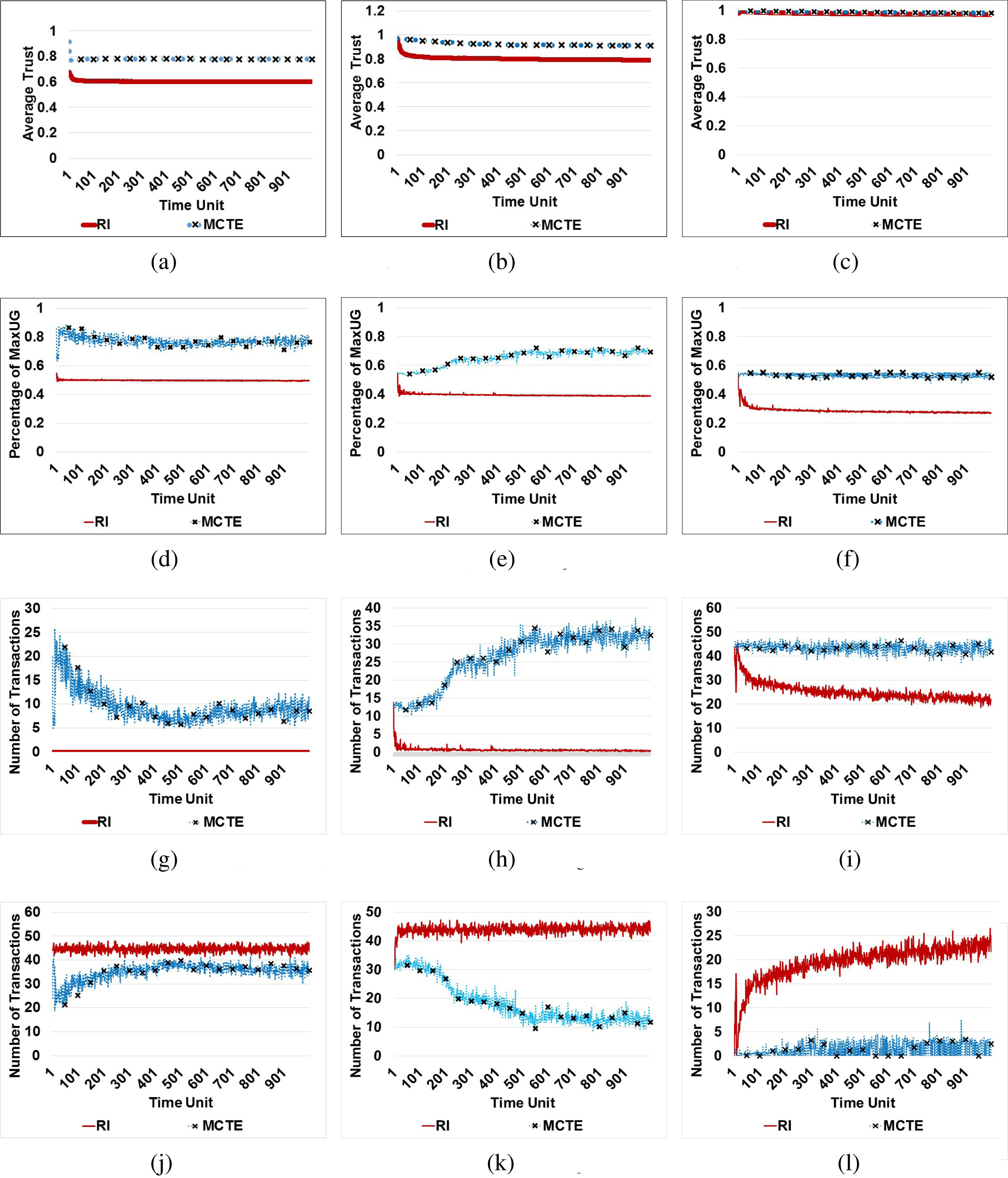
Effect of trustors’ demands on number of transactions. (a) Number of transaction: Higly demanding trustors. (b) Number of transaction: Regular demanding trustors. (c) Number of transaction: Low demanding trustors.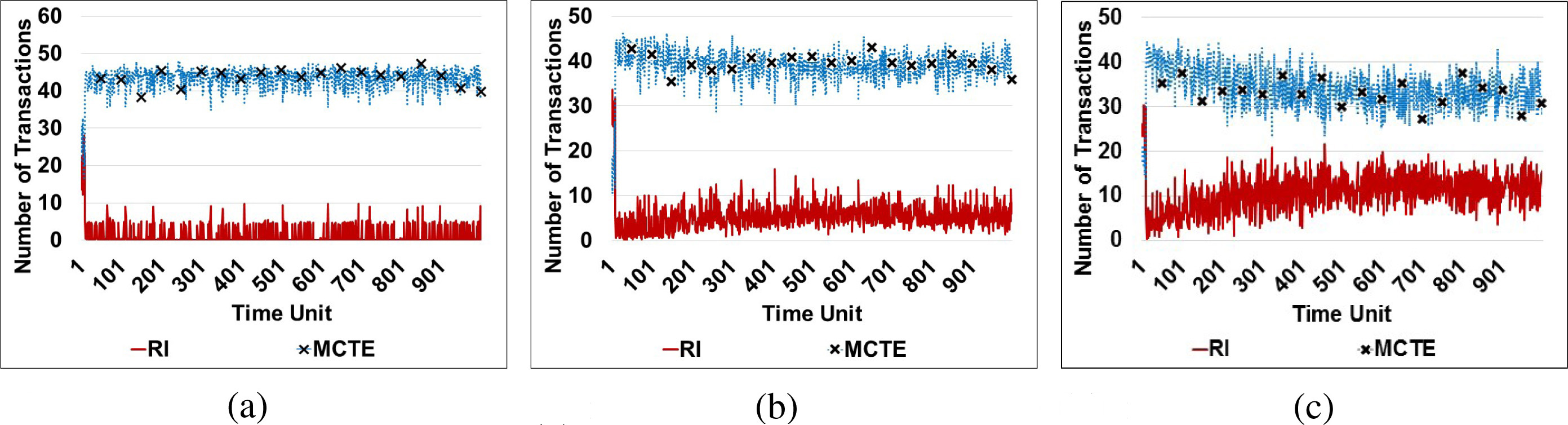
Effects of trustors’ demand level
The level of service required to satisfy needs of trustors can vary within the same environment, as well as in different environments. For example, in the context of a smart grid, the various electrical vehicle may require different service levels of charging stations depending on factors like distance to destination, urgency of the trip and so on. To study the effects of trustors’ levels of demand on the behavior of the proposed model, we analyze three extreme cases where all trustors belong to the same demand category: all with high demand, all with low demand or all intermediate (normal) demand such that highly demanding trustors requires at least 65% of the maximum possible UG for each criterion, low demanding trustors requires no more than 35% of the maximum possible UG for each criterion and regular demanding trustors requires something in between.
Figure 5 presents the performance of MCTE, compared to RI model, under different levels of demands. The figure shows that trustees empowered with MCTE have higher average trust with highly demanding trustors and intermediate demanding trustors (Fig. 5a and b). For regular demanding trustors, trustees can easily satisfy part of them but need more effort to satisfy the others. In this case, nonloyal trustors can cause the provided UG of MCTE based trustees to increase slightly, and so the average trust of trustees. For easy going trustors, both models cause trustees to provide lower UG and stay trustworthy (Fig. 5c). The higher level of trust is due to higher UG provided in general as indicated in (Fig. 5d–f) and especially for the important criterion. Keeping a relatively stable level of trust, despite the decline in the number of good transactions, and consequently, the increase in the number of bad transactions, when demand is high (Fig. 5g) suggests that unfulfilled criterion either not important, or highly, rather than completely, fulfilled or both. Providing higher UG increases the number of good transactions in the systems and reduces the number of bad transactions in the system, this is especially clear witha moderate level of demand (Fig. 5h and k). Low demanding trusters can be easily satisfied, therefore, using the proposed model, the variation in the number of good and bad transaction in the systems is relatively small as described in (Fig. 5i and l).
Figure 6 shows that when the two models coexist in the environment, MCTE empowered trustees can achieve a higher number of transactions, compared to those using RI model. At the beginning of the simulation, when all trustees have a neutral reputation, RI model provides higher UG than MCTE. The proposed model adjust the provided UG per criterion and gains more transactions as seen in (Fig. 2a–c). The difference in the performance of the two models in much obvious with highly demanding trustors and the difference declines as the demand of trustors gets lower, where many trustees can fulfill them.
Effect of trustors’ activity. (a) Average trust: High activity trustors. (b) Average trust: Regular activity trustors. (c) Average trust: Low activity trustors. (d) UG: High activity trustors. (e) UG: Regular activity trustors. (f) UG: Low activity trustors. (g) Number of good transactions: High activity trustors. (h) Number of good transactions: Regular activity trustors. (i) Number of good transactions: Low activity trustors. (j) Number of bad transactions: High activity trustors. (k) Number of bad transactions: Regular activity trustors. (l) Number of bad transactions: Low activity trustors.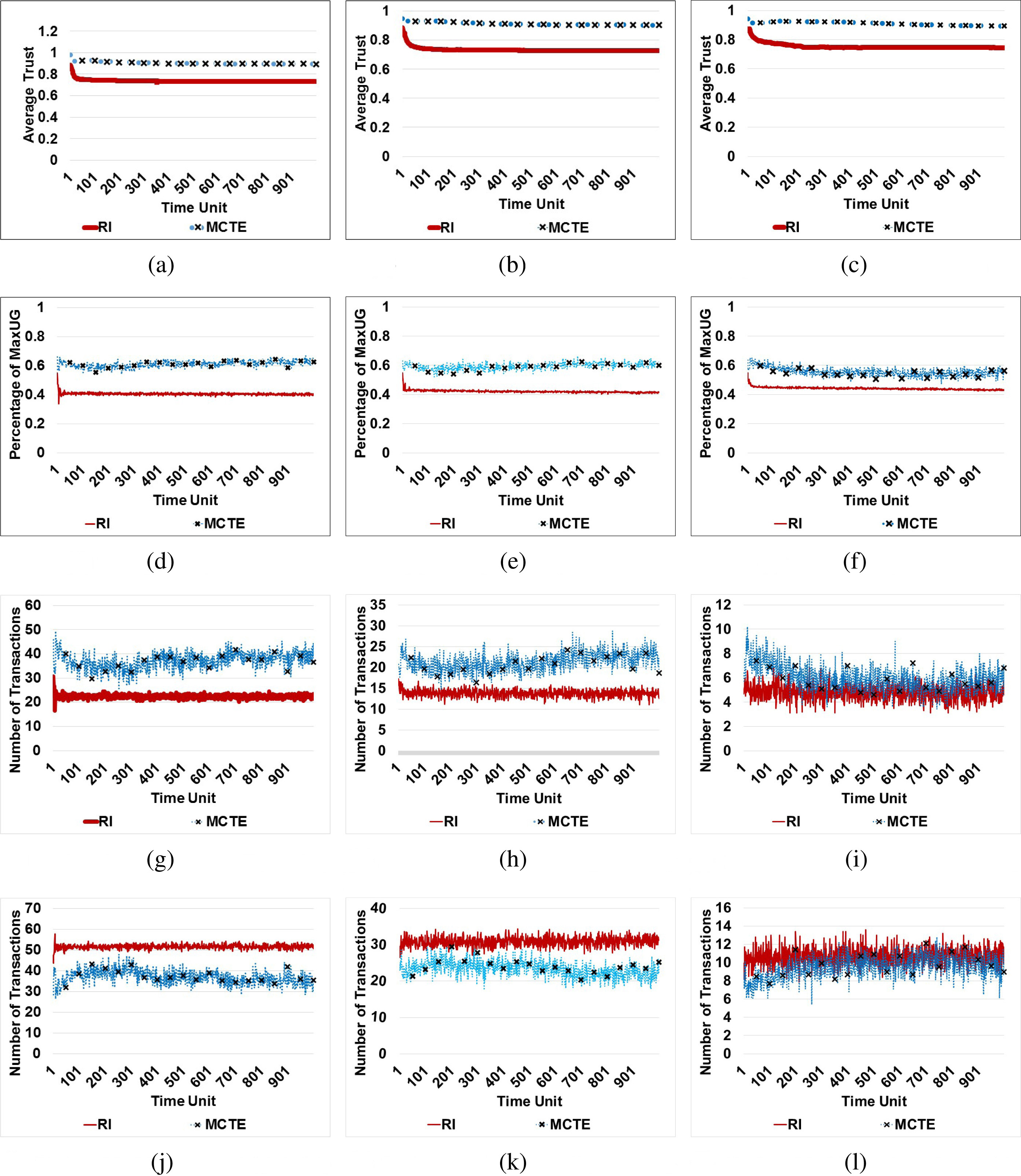
It is possible that trustors do not always use the service in every round. While some trustors can be highly active, some others can have a low or intermediate level of activity. To study the effects of trustors’ activity level on the behavior of the proposed model, we analyze three extreme cases where all trustors belong to the same demand category: all with high activity level, all with intermediate (normal) activity level, or all with low activity level. In each round, highly active trustors request the service with a probability of at least 65%, low active ones request the service with a probability of at most 35%, while trustors with a regular level of activity request the service with probability in between.
Effect of trustors’ activity on number of transactions. (a) Number of transactions: High activity trustors. (b) Number of transactions: Regular activity trustors. (c) Number of transactions: Low activity trustors.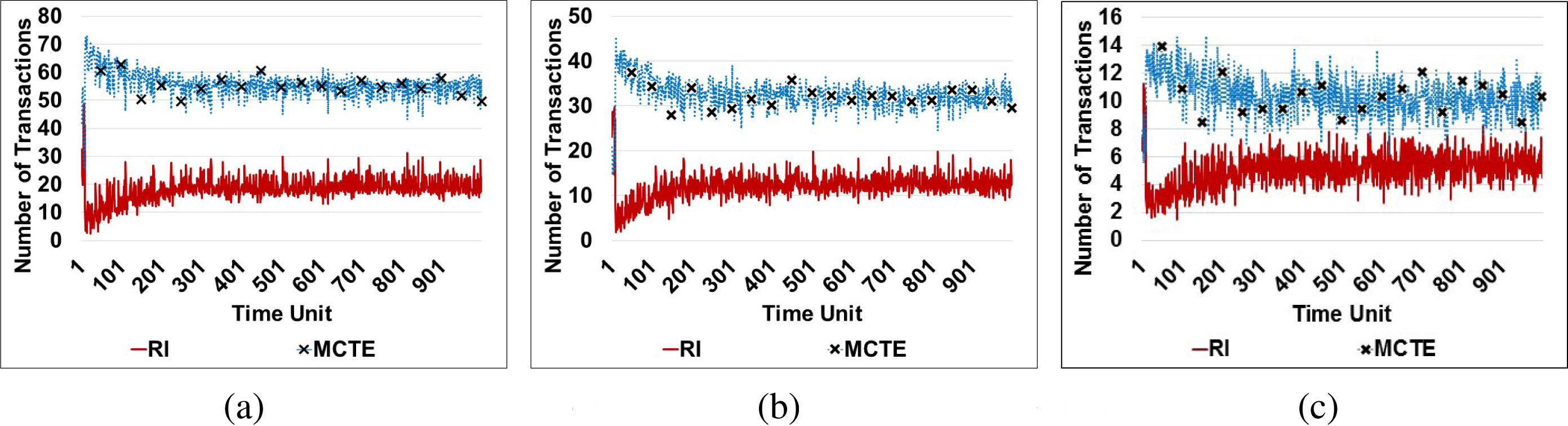
Figure 7 presents the performance of MCTE, compared to the RI model, under different levels of trustors’ activity. The figure shows no significant performance variation of the two models under different activity levels. Generally, the proposed model outperforms RI, and as the activity level of trustors increases, the performance of proposed model gets better due to the incremental learning mechanism MCTE uses.
Figure 8 shows that when the two models coexist in the environment, MCTE empowered trustees can achieve a higher number of transactions, compared to those using RI model. At the beginning of the simulation, when all trustees have a neutral reputation, RI model provides higher UG than MCTE. The proposed model adjust the provided UG per criterion and gains more transactions as seen in (Fig. 7a–c). The difference in the performance of the two models in much obvious with highly active trustors and the difference declines as the activity level of trustors gets lower, where the speed of learning of MCTE decreases.
Effect of society size. (a) Average trust: Community size 900. (b) Average trust: Community size 500. (c) Average trust: Community size 100. (d) UG: Community size 900. (e) UG: Community size 500. (f) UG: Community size 100. (g) Number of good transactions: Community size 900. (h) Number of good transactions: Community size 500. (i) Number of good transactions: Community size 100. (j) Number of bad transactions: Community size 900. (k) Number of bad transactions: Community size 500. (l) Number of bad transactions: Community size 100.
Effect of society size on number of transactions. (a) Number of transactions: Community size 900. (b) Number of transactions: Community size 500. (c) Number of transactions: Community size 100.
We want to extract conclusions that are unrelated to the number of agents in the system (population size). Therefore, we experiment on different population sizes so we can extrapolate the results. To determine the impact of population size on the performance of the proposed model we considered three different sets of scenarios, one with 100 agents, the other with 500 agents and the last one with 900 agents. To maintain consistency among different scenarios, we use 10% of the population size as trustees.
Figures 9 and 10 present the performance of MCTE, compared to the RI model, for three different sizes of the system. The figures show that using the proposed model, trustees can achieve a higher number of transactions, compared to those using RI model when the size of the system gets larger. As the size of the system gets larger, the number of trustors increases and so the number of transactions. Because of competition, MCTE based trustees increase the UG they provide and gets more interactions.
Discussion
Even though a centralized architecture for trust establishment models can go well with online crowdsourcing, such as Amazon Mechanical Turk (AMT), such architecture contradicts with the characteristics of a dynamic environment where the population of agents can vary over time, such as various renewable energy in SGs. Models with centralized architecture, such as SWORD, can experience scalability and transparency issues [50]. Moreover, a centralized architecture contradicts with the characteristics of a dynamic environment where the population of agents can vary over time and subsequently when the number of agents grows in a distributed environment, the operational cost of trust establishment models can be large. Typically, single points of failure and performance bottlenecks are major concerns for a centralized model. On the other hand, the decentralized approach can provide good scalability, robustness and assures the accessibility of services [50], and can be more appropriate for modeling SGs using IoA.
RI [6] is a decentralized, generic model that can be instantiated and applied in a wide range of applications. The model can deal with the dynamic characteristics of IoA, such as changeability in trustors’ behaviors. Even though the model allows environments with multiple contexts, context diversity checking and mapping is not available. Furthermore, the model does not use any defense mechanism against potential attacks on reputation; rather the model assumes that trustees can get an accurate evaluation of their reputation in the community.
The decentralized trust establishment models described in [40] assumes a single context environment and corporative set of trustor that are willing to provide accurate explicit feedbacks. Even though the model has no explicit defense against misleading information, third party information sources are not used, and buyers have no incentive to lie.
RLTE [3] is a decentralized trust establishment model that depends on implicit feedback from interactions’ partners to address the situation where explicit feedback in not possible or not desirable. The model uses retention as a single criterion represented as a real number and implicitly assumes that trustors are neither cooperative nor liars. Context handling in not addresses in the model neither explicitly not implicitly. However, we believe that it can be extended easily of as address different contexts.
As with RLTE, other decentralized trust establishment models described in [2, 1] use retention of trustors as and implicitly assumes that trustors are uncooperative. Those models, generally, differ in the computation engine used. While the FTE [1] uses fuzzy logic, [2] uses a set of handcrafted equations. As with RLTE, trustees dynamically update their prediction of interaction partners’ behaviors and attempt to attract the attention of trustors by providing high performance in response to the first few interaction requests of a particular trustor, which makes the models susceptible to whitewash attack. Trustors can maximize their gains by choosing different partners each time; also context handling is not addressed in those models neither explicitly nor implicitly, and the use of many parameters and thresholds can limit the applicability of those models.
In this work, we presented a multi-criteria, distributed trust establishment model for IoA that can be used for SGs. The model is aimed at situations where trustors are willing to provide only aggregated explicit satisfaction feedback, without detailing the importance or weight of individual service dimensions. The proposed model uses the provided feedback from trustors regarding how satisfied they were with recent transactions to predict the importance of different service dimensions for trustors, and adjust the behavior of trustee(s) accordingly. The aim of trustees is to enhance their trustworthiness scores with the hope to be selected for future interactions. Simulation results indicate that, in a competitive environment, trustees can improve their portion of transactions if they use MCTE to adjust their proposed UG.
We would like to extend the proposed model to address the case when social relations between agents are available. Furthermore, we would like to study the effects of other parameters such as the type of trust evaluation model used by trustors, partner selection mechanisms, the capacity of trustees, and the percentage trustees. Additionally, we would like to investigate the effects of detecting patterns of trustors satisfactions and behaviors on trust establishment. Also, dynamically determining parameter values for the model and further performance comparison with other related work is left as future work.
Footnotes
Authors’ Bios