



Abstract
This paper proposes an innovative based on a multi-agent system to increase the stability and security of power systems. For increasing the safety and reliability of protection for distribution networks, a multi-agent system (MAS) is proposed for fault location, fault line isolation, distance estimation, and automatic power restoration. The multi-agent system proposed consisting of several smart agents to provide real-time data and power flow between different physical processes of electrical networks, allowing various switching arrangements of the circuit breakers (CBs) control in the electrical systems. The detection, location, and analysis of fault required intelligent devices and techniques to protect the systems from failure and blackouts. The performance of the proposed algorithm based on a combination of two algorithms is tested on a part of Kenitra city distribution system in Morocco under several large changes and challenges such as voltage drop, short-circuits faults, and circuit breakers fail in the systems. The results of simulation show that the proposed approach based on multi-agent system combined with impedance fault method for fault location significantly improves the stability of power systems.
Introduction
Nowadays, increasing energy demand and dependence on conventional energies enhance an important challenge facing the whole world. Therefore, there is an important bearing to use renewable energy sources (RES) to address electricity production [1, 2]. The high integration of RES and energy management system impose large issues on the power system operation. With these challenges, the overall system operation requires advanced technologies and intelligence algorithms to improve power system management [3, 4]. These changes make the Power Distribution Systems (PDS) more complicated and more exposed to faults that influence the system’s security, reliability, and energy quality. Modern power systems and smart grids are meeting a variety of challenges that make the design, analysis, and control of power systems more complex. The centralized control structure is the principal control mode for traditional distribution networks. It can deliver good performance based on data analysis and traditional protection principles, especially for small-scale power systems.
On the other hand, the increasing requirement of developing and improving power quality requests a safe and reliable distribution system operation. The solution to success in achieving these attributes is associated with a smart distribution system, this includes the integration of smart and new technologies devices for fault diagnosis and fault location (FL) [5].
Electric power distribution feeders are sensitive to faults produced by a variety of conditions such as unfavorable weather conditions, material failure, traffic accidents, etc. When a fault occurs in distribution lines, the operators know the fault location as quickly as possible for improving service reliability [6].
There have been many types of research in the location fault of transmission systems, but not in the distribution systems caused by its complexity, non-homogeneity of line, fault resistance, and unbalance. The traditional fault location methods for distribution networks are based on activities such as a grouping of consumer trouble calls, visual, and manual inspection. The fault restoration and diagnosis process can take a long time to reach many hours. Therefore, several research activities have been devoted to designing and proposing more efficient fault location methods [7].
Several fault location methods are presented in the power distribution network (PDN) which can be gathered in four types: impedance-based method, intelligent method, travelling wave method, and differential equation method [8].
The travelling wave and differential equation methods require to special digital fault recorder which has a high sampling frequency rate and are very expensive methods for applying in real systems [9]. The intelligent methods (intelligence artificial: neural network, multiagent system, etc.) based on voltage or currents data to locate the faults. The challenge of these methods is needing to databank with a high sampling rate of voltage or current and it should be updated with each network changing [10, 11].
The impedance-based methods use of fundamental frequency component of voltage and current based on the calculation of the impedance to the fault from the main substation and locating the fault points. The impedance methods usually can be efficiently implemented and are cheaper than the others [12].
Many studies have been conducted in the past for improving the fault location estimation. In this paper, two methods are considered, impedance-based method and the intelligent method based on multi-agent system (MAS) for locating the distribution faults. Recently, several intelligent algorithms for fault location and power restoration have been proposed for improving the power quality [13, 14].
There are several Artificial intelligent methods such as an Artificial Neural network (ANN), Multi-Agent Systems (MAS), Fuzzy Logic (FL), and Genetic Algorithm (GA), recently using in the distribution system to resolve several challenges such as renewable energy intermittent and fault location.
In Ref [15], a location single-line-to-ground faults techniques proposed using the resistance that may occur anywhere in the multi-ring electrical distribution network based on Artificial Neural Network (ANN) algorithm to minimize the time in the fault location process.
In [16] an innovative peer-to-peer agent-based protection system for fault location and autonomy power restoration in power distribution systems using MAS is proposed. New fault diagnosis and location method in the distribution network, using EMTP software and based on advanced signal processing using three methods wavelet analysis, artificial neural network (ANN), and the fuzzy logic system (FLS) [17]. In [18], a new combination algorithm based on the ANN technique and fault impedance method to determinate the fault location distance is proposed.
For this reason, the Smart Grid (SG) network inquires the Self-Healing concept where Fault Detection, Isolation and Restoration technics are applied by the Outage Management System (OMS) to increase the performance of the power system by automatically solving or limitation of fault consequences [19]. A new combination method for location of the single-phase fault to earth in power distribution is proposed in [20], the impedance-based fault-location algorithm is used to estimate the fault distance. Then, the new method is proposed for determining the faulty section using voltage sag matching algorithm.
In this paper, a new hybrid location method is proposed using a multi-agent system framework for fault location, line isolation, and system automatic power restoration and also the impedance calculated by voltage and current measured using Phasor Measurement Units (PMU) devices to estimate the fault distance.
Therefore, this paper is divided as follows: Section 2 describes the multi-agent for fault location in power networks, Section 3 presents the proposed fault localization method. The description of the distributed MAS algorithm is presented in Section 4. Section 5 discusses the single-line model of the test distribution system used in this paper. The simulation results are shown in Section 5. Finally, conclusions are shown in Section 6.
Literature review
In current years, several intelligent algorithms have been proposed with the research center to satisfy the electrical power protection conditions. A multi-agent system (MAS) is generally identified as an efficient real-time platform and represents a new area in artificial intelligence which used for the automation and stability of electrical systems [21].
The MAS architecture consists of several agents, each agent communicates with others by neighboring data transfer to achieve a global objective. An agent is an entity, such as a computer program, a robot or a sensor, situated in the environment, which can be seen as perceiving and autonomous action in this environment. An agent is an autonomous pro-active entity defined by a set of properties capable to communicate with another agent. The relay devices and circuit breakers are controlled by agents proposed.
Current research indicates that few multi-agent systems technologies have been proposed for designing protection automation tools and fault location in power distribution systems [22]. In [23], a multi-agent system co-simulation platform is developed for fault location and reconfiguration of the distribution system using a high-level architecture (HLA) framework to managing the data exchange between agents.
An autonomous control algorithm agent-based switching is proposed in [24] for fault location and power restoration solutions in distribution networks based on a multi-agent system. A new multiagent-based distribution strategy is proposed to solve the service reparation problems such as fault location in the distribution of smart self-healing grids [25].
The fault location in power distribution network using a combination between Artificial Neural Network and fuzzy logic algorithms presented in [15]. Rahman et al. [22] proposed a multi-agent system for fault location and diagnosis at the distribution feeder.
Ref [26] presents a novel MAS based fault location and isolation system that can efficiently run in a distribution system with important integration of photovoltaic systems. The multiagent system configuration for fault location, quickly isolation, and restoration in power distribution is presented in [27]. A quick fault location, isolation, and power restoration (FLISR) algorithm that can significantly decrease current interruption time of customers [28].
Automatic power restoration in the real power distribution systems based on the new multi-agent algorithm is proposed in [29]. A multi-agent-based method for fault location and power restoration problems with the integration of renewable energies [30].
In the next section, the proposed approach based on two methods: the multi-agent systems method and the impedance method calculated by voltage and current for fault location, isolation, and power restoration.
Faulted distribution system.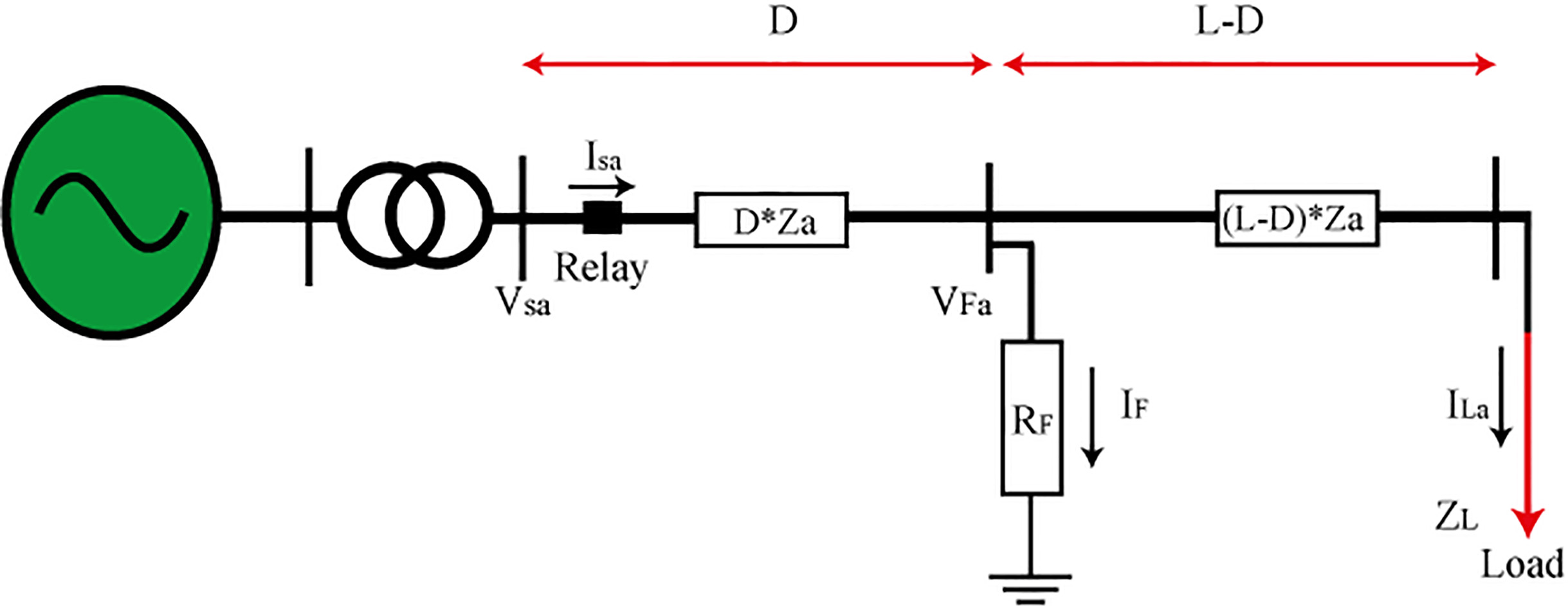
Impedance-based fault location method (IFL)
This method is based on determining impedance (or admittance) at the fault location via measuring associated voltages and currents. Consider the circuit is shown in Fig. 1, which represents a single line-to-ground (SLG) fault on phase
where:
Since the fault is created in phase
where
Note that the voltage equation contains three unknown variables fault distance (
where the index
Equation (4) is valid for phase-to-ground faults in the power system. In the same way that those equations were obtained, it is possible to obtain equations for other types of faults, as double phase-to-ground, phase-to-phase, and three phase faults. The following algorithm can be used to estimate the distance of fault:
Interaction between multi-agent system and power system.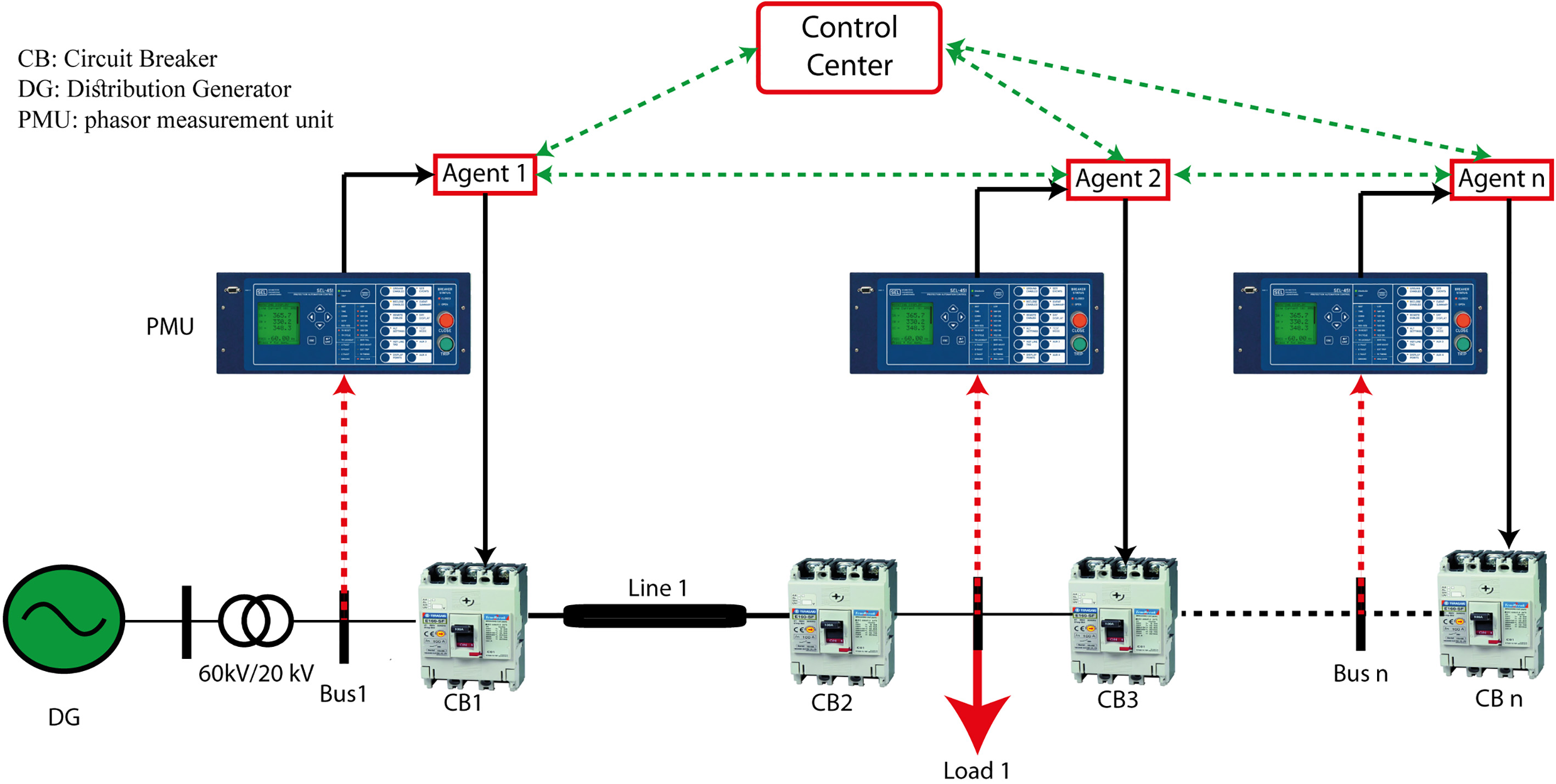
Flowchart of proposed agent activities.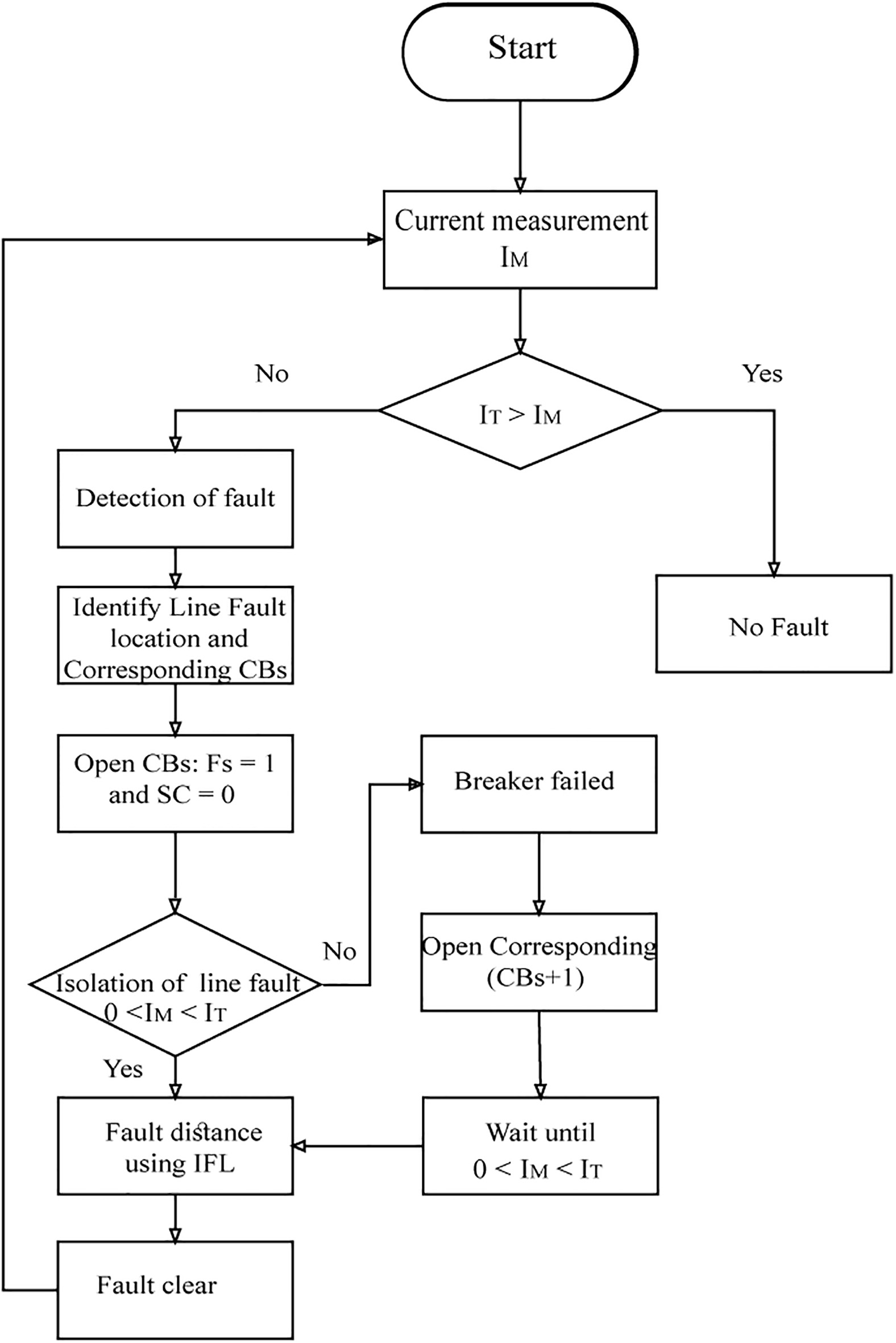
It is assumed that the load current ( The fault current is calculated by using:
The voltage at the point of the fault is calculated.
The load current is refreshed using the fault-point voltages in Eqs (8) and (9).
where Verify if
where If has converged, stop the system; unless, go back to Step 2.
The main idea behind this work is that the Phasor Measurement Units (PMU) device can measure the three phases’ current amplitude at both terminals of each distribution line and the PMU sends data to corresponding agents that can determine the if current values passed the relay threshold (Fig. 2). When a fault happens in the power system, the agents compare the fault threshold values and current amplitude measurement and send a control signal to circuit breakers (CBs) that are attached at the two ends of the electrical line in case of abnormal operation. Besides, the decision on fault state taking by the Control Center that is connected to all agents. Hence, access to the PMU data can improve the decision-making efficiency of the proposed algorithm.
The agents can send and accept requests and share information with the neighboring agents via information exchange to rapidly determine the fault location and remove that fault from the system (Fig. 2).
In this study, any relay device in the electrical network is supposed as a specific agent that is programmed to control and command the corresponding circuit breakers (CBs) through command signals. Each agent identifies by their proper IDs wherever they operate to discover faults, estimate fault distance using the impedance method, determine the breaker failures and fault line isolation to restore the power system operation. The agents used data of currents and voltages measured by PMUs to determine the current threshold and to control the corresponding CBs.
At each instant, the agents collect current and voltage values from PMU and take corrective steps based on commands described in Algorithm (Fig. 3) to command the corresponding CBS and to detect the faults in the system, calculate the fault distance, determine breaker failed, and restoration of the system.
Multi-agent framework
Fault location and line isolation
In power systems, electrical faults and outages are possible to occur in each time. In these cases, the efficient algorithm of fault detection and location is essential as this can improve the stability, reliability, and security of power systems. In the proposed distributed multi-agent algorithm, the agents are used to detect the fault, location (using IFL) and isolation of fault line. At each time, the voltage and current value can be written as [33]:
where
The fault is detected from the following relationship between fault current status (
where
Depending on the fault status, the agents apply a set of logic to control the corresponding CBs via the signal control (SC) can be written as:
The multi-agent systems are developed and simulated using a simulator of network based on Java JADE (Java Agent Development Framework) an open architecture framework based on Foundation for Intelligent Physical Agents (FIPA) [34].
The FIPA is the IEEE organization founded in 1996 that develops agent-based technology and the interoperability of its models with other technologies. The agents can communicate by using a set of FIPA defined iteration protocols, e.g. FIPA-Request Protocol and FIPA-Subscribe based on FIPA-Agent Communication Language (ACL) as a standard language for agent communications. JADE is an open-source software used for executing multi-agent systems through a middleware that corresponds to the FIPA standard. JADE used Java language for agents’ applications [34].
The distribution electrical part is simulated using MATLAB/Simulink (SimPowerSystems toolbox). The JADE must be connected to MATLAB/Simulink and run on the same machine in the real-time simulation to collect the data and decision making open/close the circuit breakers. The connection between MAS in JADE and electrical model in the Simulink based on the MACSimJX (Multi-Agent Control for Simulink program) interface for send/receive data between both [35] to facilitate the communication as shown in Fig. 4.
Simulink and JADE co-simulation [34].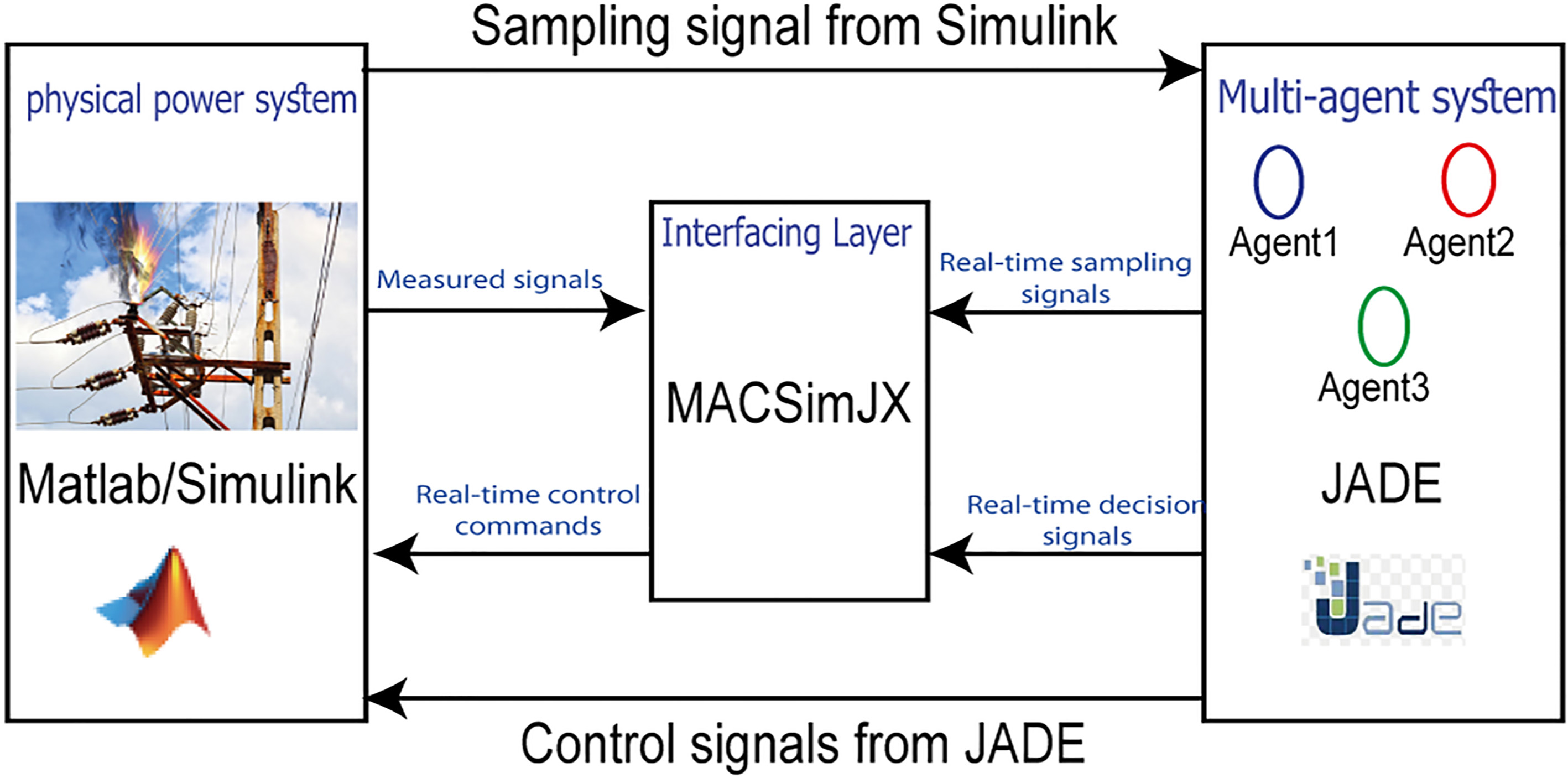
Test distribution system
In this paper, the studied distribution system is subdivided into two subsystems a 50 Hz medium voltage (MV) with a load consumption of 6 MW. This distribution network is a part of the distribution system of Kenitra city, Morocco. The distribution system consists of two generators, fourteen circuit breakers (CBs), four loads (numbered from Load 1 to Load 4), seven power distribution lines (Pi) section each line have 0.5 km in length (numbered from Line 1 to Line 7). Meanwhile, the distribution system is able of making a ring-type topology by Line 4 provided with circuit breakers (CB7 and CB8) to support the load consumption and reconfiguration of distribution networks (Fig. 5). The subsystems used the PMUs devices at each bus for collected the voltage and current values. Each agent has total access to the PMU data and command (open/close the breakers). At normal running condition, subsystem-1 has two loads with power demand total is 4 MW are supplied from DG-1 and subsystem-2 also consists of two loads with a total of power demand is 2 MW are supplied from DG-2.
Test distribution system.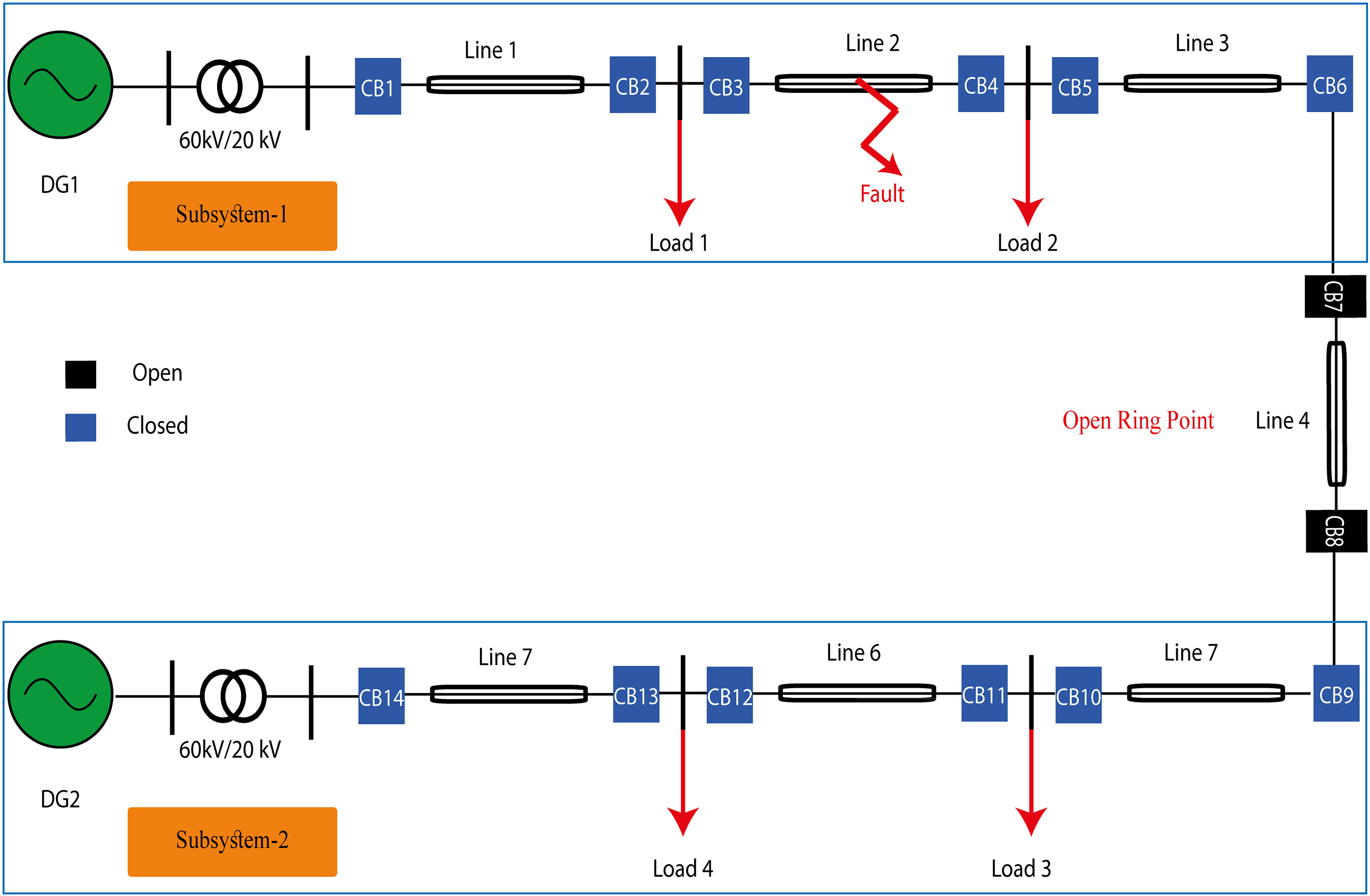
For testing the performance of our proposed multiagent system, the distribution system in Fig. 5 used to illustrate the effectiveness of the algorithm proposed in various case studies. The agents are capable of detecting, locating, and removing faults from the system, handling various failure modes and automatically restoring power to the un-faulted sections in a short period by coordinating with the Control Center. A short-circuit fault is applied at Line 2 in subsystem-1 at 0.05 s (Fig. 5). Since the electric power to supply all loads in subsystem-1, it’s produced from DG-1, the fault current measurement is very high through all agents (A1–3) except A4.
The current and voltage are represented in terms of space vector which is represented in a stationary reference frame using Clarke and Park transformation.
Nevertheless, A1–3 will not take any decision, A4 it does not sense the fault, therefore the agent A3 identifies the fault at Line 2. As the fault current measurement at CB3 exceeds the threshold value (
Now, once the fault has been removed by the A3, the CB4 is opened (SC
Load 2 voltage and current are shown in Figs 11 and 12, respectively, it is observed that there is an important quantity of noise present in the voltage because of the harmonics of current interacting with the impedance present in the power sources.
When the system delivers, the power requirement at Load 2 is 3 MW. The DG-1 and DG-2 power production are shown in Figs 13 and 14, the DG-1 source has lost 3 MW and DG-2 power increased by 3 MW to supply Load 2 demand.
The fault current measurement at CB3.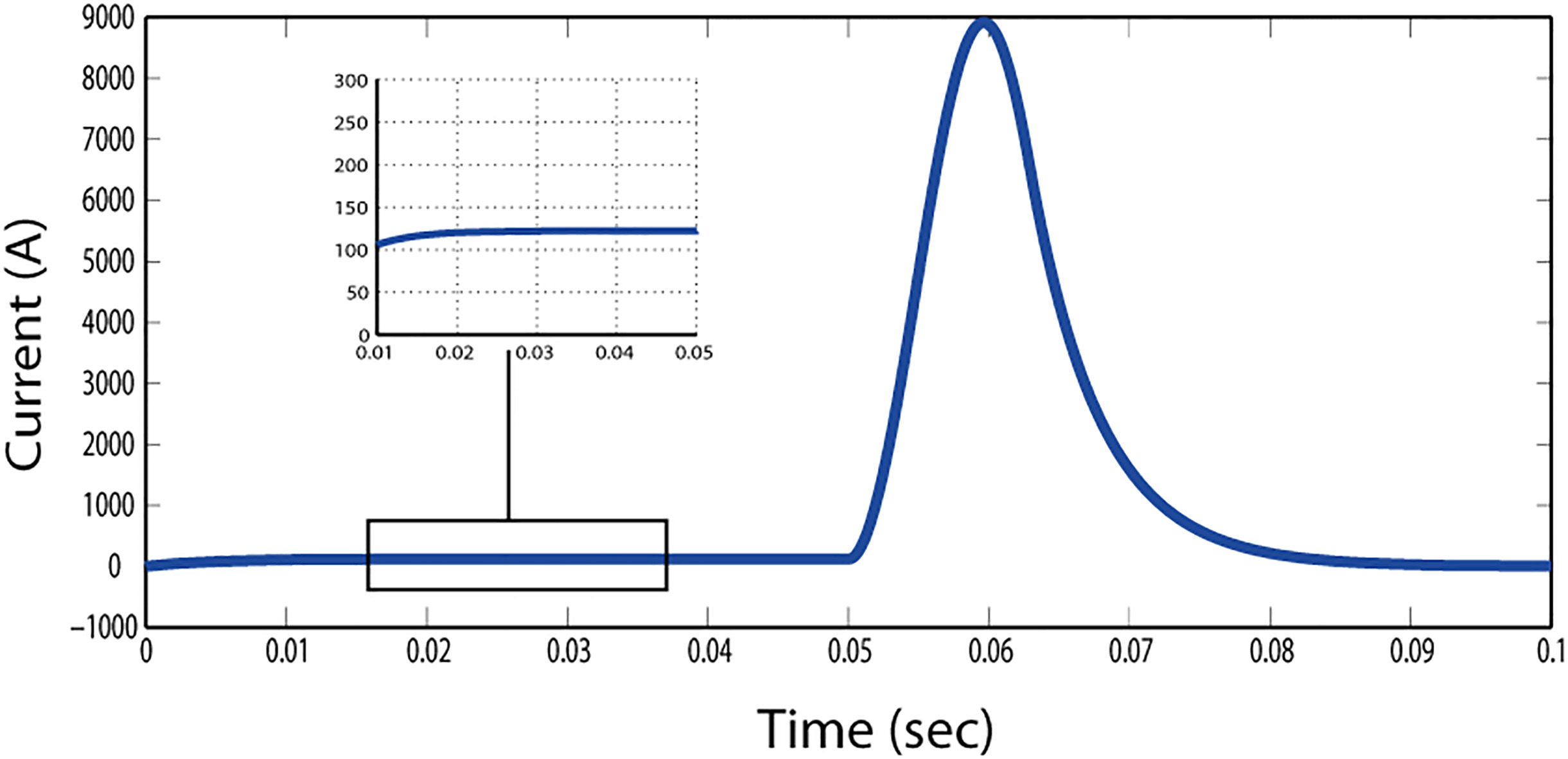
Corresponding CB status during a fault in subsystem-1.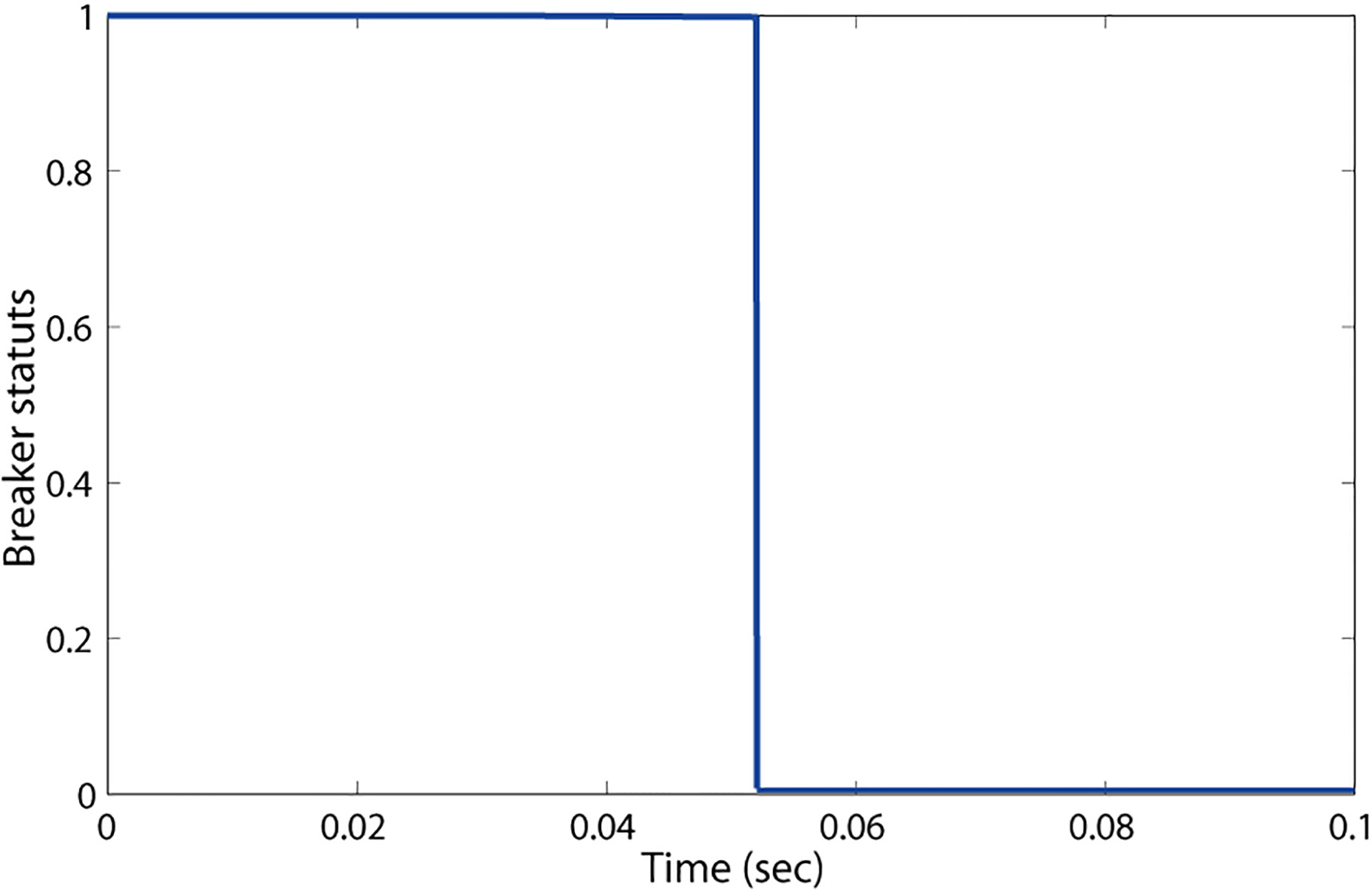
Current through CB4.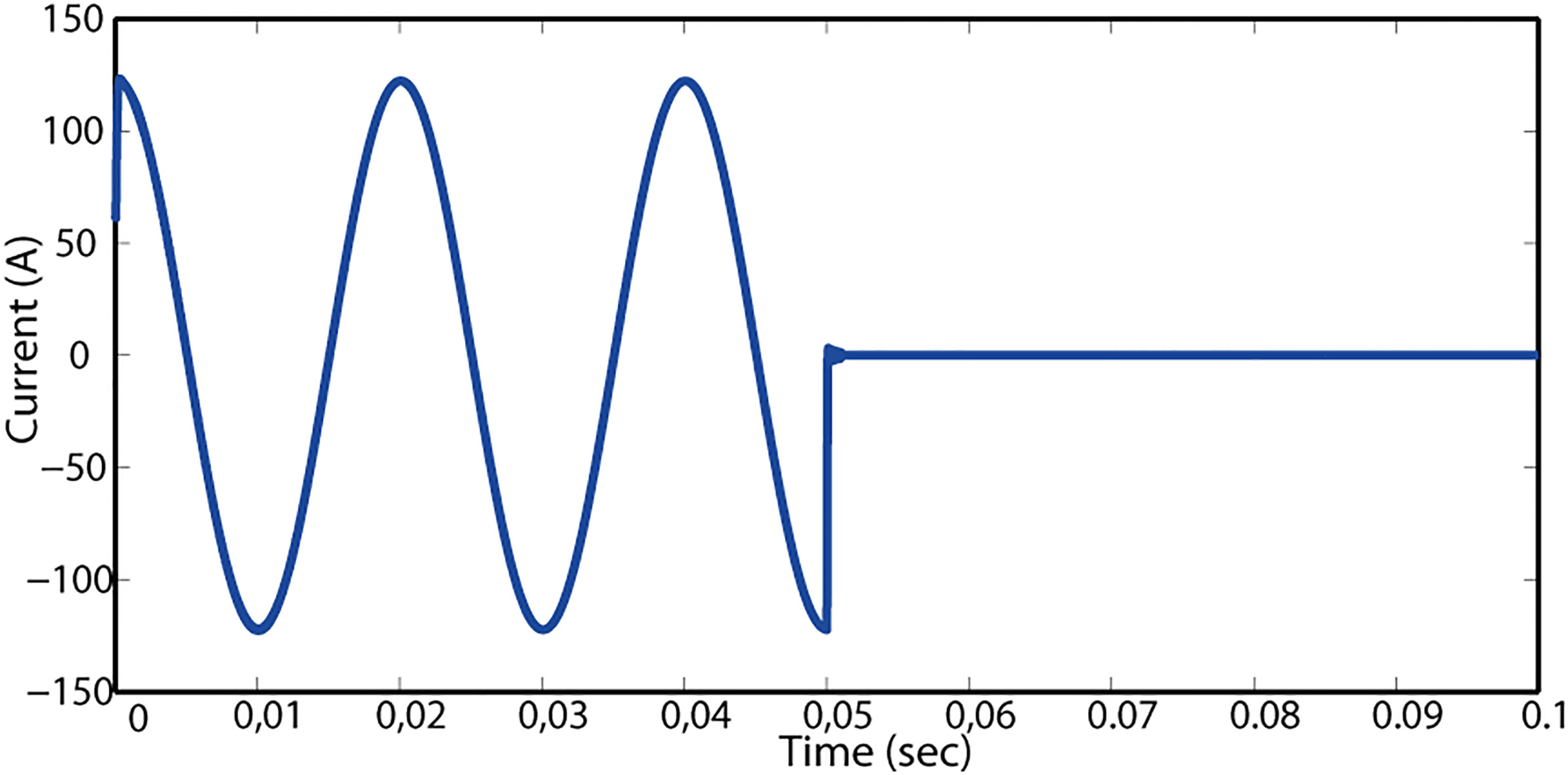
Breaker status for CB7 and CB8.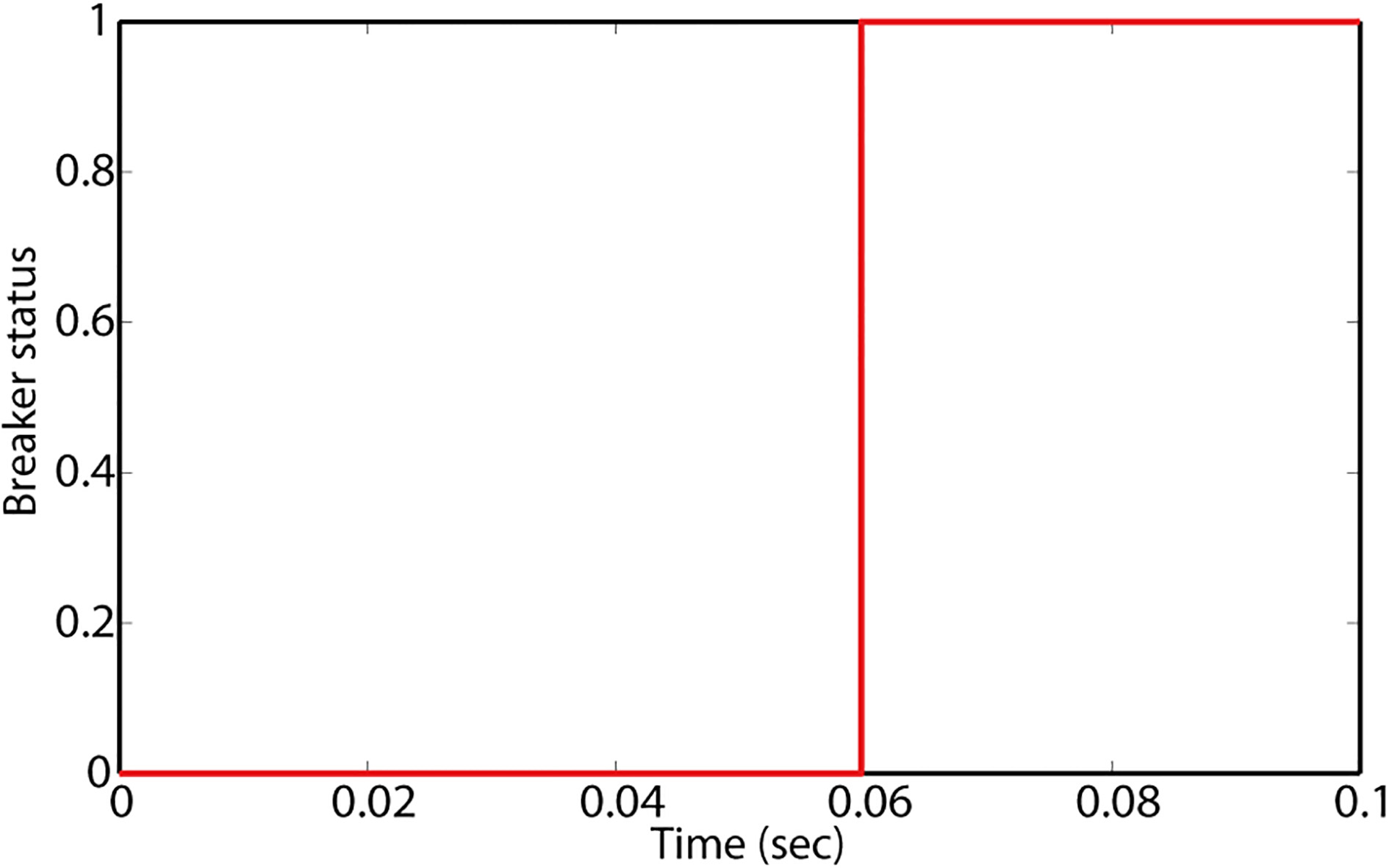
Current through CB7 and CB8 during a fault in subsystem-1.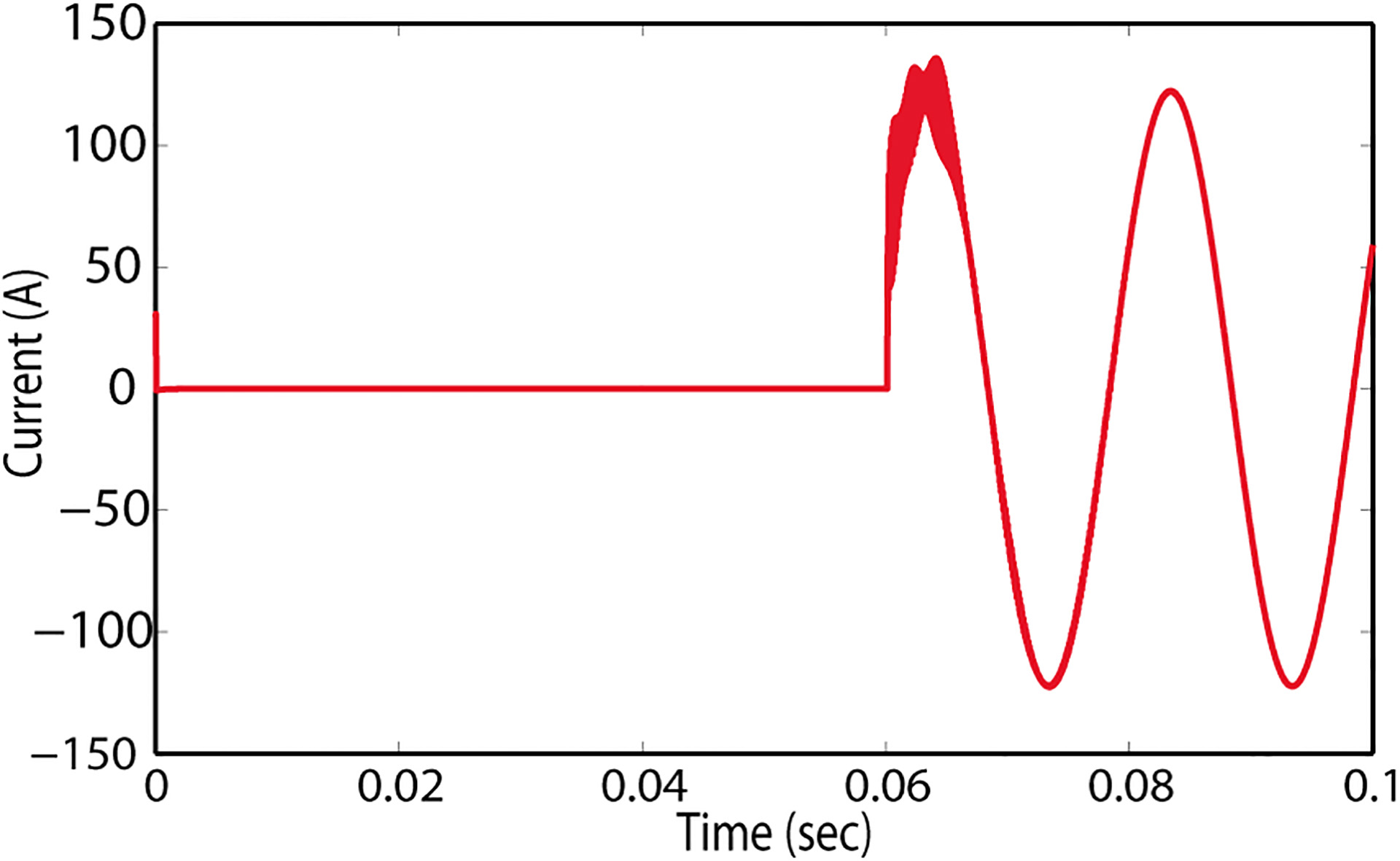
Voltage at Load 2 during a fault in subsystem-1.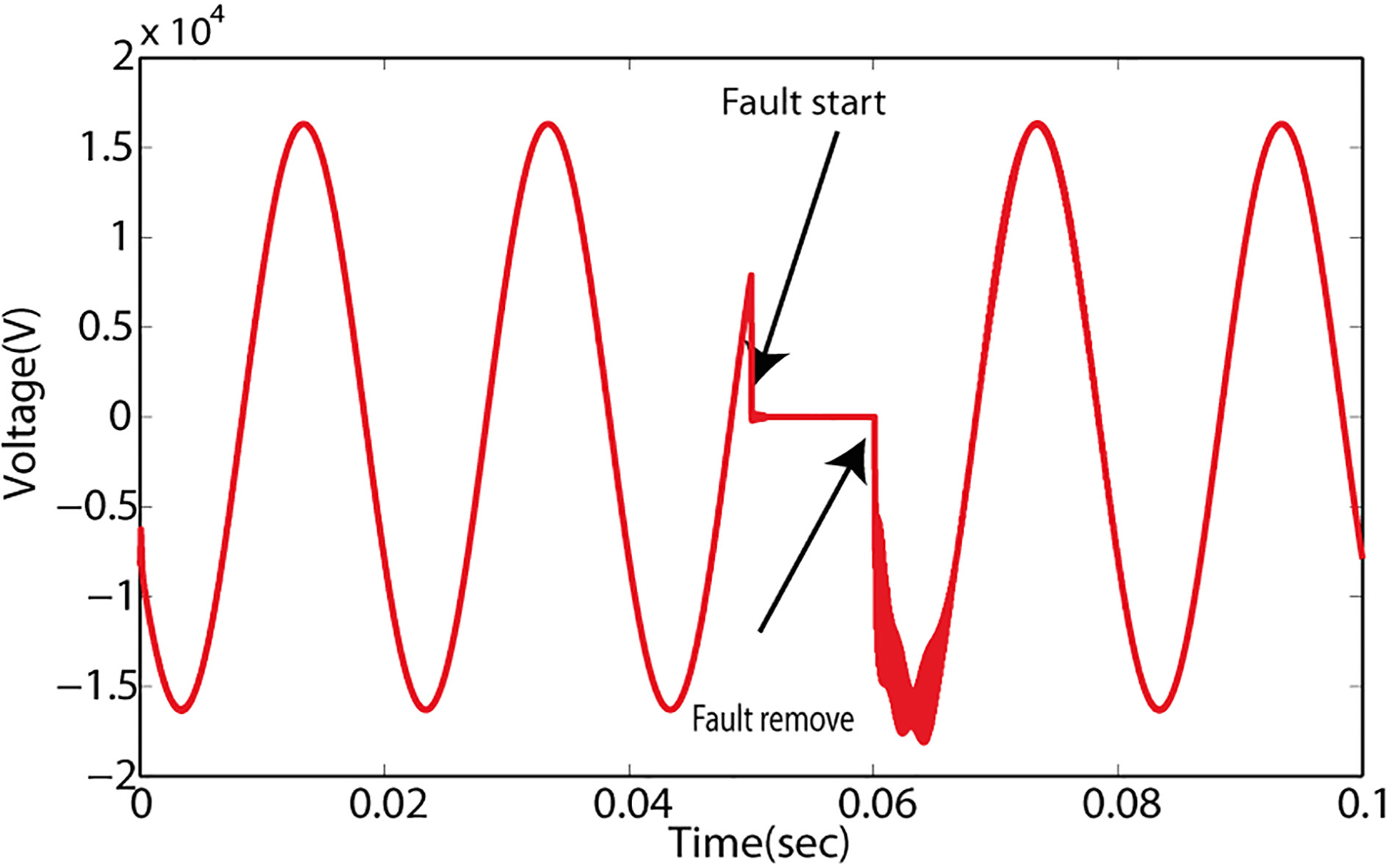
Current at Load 2 during a fault in subsystem-1.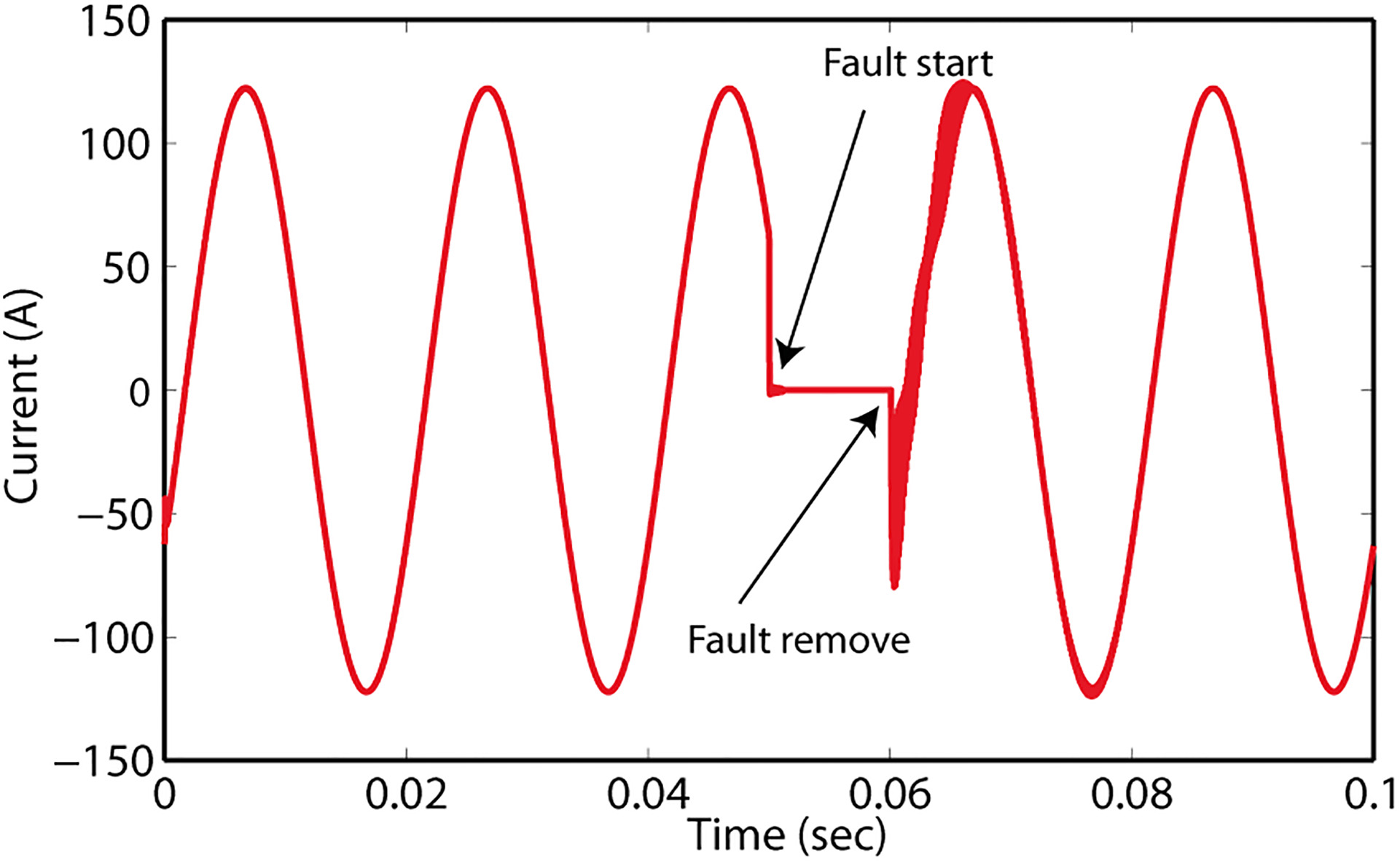
Active power output from DG-1.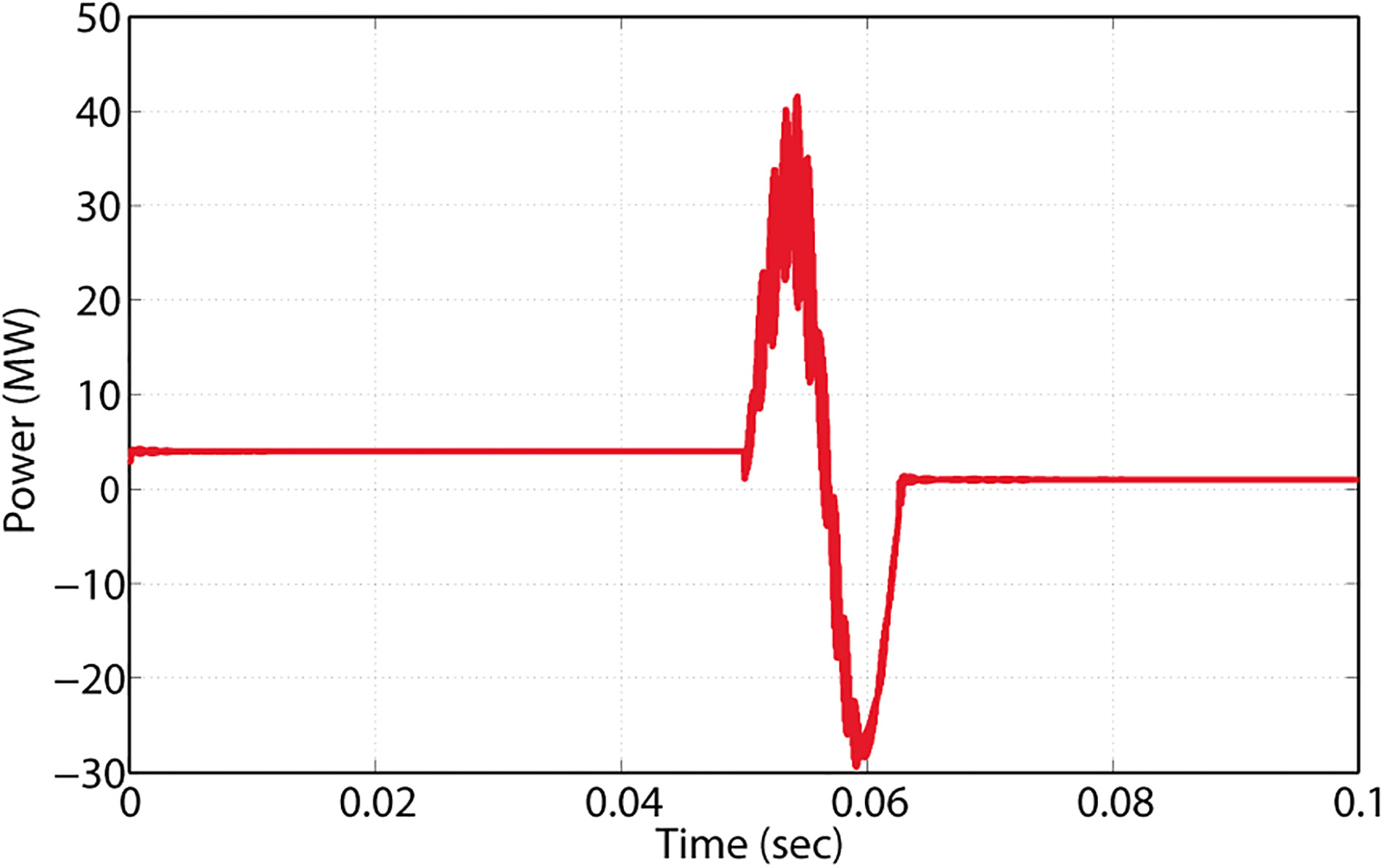
Active power output from DG-2.
Now after isolation of Line 2, the Control Center locate and calculate the fault distance using the Impedance Fault Location method, the performances of fault location algorithms are usually measured by the errors on the fault distance in order to analyze the accuracy of the method using by a multi-agent system. The fault distance is calculated using Eq. (3) for each based on the currents and voltages at the input of the line measured by agents (PMU). An estimation error of fault location is calculated using (16), the equation proposed in [6, 30] was used:
Calculated fault distance for each iteration procedure
Estimated fault location errors.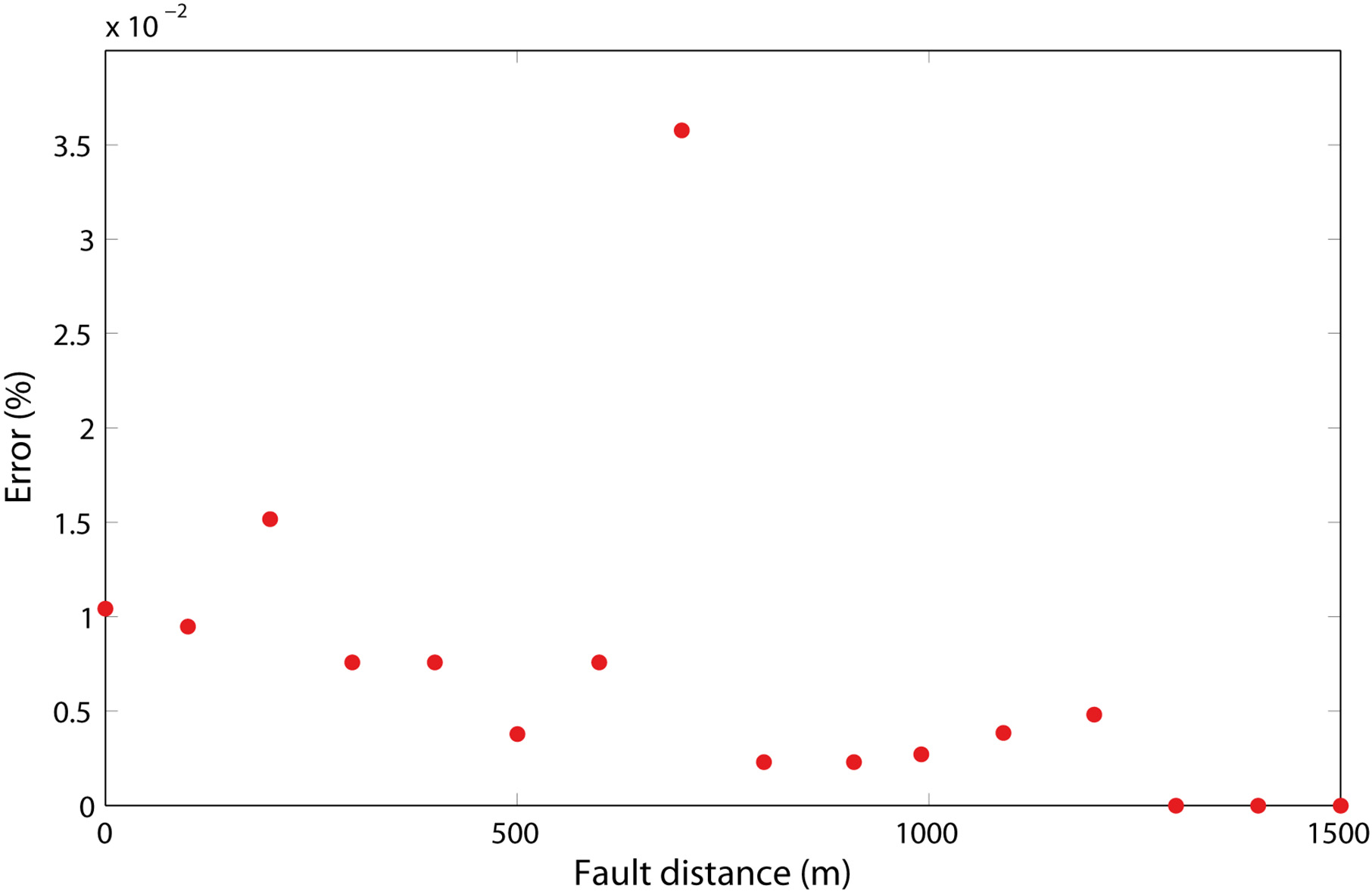
Agents messages.
where
For testing the performance of this method and calculate fault distance from the local terminal (Transformer) for fault resistance Rf
Figure 15 represents the variation of Error of fault location according to the real distance. So, whatever the fault distance from the terminal can calculate by the agents for location the fault position.
From the case study, it is obvious that the proposed method can work effectively to determine the position of fault from the terminal. When an agent detected that it has a fault on its protection segment, it will send a message along with ID of line and CB to the Control center. Moreover, if any CB is not working, the corresponding agent will send a message which records the individual breaker ID (Fig. 16).
In this study, the fault clearance, line isolation, fault location, and the power restoration time for the system is a few milliseconds after the fault occurred. From the simulation results, it is obvious that the distribution MAS proposed improves the transient stability of power systems in a more superior and smarter approach than the traditional method.
For many years, the design and applications of the multi-agent system have used in power systems and power engineering applications such as the integration of distributed energy resources, management of renewable energy intermittent challenges, distribution system security, and fault location. In this paper, a multi-agent system is proposed for fault location in distribution systems based on data collected by PMU for line isolation and fault location used IFL. The data exchange between agent collaboration increases the safety and security of the system to decreases fault clearance time and system restoration. The proposed protection system has been applied to a real distributions system and the simulation results have shown the effectiveness of multiagent system proposed. The simulation results also confirm the reliability of the MAS strategy to correctly manage a situation when the breakers fail to remove the fault and for fault distance estimation.
Footnotes
Author’s Bios