



Abstract
Multiagent Resource Allocation (MARA) is a field to find out solutions that distribute a set of resources among agents. Heretofore, lots of utility- and reputation-based approaches have been proposed. In this paper, we develop a preference-based resource reservation approach for resource allocation in a system that consists of entirely selfless agents. Preference, defined as the satisfaction of required resources, has a crucial impact on resource allocation. The importance degree is also adopted to represent the extent to which a particular attribute is needed. In the system, agents communicate with semi-local friends to exchange information as well as reserving resources. Finally, a confirmation or cancelation message is sent to obtain or release the reserved resources. Numerical examples are given to show the rationality and effectiveness of the proposed method.
Introduction
Resource allocation is a crucial concern in the fields of both computer science and economics. Computer scientists often concentrate on how to find a satisfying distribution, while economists usually care about how to make a beneficial allocation [7]. With the rapid development of agents, the multiagent system (MAS) is an appropriate tool to emphasize the issues in resource allocation. MAS consists of multiple agents and their environment. Typically, agents refer to computer programs that can act on behalf of humans, robots, objects, or human-object teams. The field which illustrates the allocation of resources in MASs is known as MARA.
MARA is defined as the process of distributing a set of resources among various agents [7, 35]. Generally, there are two main models in MARA, namely centralized and distributed models [4, 14, 18, 33]. In a centralized approach, one of the agents is appointed as the controller taking charge of collecting individuals’ preferences and making optimal decisions [26]. Compared with centralized approaches, agents are of equal roles in distributed approaches. Meanwhile, they could only realize the information or knowledge about their friends locally [13, 29]. In practice, distributed approaches are more applicable in many large-scale distributed environments, for instance, train ticket booking. Meanwhile, distributed methods are more economically as a centrale controller is no longer required [23]. Also, distributed approaches are more humanized and ensure privacy for individuals in the system. As a result, distributed systems have a wide range of applications, including industrial procurement, earth observation satellites, manufacturing systems, and grid computing. In this paper, we study MARA in a fully distributed environment.
The existing researches related to negotiations and coordination mechanisms in MARA are numerous. Generally, these approaches might firstly be Market-based approaches where service demanders and providers are of peer roles as clients and suppliers in markets. Auctions, contract mechanisms, games theory are often adopted [19]. Cui et al. propose a game theory-based negotiation method for task allocation in multiple robots’ systems [12]. Scheléen and Pink illustrate a method for pursuing the required resources where clients can make reservations through agents responsible for advance admission control [39]. Lewis et al. present a novel market-based approach that is inspired by the retail market for MARA [25]. After that, agent-based approaches play a critical role in resource allocation where resources are distributed among agents; they dialogue and exchange resource information as well as resources autonomously. Usually, agents acknowledge what resources their friends have occupied and make decisions based on the perceived information. Savla and Frazzoli consider a novel dynamical queue approach to intelligent task management for human operators [38]. They consider a model of a dynamical queue, where the service time depends on the server utilization history. Vig and Adams propose a heuristic-based coalition formation algorithm to operate in precedence ordered cooperative environments [40]. Afterward, society-based approaches are also essential. Such as coalition formation, group mechanisms and so on [27, 42, 1]. In the literature [1], a generic model for task/resource-constrained multiagent stochastic planning that analyzes dependent task/resource. Ye et al. propose a multiagent coalition formation-based energy dispatch mechanism [42]. Finally, some other approaches where nodes negotiate and coordinate mutually for their goals, where trust, social welfare, preference are taken into account. Nongaillard and Mathieu provide an adaptive, anytime, and scalable algorithm to hold efficient egalitarian negotiations for discrete and indivisible resource allocation [32]. The literature [8] studied a framework for MARA where agents negotiate autonomously. They give particular consideration to scenarios where the preferences of agents are modeled in terms of k-additive utility functions. Chevaleyre et al. studied the convergence properties for distributed mechanisms for allocating indivisible goods when used as fair division procedures [10]. Trust has a significant impact on agents’ decision making, which intuitively reflects the risk level when one agent relay on the provided information or resource of the particular agent for the fulfillment of their goals. Du et al. investigated the trust model in online social media networks where individuals share options, communicate, and provide services [15]. In this paper, we adopt agent-based resource reservation approaches combined with the flexible preferences for resource allocation.
Resources in MARA have a lot of characters when concerning the resource types. For example, the shared resources could be visible or invisible. On the other side, some resources could be better featured by the allocation models, such as the property of being sharable or not relies mainly on the allocation procedures [3, 41, 44, 10]. Thus far, MARA researchers have devoted considerable efforts to resource allocation of indivisible and nonsharable resources [7, 10]. In this setting, resources are distributed among agents, and acquaintances may offer compensations to make use of some resources. In the literature [2], Airiau and Endriss studied a particular MARA system where resources are indivisible and nonsharable. In their model, agents share resources also share the control of those resources, and they prove the existence of distributed protocol that leads to optimal social welfare. In this paper, we study a model where agents are wholly selfless and cooperative, and resources are stable and indivisible. Agents control several resources, and they share resources by sharing the utilization of the resources rather than sharing its control to the particular resources. Once a demander accomplishes its tasks, the obtained resources are returned to its owner agent.
Preferences express the relative or absolute satisfaction of an individual when faced with a choice between different alternatives [7, 36]. In MARA, these alternatives are of all potential allocation of resources. A preference structure represents an agent’s preference or demands over all the choices. There are many mathematical representations regarding preference management, especially in decision theory [11, 16, 28]. Namely, preference representation can be a cardinal preference structure that adopts the utility function to evaluate various bundles of alternatives. In the ordinal preference structure, a comparison relationship, ‘Not worse than’ represented by ‘
In this paper, uncertainty in preference representation is emphasized for the allocation of resources. The generated resource requirements demand some resources rather than a fixed number. Moreover, flexibility in required characters is also stressed during the distribution. In the proposed dynamic and distributed systems, an agent communicates with its acquaintances for needed resources. Meanwhile, their friends reserve needed resources cooperatively. The rest of the paper is organized as follows. Some preliminaries and explanations used in this paper are exhibited in Section 2, including dynamic and distributed network structure and resource representation. In Section 3, the proposed uncertain preference-based approach for resource allocation are detailed stressed. The simulation and results are shown in Section 4 to show the effectiveness of the proposed method. Discussions on the results are presented in Section 5. Conclusion and future works conclude the paper in the last part.
Preliminaries and explanation
In this part, some necessary concepts and definitions of distributed network architecture, agents, friends, and resources are detailed introduced and explained.
Distributed network architecture
Distributed network architecture consists of various computing structures that are modeled as intelligent agents. They are described schematically as abstract functions that are similar to computer programs. Agents are capable of taking actions and making decisions on behalf of users or other entities. In this paper, a dynamic social network
Agents in the dynamic distributed network have several operations. To make it clear, we adopt a random social network shown in Fig. 1 for a detailed explanation.
A social network with 8 nodes: Two connected nodes show that they are friends.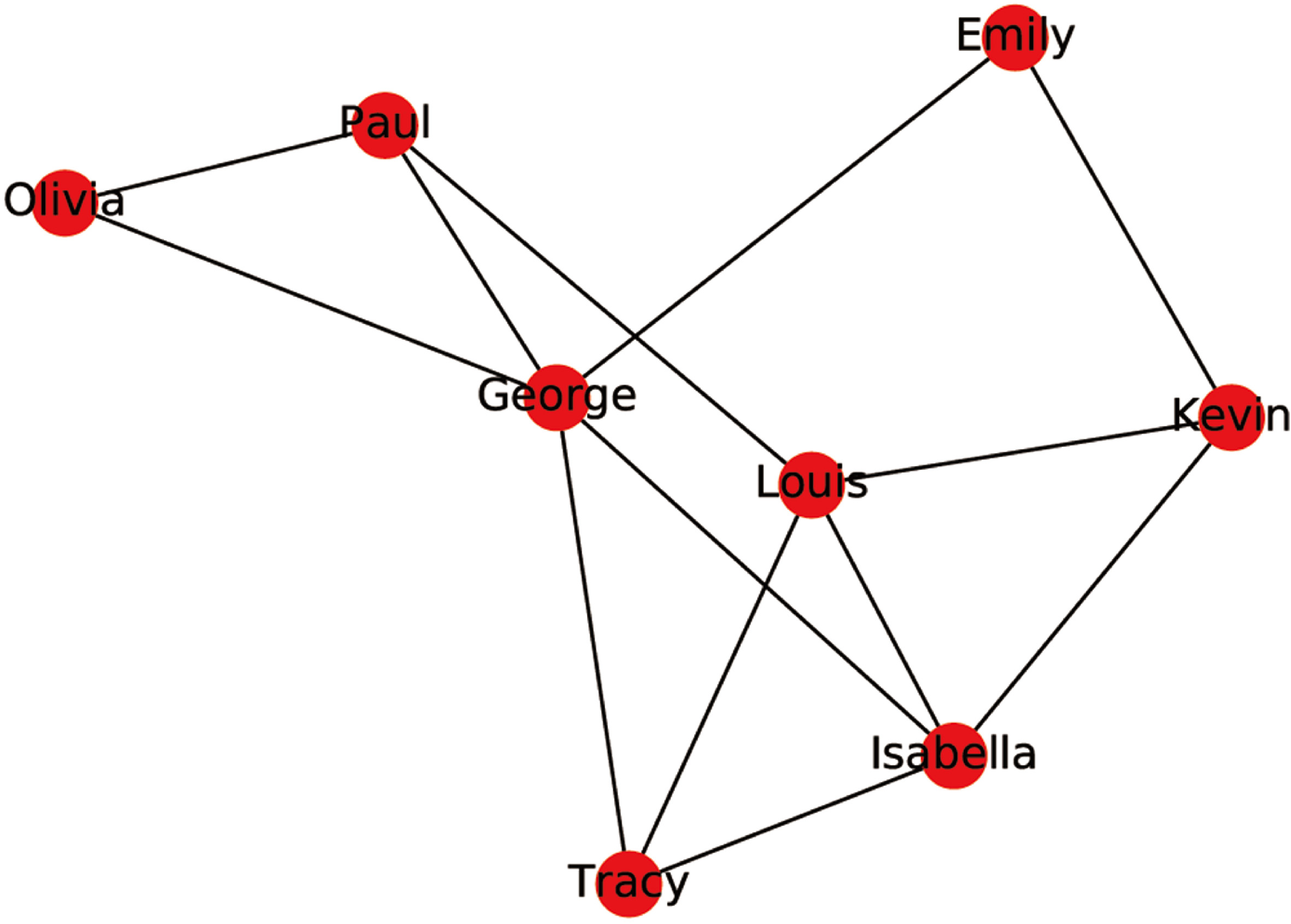
An agent can join in the system successively. It makes friends with all other agents by probability The long-term lived agents in the system can make new friends occasionally by probability An agent who is not in interaction may break up relationships by probability
As explained, various resources are distributed in intelligent agents that are capable of implementing different proposals. However, one of the challenges is about what a resource is and how to represent a resource in MARA.
In our opinions, resources relate to attributes and the corresponding values. An attribute is defined as a quality or feature regarded as a natural or inherent part of someone or something. When representing a resource, the first attribute refers to the resource type, which defines the resource area. The resource area discussed in this paper can be transportation, sport, stationery, and so on. The rest attributes are used for the detailed description. For instance, languages, subjects, and authors are often used to describe a book. Thus, a detailed resource consists of resource attributes and the exact values. In this paper, we discuss physical resource allocation in real life, such as bikes, computers, books, and houses. Thus, resources can be formally summarized as follows.
Corresponding, to the agent
As is explained, resources with distinguishing attribute values are placed among agents. To the agent
…
…
where
.
For instance, an agent has two completely the same bikes and one book, the bikes are blue and tall while the book written in English is about ‘History’. Here
In this section, we propose an uncertain preference-based resource reservation approach for resource allocation in dynamic and distributed systems. The proposed method is analyzed from mainly two aspects, the preference representation, and resource allocation.
Proposed uncertain resource requirements
Agents in the fully distributed systems send acquaintances messages to ask for resources. A message mainly consists of several needed resources, and each resource contains attributes and values as well as their degrees of importance. To the agent
(Interval numbers).
An interval number is a set of real numbers with the property that any number that lies between the two numbers in the set is also included in the set, where,
In this paper, interval numbers are used to represent the needed amount of different resource types. When an agent generates a resource requirement, it needs a minimum number of the resources for the task implement. However, if the obtained resource amount reaches the maximum value, the task can be perfectly accomplished.
(Degree of importance).
The degree of importance is defined as the fact of being important, or the degree to which something or some characters are important. In this article, we adopt the degree of importance
(Resource requirement message).
A complete requirement consists of several needed resources. Each resource comprises attributes and the exact values together with the degrees of importance. Meanwhile, deadlines and needed processing time are also included for an individual required resource.
To simplify the representation, we use a two-element tuple
As is explained in the above parts, we are discussing indivisible and non-sharable resource allocation. Therefore, detailed requirements can also be rewritten in a single resource list. An individual requires resources that consist of attributes and the corresponding values as well as the degree of importance. At the same time, deadline and processing time are also necessary to obtain a needed resource. The details are shown as follows,
…
…
In the proposed system, agents act as both resource providers and demanders, or both simultaneously. When a requirement is generated, the resource demander firstly sends it to its friends.
Distributed network architecture has a significant influence on the efficiency of resource allocation. In this paper, agents have dynamic numbers of friends in the system and each time, an agent sends its requirements to friends one after another. If the friend
Most of the time, all the required resources can be reserved before having interacted with all its friends. In this situation, the diffusion implementation is reduced by permitting agents to communicate with a subset of its friends. However, all the needed resources may not be reserved, even all its friends act selfless and generous enough because agents in the system have limited resources. Under this circumstance, the demander cheekily asks its friends to send requirements to their acquaintances sequentially. It is to say, the demander has to interact with the acquaintance of its friends if not all the needed resources are being reserved.
After the interaction, if the demander is content with the egalitarian degree of satisfaction calculated from the reserved resources, the demander sends a confirmation message to its acquaintances to obtain the reserved resources. Thus, the resources are decremented at the friends concerned and incremented at the demander. Otherwise, a cancelation message is sent to release the resources they have possibly reserved. Of course, the demander cannot implement its task because of not having received enough resources.
The proposed distributed approach for resources reservation is summarized in Algorithm 3.2. As is shown,
[h] Resource reservation (RB(MR(i)))[1]
As described above, a confirmation or cancelation message is finally sent when the interaction is completed. The proposed approach for resource sharing in dynamic and distributed systems is concluded in Algorithm 3.2 as follows. The dynamic system, resource reservation and confirmation or cancelation messages are all included.
[h] Distributed approach for resource sharing (CCM(MR’(i))[1]
Satisfaction analysis
An acquaintance reserves the required resources for the demander as well as sending the reserved resource back as a response. The demander decides to accept the reserved resources or not according to the individual degree of satisfaction. As the resources requirement is shown, the degree of importance is adopted to show the importance of different attributes. Firstly, the reserved resource will be taken into account only when it owns the required attributes whose importance degree are 100%. Then, the demander will be more contented if more characters whose importance degree in the range of (0,100%) are involved. For a generated resource requirement represented by
If the reserved resource
(Individual degree of satisfaction to a required resource).
As a result, the degree of satisfaction to a single required resource is defined as,
where
(Egalitarian degree of satisfaction).
As is explained, a requirement may contain several individual resources, here we define an egalitarian degree of satisfaction as follows,
.
similarly,
In this section, an illustrative numerical example is firstly given to exhibit the implementation of the proposed method. Next, some comparisons and discussion are provided to show the effectiveness of the proposed method.
Numerical example for resource reservation
In this paper, a random network
The distributed network structure.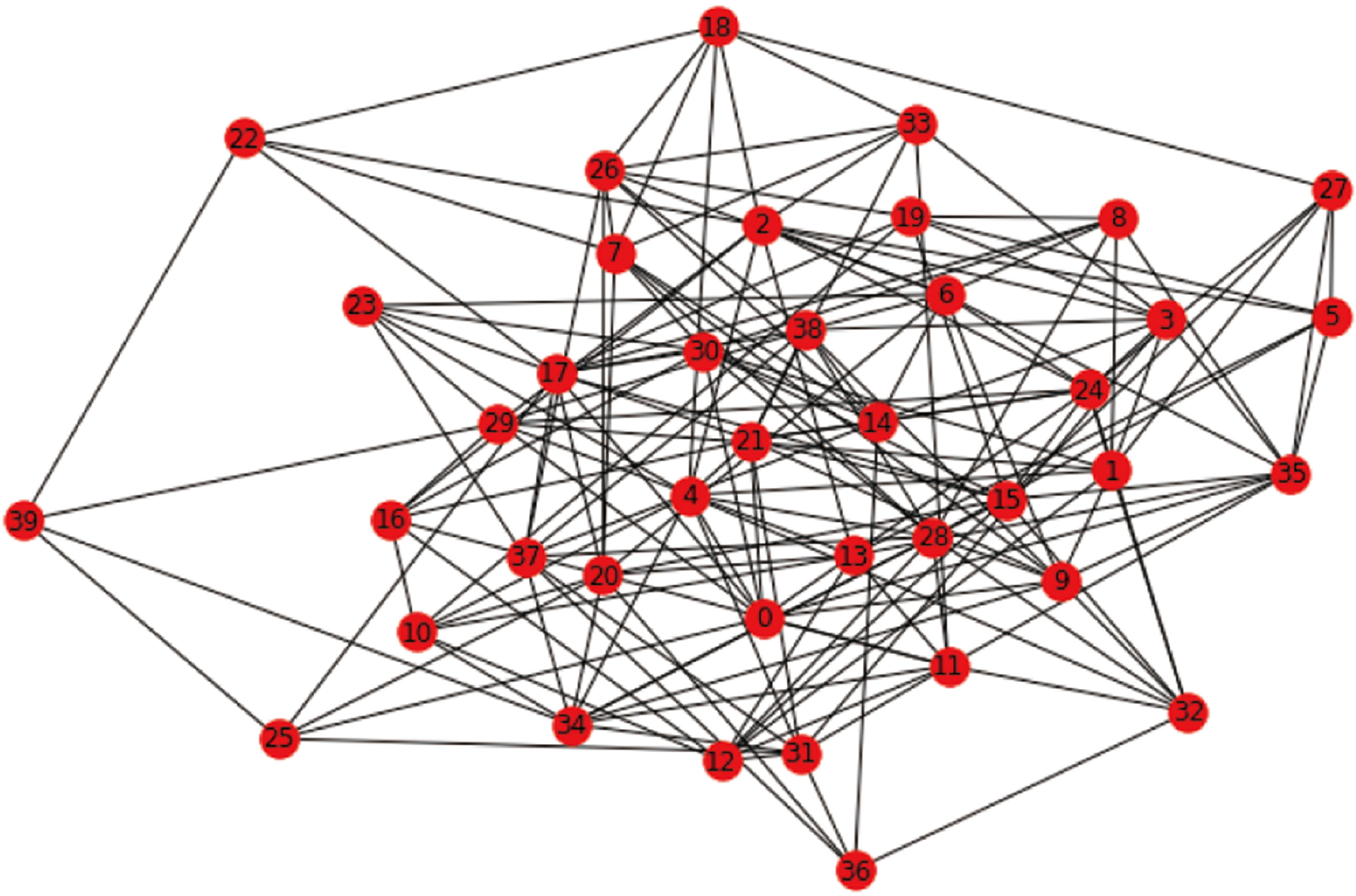
In the network, red nodes represent the 40 agents and blue lines which connect two nodes indicate that the two agents are friends. According to the topological structure, node 39 has only four extra edges connected, i.e., as defined in Section 2.1,
We suppose that the resource types in this paper are computers, books, bikes and umbrellas, i.e.,
Sharing computers: Sharing books: Sharing bikes: Sharing umbrella:
Agents own one to four different resources which have distinguishing characters. Corresponding, an agent demands one to four resources each time. Deadlines and processing times are in the range of [1, 2.5] and [2.5, 5] unit of time. In the first round,
{(books, 100%), (History, 58%), (English, 93%), (Middle size, 85%), (dl: 1.0), (pt: 3.5)} {(computers, 56%), (Dell, 95%), (8G, 58%), (Other condition, 94%), (dl: 2.5), (pt: 4.5)}
Judging from its requirements, the agent
The individual degree of satisfaction changes with reserved times. a: The satisfaction degrees when demanding the book. b: The satisfaction degrees when demanding the computer.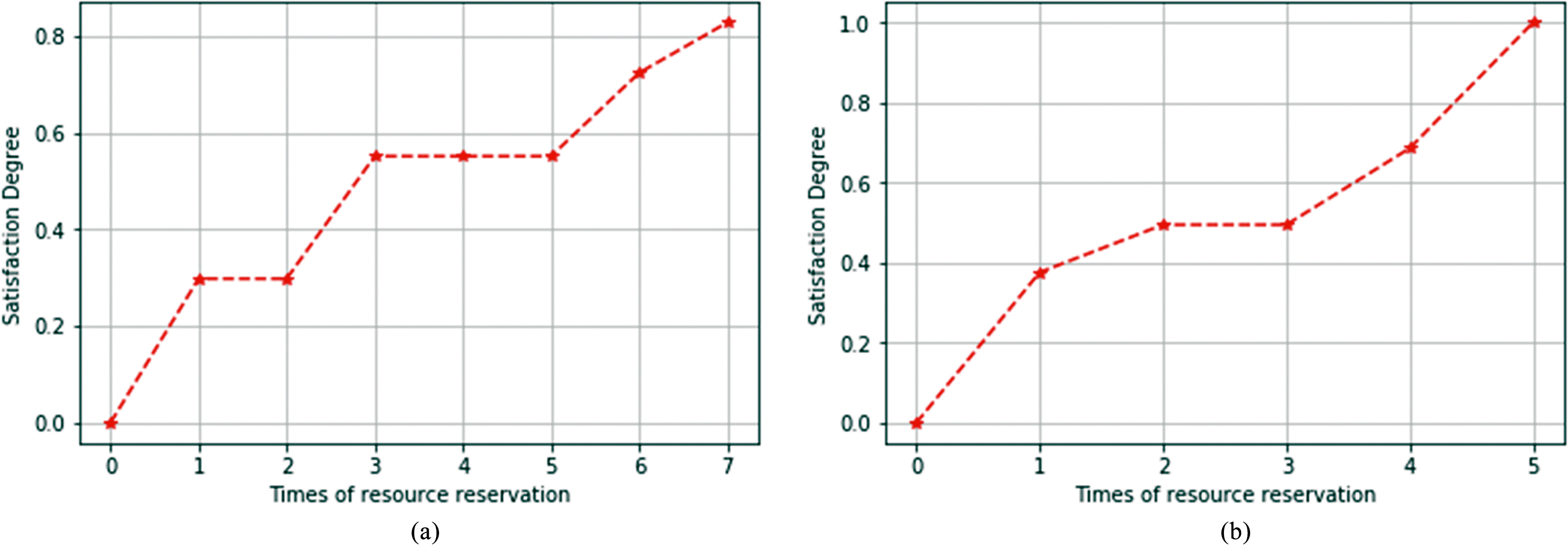
As is shown in Fig. 3, two subgraphs denote the degree of satisfaction about the two resources, respectively. Take Fig. 3b as an example, it shows the changes of satisfaction to resource demand {(Computer, 56%), (Dell, 95%), (8G, 58%), (Other condition, 94%), (dl: 2.5), (pt: 4.5)}. The agent
For detailed illustration, we provide a comparative study between preference represented by the degree of importance and fixed real numbers when asking for resources. To the best of our knowledge, nearly all the required resource amount representations in MARA rely on fixed real numbers. Most of the time, utility functions are used to stress quality requirements rather than demanded quantity [8, 30]. In [22], the preferences consist of a single propositional formula that represents the agent’s goal and its numerical weights. The proposals can be accepted or rejected are taken into accounted in [20]. However, uncertainty is rarely adopted in preference representation.
For this purpose, we use the numerical example discussed in Section 4.1 to illustrate the degrees of satisfaction between the preference denoted by uncertain information and fixed numbers. Forty agents exist in the system, and they respectively acquire one to four different resources. A demand consists of one to four individual resources. In the proposed method, the degrees of importance to fixed characters are a percentage in [0, 100%] while they are 100% in fixed resources requirement. For instance,
{(computer, 100%), (Lenovo, 100%), (16 {(bike, 100%), (Ofo, 90%), (child, 100%), (Red, 66%), (dl: 1.0), (pt: 4)}
On the contrary, an agent needs resources with fixed character values are as follows.
{(computer, 100%), (Lenovo, 100%), (16 G, 100%), (13.3 Inch, 100%), (dl: 1.5), (pt: 3)} {(bike, 100%), (Ofo, 100%), (child, 100%), (Red, 100%), (dl: 1.0), (pt: 4)}
These two resource requirements do exist in real life. Most of the time, agents show the indispensable characters (same as the second requirements). So the received resource owns all the listed characteristics. However, a resource requirement can be more flexible. It is to say, some characters can be needed but not necessary. As is shown in the first requirement, the agent needs a computer of ‘Lenovo,’ and an agent usually does in the previous works. What’s more, the computer’s RAM is 16 G, and the scream size is 13.3 inches could be better. As a result, the two requirements are adopted to analyze the degree of satisfaction to show the efficiency of uncertain preferences.
The egalitarian degree of satisfaction and total interaction times of the 40 requirements whose preference are denoted by degree of importance.
In Fig. 4, the error bars show the egalitarian degree of satisfaction of 40 demands. The redpoint equals ‘0’ means that the agent does not receive all-satisfying resources. The error of the corresponding point indicates the difference between the average degree of satisfaction and the egalitarian degree of satisfaction. As calculated, the average degree of satisfaction is 81.5% of the 40 resource requirements. In the second subgraph, the red lines indicate the total interaction times of each requirement, averagely agent can receive satisfied resources after 26.10 interactions. As a comparison, the requirement denoted by fixed numbers is considered. The egalitarian degree of satisfaction and number of interacted agents are shown in Fig. 5. As we can see, most of the requirements can not be satisfied, while the average interacted agents are 32.17. Therefore, a resource requirement can be represented by the degree of importance, and it contents agents when demanding resources.
The egalitarian degree of satisfaction and total interaction times of the 40 requirements whose preference are with fixed attributes.
In the section as mentioned above, an original social network that consists of 40 agents is adopted for resource allocation. In the resource requirements representation part, resource demanders have fuzzy preferences, for both resource quantity and quality. We illustrate its effectiveness by analyzing the satisfaction of the obtained resource. The results compared with the preference, which is represented by fixed numbers (Utility function), suggests that the proposed method can help resource demanders obtain needed resources effectively.
In this paper, we propose an uncertain preference-based resource reservation method for MARA in a fully distributed systems. Agents communicate with each other to pursue more satisfying resources. There are some related works to the proposed method. An efficiency analysis-based resource allocation method is proposed in [21]. The centralized unit is quite impressive in maximizing the total amount of outputs produced by allocating required resources to individuals. A formal interactive approach based on data envelopment analysis and multiple-object programming to find optimal allocation plan. However, the centralized approaches have its limitation in resource allocation compared with decentralized methods. In this paper, agents in the distributed systems act altruistically and cooperatively. They reserve whatever they own that satisfies their friends’ demands. Moreover, agents in distributed systems cooperate mutually for resource allocation is more applicable in real life. In [24, 5], a formal model for indivisible goods resource sharing without monetary compensations and with arbitrary feasibility constraints are improved. A compact representation language is adopted to represent the preference, especially the dependencies between resources. All agents in the distributed systems would like to maximize their degree of satisfaction. The model is applied to Earth-observing satellites (EOS), and three constraints are taken into account, namely, physical problem constraints, efficiency constraints, and fairness constraints. Compared with the proposed method in this paper, the agent needs to find out the necessary resources which own all the needed characters. Then, agents are more contented if more attributes are covered. Degree of importance is applicable as a compact representation language, and it is more comfortable and more flexible in real-life utilization. Meanwhile, agents are always selfless and cooperative to their acquaintances when sharing some kinds of resources, which is also close to real-world life. In [43], a trust-based method is developed for resource management. However, the article mainly focuses on trust through reinforcement learning. In future work, trust-based resource allocation will be taken into account in a completely selfless and cooperative system.
As is explained, agents’ preferences in MARA are mostly represented in cardinal or ordinal preference structures, fuzzy and qualitative approaches are rarely emphasized. However, fuzziness and uncertainty are always one of the indispensable parts of preference representation. Resource demanders always keep two separated acceptable and ideal amounts for required resources, so it is the same to required characters. The comparisons in this part are efficient in explanation. Anyhow, we would like to put the proposed system in our real world to illustrate its efficiency.
Conclusions
In this paper, a preference-based approach for resource allocation is proposed. We introduced interval numbers and importance degrees to represent the detailed resource requirements from both perspectives of resource quantities and properties. In full distributed systems, all agents are collaborative and desire to share their resources. However, agents only act friendly to their acquaintance and never cooperate with strangers. An illustrative example of resource sharing in a distributed network is presented to show the working process and the effectiveness of the proposed distributed method. In future research, the cooperative mode needs to be improved, and agents can reserve resources for both friends and strangers. Agents negotiate for more satisfied resources, and trust-based resource allocation method would be taken into account.
Footnotes
Acknowledgments
This work is supported by CRIStAL (Research center in Computer Science, Signal and Automatic Control of Lille) (UMR 9189) and China Scholarship Council (CSC).