



Abstract
Micro differential evolution (mDE) refers to algorithms that evolve with a small population to search for good solutions. Although mDEs are very useful for resource-constrained optimization tasks, the research on mDEs is still limited. In this paper, we propose a new mDE, i.e., vectorized bimodal distribution based mDE (called VB-mDE). The main idea is to employ a vectorized bimodal distribution parameter adjustment mechanism in mDE for performance enhancement. Specifically, in the VB-mDE, two important control parameters, i.e., scale factor
Keywords
Introduction
Differential evolution (DE) is one of the most powerful evolutionary algorithms for global optimization problems [1]. During the past two decades, DE has received much attention due to its attractive characteristics such as simplicity, speediness and robustness. DE has also been successfully applied to solve various scientific and engineering problems, such as chemical process optimization [2], economic load dispatch [3], and flow shop scheduling [4].
Normal DEs usually works on a large population size [5]. With a large population size, DE has better population diversity during the search process, and also has a higher opportunity to achieve global solutions for complex problems. However, for the resource-constrained problems like on-line nonlinear model predictive control (NMPC) [6] or real-time vehicle navigation system [7], the computing resources available for population re-evaluation in one iteration are largely restricted. In such circumstances, DEs with large population may become ineffective.
Recently, micro-DE (mDE) algorithms, also called as
Though, the research on the mDE algorithms is still little compared to normal DE algorithms. On the other hand, it is recognized that the parameter adjustment mechanism (PAM) has important impacts on the performance of mDE algorithms [15, 16], while most current mDEs still lack effective PAMs.
In this paper, we develop a vectorized bimodal distribution based PAM (VB-PAM) for mDE algorithms. Further, using the VB-PAM, we propose a novel
The bimodal distribution based PAM is taken from the normal DE algorithm in the literature [17]. This paper will employ the vectorized version of bimodal distribution based PAM to design novel mDE algorithm. Our proposed VB-mDE will be compared with several state-of-the-art mDE and normal DE algorithms on the CEC2014 functions under the scenarios of small computational resources available for population re-evaluation.
The remainder of this paper is organized as follows. Section 2 reviews the existing research of mDE algorithms. Section 3 proposes our VB-mDE algorithm. Section 4 evaluates our proposed VB-mDE algorithm with comprehensive simulation results and analysis. Section 5 draws conclusion and gives an outlook on future work.
Literature review
This section will briefly review the research work of the mDE algorithms. The main methods of mDE include (i) modification of search operators, (ii) local search based method, and (iii) adjustment of parameters or operators, among others.
The first method to develop efficient mDE algorithms may be modifying the search operators. For example, to address the prematurity problem, a modified DE using smaller population called DESP is developed in [9]. In DESP, the disturbance is introduced to the mutation operator, and an adaptive scheme is also used to adjust the disturbance size. For the purpose of enhancing the population diversity, the random perturbation and modified selection strategies are introduced to the mDE [10]. It is shown that the two modifications can significantly improve the performance of mDE. However, the mDE algorithms developed in [9, 10] use constant control parameters and were only evaluated in simple test functions. Therefore, it is difficult for them to obtain good performance in complex optimization functions.
The second method may be employing local search technique to design efficient mDE algorithms. In [11], a mDE algorithm with local search operator, called mDELS, is developed and applied for solving large-scale optimization problems. In [12], a mDE algorithm with a directional local search (called
The third method may be devising parameter and operator adaptive strategies for mDE algorithms. In [13], a mDE algorithm with vectorized random mutation factor called MDEVM is proposed. In MDEVM, by randomizing and vectorizing the scale factor, the diversity of the population can be increased, thereby alleviating the problems of premature and stagnation. Later, by employing ensemble mutation and oppositional learning strategies in MDEVM, the ensemble mDE (EMDE) [14] and oppositional ensemble mDE (OEMDE) [18] are presented, resectively. In these mDE algorithms [13, 14, 18], the parameter or operator adjustment strategies are devised based on random uniform distribution, and thus the performance is limited. In [6], an adaptive mDE algorithm called
Furthermore, some mDE algorithms are designed for real-world optimization problems. To deal with the image thresholding problem, opposition-based population initialization (OBPI) is embedded into mDE, and the mODE algorithm is proposed in [8]. It is shown that mODE converges faster than mDE through the OBPI. To solve the optimization problems of topological active net, mDE with best improvement local search (deBILS) is proposed in [20].
Compact DE (cDE) [21] is a related work to mDE. In cDE, a statistical description of the population is used to evolve the search process and the memory requirement is a population of four individuals.
The existing mDE algorithms may be summarized in Table 1.
Summary of existing mDE algorithms
Summary of existing mDE algorithms
This section proposes a new mDE algorithm, i.e.,
Block diagram of proposed VB-mDE algorithm.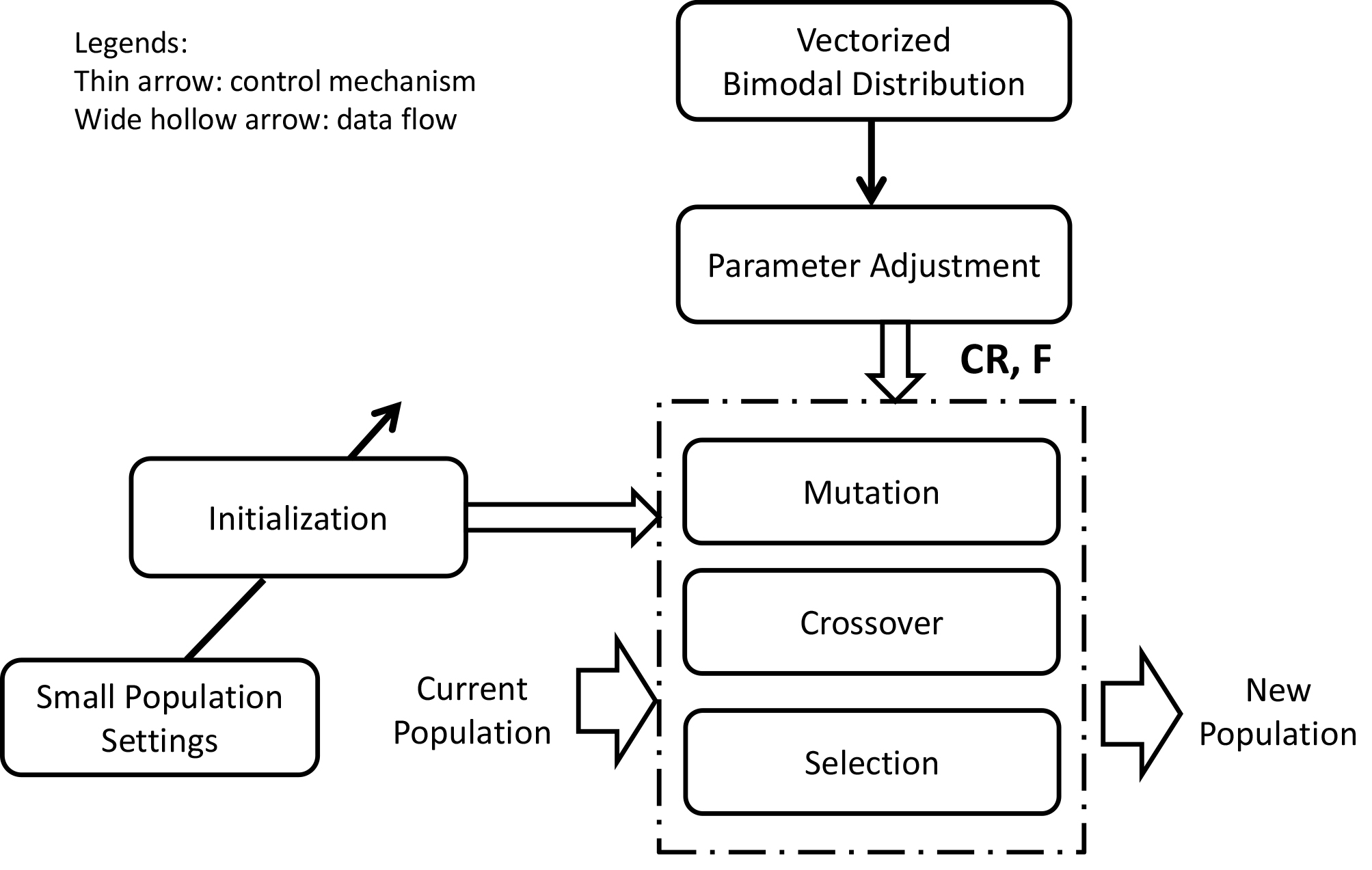
DE randomly initializes a population of
where
where
DE works over three phases in order, namely initialization, search and termination. After initialization, DE implements three operators, namely mutation, crossover and selection to generate the offspring of the population in the search, until the termination condition is satisfied.
The mutation operator is firstly applied to generate new offspring. The most commonly used mutation strategies include:
DE/rand/1:
DE/rand/2:
DE/best/1:
DE/best/2:
DE/current-to-best/1:
where
After mutation, the crossover operator is applied between
where
After crossover, the selection operator is applied between the target vector
where
The bimodal distribution PAM (B-PAM) was proposed in [17], aiming at efficiently combining the global exploration and local exploitation during the searching process. B-PAM has two advantages, i.e., (1) it can be coded and implemented very easily in DE; and (2) it is shown that B-PAM obtains consistently high performance [16, 17].
In this paper, we will employ B-PAM for the mDE, and integrate it into our VB-mDE algorithm. Furthermore, to enhance the population diversity and reduce the risk of premature convergence, the vectorized mutation strategy [13] is introduced into B-PAM, resulting in a vectorized version of B-PAM, called VB-PAM. To be specific, the bimodal distribution based scale factor in VB-PAM is set as follows:
From Eq. (10), it can be seen that the scale factor
In Eq. (11),
The bimodal distribution based crossover rate is set as follows:
In Eq. (12), the range of cross rate
In DE, the scale factor
In addition, a large value of
By using the VB-PAM and small population, our proposed VB-mDE algorithm can be represented by pseudocodes as shown in Algorithm 1.
[H] linenosize=
The structure of the proposed VB-mDE algorithm would remain unchanged if the mutation strategy rand/1 is substituted with any other mutation strategies, such as rand/2, best/1, best/2 and current-to-best/1, in which case the VB-mDE algorithm accordingly turns to be a VB-mDE/a/b algorithm. In general, VB-mDE has a very simple structure, just like basic DE, and can be coded and implemented very easily.
Difference between VB-mDE and MDEVM
MDEVM [13] is a recently-developed mDE algorithm, which originally uses the vectorized mutation strategy. Since VB-mDE and MDEVM appear in great similarities, it is worthwhile to highlight the differences between the two algorithms.
The main difference between VB-mDE and MDEVM lies in the parameter adjustment mechanisms. Firstly, MDEVM generates the scale factor
Performance evaluations
The proposed VB-mDE is compared with the state-of-the-art mDE and nomal DE algorithms to validate its performance. All the algorithms are tested on 30 benchmark functions from CEC2014 with four different dimensions, i.e.,
The comparisons are summarized using B-S-W triplets, in which B, S and W represent the numbers of test functions, respectively, on which VB-mDE performs better than, similarly to and worse than its competitor according to the Wilcoxon rank sum test at significant level
Comparisons between VB-mDE and MDEVM with different small population sizes
Firstly, we compare VB-mDE and MDEVM to investigate whether the vectorized bimodal distribution based PAM outperforms the vectorized uniform distribution based PAM in the mDEs.
We compare the performances of VB-mDE and MDEVM with different small population sizes. Table 2 shows the comparisons between VB-mDE and MDEVM with small population size
When
When
When
When
Overall, VB-mDE outperforms MDEVM on 161, 116, 158, 125 and 123 functions, but loses merely to MDEVM on 10, 19, 10, 23 and 11 functions under the mutation strategies rand/1, rand/2, best/1, best/2 and current-to-best/1, respectively.
From the comparisons it is clear that VB-mDE performs significantly better than MDEVM on most of the CEC2014 functions with different small population sizes. This validates the effectiveness of the vectorized bimodal distribution based PAM being built in VB-mDE.
Comparisons between VB-mDE and MDEVM with small population sizes
for dimension
30
Comparisons between VB-mDE and MDEVM with small population sizes
B, S and W represent the numbers of test functions on which VB-mDE performs better than, similarly to, or worse than MDEVM, respectively.
We further compare the performances of VB-mDE and MDEVM with four different problem dimensions. In the comparisons below, the population size for all mDE algorithms is set as
Table 3 shows the comparisons between VB-mDE and MDEVM with four different dimensions
When
When
When
When considering all four problem dimensions (
Based on the above analysis, it can be said that VB-mDE largely outperforms MDEVM under any problem dimension and with any mutation strategy. These comparisons further validate the effectiveness of the vectorized bimodal distribution based PAM being built in VB-mDE.
Comparisons between VB-mDE and MDEVM with different problem dimensions
Comparisons between VB-mDE and MDEVM with different problem dimensions
B, S and W represent the numbers of test functions on which VB-mDE performs better than, similarly to, or worse than MDEVM, respectively.
Friedman ranks of VB-mDE and MDEVM algorithms.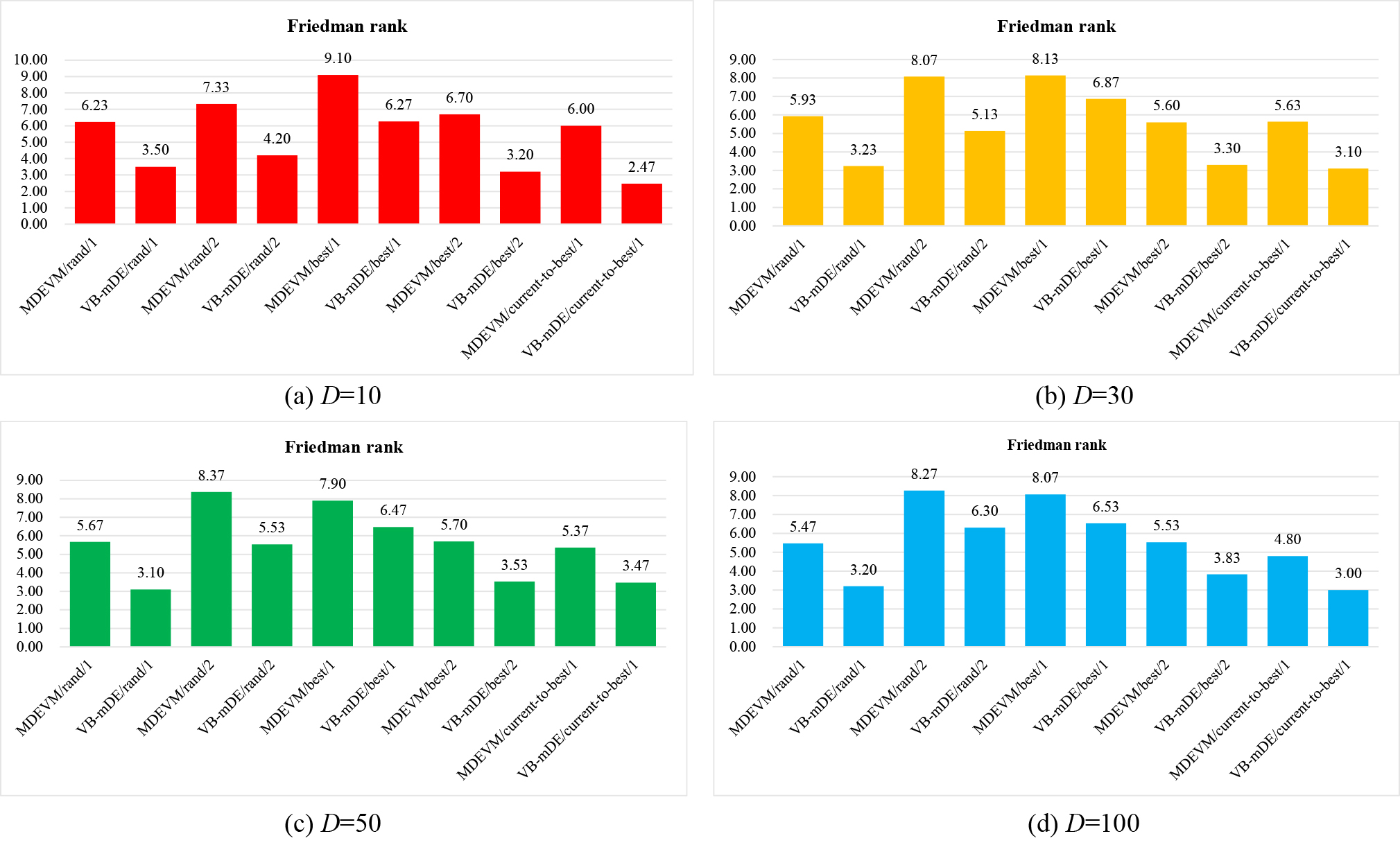
Convergence graphs of VB-mDE and MDEVM algorithms.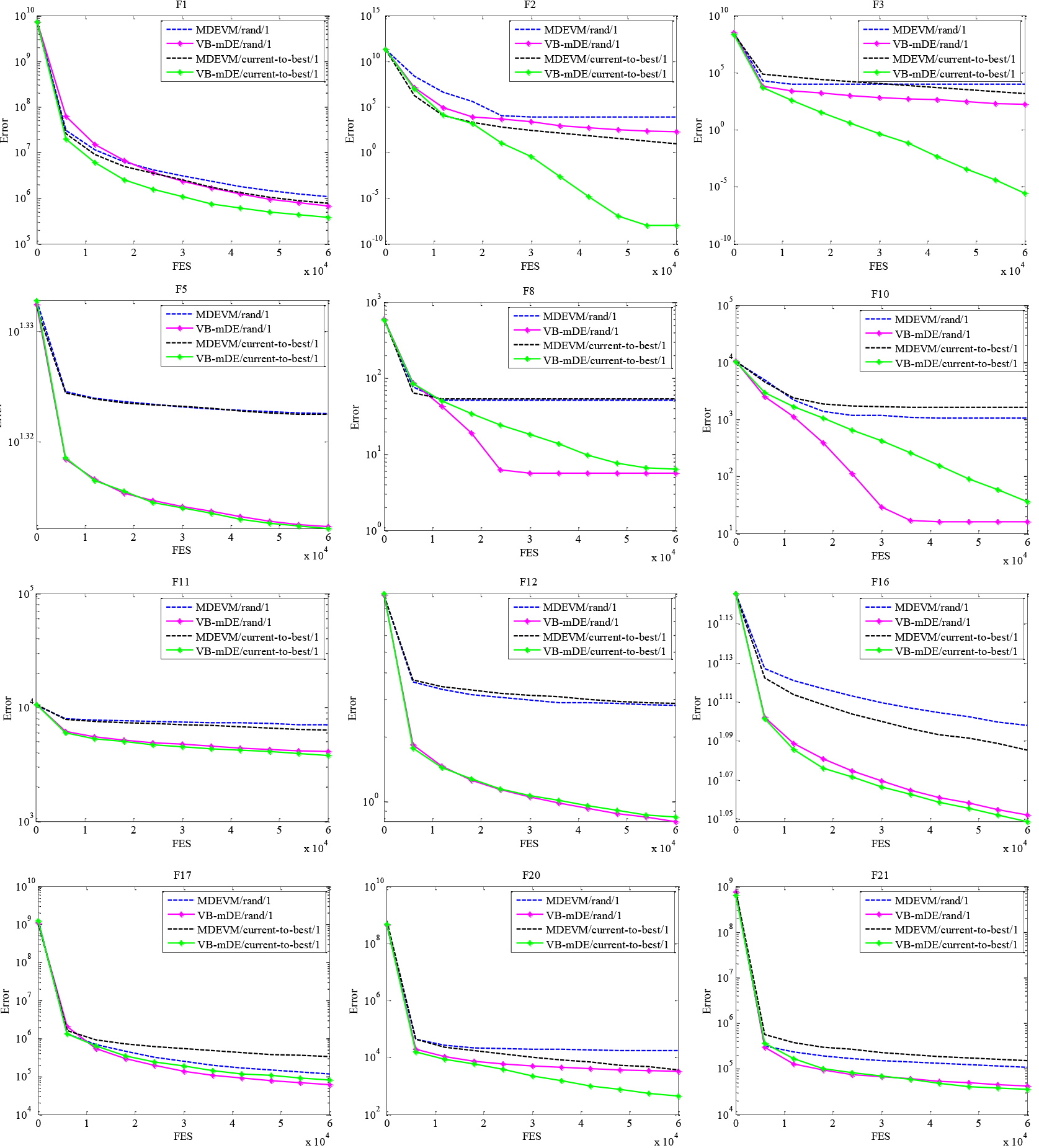
To compare the performances of VB-mDE and MDEVM algorithms with five different mutation strategies, Fig. 2 plots the Friedman ranks [24] of these algorithms on all the 30 functions.
As can be seen from Fig. 2, for all four problem dimensions
When
When
When
When
From the analysis of Friedman test ranks, it is clear that VB-mDE/rand/1 and VB-mDE/current-to-best/1 achieve the overall best performance among the ten mDE algorithms. Thus, in the following sections, VB-mDE/rand/1 and VB-mDE/current-to-best/1 will be selected for further comparison.
Convergence comparison between VB-mDE and MDEVMM
Figure 3 plots the convergence graphs of VB-mDE and MDVEM with mutation strategies rand/1 and current-to-best/1 on some typical functions with
As can be seen from Fig. 3, VB-mDE/a/b has relatively faster convergence speed than MDEVM/a/b on these functions.
Comparisons between VB-mDE and other mDEs
The performances of VB-mDE/rand/1 and VB-mDE/current-to-best/1 are further compared with other four mDE algorithms, i.e., DESP [9], EMDE [14], OEMDE [18] and
Comparisons between VB-mDE and other mDEs with different problem dimensions
Comparisons between VB-mDE and other mDEs with different problem dimensions
B, S and W represent the numbers of test functions on which VB-mDE performs better than, similarly to, or worse than its competitor, respectively.
Table 4 presents the comparisons between VB-mDE and other mDEs with four different dimensions (
When
When
When
When
When considering all four problem dimension (
In summary, based on the above analysis, it is clear that VB-mDE largely exhibits better performance than DESP, EMDE and OEMDE with four different dimensions (
Comparisons between VB-mDE and normal DEs with different problem dimensions
B, S and W represent the numbers of test functions on which VB-mDE performs better than, similarly to, or worse than normal DE, respectively.
The performances of VB-mDE/rand/1 and VB-mDE/current-to-best/1 are further compared with three normal DEs, namely CoBiDE [17], SaDE [25] and JADE [19]. The normal DEs are implemented with small population size, i.e., CoBiDE (
Table 5 presents the comparisons between VB-mDE and DEs with four different dimensions (
When
When considering all four problem dimensions (
Based on the above analysis, it can be seen that VB-mDE generally outperforms normal DEs, if the normal DEs are implemented directly with small population size. This also reinforces the motivation that mDE algorithms should be elaborately designed, rather than simply implementing normal DE algorithms with small population size.
It can be seen that VB-mDE generally loses to normal DEs with large population size. This is perceivable because DEs with large population size can maintain better diversity. At the same time, it is also worth noting that DEs with large population size cannot be used for some resource constrained optimization applications.
Conclusions
In this paper, a novel bimodal distribution based micro-DE (VB-mDE) has been developed. In our proposed VB-mDE, the vectorized bimodal distribution mechanism is employed to adjust the control parameters. Specifically, the scale factor
Comprehensive experiments have been carried out to compare the proposed VB-mDE with the state-of-the-art mDEs and normal DEs using the CEC2014 benchmark functions. Firstly, it is observed that our proposed VB-mDE outperforms the state-of-the-art mDEs (including MDEVM, DESP, EMDE, OEMDE and
There are several aspects worth exploring in the future. Firstly, it is worthwhile to look into other parameter adjustment mechanism to further improve the performance of mDEs. Secondly, this paper only considers the parameter adaptive mechanism for mDE. However, actually, multi-strategy adaptive mechanism may be useful for mDEs as well. Finally, mDEs may be extended to other types of problems, such as constrained, dynamic, multi-objective and real-world problems.
Footnotes

Appendix
Mean error and standard deviation of VB-mDE and MDEVM (
VB-mDE/ rand/1
MDEVM/ rand/1
VB-mDE/ best/1
MDEVM/ best/1
VB-mDE/ cur2best/1
MDEVM/ cur2best/1
F01
6.77E+05
1.07E+06
2.17E+06
1.89E+06
3.85E+05
7.72E+05
(4.67E+05)
(8.54E+05)
(4.45E+06)
(1.13E+06)
(3.05E+05)
(1.53E+06)
F02
1.99E+02
8.09E+03
4.96E+07
1.68E+04
0.00E+00
8.80E+00
(8.30E+02)
(8.83E+03)
(1.91E+08)
(2.42E+04)
(0.00E+00)
(1.39E+01)
F03
1.59E+02
9.33E+03
2.12E+03
2.03E+04
2.74E-06
1.50E+03
(4.92E+02)
(8.92E+03)
(4.13E+03)
(1.80E+04)
(8.75E-06)
(2.44E+03)
F04
7.38E+01
7.35E+01
8.26E+01
9.78E+01
5.63E+01
4.79E+01
(4.61E+01)
(4.83E+01)
(4.49E+01)
(3.56E+01)
(4.34E+01)
(3.60E+01)
Table A1, continued
VB-mDE/ rand/1
MDEVM/ rand/1
VB-mDE/ best/1
MDEVM/ best/1
VB-mDE/ cur2best/1
MDEVM/ cur2best/1
F05
2.05E+01
2.10E+01
2.05E+01
2.10E+01
2.05E+01
2.10E+01
(5.74E-02)
(5.03E-02)
(6.37E-02)
(5.04E-02)
(5.13E-02)
(4.78E-02)
F06
1.83E+01
1.30E+01
1.96E+01
2.66E+01
1.29E+01
1.48E+01
(2.86E+00)
(3.31E+00)
(3.02E+00)
(3.73E+00)
(4.23E+00)
(4.20E+00)
F07
1.86E-02
7.13E-02
4.36E-01
7.76E-01
4.62E-02
4.94E-02
(5.24E-02)
(2.20E-01)
(9.91E-01)
(3.39E+00)
(6.71E-02)
(8.62E-02)
F08
5.60E+00
5.13E+01
4.75E+01
1.06E+02
6.43E+00
5.35E+01
(4.02E+00)
(1.52E+01)
(2.07E+01)
(3.23E+01)
(6.01E+00)
(1.54E+01)
F09
1.13E+02
6.06E+01
9.59E+01
1.30E+02
9.22E+01
7.10E+01
(1.21E+01)
(2.76E+01)
(2.06E+01)
(3.60E+01)
(1.38E+01)
(1.58E+01)
F10
1.59E+01
1.06E+03
2.07E+02
2.46E+03
3.62E+01
1.62E+03
(3.24E+01)
(4.29E+02)
(2.10E+02)
(5.31E+02)
(2.64E+01)
(6.26E+02)
F11
4.09E+03
7.01E+03
3.76E+03
3.44E+03
3.80E+03
6.33E+03
(3.86E+02)
(1.21E+03)
(3.99E+02)
(9.54E+02)
(3.26E+02)
(1.46E+03)
F12
8.06E-01
2.82E+00
8.24E-01
2.47E+00
8.44E-01
2.88E+00
(1.20E-01)
(3.47E-01)
(1.28E-01)
(1.02E+00)
(1.34E-01)
(3.38E-01)
F13
4.39E-01
5.01E-01
5.05E-01
5.61E-01
4.65E-01
5.00E-01
(8.12E-02)
(1.04E-01)
(1.16E-01)
(1.57E-01)
(7.42E-02)
(1.04E-01)
F14
2.90E-01
3.49E-01
4.54E-01
4.30E-01
2.64E-01
3.48E-01
(4.43E-02)
(1.58E-01)
(7.60E-01)
(2.71E-01)
(4.73E-02)
(1.51E-01)
F15
1.16E+01
1.63E+01
1.31E+02
3.70E+02
1.73E+01
1.64E+01
(1.47E+00)
(1.03E+01)
(3.55E+02)
(3.74E+02)
(6.90E+00)
(1.26E+01)
F16
1.13E+01
1.25E+01
1.10E+01
1.13E+01
1.12E+01
1.22E+01
(3.54E-01)
(7.49E-01)
(4.54E-01)
(7.85E-01)
(4.35E-01)
(5.71E-01)
F17
6.04E+04
1.16E+05
2.24E+05
3.81E+05
7.91E+04
3.38E+05
(4.10E+04)
(6.97E+04)
(4.50E+05)
(2.32E+05)
(7.19E+04)
(2.91E+05)
F18
3.31E+03
2.68E+03
4.46E+06
4.08E+03
1.98E+03
3.65E+03
(3.95E+03)
(3.24E+03)
(2.26E+07)
(4.34E+03)
(2.22E+03)
(4.28E+03)
F19
1.02E+01
1.66E+01
2.74E+01
2.72E+01
1.18E+01
1.26E+01
(1.48E+01)
(2.31E+01)
(4.72E+01)
(2.86E+01)
(1.62E+01)
(1.73E+01)
F20
3.32E+03
1.74E+04
6.15E+03
3.70E+04
4.38E+02
3.67E+03
(4.20E+03)
(1.17E+04)
(7.08E+03)
(1.99E+04)
(4.45E+02)
(3.84E+03)
F21
4.22E+04
1.09E+05
8.09E+04
2.97E+05
3.60E+04
1.51E+05
(4.53E+04)
(8.50E+04)
(1.00E+05)
(2.81E+05)
(3.74E+04)
(1.88E+05)
F22
2.86E+02
3.30E+02
4.35E+02
6.17E+02
2.61E+02
2.72E+02
(1.17E+02)
(2.18E+02)
(2.22E+02)
(2.41E+02)
(1.11E+02)
(1.15E+02)
F23
3.15E+02
3.15E+02
3.16E+02
3.15E+02
3.15E+02
3.15E+02
(6.62E-12)
(1.11E-06)
(1.01E+00)
(2.59E-01)
(2.84E-11)
(6.05E-10)
F24
2.32E+02
2.45E+02
2.52E+02
2.59E+02
2.43E+02
2.45E+02
(6.36E+00)
(6.27E+00)
(8.18E+00)
(9.50E+00)
(6.95E+00)
(8.23E+00)
F25
2.06E+02
2.08E+02
2.15E+02
2.18E+02
2.09E+02
2.10E+02
(1.87E+00)
(3.38E+00)
(5.96E+00)
(8.45E+00)
(3.89E+00)
(4.48E+00)
F26
1.06E+02
1.10E+02
1.39E+02
1.54E+02
1.36E+02
1.22E+02
(2.37E+01)
(2.99E+01)
(5.60E+01)
(6.48E+01)
(4.81E+01)
(4.14E+01)
F27
4.98E+02
6.05E+02
7.73E+02
9.21E+02
4.92E+02
6.35E+02
(1.48E+02)
(1.29E+02)
(2.16E+02)
(2.86E+02)
(1.14E+02)
(1.52E+02)
F28
9.75E+02
1.08E+03
1.35E+03
1.99E+03
9.84E+02
1.09E+03
(5.66E+01)
(1.65E+02)
(3.15E+02)
(5.52E+02)
(9.17E+01)
(1.19E+02)
F29
1.36E+03
1.28E+03
2.01E+03
1.57E+03
1.17E+03
1.39E+03
(3.71E+02)
(3.27E+02)
(2.66E+03)
(6.81E+02)
(3.88E+02)
(4.57E+02)
F30
2.13E+03
2.77E+03
3.62E+03
5.04E+03
2.49E+03
2.44E+03
(7.60E+02)
(9.04E+02)
(9.64E+02)
(3.77E+03)
(8.97E+02)
(1.07E+03)
B-S-W
21-7-2
18-8-4
17-12-1
Mean error and standard deviation of VB-mDE and other mDEs (
VB-mDE/rand/1
DESP
EMDE
OEMDE
F01
6.77E+05
3.20E+06
7.12E+05
6.61E+07
1.08E+07
(4.67E+05)
(1.57E+06)
(4.98E+05)
(2.68E+08)
(6.24E+06)
F02
1.99E+02
1.09E+04
8.35E+03
1.06E+04
4.91E-10
(8.30E+02)
(8.84E+03)
(7.99E+03)
(9.91E+03)
(3.51E-09)
F03
1.59E+02
7.10E+04
8.66E+03
6.02E+05
6.50E-04
(4.92E+02)
(1.89E+04)
(8.20E+03)
(3.54E+06)
(2.63E-03)
F04
7.38E+01
1.25E+02
6.08E+01
8.34E+01
5.88E+01
(4.61E+01)
(3.82E+01)
(3.45E+01)
(4.14E+01)
(4.48E+01)
F05
2.05E+01
2.03E+01
2.10E+01
2.10E+01
2.04E+01
(5.74E-02)
(4.17E-01)
(5.18E-02)
(2.02E-01)
(1.84E-01)
F06
1.83E+01
2.44E+01
1.61E+01
2.25E+01
2.62E+01
(2.86E+00)
(3.36E+00)
(3.48E+00)
(9.89E+00)
(1.71E+00)
F07
1.86E-02
1.27E-02
2.23E-01
1.00E-01
6.03E-03
(5.24E-02)
(1.59E-02)
(1.16E+00)
(1.65E-01)
(1.19E-02)
F08
5.60E+00
1.07E+02
6.36E+01
6.22E+01
3.31E+01
(4.02E+00)
(2.43E+01)
(1.62E+01)
(1.87E+01)
(8.87E+00)
F09
1.13E+02
1.34E+02
7.66E+01
8.54E+01
1.62E+02
(1.21E+01)
(3.52E+01)
(2.52E+01)
(2.48E+01)
(1.87E+01)
F10
1.59E+01
2.67E+03
1.38E+03
3.56E+03
1.05E+03
(3.24E+01)
(7.16E+02)
(4.91E+02)
(2.06E+03)
(3.79E+02)
F11
4.09E+03
3.38E+03
5.84E+03
6.48E+03
5.32E+03
(3.86E+02)
(8.16E+02)
(2.23E+03)
(1.55E+03)
(7.49E+02)
F12
8.06E-01
1.05E+00
2.83E+00
2.15E+00
8.66E-01
(1.20E-01)
(4.36E-01)
(3.49E-01)
(1.23E+00)
(5.46E-01)
F13
4.39E-01
4.28E-01
4.90E-01
5.25E-01
4.57E-01
(8.12E-02)
(9.84E-02)
(9.74E-02)
(1.11E-01)
(6.62E-02)
F14
2.90E-01
2.88E-01
3.58E-01
3.49E-01
3.40E-01
(4.43E-02)
(7.50E-02)
(1.70E-01)
(1.35E-01)
(1.57E-01)
F15
1.16E+01
4.23E+01
1.75E+01
2.26E+01
1.50E+01
(1.47E+00)
(2.15E+01)
(1.18E+01)
(2.77E+01)
(2.99E+00)
F16
1.13E+01
1.14E+01
1.23E+01
1.27E+01
1.14E+01
(3.54E-01)
(7.11E-01)
(7.57E-01)
(6.80E-01)
(9.77E-01)
F17
6.04E+04
7.97E+05
8.74E+04
2.60E+05
5.10E+05
(4.10E+04)
(5.26E+05)
(5.24E+04)
(6.38E+05)
(4.62E+05)
F18
3.31E+03
3.67E+03
2.85E+03
3.70E+03
1.78E+03
(3.95E+03)
(4.25E+03)
(3.41E+03)
(3.68E+03)
(2.79E+03)
F19
1.02E+01
4.62E+01
1.59E+01
2.10E+01
8.59E+00
(1.48E+01)
(4.40E+01)
(2.24E+01)
(2.43E+01)
(1.19E+00)
F20
3.32E+03
4.89E+04
1.11E+04
1.46E+04
2.70E+02
(4.20E+03)
(2.72E+04)
(8.53E+03)
(1.01E+04)
(2.70E+02)
F21
4.22E+04
2.86E+05
4.91E+04
1.09E+05
2.31E+04
(4.53E+04)
(2.28E+05)
(3.82E+04)
(7.21E+04)
(1.61E+04)
F22
2.86E+02
5.92E+02
3.77E+02
4.19E+02
2.94E+02
(1.17E+02)
(2.17E+02)
(2.15E+02)
(2.10E+02)
(1.43E+02)
F23
3.15E+02
3.20E+02
3.15E+02
3.15E+02
3.15E+02
(6.62E-12)
(4.14E+00)
(4.33E-10)
(4.47E-05)
(3.95E-13)
F24
2.32E+02
2.61E+02
2.47E+02
2.46E+02
2.28E+02
(6.36E+00)
(1.03E+01)
(7.45E+00)
(7.32E+00)
(3.98E+00)
F25
2.06E+02
2.24E+02
2.10E+02
3.03E+02
2.11E+02
(1.87E+00)
(6.15E+00)
(5.01E+00)
(8.39E+01)
(2.52E+00)
F26
1.06E+02
1.63E+02
1.32E+02
2.56E+02
1.08E+02
(2.37E+01)
(4.88E+01)
(4.63E+01)
(1.16E+02)
(2.74E+01)
Table A2, continued
VB-mDE/rand/1
DESP
EMDE
OEMDE
F27
4.98E+02
7.51E+02
7.20E+02
7.32E+02
5.43E+02
(1.48E+02)
(2.79E+02)
(1.33E+02)
(2.92E+02)
(1.74E+02)
F28
9.75E+02
2.40E+03
1.23E+03
2.15E+03
1.03E+03
(5.66E+01)
(5.58E+02)
(2.42E+02)
(1.78E+03)
(1.35E+02)
F29
1.36E+03
1.39E+07
1.36E+03
1.23E+07
6.68E+05
(3.71E+02)
(2.55E+07)
(3.91E+02)
(8.79E+07)
(2.30E+06)
F30
2.13E+03
2.35E+04
2.82E+03
3.13E+03
3.06E+03
(7.60E+02)
(1.27E+04)
(8.58E+02)
(8.88E+02)
(9.45E+02)
B-S-W
23-5-2
20-8-2
25-4-1
12-9-9
Author’s Bios