Cloud computing provisions and allocates resources, in advance or real-time, to dynamic applications planned for execution. This is a challenging task as the Cloud-Service-Providers (CSPs) may not have sufficient resources at all times to satisfy the resource requests of the Cloud-Service-Users (CSUs). Further, the CSPs and CSUs have conflicting interests and may have different utilities. Service-Level-Agreement (SLA) negotiations among CSPs and CSUs can address these limitations. User Agents (UAs) negotiate for resources on behalf of the CSUs and help reduce the overall costs for the CSUs and enhance the resource utilization for the CSPs. This research proposes a broker-based mediation framework to optimize the SLA negotiation strategies between UAs and CSPs in Cloud environment. The impact of the proposed framework on utility, negotiation time, and request satisfaction are evaluated. The empirical results show that these strategies favor cooperative negotiation and achieve significantly higher utilities, higher satisfaction, and faster negotiation speed for all the entities involved in the negotiation.
Cloud service provides virtual resources and secure and adaptable infrastructures through Infrastructure-as-a-Service (IaaS) delivery model. However, the Cloud-Service-Providers (CSPs) do not have infinite amount of resources. Also, the Cloud-Service-Users (CSUs) consistently have budget and time constraints in availing the resources of the CSPs. This situation can be optimized if the CSUs and CSPs negotiate the Service-Level-Agreements (SLAs) regarding their resources (i.e., utilities). This research presents a Broker () based SLA negotiation framework in which the CSUs (through User Agents (UAs)) and CSPs are represented as buyers and sellers, respectively. A list of some acronyms used in this research, along with their meanings, is provided in Table 1.
A list of some acronyms and their meaning
Notations
Meaning
ACN
Automated concurrent negotiations
SRCNS
Static resource cost negotiation scheme
ABAP
Agreeable by all proposals
Offer acceptance criterion
Offer acceptable by from
Partial offer acceptable by from
Broker
‘’ broker
CSU
Cloud service user
CSUs
Cloud service users
Cloud service user identified with
UA
User Agent
UAs
User Agents
‘’ user agent
CSP
Cloud service provider
CSPs
Cloud service providers
‘’ cloud service provider
IaaS
Infrastructure-as-a-Service
NPCA
Negotiation through participation of CSU agents
Concession Speed of
PRACP
Proposal ranking according to CSU proposals
QoS
Quality-of-service
Minimum utility expected by for offer to be accepted from
Minimum utility expected by for offer to be accepted from
RSL
Random Selection of Leader
Current round of the negotiation
Agent’s Utility achieved
’s concession strategy
SLA
Service level agreement
Opponent, ’s, deadline
Utility of the
VM
Virtual machine
Complete proposal
Partial proposal
Offer received by
SLAs have developed as a new technique to control resource utilization in the Cloud, and a number of Cloud services, such as Amazon EC2 and Google Cloud Platform, have already implemented them. As a result, it is only reasonable to explore ways to include SLAs into job scheduling [1]. To accomplish it, effective and flexible solutions that facilitate dynamic SLA negotiation are required.
A dynamic SLA is the agreement that is negotiated each time the service is to be delivered. The services to be negotiated are resource provisioning services, which must deliver higher-level services such as solving a complex problem, running a given application, and so forth [12]. These services necessitate the utilization of a variety of resources, such as computing nodes, network connections, storage locations, or any combination thereof [22].
Agent framework, which is a collection of autonomous software agents, is significant in resource negotiation strategies in Cloud computing [14]. Agents negotiate over SLAs for the utilities associated with service provisioning and availability of resources. Agent-based negotiation strategies comprise a novel subject of research pertaining to negotiation strategies [14]. Schemes to permit agent-based negotiation strategies are required for handling SLA negotiations among CSUs and CSPs.
This research considers a concurrent one-to-many negotiation mechanism for resource allocation in which a UA negotiates, for multiple resources, with multiple CSPs. It involves agents viz. UA and for the SLA negotiation. mediates SLA negotiation between CSUs (through UAs) and CSPs by using multiple negotiation strategies. A strategy between and defines what, how, and when the decisions have to be taken by both these entities while negotiating for resources. The following four negotiation strategies are proposed in this research: (i) Random Selection of Leader (RSL), (ii) Negotiation through Participation of CSU Agents (NPCA), (iii) Proposal Ranking According to CSU Proposals (PRACP), and (iv) Agreeable By All Proposals (ABAP). The proposed framework allows the UAs, , and CSPs to develop an adaptive strategy towards concurrent negotiations in an environment with incomplete information in which a CSU knows its own negotiation parameters but has incomplete information about its opponent’s (i.e., CSP’s) parameters.
A summary of some existing resource negotiation schemes
Bilateral bargaining by considering the deadline and reserved price
Rules for multi-party negotiations are undefined
The rest of the paper is organized as follows. The next section presents some background on the issues of negotiation and SLA in Cloud computing. Section 3 presents the proposed framework for SLA negotiation strategies. Section 4 presents the simulation studies and results. Finally, Section 5 concludes this research and highlights some future work.
Literature review
Negotiation is a widely studied topic and there are numerous publications addressing various aspects of negotiation. The current research differs from the existing negotiation strategies such as automated concurrent negotiations, fuzzy negotiation, etc. shown in Table 2.
Researchers [2] surveyed the need for devising a technique for resolving the Cloud service negotiation challenge that is well aligned with the needs of both users and the providers. The work in [3] presents a method for aggregating the outcomes of simple task requirement in order to ensure end-to-end composite service requirements. The research in [24] provides a novel agent-based technique to negotiate permission for users and services to exchange private data.
Existing literature also presents the broker-based models to study the issues in SLA negotiation. A broker acts as a middleware between the CSUs and CSPs. Most of the research in this domain is designed for supporting negotiation in a single market. However, such research does not consider dynamic or parallel negotiations in multiple inter-related markets such as e-commerce, web services, etc. (e.g., [4]). For the directed networks with some Byzantine agents, a hybrid censoring technique is devised to reach robust consensus for cooperative agents [25]. A fuzzy membership function is used to represent imprecise Quality of Service (QoS) preferences for SLA negotiation [16]. However, it fails to investigate SLA re-negotiations for dynamic resource capacities of the CSPs.
Some significant research is available on the negotiations in Cloud environment [18, 4]. However, that research does not include dynamicity with respect to the SLA negotiation strategies between the CSUs and the CSPs. The current research is intended to overcome that drawback, resulting in more number of successful negotiations.
A negotiation scenario.
Broker-based mediation in cloud computing
A one-to-one negotiation between a CSU and a CSP may not be an optimal approach for negotiation, as the CSU may have to pay more price for the resource(s) and the CSP may not be able to utilize all its available resources, i.e., Virtual Machines (VMs). In this research, a mediated SLA negotiation framework for the UAs and CSPs to enhance the utilities of the CSUs (through UAs) and CSPs is addressed. Utility is defined as the profit or satisfaction, in terms of price, deadline, and resource types, received from the negotiation process. UA is responsible for consolidating its CSUs’ requirements for the resources and negotiating with one or more CSPs on behalf of those CSUs. The utilities of the UAs are in proportion to the resource requirements made by its CSUs (e.g., a CSU requesting more resource shall gain higher utility than another CSU that requests for lesser resource). The Bs mediated negotiation scenarios for UAs and CSPs in cooperative [7] and non-cooperative [15] environments, with the utilities of the UAs and CSPs, are considered.
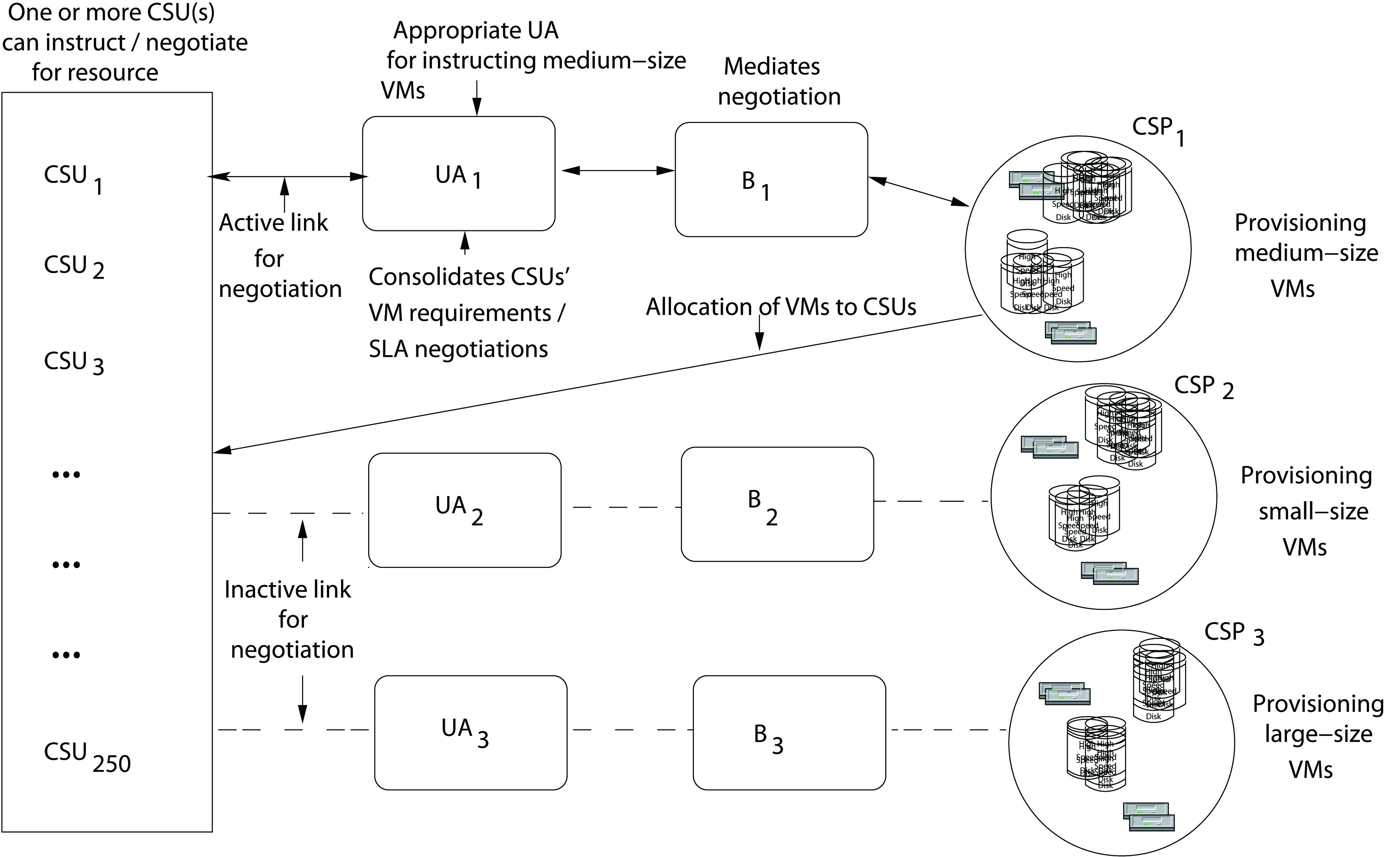
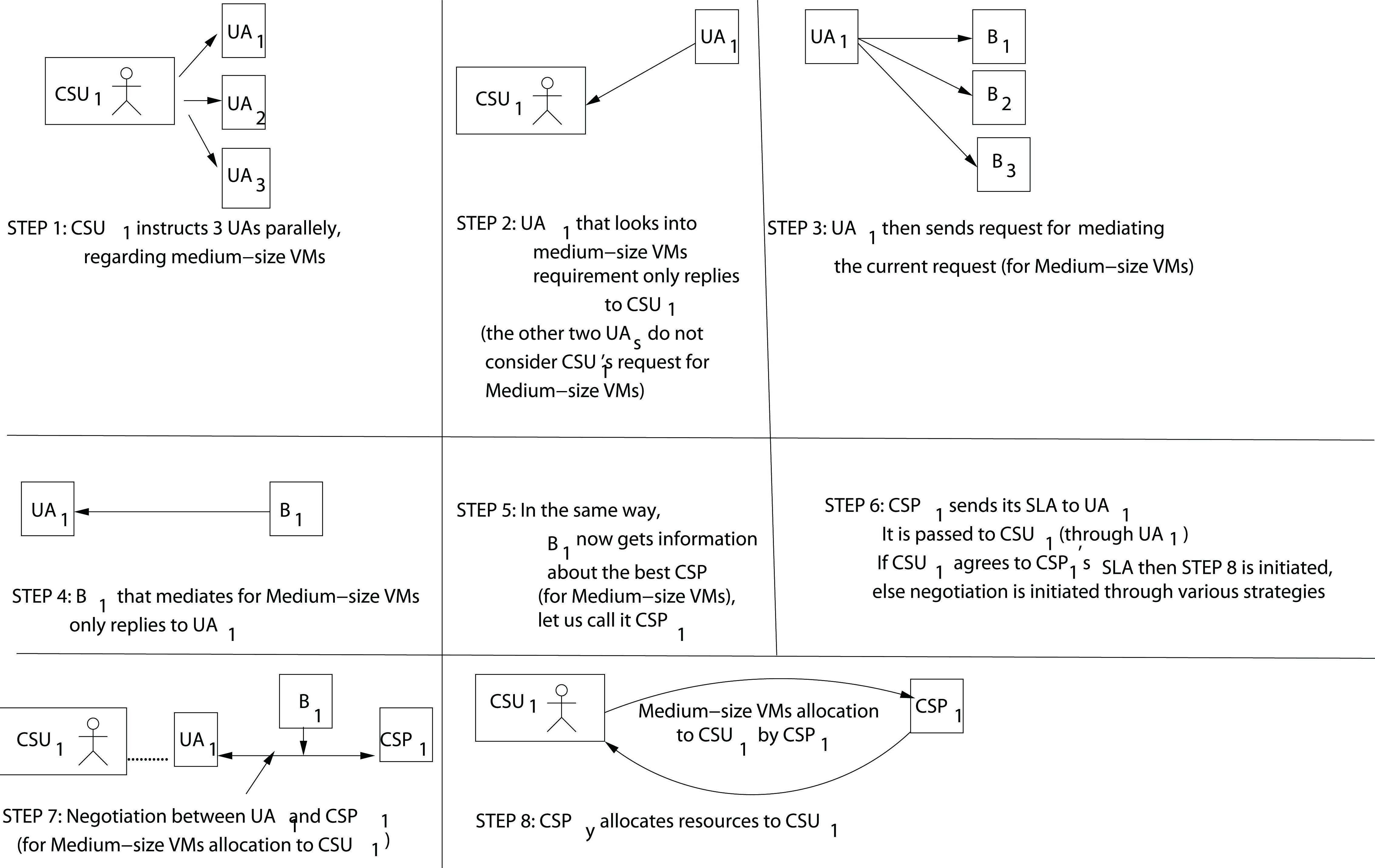
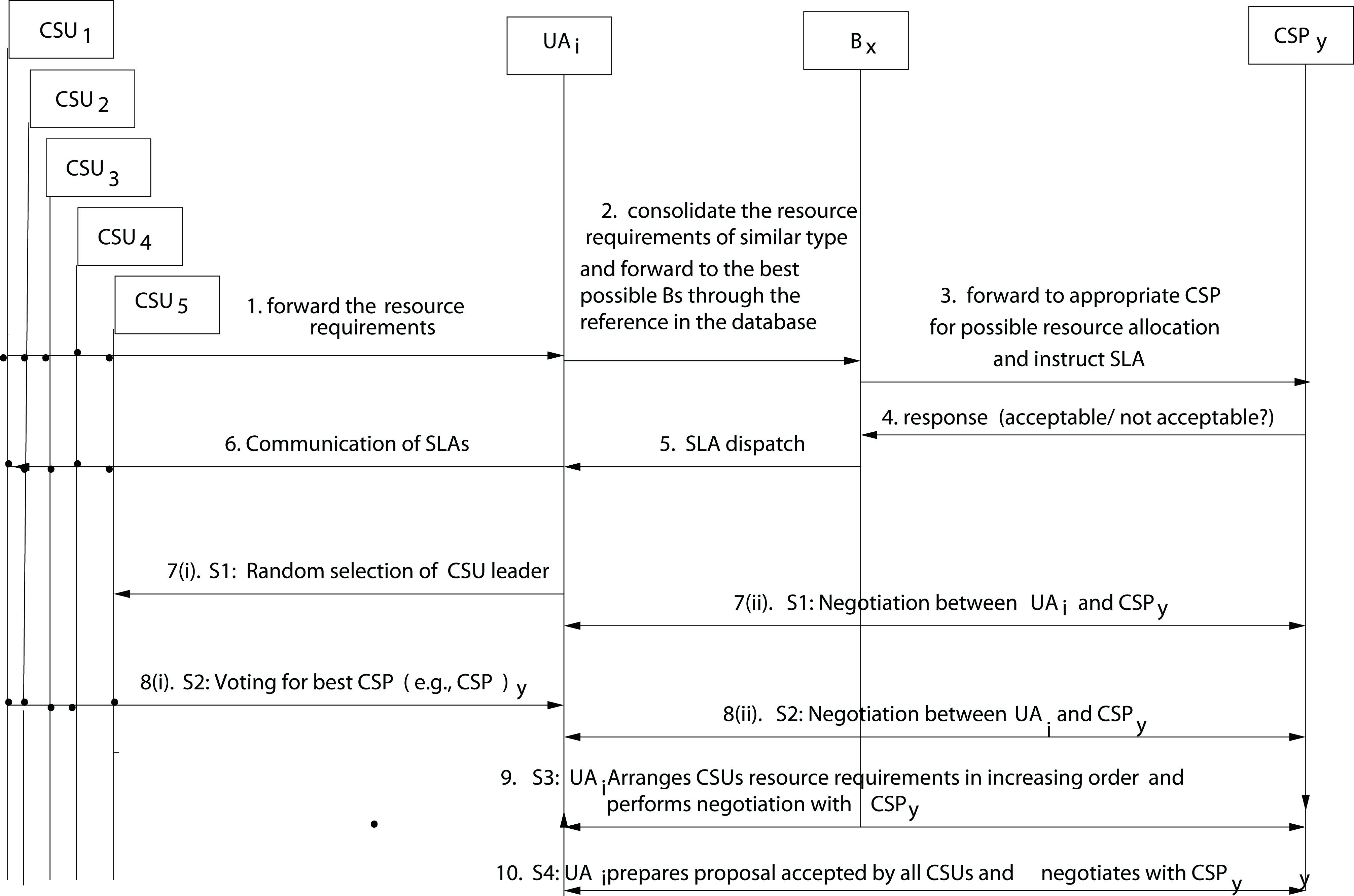
A new agent-based dynamic SLA negotiations framework for many-to-many concurrent multilateral negotiations in an open, dynamic, and parallel Cloud service environment, as shown in Fig. 1, is proposed. This framework allows the UAs, , and CSPs to develop an adaptive strategy towards concurrent negotiations in an environment with incomplete information in which a CSU knows its own negotiation parameters but has incomplete information about its opponent’s (i.e., CSP’s) parameters. The steps encountered from resource request made by a single CSU all the way to resource allocation made by a CSP are shown in Fig. 2. The sequence diagram of an UA strategy for negotiation is shown in Fig. 3.
The steps encountered in the process of resource request made by a single CSU all the way to resource allocation by a CSP.
Sequence diagram for the negotiations of SLAs. S1: RSL, S2: NPCA, S3: PRACP, and S4: ABAP are the negotiation strategies discussed in Section 3.2.
call _service_intialization() //Given in Algorithm 3
for (; 250; )
{
if (SLA between [ and ] is acceptable) assign (by ) to ;
else GOTO 8 // for all not accepting the SLA
}
Call (Mediation of SLA negotiation) //Given in Algorithm 3
return to the remaining
[t!] _service_intialization()
(i) resource request from , (ii) list of registered CSPs with providing the resources requested by
for each of the CSPs registered with
analyze the resource request from each with needs ()
search for the CSP that matches resource requirement
return and exit // this is the appropriate CSP to serve the required resources
if NULL // in case an appropriate CSP is not in the registered list
search the list of CSPs not registered with
(i.e., outside ’s database)
call for CSPs to register with //given in Algorithm 3
GOTO 1
An UA is an approaching point for multiple CSUs with similar resource requirement specifications for running the resource-intensive applications of those CSUs. There could be many UAs in the Cloud market catering to varied resource requirements of the CSUs. For example, one UA could assist the CSUs for medium-size VMs, while another UA could assist for large-size VMs.
In the IaaS scenario that is considered in this research, initially, one or more CSUs submit(s) queries for resource requirements to multiple UAs. Each UA in turn contacts multiple . Each analyzes the queries it received from an UA to assess the requirement of those queries. The searches its own database to suggest an appropriate CSP for the incoming request for VMs from the UA. The SLA information pertaining to the appropriate CSP is passed to the CSU (that submitted the query) through its UA. Now, if the CSU agrees to the SLA specified by the CSP, the resource requests and allocation procedure starts between that CSU and that CSP, respectively, i.e., on one-to-one basis.
[t!] Mediation of SLA negotiation
(from ) that requires SLA negotiation a negotiation strategy between a and a
mediate negotiation strategies of with (through feasible negotiation strategies discussed in Section 3.2)
[t!] CSPs’ registration with
registration request from to register the CSPslist of new CSPs successfully registered with
send the required VM specification details of each to all the CSPs
receive the specifications of VMs available at all the CSPs
create entry for all the CSPs in ’s database (indicating CSPs’ successful registration with ’s database)
If one or more CSUs have budget constraints and prefer to negotiate with a CSP (exactly one CSP which can match the resource requirements of the CSUs), those communicate(s) the same to their appropriate UAs. An appropriate UA for a CSU would be the one that represents that CSU in negotiating with a CSP optimally, considering the resource types, deadline and price parameters specified by the CSU. Depending on the negotiation profile (cooperative or non-cooperative) of similar requests in the past, (exactly one ) initiates multiple strategies to enable a cooperative or non-cooperative negotiation between that UA and a CSP (one-to-one) for the incoming requests (for VMs). If the incoming request from an UA has not been encountered by a during the previous requests, the queries the details (e.g., the VM type, its usage, number of users, etc.) from that CSU (through its UA).
After processing the query, the adds the current request details to its database(s) for future reference. The proposed work considers a concurrent many-to-many negotiation mechanism in which a UA (one UA for multiple CSUs) and a CSP negotiate (i.e., one-to-one negotiation between UA and CSP), and this negotiation is mediated by a single . The service request(s) along with the mediation procedures and service response(s) by are given in Algorithms 1–4. Algorithm 3 accepts the requirements from the CSUs then pass on those requirements to the CSP. The SLA negotiation for the requested service is monitored. If the SLA is acceptable in the original form then the resources are exchanged between the CSU and the CSP, else a mediation of SLA negotiation is performed through Algorithm 3. Algorithms 3 and 4 aid in exploring new CSPs registering with and fulfilling the requirements of the CSUs.
The Iterated Contract Net Protocol (ICNP) [6], which is a commonly used negotiation protocol, is used in this study. Recursive negotiation is supported by ICNP, as is multi-round iterative negotiation, to reach a common agreement. Further, by exchanging the modified proposals and counter-proposals, a more acceptable negotiation result is likely to be reached. Next, the proposed SLA negotiation strategies among the UAs and CSPs through are discussed.
Negotiations strategies
In this section, the assumptions and the negotiation strategies employed for the proposed model are presented.
There are many CSUs and many UAs in the Cloud market. Different UAs assist the CSUs in getting the required resources needed to run the applications of the CSUs. For example, one UA could cater to assisting the CSUs for medium-size VMs, while another UA could assist in getting large-size VMs. There are several for mediation during negotiation, and several CSPs for resource provisioning and allocation. CSP agents are not considered in this work because, currently, in the market, the number of CSPs is small when compared to the number of UAs and .
In this research, there is exactly one UA for all the CSUs that require medium-size VMs. That UA is represented by . In this research, the range of CSUs associated with the is in between 1 and 250. The aims to negotiate a successful deal for its CSUs (belonging to the ) and , where is one of the available CSPs. In this research, the total number of available CSPs is in between 1 and 5. The negotiation between and is mediated by , where is one of the available . In this research, the total number of available is in between 1 and 5.
In the mathematical modeling of the negotiation strategies of this work, a single () and a single CSP () are considered. However, the same modeling is applicable to a scenario that contains multiple UAs, CSPs, and . Each entity, i.e., and , that is involved in the negotiation process aims to maximize its own utility. For example, an utility of 0.60 for indicates that out of 100 negotiations between and , 60 negotiations are as per the satisfaction of (and hence for the satisfaction of its corresponding CSUs). The has a reservation utility . Any proposal from whose utility is lower than will be rejected by . A time-based concession tactic [9, 19] to model the tactic of the opponent (i.e., ), as expressed in Eq. (1), is used in this work.
In Eq. (1), is the current negotiation round number, is the ’s concession strategy, is the deadline set by to complete the negotiation, and is a parameter that governs the concession speed of the negotiation. The concession speed of during the negotiation process determines the final outcome of the agreement for the CSUs of a . For instance, if the concedes very quickly towards its reservation utility, better agreements for the CSUs may come earlier in the negotiation process.
The uses an offer acceptance criterion during the negotiation process. Inspired by the research in [9, 19], the criterion is formalized as shown in Eq. (2).
where is the proposal received by from the , is the utility function of the , is the ’s concession strategy, and is the current round number of the negotiation process.
The proposes , whose utility is given by . Inspired by [20], it is assumed that the attempts to propose the offer that is more similar to the last offer received from , and whose utility is mathematically represented as .
UA strategies for negotiation
A strategy between and defines what, how, and when the decisions have to be taken by both these entities while negotiating for resources. The following four negotiation strategies are proposed in this research: (i) RSL, (ii) NPCA, (iii) PRACP, and (iv) ABAP. In these four strategies that are discussed in the following subsections, represents the ‘’ broker. The framework w.r.t. a single is discussed. However, the same is applicable to a scenario with multiple .
Random selection of leader (RSL)
RSL is a simple strategy employed by , in which initiates the negotiation on behalf of its CSUs that need resources for running the resource intensive applications. One of the CSU members from , , is randomly selected as the leader by . The leader negotiates with , according to the leader’s () own utility function , on behalf of all the CSUs looking for similar resource(s) over the Cloud. The criteria for selecting the leader (among several CSUs of the ) is decided by through one of the following two methods:
Request-based hierarchy: The CSU for which the amount of each of the needed resources is the highest will be the leader. If a CSU needs more resources of type and another needs more resources of type , the cumulative sum of different resources that are required is prioritized for the selection of the leader. In case of a tie, the history of the CSUs’ transactions is considered, and the CSU that requested more resources in the past will be the leader.
Capacity-based hierarchy: The CSU for which the resource usage duration is the highest will be the leader. In case of a tie, the history of the CSUs’ transactions is considered, and the CSU that utilized more resources efficiently in the past will be the leader.
Being a time-bounded negotiation, the leader employs a time-based concession tactic, , to negotiate with the , as provided in Eq. (3).
Any proposal proposed by to at round will obey the condition given in Eq. (4).
With the ’s strategy, the leader selects, in current negotiation round number , the offer that is more similar to the previous offer (during previous negotiation in round number ), given in Eq. (5). Here, denotes the utility associated with the selection of proposal .
The leader accepts the ’s offer, , at round , provided the utility is greater than or equal to .
Type of negotiation: Since mediates the negotiations according to utility function, cannot guarantee any kind of unanimity regarding the leader’s decision (i.e., acceptance of leader’s decision by other CSU members of the ). Hence, it is considered as a non-cooperative negotiation between and . It appears as if this strategy is not worth being used because no unanimity can be assured. However, when all CSU members of the tend to be very similar in their resource requirements, this strategy yields fruitful results.
Negotiation through participation of CSU agents (NPCA)
Whenever a new proposal from one or more have to be proposed to the at round , opens a call for resource proposals (containing the description of the required VMs with the specifications of the CPU, RAM, and storage requirements) among the members that are looking for resources. Each such of the anonymously sends a proposal to . Once every proposal has been gathered, opens a voting process where the proposals are made public among the members of that participate in the voting. Then, each of the communicates a multi-vote, , to the .
When all the votes are assembled, summarizes the quantity of positive votes, and the most upheld proposition is chosen according to Eq. (6). It is then made public among the , and the winning offer is communicated to .
Since the negotiation is time-bound, members follow a time-based concession strategy with the , where the concession speed is common and agreed by the members at the beginning of the negotiation process given in Eq. (7).
In case of multiple offers with such utility, the needs to pick at random one of those offers received from s. Let denotes an offer. If the needs its offer to be accepted by , it ought to boost its likelihood being the most accepted by other CSU s as given in Eq. (8).
In Eq. (8), is the probability for to be accepted by the , and is the probability for to be selected by the . The offer selection and rejection mechanism can be specified as in Eq. (3.2.2).
The way in which CSUs decide the acceptability of the ’s offer follows the rational mechanism that is employed so far in this work. The offer is considered acceptable if it yields a utility which is greater than or equal to the utility demanded by the concession strategy in the next negotiation round . Otherwise, the offer is not considered acceptable. Equation (10) formalizes the acceptance criterion used by in determining the offer made by .
Type of negotiation: This strategy is supported by a plurality and majority of the CSUs, regarding decisions to select the best proposal. Plurality is guaranteed when the offer is proposed (by ) to the by selecting that offer from multiple CSUs by using a voting mechanism as explained, and majority is assured when choosing the offers from multiple CSPs, resulting in cooperative negotiation scenario.
Proposal ranking according to CSU proposals (PRACP)
The essential feature of PRACP is similar to NPCA, however the voting rules employed in PRACP are unique. In particular, when each CSU votes on the proposition made by the , borda count [10] is utilized to decide the winner, and an unanimity rule is used to decide the acceptance of the proposal from .
As in NPCA, the opens a call for proposals. Once all the proposals are gathered (from various CSUs), makes public those proposals to the and a voting process starts. Each CSU member (i.e., each ) from ranks the proposal (i.e., proposal of received from its CSUs) in ascending order as per its own utility function . The ’s offer is accepted if it is acceptable to all the CSUs. The offer acceptance mechanism is formalized in Eq. (11). It gives the number of proposals sent by , and accepted by , and this number is same as the number of proposals supported (offered positive votes) by its CSUs.
Type of negotiation: The ’s offer is accepted by the if it is acceptable by every member (every CSU) due to the unanimity rule employed. Hence, PRACP yields a cooperative negotiation between the CSU members of and .
Agreeable by all proposals (ABAP)
The last strategy, ABAP, seeks to reach unanimity regarding the decisions made by and . In order to determine which offer is sent to , the governs an iterated building process. The aim of this iterated process is to build an offer, attribute per attribute, so that the offer sent from to the is acceptable to every . Briefly, the iterated building process is as follows.
The iterated process is initiated by . Every CSU of that is considered a member () in the building process. In the beginning, the partial proposal from to , i.e., , has attributes (resource types, price, deadline, etc.) whose values are not set. The analyzes the attributes (resource types, price, deadline, etc.) that are Not Prioritized (NP) for every , i.e., . These NP attributes are maximized according to the ’s preferences, so as to acquire its minimum value for the interested attributes. The new attributes’ values are updated for the partial proposal.
The next attribute , which is not already selected, is selected (). The s interested in are instructed by the to submit the value which represents the offer associated with attribute to get the offer as close as possible to the aspiration levels of those s. The values for each attribute , are aggregated. In order to aggregate and obtain the final value for the attribute , operator is used for monotonically increasing function and operator is used for monotonically decreasing function.
When each has been satisfied by the partial offer , and if there are still some attributes that have not been set, those attributes are maximized according to the ’s preferences. Then, a final proposal is obtained, made public among the CSUs, and sent to the . The concession strategy , which determines the level of demand at each negotiation round, is formalized in Eq. (12), which is inspired by [9].
When the CSUs are instructed about a value for , each CSU communicates anonymously that value, i.e., . Taking the linear additive utility function formula, this is calculated as shown in Eq. (13).
In Eq. (13), is the utility demanded by the at negotiation round number , and is the utility reported by the current partial proposal, and is the weighted utility reported by the value demanded by the .
Type of negotiation: ABAP strategy is capable of guaranteeing unanimity regarding the decisions of and the CSU members of . The guarantee of unanimity in the offer acceptance phase is obvious, because a voting mechanism based on the unanimity rule is used, resulting in cooperative negotiations.
Performance parameters
The performance parameters considered in the simulation discussed in the next section are: (i) Utility: Each player involved in the negotiation is characterised by a pre-defined utility function with respect to the negotiated variables. In other words, utility indicates the profit CSUs and CSPs have obtained after the negotiation game, employing several strategies, (ii) Negotiation time: It is the time taken to converge the negotiation process to an equilibrium, and (iii) Request satisfaction: It is the ratio of total number of jobs executed successfully by CSP to the total number of jobs submitted by the CSUs in any given time interval.
Results and discussion
This section describes the simulation procedure and the results.
Simulation
The proposed work is simulated on a Pentium IV machine using Genius simulator [26]. Based on the workload (i.e., dataset of negotiation scenarios), the utility, negotiation time, and the request satisfaction of the CSUs and CSPs are analyzed. The values of simulation parameters are presented in Table 3. To consider the real-world negotiation data for the initial training of datasets, the scenarios discussed in ACN [15] and SRCNS [7] are considered in this work.
Simulation parameters
Symbol
Values
ranges from 1–250
ranges from 1–5 nodes
ranges from 1–5 nodes
ranges from 1–5 nodes
Medium-size VMs per
100–500 nodes
Processor’s speed
2–4 Mghz
Processor’s memory
4–8 GB
Jobs
100 applications that require medium-size VMs
Jobs arrival rate
5–100 jobs/ms.
Job_deadline
60–600 sec./job
Buffered resource to serve dynamic requests
100–200 VMs
Simulation procedure
The simulation procedure contains the following steps:
Deploy CSUs, , , and for the scenario considered in the Cloud environment.
CSUs submit resource requirements to .
approaches .
searches for and then recommends it to for job execution.
and negotiate in cooperative or non-cooperative manner, mediated by .
schedules jobs, executes and returns back the results.
Performance parameters are computed.
To assess the performance parameters with regard to utility, negotiation time, and request satisfaction, recommends negotiation strategies among the members of and from a sample of workloads. Each CSU in negotiates with in the range of 2 to 6 steps (on average).
The results obtained for the average utility, by using different negotiation strategies between and , are presented in Table 4.
Negotiation time vs. negotiation strategies for various instances of VMs.
Critical analysis
It is to be noted that the approach discussed in [15] is CSP centric for Cloud environment and it results in non-cooperative negotiation scenario for the CSUs. The authors in [7] have discussed a cooperative negotiation scenario for Cloud environment, with the limitation being the negotiation time and successful offers that affect the scalability of the resources in Cloud. Approaches such as ACN [15] and SRCNS [7] allow more negotiation time between the buyers and the sellers as those negotiations are either non-automated or semi-automated. With increased demand and supply for/of resources, automated negotiation reduces the negotiation time and saves from embarrassment as in the case of manual or physical negotiations.
If the performance results of the proposed negotiation strategies namely RSL, NPCA, PRACP, and ABAP are compared, they show that the CSUs using ABAP gather higher utility on average than the rest of the strategies, as shown in Table 4. RSL’s performance, in terms of utility, is less than that of [7]. This shows that a non-cooperative strategy’s utility is lower than that of a cooperative strategy even if that non-cooperative strategy is automated.
As shown in Fig. 4, RSL takes more negotiation time than ACN and SRCNS for all the VM instances considered. This shows that the negotiation time for non-cooperative automated strategy (i.e., RSL) is worse than that of a non-cooperative non-automated (or semi-automated) strategy (i.e., ACN) also. Therefore, non-cooperative automated strategy is worse than all other strategies in terms of negotiation time needed (i.e., it takes the highest amount of negotiation time). ABAP takes less negotiation time than all other negotiation strategies except SRCNS, specifically when the number of VMs is in higher ranges. As shown in Table 5, cooperative negotiation strategies lead CSUs and CSPy to win-win situations, with ABAP contributing to 78% successful negotiations.
The fact that ABAP approach is the best may be explained due to the fact that it ensures all the negotiating entities are satisfied with those offers received and sent during the negotiation rounds. As expected, all these strategies, especially the cooperative ones, get higher average utility while negotiating with an opponent, involving and . This result supports the observation that a successful negotiating agent, considering a single negotiation with the opponent (short-term relationship), should support cooperative strategies for longer term of services (long-term relationship).
The negotiation frameworks used by the models such as [25, 24, 17] are rather inadequate, as they rely on a very simplistic acceptance semantics. A negotiating framework such as [14, 5] circumvents some of these limitations. A protocol for dealing with negotiations has been developed in that research. However, in that framework, it is unclear what the status of the negotiations’ outcome is and how an agent picks an offer to make at a given point during the negotiations. The work that is presented in this research attempts to improve the quality of the negotiated outcome, and demonstrates that cooperative negotiations may always enhance the quality of a negotiation.
Conclusion
This work simulated the Broker mediated SLA negotiation strategy using agents to have multiple options for selecting a CSP among several CSPs available. This negotiation system is observed to be dynamic. That is, depending on the request from the CSUs, a suitable strategy (among different negotiation strategies proposed) is applied to reduce the negotiation time. This work can be further extended to make a faster, secure, and flexible e-negotiation strategy. As part of future work, more complex market settings involving multiple issues in negotiations will be considered. Also, federated Clouds for designing negotiation strategies that analyze the behavior of the opponents and act accordingly will be analyzed.
Footnotes
Authors’ Bios
Priyanka Bharti received Master’s Degree in Software Engineering from Visvesvaraya Technological University, Belagavi, India. Her research interests include Cloud Computing, Grid Computing, and Data Mining. She has published 10 papers in International conferences and 5 papers in International journals.
Rajeev Ranjan received PhD degree from Indian Institute of Information Technology, Allahabad, India. He is involved in research of Wireless Sensor Networking, Vehicular Ad-hoc networks, E-commerce and Mobile computing. He has published about 30 papers in National and International conferences and 20 papers in National and International journals. He is a professional member of Computer Society of India (CSI), ISTE and a member of ACM.
Bhanu Prasad received Master of Technology and Ph.D. degrees, both in computer science, from Andhra University and Indian Institute of Technology Madras, respectively. He is currently serving as a Professor in the Department of Computer and Information Sciences at Florida A&M University in Tallahassee, Florida, USA. His research interests include Artificial Intelligence, Knowledge-based Systems, and Software Engineering.
References
1.
BadshahA.GhaniA.ShamshirbandS.AcetoG. and PescapéA., Performance-based service-level agreement in cloud computing to optimise penalties and revenue, IET Communications14 (2020), 1102–1112.
2.
ShojaiemehrB.RahmaniA.M. and QaderN.N., Cloud computing service negotiation: A systematic review, Computer Standards & Interfaces55 (2018), 196–206.
3.
ShojaiemehrB.RahmaniA.M. and QadarN.N., Automated negotiation for ensuring composite service requirements in Cloud computing, Journal of Systems Architecture99 (2019), 201–211.
4.
LiangC.LiangW. and TsengT., Evaluation of intelligent agents in consumer-to-business e-commerce, Computer Standards & Interfaces65 (2019), 122–131.
5.
PascualF.RzadcaK. and TrystramD., Cooperation in multiorganization scheduling, Concurrency and Computation: Practice and Experience21 (2007), 905–921.
6.
Foundation for intelligent physical agents, Available online at http://www.fipa.org/, Accessed on January 10, 2021.
7.
ShyamG.K.ManviS. and PrasadB., Concurrent and cooperative negotiation of resources in cloud computing: A game theory based approach, Journal of Multiagent and Grid Systems, 14 (2018), 177–202.
8.
RocheteauaG.HuT.W.LebeauaL. and InY., Gradual bargaining in decentralized asset markets, Review of Economic Dynamics, Elsevier, (2020), doi: 10.1016/j.red.2020.10.008.
9.
LaiG.SycaraK. and LiC., A decentralized model for multi-attribute negotiations with incomplete information and general utility functions, Rational, Robust, and Secure Negotiations in Multi-Agent Systems. Studies in Computational Intelligence89 (2008), doi: 10.1007/978-3-540-76282-9_3.
10.
NurmiH., Voting systems for social choice, in: Handbook of Group Decision and Negotiation. Advances in Group Decision and Negotiation, Springer, DordrechtKilgourD.EdenC., eds, doi: 10.1007/978-90-481-9097-3_114 (2010), 167–182.
11.
WeerdH.D.VerbruggeR. and VerheijB., Negotiating with other minds: The role of recursive theory of mind in negotiation with incomplete information, Autonoumous Agent Multi-Agent Systems31 (2017), 250–287.
12.
HuJ.XuR. and XiaoD., Dynamic negotiation strategy based parallel-offer in cloud computing, Journal of Computational Information Systems11 (2015), 3691–3699.
13.
SimK.M., G-commerce, market-driven G-negotiation agents and grid resource management, IEEE Transactions on Systems, Man and Cybernetics36 (2006), 1381–1394.
KolomvatsosK.PanagidiK.NeokosmidisI.VaroutasD. and HadjiefthymiadesS., Automated concurrent negotiations: An artificial bee colony approach, Electronic Commerce Research and Applications19 (2016), 56–69.
16.
LiL.YeoC.S.HsuC.YuL. and LaiK.R., Agent-based fuzzy constraint-directed negotiation for service level agreements in Cloud computing, Journal of Cluster Computing21 (2018), 1349–1363.
17.
LiL.LaiK.R. and ZhuS., Data-driven behavior-based negotiation model for cyber physical social systems, IEEE Access on Visual Analysis for CPS Data7 (2019), 83319–83331.
18.
MareyO.BentaharJ.DssouliR. and MbarkiM., Measuring and analyzing agents uncertainty in argumentation-based negotiation dialogue games, Expert Systems with Applications41 (2014), 306–320.
19.
FaratinP.SierraC. and JenningsN.R., Negotiation decision functions for autonomous agents, Robotics and Autonomous Systems24 (1998), 159–182.
20.
FaratinP.SierraC. and JenningsN.R., Using similarity criteria to make issue trade-offs in automated negotiations, Artificial Intelligence142 (2002), 205–237.
21.
JankoaS. and JohnsonbN.G., Reputation-based competitive pricing negotiation and power trading for grid-connected microgrid networks, Applied Energy277 (2020), doi: 10.1016/j.apenergy.2020.115598.
22.
ShivaniSinghA.SinghrovaA. and KumarJ., A makespan based framework for detection of SLA violations in Cloud computing environment, in: Soft Computing: Theories and Applications. Advances in Intelligent Systems and ComputingPantM.SharmaT.VermaO.SinglaR.SikanderA., eds, Springer, Singapore 1053 (2020), 503–512. doi: 10.1007/978-981-15-0751-9_47.
23.
LabidiT.MtibaaA.GaaloulW. and GargouriF., Cloud SLA negotiation and re-negotiation: An ontology-based context-aware approach, Journal of Concurrency and Computation: Practice and Experience32 (2020), 53–61. doi: 10.1002/cpe.5315.
24.
BaarslagT.AlanA.T.GomerR.AlamM.PereraC.GerdingE.H. and SchraefelM.C., An automated negotiation agent for permission management, in: Proceedings of International Conference on Autonomous Agents and Multiagent Systems, Sao Paulo, Brazil, 2017, pp. 380–390.
25.
ShangY., Consensus of hybrid multi-agent systems with malicious nodes, IEEE Transactions on Circuits and Systems67 (2020), 685–689.
26.
Genius simulator: http://ii.tudelft.nl/genius, Accessed on January 10, 2021.