



Abstract
Compression and encryption of images are emerging as recent topics in the area of research to improve the performance of data security. A joint lossless image compression and encryption algorithm based on Integer Wavelet Transform (IWT) and the Hybrid Hyperchaotic system is proposed to enhance the security of data transmission. Initially, IWT is used to compress the digital images and then the encryption is accomplished using the Hybrid Hyperchaotic system. A Hybrid Hyperchaotic system; Fractional Order Hyperchaotic Cellular Neural Network (FOHCNN) and Fractional Order Four-Dimensional Modified Chua’s Circuit (FOFDMCC) is used to generate the pseudorandom sequences. The pixel substitution and scrambling are realized simultaneously using Global Bit Scrambling (GBS) that improves the cipher unpredictability and efficiency. In this study, Deoxyribonucleic Acid (DNA) sequence is adopted instead of a binary operation, which provides high resistance to the cipher image against crop attack and salt-and-pepper noise. It was observed from the simulation outcome that the proposed Hybrid Hyperchaotic system with IWT demonstrated more effective performance in image compression and encryption compared with the existing models in terms of parameters such as unified averaged changed intensity, a number of changing pixels rate, and correlation coefficient.
Keywords
Introduction
Due to the fast-paced development of communication networks and digital technologies, several multimedia data are developed and transmitted over the networks [1]. Protecting information from unauthorized access is a primary objective that leads to the development of several data encryption algorithms. Usually, the encryption algorithms are categorized into two types that are named as: transform domain encryption algorithms and spatial domain encryption algorithms [2, 3]. Due to the intrinsic properties of digital images, such as high information redundancy, high data capacity, and strong inter-pixel correlation, conventional encryption algorithms have proven to be ineffective in image encryption [4, 5]. Further, multimedia-based applications such as commercial, military, medical, and political fields require large bandwidth for data communication [6]. Hence, the combination of compression and encryption is useful for real-time applications, in which the compression saves the bandwidth and the encryption protects the privacy of the data [7, 8]. However, the combination of compression and encryption of the image makes the operation difficult for implementation. Several types of research were undertaken on the joint operation of image compression and encryption to achieve a more secure data transmission such as sine chaotification [9], 2D logistic adjusted sine map [10], Convolutional Neural Network (CNN) [11], cross-coupled chaotic maps [12], 5D chaotic map [13], phase-truncated short-time fractional Fourier transform [14], Knuth-Durstenfeld algorithm [15], etc. In the aforementioned algorithms, complexity and time consumption of the compression and encryption of the images are higher. So, the motivation of this research is to develop a hybrid algorithm for ensuring high security, fast speed, and a promising compression ratio for protecting the content of the image and to diminish the amount of data required for transmission. the major contributions of the research work are listed below;
Initially, the IWT is applied to digital images such as cameraman, Lena, circuit, Barbara, peppers, aerial, etc. for data compression. The coefficients of IWT are similar to the input images, hence it is very easy to compress the digital images that significantly diminishes the complexity of the system. In addition, the Deoxyribonucleic Acid (DNA) and Hyperchaotic sequences are utilized to encrypt the images and a Hybrid Hyperchaotic system (FOHCNN and FOFDMCC) is used to generate the pseudorandom sequences. The image pixel intensity values are transformed into serial binary digital streams and then the bit-streams are scramble by Hyperchaotic sequence. The complementation and DNA algebraic sequence are applied between the DNA and Hyperchaotic sequence to achieve a significant encryption performance. In the experimental segment, a few performance measures such as the number of Changing Pixel Rate (NPCR), Unified Averaged Changed Intensity (UACI), and correlation coefficient are used to analyze the performance of the proposed image compression and encryption model.
Abbreviations used in the paper are as follows.
The structure of this paper is given as follows; Section 2 reviews some recent research papers on “image compression and encryption”. Section 3 details the proposed model with mathematical expressions and the simulation result of the proposed model are stated in Section 4. Section 5 details the conclusion of the research work.
Zhang and Tong [16] developed new lossless image encryption and compression method based on Secure Set Partitioning in Hierarchical Trees (SSPIHT) and IWT. The developed SSPIHT encryption algorithm does not affect the compression performance. Furthermore, a non-linear inverse operation, hyperchaotic system, plaintext-based keystream, and secure hash algorithm 256 were utilized in this research to enhance the security. Simulation outcome proves that the developed method has good lossless compression and higher security performance. If the external key size was high, then the developed lossless image encryption and compression methodology has the problem of underflow/overflow. Zhou et al. [17] presented a new image compression and encryption algorithm based on nonlinear fractional Mellin transformation. The original image was measured in two directions using measurement matrices to accomplish both compression and encryption, and the measurement matrices were controlled by Chaos map. Then, the resultant image was re-encrypted by applying nonlinear fractional Mellin transformation. Finally, the newton smoothed
Chen et al. [18] used a diffusion mask and a permutation vector for image encryption and a 3D cat map was introduced to generate the measurement matrix of compression sensing. Furthermore, security, histogram, image reconstruction, information entropy, and keyspace performances were comprehensively analyzed in this literature study. The developed model achieved satisfactory performance in the encryption and compression of public networks. Hence, the input of diffusion was uncontrollable or unknown, due to the encryption effect in the permutation and the unpredictability of compression sensing outputs. Zhu et al. [19] has developed a hybrid algorithm for image compression and encryption. Initially, a random scrambling matrix and gauss random matrix were generated utilizing logistic mapping and Chebyshev mapping. A compression approach was developed for cipher-text images based on random scrambling matrix and gauss random matrix. The developed compression approach consists of three phases; the First phase: a random scrambling matrix that was used for permutation-based encryption, the second phase: a gauss random matrix that was used for encoding, and the third phase: joint decoding and decryption. The simulation outcome proves that the developed hybrid algorithm attained better image encryption performance in terms of peak signal-to-noise ratio value under conditions such as plaintext attack and noise. The developed hybrid algorithm includes two major problems which were: high computational complexity, and blocking artifacts.
Brindha and Gounden, [20] developed a new image encryption algorithm based on compression and Chaos based on the Chinese remainder theorem and hash table structure to compress and encrypt the images. At first, the Henon map and Arnold cat map were used for generating the scramble blocks in the input image. Furthermore, the scrambled image was permuted using a hash table structure to decrease the complexity of Chaos systems. Hence, the permuted image was divided into blocks and then diffusion and compression were performed using the Lorenz equation and the Chinese remainder theorem, respectively. In this literature, keyspace of the developed algorithm was small, which was considered a major concern. Mou et al. [21] developed a modular operation algorithm, Arnold matrix transformation algorithm, and 3D hyperchaotic map for compressing and encrypting the images to improve the security of data transmission and diminish the amount of data required for storage and transmission. It was observed in the Safety performance analysis that the developed algorithm attained better performance against statistical, brute force, and other such attacks. The Arnold matrix transformation algorithm was applied only to the square area of the image, where it may degrade the performance of encryption.
Liu et al. [22] developed a new Chaos-based image compression and encryption approach for multi-modal images. At first, the sparse images were identified using a key-controlled pseudorandom measurement matrix, which was constructed by a logistic map that decreases the amount of data to be processed. Then, an adaptive weighted fusion rule was utilized for fusing the obtained measurements that were further encrypted into cipher text using fractional Fourier transform and the improved random pixel changing approach. By using a recovery algorithm, the fused images were decrypted, in which the reconstructed image reveals major information about the source images. It was observed from the experimental outcome that the reliability and validity of the developed approach was degraded. Zhan et al. [23] implemented a new simple encryption algorithm based on the Hyperchaotic and Deoxyribonucleic Acid (HC-DNA) sequence. In this literature, the 4D hyperchaotic sequence was used to generate the pseudorandom sequence. The DNA addition operation was used instead of the binary operation to increase the effectiveness of the 4D hyperchaotic sequence and cipher unpredictability. It was observed in the experimental evaluation that the developed algorithm (HC-DNA) was robust against differential attacks and resisted the linear attacks, cropping attacks, and noise effectively. Some of the issues faced by the researchers in these studies were; small keyspace and security vulnerability.
Wang and Liu [24] developed a novel image encryption approach based on DNA encoding rules and Chaos encryption. The Logistic map and Piecewise Linear Chaotic Map (PWLCM) were utilized to generate the parameters for the DNA encoding rule. The developed algorithm consists of three phases; (i) PWLCM was used to develop a key image, whose image pixels was generated by Chaos encryption, (ii) To encode the key and plain image using DNA rules, where the rules were decided by logistic map, and (iii) To finally decode the intermediate image as the plain image. Hence, it was observed from the experimental results that the developed encryption approach withstands typical attacks, but showed limited performance towards security. Zhu et al. [25] presented a parallel encryption algorithm based on Crisscross Pattern and improved hyperchaotic sequence. At first, the hyperchaotic sequences were modified for generating the chaotic key streams. Then, the plaintext and chaotic key streams were correlated with the results in plaintext and key sensitivity. The plain image was categorized into two sub-images, which were encrypted in a parallel manner. It was observed in the security analysis and performance test that the developed encryption algorithm has a better ability to resist key sensitivity tests and differential attacks. Furthermore, Zhu and Sun [26] presented an effective encryption algorithm based on hyper-chaos, which includes two rounds of the encryption operation. It was observed from the simulation outcome that the developed algorithm obtained better cryptographic performance against differential attacks, but the encryption speed need to be improved. The developed hyper-chaos algorithm does not make use of the perceptual relevance and obtained poor performance while compressing and encrypting the digital images with homogeneous background. To highlight the above-stated issues, a new compression and encryption algorithm is proposed in this research paper.
Hybrid image compression and encryption model
The network has become a common technology that is used to acquire and transmit information resources, due to the increased development of multimedia data. Recently, information security has become an important factor since it plays a vital role in the applications such as commercial, military, medical, and political fields as these domains require high confidentiality for their data [27, 28]. The image encryption has a unique practical application value compared with conventional information carries, in which the digital image has the following properties; (1) redundancy of big data, (2) capacity of big data, and (3) correlation between neighborhood pixels [29, 30]. The conventional encryption algorithms do not possess these inherent properties, therefore, an effective hyperchaotic system is proposed in this research along with IWT to achieve better performance in image compression and encryption. The workflow of the proposed model majorly includes three phases such as data collection: multimedia images and medical images from MedPix
Whorkflow of the proposed model.
In this research, digital images such as cameraman, Lena, circuit, Barbara, peppers, aerial, etc. are used for experimental analysis. The spatial frequency characteristics and multi-resolution analysis are the advantages of discrete wavelet transform (DWT) that decomposes the input image into higher and lower frequency components. The higher frequency components provide detailed information about the image and the lower frequency components comprises the signal energy of the image. The digital image is decomposed into 4 frequency sub-bands are Low Low (LL), Low High (LH), High Low (HL), and High High (HH) by applying DWT. During image reconstruction, the wavelet transform known as DWT returns floating-point variables, during which the truncation of the floating-point variables leads to errors while extracting the secret information. The IWT approach maps integer to integer for perfect re-construction and decomposition of wavelet transform without getting affected by the truncation errors. In this research study, the input image is initially decomposed by IWT to ensure the secret bits precisely. Among the available 4 frequency sub-bands, LL is considered in IWT which looks similar to the input image. Mathematically, the IWT coefficients are denoted in Eqs (1)–(4).
Mathematically, the inverse IWT coefficients are denoted in Eqs (5)–(8).
where an input image is denoted as,
Hyper-Chaos is an extension of the Chaos algorithm, which includes more positive Lyapunov exponents. The hyperchaotic system demonstrates dynamic behaviors that are less complex compared with a chaotic system. Furthermore, the uncertainty and randomness are significantly improved in the hyperchaotic system compared with a chaotic system. Due to less state variables, the hyperchaotic system is linear and has a smaller key space, therefore it is easily predictable with limited system complex. The combined FOHCNN and FOFDMCC methods are used as a hyperchaotic system, where the FOHCNN method is mathematically represented in Eqs (3.2) and (10).
where
where
where
where
where
Based on master and slave systems, the synchronization error system
The DNA sequence comprises 4 nucleic acid bases as “T” (thymine), “A” (adenine), “G” (guanine), and “C” (cytosine). The “G” and “C” are complementary to one another same as “T” and “A” because the binary digits “1” and “0” are complementary to each other. Here, two binary digits represents a DNA base, where twenty-four rules are generated for data representation, in that only 8 rules satisfy the Watson crick complement rule. These 8 coding rules are stated in Table 1.
Rules of DNA coding
Rules of DNA coding
Hybrid hyperchaotic system behavior, a) 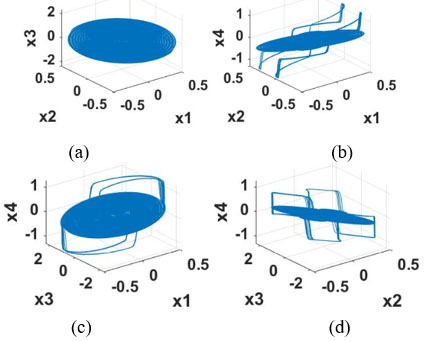
In DNA computation, the DNA subtraction and addition are carried out based on traditional binary subtraction and addition. The DNA subtraction and addition rules are described in Tables 2 and 3.
DNA subtraction sequence rules
DNA subtraction sequence rules
DNA addition sequence rules
Hyperchaotic sequence generation
The hyperchaotic sequence has better statistical characteristics to generate the pseudorandom sequences. The process involved in the generation of a pseudorandom sequence is given as follows:
The hyperchaotic system is iterated The system is iterated another During iteration, every state value is utilized for generating two dissimilar key values such as
where
After the entire iteration, the sequences are concatenated with Eq. (18) to obtain
The original image
The pixel value is represented as binary bits for obtaining a 1D binary sequence The
The outcome of GBS is a non-linear relation between the cipher and the original image that significantly improves security. The image encryption technique consists of seven steps, which are given below.
As mentioned previously, Based on the DNA coding rule,
where A sequence A threshold function
The cut sequence of The 1 To obtain the cipher binary sequence The binary sequence
a) original image, b) compressed image using IWT, c) encrypted image using hyperchaotic system, d) decrypted image, e) decompressed image using inverse IWT.

In this research, the environment of the MATLAB 2019 tool was applied for experimental simulation with a windows 10 operating system, 16 GB RAM, 3 TB hard disk, and Intel core i9 processor. The performance of the proposed model was compared with a few existing benchmark models such as HC-DNA [23], Chaotic sequence-based DNA (C-DNA) [24], Cipher Diffusion in Crisscross Pattern (CDCP) [25], and Class-based Hyper-Chaos (CHC) [26] to justify the effectiveness of the proposed model. Furthermore, the performance of the proposed Hybrid hyperchaotic system with IWT was evaluated in terms of NPCR, UACI, and correlation coefficient, under the conditions that involved salt and pepper noise and crop attack. Further, the mathematical equations of correlation coefficient
In image compression and encryption, the correlation coefficient is a crucial performance measure, which is utilized to measure the correlation among adjacent image pixels. The better correlation coefficient is closer to zero in a cipher image, where the neighboring pixel values are selected for calculating the correlation coefficient [31, 32].
Mathematically, the correlation coefficient is stated in Eq. (22).
where
where the intensity value of
In Table 4, the performance of the proposed and existing models is calculated in terms of the correlation coefficient. In Table 4 it was observed that the correlation coefficient of the cipher images is near to zero and the correlation coefficient of the input images is near to one. It states that the adjacent image pixel values of the cipher images are uncorrelated. By investigating Table 4, the proposed hybrid hyperchaotic system with IWT demonstrated significant performance compared with the existing models such as CNN, HC-DNA [23], C-DNA [24], CDCP [25], and CHC [26] in terms of the correlation coefficient in all three directions; diagonal
Correlation coefficient
Usually, an effective encryption algorithm distributes the input image information to the whole cipher image. The cipher image is changed completely even if a minor change occurs, therefore it can resist the attacks significantly. The NPCR is used to determine the variation between two cipher images of similar input image before and after a minor change. Similarly, UACI is used to determine the intensity variation between the two cipher images [33, 34]. Mathematically, UACI and NPCR are represented in Eqs (23) and (24).
where
where
Performance investigation of proposed and existing models in terms of NPCR
Performance investigation of proposed and existing models in terms of UACI
Performance investigation of proposed and existing models under salt and pepper noise condition
During data transmission, the cipher images are degraded by noise, hence a correct and accurate key is required to decrypt the cipher images to the original input images
Decrypted image under salt and pepper noise condition, a) 0.05 of noise density, b) 0.10 of noise density, c) 0.15 of noise density, d) 0.20 of noise density, and e) 0.25 of noise density.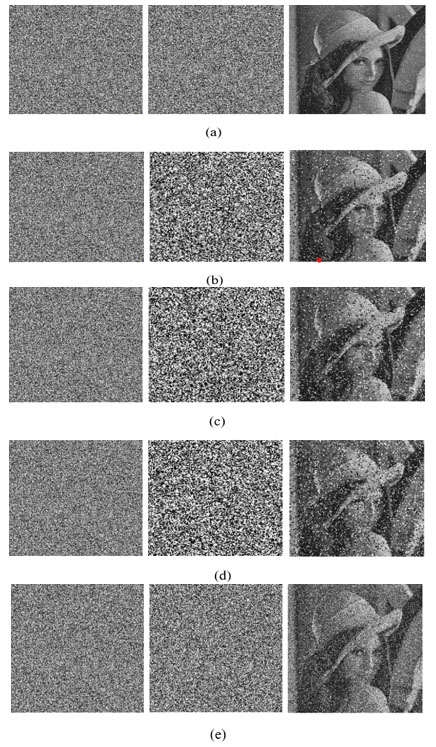
In Table 7, the NPCR, UACI and correlation coefficient of a horizontal direction
Performance investigation of proposed and existing models under crop attack condition
Decrypted image under cropping attack condition, a) position left, b) position right, c) position middle.
The cipher or encrypted image is cut off in a random position (left, right, and middle) and then the decryption is performed using the proposed model, where the decryption result is denoted in Table 8 and Fig. 5. In Table 8, the NPCR, UACI, and correlation coefficient of a horizontal direction
As seen in the Tables 4–8, the proposed hybrid algorithm obtained better performance in image compression and encryption compared to the existing algorithms by means of NPCR, UACI, and correlation coefficient under the conditions of salt and pepper noise, and crop attack. The proposed hybrid algorithm exhibits rich dynamical behaviors that includes hyperchaotic, chaotic, and periodic motions that over-comes the concerns mentioned in the literatures like underflow/overflow [16], blocking artifacts [19], small keyspace [20], and security vulnerability [23]. In addition to this, the hyper-chaotic phenomena exist within an extensive range of parametric value that significantly reduces the computational complexity of the system, which is the main issue mentioned in the literatures [19, 26].
Conclusion
In this study, new hybrid image compression and encryption algorithm are proposed to enhance the security of data transmission. At first, IWT is applied to the digital images for image compression and the image encryption is accomplished using the Hybrid hyperchaotic system. In this research article, a hybrid hyperchaotic system with IWT significantly improves the sensitivity of the input image and it is capable of decrypting the cipher image under the conditions that involve cropping attack and salt and pepper noise. From the experimental outcomes, the hybrid hyperchaotic system with IWT demonstrated better imperceptibility compared with the existing models such as CNN, HC-DNA, C-DNA, CDCP, and CHC. Furthermore, the proposed Hybrid hyperchaotic system with IWT achieved better performance in image compression and encryption compared with the existing models in terms of UACI, NPCR, and correlation coefficient. In future work, a new optimization algorithm is included in the proposed model to further enhance the image compression and encryption performance.
Footnotes
Author’s Bios