



Abstract
The data integrity verification process in cloud has become more promising research area in several Internet of Things (IoT) applications. The traditional data verification approaches use encryption in order to preserve data. Moreover, fog computing is considered as extensively employed virtualized platform and it affords various services including storage as well as services interconnected to computing and networking between user and data center based on standard cloud computing. Moreover, fog computing is an extensive description of cloud computing. Thus, fog servers effectively decrease the latency by integrating fog servers. In this paper, novel model for data integrity authentication and protection is designed in IoT cloud-fog model. This method mainly comprises fog nodes, cloud server, IoT nodes, and key distribution center. Here, dynamic and secure key is produced based on the request to key distribution center based on hashing, Exclusive OR (XOR), homomorphic encryption and polynomial. The fog nodes are employed to encrypt the data gathered from IoT nodes as well as allocate the nearby nodes based on Artificial Bee Colony-based Fuzzy-C-Means (ABC FCM) – based partitioning approach. The proposed data integrity authentication approach in IoT fog cloud system outperformed than other existing methods with respect to detection rate, computational time and memory usage of 0.8541, 34.25 s, and 54.8 MB, respectively.
Keywords
Introduction
Due to the development of new technologies and concepts, like intelligent transportation, mobile internet, smart city as well as amount of devices linked to internet is rising, thus more effective processing and powerful resources are required. The incorporation of cloud and IoT becomes more expected preference. The cloud computing is introduced for accumulating and processing large number of data gathered through IoT. Moreover, network devices are utilized for distantly monitoring and controlling any physical entity under new network conditions, which generates sensible decisions through implanting computing resources and communication in physical devices. The combination of IoT network and cloud has significantly enhanced the people’s lives and work effectiveness, and it has been preferred by more number of peoples [12]. However, obtaining data integrity verification model for huge scale IoT data in cloud storage has become as modern topic for further applications in IoT. The combination of cloud and IoT eradicates the trouble of regulation and local storage. Accordingly, cloud service providers can definitely gain the user control data, which critically threatens data security [24, 25]. Consequently, IoT data integrity verification model is great significance for effectual cloud storage [13]. Furthermore, individual users select to accumulate their data on cloud owing to the rapid development of information sharing and trade. However, users misplace the control of the data, while the data’s are accumulated on cloud. Hence, how to authenticate the integrity of data accumulated on cloud becomes as more significant concern [14].
Data Integrity Verification (DIV) is one of the immense responsibilities with cloud data, due to the involvement probability in malevolent behaviours of cloud user as well as cloud provider is very high. Thus, there are various ways to address the cloud provider issues. Additionally, decryption and encryption process are effectively utilized by user, even though it need large functional overhead and processing time [26, 27]. Moreover, data auditing approaches [15] are also utilized for solving high cloud provider issue. The data integrity verification becomes a significant security challenge in cloud technology. Consequently, downloading the entire data for integrity verification will considerably improve the computation and communication overhead. The cloud service provider is selected for obscuring the data corruption or loss in order to maintain the user’s trust, while cloud storage devices are damaged or hackers steal the outsourced data. In addition, cloud service provider saves the storage space by deleting less accessed data or reveals users’ privacy information [28]. Therefore, cloud users must identify the effectual approach for verifying outsourced data integrity [16]. The essential security concerns in data outsourcing are raised critically. Besides, cloud service provider may hide the data loss incidents for maintaining the reputation. In addition, external adversary may deform the user’s data on cloud server for political and financial causes. An effective and secure verification technique is habitually needed by users in order to guarantee the data integrity [17].
The IoT data integrity verification has huge impact for effectual cloud storage. The existing data integrity verification techniques for cloud storage are mainly based on erasure codes [20], asymmetric cryptographic techniques [19], and hash function [18]. Moreover, data integrity verification approaches is also developed, which is separated into two models, like Proofs of Retrievability (POR) and Provable Data Possession (PDP) model. Moreover, conventional approaches use trusted Third Party Auditors (TPA) for performing auditing tasks as well as users burden is highly decreased during the verification stage [13]. In recent days, growing attention model is applied for verifying data integrity in cloud storage system. In addition, POR [21] was also introduced for data integrity verification, and this model was not only authenticating the data integrity accumulated in cloud but also guarantees data retrievability with error correcting code. Besides, the method designed in [22] effectively verifies data integrity in cloud storage. This approach integrates block tags into single one with Rivest-Shamir-Adleman (RSA) – based Homomorphic Verifiable Tag (HVT) without downloading all data. Moreover, existing works specified that the integrity verification approach utilizes more computational and communication resources, because it employed RSA integers. A public data integrity verification model was developed with BLS signature in [23]. However, BLS consumes very less computation and communication resources. On the other hand, malicious attacker could access outsourced data in interactive proof system, which threatens the privacy of data.
The IoT system attaches every entity, like mobile devices, computers and wearable smart devices to the Internet, after that information sharing and communication is performed. The cloud computing is introduced for accumulating and processing large number of data gathered through IoT. The limitations in the various existing authentication approaches are listed below:
The data, which are accumulated in cloud may be corrupted or misplaced because of external malicious attacks, hardware failures, necessary software errors, and damage from cloud service providers [1]. The training model in distributed machine learning model may deeply affect and training results was not accurate, while network attacks counterfeit the data [2]. Data integrity is one of most significant security concerns, since users do not own their data after data outsourcing to cloud servers.
These challenges and the restrictions are mainly considered as motivation for developing a novel data integrity authentication scheme.
The major intention of this research work is to develop an approach for data integrity authentication and protection in Fog-IoT system. The network mainly comprises four entities, like IoT nodes, fog nodes, cloud server and key distribution center. This algorithm is devised by five phases, such as IoT and fog node registration key generation, authentication, data encryption phase and data decryption phase. Initially, in IoT and fog node registration stage, IoT devices and fog nodes are registered to cloud server. After that, key generation phase is performed in which dynamic and secure key is produced based on the request to key distribution center by various models, like Hashing, Homomorphic encryption, XOR, and polynomial. Once key generation process is completed, then authentication phase is carried out where IoT and fog nodes are authenticated with cloud server by means of session password, and keys. The next phase is data encryption stage in which fog nodes are utilized to encrypt the data composed from IoT nodes, and then allocate to neighbor fog nodes using ABC-FCM-based partitioning approach [11]. The last stage is data decryption phase where data is decrypted by server for the retrieval process, when all the shares are obtained from fog nodes.
The main contribution of this research is explained as follows. Proposed data integrity authentication and protection in IoT-cloud-fog computing: The data integrity authentication and protection scheme is developed for data security and authentication in IoT-cloud-fog computing. This network model consists of IoT nodes, fog nodes, cloud server and key distribution center. Here, fog nodes are utilized to encrypt the data collected from the IoT nodes, and then distribute to neighbor fog nodes using ABC-FCM-based partitioning approach.
The residual sections of the paper are arranged in following way: Section 2 explains conventional data integrity authentication techniques in fog computing. Section 3 illustrates the system model of IoT-fog model. Section 4 explicates the proposed data integrity authentication model. Section 5 deliberates the results of developed approach with regards to existing techniques, and Section 6 concludes the paper.
The literature survey of existing data integrity verification techniques are explained with benefits and limitations. Junfeng Tian and Xuan Jing [1] presented cloud data integrity verification technique for connected tags. In this method, operation logs were grouped based on the operation kind. Moreover, homomorphic hash function was applied into integrity verification of operation logs for understanding stronger privacy protection. This method effectively decreased audit overhead, although failed to obtain effective performance dynamic update operations. Xiao-Ping Zhao and Rui Jiang [2] modelled Distributed Machine Learning Oriented Data Integrity Verification (DML-DIV) model in cloud computing structure. At first, Provable Data Possession (PDP) sampling auditing approach for obtaining data integrity verification. After that, random number was produced as well as Discrete Logarithm Problem (DLP) was applied for making proof and ensuring privacy protection during verification process. Finally, identity-based cryptography and two step key generation model for producing data owner’s private or public key pair. This model efficiently opposes forgery and tampering attack, but still this model needs more computing and waiting time which is the major drawback. Xiuqing Lu et al. [3] developed integrity verification model for cloud computing in IoT devices. The lightweight auditing model was introduced for both integrity verification and block tag generation. In addition, Version Based_Merkle Hash Tree (VB_MHT) model was designed for improving security in integrity verification of shared data. The computational cost was highly reduced, even though the storage capacity was high in this model. However, the data integrity of the model needed to be improved. May Altulyan et al. [4] introduced unified structure for data integrity protection in smart cities. The holistic model was introduced to guarantee data integrity. Besides, fog computing was employed for concealing data with block chain overload. Moreover, this model accumulates normal data and sensitive data into block chain with no difficult pre-processing process. This algorithm affords resiliency against various threats, although failed to solve energy consumption and latency issues.
Walid I. Khedr et al. [5] designed Cryptographic Accumulator Provable Data Possession (CAPDP) method for data integrity verification in cloud storage. The data owner performs unrestricted amount of data verifications against total database, when restricting computational overhead. Moreover, this model supports several features, like dynamic data operators and blocks less verification. This algorithm effectively reduced burden and cost of verification process. Kashif Munir and Lawan A. Mohammed [6] presented data integrity approach in fog computing. This approach employs four techniques, namely KeyGen, SigGen, GenProof and VerifyProof model. This model decreases storage overhead, although failed to include more techniques for demonstrable estimation process Wei Tong et al. [7] modelled two Integrity Checking protocols for mobile Edge computing, termed ICE-basic and ICE-batch for data integrity. Here, the third-party verifier was permitted for checking data integrity on edges. In addition, remote data integrity checking model was applied for edge storage and effective batch verification. This model was effectual in communication and computational complexity, although failed to manage restricted operation abilities to maintain the system. Hui Tian et al. [8] developed Bilinear mapping approach for secure data storage in fog to cloud computing. Here, tag transforming model depends on bilinear mapping model was applied for converting tags, which are produced by mobile sinks. Besides, zero knowledge proof method was employed for verifying data integrity in IoT. This method successfully obtains public auditing, which enhances the performance of secure data storage in fog to cloud system. However, this model failed to attain effectual auditing for load balancing of multiple auditors and big data.
In the proposed method, the dynamic and secure key is produced based on Hashing, Homomorphic encryption, XOR, and polynomial. Also, the data encryption is done with ABC-FCM algorithm, which has fast convergence. Moreover, the ABC-FCM- based partitioning approach is used to allocate the neighbor fog nodes. Besides, the modulation function and Chebyshev polynomial enhance the performance of the data authentication of the proposed method.
System model
The cloud enabled IoT model is more promising, which has the capacity to afford services and storage to IoT users. Here, different devices are considered to connect with IoT network so that millions of data is produced in fraction of second. This network model mainly relies on centralized data centers, such as cloud is not practicable for IoT data, due to more distance. Therefore, fog computing is more necessary for permitting data processing at network edge, which improves the service quality through offering fast responses to sensor request. This system representation comprises cloud, fog node and IoT network. Every IoT network includes
System model of data integrity authentication in IoT fog cloud.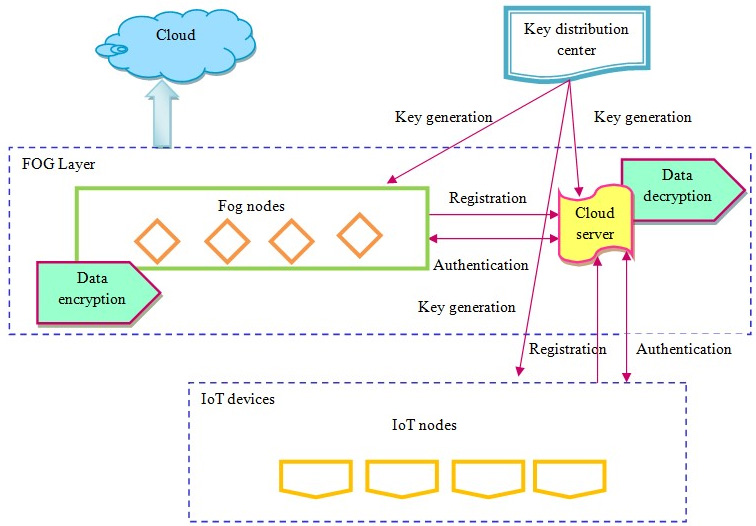
This section explains about the developed data integrity authentication model in IoT-fog-cloud system. In this technique, network structure includes IoT nodes, fog nodes, cloud server and key distribution center. This developed approach comprises five phases, like IoT and fog node registration, key generation, authentication, data encryption and data decryption phase. In IoT as well as fog node registration phase, IoT devices and fog nodes are registered to cloud server. Moreover, in key generation phase, dynamic and secure key are generated based on the request to KDC using various functions, like XOR, Hashing, Homomorphic encryption and Polynomial. Afterwards, authentication phase is done where IoT and fog nodes are authenticated with cloud server by session password, and keys. The fourth phase is data encryption phase in which fog nodes are employed to encrypt the data gathered from IoT nodes, and then allocate to neighbor fog nodes by ABC-FCM- based partitioning approach [11]. The final phase is data decryption phase in which data is decrypted by server for retrieval process, while every share is obtained from fog nodes. Figure 2 shows the overall framework of the developed authentication approach.
Overall framework of the devised authentication approach.
Table 1 explicates the symbol description of the data integrity authentication model in IoT fog cloud computing system.
Symbol description of the data integrity authentication model in IoT fog cloud computing
Figure 3 represents the process of server registration fordata integrity authentication model in IoT fog cloud computing. Initially, the server ID
where
Sever registration.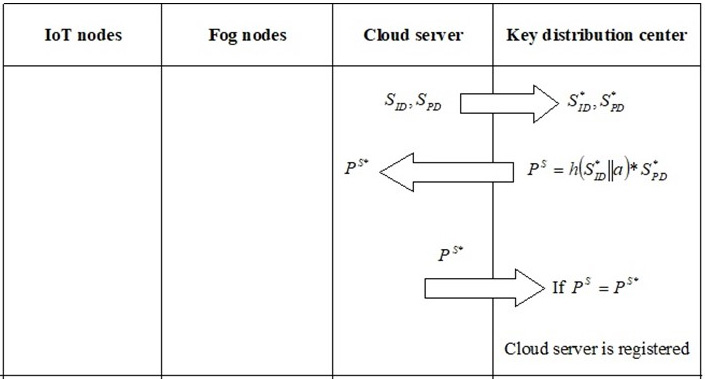
After server registration process, fog node ID
where
The generated fog node password is saved in fog node as
Thus, the password of IoT nodes created in cloud server is saved in IoTnodes as
IoT device and Fog node registration.
Once the fog and IoT node is registered in cloud server, then key generation is carried out. At first, public key
The saved server password
Thus, the generated private key for fog nodes is saved in fog node as
Finally, the generated private key for IoT nodes
Key generation phase.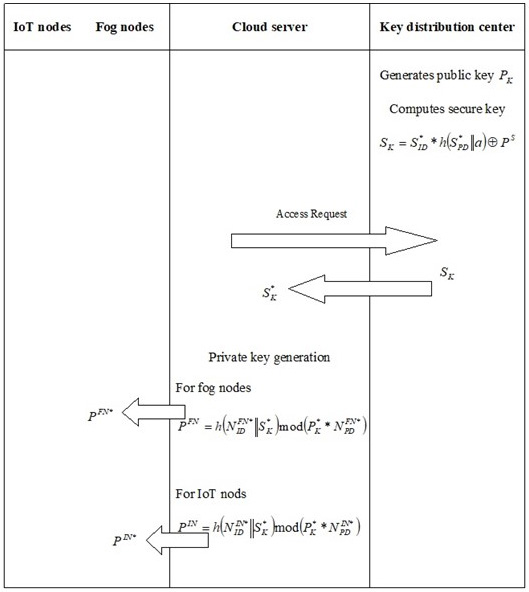
Figure 6 deliberates the authentication process of data integrity authentication and protection. Here, the fog node sends a request to cloud server, where session password of fog and IoT node are generated for authentication. The session password of fog node is created by concatenation of fog node ID, private key of fog node and random number
where
Moreover, the session password of fog node is saved as
Afterwards, the authenticated message is transmitted to cloud server and it is illustrated as,
If
The session password of fog node is produced by concatenation of random number
Thus, the session password of IoT node is saved in IoT node phase as
The authentication message
The authentication message saved in cloud server is defined as the concatenation of saved IoT node ID
Authentication phase.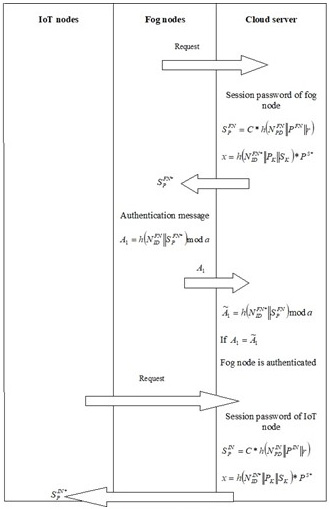
IoT node senses the data and transfers the collected data to the fog node. Let
where
Here, the fog node partitions
The distance sum among cluster center and pixels generates objective function of FCM approach, which is expressed as,
where
The dissimilarity among
where
In addition, the cluster center
The objective function
On the hand ABC is conventional optimization approach, which is functioned, based on fuzzy clustering. The ABC algorithm has strong global searching capability. Generally, ABC comprises three sets of bees, such as scout bees, onlooker and employer. Here, the information regarding the food sources are performed by employee bees. Additionally, more information related to nectar amount, distance, nest food source direction is also afforded. Besides, scout bees search a new food source around the nest surroundings, where as onlooker bee waits in hive as well as depends on information transmitted by employee bees for finding food source. Here, the employment of nectar source as well as desertion of source is defined as ABC technique. Every employer bee producesnew interest of regions in neighbourhood by below expression,
where
where
where percentage of soldiers selected for
When the user request for the data, then the server retrieves the original data using key
The data is decrypted only when all the shares the obtained.
The results and discussion of developed data integrity authentication approach in IoT-fog-cloud structure is described in this section.
Experimental setup
The implementation of developed data integrity authentication method is carried out in Python tool with windows 10 OS, 4 GB RAM, and Intel processor. For the experimentation the cluster size is considered as 3.
Dataset description
The implementation is performed usingthree datasets, namely Cleveland and Hungarian datasets taken from Heart disease dataset in UCI Machine Learning Repository [9] and Dermatology database [10].
ClevelandandHungarian dataset: In general, this dataset includes 303 instances with 14 attributes. The 14 attributes are chest pain category, patient identification number, social security integer, characteristics of patient, age, chest pain position, and so on. In general, Cleveland data is utilized by machine learning researches. Moreover, Cleveland and Hungariandatabase is multivariate in nature. The capacity of instance considered is 303 with 75 attributes, which are integer, categorical, and real. The total quantity of webhits obtained is 1558777.
Dermatology database: This data is multivariate type, and it comprises categorical and integer attribute behaviours. This data includes 34 features where 33 are linear valued and one is irrelevant. In this database, differential classification of erythemato-squamous diseases is most important dilemma. The diseases present in this group are pityriasisrosea, cronic dermatitis, lichen planus, psoriasis, seboreic dermatitis, pityriasis and rubrapilaris. This dataset contains 366 instances as well as 232965 web hits.
Performance metrics
The performance metrics utilized for developed data integrity authentication in IoT fog cloud approach are detection rate, computational time and memory usage, and it is explicated as follows.
Computational time: It is referred as the time taken by controllers to process the messages and its unit is denoted in seconds.
Detection rate: Detection rate is another metric, which is computed by the ratio of number of malicious nodes, which are exposed accurately with regards to nodes count available in IoT-fog model.
where
Memory usage: Memory usage is defined as memory consumed by developed data integrity authentication technique in IoT-fog-cloud model.
The performance of proposed data integrity authentication technique is compared with other existing approaches, namely cloud data integrity verification model [1], DML-DIV approach [2], and VB_MHT method [3].
Cloud data integrity verification model: In this technique, a new auditing scheme was implemented for operation logs (OLs) and a homomorphic hash function was implemented for the integrity verification.
DML-DIV approach: In this method, the Provable Data Possession (PDP) was utilized for verification of data integrity and a blinding factor adapted for the privacy protection.
VB_MHT method: In this method, a lightweight and secure integrity verification technique was implemented and data sharing model was utilized for sharing the data to the authorized users. Here, the MHT was implemented to enhance the shared data security.
Comparative analysis
The section exposes the comparative analysis of developed data integrity authentication approach in IoT-fog-cloud model in terms of computational time, detection rate and memory usage with various key sizes based on database-1, 2 and 3.
Comparative analysis using dataset-1
Figure 7 displays comparative analysis of developed data integrity authentication model based on database-1 in terms of computational time, detection rate and memory usage. Figure 7a portrays the comparative analysis of computational time by shifting key size. When the key size is 256, computational time of existing methods, such as cloud data integrity verification, DML-DIV, and VB_MHT methods and developed data integrity authentication model are 89.35 s, 72.41 s, 58.54 s, and 34.04 s. Figure 7b depicts comparative analysis of detection rate with respect to different key size. Moreover, detection rate attained by existing cloud data integrity verification is 0.7142, DML-DIV is 0.7541, VB_MHT is 0.8142, where as developed data integrity authentication method is 0.8352 in key size 256. Additionally, the percentage improvement of developed privacy preservation model, while compared with cloud data integrity verification, DML-DIV, and VB_MHT are 14.48%, 9.71%, and 2.51%. Figure 7c shows comparative analysis of memory usage with regards to various sizes of key. The memory usage obtained by cloud data integrity verification, DML-DIV, and VB_MHT and developed data integrity authentication approaches are 55.4 MB, 55.1 MB, 54.8 MB, and 54.3 MB for 256 key size. Along with this, percentage improvement of developed approach with existing cloud data integrity verification, DML-DIV, and VB_MHT are 1.98%, 1.54%, and 1.08%.
Comparative analysis using dataset-1 with a) Computational time, b) Detection rate and c) Memory usage.
The comparative analysis of developed data integrity authentication approach based on database-2 with respect to computational time, detection rate and memory usage is specified in Fig. 8. Figure 8a shows comparative analysis of computational time with regards to various sizes of key. The computational time obtained by cloud data integrity verification, DML-DIV, and VB_MHT and developed data integrity authentication approaches are 85.74 s, 61.24 s, 50.54 s, and 33.54 s for 256 key size. Figure 8b portrays the comparative analysis of detection rate by altering key size. When the key size is 256, detection rate of existing methods, such as cloud data integrity verification, DML-DIV, and VB_MHT methods and developed data integrity authentication model are 0.6985, 0.7254, 0.7825, and 0.8142. Along with this, percentage improvement of developed approach with existing cloud data integrity verification, DML-DIV, and VB_MHT are 1.98%, 1.54%, and 1.08%. Figure 8c depicts comparative analysis of memory usage with respect to different key size. Moreover, memory usage attained by existing cloud data integrity verification is 54.5 MB, DML-DIV is 54.1 MB, VB_MHT is 53.6 MB, where as developed data integrity authentication method is 53.4 MB in key size 256. Additionally, the percentage improvement of developed privacy preservation model, while compared with cloud data integrity verification, DML-DIV, and VB_MHT are 2.01%, 1.73%, and 1.65%.
Comparative analysis using dataset-2 with a) Computational time, b) Detection rate and c) Memory usage.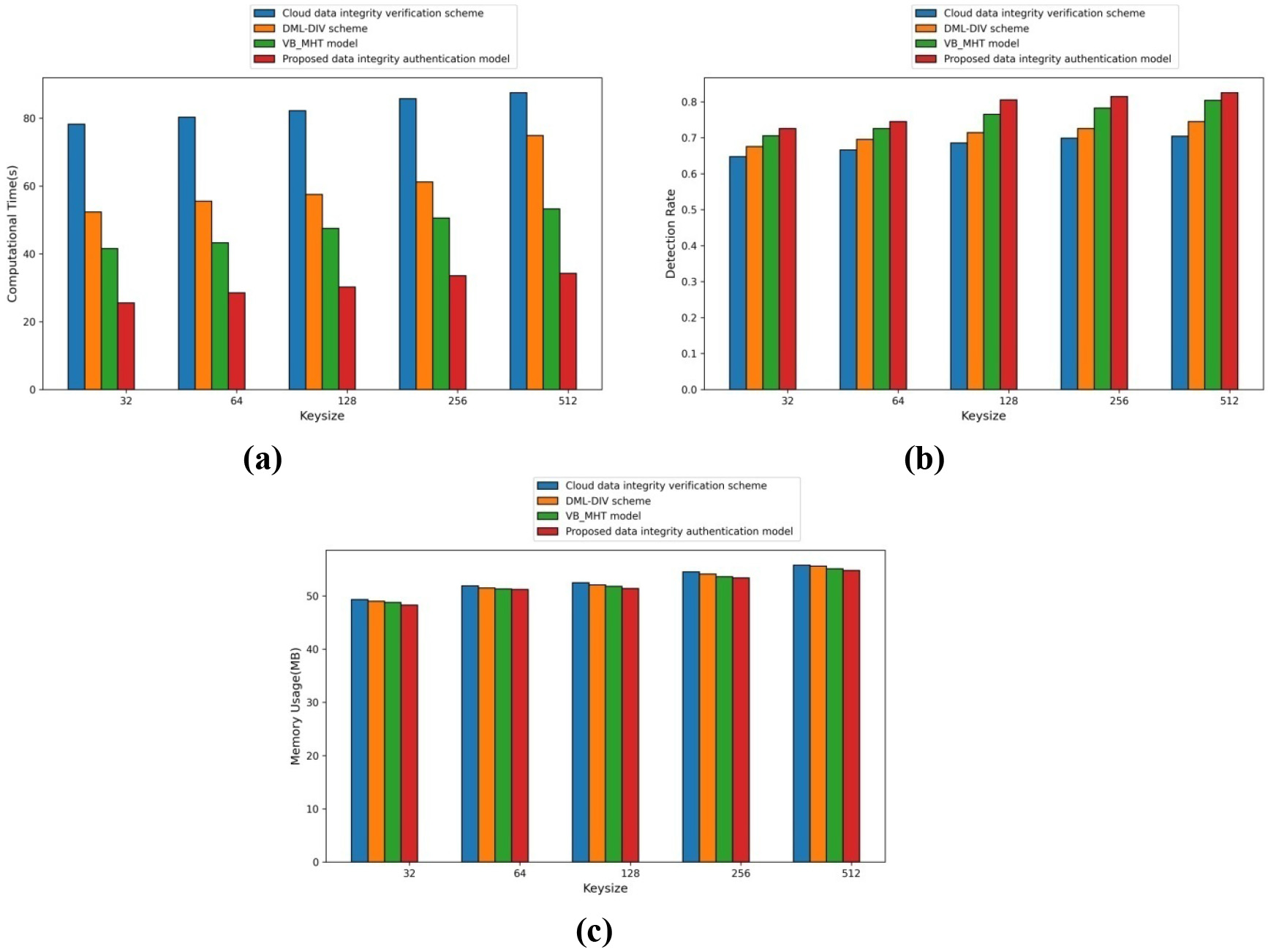
Figure 9 displays comparative analysis of developed data integrity authentication model based on database-3 in terms of computational time, detection rate and memory usage. Figure 9a portrays the comparative analysis of computational time by shifting key size. When the key size is 256, computational time of existing methods, such as cloud data integrity verification, DML-DIV, and VB_MHT methods and developed data integrity authentication model are 81.25 s, 59.35 s, 54.84 s, and 31.25 s. Figure 9b depicts comparative analysis of detection rate with respect to different key size. Moreover, detection rate attained by existing cloud data integrity verification is 0.7041, DML-DIV is 0.7451, VB_MHT is 0.7985, where as developed data integrity authentication method is 0.8362 in key size 256. Additionally, the percentage improvement of developed privacy preservation model, while compared with cloud data integrity verification, DML-DIV, and VB_MHT are 15.80%, 10.89%, and 4.50%. Figure 9c shows comparative analysis of memory usage with regards to various sizes of key. The memory usage obtained by cloud data integrity verification, DML-DIV, and VB_MHT and developed data integrity authentication approaches are 56.7 MB, 56.2 MB, 55.8 MB, and 55.4 MB for 256 key sizes. Along with this, percentage improvement of developed approach with existing cloud data integrity verification, DML-DIV, and VB_MHT are 2.29%, 1.88%, and 1.58%.
Comparative discussion
Comparative discussion
Comparative analysis based on dataset-3 with a) Computational time, b) Detection rate and c) Memory usage.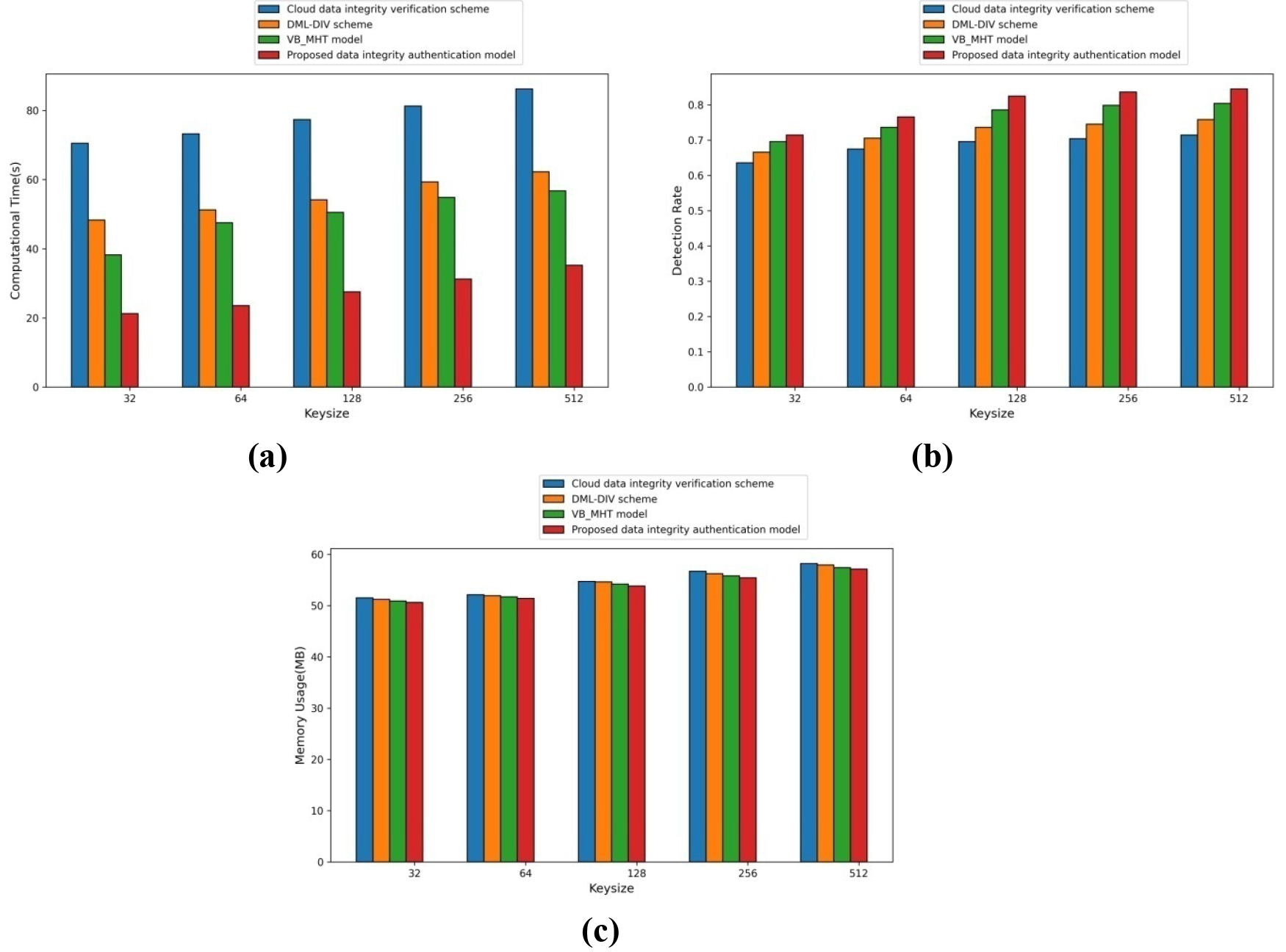
Table 2 depicts the comparative discussion of developed data integrity authentication method using database-1, 2 and 3 in terms of computational time, detection rate and memory usage. The computational time of developed data integrity authentication technique is 37.52 s, where as cloud data integrity verification approach, DML-DIV model, and VB_MHT scheme is 90.54 s, 74.51 s and 61.52 s for key size 512. Likewise, detection rate obtained by cloud data integrity verification, DML-DIV, and VB_MHT methods, are 0.7254, 0.7654, 0.8254, and 0.8541, where as developed data integrity authentication technique obtained detection rate of 0.8541 in 512 key size. When the key size is 512, memory usage obtained by cloud data integrity verification technique is 57.1 MB, DML-DIV algorithm is 56.8 MB, VB_MHT method is 56.5 MB and developed data integrity authentication approach obtained 55.2 MB. Hence, the proposed data integrity authentication method achieved high detection rate using dataset-1 as well as less memory usage and computational time using dataset-2.
Conclusion
This paper presents a data integrity authentication approach in Fog IoT system. Here, network system includes four entities, namely IoT nodes, fog nodes, cloud server and key distribution center. In this model, IoT devices and fog nodes are registered to cloud server in IoT and fog node registration stage. Moreover, dynamic and secure key is produced based on the request to key distribution center by means of XOR, hashing, Homomorphic encryption and Polynomial process in key generation phase. Afterwards, IoT and fog nodes are authenticated with cloud server using the session key and password in authentication stage. Afterwards, data encryption process is done in which fog nodes are employed in order encrypt the data gathered from IoT nodes. In addition, the data collected from IoT nodes are distributed to neighbouring fog nodes based on ABC FCM-based partitioning method. Finally, data is decrypted by server for retrieval process such that data decryption is carried out. The performance of developed data integrity authentication algorithm is evaluated using detection rate, computational time and memory usage with the range of 0.8541, 34.25 s, and 54.8 MB. Furthermore, the developed approach can be extended by including other effective optimization algorithm.
Footnotes
Author’s Bios