



Abstract
Nowadays, Blockchain is very popular among industries to solve security issues of information systems. The Internet of Things (IoT) has security issues during multi-organization communication, and any organization approves no such robust framework. The combination of blockchain technology with IoT makes it more secure and solves the problem of multi-organization communication issues. There are many blockchain applications developed for the security of IoT, but these are only suitable for some types of IoT infrastructure. This paper introduces the architecture and case studies of blockchain applications. The application scenarios of the Blockchain combined with the Internet of Things, and finally discussed four common issues of the combination of the Blockchain and the Internet of Things.
Introduction
The Internet of Things (IoT) system is the medium between contacts and society, between people and nature, and is the infrastructure for building various intelligent systems, such as smart homes, smart cities, etc., and has gradually penetrated all aspects of people’s lives and various Vertical industry [1]. Existing systems are generally based on cloud computing systems to collect data collected by IoT devices and send control instructions to IoT devices based on data analysis results [2, 3]. For delay sensitive IoT applications, edge computing can be combined to reduce processing delay, but in general, it is still a centralized data collection and processing mode [4, 5]. With the large-scale practice of various IoT applications, this centralized processing solution has gradually revealed some inherent problems, mainly including the huge cost and capacity limitations of single-point control of large-scale IoT nodes, and the attack of a single node can cause the entire system to Threats; cloud data may be tampered with or abused, user privacy risks leaking, etc. [6, 7]. The rise of blockchain technology provides a feasible solution to the above problems [8].
Blockchain is the underlying technology of Bitcoin and a synonym for a series of technology integration, including blockchain data structure, asymmetric encryption, peer-to-peer network, consensus algorithm, incentive system, etc. [9]. Since Bitcoin has been able to operate normally without human management at all, the industry and academia began to realize the great potential of blockchain technology in 2015. They even regarded it as “after mainframes, personal computers, Internet, mobile/social network, the fifth subversive innovation of the computer paradigm” and “the fourth milestone in the history of human credit evolution after blood relative credit, precious metal credit, and central bank banknote credit” [10, 11]. Up to now, blockchain technology has gone through the programmable currency stage (1.0 stage), represented by Bitcoin, and the programmable financial stage (2.0 stage), represented by Ethereum and Hyperledger and is moving towards the 3.0 stage of the programmable society [12]. Various industries are actively discussing how to use blockchain technology to solve problems that cannot be solved by the current centralized system [13].
However, we systematically evaluate that there are mainly three types of blockchain derives, such as public (permissionless), private (permissioned), and consortium (hybrid). Most importantly, the public chain is designed for the sake of creating architectural traceability, privacy preservation, and security [12, 13]. Undoubtedly, these chains are designed to manage and protect the deployed structures in chronological order with hash encryption, but they consume more resources in terms of computational power, network bandwidth, and immutable storage [13, 14]. In order to reduce the load of resource consumption, the Linux-based Hyperledger technology is introduced. This technology helps to maintain the ledger’s privacy and security and provide provenance, but the major impact is to hold the cost of resource utilization in a limited manner. More importantly, the transaction fees in the Hyperledger environment are 0.1% compared to other state-of-the-art chains. In addition, it allows multi-stakeholder participation in such a manner that it provides customized consensus policies, which allow it to manage according to the needs of the developer of the chain.
Due to the naturally distributed nature of IoT systems and the natural multi-party participation in application scenarios, IoT has become the most popular application field of blockchain technology other than finance [14]. There have been many related applied research and academic achievements in recent years. However, due to the comprehensiveness and complexity of blockchain technology and some commercial organizations and research institutions proceeding from their interests, many application demonstration cases need to reflect the core value of blockchain. Although many review articles have summarized the application of blockchain in IoT [15, 16, 17], they usually summarize the conclusions of hundreds of articles and have yet to make a detailed analysis of the specific value of the technology in the application. This article intends to compensate for this deficiency by listing some typical “blockchain
This paper is organized into 6 sections, and 2nd section is based on the application scenario and logic of blockchain. The 3rd section details the application case analysis of the blockchain in the IoT field, and the 5th section provides open research issues for future work. 4th section is based on the challenges and limitations of the combination of blockchain and IoT and finally, in Section 6, we conclude our work.
Blockchain technology based applications
Typical characteristics of blockchain applications
According to the analysis of literature [18, 19], a typical blockchain application should have the following five characteristics.
Requires an immutable database (InterPlanetary File Storage System) In a narrow sense, the blockchain system is essentially a distributed database. Therefore, blockchain technology must be used to store data [20]. However, unlike general databases, the database maintained by the blockchain can only add entries but cannot delete or modify existing entries; that is, this database cannot be tampered with, and data immutability is the primary purpose of applying the blockchain. Since the recorded data has the submitter’s digital signature and time stamp, it is traceable. It needs to be shared and maintained by multiple parties The application scenarios targeted by the blockchain system must include the participation of multiple parties to jointly maintain the database, which is readable by multiple parties and, more importantly, writable by multiple parties [21]. In the blockchain system, each party that writes the blockchain database needs to run a node and save the complete blockchain data [22]. Writing to the database is triggered by a transaction, but both parties that generate the transaction do not necessarily need a node. Lack of trust between multiple parties In the application scenario of the blockchain, there must be a need for more trust among multiple blockchain maintainers [23]. Specifically, it includes two meanings: from the perspective of writing the database, each party is unwilling to modify the database maintained by the other party due to distrust; from the perspective of reading the database, each party does not believe the query informed by the other party’s result. This distrust mainly comes from the different interests of the various parties, which may be economic or otherwise. No suitable third party For generally shared ledgers, one way to solve the problem of multi-party distrust is to find a third party trusted by many parties, and all database reading and writing are entrusted to this trusted third party [24]. However, the application scenario of the blockchain must not have such a third party. Usually, commercial interests or restrictions of policies and regulations do not allow such a third party to appear. At this point, each blockchain participant independently performs transaction verification and book reading and writing. Contacting parties to the transaction The most applicable application scenarios of the blockchain generally have a characteristic: transactions are generated between parties maintaining ledgers, and there is a relationship between transactions [25]. With this feature, the verification of a transaction is based on verifying previous related transactions so that the interests of all parties involved in the transaction are bound to each other [26]. At this time, all participants are willing to cooperate and jointly maintain this ledger related to all parties’ interests. Furthermore, for each node to independently conduct transaction verification, the legitimacy of each transaction should be verifiable. In short, a suitable blockchain application must be established between multiple distrustful parties [27]. Without a trusted third party, a non-tampered-based database is jointly constructed based on interrelated transactions to be used openly and fairly. Under the circumstances, we can achieve a win-win situation for all parties, reflected in improving efficiency and reducing costs.
So far, blockchain’s most active application field is still finance, including Bitcoin based on a public chain, cross-border payment/clearing based on an alliance chain, etc. [28]. In these applications, the data recorded by the blockchain is the financial transaction, that is, the transfer of currency or digital assets. In this case, the verification of the legality of the transaction includes the identity of the payer and the number of assets owned by the payer, and the connection between transactions is also natural. With the widespread application of blockchain technology in other fields, the types of data stored on the chain are gradually generalized, and the requirements for data verifiability become weaker. In this case, the judgment of whether to use blockchain technology is mainly based on the first four characteristics described in Section 2.1, and it is still necessary to design the legality verification method of the transaction in combination with specific application scenarios to reflect the blockchain technology to the maximum extent – the value of. The judgment conditions for the application scenarios of blockchain technology are shown in Fig. 1. An application requirement must meet the first four characteristics at the same time before it is necessary to use blockchain technology. Otherwise, traditional solutions should be sought [29, 19].
Suitable protocols for applicational blockchain.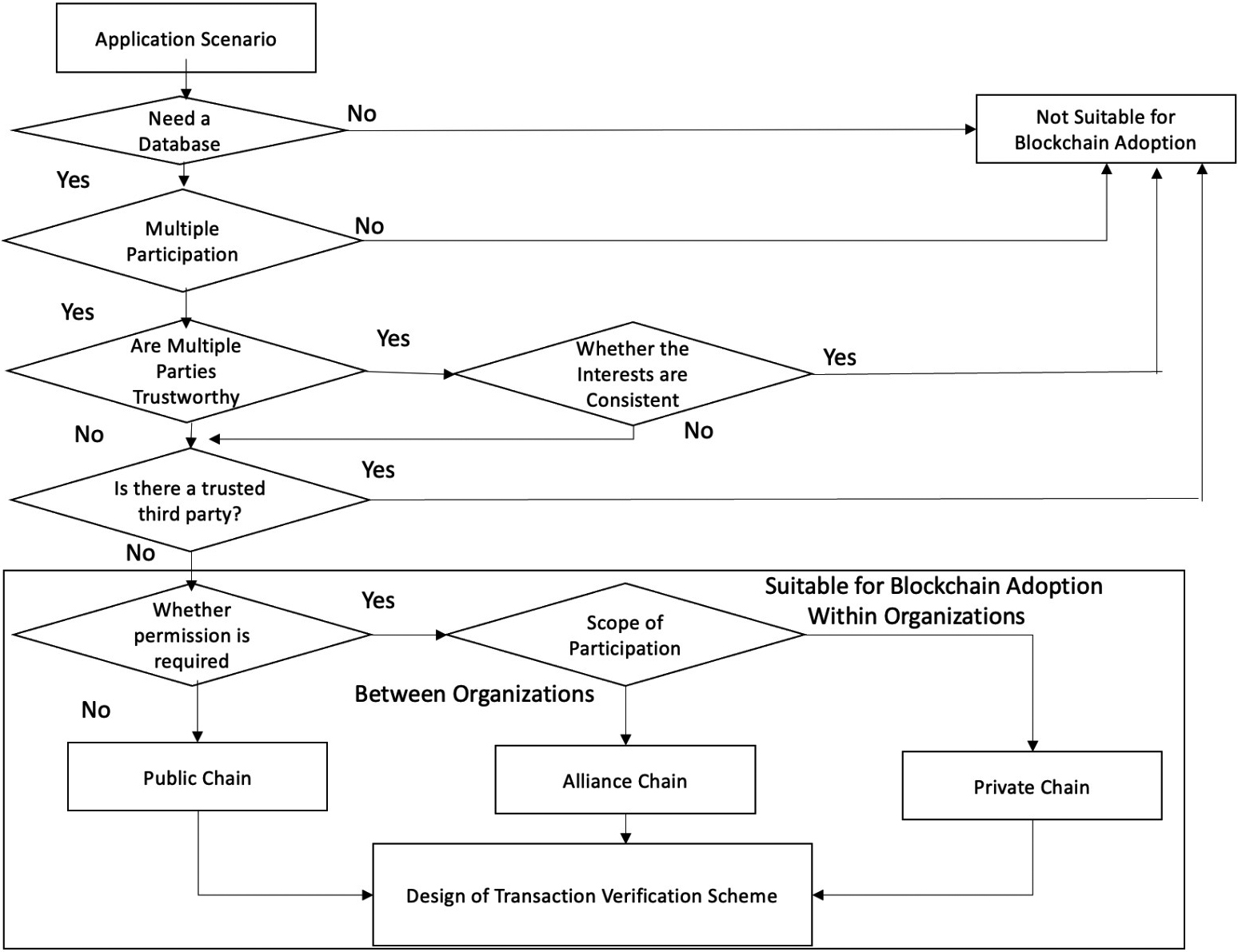
Further, after determining the use of the blockchain, it is also necessary to determine the type of blockchain system based on the authority management requirements [30]. If the read and write permissions of the participating nodes are not restricted, the public chain is used; if the read and write permissions need to be restricted, the alliance chain or private chain is used, the former is used between institutions, and the latter is used within the institution. For the latter two blockchain systems, the relevant parties are generally qualified groups with a certain degree of credibility. However, due to conflicting interests, there is still the possibility of destroying the ledger’s consistency [31]. Therefore, the blockchain can only be applied as necessary.
From the perspective of the IoT system, since most of the applications are between various vertical industries or within the enterprise, most of the parties involved are qualified organizations, and the relevant data and transactions do not want to be open to the public [32]. Therefore, public chains are generally not used but are mainly based on alliances or private chains.
Blockchain technology in IoT systems usually exists in two forms. One combines blockchain and IoT technology to solve problems in a particular application scenario, and the other uses blockchain technology to solve problems in IoT systems [33]. This section lists 5 examples (the first 3 examples belong to the first application type, and the last 2 examples belong to the second application type), focusing on the judgment conditions of applicable blockchain scenarios and analyzing the blockchain of each scenario, the value is discussed as follows.
Supply chain system based on blockchain and IoT
The supply chain refers to the process from production, quality inspection, logistics, distributors, and retailers to users [34, 35]. This process involves many links; each party independently saves its data, and the information lacks transparency. In the current supply chain, each handover link requires document-based confirmation and approval by both parties. On the one hand, this method will bring many delays; on the other hand, it also faces security problems such as file loss and tampering. Once there is a problem in product circulation, the cost of accountability will be high and will take a long time [36]. It is a typical scenario of multi-party participation, mutual distrust, and varying interests, which is very suitable for solving by combining blockchain and IoT technology [37, 38].
Literature [39] introduced a case of a hazardous chemicals supply chain. The architecture of the hazardous chemical supply chain platform based on blockchain and IoT is shown in Fig. 2. To ensure the transparency and credibility of the whole process of goods circulation, an alliance including factories, appraisal departments, customs, and logistics has been built, and a distributed database has been jointly built by multiple parties. When the product leaves the factory, it is bound with a unique digital ID and the IoT device that the user collects environmental data. At the same time, the product’s basic information is stored on the blockchain, and the identification department and customs store their respective inspection results on the blockchain. During the transportation process, each responsible unit uploads the handover information and the status of the goods to the chain, and the IoT device automatically collects the transportation environment data (including temperature, humidity, geographical location, time, etc.) and uploads it to the chain. Finally, after the purchasing unit obtains the item, it can view the whole process and multi-dimensional data based on the unique digital ID.
Hazardous chemicals supply chain platform architecture based on Blockchain and IoT [39].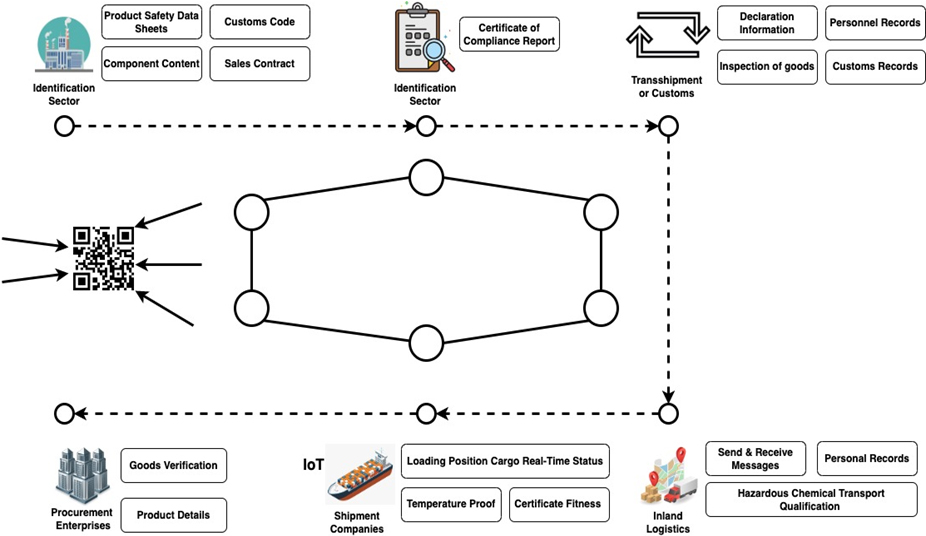
In this case, the legitimacy of the data uploaded by all parties can be verified from the following three aspects. 1) the goods cannot be in the hands of multiple parties at the same time, which is similar to the uniqueness of digital assets; 2) Each data upload requires a digital signature of the corresponding link, which cannot be forged; 3) The data collected by IoT devices is relatively objective without human participation. Therefore, some data (such as time and geographic location information) can be used as a reference to judge the legitimacy of data uploaded by all parties.
Finally, based on the combination of blockchain and IoT technology, this platform realizes the transparent sharing and mutual trust of multi-party data, simplifies the procedures of the handover link and reduces the operating costs of relevant units and the cost of negotiation when encountering problems. However, it must be clear that the blockchain guarantees the reliability of the data on the chain and cannot solve the problem of malicious packet loss. This problem can only be solved through good label design and binding technology.
In recent years, the field of self-driving cars has developed very rapidly [40]. With the gradual enhancement of vehicle intelligence and the continuous enrichment of various sensor equipment, self-driving cars will have strong intelligence and self-maintenance functions in the foreseeable future. For example, each smart self-driving car can independently go to the charging pile (or gas station) to replenish according to the electricity (or gasoline) stock; the smart self-driving car can judge the health status of each component according to the self-check system, and automatically communicate with the 4S shop or maintenance The factory can reserve the maintenance time, and automatically go to the maintenance factory at the specified time. In addition, automobile manufacturers need to monitor the status of each intelligent self-driving car at all times and predict the failure possibility and operating life of certain components based on this information to take timely countermeasures. Furthermore, the smart self-driving car can independently complete the payment of refueling, charging, and maintenance bills under the authorization of the car owner [41]. It can be seen that an ecological chain has been formed around intelligent self-driving cars, which is a typical multi-party participation scenario. Due to inconsistent interests, in the case of an accident with a smart self-driving car, the car manufacturer, car owner, and repair shop may hold different opinions due to inconsistent data, and there needs to be a credible third party to make a fair ruling. Therefore, it is a perfect blockchain application scenario.
The author [42] proposed a blockchain-based future smart car ecosystem, and the architecture of the smart car ecosystem based on blockchain and IoT is shown in Fig. 3. To be able to automatically and reliably interact with the objective data collected by the smart car’s sensors, a smart car manufacturer, dealer, 4S shop/repair shop, charging pile/gas station, the smart car itself, the car owner, and the insurance company have been constructed – consortium chain, including multiple parties. The smart car manufacturer binds the unique digital ID for the smart car when the smart car leaves the factory and uploads the relevant information to the chain; when the smart car is transferred to the owner through the dealer or 4S store, it also transfers the control right of the smart car and the data reading on the chain. The right to write; the smart car’s own sensor data and maintenance reservation transactions are directly uploaded to the chain; 4S shops or repair factories plan maintenance plans based on the data on the chain, and upload the maintenance process and result in data to the chain; Cars and gas stations/charging piles each upload service process data; smart car manufacturers and insurance companies monitor the status of smart cars by reading data on the chain; all automatic interactions and payment operations of smart cars are carried out under the authorization of car owners.
IoT and Blockchain based smart car ecosystem.
In this case, the transactions stored on the chain include sensory data, service information, and payment information, and its legality verification includes sensory data is based on digital signatures to ensure objectivity; service information is based on digital signatures of both parties to ensure unforgeability, and Sensitive data are mutually verified; payment information is based on account balance and digital signature to ensure legitimacy.
The sharing economy is mainly the temporary transfer of the right to use items between the owner and the user of the item, which is a typical multi-party participation and point-to-point application scenario. However, since item owners and users usually do not trust each other, they mainly rely on third-party platforms to complete the connection between the two parties and conclude transactions. There are two main problems in this method: 1) The third-party platform will charge a certain fee, which increases the cost of the renter; 2) Since the third-party platform controls all data, it may tamper with the relevant data of the item for its benefit, which is not conducive to renting The buyer has the real information of the item in advance.
To solve the problems, an alliance chain consisting of item owners, platform maintainers, government regulators, and insurance companies can be built based on blockchain technology, and the shared items can be connected to the blockchain platform based on IoT technology. For example, the Share & Charge project of Slock Company realizes the sharing of charging piles without the participation of a third party [43]. In this project, charging piles will be equipped with IoT smart devices that can interact with the Share & Charge App on users’ mobile phones. Under the control of the smart contract, the charging pile can charge legitimate users and automatically complete the transfer after the charging is completed. Similarly, the company has developed a home-sharing business. The smart room lock can interact with the blockchain. After the user makes a room reservation based on the App, the legitimate user can obtain the unlock password by interacting with the smart lock. At the same time, a part of the tokens is locked in the smart contract account on the chain. When the user finishes using the house, the smart contract automatically transfers the tokens in the contract account to the homeowner and returns the remainder to the tenant.
The blockchain, in this case, mainly stores the following four types of information: 1) The item status data uploaded by the item owner, and the submitter’s legitimacy is verified through digital signature; 2) The sharing application submitted by the renter, and the submitter is verified through digital signature 3) The status information of the item uploaded by the IoT device and the service and transaction data provided by both parties, the former can assist in verifying the legitimacy of the latter; 4) The evaluation data of the renter on the shared service can be compared with the data submitted by the item owner. The item status data confirm each other, which is helpful for renters to grasp the real item status.
Blockchain-based health monitoring ecosystem
With the continuous improvement of people’s health awareness, health monitoring applications based on wearable devices have developed rapidly [44, 45]. A typical application scenario includes two steps: 1) The wearable device worn by the user collects the user’s health data in real time and submits the data to the cloud through the App; 2) The application service provider reads the cloud data and analyzes it and returns the result to users and make reasonable suggestions. This process involves stakeholders with different interests, including cloud service providers, application software developers, sensor device providers, and users [46, 47]. Once an accident occurs to the user due to a problem in a specific link, it is not easy to pursue accountability. For example, it may be due to the delay or instability of cloud services that leads to no timely warning, it may be a bug in the cloud application that leads to data analysis errors, or the user does not wear the device properly, resulting in data reading errors, or it may be the fault of the device itself the data is not uploaded. Neither of these parties has a complete picture of the system, so it is difficult to find the root cause of the problem. We can only rely on a third party for fault tracking and ruling. However, we also face problems such as opaque processes, abuse of power, and complex implementation of accountability actions.
To solve the above problems, the author [48] proposed a blockchain-based health monitoring ecosystem alliance chain. The relevant participants in maintaining bookkeeping include cloud service providers, application software developers, sensor device providers, and insurance companies. All parties upload the status data of their respective responsible parts according to the pre-negotiated regulations and write the abnormal event handling rules and accountability process into the smart contract. The system utilizes the following characteristics of the blockchain:
All parties submit data based on digital signatures, which are transparent and non-repudiable to all parties. The interests of all parties are inconsistent, forming a mutual supervision mechanism to ensure that data cannot be tampered with. Based on intelligence, The contract automatically completes exception handling to solve the problem of complex implementation of accountability.
This case is similar to a supply chain; the difference is that multiple parties jointly complete the transmission and use of health data, and each link must be handed over to both parties for confirmation to form a verification of the validity of the data.
With the function upgrade of wearable devices and the replacement of new devices, dealing with the original wearable devices has become an important issue that users must consider [49, 50]. Many users’ original devices are functional and can continue to be used. Therefore, most users hope to transfer them to others, which forms a substantial second-hand wearable device trading market. However, this market involves many different interests: first, users worry about the misuse of personal data related to the device after selling the wearable device; Users provide warranty services and recall them on time when quality problems are found; third, health monitoring application providers (usually also device sellers) need to track changes in device owners, to be able to provide customized services based on the physical characteristics of new users [51]. Since this process involves the protection of user privacy data and requires multiple stakeholders’ cooperation, it is unsuitable for centralized processing [52, 53].
To solve the above problems, the author [54] proposed a blockchain solution based on Hyperledger, which is used for registering IoT devices, transferring ownership rights, and controlling data usage rights. The ledger storage node of the blockchain system comprises three parties, including IoT device manufacturers, IoT device sellers, and government regulators. First, the device manufacturer registers the ID information of all IoT devices on the chain, notes the device’s status (qualified, problematic, etc.), and sells qualified products. Second, the equipment seller can verify that the equipment on the chain comes from a trusted manufacturer and purchase qualified equipment. At this time, the manufacturer will update the owner’s information on the equipment on the chain. When selling goods, the seller puts the device ownership transfer information on the chain and attaches a price. Third, users can verify on the chain whether the device is from a trusted manufacturer and have two rights after purchasing the device: 1) submit the ownership transfer information and price on the chain when reselling the device; 2) allow others to use it When the data is collected, the authorization license and usage price are submitted on the chain. In addition, when the device manufacturer finds a potential problem with the device, it will mark the status of the device on the chain as unusable, and the user can no longer sell the device. Finally, government regulators have the right to read all the data on the chain to fully supervise the circulation path, data usage, and equipment sales price. The wearable device resale platform based on the blockchain smart contract is shown in Fig. 4 [54]. The above operation processes are solidified in the smart contract, and the subsequent processes triggered by each transaction behavior will be automatically completed on the chain.
Blockchain smart contract for wearable devices.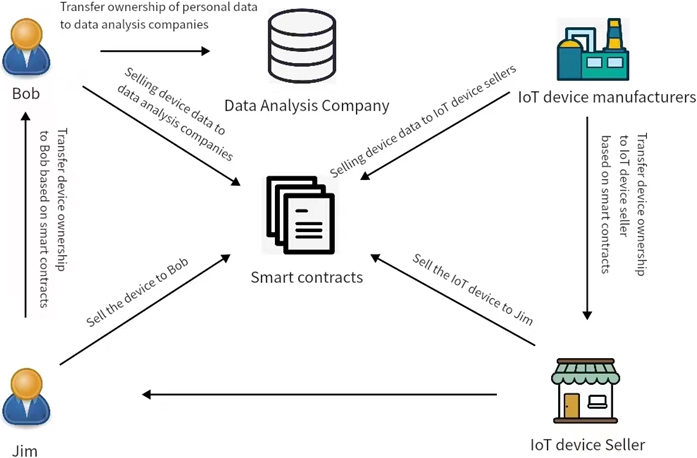
The above scheme applies to other device transaction scenarios with user data storage functions, which is similar to the sharing economy case in essence; the difference is that what is shared is the IoT device itself, and it involves the privacy protection of user data. The validity verification of the data relies on the uniqueness of the control right of the device, the digital signature of the handover of the control right, and the public key address of the receiver of the control right.
Security is the main issue for the implementation of IoT infrastructures because IoT devices made by different vendors and the combination of them in one system make trust issues, so research is required to make one common blockchain-based security framework for all vendor IoT devices and all follow that framework during the implementation of the system [76, 77]. Data generated by IoT devices is stored in the cloud, but data is tampered with due to a lack of new security techniques, which impacts the accuracy of IoT systems [78, 79]. In the future implementation of blockchain, security techniques will increase cloud data security, so research is required to develop new security techniques/protocols to protect cloud/IoT data from hackers [80]. Many blockchain-based solutions were discussed in the literature for IoT systems, but every solution was designed to handle different types of threat models and security issues [81, 82]. The main issue is how to make a security solution that will be strong again all types of attacks during the installation and operations of IoT devices.
Privacy of user personal information is also a significant concern in IoT systems during data mining, and advanced techniques fetch user personal information, so future research is required to develop new blockchain applications which protect user personal information during data mining [83]. It will make the IoT system more robust.
The major problem is the storage capacity limitations of IoT devices, which cannot store large blockchains that increase as the blocks are added to the blockchain [84]. It is usually seen that data of blockchain stored by IoT devices is not beneficial for their communications. The decentralized storage of large blockchains supported by specific devices is a significant concern [84]. Communication protocols and address management have important roles in blockchain structure. The security trust will be made via blockchain structure in devices with computational resources. Developing user-friendly blockchain-based application programming interfaces (APIs) will help users use and manage IoT devices quickly and efficiently.
Challenges and limitations in the combination of blockchain and IoT
Security issues in IoT systems
The security issue is an aspect that is often mentioned in the combination of blockchain and IoT technology [55, 56]. Most current research usually describes this issue from two perspectives: 1) IoT devices may come from different manufacturers, and there is a problem of mistrust in the interaction between these devices; 2) IoT devices usually interact through a centralized cloud server [57, 58]. This cloud may not be trusted, and the data stored on the cloud may be tampered with. Like all application scenarios, the core value of the blockchain in the IoT system is to ensure that the data is not tampered with after being uploaded to the chain. However, if the original interactive parties do not trust the data sent by the other party, the data will still not be trusted after being uploaded to the chain [59]. Therefore, blockchain technology cannot solve the mistrust problem among IoT devices. In addition, the use of blockchain systems instead of centralized cloud services may solve the problem of IoT devices’ distrust of data, but the premise is that multiple participants in the system choose reasonably; that is, they do not have the same interest background so that they can maintain their respective interests under the motivation of keeping data from being tampered with.
Identity management and access control
The identity management of IoT devices and related access control issues are often mentioned in the literature on the combination of blockchain and IoT [60, 61]. This problem is a question of trust in the controller of the IoT device [62]. It is generally believed that as long as the trusted owner registers the device ID on the chain and performs a digital signature, the device is credible, and the corresponding data on the chain is read. Write permissions can be identified. However, from the judgment conditions of the blockchain application in Section 2, although multiple IoT device owners are involved in this process, there is no connection between the device ID information registered on each chain and other device registration information. In this case, all parties can only verify the digital signature of the uploader for the uploaded data, and there are no other means of legal verification. Therefore, the logic of maintaining a non-tampered-based shared database based on multiple nodes needs to be clearer. Past research discusses explicitly the issue of identity management based on the blockchain [63]. The basic conclusion is that if only one party writes ID information on the chain, then the blockchain is insignificant. However, if multiple parties jointly track the state of the same ID, such as a refugee’s migration path, the blockchain’s traceability is meaningful.
Privacy and usage rights management issues of IoT data
In many scenarios, the data collected by IoT systems will protect much private information of users, such as payment details, personal activity arrangements, personal living habits, personal health status, etc. [64, 65]. Previously, the solutions based on centralized cloud storage had the risk of privacy leakage. Therefore, some works of literature proposed solutions to this problem based on blockchain technology [66, 67, 68]. All data read requests need to be allowed by the user before proceeding. Based on this scheme, users can selectively expose data that does not contain private information to authenticated requesters. However, with the continuous advancement of data mining technology, it is still possible for the data acquirer to mine the user’s private information, and the user cannot control the subsequent flow of data. Therefore, the ideal way is for the user to return the data processing results required by the applicant without exposing the original data. Many blockchain-related technologies can achieve this goal, such as blind signatures, group/ring signatures, zero-knowledge proofs, homomorphic encryption, secure multi-party computation, etc. [69, 70]. However, some of these technologies are far from large-scale applications some distance.
IoT data storage problems
Generally, IoT systems based on blockchain hope to solve the problem of data credibility based on blockchain technology, but because IoT systems generally include a large number of IoT devices, and these devices may submit data frequently, some of the data may be significant in volume [71, 72]. In this case, storing all data on the blockchain is unrealistic. In the actual system, a compromise is usually taken; the data fingerprint (hash value) is stored on the chain, and the data itself is stored off the chain. For example, documents [54, 68] all store data in the cloud, but this solution cannot guarantee that the cloud data will not be tampered with. It can only be confirmed whether the data has been tampered with by comparing the hash value of the original data with the hash value on the chain. To solve this problem, literature [73] and blockchain data solution provider Datum proposed to store raw data on the interplanetary file system (IPFS, interplanetary file system) [74]. IPFS is also a blockchain-based distributed data storage system [75], which can better maintain data integrity.
Conclusion
IoT is an important field of application of blockchain technology. It can combine the two technologies to solve the difficulties faced by other industries and use blockchain technology to solve the problems of the IoT system itself. However, whether an application needs blockchain technology should be analyzed in combination with the essential characteristics of blockchain and the core pain points of the target application. This article combines five typical application cases to deeply analyze what problems the blockchain can solve and how to play the value of the blockchain in specific applications. Although blockchain technology can be applied in various forms in actual scenarios, no relevant regulations and standards explain what kind of applications can be called blockchain-based. However, only those who find a real suitable blockchain Only the application of core features can help the development of blockchain technology and the programmable society that people long for can come.
Footnotes
Conflict of interest
The authors have declared no competing interests.
Author’s Bios