



Abstract
The current healthcare insurance claim requires more procedures to be claimed from an insurance company. Healthcare insurance companies are crucial for patient financial assistance, but efficient claim processing can lead to lower the levels of care. Patients have already claimed insurance in certain locations and are attempting to claim it again in another location. This work proposes to increase claim speed, avoid fraudulent claims, and provide privacy for patient data on decentralized storage through permissioned blockchain. To ensure patient data privacy and assist insurance agents and individuals in verifying eligibility and claim status, hash values are used to store data in a block. Every claim’s information is stored in a block. If the patient attempts to claim again, the agent will validate the block and have the option to accept or reject the request. The integrity, speed, and security of patient health information can be achieved through this technique.
Introduction
Patient care access is the primary objective of health insurance. Furthermore, health insurance has been linked to better health outcomes, improved medical care, and decreased mortality rates. Not only does health insurance cover expensive medical procedures that a patient may not be able to afford, but they also provide emergency financial relief. Claim processing is essential to health insurance, and patients should find it easy to use. Most claim processing systems have multiple stages that cause delays in the claim process. Patients’ healthcare may be harmed by processing delays that prevent or delay them from receiving specific therapies. It’s crucial to have a system that can upload healthcare claims and process them quickly and accurately [1]. Each block is updated by blockchain through committed transactions, and the members of a blockchain network are allowed to view the blocks. The public blockchain provides only data integrity for patient data without providing privacy. Patient health information in a healthcare is kept highly confidential and only accessible to health professionals. Public blockchains make patient information (health and personal) accessible. A permissioned blockchain is utilized to store patient information in a healthcare organization to solve this problem. Only registered and authorized users can communicate with the network and access the data there in a permissioned blockchain network. For safe data storage and access in healthcare information storage, permissioned blockchain is the preferred solution [2].
An Ethereum and Solidity-based smart contract (SC) is used to create blocks in blockchain. The rules and regulations agreed upon by the parties are uploaded automatically by a smart contract without any involvement of a third-party authority. The Truffle framework facilitates the development and deployment of DApps. Truffle permits the developers to write, test, and debug the smart contract. Truffle, Ganache, Interplanetary File System (IPFS), and Infura, have been added to smart contract in an effort to enhance their performance [3]. IPFS is more secure and fault-tolerant. IPFS is used to build decentralized storage and distribute the data across a network of nodes. The storage size of blocks is blockchain’s main flaw. The maximum storage capacity for each block is 1 MB. Patient data in the healthcare industry encompasses text, numbers, and prescriptions, audio, scan images, and other relevant information. It is difficult to store the large scan images in a block. As a result, patient data is stored in IPFS storage while transaction information is stored in a block. IPFS uses content addressing to uniquely identify every saved data on the network. Files are identified by their content instead of their physical location. Cryptographic hashes are used by IPFS to guarantee data integrity and avoid tampering [4].
A smart contract is a crucial element for applying blockchain to the healthcare insurance. A smart contract can independently execute, maintain, validate, and limit contractual performance. Many smart contracts are combined to create DApps and decentralized autonomous organizations (DAOs). Smart contract is a system with two or more players and digital assets. As per the agreement, the assistance will be automatically divided among the parties, based on a formula that was not known at the time of singing. Converting insurance contracts to smart contracts allows for accurate authorization of claim payments [5]. Blockchain offers a secure and impenetrable way to exchange private health information, which prevents fraud and data breaches. By automating numerous administrative tasks involved in processing healthcare insurance claims, costs can be reduced and productivity can be enhanced. Trust and accountability are enhanced throughout the healthcare ecosystem by the blockchain technology, which provides a transparent and auditable record of every transaction. It can facilitate the sharing of health information among different providers and insurers, which can improve the coordination of care and patient outcomes. Blockchain can be used to eliminate the need for mediators like brokers or third-party administrators, which could lead to cost savings and productivity gains [6].
Blockchain can enable more accurate and extensive transmission of health data, which may lead to better patient diagnosis, treatment, and results. Blockchain makes decentralized healthcare feasible, giving patients more control over their health information and reducing centralized, third-party middlemen intervention. Automating many administrative tasks associated with processing healthcare insurance claims can help shorten wait times and improve the client experience [7]. Blockchain can significantly reduce the administrative costs associated with processing healthcare insurance claims, which could decrease the cost for both patients and insurers. Patients may be able to protect their privacy and reduce the risk of fraud or identity theft by keeping and transmitting health-related data securely and privately. Enhancing confidence between patients, insurers, and healthcare providers’ can be achieved by providing them with a secure and auditable record of all transactions [8]. By adopting blockchain, new healthcare products and services could be developed resulting in better patient care and reduced costs. By enabling a more extensive analysis of healthcare data, it could lead to more accurate projections and insights into patient needs and expenses [9].
The restrictions of blockchain are complexity (some healthcare organizations may find it challenging to use blockchain as it requires a significant amount of technical knowledge and resources), limited scalability (inability to scale to the level needed for complex healthcare), regulatory challenges (complicated regulatory process around healthcare and data protection may make it difficult for blockchain-based healthcare solutions), lack of standardization (make inter-operability difficult), and regulatory challenges, the possibility of errors (flaws in the coding leads to troubles), resistance to change (if an healthcare organization has heavily invested in traditional systems and procedures, it may be reluctant to accept new technology like blockchain), and potential for failure and the infrastructure shortcomings (blockchain requires a robust infrastructure to work effectively, which may be difficult to implement). Because of these restrictions, blockchain has not yet attained the next level [10].
This article is organized as follows: Section 2 discusses the existing healthcare and healthcare insurance-related work using blockchain technology. Section 3 discusses the architecture and algorithm of the proposed healthcare insurance management system. Section 4 discusses the proposed system’s experimental setup and findings, while Section 5 focuses on the security analysis of the proposed method. Finally, the proposed work is concluded with future enhancements in Section 6.
Literature review
Amiya Karmarkar et al. created Chainsure, a blockchain-based healthcare insurance solution that worked without using a middleman agent. The time and expense associated with traditional, insurance claim processes is reduced by automating the verification and settlement of healthcare insurance claims. Blockchain guarantees data management, security, and transparency, which results in fewer interactions between parties who lack confidence. Chainsure streamlines the insurance claim procedure and offers healthcare insurance a more effective and secure process [11]. Firas H.N. Al et al. discussed smart contract’s scalability and privacy for the healthcare system. The use of smart contracts in healthcare was examined, and a solution to the problems with scalability and privacy was suggested. Public and private blockchains were integrated to get a hybrid blockchain. To guarantee privacy, the private blockchain would handle sensitive information, such as patient data. In contrast, the public blockchain held responsibilities that required transparency, such as confirming the legitimacy of pharmaceuticals and medical devices. The healthcare providers can store and distribute data on a safe, scalable platform that protects patient privacy [12].
Nick Rahimi et al. examined the rise of blockchain in the healthcare and insurance industries. Healthcare security, privacy, and interoperability were improved by blockchain by enabling secure health record exchange and reducing administrative procedures. By reducing fraud and automating the processing of healthcare claims, the blockchain can enhance insurance operations. As a result, blockchain is necessary in the healthcare and insurance industries [13]. Anokye Acheampong Amponsah et al. used blockchain to analyze the financial security of healthcare insurance. Secured and privacy-based auditability and accountability for healthcare data has been provided by blockchain 3.0. In both developing and developed countries, insurance fraud causes significant economic problems. Healthcare insurance-related fraud and corruption problems cannot be managed by the national health insurance program. The blockchain-based solution was proposed to address these problems. The claim is reviewed and approved as part of the processing life cycle. The patient submits the claim to the healthcare insurance administrator, who then verifies and submits a request to the director. After director verification, the claim is accepted or rejected. If the claim is accepted, the healthcare insurance sends a notification to the patient. The healthcare insurance claim was enhanced by this method, which solely involved patients and providers and excluded other stakeholders [14].
Murugan et al. discussed healthcare information sharing using blockchain. Hyber-ledger Fabric is used to develop the permissioned network between patient and doctors. The blockchain helps handle emergency cases through partial access to healthcare records. The patient backup information is accessible by the internet of things devices. This work has also focused on the healthcare insurance claim process. This process has reduced the complexity of the manual process [15]. Wei Liu et al. have designed the blockchain-based anti-fraud system for healthcare insurance. The healthcare fraud activities include falsified billing and information, concealing third parties’ liability, etc. Likewise, the manual claiming system required a high workforce and additional resources to confirm the claim process. The patient’s health information is stored in a cloud with necessary details such as health reports, medical expenses, and so on. The agent can confirm the claim status [16]. Prateek Pandey et al. have discussed the implementation challenges of large-scale healthcare services. A blockchain network requires a significant amount of storage space to store all the information including birth, vaccination, policy claims, and death. Due to their sensitivity, these pieces of information were kept on a permissioned network. This technique helps to avoid healthcare insurance claims. The patients must find the existing claim information from the insurance provider [17].
Quazi discussed the blockchain-based healthcare storage system. Blockchain is used for emergency disaster relief, pharmaceutical supply chains, the genomic market, healthcare payments and avoiding the distribution of counterfeit drugs. In a healthcare payment process, the shared ledger stores the transaction information of each method. This storage helps access the data without delay from the end-to-end tracking process. Specifically, the healthcare payment system is useful for the insurance claiming process. The stakeholders involved in a claim can easily verify the claim status through the ledger. Due to this verification, the claim has been processed in the quickest time possible and able to settle the claim on time. This provided accurate payment, better record maintenance, reduced human resources requirements, and improved patient treatment [18]. Baker, Alhasan et al. have discussed the healthcare insurance process based on blockchain. The conventional system made it difficult to track the claim status. Thus, the decentralized blockchain technology has been preferred and used for monitoring the claim information. The consensus algorithm is used to find the truth of the claim status [19].
Abdul Mateen et al. have discussed the challenges, issues and recommendations for blockchain and cloud-based claiming system. The automated claiming process helps make claims quicker and more accessible than manual claiming. The blockchain and cloud storage techniques are combined to store the log of claims. Combining big data, internet of things, blockchain, and cloud has provided an efficient solution for the automatic claiming process [20]. Anubhav Elhence et al. have proposed blockchain and machine learning-based fast and cost-effective health insurance claims. The third-party service provider’s involvement has been eliminated through blockchain-based storage. The regression model is used for net amount calculation and the random forest method calculates the risk rate. The policy-related processes have been analyzed deeply in this work through machine learning algorithm, but the blockchain-based storage and retrieval have yet to be discussed in detail [21].
Gunjan Kalra et al. have analyzed the fraud cases in healthcare insurance systems through fuzzy expert system. Fuzzy rules have been generated based on the knowledge base, and new fraud cases have been given as input to the fuzzy rules. Five categories of fraud rates have been identified, ranging from extremely low to extremely high. Based on the matching rate, the fraud type had been categorized. Based on this study, the possibility of a fraud claiming process is proved [22]. Anokye et al. have proposed the healthcare claiming fraud detection system based on blockchain and machine learning. The original claims are identified by decision tree algorithms and fraud detection is done by knowledge-based blockchain. The blockchain-based fraud detection system provides higher than 97% of accuracy for fraud detection [23].
Aysha Alnuaimi et al. proposed the blockchain-based healthcare insurance claiming process for prescription drugs. Blockchain-based drug storage has been used to communicate effectively between health professionals and pharmacy. Healthcare insurance claims solely cover this work; other expenses are not covered in the claiming process [24]. Lincy G.C.S et al. have implemented the health insurance management system using blockchain. The blockchain-based claiming is more secure and trustworthy than the third-party administrator-based claiming process. The patient records are maintained and accessed securely in blockchain. The healthcare professionals can communicate directly with others and share patient information securely and quickly. Thus, the blockchain-based healthcare management and claiming is better than the manual processing system [25].
Momita Samanta et al. discussed ethereum-based health insurance using Zk-SNARKs. Ethereum blockchain provided more accurate claim verification than the existing verification system. Additionally, Zk-SNARKs is used for strong privacy for user private information. The computational cost depends on the number of records processed [30]. Deshmukh et al. developed the event-based smart contract for automated claims. Based on a medical emergency, the smart contracts are triggered and the terms verified. If the terms are valid, the claiming process has been started automatically. This system provided 97.6% accuracy in the claiming system and was beneficial to both policyholders and insurance companies [31].
Insurance firms kept a list of bogus or fraudulent businesses with overhead costs. A single point of failure and a claim bottleneck are caused by data that is kept confidential and hidden from other businesses in a database. The manual claiming process is both time-consuming and insecure because the third-party administrator can make changes to the claim details without the patient’s knowledge. Likewise, the patients can claim multiple times for the same document. The blockchain-based document storage and claiming process is used by the current claiming system, which is unchangeable and decentralized. The current blockchain-based claiming system is not automated fully and intensely focused on a machine learning-based fraud detection system. The blockchain-based claim storage, retrieval and processing is not discussed elaborately.
Objective of the proposed system are (i) to handle claims promptly and protect their data integrity through blockchain, and (ii) to automate the claiming process and to avoid third-party involvement through smart contract.
In a recent survey on healthcare insurance, more than 72% of respondents reported that filing a claim required more than they would have wanted, and 53% of respondents expressed dissatisfaction with how quickly their claim was processed. Claim approval, fraud detection, and claim verification are all steps in the healthcare insurance claim procedure. According to this data, there are options are available to improve the patient experience through smart contract and blockchain, which are the objectives of the proposed work. The system for processing claims would be more effective, enabling patients to get the best care they need.
Proposed model
The insurance company, the hospital, and the policyholder are being considered for creating a web application (DApp) for the proposed system. The policyholder starts the claim process by downloading the required claim supporting documentation and uploading the filled supporting document (SD) to DApp. The hospital acts as a valuator to ensure patient data accuracy. The insurance company is in-charge of disbursing funds after a claim is approved.
After the claim has been verified, the approved and verified claims are stored as a block in the blockchain network to prevent future reclaiming. Thus, the proposed approach helps to create a tamper-proof system. The claim process quickly identifies the root causes of any fraudulent process. Blockchain considered policyholder information sensitive when transferring data from one organization to another and kept it in the permissioned network. After analyzing the requirements of participants, the model is constructed for processing the claim. The policyholder, hospital, and insurance company are the participants who are going to be interacting with each other in the proposed system. The policyholder opens an account in the insurance company, submit a claim, and upload supporting document. Then, insurance company sends the request to the hospital for verification. The hospital validates the uploaded claim and sends the reply to insurance company as a request accepted or rejected. Suppose the policyholder has taken treatment at the hospital with such a claim amount, the hospital agrees with the recommendation, or if the patient has not taken the treatment or variations are there in the claim, the hospital rejects the request. The insurance company validates this reply of a hospital for reimbursement of policyholder claims. Then, insurance company will verify whether the claim is new or a reclaiming of an existing claim. If the claim is unique, insurance company accepts the supporting document for reimbursement; otherwise, the supporting document is rejected. When a claim is successfully validated, the claim reimbursement is performed and the information is stored on blockchain as a block. The suggested system’s flow diagram is presented in Fig. 1.
Flow diagram of the proposed work for claim verification.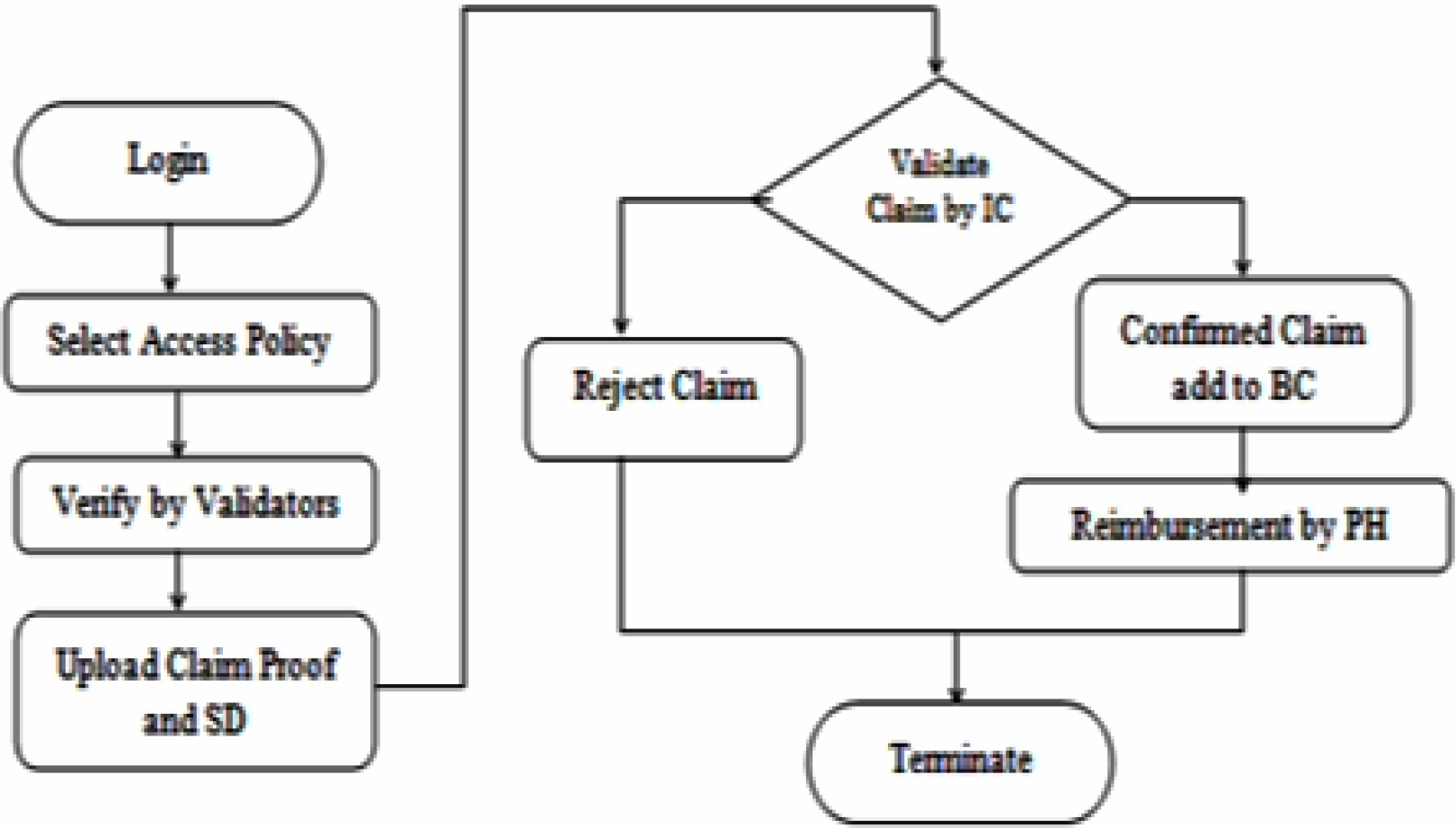
Proposed system architecture.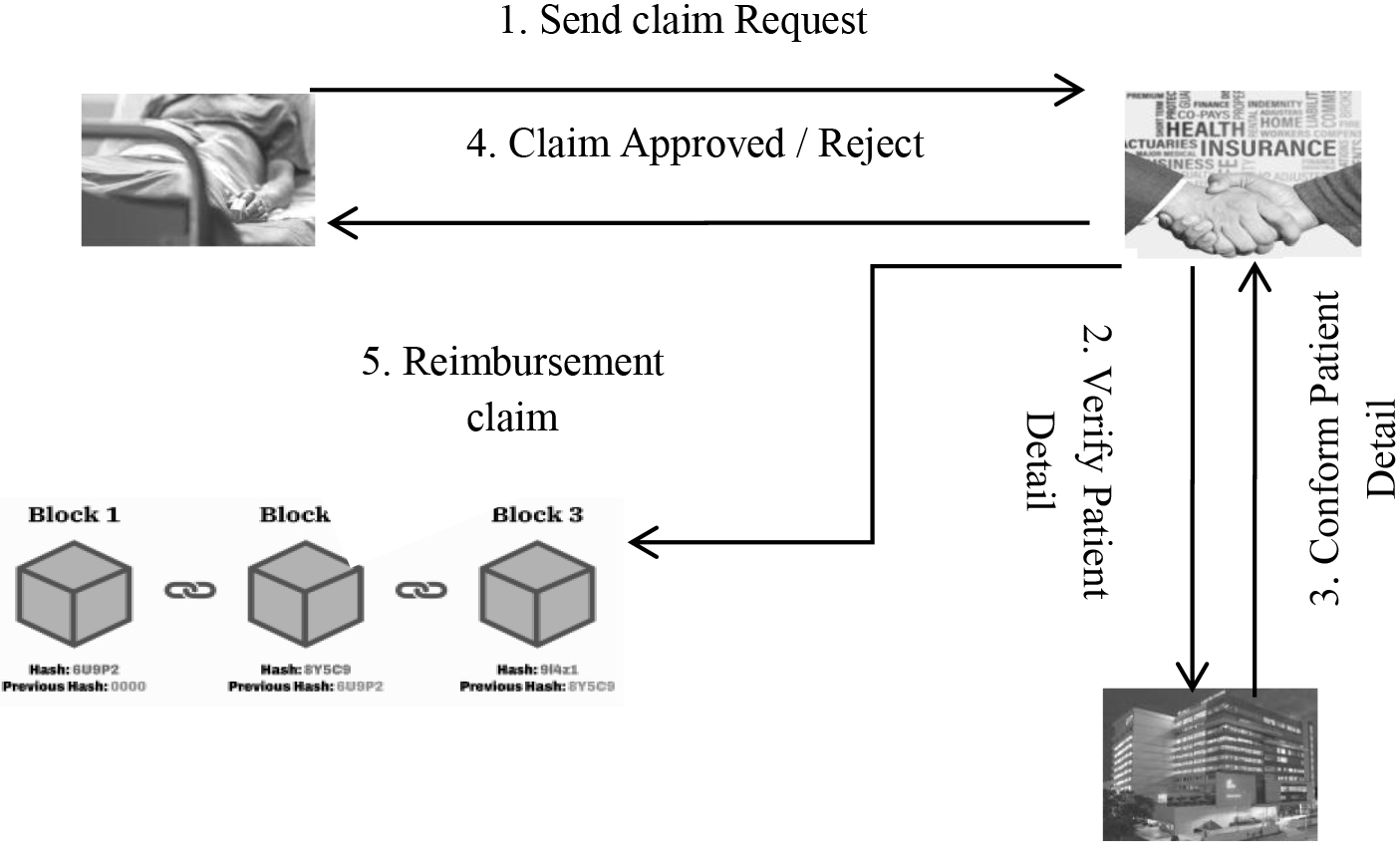
Figure 3 illustrates how messages sent between the participants involved in the process could interact in the order in which the activities are carried out. The application shows the user interface accessible by all participants while the smart contract administers the blockchain network. The node server serves as a middleman between the smart contract and the application. The entire claim approval process starts when a policyholder files a claim and provides supporting document. After being formed, the claim is forwarded to the insurance company, who attaches it to the policyholder ID, creates a particular claim ID, and selects a set of endorsers for verification. The endorsers receive the proof of claim, which the policyholder posted via the hospital and contains its data. Claim information is maintained as either approved or refused claims after encoding and uploading to the blockchain. The money is handed over to the policyholder if the claim is valid.
Interactions between insurance company (IC), Hospital and policyholder (PH) from supporting document submission to transaction.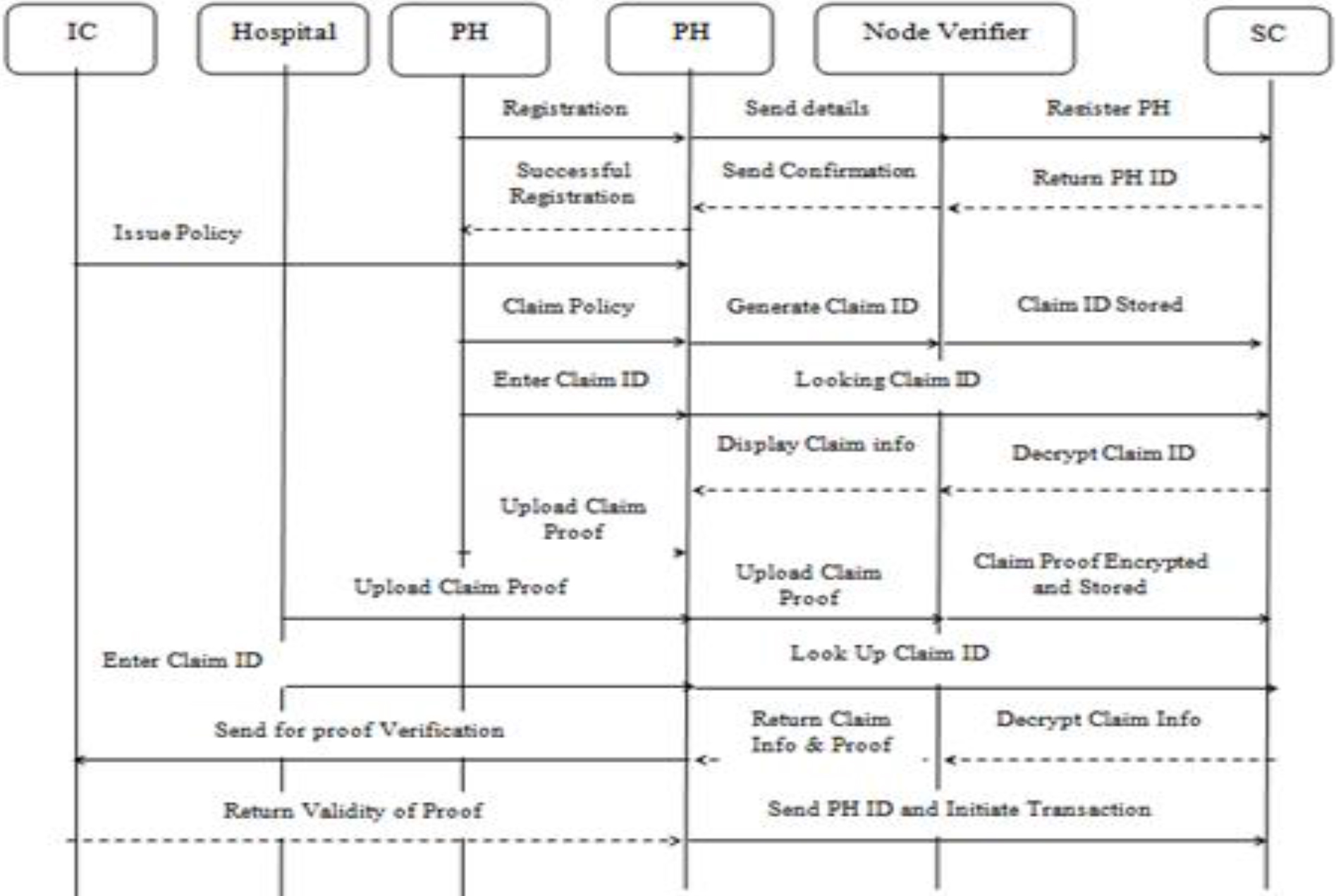
A hospital can register using the registered hospital feature by providing its name, address, and password. When the hospital is called for verification, the supplied parameters create a new instance of the hospital. The registration function will throw an error if the hospital is already registered. A hospital can sign-in using this method by providing its name, password, and address. This system initially confirms that the hospital is authentic and that the provided address matches the hospital address when a hospital is called. If the provided password matches the one stored in the hospital structure for this hospital, the procedure returns a Boolean value indicating whether or not the login was successful. The function used in the proposed system is listed as follows:
GetHospitalList: This command delivers a list of registered hospitals and their names. To do this, it checks the list of existing hospitals names and adds each hospital’s name to a list if not in the list. Patients can register by providing their name, address, username, and password in the register patient service. The patient list is verified when it is called, and the function will throw an error if the patient is already registered.
LoginPatient: A patient can access this service by entering their address, username, and password. When the function is called, it confirms the patient’s existence and verifies whether the patient’s address matches the one provided. If the patient’s password entered matches the one listed in the patient’s, this function returns a true result indicating that the login was successful.
GetPatients: It produces a list of all the patients after inputting a patient block corresponding to a patient address, using the input address to extract the patient block from the patient list and get the patient list.
GetHospitals: It produces a list of hospitals after receiving a hospital block that matches the hospital address as input and the input address to extract the hospital block from the hospital list and get the hospital information.
GetClaimDetails: This function can return a claim block specific to a given patient address after receiving a patient address as input. This is done by checking to see if the claim is part of the claims mapping, which links patient addresses to the claim block, and returning the claim’s details if it is.
GetPolicyList: This command returns a list of insurance coverage amounts. It is achieved by processing the array of policy amounts iteratively and adding each part to a list.
SelectPolicy: This function allows a patient to pick a policy by providing the policy’s ID and name. When called, it checked to see if the given policy ID is genuine and fits within the acceptable index range for the policy amount array. If so, the method updates the patient’s block with the selected policy name and ID.
ClaimPolicy: A patient may make an insurance claim by providing their address, the hospital’s address, the name of their insurance policy, a list of file names and IPFS hashes, and the date. When called, it creates a new claim instance and sets its properties based on the arguments given. The claims mapping is then updated underneath the patient’s address to reflect the claim’s current status.
GetHCliamList: This command displays a list of all claims made against a specific hospital, together with the patient’s name, address, insurance coverage, and the date of the claim. It does this by continually scanning through the claims mapping and, if the hospital address matches the one supplied, adding the details of each claim to a list. It accepts a hospital address as input.
TransferMoney: The ability to transfer money between provided addresses. It moves the specified amount of ether from the sender’s account to the receiver’s.
SignClaim: The hospital or an insurance company signs off on a claim using the SignClaim feature. The patient receives payment after the insurance company has given consent. When a function is called, it first confirms that the share is listed in the claims mapping and that the party calling the function (either the insurance company or the hospital to which the claim was made) has the authority to approve it. The process updates the claim’s signature count and distributes payments to the patient if the insurance company has accepted the claim and the required signatures have been received.
GetClaimList: This method lists all claims that have been filed, together with information on the patient, hospital, insurance company, number of signatures, and policy. Without a function being specified, the fall-back function receives external payable, which is utilized when ether is supplied to the contract.
External payable (address recipient, uint256 amount): Given a recipient address and a quantity, this function sends the provided amount of ether to the specified address. It initially converts the recipient’s address into a payment address using the payable function. Once the amount has been multiplied by 1000000000000000 (to convert it from ether to Wei), it is delivered to the recipient address using the send function. If the transaction fails, the function will reverse and throw an exception.
checkBalance on the external view returns (uint256): The remaining contract balance is returned using this function.
In the blockchain, the policyholder information and policy details is stored in an encrypted form to provide privacy for patient information. Base 64 is more suitable than the other algorithm for storing the data securely. Thus, the information is encrypted by the patient’s public key and stored in an IPFS storage system. During the claim verification, the agent’s private key decrypts the data and perform the validation. If the claim is valid (not claimed already and the claim amount is within a range), the policyholder will receive confirmation from the agent and be able to claim the policy. The committed claim process is stored in a blockchain as a hash value for future verification. Generally, HARSH VALUE can be generated through MD5, BLAKE2, SHA-1, SHA-256 and SHA-512, etc. MD-5 is not a collision-resistant algorithm, and it is vulnerable to adversaries. The BLAKE2 compression function is weakly ideal for cipher application. In SHA-1, a brute-force attack is possible and SHA-512 requires more calculations. Thus, SHA-256 is preferred to generate the harsh value (
where
During the verification, the existing harsh values of
The proposed system uses Windows 7, an AMD-Ryzen 5 processor, and 8 GB RAM. The Solidity language implements the proposed system, and the Truffle development framework is based on Ethereum blockchain is used to facilitate the development and integration of the blockchain network. Ganache is used for local environment development to test and debug the DApps and smart contract. The proposed system uses solidity language develops the smart contract. The IPFS stores patient claim information, and content-addressing identification makes it possible to get the claim information as quickly as possible. The browser extension’s for the user-friendly interface is created using Meta-mask. The Truffle framework makes developing the portal and integrating the blockchain easy. MongoDB is used for user authentication in the application, and the website is developed using the JavaScript framework React.js. Table 1 shows the hardware and software requirement of the proposed work.
Hardware and software requirements
Hardware and software requirements
Claim uploading, validation, and approval.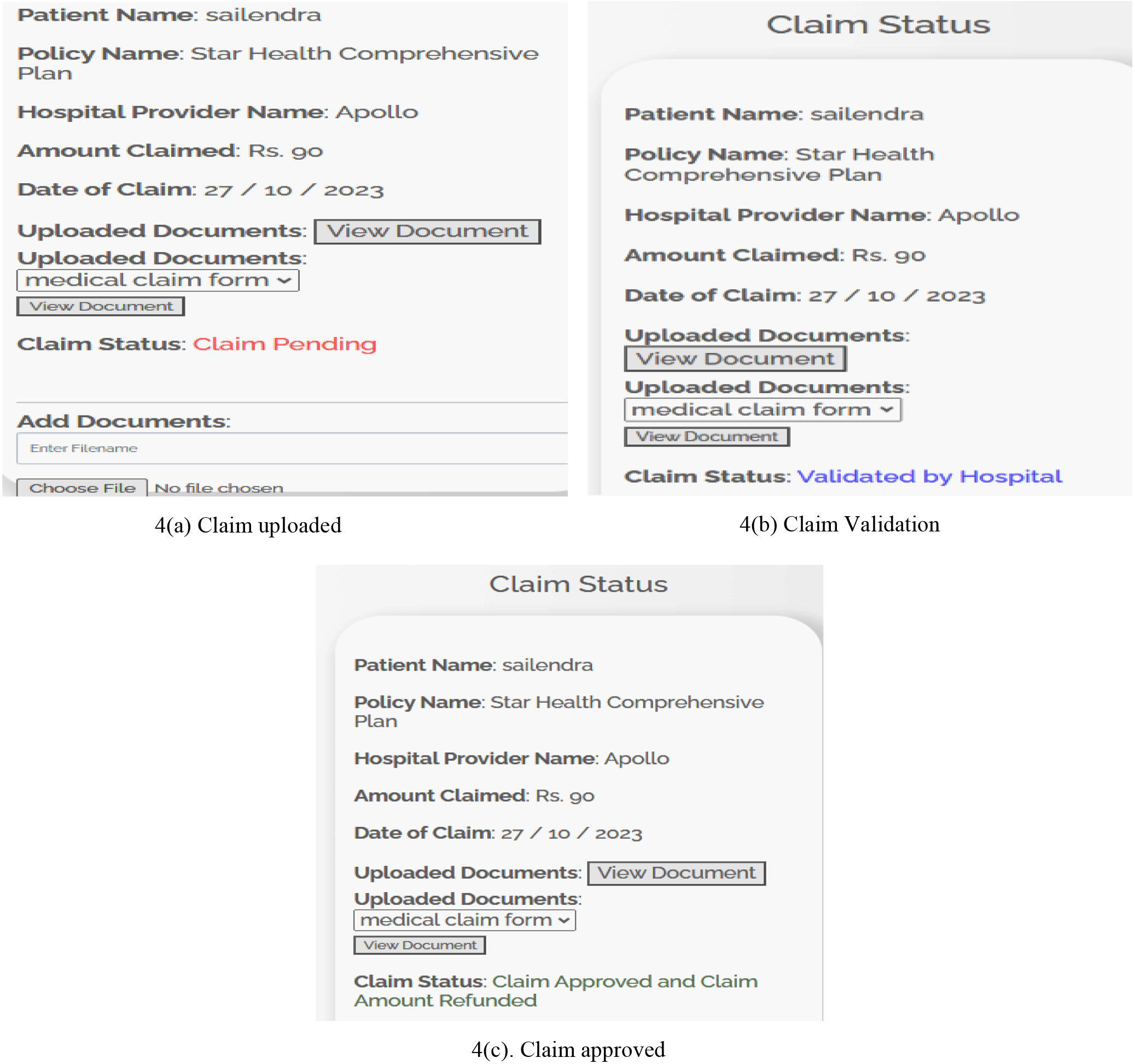
Solidity is the primary language used to write smart contracts that run on the Ethereum virtual machine. Truffle simplifies the development of blockchain applications by offering a suite of tools for compiling, linking, deploying, and managing smart contracts. Install Truffle using node package manager (npm) and initialize a new Truffle project with “truffle init” setting up the directory structure for smart contract development. Ganache is used for Ethereum development. It can be used to deploy contracts, develop applications, and run tests. It can be installed via npm. React.js is used for building the front-end of the web application, enabling dynamic and responsive user interfaces. The Ethereum blockchain, which is the underlying platform for this system, initially used proof of work (PoW) for consensus. However, Ethereum is transitioning to Proof of Stake (PoS) with Ethereum 2.0, providing enhanced security and scalability. Solidity based smart contract functionality includes patient registration – storing patient details and medical records, claim submission – allowing patients to submit claims for insurance, claim verification – enabling insurers to verify and process claims, and data access control – ensuring that only authorized parties can access sensitive information.
In order to properly utilize blockchain, building a DApp requires combining multiple software elements. To preserve network consensus and data integrity, a DApp fundamentally makes use of Ethereum and node software. On the blockchain, business logic is carried out using smart contracts written in programming languages like Solidity. A frontend user interface (UI), usually created with web frameworks, communicates with the blockchain through backend services, which use Web3 libraries and custom APIs. Security auditing techniques find vulnerabilities, while testing and deployment tools like Truffle Suite and Ganache guarantee code functionality and integrity.
Account addresses are generated in the Truffle. These addresses enable the creation of distinct Meta-mask wallets for insurance company, hospital, and policyholder transactions. After registering, the policyholder can choose the type of policy from a list of ones that are offered in the policyholder. After logging in as a policyholder, the page where a new claim may be made is displayed, allowing you to submit insurance claims under the chosen policies. The patient provides information such as name, date, hospital name, and type of disease. When making a new claim, the patient must attach all supporting documents, such as invoices, receipts, medications, and related files. The IPFS employs Base64 encryption and will push these files into the program. An image, audio or video file is converted to text format using Base64. With lesser data loss, encrypted text is delivered over networks securely and safely. Information regarding the patients, their health, and the particulars of the health insurance claim policy and uploading, processing and verifying the claim document are shown in Fig. 4.
The homepage of insurance companies and the administrator’s access to patient health and personal data, as well as details about the policy, sent to the hospital administrator for verification. The insurance company administrator approves the claim after the verifying the patient’s document and the hospital’s approval. If the insurance company administrator requires additional document for verification, it can send a message to the patient or approve it based on existing verification. The website is where policyholders can find out the status of their claims. The patient can view any messages sent by the insurance company and upload supporting document. After successful transactions, the transaction information is updated in blockchain. Based on the above results and discussion, the blockchain network proves that the claim uploading, verification, and approval are entirely automated. In a proposed work, dual verification can be performed before the support of the claim. One is to confirm with the hospital administer; another verification can verify existing claim details through the completed transaction information on blocks in blockchain.
Performance analysis
The proposed work’s performance analysis is based on the transaction’s gas consumption, latency, and block production and retrieval times. Gas consumption refers to the computational effort required to do the process in the blockchain network. The gas consumption is measured by the size of the input document processed in a particular period. The processing time has been measured in milliseconds (ms) for patient documents’ kilobytes (KB). Figure 5 shows the gas consumption for varying input sizes. The gas value is increased when the file size is increased.Latency is the time taken to start and complete the transaction. The time taken is measured by “ms” for the file size of KB. Figure 6 shows that the latency time increases when the file size increases. The latency time depends on the working environment and file size. The block creation and retrieval time depends on the file size and the number of requests processed. Block generation and retrieval take less time if the file size is smaller. The retrieval method requires less time than generating time. Figure 7 shows the block creation and retrieval times.
Gas consumed for each transaction for various input size.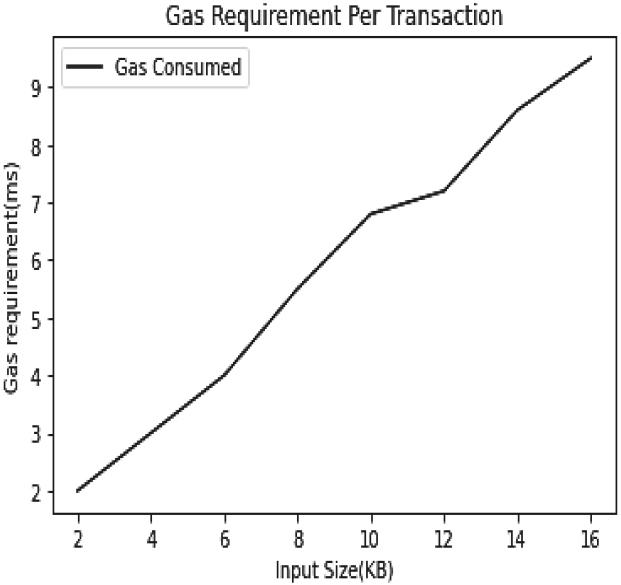
Latency analysis for various input sizes.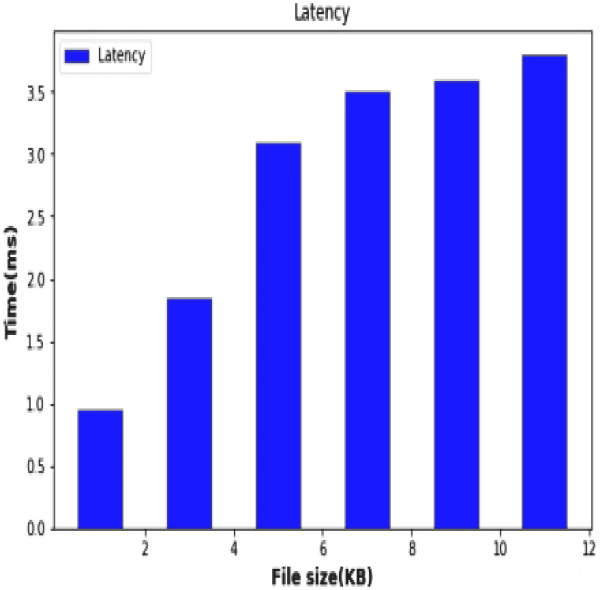
Comparison to existing work
NA – Not applicable.
Block generation and Retrieval Time Analysis for various input file size.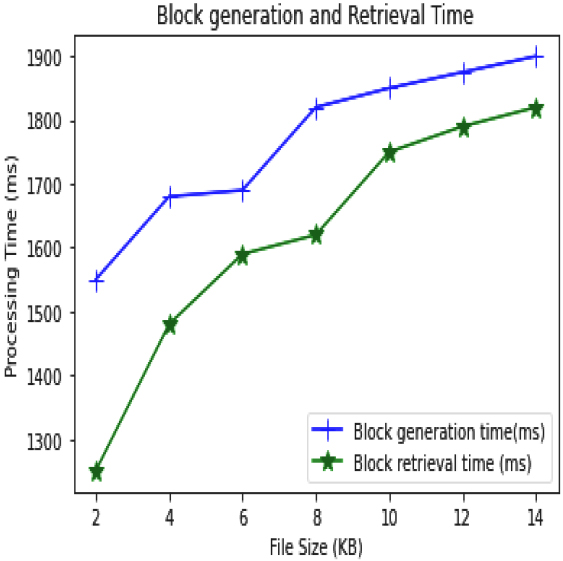
The security analysis focused on the proposed system’s security, integrity, accountability, privacy, and pseudonymity.
Security: The participants should verify the identity and authentication of their roles before being involved in a process. The patient information is stored as encrypted data in an IPFS, which provides higher security, and the network is formed by authorized users only by using permissioned blockchain. These storage representations ensure that the patient data was stored securely.
Integrity: The transaction information is stored as a harsh value in a blockchain, which provides immutable storage representation. The PH-ID,
Accountability: The proposed system is developed on a permissioned network. Every user, such as patient, insurance company administrator and hospital administrator access, is accountable in an authorized network. The adversaries cannot read, write, modify, or delete the information in the blockchain. User information is known in advance by combining patient information and blockchain property. The processing information is auditable, provides log information about the transactions, and helps to avoid the fraudulent claiming or reclaiming process. The key feature of blockchain is to maintain the distributed ledger and is frequently updated for each transaction. Hence, the participants can verify the updated claim details. In blockchain, there is no downtime. Therefore, the data availability is high in the proposed work.
Privacy: The registered and authorized users are only involved in the transaction and information access. Thus, the confidentiality of patient information is maintained between the parties.
Comparison to other work: Table 2 compares the proposed and existing work.
Instead of a manual process, DApp in blockchain is used in the proposed system. It reduces processing time and increase the speed of claim reimbursement. Due to previous block hash value usage, we cannot change the existing block values. Hence, the integrity is verified. The hospital administrator and insurance company administrator validate the claim. Thus, the verification is accurate and blockchain storage helps to avoid reclaiming.
Conclusion
The processing of health insurance claims has been completely changed by blockchain technology. This method offers a transparent and unchangeable record of each transaction, protecting the data’s integrity and lowering the risk of fraud. Blockchain technology may significantly reduce administrative costs for insurers, potentially leading to lower premiums. Patients may also be aware that their medical data is stored on a blockchain is secure. A blockchain system for processing health insurance claims can transform the healthcare industry by promoting patient autonomy, reducing costs, increasing efficiency, and improving security. In future work, this system will eventually be connected to wearable technology.
Funding
Not applicable.
Data availability
Data will be made available upon request.
Ethical approval
This article does not contain any studies with human participants or animals performed by any of the authors.
Footnotes
Conflict of interest
We declare that there is no conflict of interest.
Author’s Bios