



Abstract
BACKGROUND:
Early childhood nutrition is associated with health outcomes later in life, hence developing health promoting habits from an early age is imperative.
OBJECTIVE:
The aim of this study was to assess the nutritional adequacy of home-packed food brought to the nurseries by attending children.
METHODS:
In a cross sectional study conducted in 7 nurseries in Abu Dhabi, United Arab Emirates 315 food-boxes were assessed through detailed food observations at the nurseries prior to mealtimes. The food content was evaluated using the Alberta Guidelines for nursery food, Canada.
RESULTS:
Most food boxes contained refined grains (77.5%), fruits (74.6%), sweet/full fat dairy products (77.5%), discretionary-calorie-food-items (70.6%). Emirati children were offered sweetened drinks significantly more (p < 0.001). Non-dairy protein sources, vegetables, low-fat-natural-dairy products were offered to 45.4%, 44.1% and 3.9% of children, respectively. Overall, 70.2% of the food-boxes contained not-recommended food and 63.1% of the children were served a very poor food combination.
CONCLUSIONS:
Despite frequent inclusion of recommended food, many food boxes were nutritionally inadequate due to their low content of whole grains, low-fat dairy products, vegetables and animal proteins and high content of sweet food and drinks. The inadequate dietary patterns necessitate developing nutrition guidelines for nurseries in Abu Dhabi.
Introduction
Early childhood is a window of opportunities to promote a healthy lifestyle and prevent diet-related disease later in life. It is also an excellent opportunity to expose children to varied food as they are curious and interested in new food [1]. Healthy eating patterns have also been linked to better cognitive development and academic performance [2]. Over the past decades, remarkable changes in food consumption patterns have been reported [3]. Advertisement, attractive packaging and enlarged packages among other factors have encouraged higher consumption of high-energy-low-nutrient food making it more challenging to raise healthy children [4].
Educational settings, including child care facilities are considered important for public health actions aimed at promoting health and altering health depriving habits [5]. Home-packed food and food provisioned by the child-care facilities are known to vary considerably with each having their pros and cons. For example, Sweden and Finland have adopted free food provision policies where all nursery children eat free meals cooked on the premises [6]. By providing canteen food, differences related to socioeconomic factors are diminished and all children get a chance to consume well-balanced meals [7]. Furthermore, the concept of “the pedagogic lunch”, where teachers eat together with the children, provides an opportunity for nutrition education. When children share the same mealtime experience it can have a positive impact on childrens’ meal variation, eating behaviors and social skills and can also decrease neophobia [1]. The disadvantages of food provision by the child-care facilities may be related to children disliking the food, the cost of human labor and a lower flexibility in offering culturally diverse food. In other Western countries like the UK, the US and Canada either the childcare facilities provide food to the children and/or parents are required to bring in home-packed food for their children while attending nursery [8–10]. In the United Arab Emirates (UAE) parents are expected to provide food for their children while attending nursery. The advantages of home-packed food are that parents know their childs’ preferences, and will often pack food familiar to their child, increasing the chance that the packed food will actually be consumed. However, there is a risk that the nutrient quality of the home packed food may be lower unless the child care facilities provide parents with guidelines, or parents have sufficient nutrition knowledge about children’s nutritional needs. Another drawback of home-packed food is that children from vulnerable groups with low food security at home might be disadvantaged [7].
In many countries, guidelines have been issued to promote safe and nutritious food in childcare settings [11–13]. According to guidelines issued in the UK and the US, children are expected to consume a third to seventy percent of their daily nutrient needs at the nursery, depending on whether they are attending part-time or fulltime [12, 13]. The Alberta Nutrition Guidelines for Children and Youth are food group-based guidelines emphasizing both amounts of food and nutrient quality [11]. In the UAE, detailed school canteen guidelines exist; however no guidelines have been issued for early educational settings [14, 15]. Regardless of the food provision model in nurseries, there is great variation in compliance to nutritional guidelines, indicating the complexity of this matter [9, 16].
In Abu Dhabi, the health status among nursery children of diverse nationalities is suboptimal with 14.1% of nursery children having an abnormal weight status and 41% having dental caries [17, 18]. Assessing what children are being offered at nurseries is crucial as food habits and preferences learnt as a young child are retained through childhood and into early adulthood. To date, there are no published studies in the UAE, evaluating nursery food.
Objective
The aim of this study was to assess the nutritional adequacy of home-packed food brought to the nurseries in Abu Dhabi, UAE, by attending children.
Methods And Material
Participants
Abu Dhabi city is the capital of the UAE and one of three regions of the Abu Dhabi Emirate (state). The population consists of more than 80 nationalities including 19.3% UAE nationals and 80.7% expatriates from other countries. Nurseries (child care facilities) are defined as educational institutes that provide non-compulsory preschool education for children up to 4 years of age. The pre-school education is mainly provisioned by the private sector, with few public nurseries constituted as part of governmental bodies that exclusively serve their employees. In 2015, 11 756 children (6162 boys and 5594 girls) were enrolled in 129 nurseries in the city. In 2009 the enrollment rate in nurseries in the Emirate of Abu Dhabi was 58% for the total population of the emirate [19]. This study is part of a project titled the Nutrition, Oral health, Physical development, Lifestyle, Anthropometry, and Socioeconomic status (NOPLAS). A detailed description of other findings from the NOPLAS project is found elsewhere [17, 18].
This cross-sectional study conducted in 2015/2016 used a stratified random sampling design. The clusters did consist of nurseries stratified geographically into urban, suburban, and rural strata and they were proportional to the number of child-care facilities in each strata. Nine child-care facilities were contacted and meetings were held with the nursery management. Following these meetings, seven nurseries agreed to participate. In this study the child-care facilities were open for part-time care (5–7 hours/day) where children were expected to bring in a morning snack and lunch.
Procedure
This study was conducted according to the guidelines laid down in the Declaration of Helsinki and all procedures involving human subjects were approved by the Research Ethics Committee at Zayed University (ZU15_029_F). This study was conducted in agreement with the Ministry of Social Affairs, Abu Dhabi, the regulatory body for child care facilities. Approval was obtained from the nursery management to conduct the project within the nursery premises. Parents received oral and written information in English and Arabic about the study through face-to-face interaction with the researchers during drop-off or pick-up times at child care facilities and written consent was obtained prior to any data collection. Consenting parents completed a questionnaire regarding demographics, and detailed observations of the home packed food were conducted in the child-care facilities by the study investigators. Home packed food prepared by parents, nannies or household helpers was defined as food items brought in by the child from home to the child-care facility.
Two experienced dieticians conducted the assessment of the home packed food through visual observations and estimates of the food. Prior to the start of the assessment, clear instructions were given to the dieticians on how to score the food. A senior pediatric dietician supervised the initial assessments to minimize scoring variations. In addition, the senior dietician oversaw all assessments and if there were any uncertainties regarding the quantity, content or quality of the food, the case was verified and amended as needed on site. The assessments were done in the morning, prior to the children having their snacks, to ensure that all food provided from home was recorded. Observations were made on two random days per child. Neither nursery staff, nor consenting parents were notified about the assessment days to prevent alterations to the food box content. The food items were recorded on a structured scoring sheet. The scoring sheet included the main food groups (fruits, vegetables, grains, protein, dairy products) and also fat sources, beverages, and other food like condiments (e.g. ketchup, mustard) as well as discretionary food items (e.g. cakes, chocolates, deep fried food, crisps, salted nuts and similar). Any mixed dishes were inspected to determine the content of the dish. For example, sandwiches were closely inspected to identify their fillings, e.g. soft cheese and labnah; meat, pulses, vegetables, dairy products or other food were detected in curries and pulses or vegetables were identified in rice. Additional space on the scoring sheet was available to describe cooking methods, brands or other information as needed. As some children had separate boxes for snack and lunch, and others did not, the content for the meals were recorded together.
Data analysis
The collected data were entered into Microsoft Excel 2007 workbook (Microsoft Corporation, Redmond, WA, USA). Grains were recorded as refined or whole grains. Proteins were recorded as meat/fish/poultry/eggs/legumes including unsalted nuts/peanut butter and it was noted if the food was deep-fried. Fruits were recorded as fresh/pureed or dried (i.e. dates, raisins) or 100% juice, and vegetable type was also entered. Dairy products were entered as low fat/full fat/flavored (e.g. chocolate milk, strawberry yogurt) or cheese. Fat was recorded as saturated fat sources (butter, cream, cream sauce) and unsaturated fat sources (zaatar, pesto, olives, mayonnaise). Chocolates/cakes/sweet biscuits/Nutella/chocolate cereals and jam were recorded as sweet discretionary calories as were fruit drinks. Crisps/french-fries/ salted nuts/peanut butter and salty crackers were recorded as savory discretionary calories. Formula milk/baby porridge was entered as a separate group. During the observation of the food boxes, portion sizes were estimated using slices/grams, cups and pieces as applicable, and these amounts were used to estimate the number of servings. Once all data had been entered, a verification of the data sheet was conducted by the senior pediatric dietician (study investigator) against the original scoring sheet, and minor amendments were made to align interpretation.
As no local nutrition guidelines exist for child care facilities in Abu Dhabi, the results were compared to the Alberta Nutrition Guidelines for Children and Youth from Canada which are well established and science based [11]. These guidelines state that child care facilities can have a positive influence on the food provided by the parents by recommending that an optimal main meal should consist of four of the basic food groups (fruit and vegetables, grain product, milk and alternatives as well as meat and alternative) and a snack should consist of at least two of the basic groups [11]. As not all the observed food boxes had a clear distinction between the snack and the lunch the analysis in this study have been conducted using the assumptions that a) the home packed food should provide at least six servings (i.e. 2 for snacks and 4 for lunch) of the basic food groups and, b) the home packed food should include at least one serving from each of the basic food groups [11].
According to the Alberta Nutrition Guidelines for Children and Youth, food is divided into three categories: recommended food (should be consumed on a daily basis), acceptable food (can be consumed occasionally) and not recommended food (should not be consumed at all) [11]. In this study, food was grouped into combinations that were identified among the childrens’ home packed food boxes and subsequently a ranking of the food boxes was developed (Table 1).
Food Combination in the Food Boxes and its Associated Evaluation
Food Combination in the Food Boxes and its Associated Evaluation
Notes: *Food groups that should be included in the home packed food on a daily basis, e.g. whole grains, low-fat dairy products, fruits and vegetables, non-dairy animal protein [17]. †Food groups that can be included in the home packed food every now and then e.g. refined grains, full fat dairy product [17]. ‡Food groups that should not be part of the home packed food e.g. cakes, cookies, chocolates, sweetened drinks, crisps, sweet [17].
Descriptive statistics and comparisons were conducted using the statistical software package SPSS version 24.0 which was used for all statistical analyses (IBM Corp., Armonk, NY, USA 2016) [20]. Statistical significance for all tests was set at a P value of 0.05.
A total of 177 children, of which 42.9 % were girls, participated in this study. The distribution of participants by nursery location revealed that 37.3% resided in urban areas, 37.9% resided in suburban areas, and 24.9% resided in rural areas of the Abu Dhabi capital district. The sample included 9.6% 18–24 month-old children, 32.8% 2–3-year-old children, and 52.5% 3–4-year-old children whereas age was not reported for 5.1% of the children. Almost half of the children (40.7%) were of an Emirati nationality. The 47.5% non-Emirati children were a mixture of 24.9% Western (e.g., UK, France, Australia, USA), 16.4% Eastern-Mediterranean (e.g., Egypt, Jordan, Lebanon, Iraq, Syria) and 6.2% South-East-Asian (e.g., India, Pakistan) children. Nationality was not reported for 11.9% of the children.
Table 2 shows the content of the home packed food divided by nationality group and day of assessment. According to the Alberta Nutrition Guidelines for Children and Youth from Canada whole grains should be included on a daily basis whereas refined grains can be consumed every now and then [11]. In this study, most children (86.4%) had a source of grains like bread, pasta or rice included in their home packed food. Refined grains were the primary choice (77.5%), whereas 13.8% of the home packed food included whole grains, primarily as bread (Table 2). According to the guidelines, a protein source should be included on a daily basis, and it should not be deep fried [11]. Less than half of the children (45.4%) had a non-deep fried protein source in their food with poultry (chicken), eggs and meat being the most common sources. The guidelines indicate that fruits or vegetables should be included on a daily basis. Fruit juice is accepted as part of the recommended intake of fruits. A vast majority of the children (83.5%) had either fruit or vegetables in their food box. Three quarters of the children (74.6%) had fresh fruits on a daily basis whereas less than half of the food boxes (44.1%) contained vegetables. Around a sixth of the children (16.9%) had fruit juice as a beverage. Low fat natural dairy products are recommended to be part of the home packed food boxes on a daily basis. Most children (77.5%) had some dairy product in their food box with cheese, full fat milk and/or sweetened dairy products like full fat milk/yoghurt, chocolate milk or flavored yoghurts being the most common choices whereas fewer followed the recommendation. Furthermore, 70.6% of the children had some type of discretionary food item included in their home packed food. The most common discretionary food items were sweet food like biscuits, sponge cake and chocolates which were found in 53.7% of the home packed food, followed by sweetened drinks and savory-high-energy low-nutrient food like crisps, salty crackers and salted nuts which were found in 19.3% and 17.8% of the food boxes, respectively. Some differences were found between the Emirati and non-Emirati children regards to availability and quality of food in the home packed food boxes, whereas no significant differences were observed between the different age groups or gender (Table 2).
Assessment of Food Boxes Divided by Good Groups and Servings Distributed by Nationality Groups
Assessment of Food Boxes Divided by Good Groups and Servings Distributed by Nationality Groups
LF indicates low fat; FF, full fat.
The proportion of lunchboxes divided by the total number of food servings and combination of food categories observed in day 1 (n = 177) and day 2 (n = 138). With regards to the quantity of servings, 29.9% and 39.9% of the children were offered less than the recommended 6 servings of food per day in day 1 and day 2, respectively [11]. As recommended, 19.8% and 23.9% of the children were offered 6 servings per day in day 1 and day 2, respectively. On average, 7 servings or more were offered to 43.2% of the children during the two assessed days.
There were 6 groups of food combinations that were identified among the childrens’ food boxes that were ranked as excellent, good, fair, poor, very poor and extremely poor food (Fig. 1a-b). On average, 3.2% of the children were served excellent food and 26.1% of the children were given either good food or fair food during the two assessment days. Not recommended food was included in a majority (70.2%) of the lunch boxes. This included 7.4% of the children who were served a poor food combination, 59.3% of the children who were served a very poor food combination and 3.8% of the children who were served an extremely poor food combination including 0.4% of the children who only received food that is not recommended to consume. No significant differences were observed in the food combinations between the two assessed days.
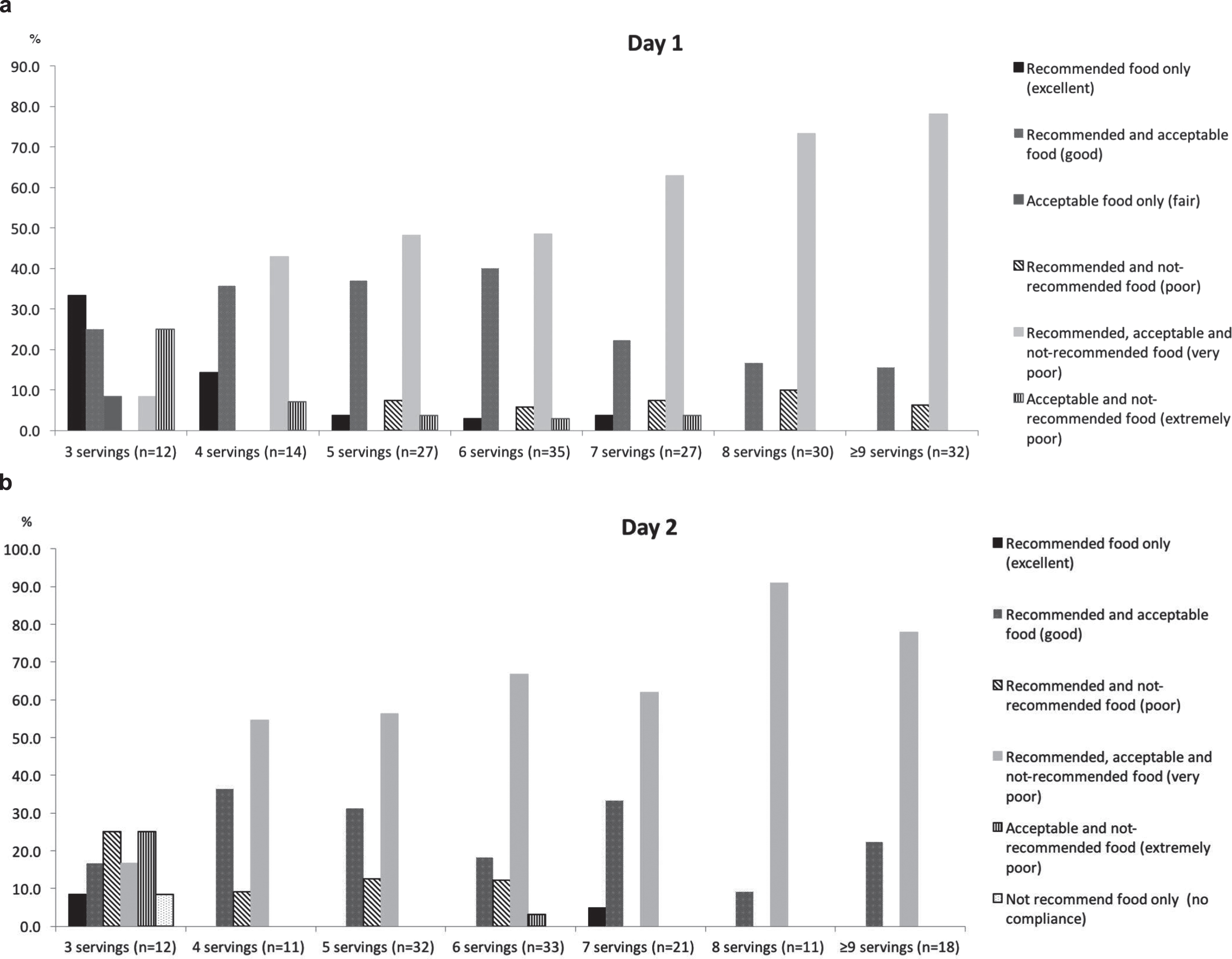
a-b The proportion of food boxes divided by the total number of food servings and combination of food categories observed in a: Day 1 (n = 177) and b: Day 2 (n = 138). According to the Alberta Nutrition Guidelines for Children and Youth food is divided into three categories: recommended food (should be consumed on a daily basis), acceptable food (can be consumed occasionally) and not recommended food (should not be consumed at all).
This is the first study in the UAE to report on the content of home packed food for nursery children. The findings revealed that a majority of the children were served refined grains, fruits, sweet/full fat dairy products, and discretionary calorie food items on a daily basis. Less than half of the children were offered a non-dairy protein source, vegetables or low fat natural dairy product and only a sixth of the children were served whole grains. The numbers of servings varied with both too little and too much food being offered to the children. Some differences were found between the two nationality groups with regards to availability and quality of food in the home packed food boxes, where Emirati children were exposed to considerably unhealthier food. Regardless of nationality, the content in food boxes was found to be suboptimal from a nutrition and health perspective.
There are well established differences between the dietary needs in children of various age groups [21]. For example, the protein requirements in young children are higher than in older children and adults due to the expected growth [21]. Dairy products, meat, fish, poultry, egg and legumes are all excellent protein sources and they also contribute with various vitamins and minerals. Furthermore, protein also contributes to satiety, an important factor for children who are learning to regulate their energy balance [22]. According to the Alberta guidelines, nursery children should get both dairy products and a non-dairy protein source as part of their daily intake at nurseries [11]. Others have argued that food boxes should only contain food that can be packed for the day from a food safety perspective [10]. In this study, around three quarters of the food boxes contained a dairy product whereas less than half contained meat, fish, chicken or egg. Whether this has a negative impact on children’s growth depends on their overall intake of protein, not only at nursery but also at home. In addition, the limited offerings of protein sources at nursery may contribute to higher risks of micronutrient deficiencies like anemia, which have been reported to be highly prevalent among children in the UAE [23].
Despite the majority of the food boxes containing dairy products, most included full fat and/or sweetened milk or yoghurts, contributing large amounts of sucrose and not adhering to the recommendations. The high prevalence of dairy products in the food boxes compared to other protein rich food items could be due to the fact that dairy products are easier both to pack and eat, unlike what has been reported in a Belgian study where children were found to consume more non-dairy protein food [24].
In addition to nutrients, carbohydrate rich food is important in the regulation of blood glucose and contributes to satiety [21]. Whilst almost 90% of the food boxes contained grains like bread, rice or pasta, only one sixth of the boxes included the recommended whole grains. This stands in contrast to a Dutch study, which reported that children primarily consumed non-refined bread and cereals [25]. These differences may be related to variations in food cultures where northern European countries often include whole grain bread as part of their daily diet whereas Middle Eastern countries primarily consume white bread. Unlike some studies in Australia, the US, Finland, and the Netherlands where a low fruit intake has been reported among preschool children, a vast majority of the children in this study were offered fresh fruit as part of their food box, positively contributing with fibers and vitamins [26, 27].
Less than half of the children were offered vegetables, which is similar to other studies were vegetables are consumed to a lower extent than fruits [10, 28]. While this may be compensated for at home, this could not be confirmed among this study population [18]. Overall, the combination of a low vegetable content and mostly refined grains will result in a low fiber intake and lower satiety which may have a negative impact on the glucose-insulin balance and body weight [29]. Furthermore, low satiety can increase a desire for high-energy low-nutrient food items like cakes, cookies and chocolates, which reinforces the imbalance in the blood glucose regulation.
In this study, seven out of ten food boxes contained discretionary food items indicating a clear lack in compliance to the guidelines [11]. As observed during the fieldwork, additional cakes and candy were provided to children during various frequent events at the nurseries, further contributing to a frequent intake of high-energy-low-nutrient food. The frequent intake of sucrose at nurseries may be one of the risk factors to the high rates of dental caries that was recently reported among the same study sample [17]. Similar findings have been reported elsewhere, indicating that these behaviors are global [25, 30].
Allergies against both tree nuts and peanuts have been found among children from the UAE [31]. Similar to schools in the UAE, most participating nurseries mentioned that they had a “no nut policy” due to the seriousness of allergic reactions [14, 15]. Despite this, nuts, Nutella, peanut butter and sesame seeds were found in a number of the food boxes suggesting lack of parental knowledge, compliance or lack of enforcement from the nurseries. Caution should be taken to protect the children in educational settings by enforcing the no nut policy.
To ensure adequate growth one must not only consider what type of food is being served, but also the amount. It has been suggested that the amount of food served to children acts as an implicit indicator of how much a child is expected to consume [32]. In this study, around one third of the children were offered fewer servings than recommended, reflecting the concern that a proportion of the study sample is malnourished, as reported previously [18]. On the other hand, over 40% of the children were offered more than 6 food servings a day, including one sixth of the children who were provided with 9 food servings or more. If children are served healthy food the risk for overconsumption is low, but as most children were offered a suboptimal food quality, with the majority including discretionary calories on daily basis, overconsumption is likely. These results are deemed concerning as previous studies have suggested that the childrens’ consumption is highly predictive of the amounts served; i.e. the more children are offered, the more they consume [33]. Hence this could be problematic in a population with a high prevalence of nutrition-related non-communicable disease as the UAE [17, 35]. However, the results should be interpreted with caution as the assessments focused on offerings rather than actual consumption.
Parents make certain choices when they pack their children’s food for nurseries. These choices are influenced by several factors including packing the child’s favorite foods; available food at home (left-overs or pre-packed); food that is easy to pack/open/eat; the food price and/ or adhering to guidelines set by the nurseries [36, 37]. In this study, it was found that considerably fewer Emirati children were offered protein food, fruits and vegetables, while more were offered fruit drinks and sweet food than non-Emirati children, indicating that sociocultural factors may have impacted the food box content. Despite a high education level and good financial status among the parents in the study sample, the food box content was suboptimal with less than a third of the childrens” food boxes considered excellent or good [18]. This indicates a need to urgently consider strategies to improve the current situation, as it may negatively impact optimal growth and development in young children.
Although some studies conducted in the UAE have assessed school childrens’ dietary intake, this is the first to observe what food is actually being served to nursery children. Nurseries are good settings to conduct health research as one reaches diverse groups of children, which is a strength of this study. In the absence of local nursery guidelines, the Alberta Nutrition Guidelines for Children and Youth, a well-established and science-based reference, was used to assess the food boxes, which is another strength [11]. As the data collection was done on random days, with neither the parents nor the nursery staff knowing when the assessments would be done, the content of the food boxes was not influenced. Furthermore, the repeated assessments of individual children’s food boxes enhanced the reliability of the results..
The findings of this study should be interpreted considering its limitations. The food servings were based on observations and estimates rather than weighed amounts, which may vary from the serving sizes defined by the Alberta Guidelines, and this could be seen as a limitation. The results were based on what children were served, rather than what they actually consumed, which could add further value to future studies. Nevertheless, assessing available food gives a good indication of the opportunities children have to consume healthy food and thus the reported findings add new important knowledge in the field of child nutrition in the UAE.
To conclude, the findings of this study indicate that the assessed food boxes, despite some positive aspects were inadequate with regards to their content and the number of food servings. The inclusion of fruits, dairy products and grains sources in most lunch boxes were positive. On the other hand, almost three quarters of the children had “not recommended food” in their food boxes, represented by an alarming high prevalence of high-energy-low-nutrient food items. Moreover, the frequent inclusion of refined grains and full fat sweetened dairy products rather than whole grains and low fat dairy products, and the low inclusion of non-dairy sources of proteins and vegetables in the lunchboxes are also concerning.
Funding details
This research project received funding from the Research Incentive Fund (R16055) of Zayed University, UAE.
Disclosure statement
The authors declare no conflicts of interests. The funding body had no role in the design of the study and collection, analysis, and interpretation of the data, and writing of the manuscript.
Footnotes
Acknowledgment
We thank the Ministry of Social Affairs, Abu Dhabi, and the management and staff of the nurseries in this study for supporting the NOPLAS project. Furthermore, we acknowledge the children and parents who participated. We also thank Farah, Nahed, Shajiya, Dhuha, Shaima, and Maitha for their assistance with data entry. Finally, we thank Zayed University for its financial support.