



Abstract
BACKGROUND:
There are growing interests in the use of medicinal mushrooms in controlling overweight and obesity.
OBJECTIVE:
The aim of the present study was to assess the effect of Lingzhi on anthropometric indices, fasting blood sugar, lipid profile and blood pressure of overweight individuals
METHODS:
This randomized double-blind clinical trial was performed on seventy-two overweight individuals (Body Mass Index (BMI) = 25–29.9 kg/m2) received 3 capsule Ganoderma Lucidum (each capsule containing 220 mg of whole powder and 30 mg of pure aqueous extract) daily or matching placebo for 6 weeks. Anthropometric indices, metabolic tests (fasting blood sugar (FBS) and serum lipid profile) and blood pressure were measured before and after treatment.
RESULTS:
Data analyses indicated that body weight and BMI were decreased after 6-week intervention (P < 0.05). The beneficial effect of supplementation was evident on some anthropometric indices. Changes in LDL-cholesterol were significantly different between two treatment and placebo groups (P < 0.05). FBS, other components of lipid profile and blood pressure did not significantly change by Lingzi treatment.
CONCLUSIONS:
Results showed that Ganoderma Lucidum might have some potential benefits on anthropometric indices and mild effects on lipid profile, but and there is no claim for weight lose function. Hence, further long-term studies are recommended.
Keywords
Introduction
Overweight and obesity are risk factors for an expanding set of chronic diseases [1] and cause serious health outcomes [2]. High BMI accounted for 4.0 million deaths globally, nearly 40% of which occurred in persons who were not obese [3]. Consumption of mushrooms due to their anti-oxidative and anti-inflammatory effects seems to be effective in the treatment of overweight, obesity and related comorbidities, and could be a good alternative for medicinal applications [4]. Lingzhi or Ganoderma lucidum is a popular mushroom, which is widely used for its health benefits in China and many other Asian countries [5]. It comprises more than 400 different biologically and pharmacologically active compounds which have been suggested to control various diseases [6]. Some previous animal studies revealed that it has anti-obesity potential due to modulating gut microbiota [7] and reducing the accumulation of visceral fat [8]. Lee et al. (2020) highlighted the potential benefit of G. lucidum extract powder in prevention of obesity and insulin resistance in a mouse model; administration of G. lucidum controlled body weight gain, improved glucose metabolism, reduced lipid accumulation in the liver, and reduced adipocyte size adipose [9].
Contrary to the extensive literature on the effects of this valuable mushroom on obesity and metabolic diseases in animals, there is not much evidence of the effect of G. lucidum in humans. Moreover, only a few [10, 11], but not all clinical trials supported the protective effect of G. lucidum on obesity-related risk factors; Klupp et al., (2016) indicated that there were no benefits of use of G. lucidum for treatment of cardiovascular risk factors in people with diabetes mellitus or metabolic syndrome [12].
Due to growing publicity on G. lucidum supplements in relation to weight loss and other metabolic health benefits, and lack of available clinical evidence in this regard, current work was undertaken to test whether supplementation had beneficial effects on anthropometric indices and metabolic parameters including fasting blood sugar, lipid profile and blood pressure in overweight individuals.
Subjects and methods
Subjects
A total of sixty-nine overweight people (male = 18 and female = 51) were selected from the outpatient clinic of Salahuddin Hospital, Baneh Province, Kermanshah. Individuals with baseline body mass index (BMI) of 25–29.9 kg/m2 were selected. Participants taking medications that may interact with G. lucidum (such as warfarin or aspirin) or subjects with any disease interfering with weight loss were not included in this study. The presence of people with diabetes and hypertension, pregnant and lactating women, and the use of any weight-loss or fat-blocking drugs were the exclusion criteria. Subjects who had any viral infections during the Covid-19 pandemic were also excluded. Participants were asked to complete a written informed consent form before taking the supplement, and were asked not to change their diet and physical activity during the study.
Study design and supplementation
This was a randomized and double-blind study for a 6-week period (42 consecutive days). Capsules of G. lucidum were provided by Kei Daroo Health Technology Company (Tehran, Iran) which was approved by Iranian Food and Drug Administration. Each capsule contained 220 mg of whole powder and 30 mg of pure aqueous extract of G. lucidum. Each participant had to consume 3 capsules (after meal) daily. The placebo, containing 250 mg of wheat flour, were prepared with the support of the pharmaceutical company and given to the placebo group.
Anthropometric measurements, biochemical tests and blood pressure
Anthropometric indices were evaluated at baseline and at the final day of supplementation according World Health Organization [13] manual of collecting physical measurements [13]. Height and weight were measured by a trained researcher using pre-calibrated equipment; including a digital scale (Seca-813) to the nearest 0.1 kg for weight and a stadiometer (Seca Model 217) to the nearest 0.1 cm for height. Body mass index (BMI) was calculated with specific formula of weight (kg)/height (m2). Waist and hip circumferences (WC & HC) (cm) and mid-arm circumference (MUAC) (cm) were measured using non-stretchable measuring tape near to 0.1 cm in accordance with the standard recommendations. WHR was then calculated by dividing WC (cm) by HC (cm). All measurements were collected twice.
Fasting intravenous blood samples were collected using scalp vein by a lab technician while sitting on a chair. Fasting blood sugar Plasma glucose was measured using a standard glucose oxidase method (Diagnostic Chemicals Limited, Prince Edward, Canada), and lipid profile (total cholesterol, LDL- c, HDL-c and triglyceride) were measured with direct enzymatic assay.
At the beginning and end of the study period, systolic and diastolic blood pressure were measured using a mercury sphygmomanometer (Critikon Dinamap; GE Medical Systems Information Technologies, Louisville, KY, USA) from the right arm, after 5 minutes of rest, in a sitting position and with an accuracy of 5 mmHg. Diastolic blood pressure was measured using the fifth korotkoff sound.
Physical activity assessment
The level of physical activity of individuals once were assessed by Persian translated version of the short International Physical Activity Questionnaire (IPAQ); the validity has already been reviewed and confirmed for the Iranian community [14]. The obtained data were calculated and presented as MET-min/week for all physical activity levels [15].
Statistical analysis
The data was analyzed using SPSS (version 25; SPSS, Inc., Chicago, IL, USA). The normality of the data was first assessed by Kolmogorov-Smirnoff test. An Independent-sample t-test was performed to analyze the differences between placebo and treatment groups for both post treatment data and changes of various parameters (subtracting the baseline values by the end of 42-day values). Data are expressed as mean values and their standard error (S.E.M). The level of significance was less than 0.05.
Results
Baseline characteristics and history
From seventy-three eligible subjects enrolled in the study, four subjects had impaired fasting glucose or lipid profile abnormalities in their first blood tests, and were excluded from the study (Fig. 1). Seventy-two subjects were allocating in placebo and ganoderma lucidum treatment groups with randomization. One subject from placebo group got infected to Coronavirus disease (Covid-19) and another two persons did not continue for personal reasons. The demographic details, baseline data, presence of illnesses and medication use of all participants by group are demonstrated in Table 1. Of the 69 participants, 11 adults took daily supplements including calcium, vitamin D3 and multivitamins, and 7 subjects took sedatives. The dependent variables based on the Kolmogorov-Smirnov test had a normal distribution, so all tests performed to compare the means were based on normal data. Independent sample t-test did not show any significant differences in anthropometric indices and biochemical tests between the two group at the baseline.
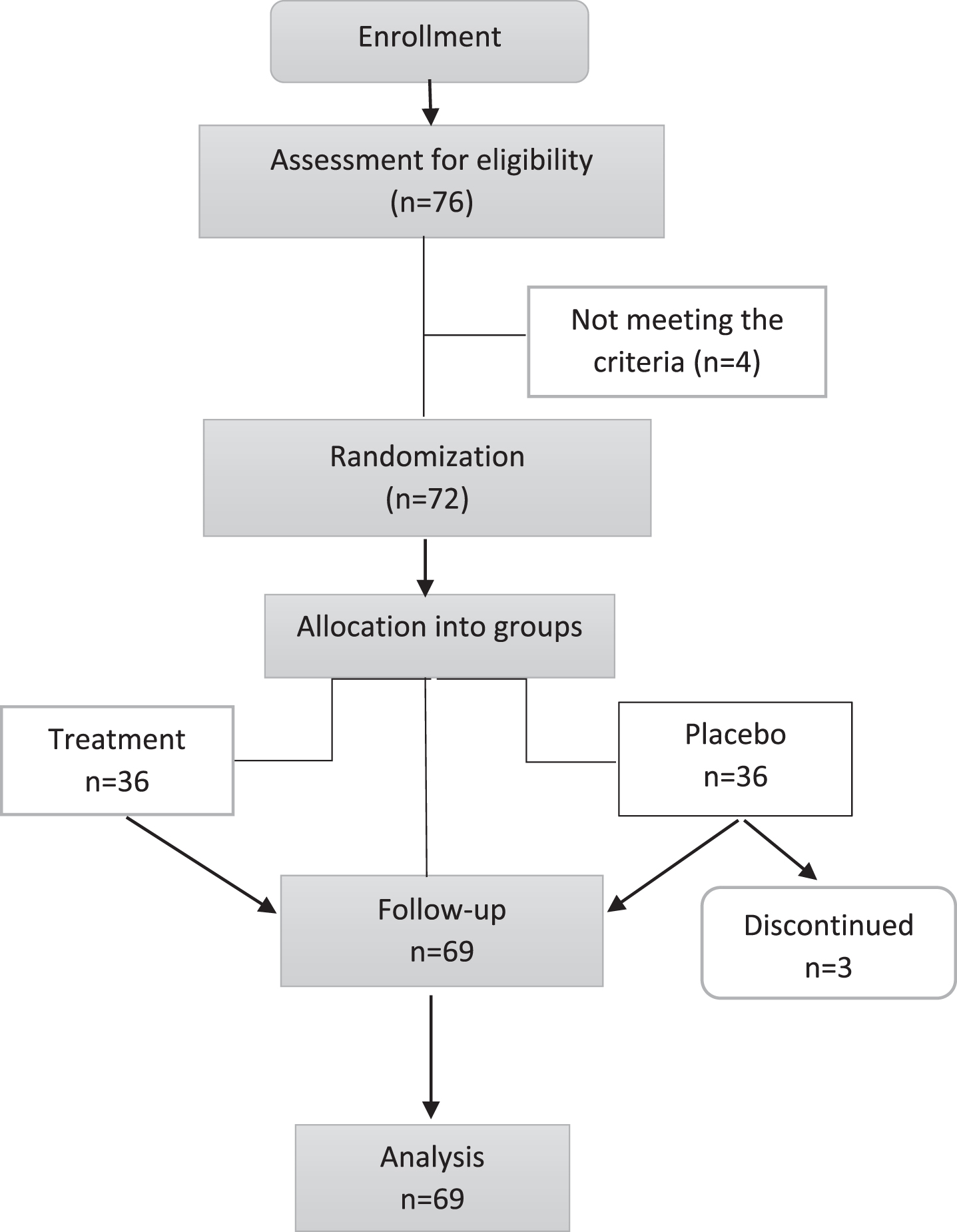
Consort diagram of the study participants.
Baseline data of the eligible participants in the study (n = 72)
BMI: body mass index, WC: waist circumference, HC: hip circumference, WHR: waist hip ratio, MAUC: mid-upper arm circumference, LDL-c & HDL-c: LDL- & HDL-cholesterol, TG: triglyceride, BP: blood pressure, PA: physical activity. Numerical data were presented as mean±S.E.M. Categorical data are presented as number (%). *Other illnesses or medications were not included in the exclusion criteria. Independent samples T test were recruited to compare means between continuous variables (aP < 0.05).
The final data and changes of anthropometric parameters, biochemical tests and blood pressure are shown in Table 2 3, respectively. Also, the parameters that were significantly different from the baseline on day 42 are shown in Table 2. Hence, body weight and BMI showed a statistically significant decrease compared to baseline in the treatment group (P < 0.01), while despite to slight increment of these two parameters in placebo group, there was no significant differences compared to the first day. Comparison of weight and BMI changes between the two groups did not show a significant difference for weight parameter, but BMI change was statistically different (P < 0.05). Similarly, the mean HC in the treatment group decreased after 42 days (P = 0.02), while in the control group there was no significant difference compared to the baseline test. There was a significant difference between the two groups in terms of HC changes (P < 0.05). G. lucidum supplementation had no significant effect in WC, but WC in the placebo group increased significantly (P = 0.01). Although intervention with G. lucidum caused no significant decrease in MAUC compared to baseline, but the difference of MAUC change was significant between the two groups (P < 0.05). In general, G. lucidum can have only minor changes in some anthropometric parameters including BMI, HC and MAUC.
Comparison the data of anthropometric parameters, biochemical tests and blood pressure at the end of the treatment between two groups
Comparison the data of anthropometric parameters, biochemical tests and blood pressure at the end of the treatment between two groups
BMI: body mass index, WC: waist circumference, HC: hip circumference, WHR: waist hip ratio, MAUC: mid-upper arm circumference, LDL-c & HDL-c: LDL- & HDL-cholesterol, TG: triglyceride, BP: blood pressure. Data are presented as mean±S.E.M. sgThe end-point data were significantly different compared with the baseline by paired sample T test.
Comparison the changes of anthropometric parameters, biochemical tests and blood pressure throughout the study between two groups
BMI: body mass index, WC: waist circumference, HC: hip circumference, WHR: waist hip ratio, MAUC: mid-upper arm circumference, LDL-c & HDL-c: LDL- & HDL-cholesterol, TG: triglyceride, BP: blood pressure. Data are presented as mean±S.E.M. Mean values were significantly different between groups by Independent Samples T test comparison: *P < 0·05, **P < 0·01.
In biochemical experiments, no significant changes were observed during the intervention. Except for total serum cholesterol, the difference between the two groups was significant (P < 0.05). Treatment with G. lucidum had no significant effect on systolic and diastolic BP.
Both capsules of G. lucidum and placebo were well tolerated by the subjects. No side effects were reported within 6 weeks of supplementation, nor one month after the end of the study.
Discussion
Recent scientific studies of animal models have claimed that G. lucidum has the tendency to reduce body weight and visceral fat in animal models [7, 16]. Since animal experiments cannot be accurately applied to human, controlled trials are suggested to determine the efficacy. Therefore, current double-blinded, placebo-controlled study in overweight subjects was designed to elucidate the effect of G. lucidum on anthropometric indices, fasting blood sugar, lipid profile and blood pressure. Supplementation of three capsules of G. lucidum per day (each containing 220 mg of whole powder and 30 mg of its pure aqueous extract) significantly reduced body weight and BMI compared with the baseline test, the mean of BMI changes of treatment subjects was significantly different with the placebo group. Despite these statistical differences, the changes may easily be related to physiological fluctuations in weight, and no claim can be made about the effect of this fungus on weight loss. The supplementation also seemed to have a positive effect on reducing other anthropometric indices including HC compared to baseline. Due to the slight and insignificant increase in MAUC in the placebo group, the mean changes of this parameter were significantly different between the two groups. Intervention with G. lucidum also had no effect on WC, but due to the significant increase in WC and WHR in the placebo group, it is hypothesized that G. lucidum acts more as an inhibitor in increasing anthropometric indices than as a reducing agent.
The mechanism involved might be due to the modulating effect of high molecular weight polysaccharide that act as prebiotics, and affect the intestinal microbiota and maintain intestinal integrity, thus controlling obesity and its complications and related inflammation [7]. Moreover, Huang et al. (2020) revealed that G. lucidum supplementation reduced the accumulation of visceral fat in diabetic rats fed a high-fat diet [8]. In contrast, dietary intervention by G. lucidum ethanolic extract in high-fat diet fed rats had no effect on body weight, while modulating intestinal microbiota composition [17].
One of the limitations of the current work was the lack of evaluation of calorie intake during the study, which could determine whether G. lucidum capsules can make satiety feeling. Because there were some increases in anthropometric indices in the placebo group, which was not evident in the treatment group.
According to the results of chemical biomarkers, despite the decreasing trend of FBS, LDL-c and TG in the intervention group and the increasing trend in the control group, no significant difference was observed between the two groups. Mean serum HDL-c was also slightly improved by G. lucidum supplementation (P > 0.05); however, the changes in total cholesterol level between the two groups were significant. Surveys on previous works about these metabolic indices were inconsistent with our results; as most animal studies revealed hypoglycemic action of G. lucidum or its extracts and related components [18–21], and supplementation of G. lucidum polysaccharide had anti-diabetic effect of on type 2 diabetic patients [22]. While, evidence from other clinical trial does not support the use of G. lucidum for treatment of cardiovascular risk factors in people with diabetes mellitus or metabolic syndrome [10, 12]. In line to slight alteration of lipid profile, polysaccharide peptides from G. lucidum ameliorated lipid metabolic disorders via the catabolism of cholesterol into bile acids, fatty acid biosynthesis and regulation of mRNA levels of hepatic genes involved in fatty acid metabolism in animal model [23, 24]. Moreover, G. lucidum potentially improved dyslipidemia after 12 weeks of supplementation in human subject [10]. So, we can conclude that our 6-week intervention might not be enough to trigger significant changes in metabolic indices; though, FBS and lipid profile were in normal range in our subjects.
Blood pressure was another variable that were recorded before and after the intervention in our study. Despite the fact that many previous clinical trials have indicated that G. lucidum can lower blood pressure [22, 25–27], our results showed that there were no significant changes following the daily consumption of G. lucidum. Nor, no significant differences were observed between two experimental groups. Mohamad Ansor (2013) showed that the mycelia of G. lucidum has high potential in lowering blood pressure level due to the presence of four different antihypertensive-related proteins [28].
In conclusion, this study has shown that G. lucidum supplementation not only directly affects body weight and BMI, but also affects other anthropometric indices in overweight individuals. It should be noted that although some anthropometric indicators have changed statistically, these changes are not clinically valuable and there is no claim for weight lose function in the present work.
Intervention had more inhibitory effects on FBS and lipid profiles components, and no impact on blood pressure. We have not explored any possible mechanisms, so further research needs to be done on the cause of the changes. It seems that more long-term interventions needs to be conducted to achieve greater moderating effects.
Footnotes
Acknowledgments
The authors would like to thank all the participants in the study. We also thank the principal of Salahe-Din Hospital and the staff who accompanied us in our current work.
Author contributions
MSMQ and MSH developed the main design of manuscript, SHB coordinated and performed all procedure of data collection. MSMQ analyzed the data and wrote the first draft of the manuscript, and other co–authors had contribution and participated in the revision of the manuscript.
Funding
The article is taken from a dissertation approved by the Tehran Medical Sciences from Islamic Azad University in 28th June 2020.
Conflict of interest disclosures
There is no conflict of interest for this work.
Ethics and other permissions
All participants filled out written consent form, and they ensured that their information was confidential. The study protocol was approved by the Research Ethical Committee of Tehran Medical Sciences of Islamic Azad University (IR.QUMS.REC.1399.151).